
Multiple Criteria Analysis for Evaluation of Information System

- Slides: 20
Multiple Criteria Analysis for Evaluation of Information System Risk David L. Olson University of Nebraska Desheng Wu University of Toronto Finland May 2010
Information Systems Risk • Physical – Flood, fire, etc. • Intrusion – Hackers, malicious invasion, disgruntled employees • Function – Inaccurate data – Not providing needed data • ERM contributions – More anticipatory; Focus on potential risks, solutions – COSO process framework 2008 ERM Symposium - Chicago
IT & ERM • Enterprise Risk Management – IT perspectives • Enterprise Risk Management, Olson & Wu, World Scientific (2008) • New Frontiers in Enterprise Risk Management, Olson & Wu, eds. (contributions from 27 others) – Includes three addressing IT » Sarbanes-Oxley impact – Chang, Choy, Cooper, Lin » IT outsourcing evaluation – Cao & Leggio » IT outsourcing risk in China – Wu, Olson, Wu – Enterprise Systems a major IT focus 2008 ERM Symposium - Chicago
History of ERP • Extension of materials resource planning, accounting • Integrate a firm’s computing for reporting, planning, & control – common architecture – Multifunctional, Integrated, Modular • In 1990 industry about $1 billion – SAP, Baan, People. Soft, JDEdwards, Oracle, others • Rapid growth in late 1990 s – Some relation to Y 2 K fears, but not the main reason • Mergers in early 2000 s – Peoplesoft bought JDEdwards; – Oracle bought Peoplesoft
History of ERP • SAP: All-comprehensive in theory, apply bestpractices – Very intrusive, very expensive, require massive changes in operations – If changes a core business competency, don’t; • While theory centralized, many implementations modular – People. Soft – human resources – Finance & Accounting a common first module
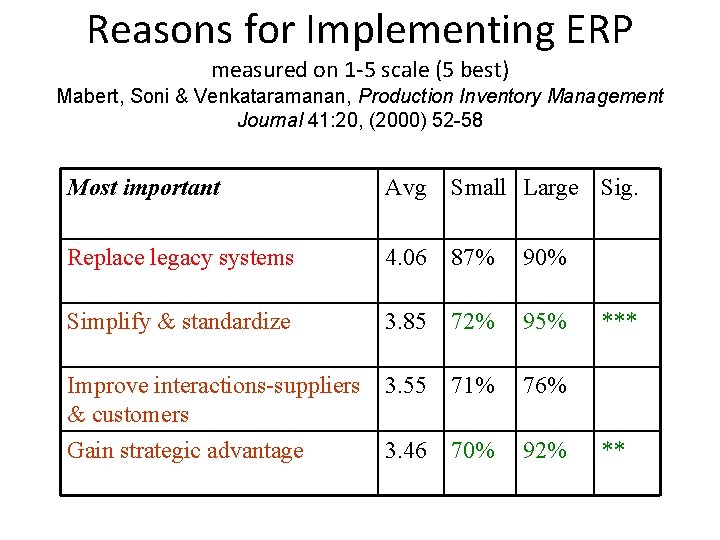
Reasons for Implementing ERP measured on 1 -5 scale (5 best) Mabert, Soni & Venkataramanan, Production Inventory Management Journal 41: 20, (2000) 52 -58 Most important Avg Small Large Sig. Replace legacy systems 4. 06 87% 90% Simplify & standardize 3. 85 72% 95% Improve interactions-suppliers & customers 3. 55 71% 76% Gain strategic advantage 3. 46 70% 92% *** **
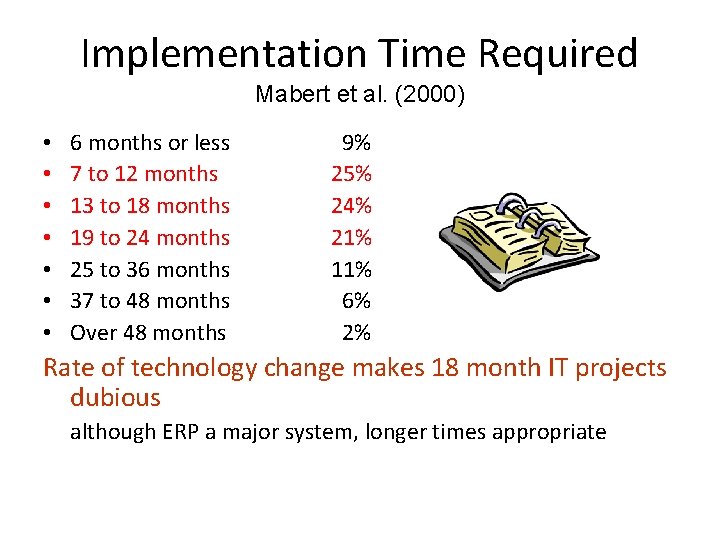
Implementation Time Required Mabert et al. (2000) • • 6 months or less 7 to 12 months 13 to 18 months 19 to 24 months 25 to 36 months 37 to 48 months Over 48 months 9% 25% 24% 21% 11% 6% 2% Rate of technology change makes 18 month IT projects dubious although ERP a major system, longer times appropriate
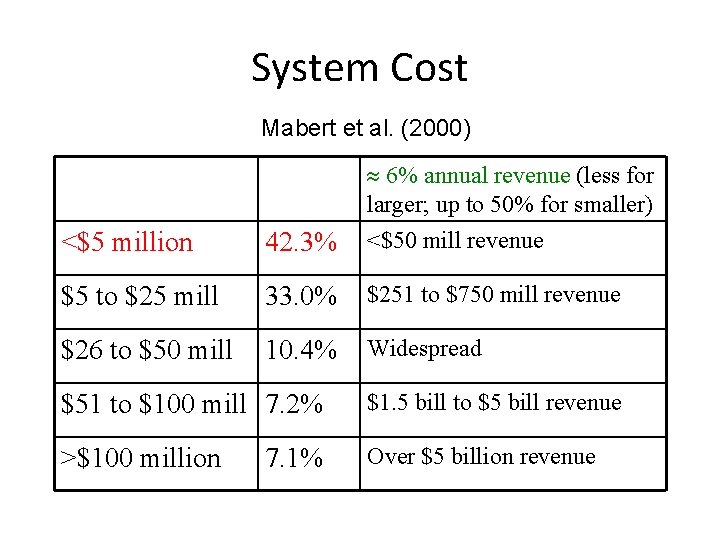
System Cost Mabert et al. (2000) 6% annual revenue (less for larger; up to 50% for smaller) <$5 million 42. 3% <$50 mill revenue $5 to $25 mill 33. 0% $251 to $750 mill revenue $26 to $50 mill 10. 4% Widespread $51 to $100 mill 7. 2% $1. 5 bill to $5 bill revenue >$100 million Over $5 billion revenue 7. 1%
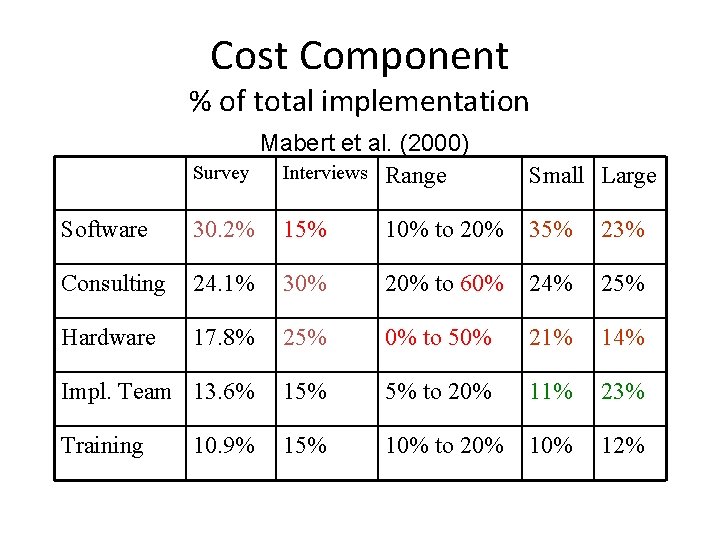
Cost Component % of total implementation Mabert et al. (2000) Survey Interviews Range Small Large Software 30. 2% 15% 10% to 20% 35% 23% Consulting 24. 1% 30% 20% to 60% 24% 25% Hardware 17. 8% 25% 0% to 50% 21% 14% Impl. Team 13. 6% 15% 5% to 20% 11% 23% Training 15% 10% to 20% 12% 10. 9%
Cost Impact Mabert et al. (2000) • Also affects operations – Intent was to lower operations cost – Initially, often the reverse • Often use data warehouse system – Very efficient data storage – Very expensive
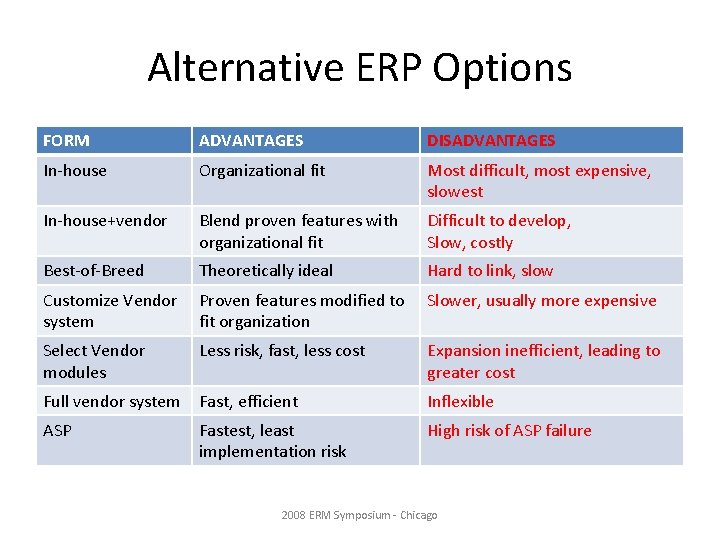
Alternative ERP Options FORM ADVANTAGES DISADVANTAGES In-house Organizational fit Most difficult, most expensive, slowest In-house+vendor Blend proven features with organizational fit Difficult to develop, Slow, costly Best-of-Breed Theoretically ideal Hard to link, slow Customize Vendor system Proven features modified to fit organization Slower, usually more expensive Select Vendor modules Less risk, fast, less cost Expansion inefficient, leading to greater cost Full vendor system Fast, efficient Inflexible ASP Fastest, least implementation risk High risk of ASP failure 2008 ERM Symposium - Chicago
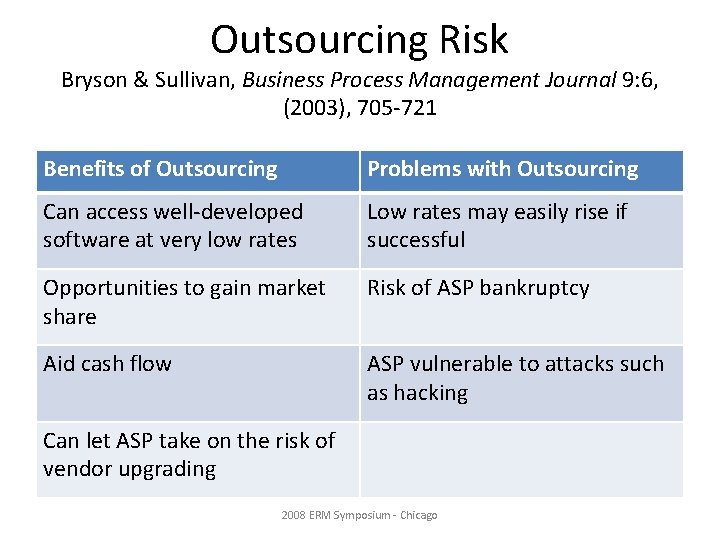
Outsourcing Risk Bryson & Sullivan, Business Process Management Journal 9: 6, (2003), 705 -721 Benefits of Outsourcing Problems with Outsourcing Can access well-developed software at very low rates Low rates may easily rise if successful Opportunities to gain market share Risk of ASP bankruptcy Aid cash flow ASP vulnerable to attacks such as hacking Can let ASP take on the risk of vendor upgrading 2008 ERM Symposium - Chicago
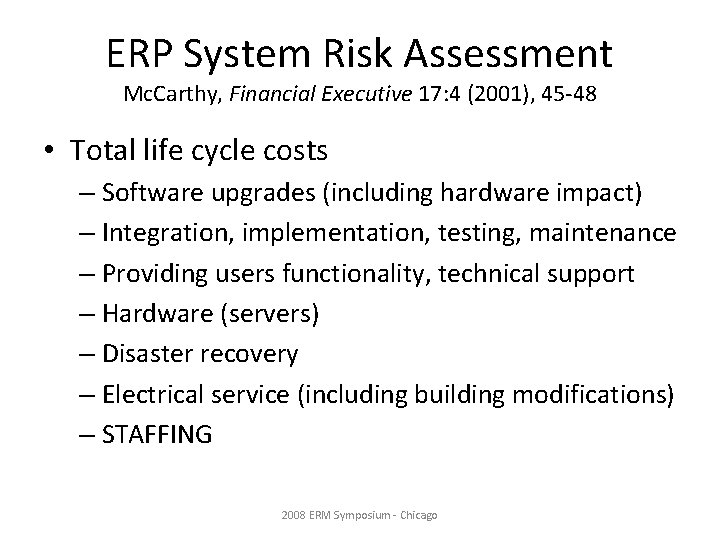
ERP System Risk Assessment Mc. Carthy, Financial Executive 17: 4 (2001), 45 -48 • Total life cycle costs – Software upgrades (including hardware impact) – Integration, implementation, testing, maintenance – Providing users functionality, technical support – Hardware (servers) – Disaster recovery – Electrical service (including building modifications) – STAFFING 2008 ERM Symposium - Chicago
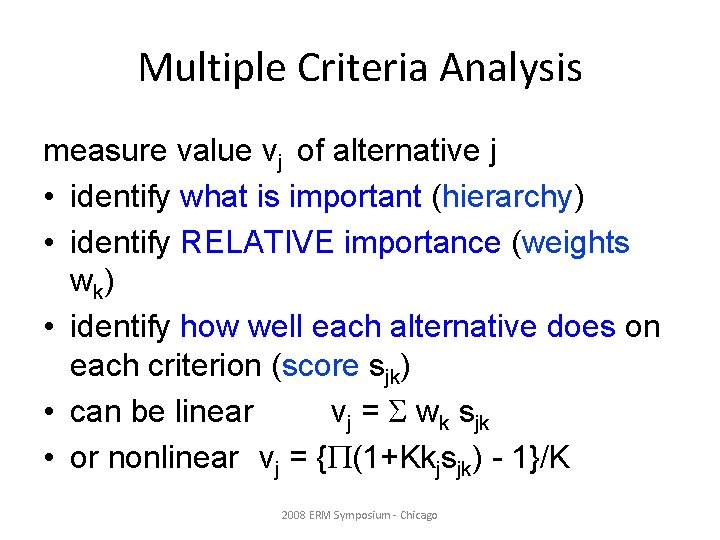
Multiple Criteria Analysis measure value vj of alternative j • identify what is important (hierarchy) • identify RELATIVE importance (weights wk) • identify how well each alternative does on each criterion (score sjk) • can be linear vj = wk sjk • or nonlinear vj = { (1+Kkjsjk) - 1}/K 2008 ERM Symposium - Chicago
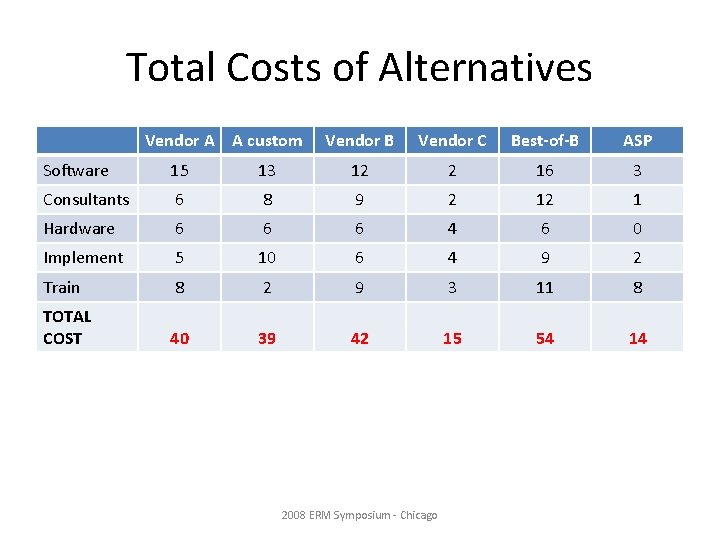
Total Costs of Alternatives Vendor A A custom Vendor B Vendor C Best-of-B ASP Software 15 13 12 2 16 3 Consultants 6 8 9 2 12 1 Hardware 6 6 6 4 6 0 Implement 5 10 6 4 9 2 Train 8 2 9 3 11 8 TOTAL COST 40 39 42 15 54 14 2008 ERM Symposium - Chicago
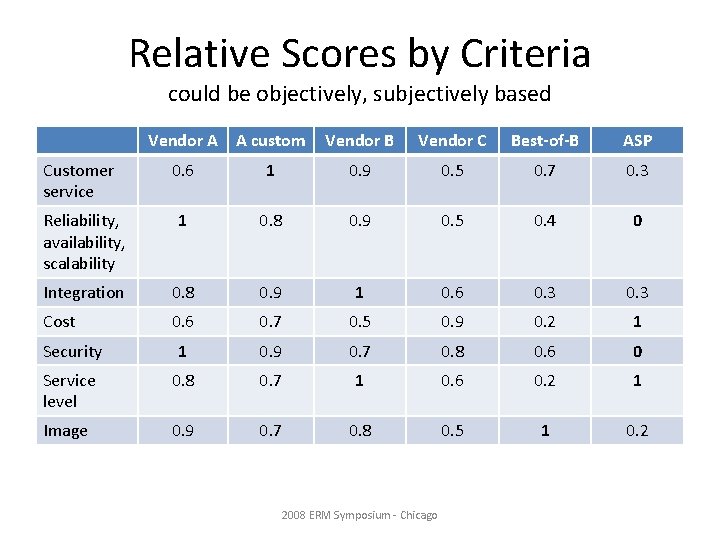
Relative Scores by Criteria could be objectively, subjectively based Vendor A A custom Customer service Vendor B Vendor C Best-of-B ASP 0. 6 1 0. 9 0. 5 0. 7 0. 3 Reliability, availability, scalability 1 0. 8 0. 9 0. 5 0. 4 0 Integration 0. 8 0. 9 1 0. 6 0. 3 Cost 0. 6 0. 7 0. 5 0. 9 0. 2 1 Security 1 0. 9 0. 7 0. 8 0. 6 0 Service level 0. 8 0. 7 1 0. 6 0. 2 1 Image 0. 9 0. 7 0. 8 0. 5 1 0. 2 2008 ERM Symposium - Chicago
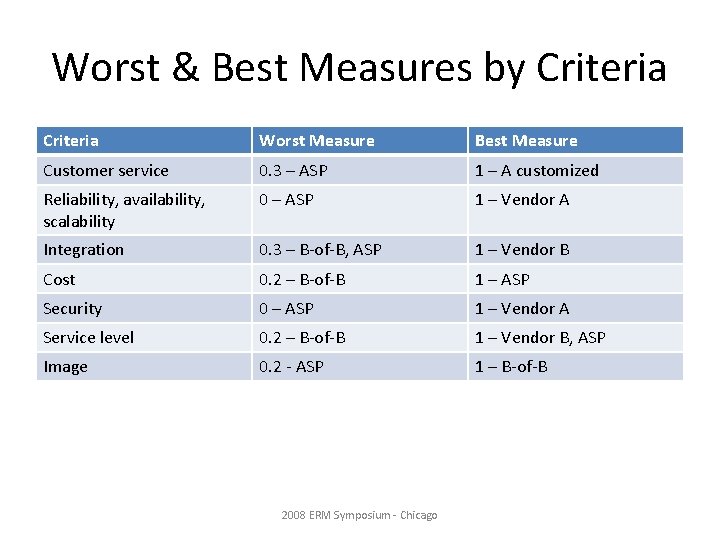
Worst & Best Measures by Criteria Worst Measure Best Measure Customer service 0. 3 – ASP 1 – A customized Reliability, availability, scalability 0 – ASP 1 – Vendor A Integration 0. 3 – B-of-B, ASP 1 – Vendor B Cost 0. 2 – B-of-B 1 – ASP Security 0 – ASP 1 – Vendor A Service level 0. 2 – B-of-B 1 – Vendor B, ASP Image 0. 2 - ASP 1 – B-of-B 2008 ERM Symposium - Chicago
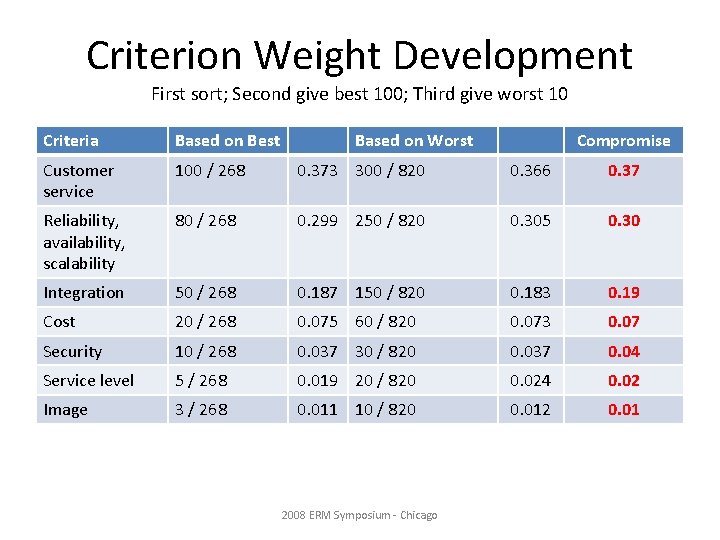
Criterion Weight Development First sort; Second give best 100; Third give worst 10 Criteria Based on Best Based on Worst Customer service 100 / 268 0. 373 300 / 820 0. 366 0. 37 Reliability, availability, scalability 80 / 268 0. 299 250 / 820 0. 305 0. 30 Integration 50 / 268 0. 187 150 / 820 0. 183 0. 19 Cost 20 / 268 0. 075 60 / 820 0. 073 0. 07 Security 10 / 268 0. 037 30 / 820 0. 037 0. 04 Service level 5 / 268 0. 019 20 / 820 0. 024 0. 02 Image 3 / 268 0. 011 10 / 820 0. 012 0. 01 2008 ERM Symposium - Chicago Compromise
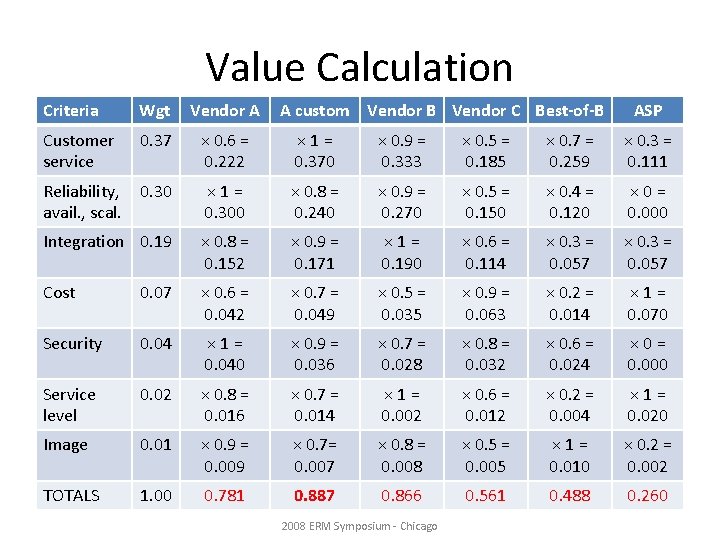
Value Calculation Criteria Wgt Vendor A A custom Vendor B Vendor C Best-of-B Customer service 0. 37 × 0. 6 = 0. 222 × 1= 0. 370 × 0. 9 = 0. 333 × 0. 5 = 0. 185 × 0. 7 = 0. 259 × 0. 3 = 0. 111 Reliability, avail. , scal. 0. 30 × 1= 0. 300 × 0. 8 = 0. 240 × 0. 9 = 0. 270 × 0. 5 = 0. 150 × 0. 4 = 0. 120 × 0= 0. 000 Integration 0. 19 × 0. 8 = 0. 152 × 0. 9 = 0. 171 × 1= 0. 190 × 0. 6 = 0. 114 × 0. 3 = 0. 057 Cost 0. 07 × 0. 6 = 0. 042 × 0. 7 = 0. 049 × 0. 5 = 0. 035 × 0. 9 = 0. 063 × 0. 2 = 0. 014 × 1= 0. 070 Security 0. 04 × 1= 0. 040 × 0. 9 = 0. 036 × 0. 7 = 0. 028 × 0. 8 = 0. 032 × 0. 6 = 0. 024 × 0= 0. 000 Service level 0. 02 × 0. 8 = 0. 016 × 0. 7 = 0. 014 × 1= 0. 002 × 0. 6 = 0. 012 × 0. 2 = 0. 004 × 1= 0. 020 Image 0. 01 × 0. 9 = 0. 009 × 0. 7= 0. 007 × 0. 8 = 0. 008 × 0. 5 = 0. 005 × 1= 0. 010 × 0. 2 = 0. 002 TOTALS 1. 00 0. 781 0. 887 0. 866 0. 561 0. 488 0. 260 2008 ERM Symposium - Chicago ASP
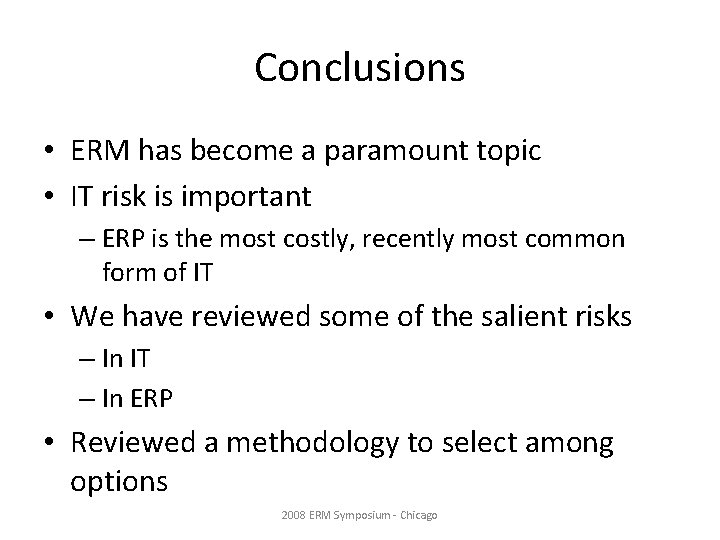
Conclusions • ERM has become a paramount topic • IT risk is important – ERP is the most costly, recently most common form of IT • We have reviewed some of the salient risks – In IT – In ERP • Reviewed a methodology to select among options 2008 ERM Symposium - Chicago