
Multiple Comparison Procedures Cohen Chapter 13 For EDUCPSY
- Slides: 36
Multiple Comparison Procedures Cohen Chapter 13 For EDUC/PSY 6600 1
“We have to go to the deductions and the inferences, ” said Lestrade, winking at me. “I find it hard enough to tackle facts, Holmes, without flying away after theories and fancies. ” Inspector Lestrade to Sherlock Holmes The Boscombe Valley Mystery Cohen Chap 13 - Multiple Comparisons 2
ANOVA Omnibus: Significant F-ratio • Factor (IV) had effect on DV • Groups are not from same population • Which levels of factor differ? • Must compare and contrast means from different levels • Indicates ≥ 1 significant difference among all POSSIBLE comparisons • Simple vs. complex comparisons • Simple comparisons • Comparing 2 means, pairwise • Possible for no ‘pair’ of group means to significantly differ • Complex comparisons • Comparing combinations of > 2 means Cohen Chap 13 - Multiple Comparisons 3
Multiple Comparison Procedure • ‘Multiple comparison procedures’ used to detect simple or complex differences • Significant omnibus test NOT always necessary • Inaccurate when assumptions violated • Type II error • OKAY to conduct multiple comparisons when p-value CLOSE to significance Cohen Chap 13 - Multiple Comparisons 4
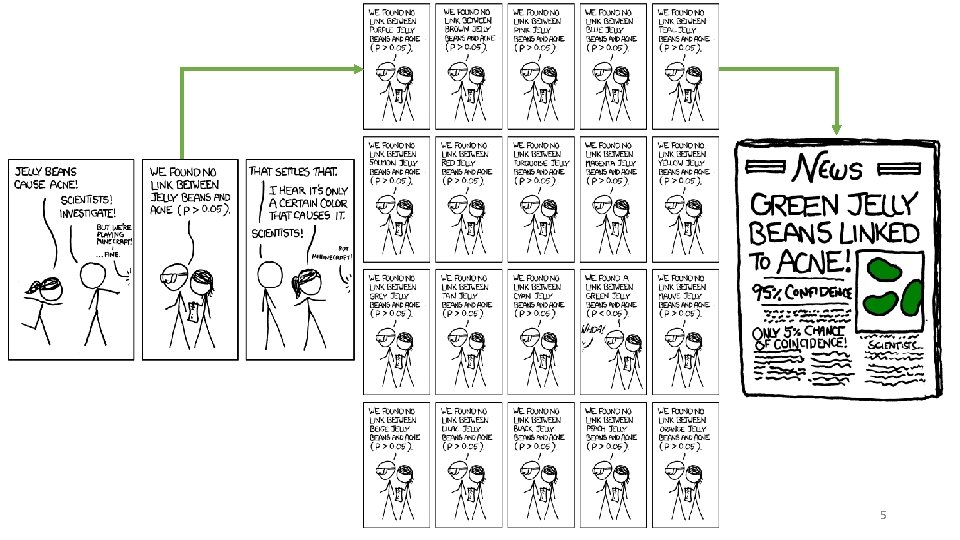
Cohen Chap 13 - Multiple Comparisons 5
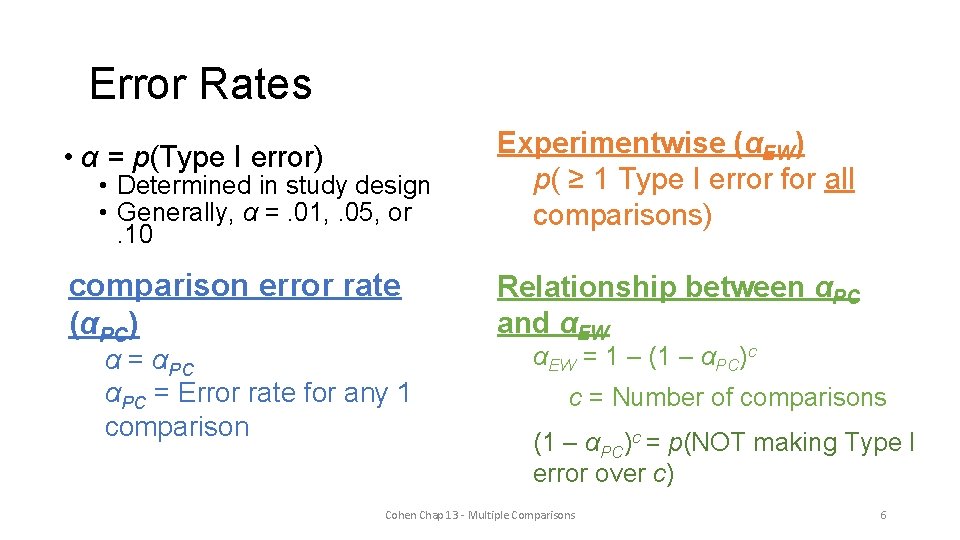
Error Rates • α = p(Type I error) Experimentwise (αEW) p( ≥ 1 Type I error for all comparisons) comparison error rate (αPC) Relationship between αPC and αEW • Determined in study design • Generally, α =. 01, . 05, or. 10 α = αPC = Error rate for any 1 comparison αEW = 1 – (1 – αPC)c c = Number of comparisons (1 – αPC)c = p(NOT making Type I error over c) Cohen Chap 13 - Multiple Comparisons 6
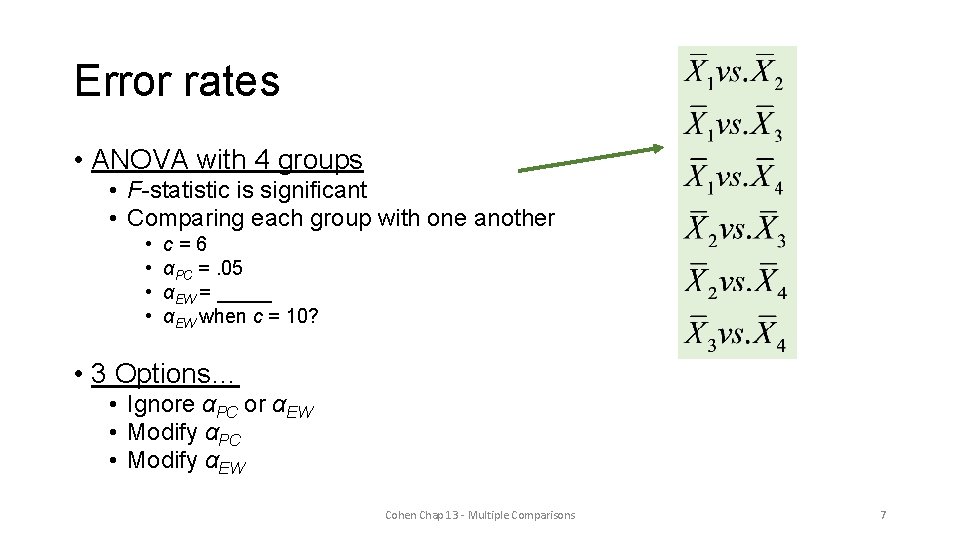
Error rates • ANOVA with 4 groups • F-statistic is significant • Comparing each group with one another • • c=6 αPC =. 05 αEW = _____ αEW when c = 10? • 3 Options… • Ignore αPC or αEW • Modify αPC • Modify αEW Cohen Chap 13 - Multiple Comparisons 7
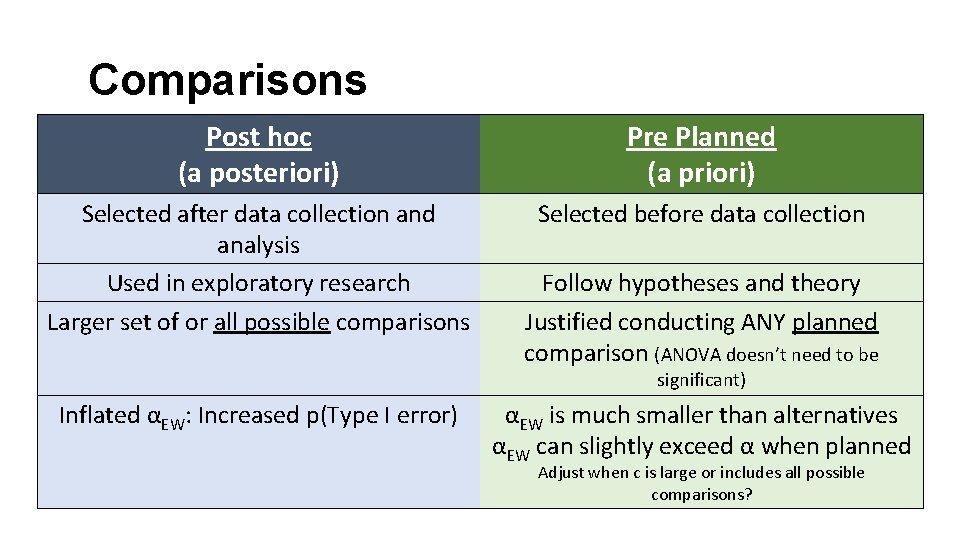
Comparisons Post hoc (a posteriori) Pre Planned (a priori) Selected after data collection and analysis Used in exploratory research Larger set of or all possible comparisons Selected before data collection Follow hypotheses and theory Justified conducting ANY planned comparison (ANOVA doesn’t need to be significant) Inflated αEW: Increased p(Type I error) αEW is much smaller than alternatives αEW can slightly exceed α when planned Adjust when c is large or includes all possible comparisons?
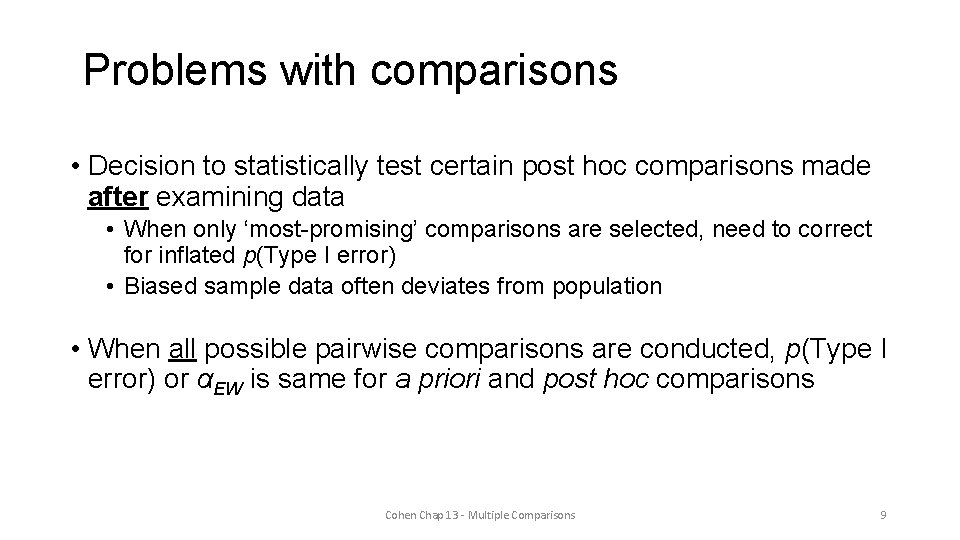
Problems with comparisons • Decision to statistically test certain post hoc comparisons made after examining data • When only ‘most-promising’ comparisons are selected, need to correct for inflated p(Type I error) • Biased sample data often deviates from population • When all possible pairwise comparisons are conducted, p(Type I error) or αEW is same for a priori and post hoc comparisons Cohen Chap 13 - Multiple Comparisons 9
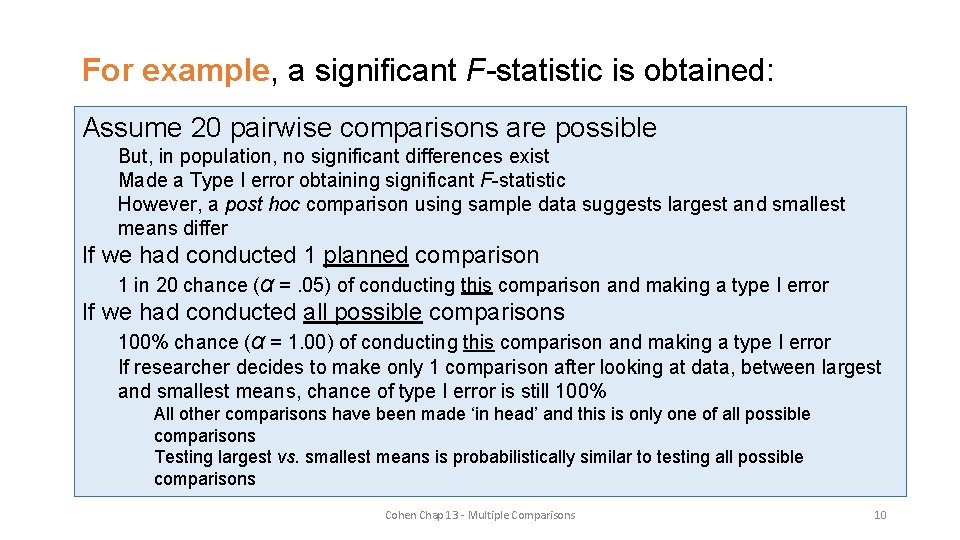
For example, a significant F-statistic is obtained: Assume 20 pairwise comparisons are possible But, in population, no significant differences exist Made a Type I error obtaining significant F-statistic However, a post hoc comparison using sample data suggests largest and smallest means differ If we had conducted 1 planned comparison 1 in 20 chance (α =. 05) of conducting this comparison and making a type I error If we had conducted all possible comparisons 100% chance (α = 1. 00) of conducting this comparison and making a type I error If researcher decides to make only 1 comparison after looking at data, between largest and smallest means, chance of type I error is still 100% All other comparisons have been made ‘in head’ and this is only one of all possible comparisons Testing largest vs. smallest means is probabilistically similar to testing all possible comparisons Cohen Chap 13 - Multiple Comparisons 10
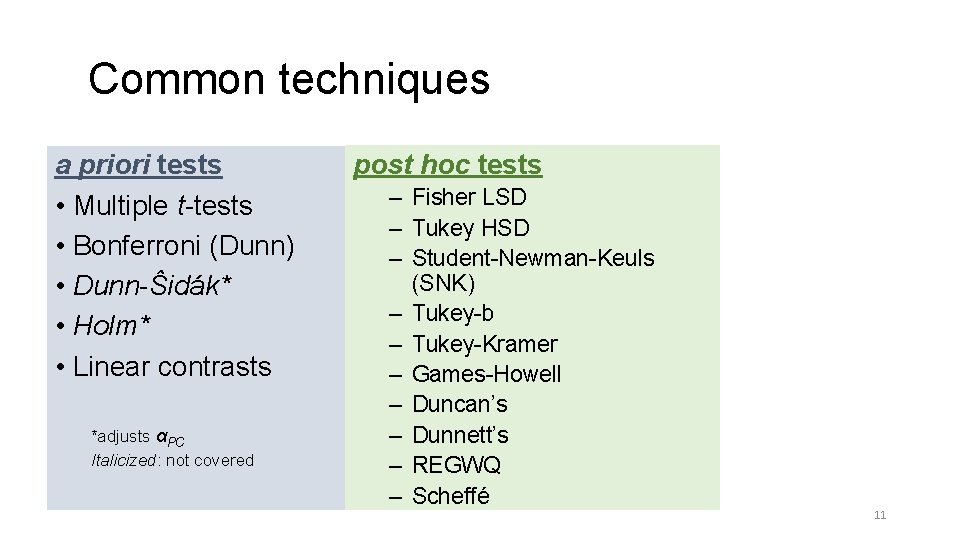
Common techniques a priori tests • Multiple t-tests • Bonferroni (Dunn) • Dunn-Ŝidák* • Holm* • Linear contrasts *adjusts αPC Italicized: not covered post hoc tests – Fisher LSD – Tukey HSD – Student-Newman-Keuls (SNK) – Tukey-b – Tukey-Kramer – Games-Howell – Duncan’s – Dunnett’s – REGWQ – Scheffé 11
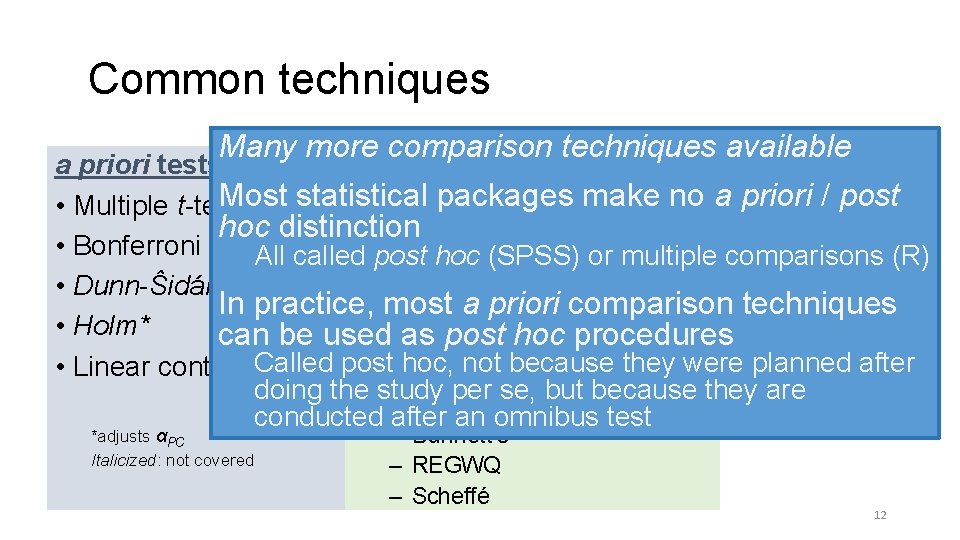
Common techniques Many more comparison techniques available post hoc tests a priori tests – Fisher LSD Most statistical packages make no a priori / post • Multiple t-tests – Tukey HSD hoc distinction • Bonferroni (Dunn) All called post hoc (SPSS) or multiple comparisons (R) – Student-Newman-Keuls (SNK) • Dunn-Ŝidák* In practice, most a priori comparison techniques – Tukey-b • Holm* can be used–as post hoc procedures Tukey-Kramer Called post–hoc, not because they were planned after • Linear contrasts Games-Howell doing the study per se, but because they are Duncan’s conducted –after an omnibus test *adjusts αPC Italicized: not covered – Dunnett’s – REGWQ – Scheffé 12
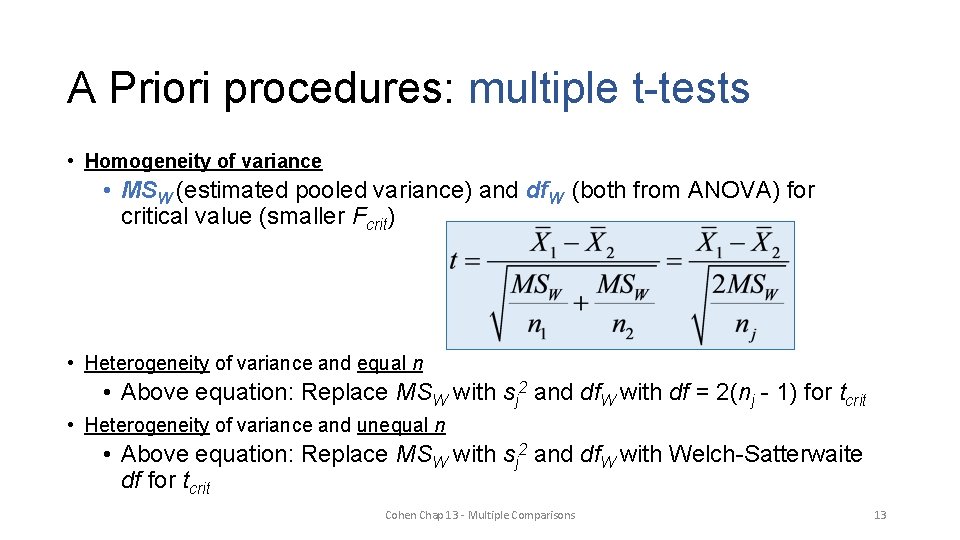
A Priori procedures: multiple t-tests • Homogeneity of variance • MSW (estimated pooled variance) and df. W (both from ANOVA) for critical value (smaller Fcrit) • Heterogeneity of variance and equal n • Above equation: Replace MSW with sj 2 and df. W with df = 2(nj - 1) for tcrit • Heterogeneity of variance and unequal n • Above equation: Replace MSW with sj 2 and df. W with Welch-Satterwaite df for tcrit Cohen Chap 13 - Multiple Comparisons 13
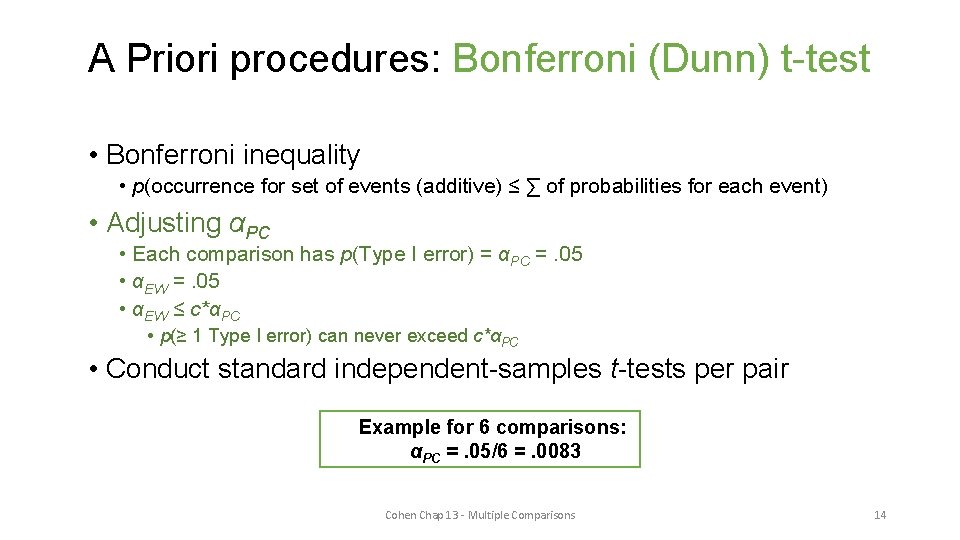
A Priori procedures: Bonferroni (Dunn) t-test • Bonferroni inequality • p(occurrence for set of events (additive) ≤ ∑ of probabilities for each event) • Adjusting αPC • Each comparison has p(Type I error) = αPC =. 05 • αEW ≤ c*αPC • p(≥ 1 Type I error) can never exceed c*αPC • Conduct standard independent-samples t-tests per pair Example for 6 comparisons: αPC =. 05/6 =. 0083 Cohen Chap 13 - Multiple Comparisons 14
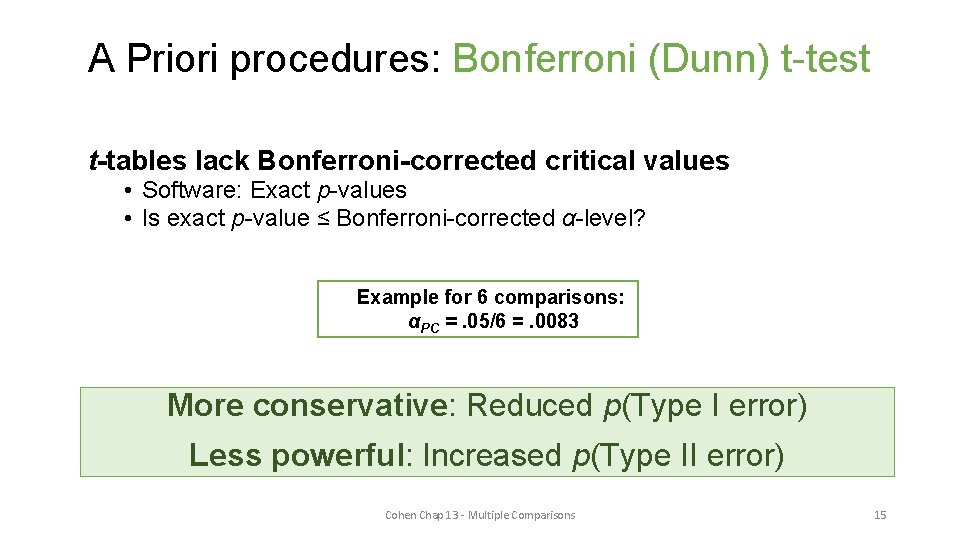
A Priori procedures: Bonferroni (Dunn) t-test t-tables lack Bonferroni-corrected critical values • Software: Exact p-values • Is exact p-value ≤ Bonferroni-corrected α-level? Example for 6 comparisons: αPC =. 05/6 =. 0083 More conservative: Reduced p(Type I error) Less powerful: Increased p(Type II error) Cohen Chap 13 - Multiple Comparisons 15
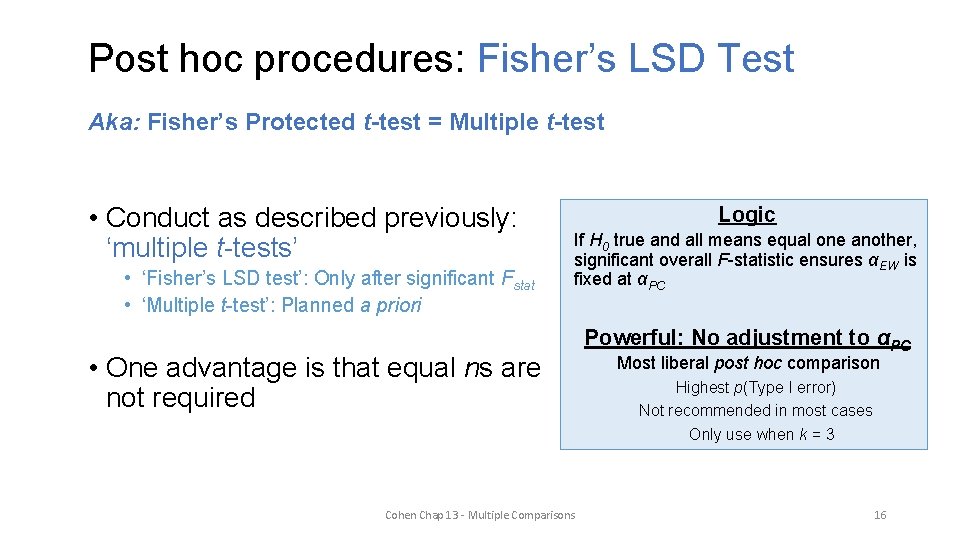
Post hoc procedures: Fisher’s LSD Test Aka: Fisher’s Protected t-test = Multiple t-test • Conduct as described previously: ‘multiple t-tests’ • ‘Fisher’s LSD test’: Only after significant Fstat • ‘Multiple t-test’: Planned a priori Logic If H 0 true and all means equal one another, significant overall F-statistic ensures αEW is fixed at αPC • One advantage is that equal ns are not required Cohen Chap 13 - Multiple Comparisons Powerful: No adjustment to αPC Most liberal post hoc comparison Highest p(Type I error) Not recommended in most cases Only use when k = 3 16
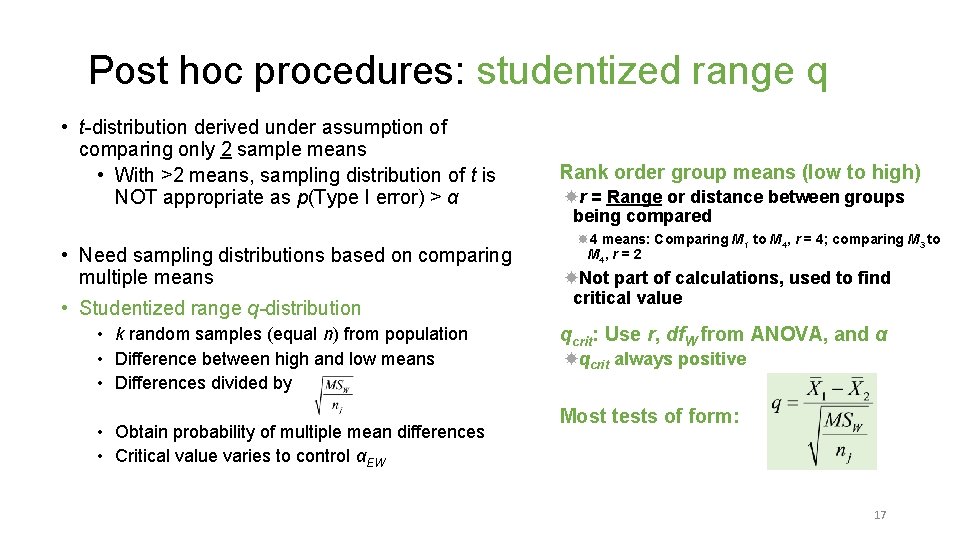
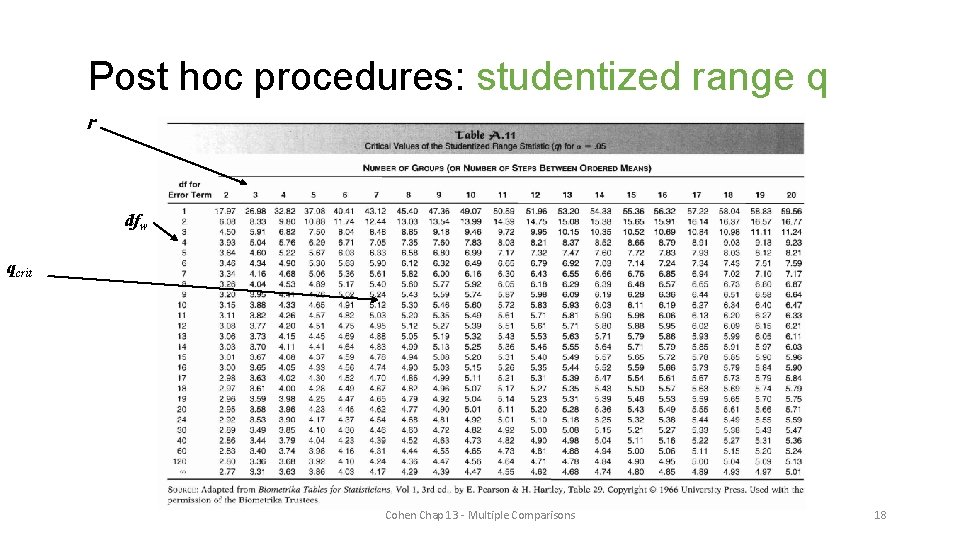
Post hoc procedures: studentized range q • t-distribution derived under assumption of comparing only 2 sample means • With >2 means, sampling distribution of t is NOT appropriate as p(Type I error) > α • Need sampling distributions based on comparing multiple means • Studentized range q-distribution • k random samples (equal n) from population • Difference between high and low means • Differences divided by • Obtain probability of multiple mean differences • Critical value varies to control αEW Rank order group means (low to high) r = Range or distance between groups being compared 4 means: Comparing M 1 to M 4, r = 4; comparing M 3 to M 4, r = 2 Not part of calculations, used to find critical value qcrit: Use r, df. W from ANOVA, and α qcrit always positive Most tests of form: 17
Post hoc procedures: studentized range q r dfw qcrit Cohen Chap 13 - Multiple Comparisons 18
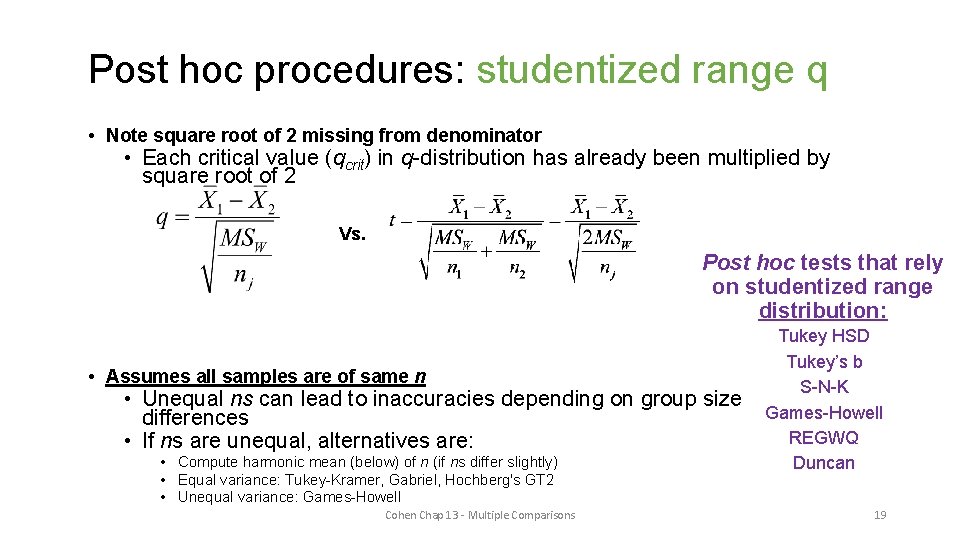
Post hoc procedures: studentized range q • Note square root of 2 missing from denominator • Each critical value (qcrit) in q-distribution has already been multiplied by square root of 2 Vs. Post hoc tests that rely on studentized range distribution: • Assumes all samples are of same n • Unequal ns can lead to inaccuracies depending on group size differences • If ns are unequal, alternatives are: • Compute harmonic mean (below) of n (if ns differ slightly) • Equal variance: Tukey-Kramer, Gabriel, Hochberg's GT 2 • Unequal variance: Games-Howell Cohen Chap 13 - Multiple Comparisons Tukey HSD Tukey’s b S-N-K Games-Howell REGWQ Duncan 19
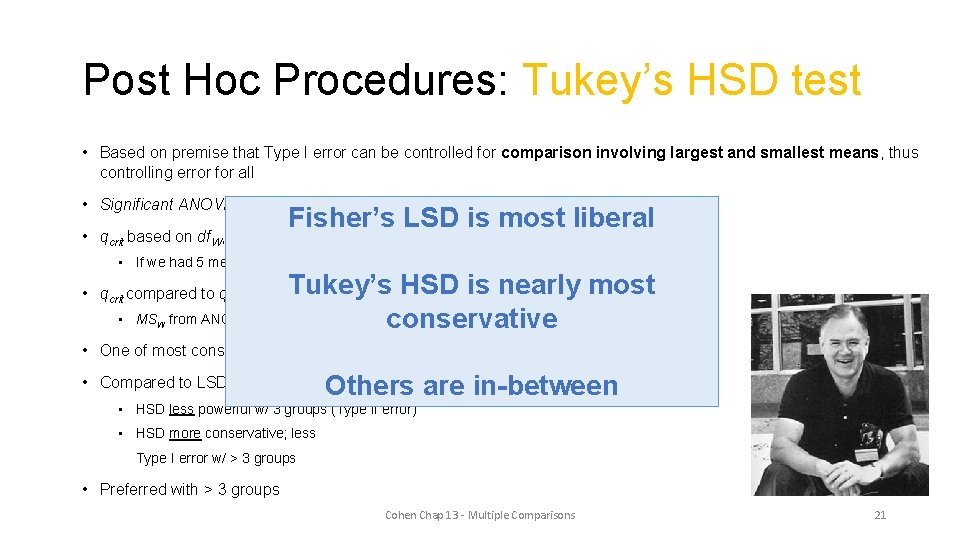
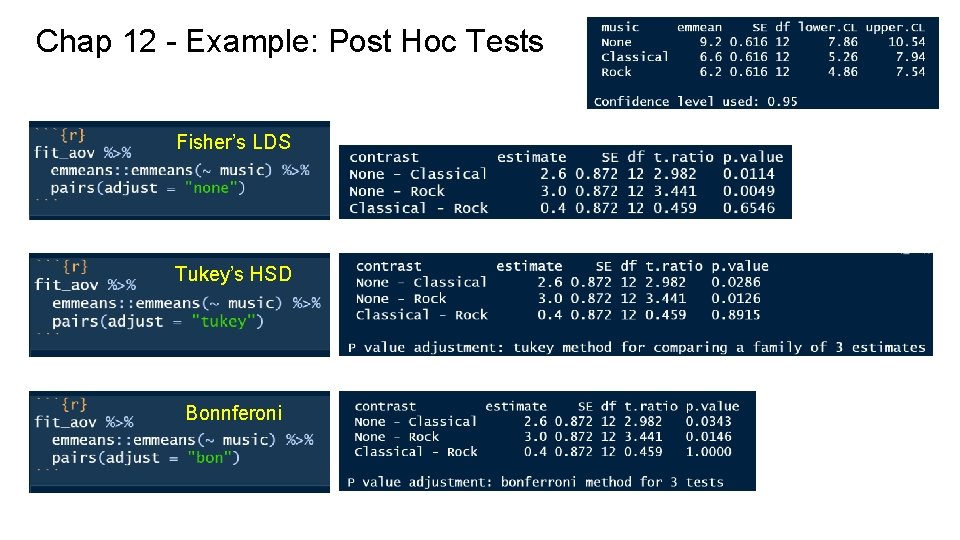
Post Hoc Procedures: Tukey’s HSD test • Based on premise that Type I error can be controlled for comparison involving largest and smallest means, thus controlling error for all • Significant ANOVA NOT required • qcrit based on df. W, αEW (table. 05), and largest r • If we had 5 means, all comparisons would be evaluated using qcrit based on r = 5 • qcrit compared to qobt • MSW from ANOVA • One of most conservative post hoc comparisons, good control of αEW • Compared to LSD… • HSD less powerful w/ 3 groups (Type II error) • HSD more conservative; less Type I error w/ > 3 groups • Preferred with > 3 groups Cohen Chap 13 - Multiple Comparisons 20
Post Hoc Procedures: Tukey’s HSD test • Based on premise that Type I error can be controlled for comparison involving largest and smallest means, thus controlling error for all • Significant ANOVA NOT required Fisher’s LSD is most liberal • qcrit based on df. W, αEW (table. 05), and largest r • If we had 5 means, all comparisons would be evaluated using qcrit based on r = 5 • qcrit compared to qobt • MSW from ANOVA Tukey’s HSD is nearly most conservative • One of most conservative post hoc comparisons, good control of αEW • Compared to LSD… Others are in-between • HSD less powerful w/ 3 groups (Type II error) • HSD more conservative; less Type I error w/ > 3 groups • Preferred with > 3 groups Cohen Chap 13 - Multiple Comparisons 21
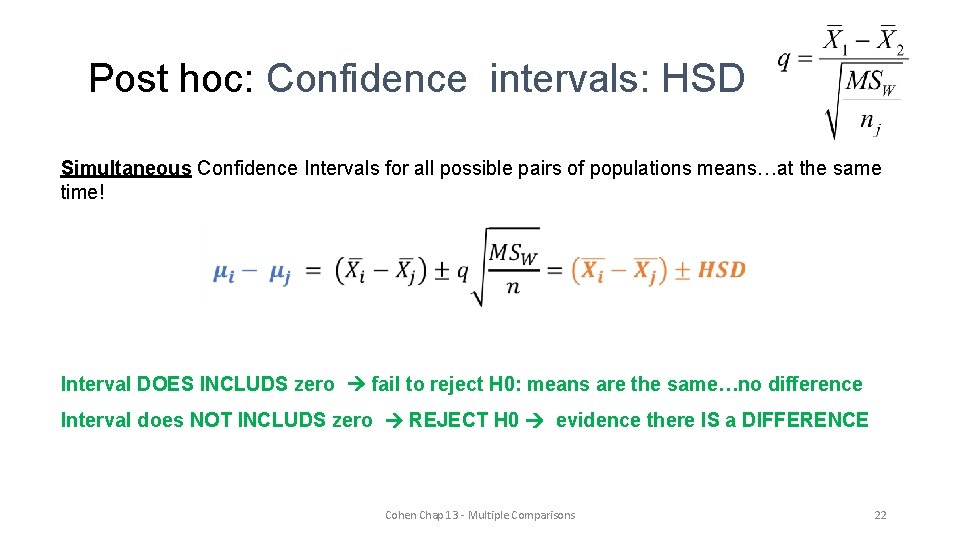
Post hoc: Confidence intervals: HSD Simultaneous Confidence Intervals for all possible pairs of populations means…at the same time! Interval DOES INCLUDS zero fail to reject H 0: means are the same…no difference Interval does NOT INCLUDS zero REJECT H 0 evidence there IS a DIFFERENCE Cohen Chap 13 - Multiple Comparisons 22
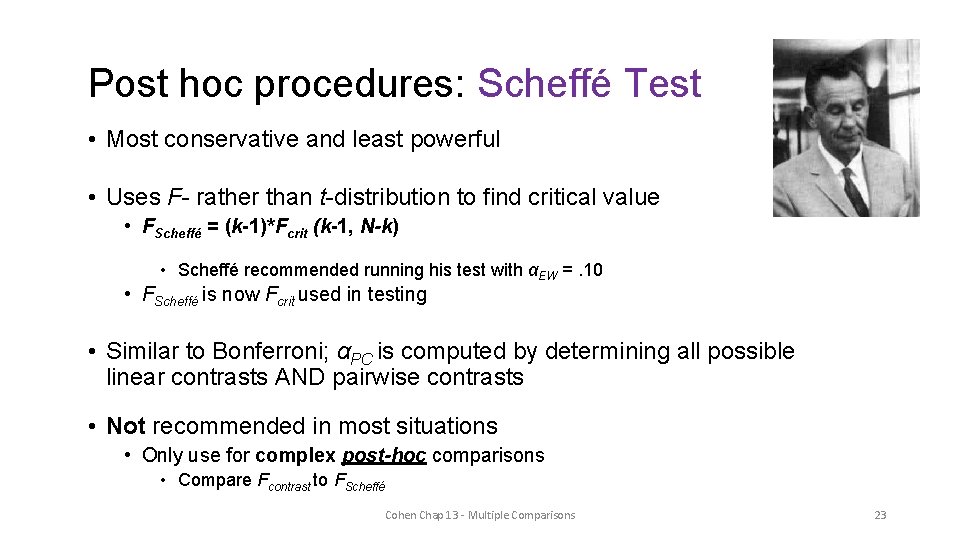
Post hoc procedures: Scheffé Test • Most conservative and least powerful • Uses F- rather than t-distribution to find critical value • FScheffé = (k-1)*Fcrit (k-1, N-k) • Scheffé recommended running his test with αEW =. 10 • FScheffé is now Fcrit used in testing • Similar to Bonferroni; αPC is computed by determining all possible linear contrasts AND pairwise contrasts • Not recommended in most situations • Only use for complex post-hoc comparisons • Compare Fcontrast to FScheffé Cohen Chap 13 - Multiple Comparisons 23
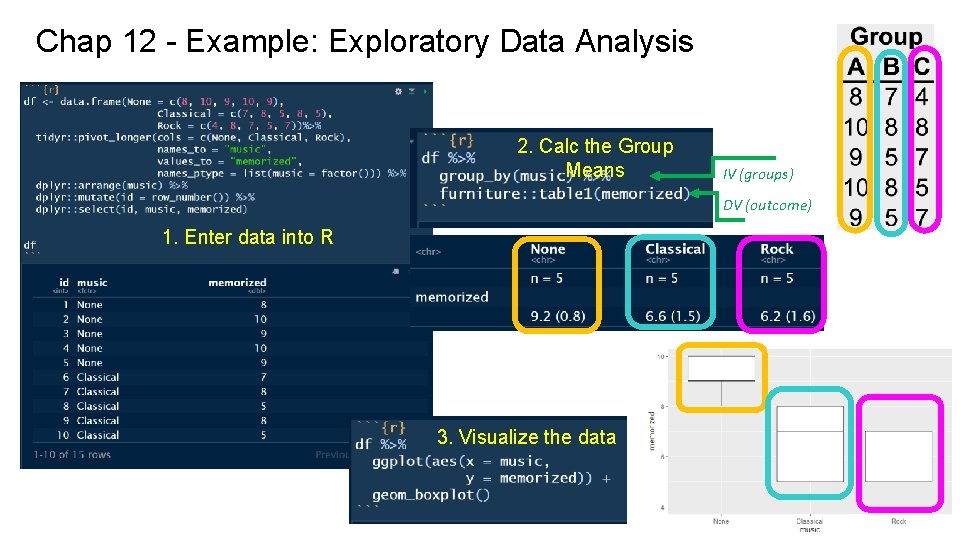
Chap 12 - Example: Exploratory Data Analysis 2. Calc the Group Means IV (groups) DV (outcome) 1. Enter data into R 3. Visualize the data
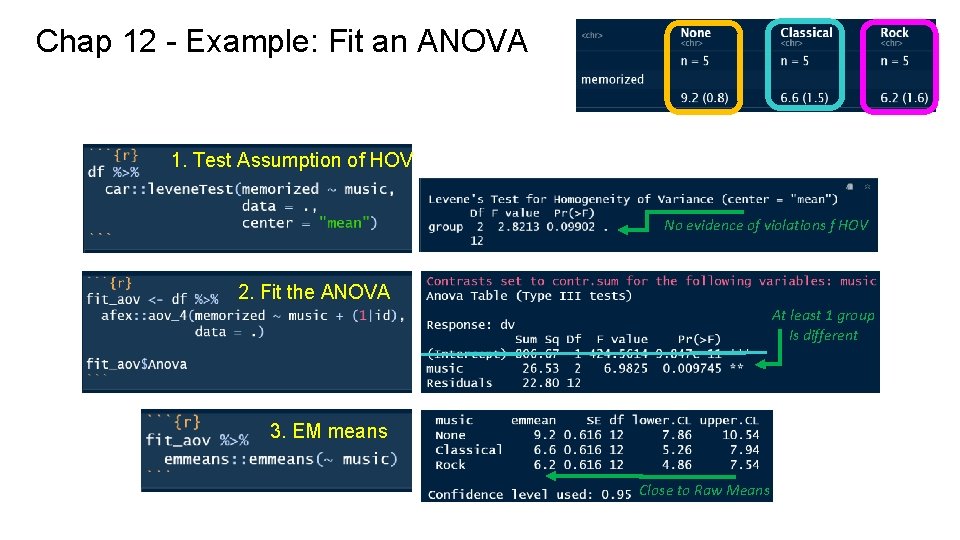
Chap 12 - Example: Fit an ANOVA 1. Test Assumption of HOV No evidence of violations f HOV 2. Fit the ANOVA At least 1 group Is different 3. EM means Close to Raw Means
Chap 12 - Example: Post Hoc Tests Fisher’s LDS Tukey’s HSD Bonnferoni
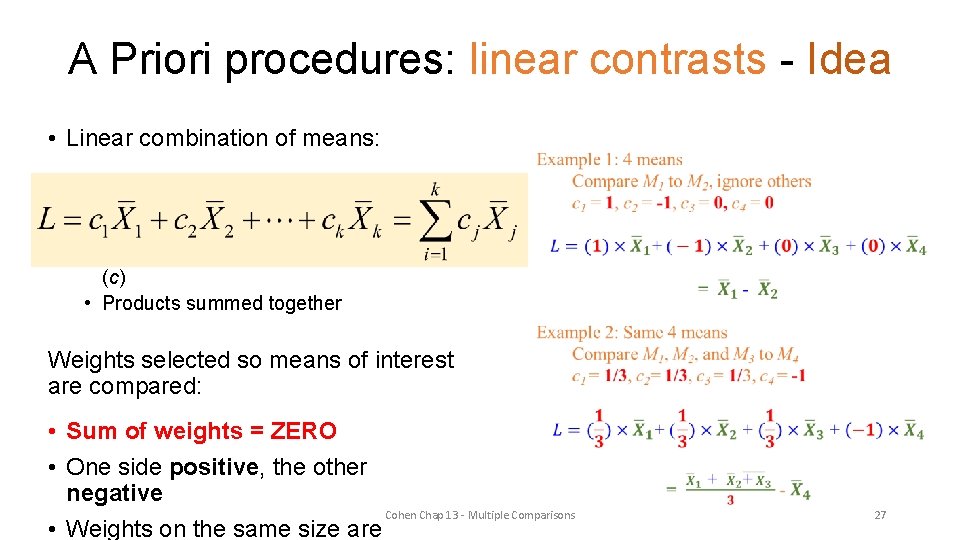
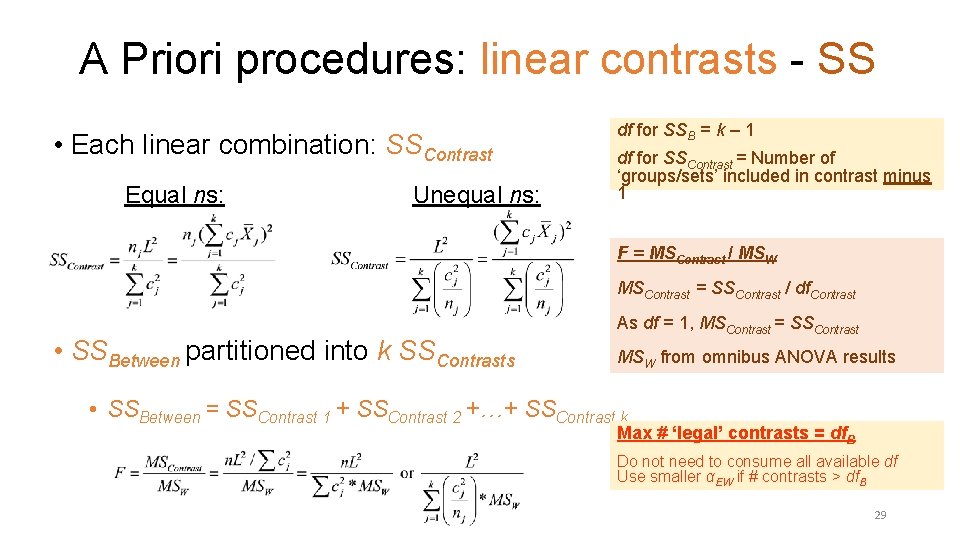
A Priori procedures: linear contrasts - Idea • Linear combination of means: • Each group mean weighted by constant (c) • Products summed together Weights selected so means of interest are compared: • Sum of weights = ZERO • One side positive, the other negative Cohen Chap 13 - Multiple Comparisons • Weights on the same size are 27
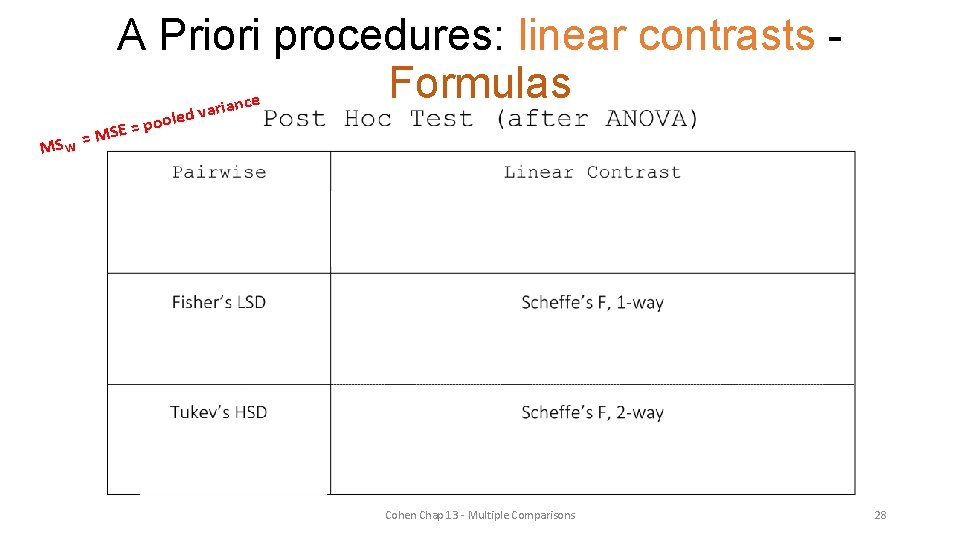
A Priori procedures: linear contrasts Formulas e c n a vari = MS W led poo = E S M Cohen Chap 13 - Multiple Comparisons 28
A Priori procedures: linear contrasts - SS • Each linear combination: SSContrast Equal ns: Unequal ns: df for SSB = k – 1 df for SSContrast = Number of ‘groups/sets’ included in contrast minus 1 F = MSContrast / MSW MSContrast = SSContrast / df. Contrast • SSBetween partitioned into k SSContrasts As df = 1, MSContrast = SSContrast MSW from omnibus ANOVA results • SSBetween = SSContrast 1 + SSContrast 2 +…+ SSContrast k Max # ‘legal’ contrasts = df. B Do not need to consume all available df Use smaller αEW if # contrasts > df. B 29
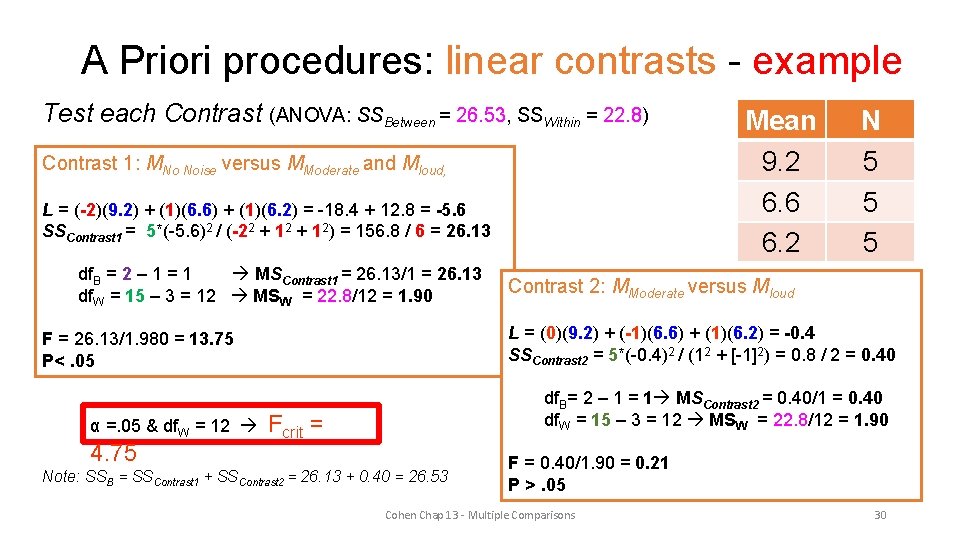
A Priori procedures: linear contrasts - example Test each Contrast (ANOVA: SSBetween = 26. 53, SSWithin = 22. 8) Contrast 1: MNo Noise versus MModerate and Mloud, L = (-2)(9. 2) + (1)(6. 6) + (1)(6. 2) = -18. 4 + 12. 8 = -5. 6 SSContrast 1 = 5*(-5. 6)2 / (-22 + 12) = 156. 8 / 6 = 26. 13 df. B = 2 – 1 = 1 MSContrast 1 = 26. 13/1 = 26. 13 df. W = 15 – 3 = 12 MSW = 22. 8/12 = 1. 90 4. 75 N 5 5 5 Contrast 2: MModerate versus Mloud L = (0)(9. 2) + (-1)(6. 6) + (1)(6. 2) = -0. 4 SSContrast 2 = 5*(-0. 4)2 / (12 + [-1]2) = 0. 8 / 2 = 0. 40 F = 26. 13/1. 980 = 13. 75 P<. 05 α =. 05 & df. W = 12 Mean 9. 2 6. 6 6. 2 df. B= 2 – 1 = 1 MSContrast 2 = 0. 40/1 = 0. 40 df. W = 15 – 3 = 12 MSW = 22. 8/12 = 1. 90 Fcrit = Note: SSB = SSContrast 1 + SSContrast 2 = 26. 13 + 0. 40 = 26. 53 F = 0. 40/1. 90 = 0. 21 P >. 05 Cohen Chap 13 - Multiple Comparisons 30
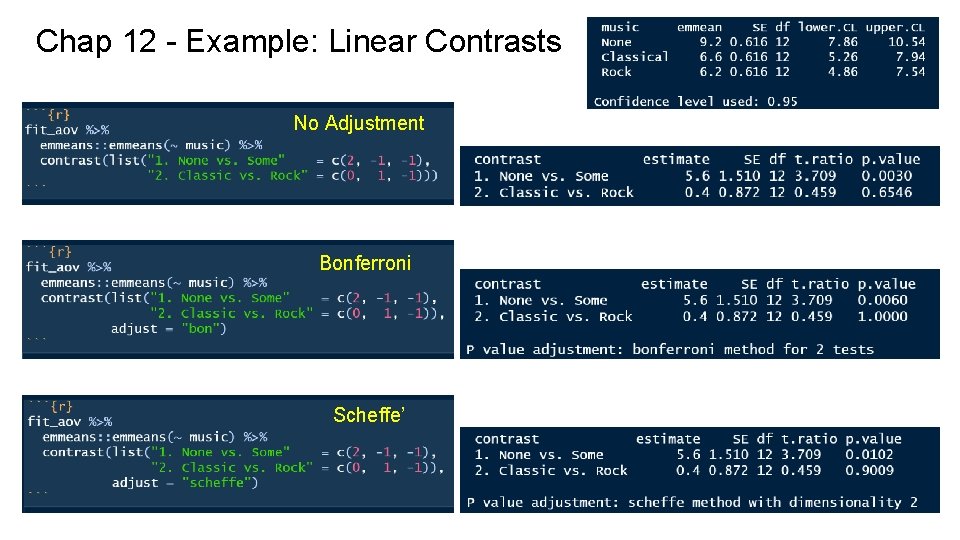
Chap 12 - Example: Linear Contrasts No Adjustment Bonferroni Scheffe’
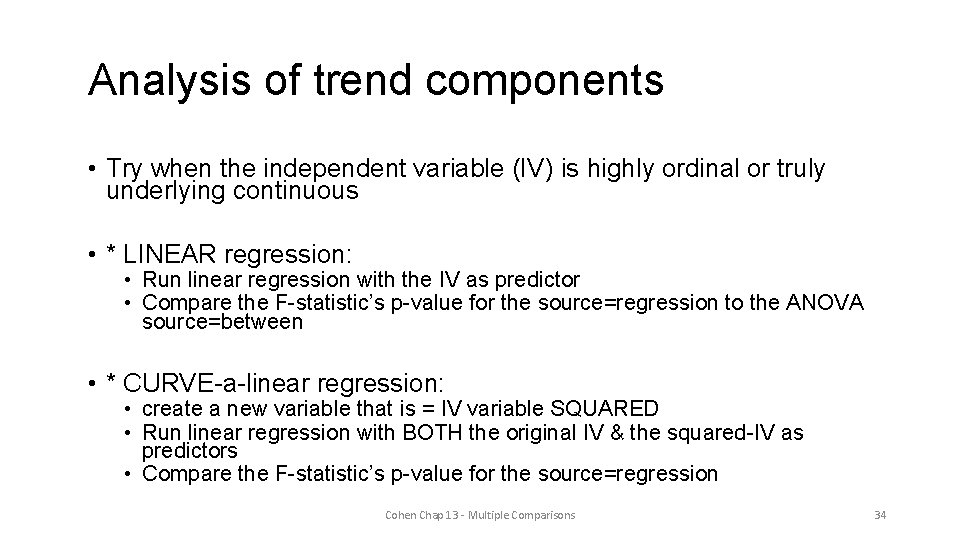
Analysis of trend components • Try when the independent variable (IV) is highly ordinal or truly underlying continuous • * LINEAR regression: • Run linear regression with the IV as predictor • Compare the F-statistic’s p-value for the source=regression to the ANOVA source=between • * CURVE-a-linear regression: • create a new variable that is = IV variable SQUARED • Run linear regression with BOTH the original IV & the squared-IV as predictors • Compare the F-statistic’s p-value for the source=regression Cohen Chap 13 - Multiple Comparisons 34
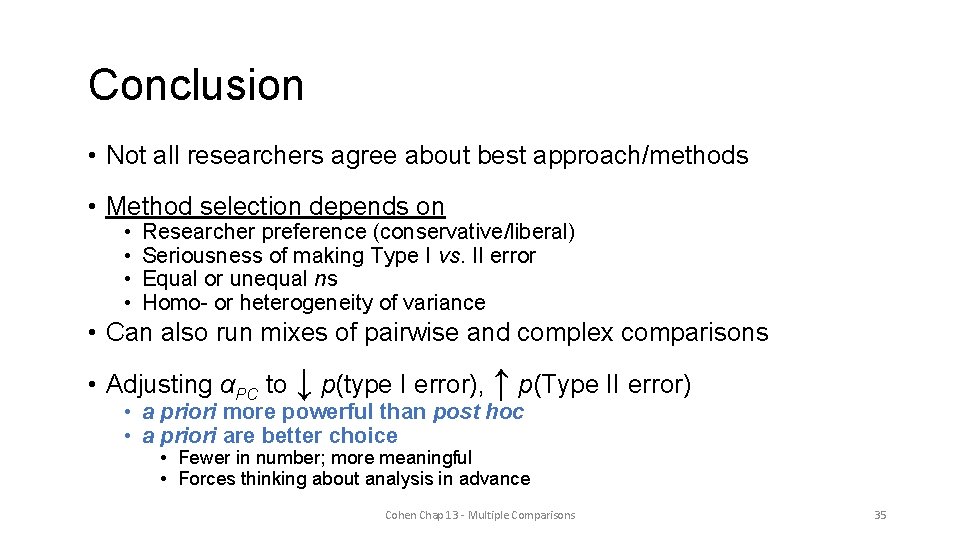
Conclusion • Not all researchers agree about best approach/methods • Method selection depends on • • Researcher preference (conservative/liberal) Seriousness of making Type I vs. II error Equal or unequal ns Homo- or heterogeneity of variance • Can also run mixes of pairwise and complex comparisons • Adjusting αPC to ↓ p(type I error), ↑ p(Type II error) • a priori more powerful than post hoc • a priori are better choice • Fewer in number; more meaningful • Forces thinking about analysis in advance Cohen Chap 13 - Multiple Comparisons 35
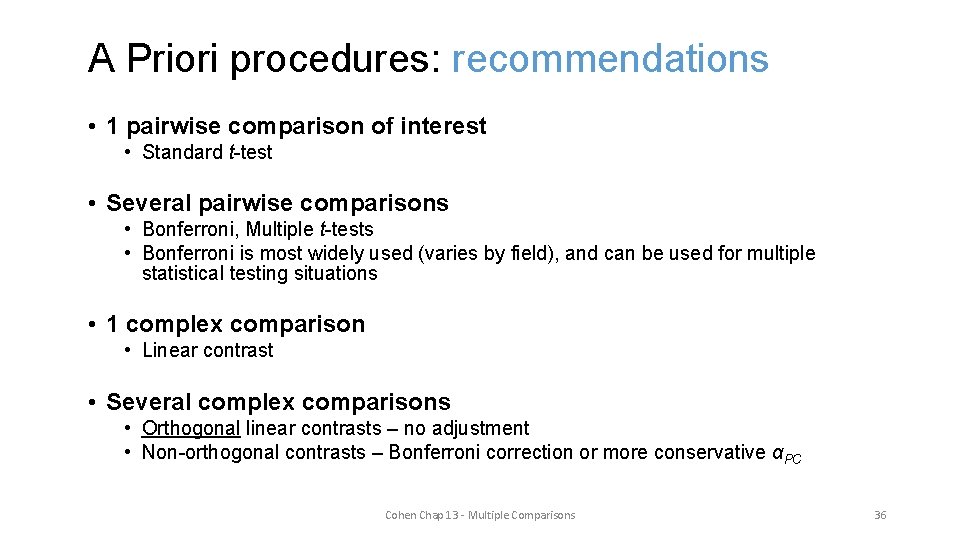
A Priori procedures: recommendations • 1 pairwise comparison of interest • Standard t-test • Several pairwise comparisons • Bonferroni, Multiple t-tests • Bonferroni is most widely used (varies by field), and can be used for multiple statistical testing situations • 1 complex comparison • Linear contrast • Several complex comparisons • Orthogonal linear contrasts – no adjustment • Non-orthogonal contrasts – Bonferroni correction or more conservative αPC Cohen Chap 13 - Multiple Comparisons 36
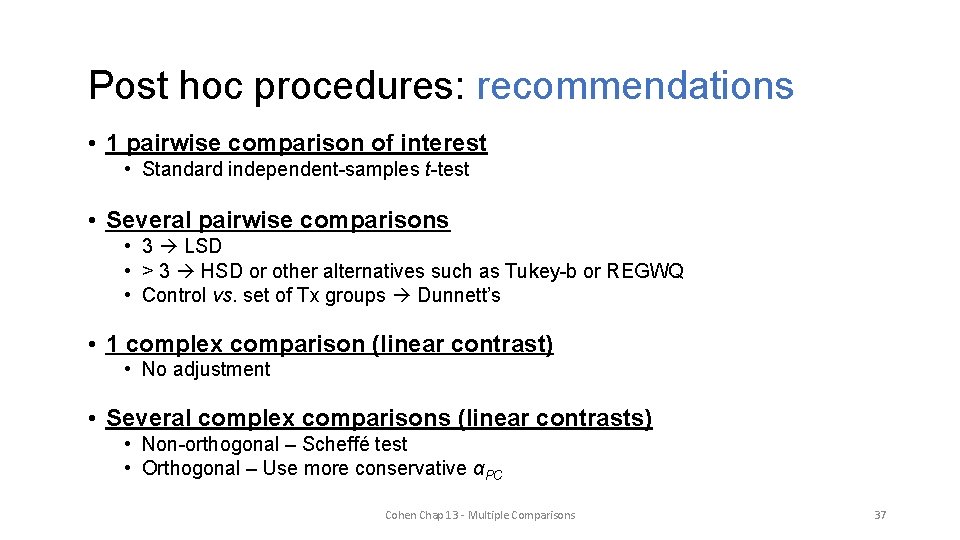
Post hoc procedures: recommendations • 1 pairwise comparison of interest • Standard independent-samples t-test • Several pairwise comparisons • 3 LSD • > 3 HSD or other alternatives such as Tukey-b or REGWQ • Control vs. set of Tx groups Dunnett’s • 1 complex comparison (linear contrast) • No adjustment • Several complex comparisons (linear contrasts) • Non-orthogonal – Scheffé test • Orthogonal – Use more conservative αPC Cohen Chap 13 - Multiple Comparisons 37
38