
Multiple Clock Domains Arvind Computer Science Artificial Intelligence
- Slides: 44
Multiple Clock Domains Arvind Computer Science & Artificial Intelligence Lab Massachusetts Institute of Technology Based on material prepared by Bluespec Inc March 4, 2009 http: //csg. csail. mit. edu/6. 375 L 13 -1
Why Multiple Clock Domains Arise naturally in interfacing with the outside world Needed to manage clock skew Allow parts of the design to be isolated to do selective power gating and clock gating Reduce power and energy consumption March 4, 2009 http: //csg. csail. mit. edu/6. 375 2
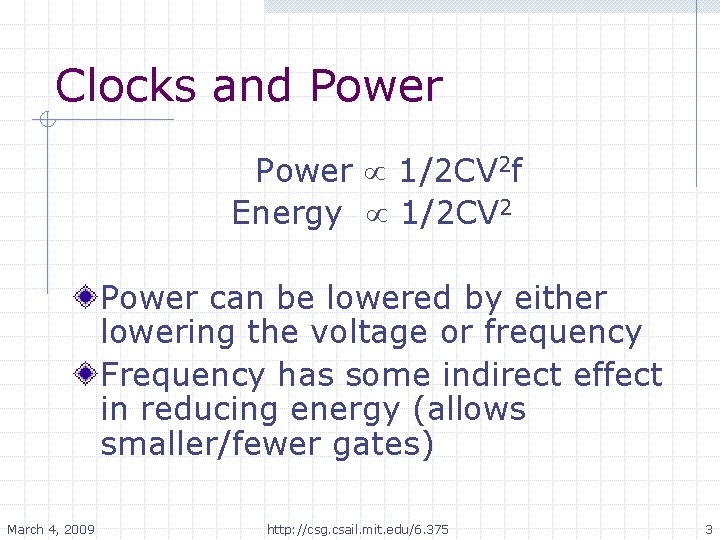
Clocks and Power 1/2 CV 2 f Energy 1/2 CV 2 Power can be lowered by either lowering the voltage or frequency Frequency has some indirect effect in reducing energy (allows smaller/fewer gates) March 4, 2009 http: //csg. csail. mit. edu/6. 375 3
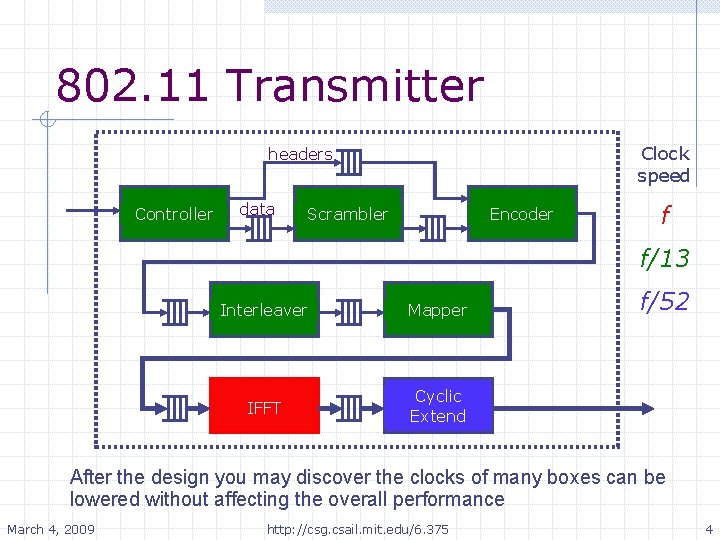
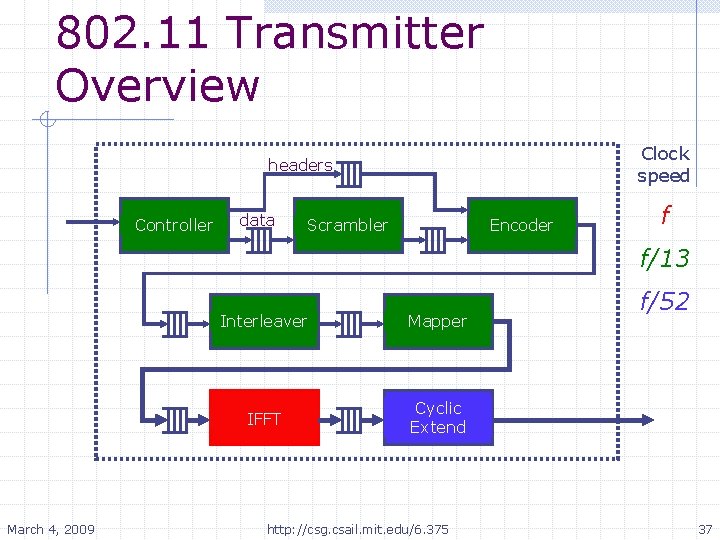
802. 11 Transmitter Clock speed headers Controller data Scrambler Encoder f f/13 Interleaver Mapper IFFT Cyclic Extend f/52 After the design you may discover the clocks of many boxes can be lowered without affecting the overall performance March 4, 2009 http: //csg. csail. mit. edu/6. 375 4
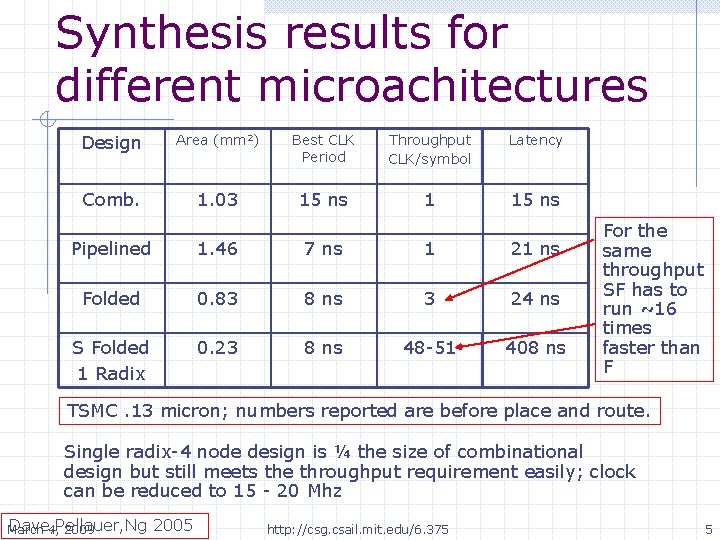
Synthesis results for different microachitectures Design Area (mm 2) Best CLK Period Throughput CLK/symbol Latency Comb. 1. 03 15 ns 1 15 ns Pipelined 1. 46 7 ns 1 21 ns Folded 0. 83 8 ns 3 24 ns S Folded 1 Radix 0. 23 8 ns 48 -51 408 ns For the same throughput SF has to run ~16 times faster than F TSMC. 13 micron; numbers reported are before place and route. Single radix-4 node design is ¼ the size of combinational design but still meets the throughput requirement easily; clock can be reduced to 15 - 20 Mhz Dave, Pellauer, Ng March 4, 2009 2005 http: //csg. csail. mit. edu/6. 375 5
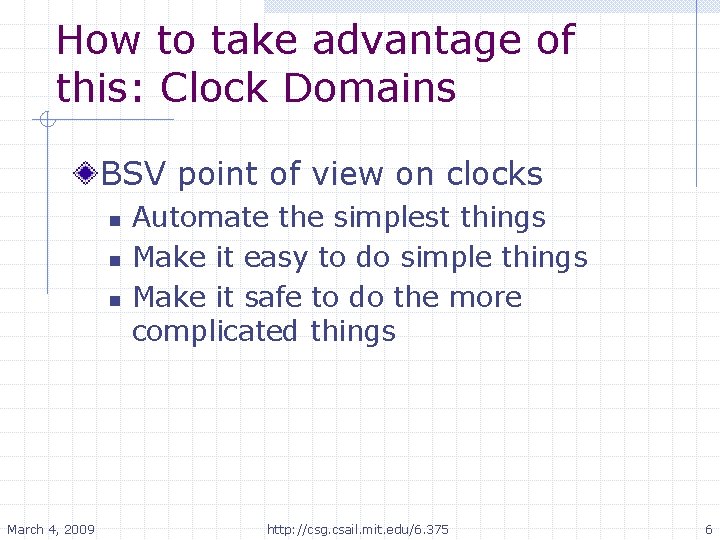
How to take advantage of this: Clock Domains BSV point of view on clocks n n n March 4, 2009 Automate the simplest things Make it easy to do simple things Make it safe to do the more complicated things http: //csg. csail. mit. edu/6. 375 6
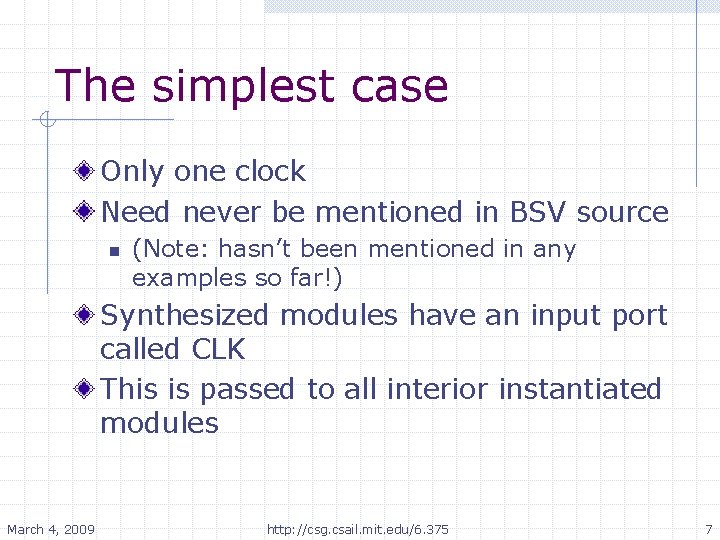
The simplest case Only one clock Need never be mentioned in BSV source n (Note: hasn’t been mentioned in any examples so far!) Synthesized modules have an input port called CLK This is passed to all interior instantiated modules March 4, 2009 http: //csg. csail. mit. edu/6. 375 7
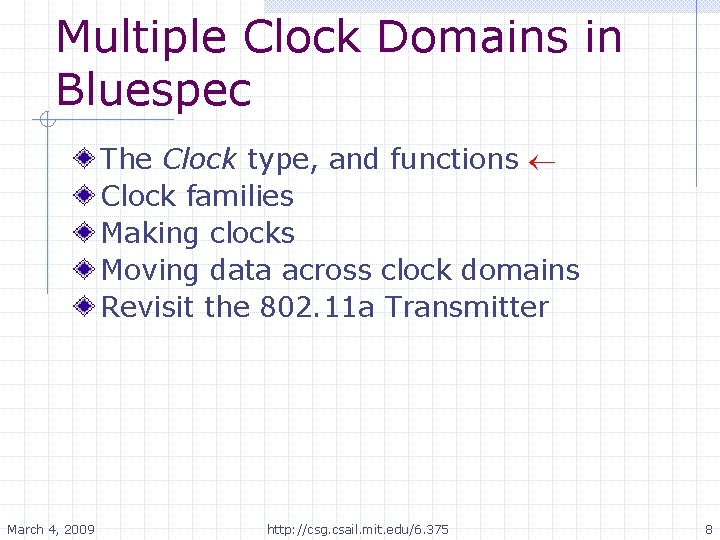
Multiple Clock Domains in Bluespec The Clock type, and functions Clock families Making clocks Moving data across clock domains Revisit the 802. 11 a Transmitter March 4, 2009 http: //csg. csail. mit. edu/6. 375 8
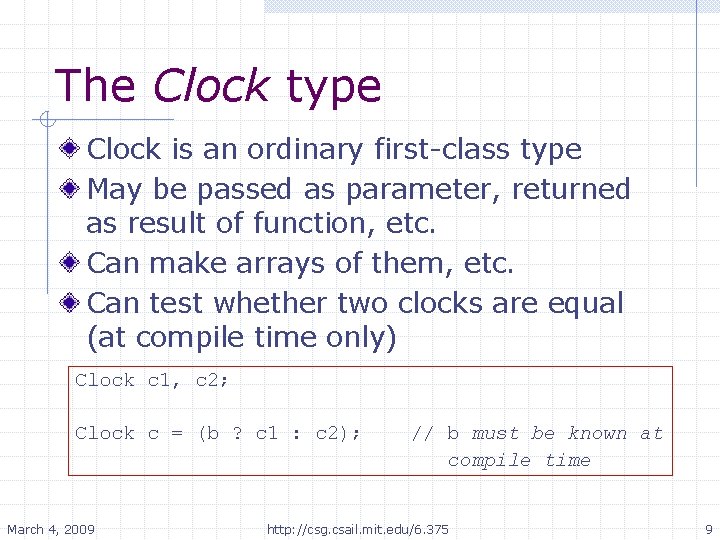
The Clock type Clock is an ordinary first-class type May be passed as parameter, returned as result of function, etc. Can make arrays of them, etc. Can test whether two clocks are equal (at compile time only) Clock c 1, c 2; Clock c = (b ? c 1 : c 2); March 4, 2009 // b must be known at compile time http: //csg. csail. mit. edu/6. 375 9
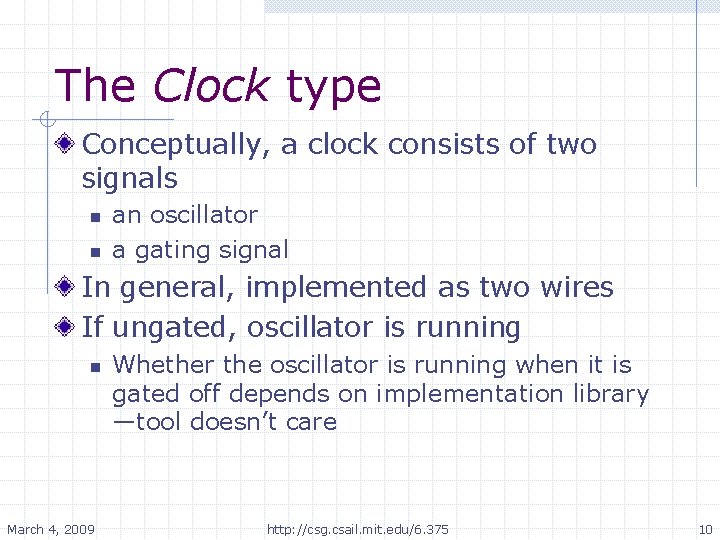
The Clock type Conceptually, a clock consists of two signals n n an oscillator a gating signal In general, implemented as two wires If ungated, oscillator is running n March 4, 2009 Whether the oscillator is running when it is gated off depends on implementation library —tool doesn’t care http: //csg. csail. mit. edu/6. 375 10
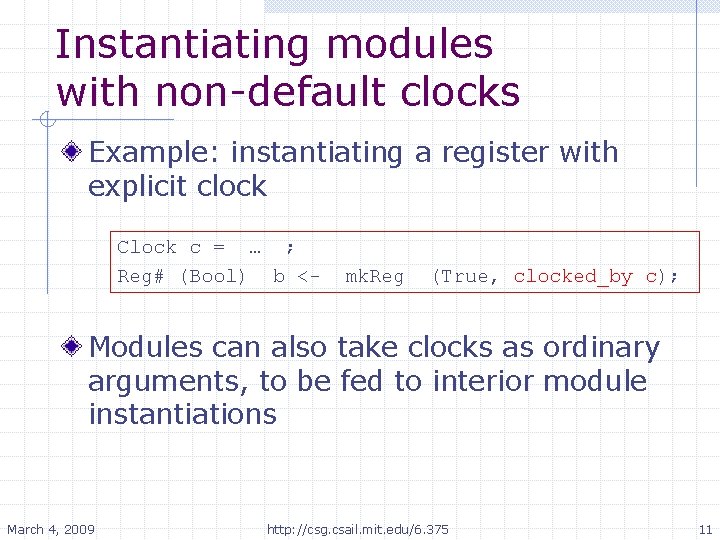
Instantiating modules with non-default clocks Example: instantiating a register with explicit clock Clock c = … ; Reg# (Bool) b <- mk. Reg (True, clocked_by c); Modules can also take clocks as ordinary arguments, to be fed to interior module instantiations March 4, 2009 http: //csg. csail. mit. edu/6. 375 11
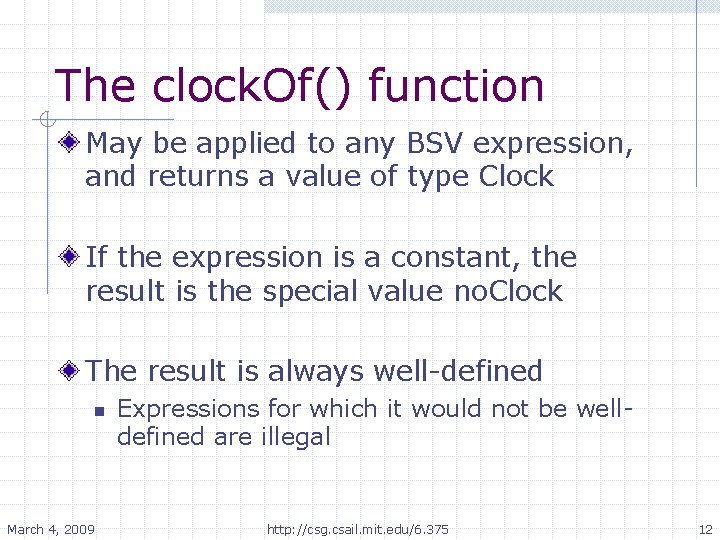
The clock. Of() function May be applied to any BSV expression, and returns a value of type Clock If the expression is a constant, the result is the special value no. Clock The result is always well-defined n March 4, 2009 Expressions for which it would not be welldefined are illegal http: //csg. csail. mit. edu/6. 375 12
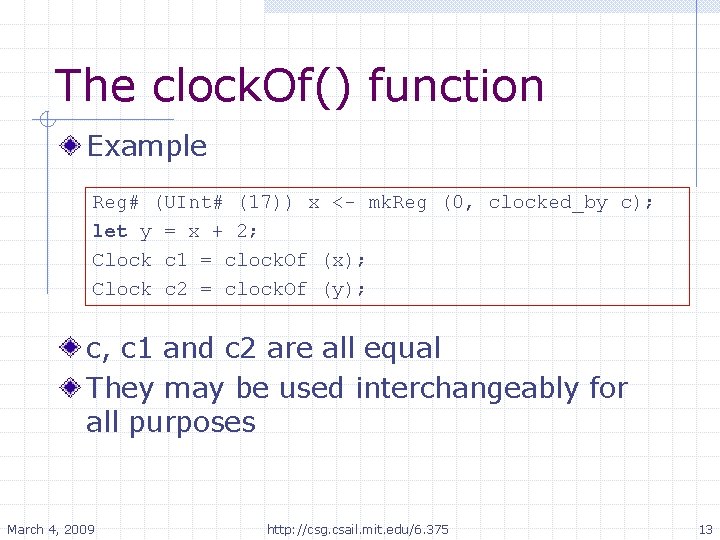
The clock. Of() function Example Reg# (UInt# (17)) x <- mk. Reg (0, clocked_by c); let y = x + 2; Clock c 1 = clock. Of (x); Clock c 2 = clock. Of (y); c, c 1 and c 2 are all equal They may be used interchangeably for all purposes March 4, 2009 http: //csg. csail. mit. edu/6. 375 13
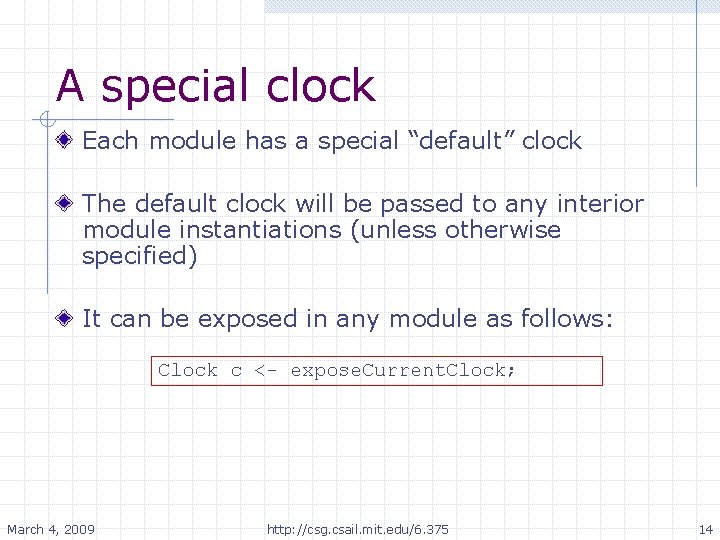
A special clock Each module has a special “default” clock The default clock will be passed to any interior module instantiations (unless otherwise specified) It can be exposed in any module as follows: Clock c <- expose. Current. Clock; March 4, 2009 http: //csg. csail. mit. edu/6. 375 14
Multiple Clock Domains in Bluespec The Clock type, and functions √ Clock families Making clocks Moving data across clock domain Revisit the 802. 11 a Transmitter March 4, 2009 http: //csg. csail. mit. edu/6. 375 15
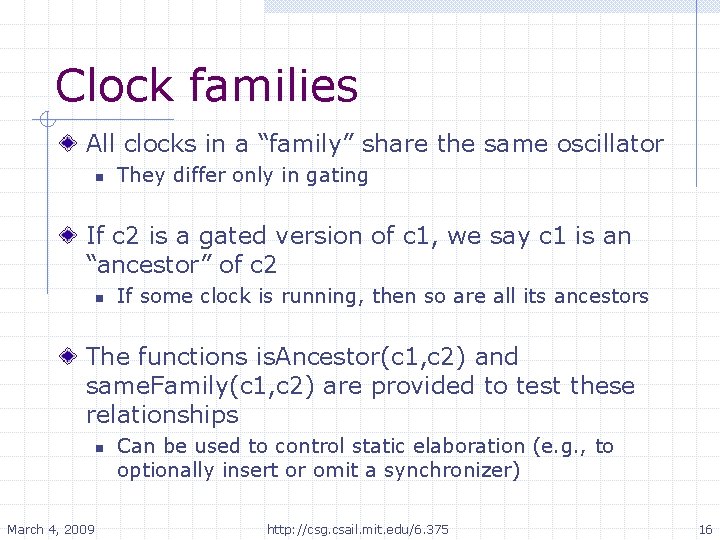
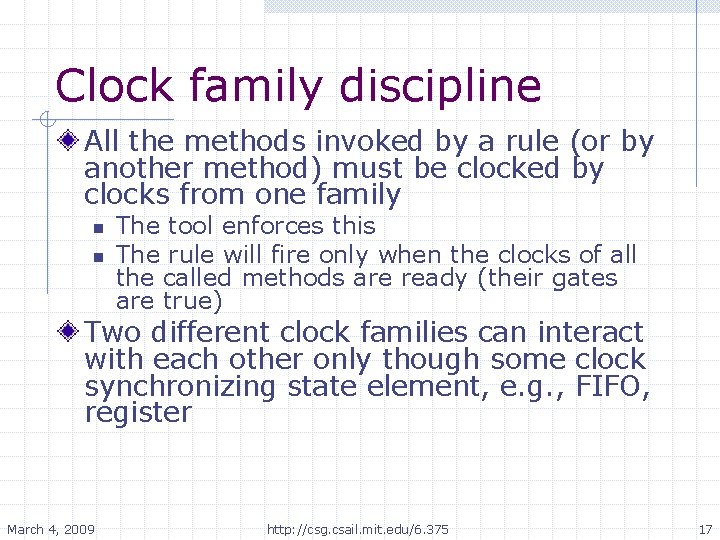
Clock families All clocks in a “family” share the same oscillator n They differ only in gating If c 2 is a gated version of c 1, we say c 1 is an “ancestor” of c 2 n If some clock is running, then so are all its ancestors The functions is. Ancestor(c 1, c 2) and same. Family(c 1, c 2) are provided to test these relationships n March 4, 2009 Can be used to control static elaboration (e. g. , to optionally insert or omit a synchronizer) http: //csg. csail. mit. edu/6. 375 16
Clock family discipline All the methods invoked by a rule (or by another method) must be clocked by clocks from one family n n The tool enforces this The rule will fire only when the clocks of all the called methods are ready (their gates are true) Two different clock families can interact with each other only though some clock synchronizing state element, e. g. , FIFO, register March 4, 2009 http: //csg. csail. mit. edu/6. 375 17
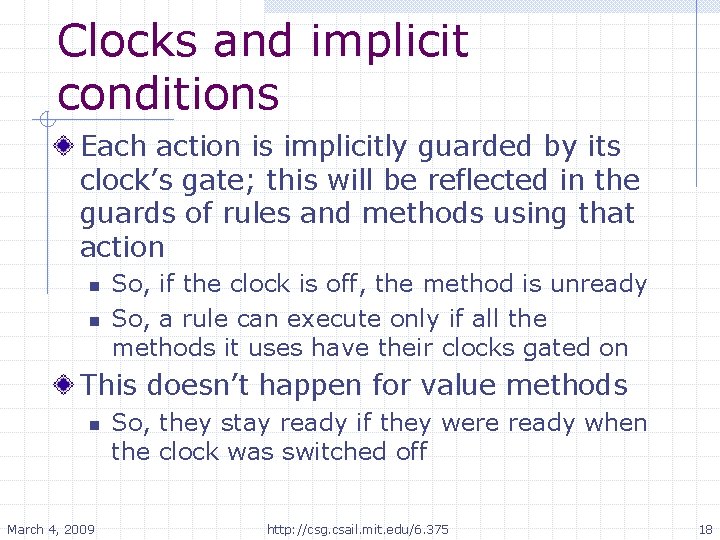
Clocks and implicit conditions Each action is implicitly guarded by its clock’s gate; this will be reflected in the guards of rules and methods using that action n n So, if the clock is off, the method is unready So, a rule can execute only if all the methods it uses have their clocks gated on This doesn’t happen for value methods n March 4, 2009 So, they stay ready if they were ready when the clock was switched off http: //csg. csail. mit. edu/6. 375 18
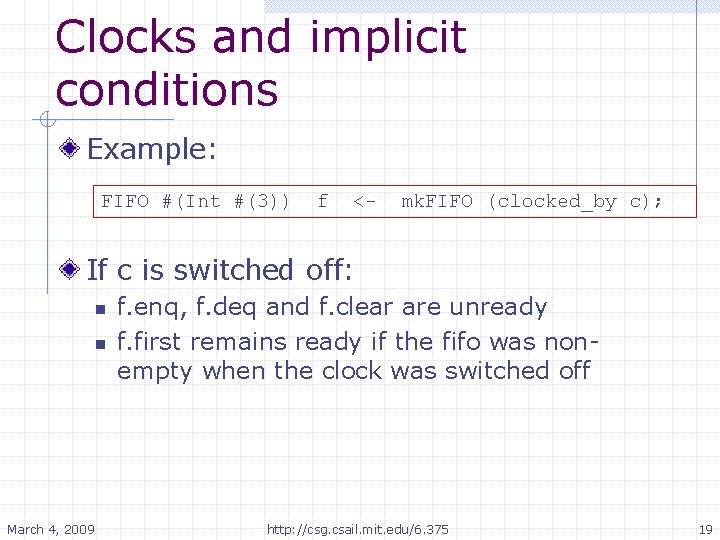
Clocks and implicit conditions Example: FIFO #(Int #(3)) f <- mk. FIFO (clocked_by c); If c is switched off: n n March 4, 2009 f. enq, f. deq and f. clear are unready f. first remains ready if the fifo was nonempty when the clock was switched off http: //csg. csail. mit. edu/6. 375 19
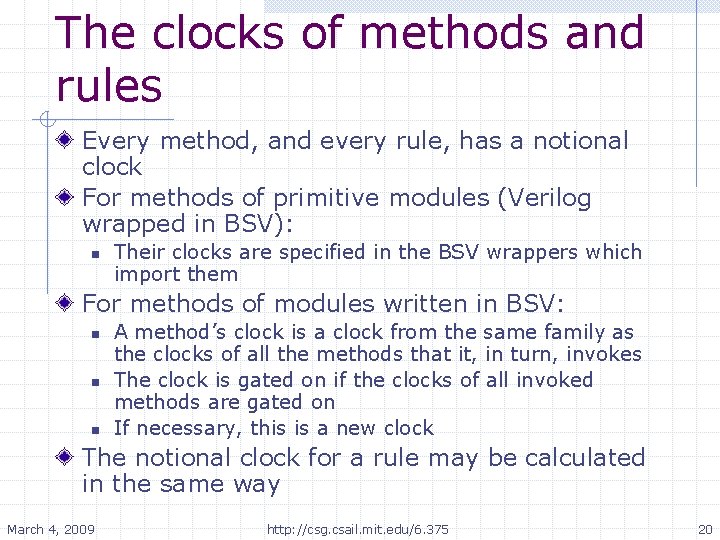
The clocks of methods and rules Every method, and every rule, has a notional clock For methods of primitive modules (Verilog wrapped in BSV): n Their clocks are specified in the BSV wrappers which import them For methods of modules written in BSV: n n n A method’s clock is a clock from the same family as the clocks of all the methods that it, in turn, invokes The clock is gated on if the clocks of all invoked methods are gated on If necessary, this is a new clock The notional clock for a rule may be calculated in the same way March 4, 2009 http: //csg. csail. mit. edu/6. 375 20
Multiple Clock Domains in Bluespec The Clock type, and functions √ Clock families √ Making clocks Moving data across clock domain Revisit the 802. 11 a Transmitter March 4, 2009 http: //csg. csail. mit. edu/6. 375 21
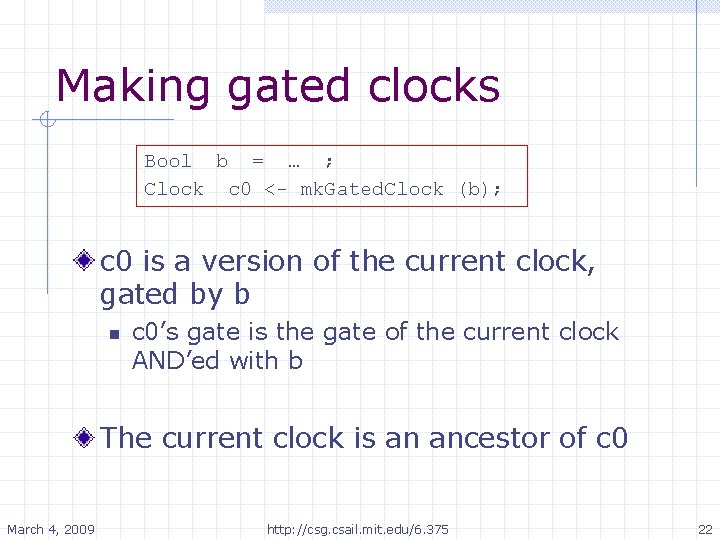
Making gated clocks Bool b = … ; Clock c 0 <- mk. Gated. Clock (b); c 0 is a version of the current clock, gated by b n c 0’s gate is the gate of the current clock AND’ed with b The current clock is an ancestor of c 0 March 4, 2009 http: //csg. csail. mit. edu/6. 375 22
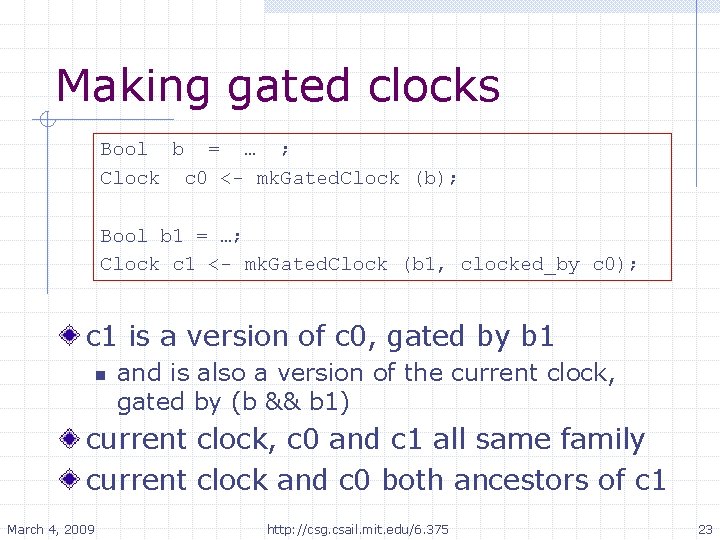
Making gated clocks Bool b = … ; Clock c 0 <- mk. Gated. Clock (b); Bool b 1 = …; Clock c 1 <- mk. Gated. Clock (b 1, clocked_by c 0); c 1 is a version of c 0, gated by b 1 n and is also a version of the current clock, gated by (b && b 1) current clock, c 0 and c 1 all same family current clock and c 0 both ancestors of c 1 March 4, 2009 http: //csg. csail. mit. edu/6. 375 23
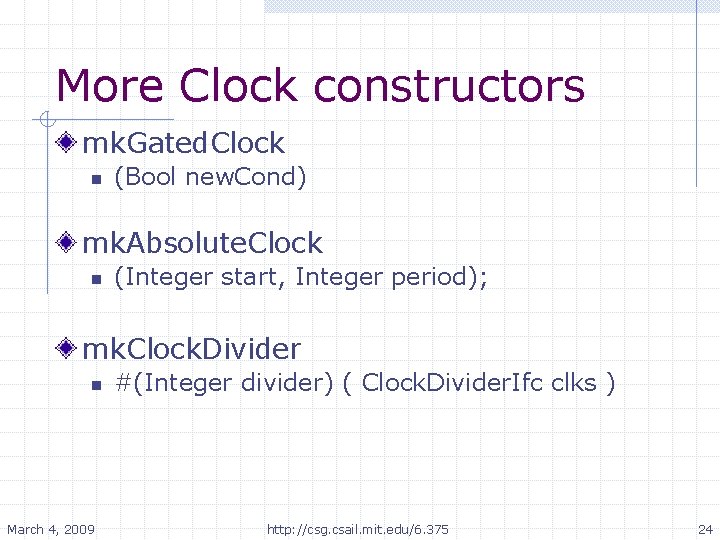
More Clock constructors mk. Gated. Clock n (Bool new. Cond) mk. Absolute. Clock n (Integer start, Integer period); mk. Clock. Divider n March 4, 2009 #(Integer divider) ( Clock. Divider. Ifc clks ) http: //csg. csail. mit. edu/6. 375 24
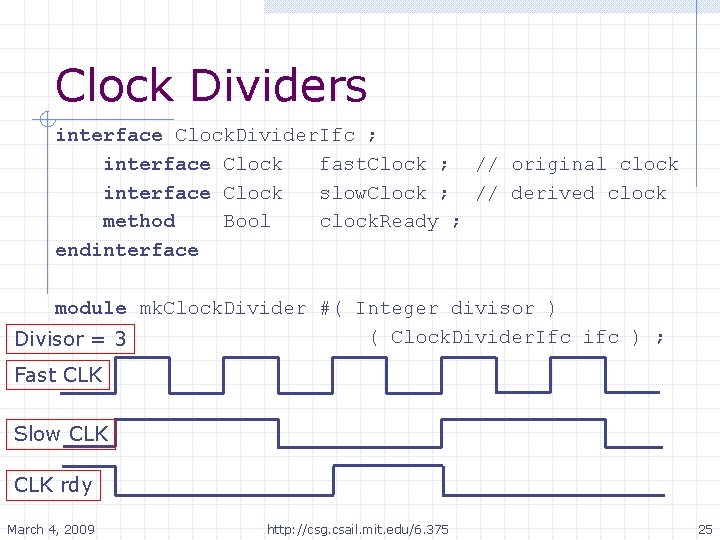
Clock Dividers interface Clock. Divider. Ifc ; interface Clock fast. Clock ; // original clock interface Clock slow. Clock ; // derived clock method Bool clock. Ready ; endinterface module mk. Clock. Divider #( Integer divisor ) ( Clock. Divider. Ifc ifc ) ; Divisor = 3 Fast CLK Slow CLK rdy March 4, 2009 http: //csg. csail. mit. edu/6. 375 25
Clock Dividers No need for special synchronizing logic The clock. Ready signal can become part of the implicit condition when needed March 4, 2009 http: //csg. csail. mit. edu/6. 375 26
Multiple Clock Domains in Bluespec The Clock type, and functions √ Clock families √ Making clocks √ Moving data across clock domains Revisit the 802. 11 a Transmitter March 4, 2009 http: //csg. csail. mit. edu/6. 375 27
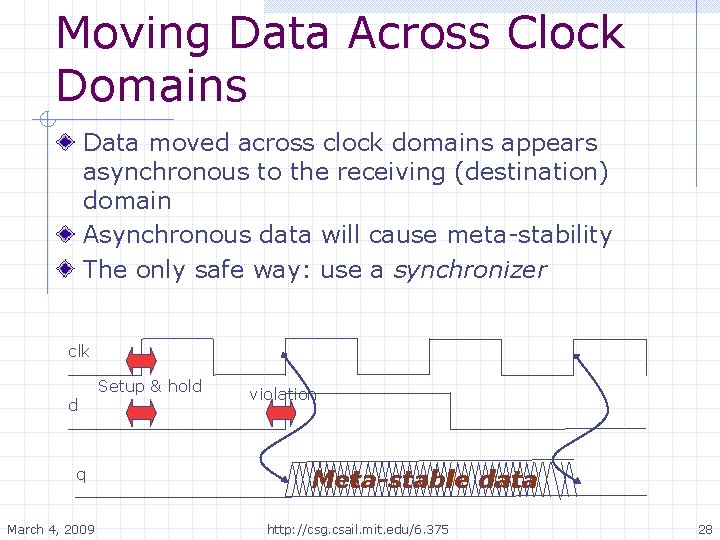
Moving Data Across Clock Domains Data moved across clock domains appears asynchronous to the receiving (destination) domain Asynchronous data will cause meta-stability The only safe way: use a synchronizer clk d q March 4, 2009 Setup & hold violation Meta-stable data http: //csg. csail. mit. edu/6. 375 28
Synchronizers Good synchronizer design and use reduces the probability of observing meta -stable data Bluespec delivers conservative (speed independent) synchronizers User can define and use new synchronizers Bluespec does not allow unsynchronized crossings (compiler static checking error) March 4, 2009 http: //csg. csail. mit. edu/6. 375 29
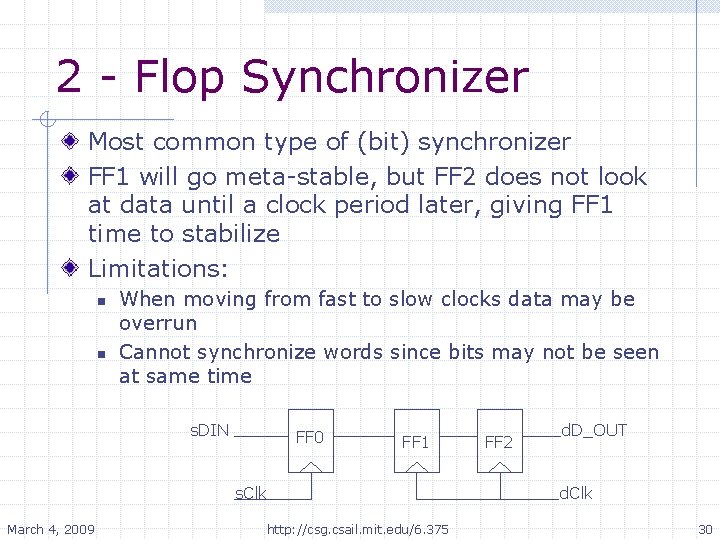
2 - Flop Synchronizer Most common type of (bit) synchronizer FF 1 will go meta-stable, but FF 2 does not look at data until a clock period later, giving FF 1 time to stabilize Limitations: n n When moving from fast to slow clocks data may be overrun Cannot synchronize words since bits may not be seen at same time s. DIN FF 0 FF 1 s. Clk March 4, 2009 http: //csg. csail. mit. edu/6. 375 FF 2 d. D_OUT d. Clk 30
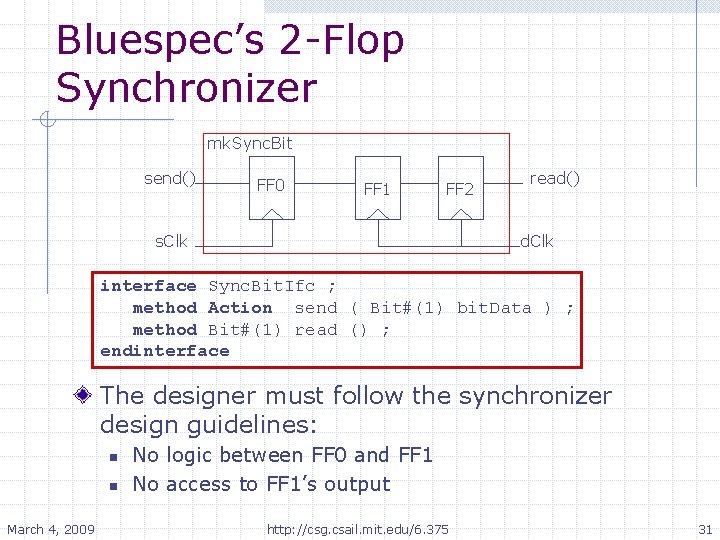
Bluespec’s 2 -Flop Synchronizer mk. Sync. Bit send() FF 0 FF 1 FF 2 s. Clk read() d. Clk interface Sync. Bit. Ifc ; method Action send ( Bit#(1) bit. Data ) ; method Bit#(1) read () ; endinterface The designer must follow the synchronizer design guidelines: n n March 4, 2009 No logic between FF 0 and FF 1 No access to FF 1’s output http: //csg. csail. mit. edu/6. 375 31
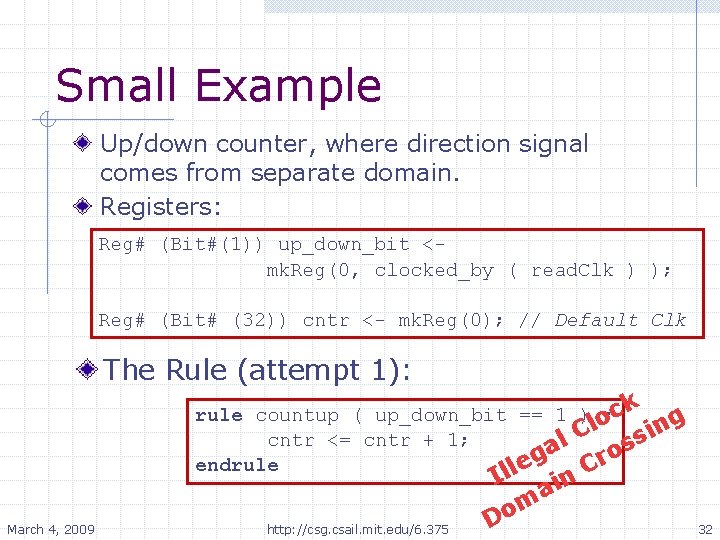
Small Example Up/down counter, where direction signal comes from separate domain. Registers: Reg# (Bit#(1)) up_down_bit <mk. Reg(0, clocked_by ( read. Clk ) ); Reg# (Bit# (32)) cntr <- mk. Reg(0); // Default Clk The Rule (attempt 1): rule countup ( up_down_bit == 1 ) o ; ck g l n i C s cntr <= cntr + 1; l s a g ro endrule e C l l March 4, 2009 http: //csg. csail. mit. edu/6. 375 I ain m o D 32
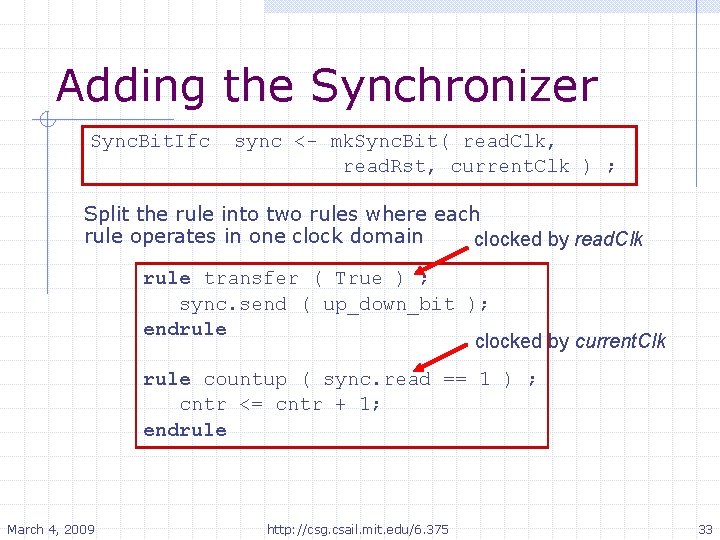
Adding the Synchronizer Sync. Bit. Ifc sync <- mk. Sync. Bit( read. Clk, read. Rst, current. Clk ) ; Split the rule into two rules where each rule operates in one clock domain clocked by read. Clk rule transfer ( True ) ; sync. send ( up_down_bit ); endrule clocked by current. Clk rule countup ( sync. read == 1 ) ; cntr <= cntr + 1; endrule March 4, 2009 http: //csg. csail. mit. edu/6. 375 33
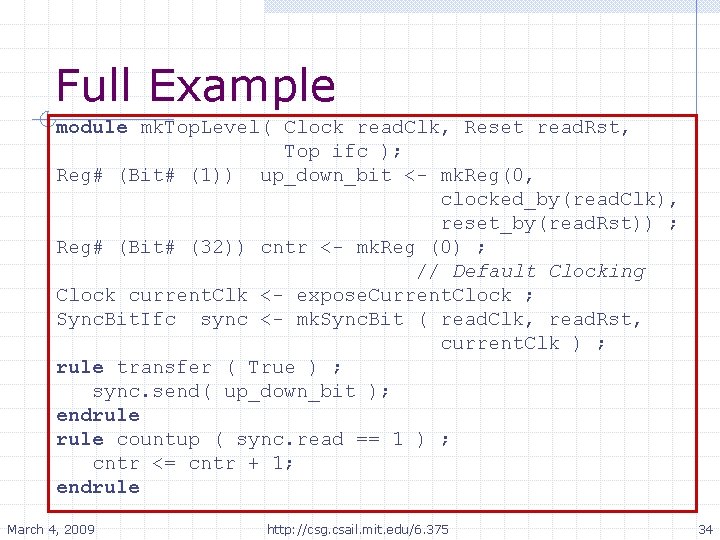
Full Example module mk. Top. Level( Clock read. Clk, Reset read. Rst, Top ifc ); Reg# (Bit# (1)) up_down_bit <- mk. Reg(0, clocked_by(read. Clk), reset_by(read. Rst)) ; Reg# (Bit# (32)) cntr <- mk. Reg (0) ; // Default Clocking Clock current. Clk <- expose. Current. Clock ; Sync. Bit. Ifc sync <- mk. Sync. Bit ( read. Clk, read. Rst, current. Clk ) ; rule transfer ( True ) ; sync. send( up_down_bit ); endrule countup ( sync. read == 1 ) ; cntr <= cntr + 1; endrule March 4, 2009 http: //csg. csail. mit. edu/6. 375 34
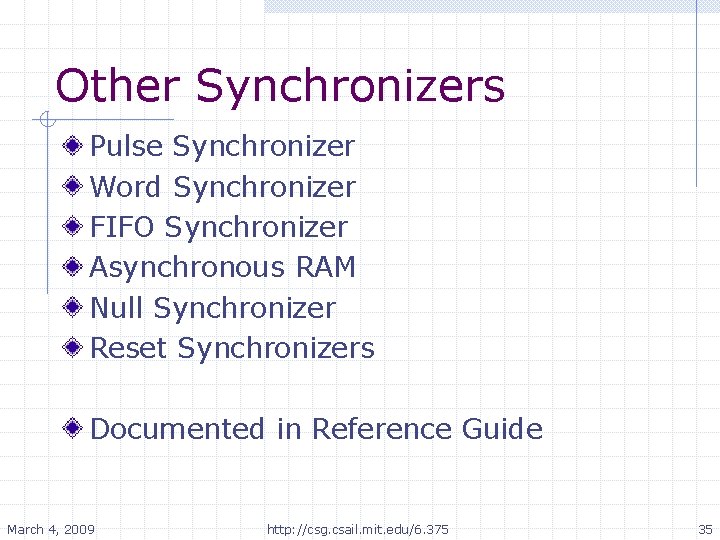
Other Synchronizers Pulse Synchronizer Word Synchronizer FIFO Synchronizer Asynchronous RAM Null Synchronizer Reset Synchronizers Documented in Reference Guide March 4, 2009 http: //csg. csail. mit. edu/6. 375 35
Multiple Clock Domains in Bluespec The Clock type, and functions √ Clock families √ Making clocks √ Moving data across clock domains √ Revisit the 802. 11 a Transmitter March 4, 2009 http: //csg. csail. mit. edu/6. 375 36
802. 11 Transmitter Overview Clock speed headers Controller data Scrambler Encoder f f/13 March 4, 2009 Interleaver Mapper IFFT Cyclic Extend http: //csg. csail. mit. edu/6. 375 f/52 37
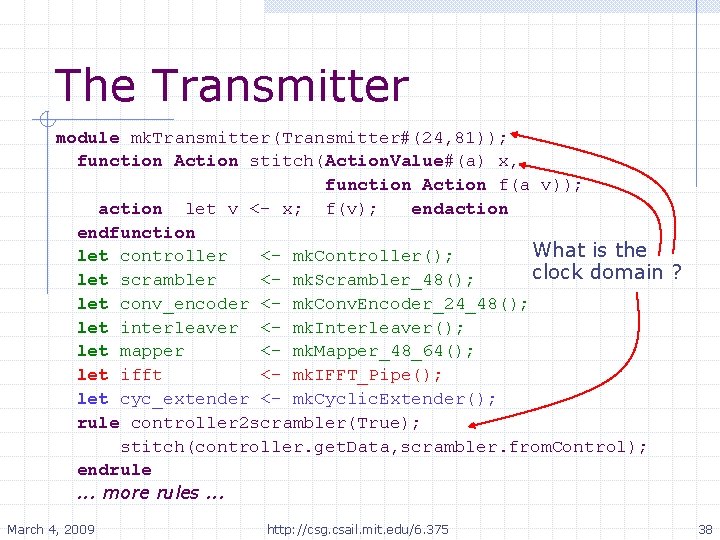
The Transmitter module mk. Transmitter(Transmitter#(24, 81)); function Action stitch(Action. Value#(a) x, function Action f(a v)); action let v <- x; f(v); endaction endfunction What is the let controller <- mk. Controller(); clock domain ? let scrambler <- mk. Scrambler_48(); let conv_encoder <- mk. Conv. Encoder_24_48(); let interleaver <- mk. Interleaver(); let mapper <- mk. Mapper_48_64(); let ifft <- mk. IFFT_Pipe(); let cyc_extender <- mk. Cyclic. Extender(); rule controller 2 scrambler(True); stitch(controller. get. Data, scrambler. from. Control); endrule. . . more rules. . . March 4, 2009 http: //csg. csail. mit. edu/6. 375 38
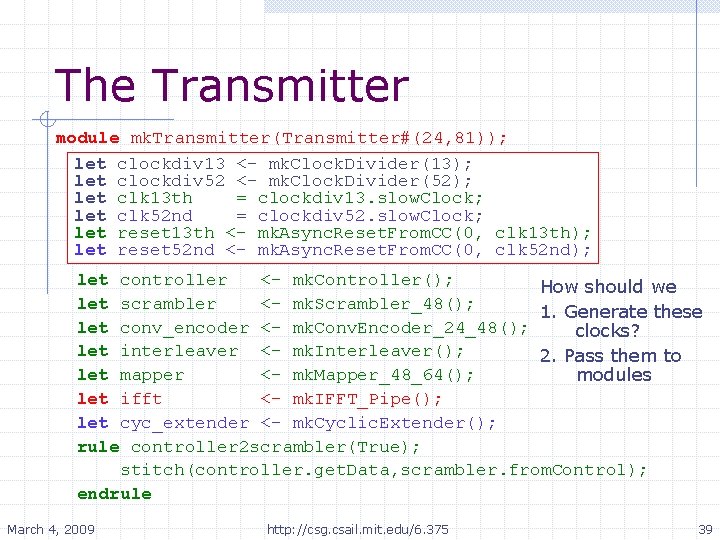
The Transmitter module mk. Transmitter(Transmitter#(24, 81)); let clockdiv 13 <- mk. Clock. Divider(13); let. . . clockdiv 52 <- mk. Clock. Divider(52); let clk 13 th = clockdiv 13. slow. Clock; let clk 52 nd = clockdiv 52. slow. Clock; let reset 13 th <- mk. Async. Reset. From. CC(0, clk 13 th); let reset 52 nd <- mk. Async. Reset. From. CC(0, clk 52 nd); let controller <- mk. Controller(); How should we let scrambler <- mk. Scrambler_48(); 1. Generate these let conv_encoder <- mk. Conv. Encoder_24_48(); clocks? let interleaver <- mk. Interleaver(); 2. Pass them to let mapper <- mk. Mapper_48_64(); modules let ifft <- mk. IFFT_Pipe(); let cyc_extender <- mk. Cyclic. Extender(); rule controller 2 scrambler(True); stitch(controller. get. Data, scrambler. from. Control); endrule March 4, 2009 http: //csg. csail. mit. edu/6. 375 39
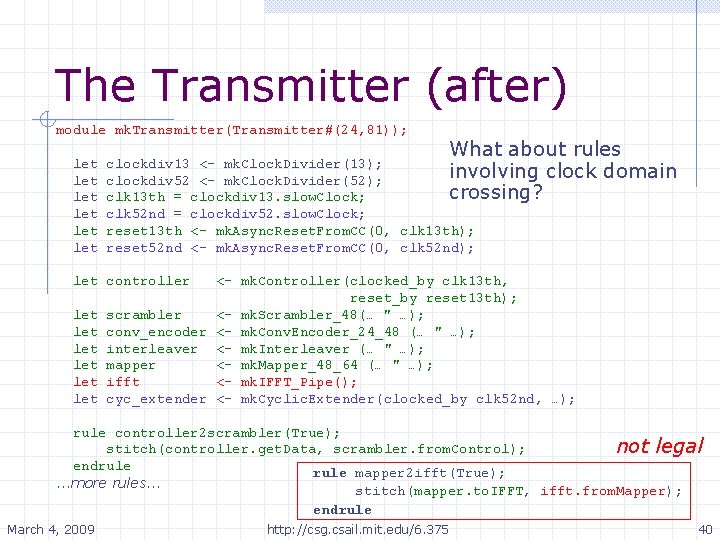
The Transmitter (after) module mk. Transmitter(Transmitter#(24, 81)); let let let What about rules domain clockdiv 13 <- mk. Clock. Divider(13); involving clockdiv 52 <- mk. Clock. Divider(52); crossing? clk 13 th = clockdiv 13. slow. Clock; clk 52 nd = clockdiv 52. slow. Clock; reset 13 th <- mk. Async. Reset. From. CC(0, clk 13 th); reset 52 nd <- mk. Async. Reset. From. CC(0, clk 52 nd); let controller <- mk. Controller(clocked_by clk 13 th, reset_by reset 13 th); let scrambler <- mk. Scrambler_48(… " …); let conv_encoder <- mk. Conv. Encoder_24_48 (… " …); let interleaver <- mk. Interleaver (… " …); let mapper <- mk. Mapper_48_64 (… " …); let ifft <- mk. IFFT_Pipe(); let cyc_extender <- mk. Cyclic. Extender(clocked_by clk 52 nd, …); rule controller 2 scrambler(True); not legal stitch(controller. get. Data, scrambler. from. Control); endrule mapper 2 ifft(True); . . . more rules. . . stitch(mapper. to. IFFT, ifft. from. Mapper); endrule March 4, 2009 http: //csg. csail. mit. edu/6. 375 40
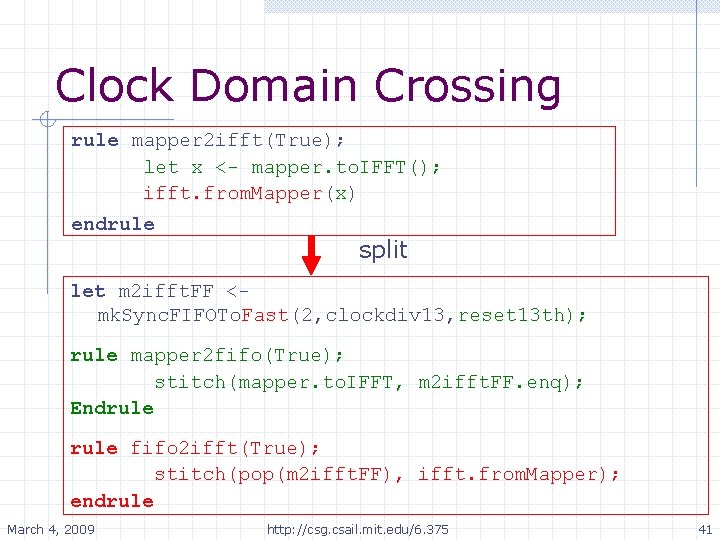
Clock Domain Crossing rule mapper 2 ifft(True); let x <- mapper. to. IFFT(); ifft. from. Mapper(x) endrule split let m 2 ifft. FF <mk. Sync. FIFOTo. Fast(2, clockdiv 13, reset 13 th); rule mapper 2 fifo(True); stitch(mapper. to. IFFT, m 2 ifft. FF. enq); Endrule fifo 2 ifft(True); stitch(pop(m 2 ifft. FF), ifft. from. Mapper); endrule March 4, 2009 http: //csg. csail. mit. edu/6. 375 41
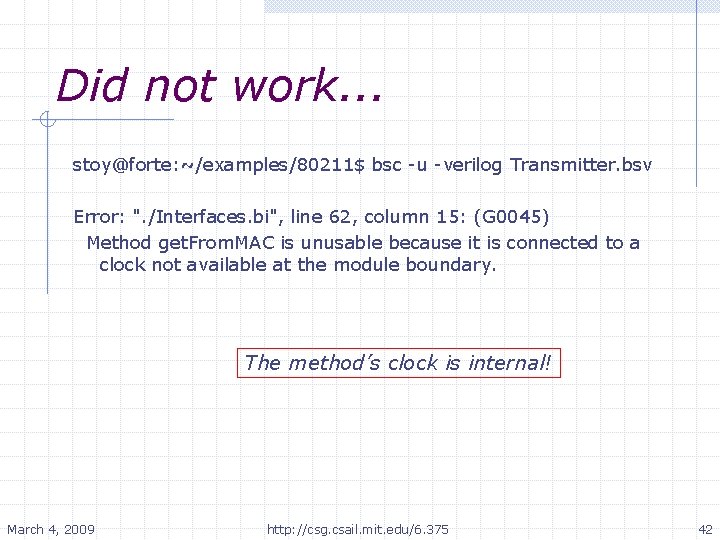
Did not work. . . stoy@forte: ~/examples/80211$ bsc -u -verilog Transmitter. bsv Error: ". /Interfaces. bi", line 62, column 15: (G 0045) Method get. From. MAC is unusable because it is connected to a clock not available at the module boundary. The method’s clock is internal! March 4, 2009 http: //csg. csail. mit. edu/6. 375 42
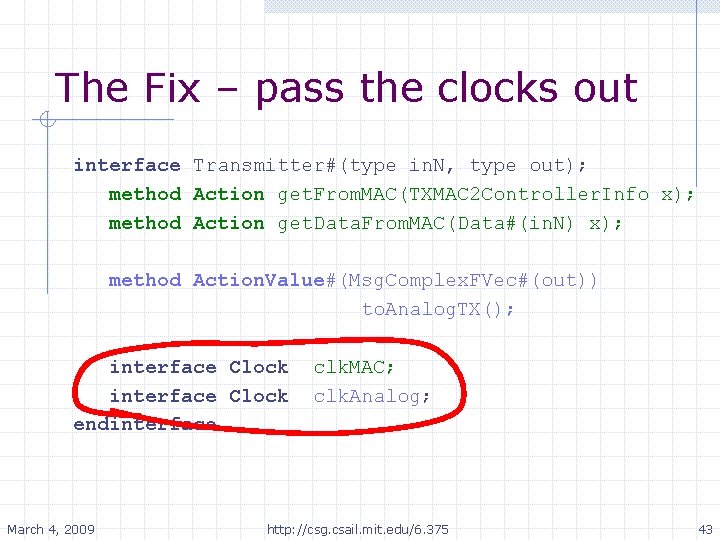
The Fix – pass the clocks out interface Transmitter#(type in. N, type out); method Action get. From. MAC(TXMAC 2 Controller. Info x); method Action get. Data. From. MAC(Data#(in. N) x); method Action. Value#(Msg. Complex. FVec#(out)) to. Analog. TX(); interface Clock endinterface March 4, 2009 clk. MAC; clk. Analog; http: //csg. csail. mit. edu/6. 375 43
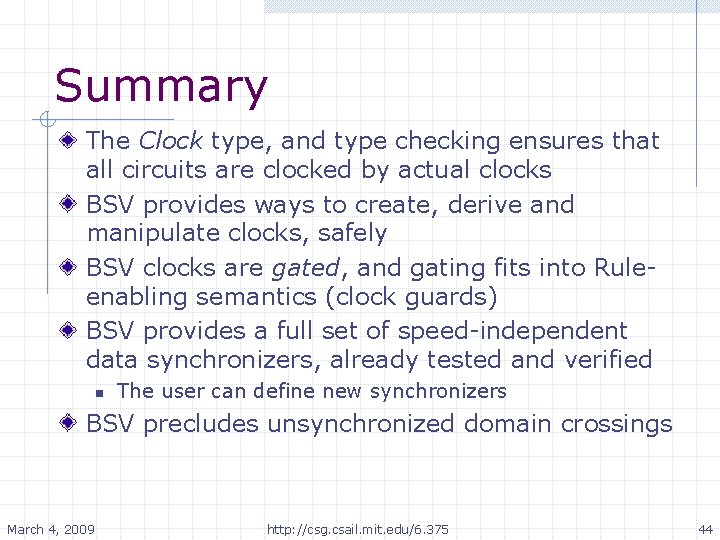
Summary The Clock type, and type checking ensures that all circuits are clocked by actual clocks BSV provides ways to create, derive and manipulate clocks, safely BSV clocks are gated, and gating fits into Ruleenabling semantics (clock guards) BSV provides a full set of speed-independent data synchronizers, already tested and verified n The user can define new synchronizers BSV precludes unsynchronized domain crossings March 4, 2009 http: //csg. csail. mit. edu/6. 375 44