
Multiple choice Short answer Essay The Descriptive Research

- Slides: 52
Multiple choice, Short answer, Essay
The Descriptive Research Strategy Chapter 13
Descriptive research • Typically involves measuring a variable or set of variables as they exist naturally. • The descriptive strategy is not concerned with relationships between variables but rather with the description of individual variables.
Examples?
Three descriptive research designs • the observational research design, • the survey research design, and • the case study research design.
Types of observation sampling? • Time interval, event sampling, and individual sampling
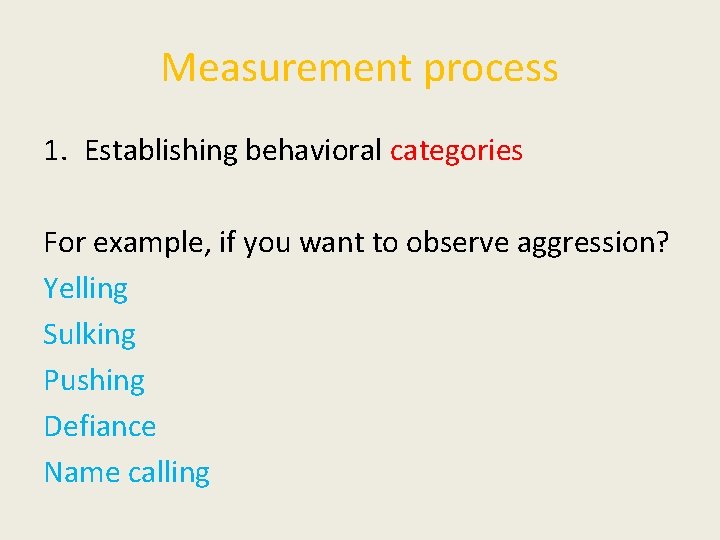
Measurement process 1. Establishing behavioral categories For example, if you want to observe aggression? Yelling Sulking Pushing Defiance Name calling
Measurement process 2. Obtain a numerical score for each behavioral category using. the frequency method(how many per hour/day/month) the duration method (how long) the interval method - how soon it happens again hour/day/month)
What is the observer problem and what are the solutions?
Types of observation • In naturalistic observation, or nonparticipant observation, a researcher observes behavior in a natural setting as unobtrusively as possible. (one-way mirrors/video recording) • In participant observation, the researcher engages in the same activities as the people being observed in order to observe and record their behavior. (high school confidential) • Contrived observation, or structured observation, Observation of behavior in settings arranged specifically to facilitate the occurrence of specific behaviors. (Bully)
The survey research design • A research study that uses a survey to obtain a description of a particular group of individuals is called a survey research design.
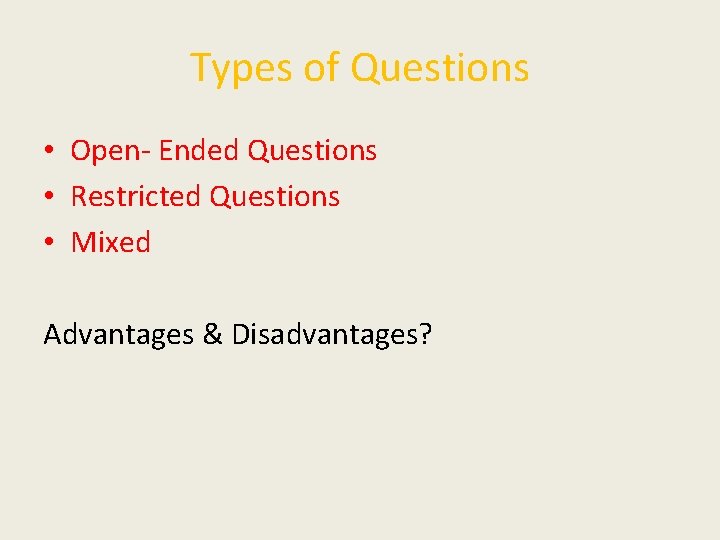
Types of Questions • Open- Ended Questions • Restricted Questions • Mixed Advantages & Disadvantages?
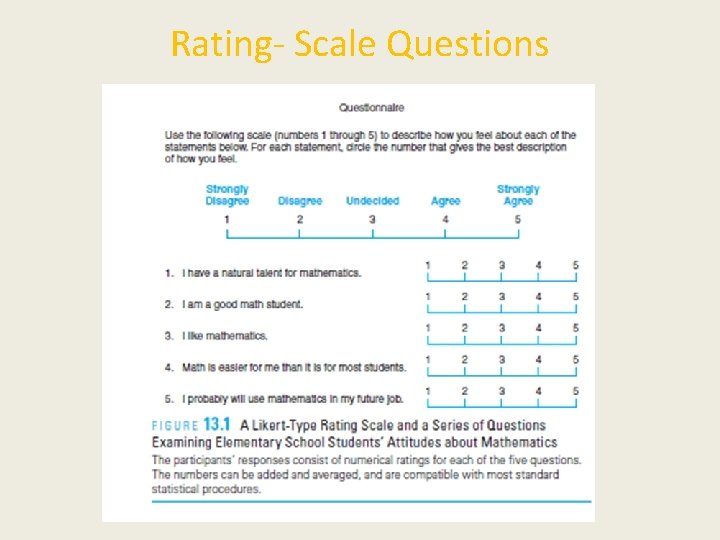
Rating- Scale Questions
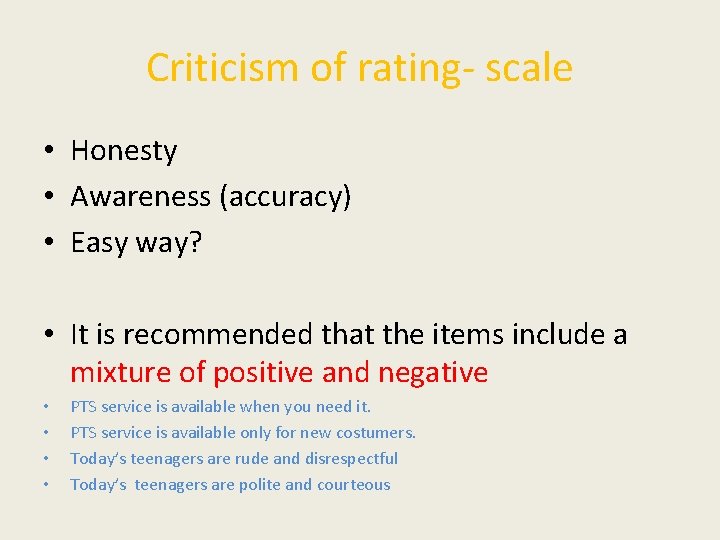
Criticism of rating- scale • Honesty • Awareness (accuracy) • Easy way? • It is recommended that the items include a mixture of positive and negative • • PTS service is available when you need it. PTS service is available only for new costumers. Today’s teenagers are rude and disrespectful Today’s teenagers are polite and courteous
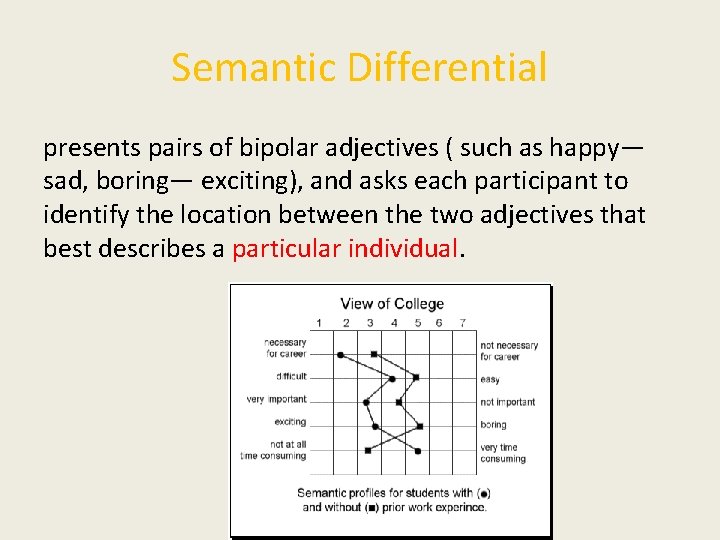
Semantic Differential presents pairs of bipolar adjectives ( such as happy— sad, boring— exciting), and asks each participant to identify the location between the two adjectives that best describes a particular individual.
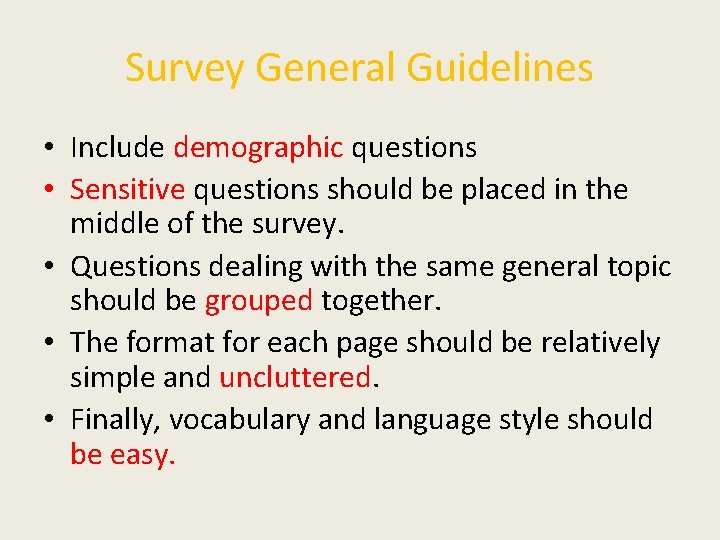
Survey General Guidelines • Include demographic questions • Sensitive questions should be placed in the middle of the survey. • Questions dealing with the same general topic should be grouped together. • The format for each page should be relatively simple and uncluttered. • Finally, vocabulary and language style should be easy.
Sampling? • (online courses)
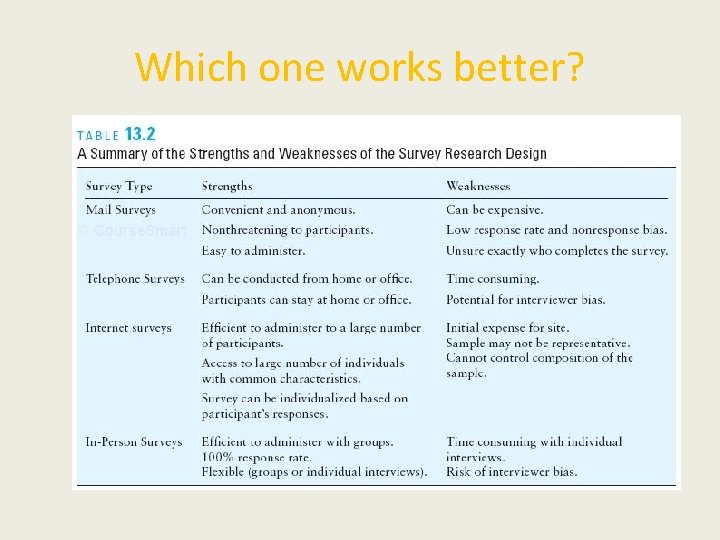
Which one works better?
Qualities of good items
Qualities of good items • Do you spend a lot of time preparing for your classes? • Are most of your students from California?
Qualities of good items • Do you agree with experts that…? • Do you agree with most people that…?
Single- Subject Research Designs Chapter 14 27
Single- subject designs, or single- case designs, are research designs that use the results from a single participant or subject to establish the existence of cause- and- effect relationships. 28
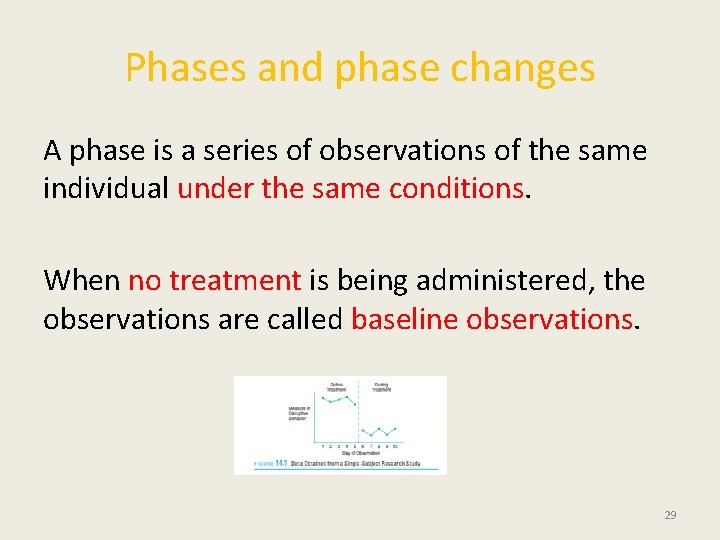
Phases and phase changes A phase is a series of observations of the same individual under the same conditions. When no treatment is being administered, the observations are called baseline observations. 29
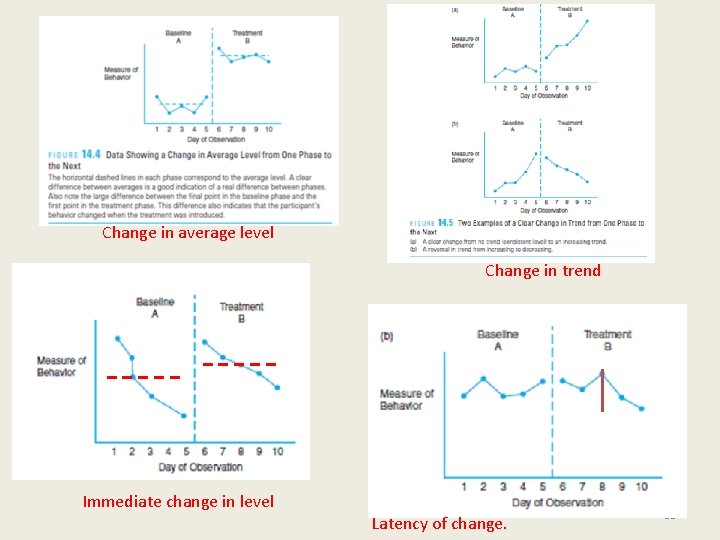
Visual Inspection Techniques • Unfortunately, there are no absolute, objective standards for determining how much of a change in pattern is sufficient to provide a convincing demonstration of a treatment effect. • The most convincing results occur when the change in pattern is immediate and large. 30
4 types of change • • Change in average level Immediate change in level Change in trend Latency of change. 31
1 - Change in average level 32
Change in average level Change in trend Immediate change in level Latency of change. 33
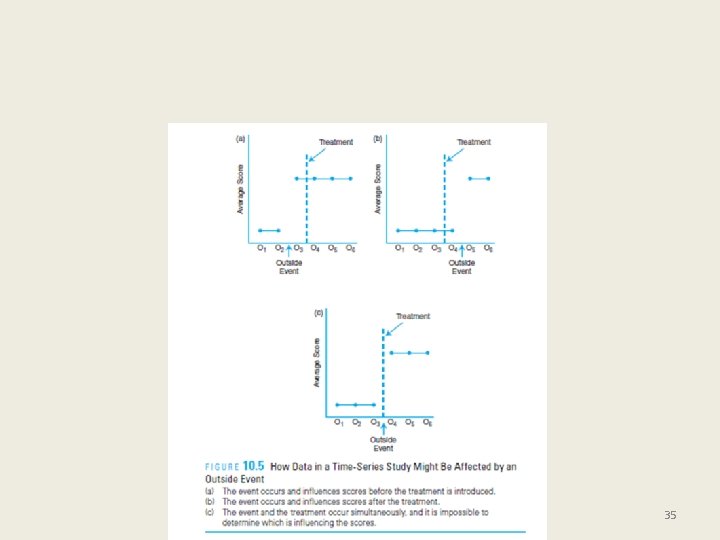
The problem with single subject design 34
35
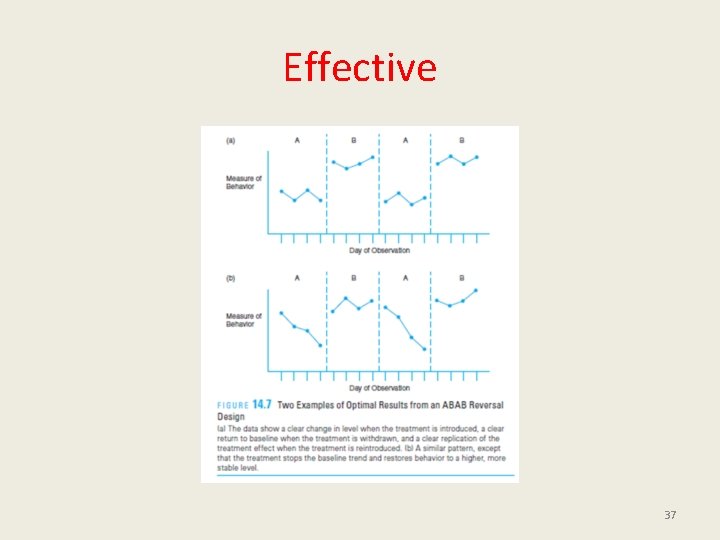
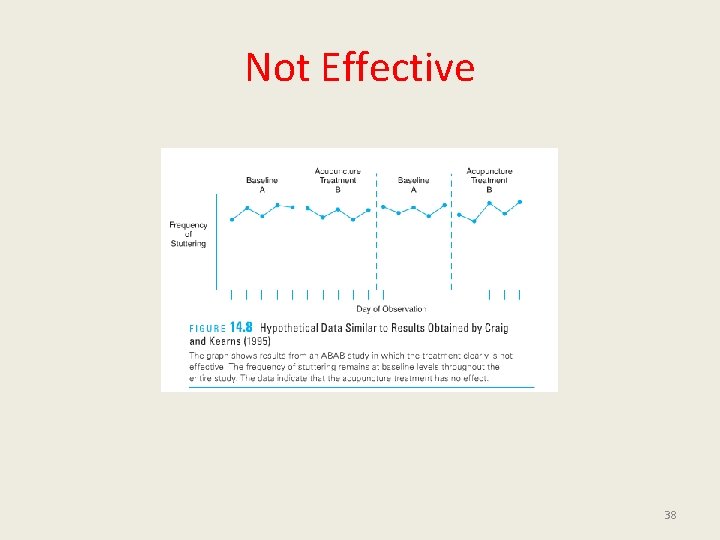
THE ABAB REVERSAL DESIGN • the majority of single- subject research studies use ABAB design; • consists of four phases: a baseline phase ( A), followed by treatment ( B), then a return to baseline ( A), and finally a repetition of the treatment phase ( B). 36
Effective 37
Not Effective 38
Variations on the ABAB Design 39
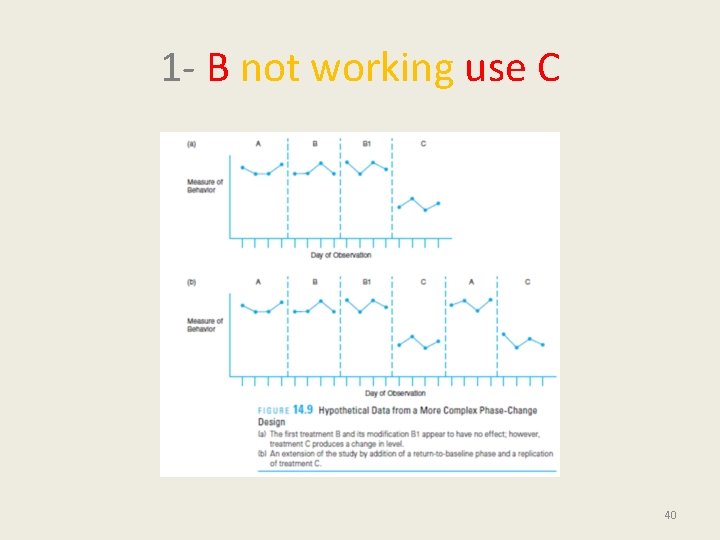
1 - B not working use C 40
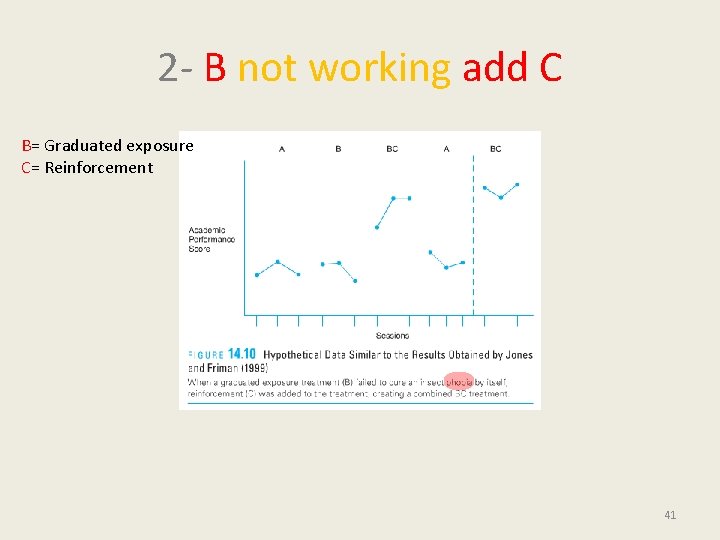
2 - B not working add C B= Graduated exposure C= Reinforcement 41
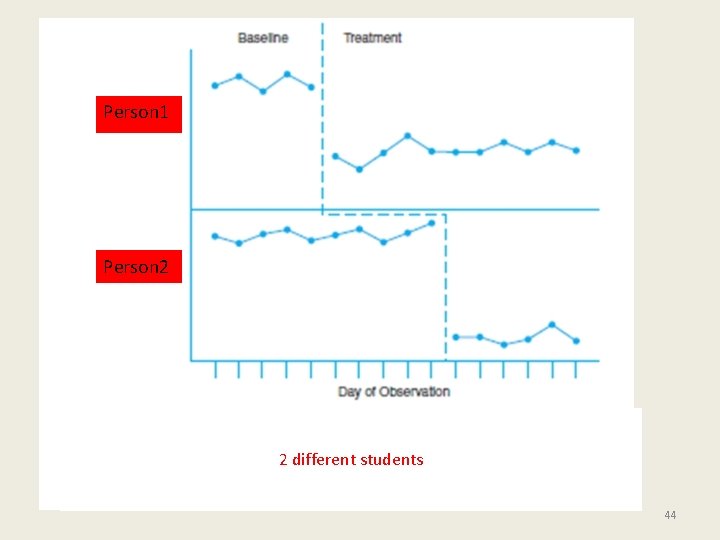
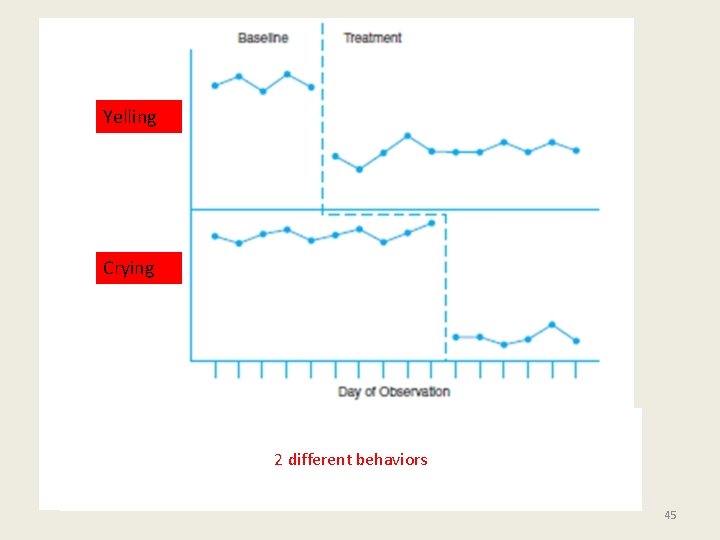
3 - MULTIPLE- BASELINE DESIGNS 1 - Eliminates the need for a return to baseline and therefore, 2 - Is particularly well suited for evaluating treatments with long- lasting or permanent effects. 42
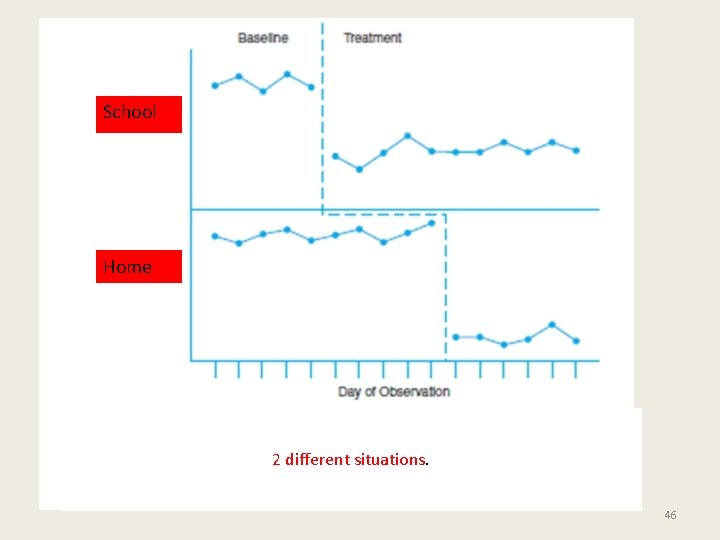
3 - MULTIPLE- BASELINE DESIGNS Examples A therapist uses the same method for 2 different behaviors (across behaviors) For one behavior that is exhibited in 2 different situations. (across situations) A teacher uses the same method on 2 different students (across subjects) 43
Person 1 Person 2 2 different students 44
Yelling Crying 2 different behaviors 45
School Home 2 different situations. 46
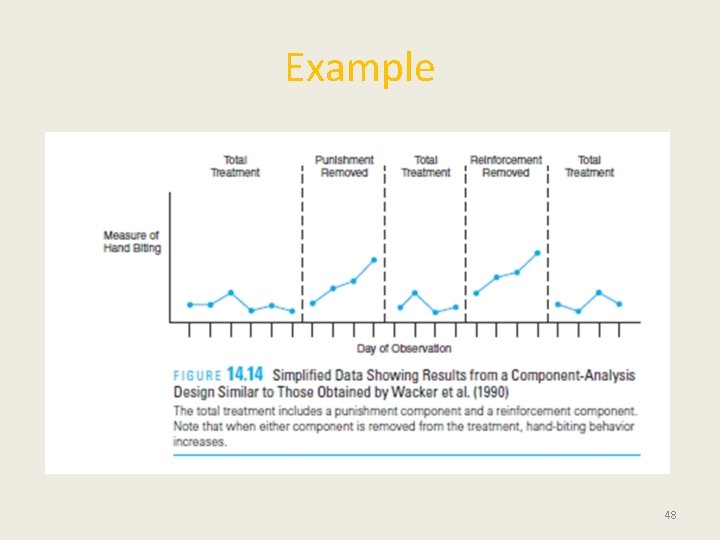
4 - Dismantling design A dismantling design, also called a componentanalysis design, consists of a series of phases in which each phase adds or subtracts one component of a complex treatment to determine how each component contributes to the overall treatment effectiveness. 47
Example 48
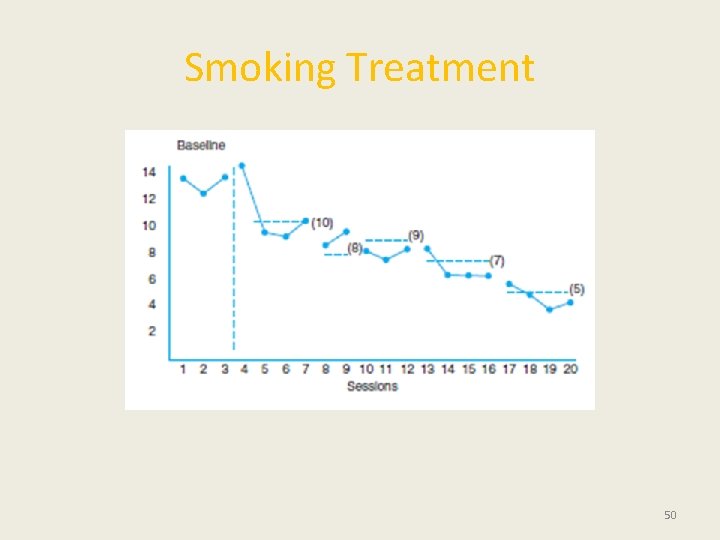
5 - The Changing- Criterion Design • The criterion level is changed from one phase to the next. 49
Smoking Treatment 50
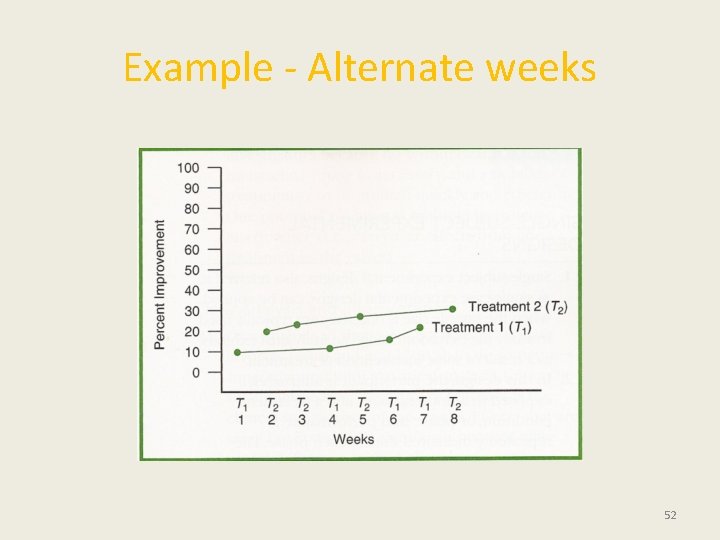
6 -The Alternating- Treatments Design • In an alternating- treatments design, also called a discrete-trials design, two ( or more) treatment conditions are randomly alternated from one observation to the next. 51
Example - Alternate weeks 52