
Multiple choice questions Introduction to the Middle Ages
- Slides: 11
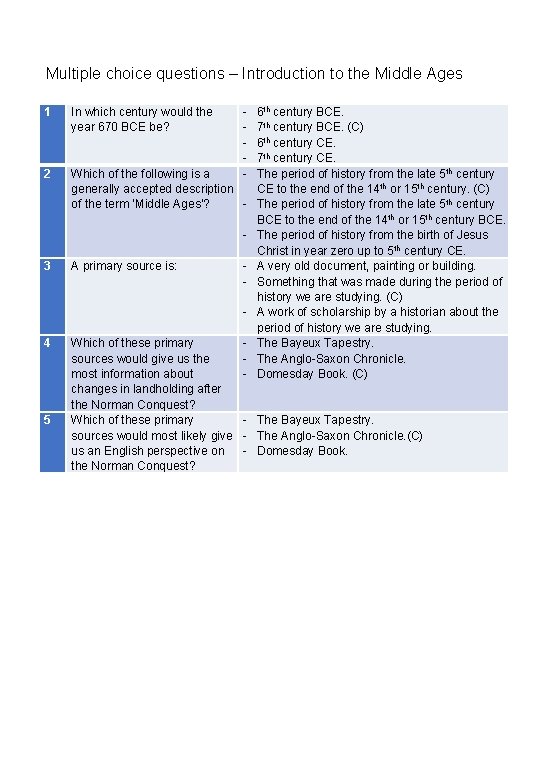
Multiple choice questions – Introduction to the Middle Ages - 1 In which century would the year 670 BCE be? 2 Which of the following is a generally accepted description of the term ‘Middle Ages’? - 3 A primary source is: - 4 5 Which of these primary sources would give us the most information about changes in landholding after the Norman Conquest? Which of these primary sources would most likely give us an English perspective on the Norman Conquest? - 6 th century BCE. 7 th century BCE. (C) 6 th century CE. 7 th century CE. The period of history from the late 5 th century CE to the end of the 14 th or 15 th century. (C) The period of history from the late 5 th century BCE to the end of the 14 th or 15 th century BCE. The period of history from the birth of Jesus Christ in year zero up to 5 th century CE. A very old document, painting or building. Something that was made during the period of history we are studying. (C) A work of scholarship by a historian about the period of history we are studying. The Bayeux Tapestry. The Anglo-Saxon Chronicle. Domesday Book. (C) - The Bayeux Tapestry. - The Anglo-Saxon Chronicle. (C) - Domesday Book.
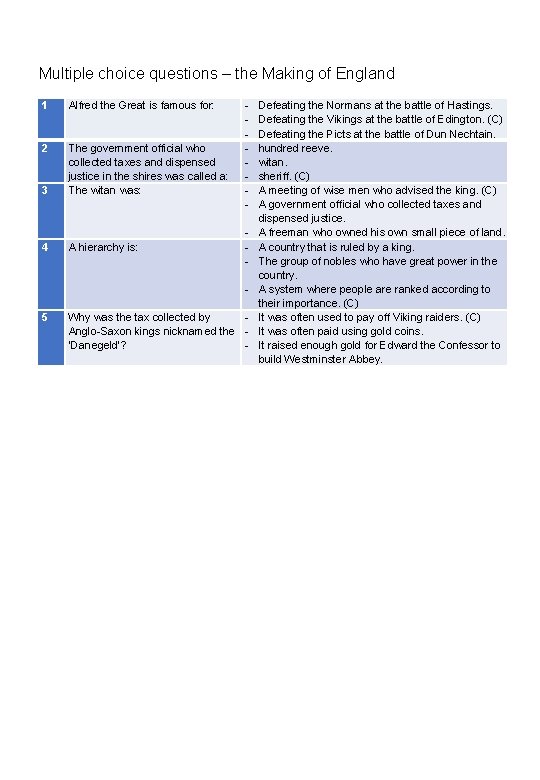
Multiple choice questions – the Making of England 1 Alfred the Great is famous for: 2 3 The government official who collected taxes and dispensed justice in the shires was called a: The witan was: 4 A hierarchy is: - 5 Why was the tax collected by Anglo-Saxon kings nicknamed the ‘Danegeld’? - Defeating the Normans at the battle of Hastings. Defeating the Vikings at the battle of Edington. (C) Defeating the Picts at the battle of Dun Nechtain. hundred reeve. witan. sheriff. (C) A meeting of wise men who advised the king. (C) A government official who collected taxes and dispensed justice. A freeman who owned his own small piece of land. A country that is ruled by a king. The group of nobles who have great power in the country. A system where people are ranked according to their importance. (C) It was often used to pay off Viking raiders. (C) It was often paid using gold coins. It raised enough gold for Edward the Confessor to build Westminster Abbey.
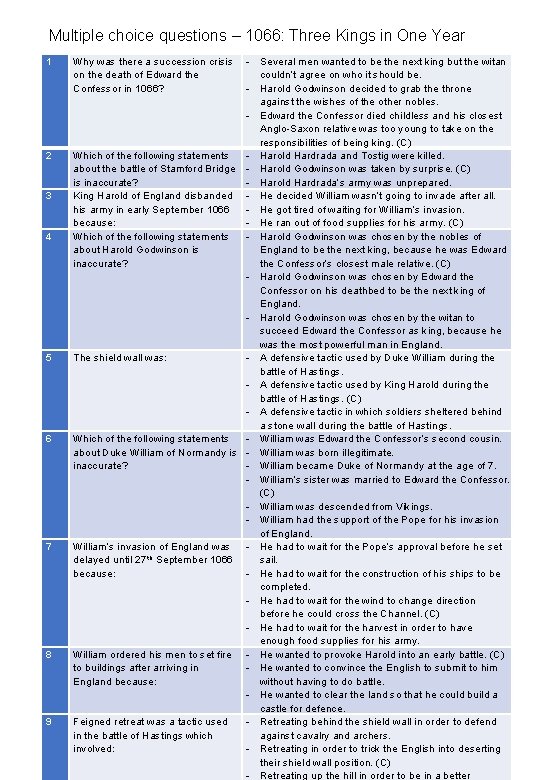
Multiple choice questions – 1066: Three Kings in One Year 1 2 3 4 5 6 7 8 9 - Several men wanted to be the next king but the witan couldn’t agree on who it should be. - Harold Godwinson decided to grab the throne against the wishes of the other nobles. - Edward the Confessor died childless and his closest Anglo-Saxon relative was too young to take on the responsibilities of being king. (C) Which of the following statements - Harold Hardrada and Tostig were killed. about the battle of Stamford Bridge - Harold Godwinson was taken by surprise. (C) is inaccurate? - Harold Hardrada’s army was unprepared. King Harold of England disbanded - He decided William wasn’t going to invade after all. his army in early September 1066 - He got tired of waiting for William’s invasion. because: - He ran out of food supplies for his army. (C) Which of the following statements - Harold Godwinson was chosen by the nobles of about Harold Godwinson is England to be the next king, because he was Edward inaccurate? the Confessor’s closest male relative. (C) - Harold Godwinson was chosen by Edward the Confessor on his deathbed to be the next king of England. - Harold Godwinson was chosen by the witan to succeed Edward the Confessor as king, because he was the most powerful man in England. The shield wall was: - A defensive tactic used by Duke William during the battle of Hastings. - A defensive tactic used by King Harold during the battle of Hastings. (C) - A defensive tactic in which soldiers sheltered behind a stone wall during the battle of Hastings. Which of the following statements - William was Edward the Confessor’s second cousin. about Duke William of Normandy is - William was born illegitimate. inaccurate? - William became Duke of Normandy at the age of 7. - William’s sister was married to Edward the Confessor. (C) - William was descended from Vikings. - William had the support of the Pope for his invasion of England. William’s invasion of England was - He had to wait for the Pope’s approval before he set delayed until 27 th September 1066 sail. because: - He had to wait for the construction of his ships to be completed. - He had to wait for the wind to change direction before he could cross the Channel. (C) - He had to wait for the harvest in order to have enough food supplies for his army. William ordered his men to set fire - He wanted to provoke Harold into an early battle. (C) to buildings after arriving in - He wanted to convince the English to submit to him England because: without having to do battle. - He wanted to clear the land so that he could build a castle for defence. Feigned retreat was a tactic used - Retreating behind the shield wall in order to defend in the battle of Hastings which against cavalry and archers. involved: - Retreating in order to trick the English into deserting their shield wall position. (C) - Retreating up the hill in order to be in a better Why was there a succession crisis on the death of Edward the Confessor in 1066?
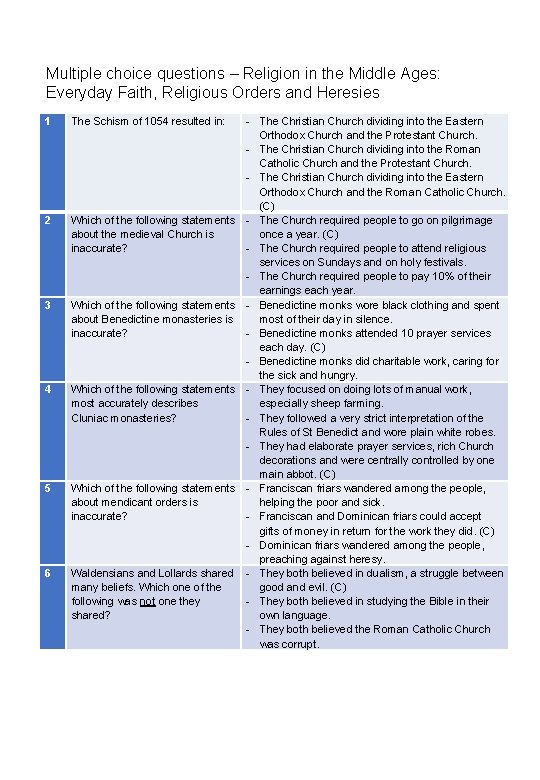
Multiple choice questions – Religion in the Middle Ages: Everyday Faith, Religious Orders and Heresies 1 The Schism of 1054 resulted in: 2 Which of the following statements about the medieval Church is inaccurate? 3 Which of the following statements about Benedictine monasteries is inaccurate? 4 Which of the following statements most accurately describes Cluniac monasteries? 5 Which of the following statements about mendicant orders is inaccurate? 6 Waldensians and Lollards shared many beliefs. Which one of the following was not one they shared? - The Christian Church dividing into the Eastern Orthodox Church and the Protestant Church. - The Christian Church dividing into the Roman Catholic Church and the Protestant Church. - The Christian Church dividing into the Eastern Orthodox Church and the Roman Catholic Church. (C) - The Church required people to go on pilgrimage once a year. (C) - The Church required people to attend religious services on Sundays and on holy festivals. - The Church required people to pay 10% of their earnings each year. - Benedictine monks wore black clothing and spent most of their day in silence. - Benedictine monks attended 10 prayer services each day. (C) - Benedictine monks did charitable work, caring for the sick and hungry. - They focused on doing lots of manual work, especially sheep farming. - They followed a very strict interpretation of the Rules of St Benedict and wore plain white robes. - They had elaborate prayer services, rich Church decorations and were centrally controlled by one main abbot. (C) - Franciscan friars wandered among the people, helping the poor and sick. - Franciscan and Dominican friars could accept gifts of money in return for the work they did. (C) - Dominican friars wandered among the people, preaching against heresy. - They both believed in dualism, a struggle between good and evil. (C) - They both believed in studying the Bible in their own language. - They both believed the Roman Catholic Church was corrupt.
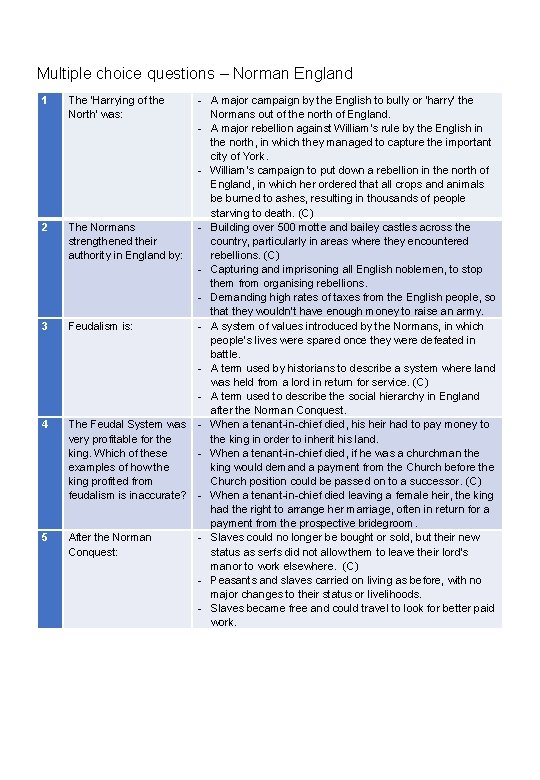
Multiple choice questions – Norman England 1 2 3 4 5 - A major campaign by the English to bully or ‘harry’ the Normans out of the north of England. - A major rebellion against William’s rule by the English in the north, in which they managed to capture the important city of York. - William’s campaign to put down a rebellion in the north of England, in which her ordered that all crops and animals be burned to ashes, resulting in thousands of people starving to death. (C) The Normans - Building over 500 motte and bailey castles across the strengthened their country, particularly in areas where they encountered authority in England by: rebellions. (C) - Capturing and imprisoning all English noblemen, to stop them from organising rebellions. - Demanding high rates of taxes from the English people, so that they wouldn’t have enough money to raise an army. Feudalism is: - A system of values introduced by the Normans, in which people’s lives were spared once they were defeated in battle. - A term used by historians to describe a system where land was held from a lord in return for service. (C) - A term used to describe the social hierarchy in England after the Norman Conquest. The Feudal System was - When a tenant-in-chief died, his heir had to pay money to very profitable for the king in order to inherit his land. king. Which of these - When a tenant-in-chief died, if he was a churchman the examples of how the king would demand a payment from the Church before the king profited from Church position could be passed on to a successor. (C) feudalism is inaccurate? - When a tenant-in-chief died leaving a female heir, the king had the right to arrange her marriage, often in return for a payment from the prospective bridegroom. After the Norman - Slaves could no longer be bought or sold, but their new Conquest: status as serfs did not allow them to leave their lord’s manor to work elsewhere. (C) - Peasants and slaves carried on living as before, with no major changes to their status or livelihoods. - Slaves became free and could travel to look for better paid work. The ‘Harrying of the North’ was:
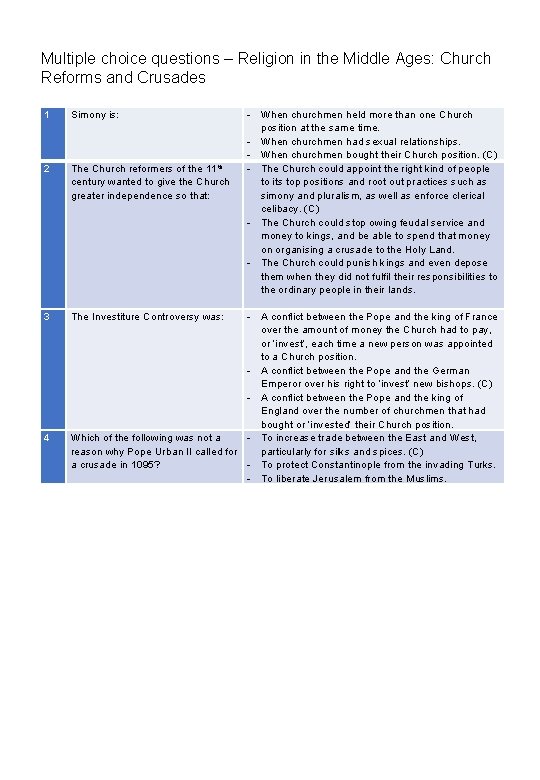
Multiple choice questions – Religion in the Middle Ages: Church Reforms and Crusades 1 Simony is: 2 The Church reformers of the 11 th century wanted to give the Church greater independence so that: 3 The Investiture Controversy was: 4 - When churchmen held more than one Church position at the same time. - When churchmen had sexual relationships. - When churchmen bought their Church position. (C) - The Church could appoint the right kind of people to its top positions and root out practices such as simony and pluralism, as well as enforce clerical celibacy. (C) - The Church could stop owing feudal service and money to kings, and be able to spend that money on organising a crusade to the Holy Land. - The Church could punish kings and even depose them when they did not fulfil their responsibilities to the ordinary people in their lands. - A conflict between the Pope and the king of France over the amount of money the Church had to pay, or ‘invest’, each time a new person was appointed to a Church position. - A conflict between the Pope and the German Emperor over his right to ‘invest’ new bishops. (C) - A conflict between the Pope and the king of England over the number of churchmen that had bought or ‘invested’ their Church position. Which of the following was not a - To increase trade between the East and West, reason why Pope Urban II called for particularly for silks and spices. (C) a crusade in 1095? - To protect Constantinople from the invading Turks. - To liberate Jerusalem from the Muslims.
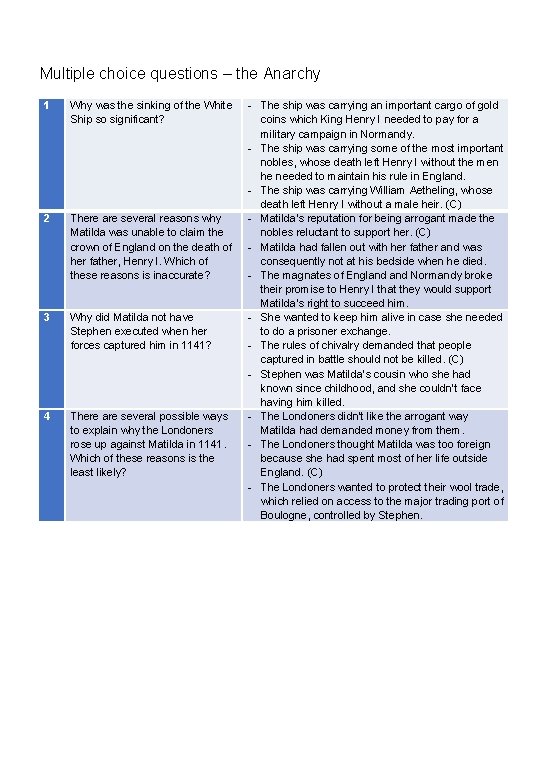
Multiple choice questions – the Anarchy 1 Why was the sinking of the White Ship so significant? 2 There are several reasons why Matilda was unable to claim the crown of England on the death of her father, Henry I. Which of these reasons is inaccurate? 3 Why did Matilda not have Stephen executed when her forces captured him in 1141? 4 There are several possible ways to explain why the Londoners rose up against Matilda in 1141. Which of these reasons is the least likely? - The ship was carrying an important cargo of gold coins which King Henry I needed to pay for a military campaign in Normandy. - The ship was carrying some of the most important nobles, whose death left Henry I without the men he needed to maintain his rule in England. - The ship was carrying William Aetheling, whose death left Henry I without a male heir. (C) - Matilda’s reputation for being arrogant made the nobles reluctant to support her. (C) - Matilda had fallen out with her father and was consequently not at his bedside when he died. - The magnates of England Normandy broke their promise to Henry I that they would support Matilda’s right to succeed him. - She wanted to keep him alive in case she needed to do a prisoner exchange. - The rules of chivalry demanded that people captured in battle should not be killed. (C) - Stephen was Matilda’s cousin who she had known since childhood, and she couldn’t face having him killed. - The Londoners didn’t like the arrogant way Matilda had demanded money from them. - The Londoners thought Matilda was too foreign because she had spent most of her life outside England. (C) - The Londoners wanted to protect their wool trade, which relied on access to the major trading port of Boulogne, controlled by Stephen.
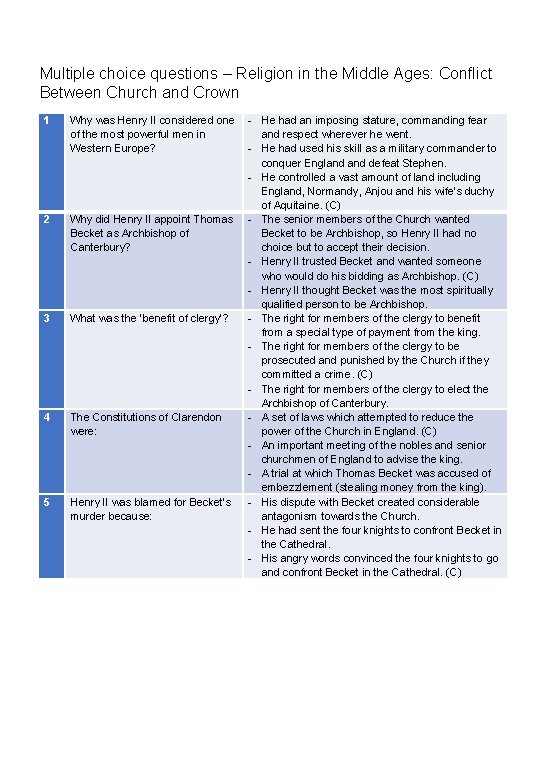
Multiple choice questions – Religion in the Middle Ages: Conflict Between Church and Crown 1 Why was Henry II considered one of the most powerful men in Western Europe? 2 Why did Henry II appoint Thomas Becket as Archbishop of Canterbury? 3 What was the ‘benefit of clergy’? 4 The Constitutions of Clarendon were: 5 Henry II was blamed for Becket’s murder because: - He had an imposing stature, commanding fear and respect wherever he went. - He had used his skill as a military commander to conquer England defeat Stephen. - He controlled a vast amount of land including England, Normandy, Anjou and his wife’s duchy of Aquitaine. (C) - The senior members of the Church wanted Becket to be Archbishop, so Henry II had no choice but to accept their decision. - Henry II trusted Becket and wanted someone who would do his bidding as Archbishop. (C) - Henry II thought Becket was the most spiritually qualified person to be Archbishop. - The right for members of the clergy to benefit from a special type of payment from the king. - The right for members of the clergy to be prosecuted and punished by the Church if they committed a crime. (C) - The right for members of the clergy to elect the Archbishop of Canterbury. - A set of laws which attempted to reduce the power of the Church in England. (C) - An important meeting of the nobles and senior churchmen of England to advise the king. - A trial at which Thomas Becket was accused of embezzlement (stealing money from the king). - His dispute with Becket created considerable antagonism towards the Church. - He had sent the four knights to confront Becket in the Cathedral. - His angry words convinced the four knights to go and confront Becket in the Cathedral. (C)
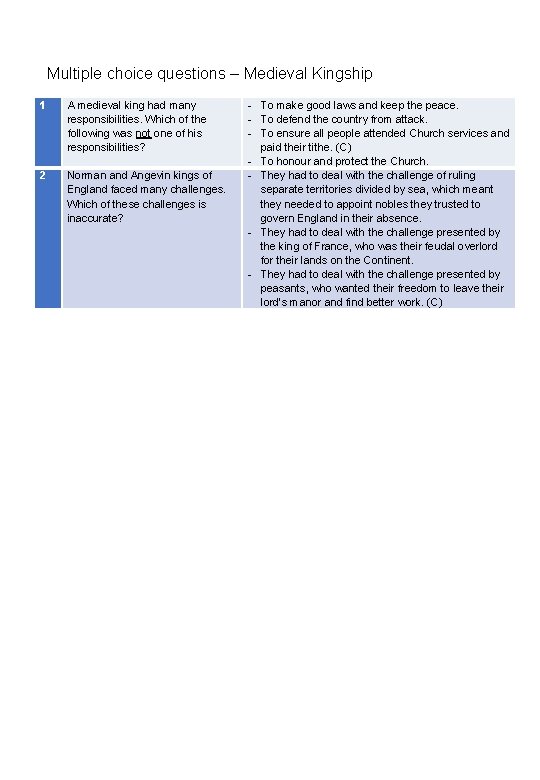
Multiple choice questions – Medieval Kingship 1 A medieval king had many responsibilities. Which of the following was not one of his responsibilities? 2 Norman and Angevin kings of England faced many challenges. Which of these challenges is inaccurate? - To make good laws and keep the peace. - To defend the country from attack. - To ensure all people attended Church services and paid their tithe. (C) - To honour and protect the Church. - They had to deal with the challenge of ruling separate territories divided by sea, which meant they needed to appoint nobles they trusted to govern England in their absence. - They had to deal with the challenge presented by the king of France, who was their feudal overlord for their lands on the Continent. - They had to deal with the challenge presented by peasants, who wanted their freedom to leave their lord’s manor and find better work. (C)
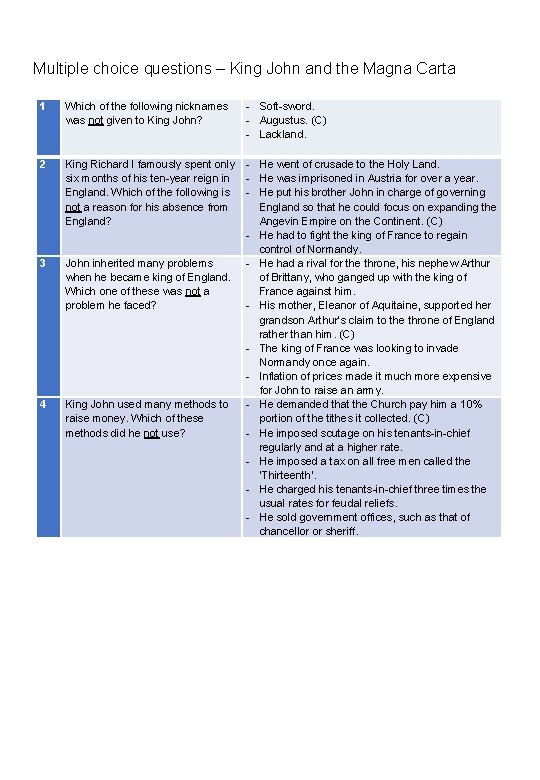
Multiple choice questions – King John and the Magna Carta - Soft-sword. - Augustus. (C) - Lackland. 1 Which of the following nicknames was not given to King John? 2 King Richard I famously spent only - He went of crusade to the Holy Land. six months of his ten-year reign in - He was imprisoned in Austria for over a year. England. Which of the following is - He put his brother John in charge of governing not a reason for his absence from England so that he could focus on expanding the England? Angevin Empire on the Continent. (C) - He had to fight the king of France to regain control of Normandy. John inherited many problems - He had a rival for the throne, his nephew Arthur when he became king of England. of Brittany, who ganged up with the king of Which one of these was not a France against him. problem he faced? - His mother, Eleanor of Aquitaine, supported her grandson Arthur’s claim to the throne of England rather than him. (C) - The king of France was looking to invade Normandy once again. - Inflation of prices made it much more expensive for John to raise an army. King John used many methods to - He demanded that the Church pay him a 10% raise money. Which of these portion of the tithes it collected. (C) methods did he not use? - He imposed scutage on his tenants-in-chief regularly and at a higher rate. - He imposed a tax on all free men called the ‘Thirteenth’. - He charged his tenants-in-chief three times the usual rates for feudal reliefs. - He sold government offices, such as that of chancellor or sheriff. 3 4
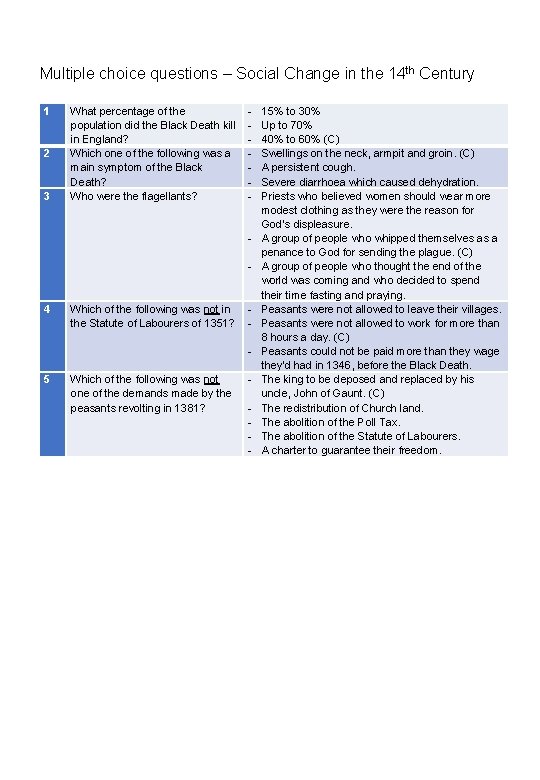
Multiple choice questions – Social Change in the 14 th Century 1 2 3 What percentage of the population did the Black Death kill in England? Which one of the following was a main symptom of the Black Death? Who were the flagellants? - - 4 Which of the following was not in the Statute of Labourers of 1351? - 5 Which of the following was not one of the demands made by the peasants revolting in 1381? - 15% to 30% Up to 70% 40% to 60% (C) Swellings on the neck, armpit and groin. (C) A persistent cough. Severe diarrhoea which caused dehydration. Priests who believed women should wear more modest clothing as they were the reason for God’s displeasure. A group of people who whipped themselves as a penance to God for sending the plague. (C) A group of people who thought the end of the world was coming and who decided to spend their time fasting and praying. Peasants were not allowed to leave their villages. Peasants were not allowed to work for more than 8 hours a day. (C) Peasants could not be paid more than they wage they’d had in 1346, before the Black Death. The king to be deposed and replaced by his uncle, John of Gaunt. (C) The redistribution of Church land. The abolition of the Poll Tax. The abolition of the Statute of Labourers. A charter to guarantee their freedom.