
Multiple Brane Dynamics D Branes to M Branes
Multiple Brane Dynamics: D Branes to M Branes Up from String Theory Neil Lambert King’s College London Annual UK Theory Meeting Durham 18 December 2008
Plan • How Particle Physicists View the World • What is String Theory? • What is M theory? • What are D branes? • What about M branes? • Conclusions
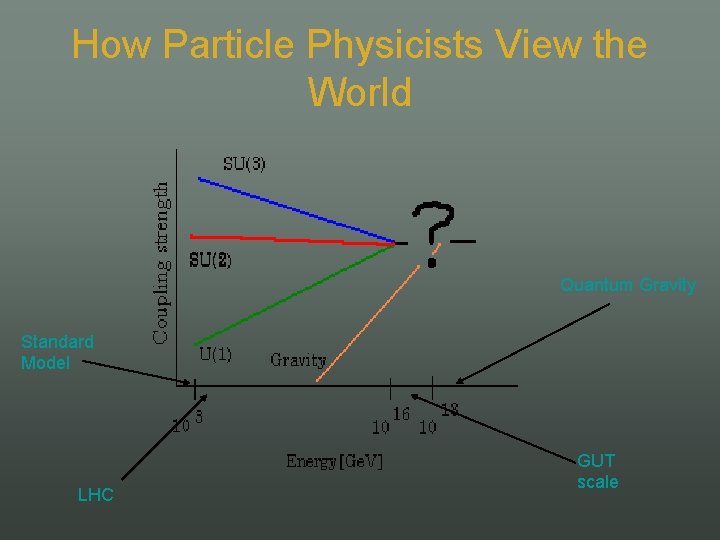
How Particle Physicists View the World Quantum Gravity Standard Model LHC GUT scale
• String Theory seems capable of describing all that we expect in one consistent framework: – Quantum Mechanics – Standard Model like gauge theory – General Relativity – Cosmology (inflation)

What is String Theory? STRING-THEORY SUMMARIZED I JUST HAD AN AWESOME IDEA. SUPPOSE ALL MATTER AND ENERGY IS MADE OF TINY , VIBRATING “STRINGS” OKAY. WHAT WOULD THAT IMPLY? I DUNNO Well in fact we know an awful lot
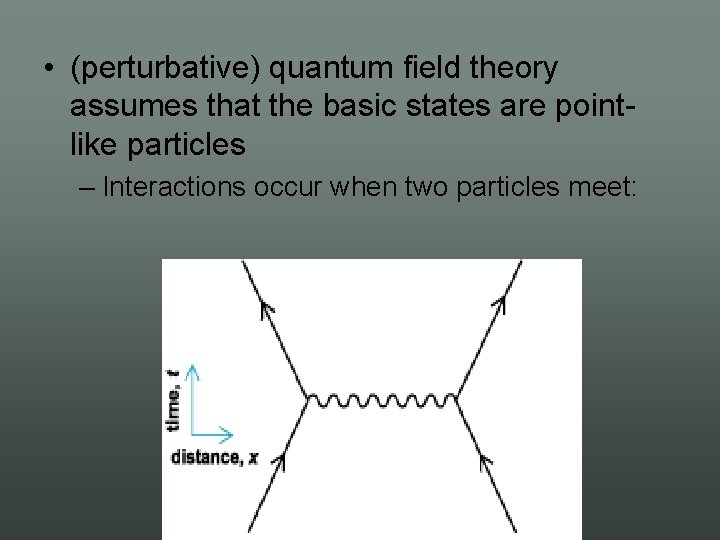
• (perturbative) quantum field theory assumes that the basic states are point like particles – Interactions occur when two particles meet:
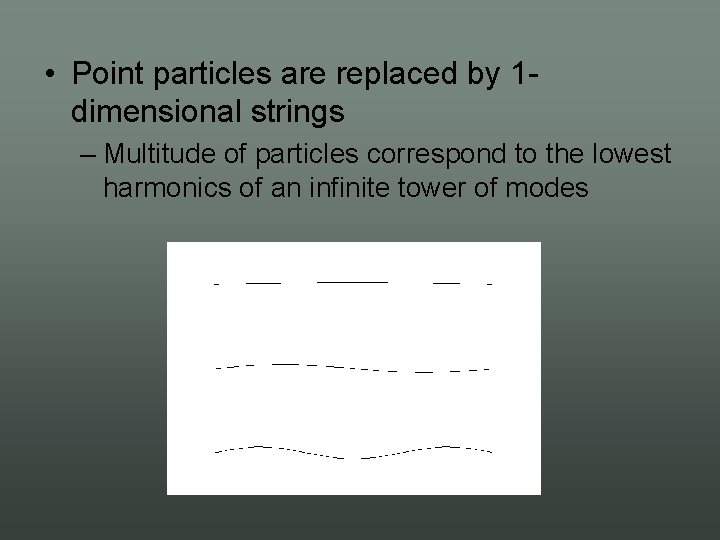
• Point particles are replaced by 1 dimensional strings – Multitude of particles correspond to the lowest harmonics of an infinite tower of modes
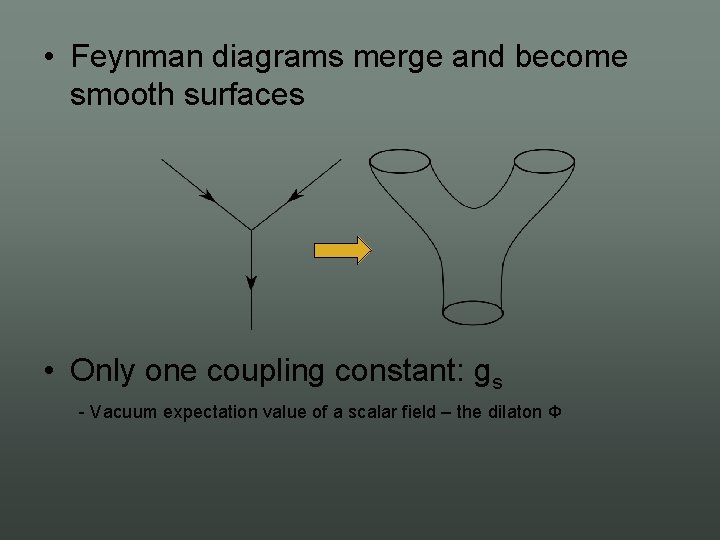
• Feynman diagrams merge and become smooth surfaces • Only one coupling constant: gs Vacuum expectation value of a scalar field – the dilaton Φ
• A remarkable feature is that gravity comes out of the quantum theory, unified with gauge forces • The dimension of spacetime is 10 • Must compactify to 4 D • There appear to be a plethora of models with Standard Model like behaviour – Estimated 10500 4 D vacua Landscape
What is M Theory? M-THEORY SUMMARIZED I JUST HAD AN AWESOME IDEA. SUPPOSE THE 5 STRING THEORIES ARE REALLY ALL ASPECTS OF ONE THEORY OKAY. WHAT WOULD THAT IMPLY? M-THEORY
• There are in fact 5 possible string theories • But now they are all thought to be related as different aspects of single theory: M theory • How? Duality • Two theories are dual if they describe the same physics but with different variables. e. g. S duality gs ↔ 1/gs
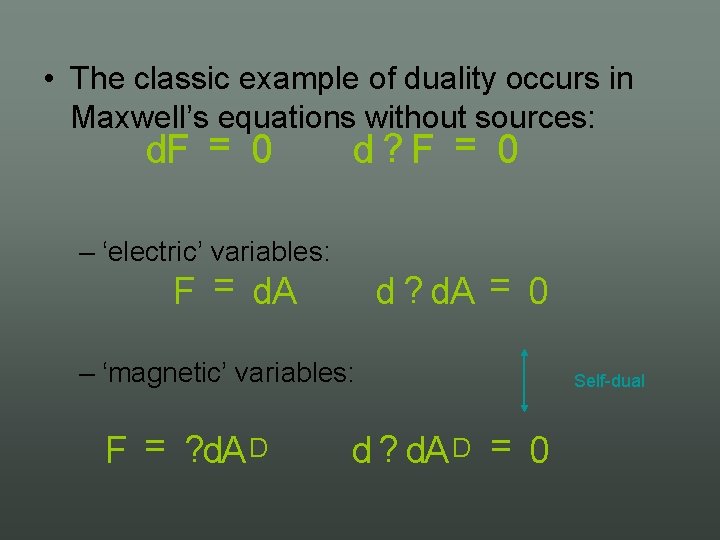
• The classic example of duality occurs in Maxwell’s equations without sources: d. F = 0 d? F = 0 – ‘electric’ variables: F = d. A d ? d. A = 0 – ‘magnetic’ variables: F = ? d. A D d ? d. A D = 0 Self dual
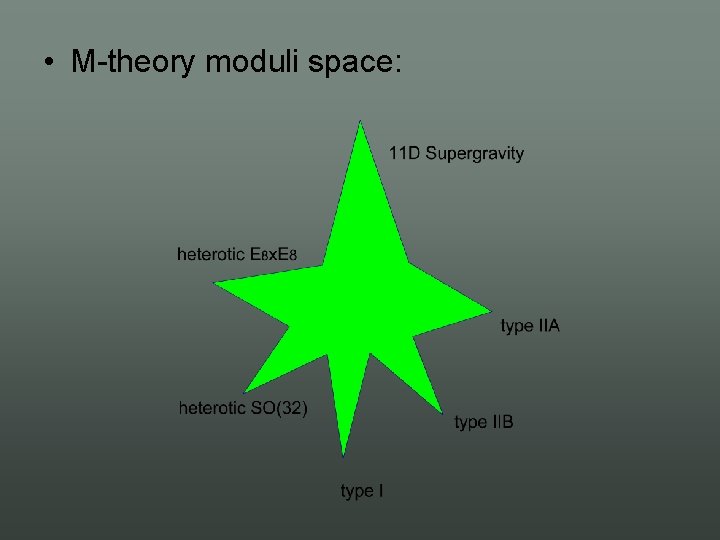
• M theory moduli space:
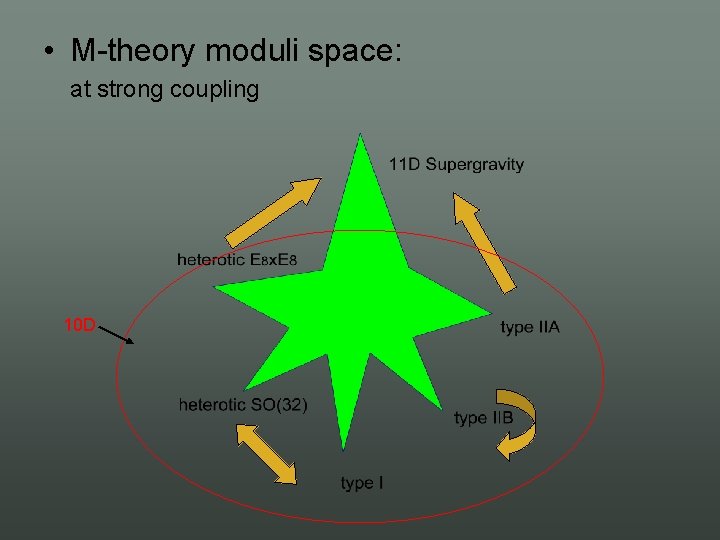
• M theory moduli space: at strong coupling 10 D
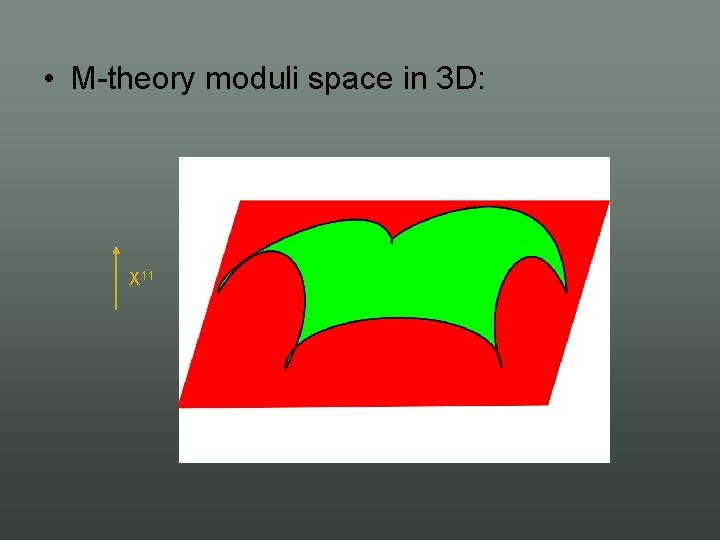
• M theory moduli space in 3 D: X 11
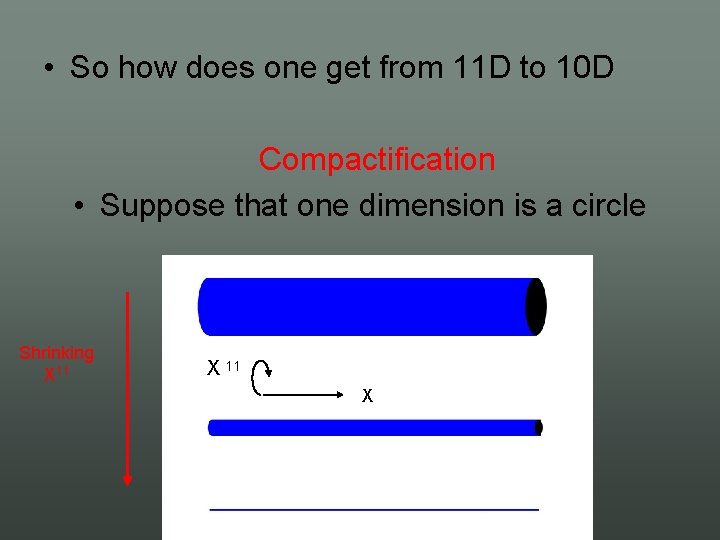
• So how does one get from 11 D to 10 D Compactification • Suppose that one dimension is a circle Shrinking X 11 X
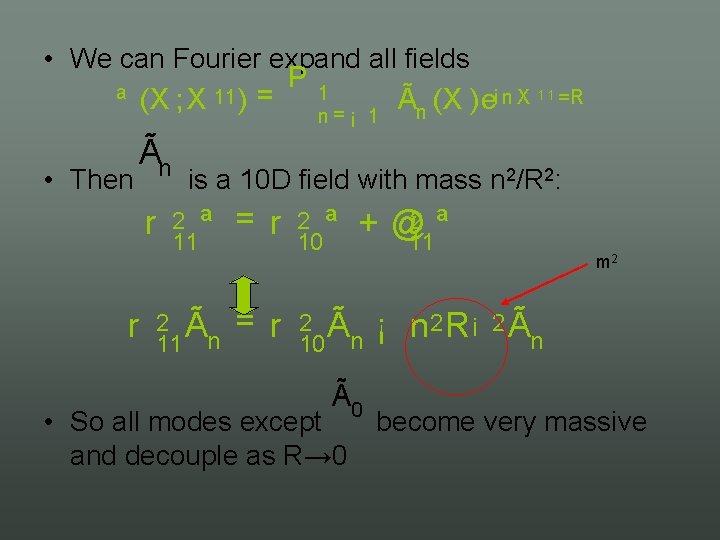
• We can Fourier expand all fields P 1 i n X 1 1 =R (X )e ª (X ; X 11 ) = Ã n = n • Then Ãn r is a 10 D field with mass n 2/R 2: 2 ª 11 = r 2 Ã 11 n = r r ¡ 1 2 ª 10 2 ª +@ 11 2 Ã 10 n Ã0 • So all modes except and decouple as R→ 0 m 2 ¡ n 2 R ¡ 2 Ãn become very massive
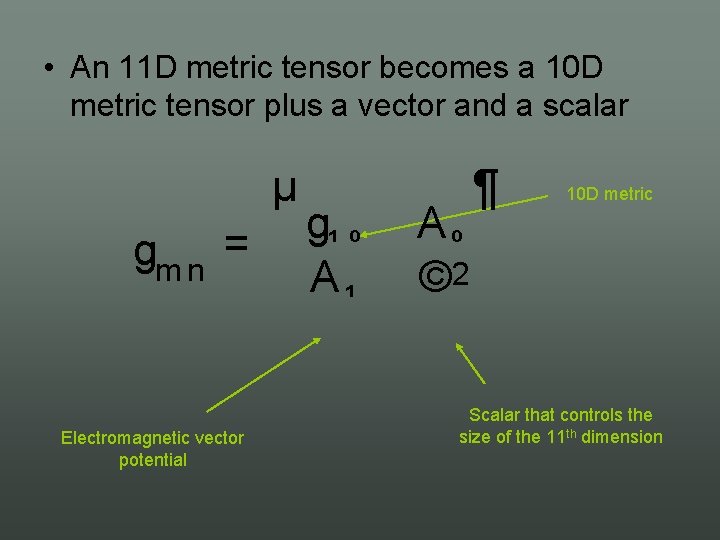
• An 11 D metric tensor becomes a 10 D metric tensor plus a vector and a scalar µ gm n = Electromagnetic vector potential g¹ º A¹ Aº © 2 ¶ 10 D metric Scalar that controls the size of the 11 th dimension
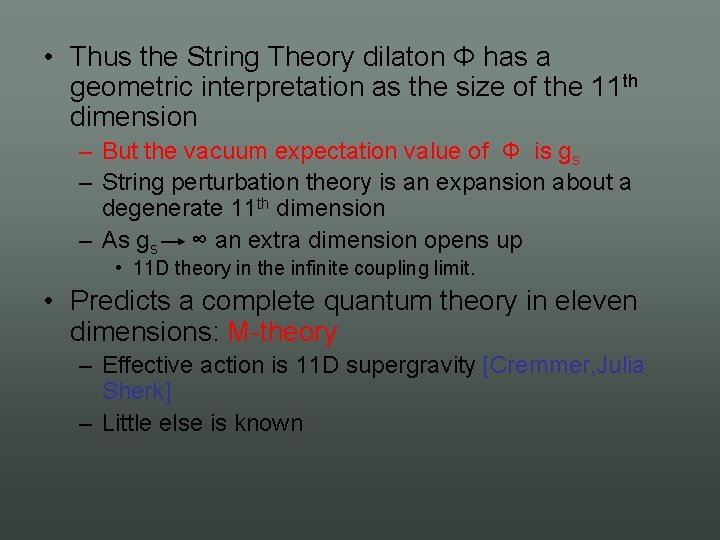
• Thus the String Theory dilaton Φ has a geometric interpretation as the size of the 11 th dimension – But the vacuum expectation value of Φ is gs – String perturbation theory is an expansion about a degenerate 11 th dimension – As gs ∞ an extra dimension opens up • 11 D theory in the infinite coupling limit. • Predicts a complete quantum theory in eleven dimensions: M theory – Effective action is 11 D supergravity [Cremmer, Julia Sherk] – Little else is known
What are D branes? D-BRANES SUMMARIZED I JUST HAD AN AWESOME IDEA. SUPPOSE IN ADDITION TO STRINGS THERE ALSO VIBRATING D-BRANES OKAY. WHAT WOULD THAT IMPLY? YANG-MILLS THEORIES
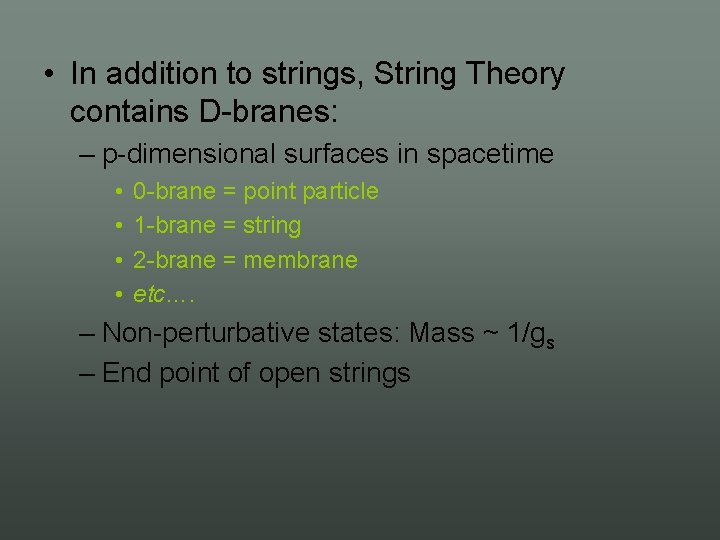
• In addition to strings, String Theory contains D branes: – p dimensional surfaces in spacetime • • 0 brane = point particle 1 brane = string 2 brane = membrane etc…. – Non perturbative states: Mass ~ 1/gs – End point of open strings
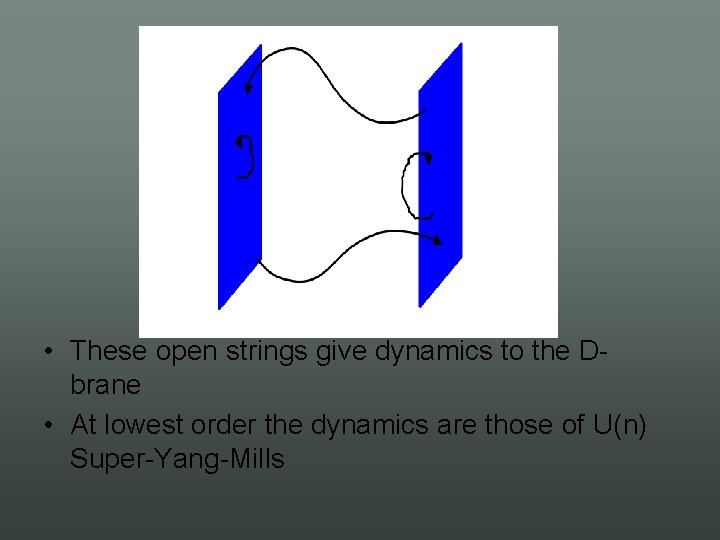
• These open strings give dynamics to the D brane • At lowest order the dynamics are those of U(n) Super Yang Mills
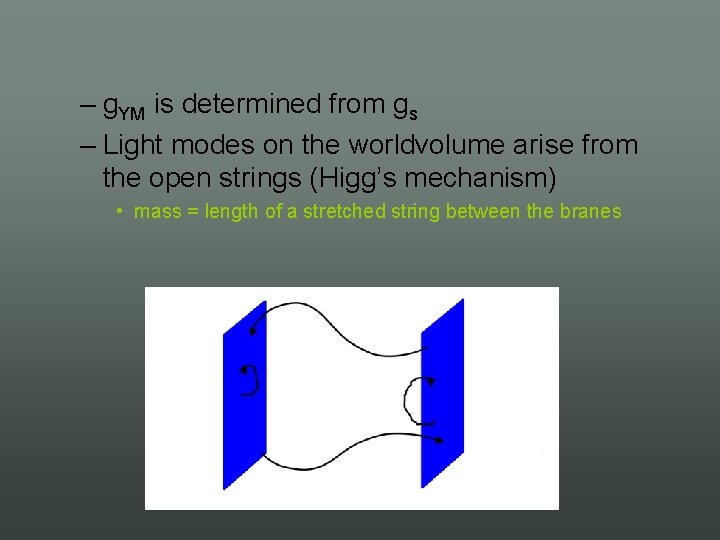
– g. YM is determined from gs – Light modes on the worldvolume arise from the open strings (Higg’s mechanism) • mass = length of a stretched string between the branes m
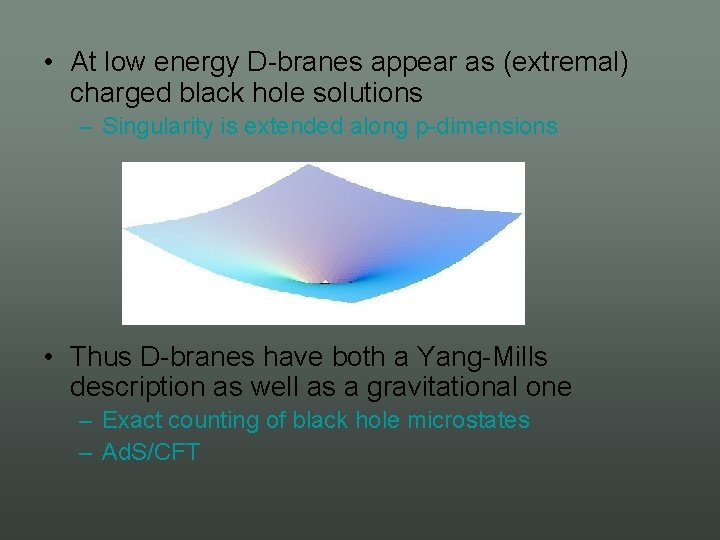
• At low energy D branes appear as (extremal) charged black hole solutions – Singularity is extended along p dimensions • Thus D branes have both a Yang Mills description as well as a gravitational one – Exact counting of black hole microstates – Ad. S/CFT

What about M branes? M-BRANES SUMMARIZED I JUST HAD AN AWESOME IDEA. SUPPOSE THAT M-THEORY ALSO HAS INTERACTING NONABELIAN M-BRANES OKAY. WHAT WOULD THAT IMPLY? I DUNNO Well in fact we now know something
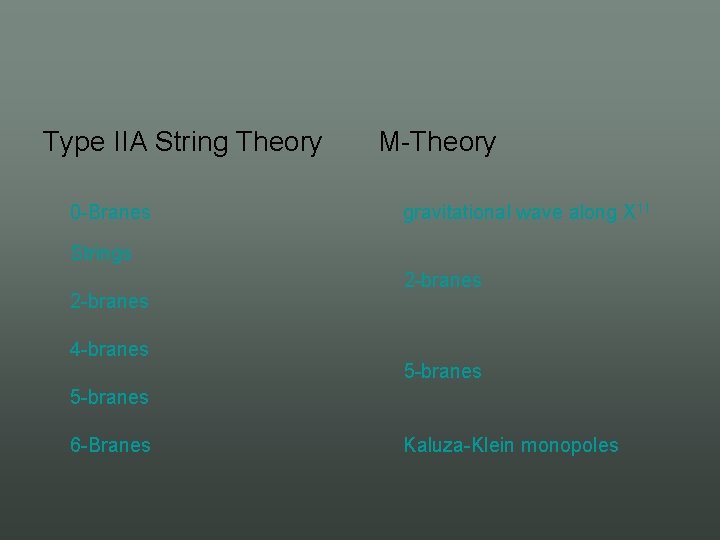
Type IIA String Theory 0 Branes M Theory gravitational wave along X 11 Strings 2 branes 4 branes 2 branes 5 branes 6 Branes Kaluza Klein monopoles
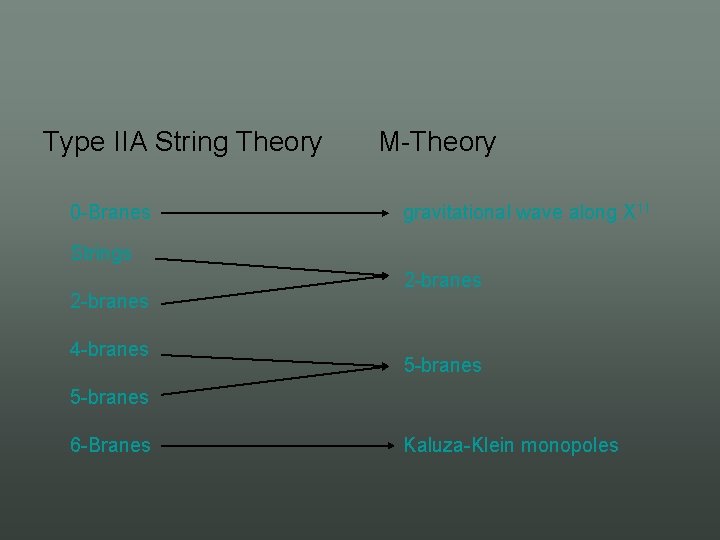
Type IIA String Theory 0 Branes M Theory gravitational wave along X 11 Strings 2 branes 4 branes 2 branes 5 branes 6 Branes Kaluza Klein monopoles
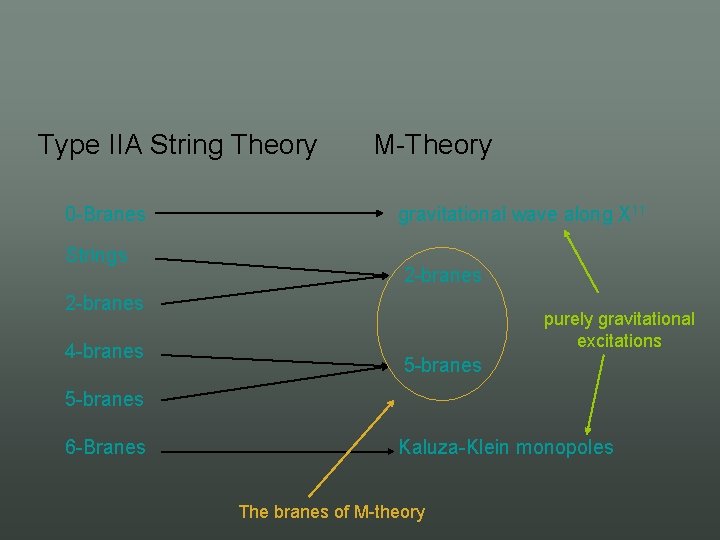
Type IIA String Theory 0 Branes Strings M Theory gravitational wave along X 11 2 branes 4 branes purely gravitational excitations 5 branes 6 Branes Kaluza Klein monopoles The branes of M theory
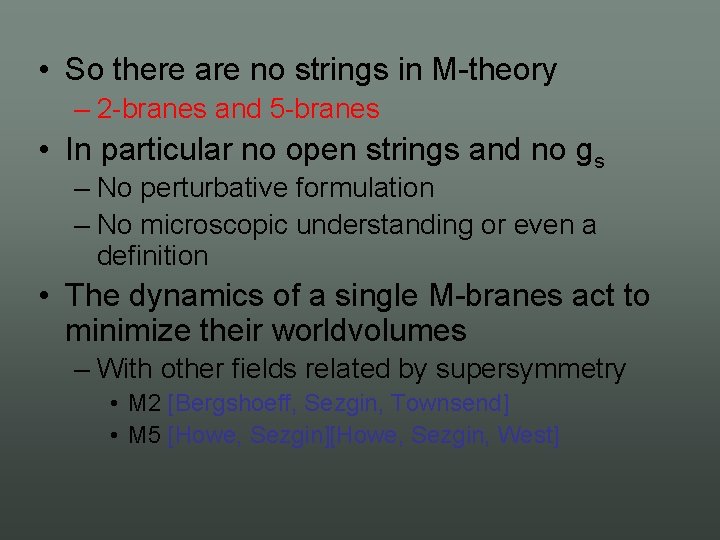
• So there are no strings in M theory – 2 branes and 5 branes • In particular no open strings and no gs – No perturbative formulation – No microscopic understanding or even a definition • The dynamics of a single M branes act to minimize their worldvolumes – With other fields related by supersymmetry • M 2 [Bergshoeff, Sezgin, Townsend] • M 5 [Howe, Sezgin][Howe, Sezgin, West]
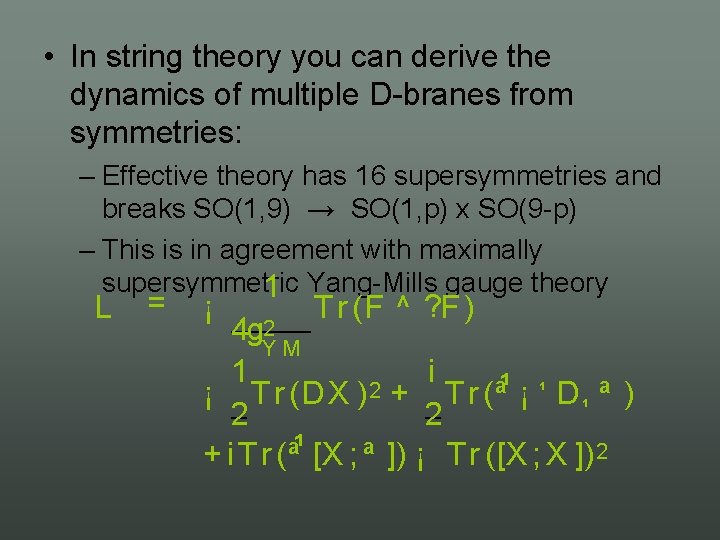
• In string theory you can derive the dynamics of multiple D branes from symmetries: – Effective theory has 16 supersymmetries and breaks SO(1, 9) → SO(1, p) x SO(9 p) – This is in agreement with maximally supersymmetric 1 Yang Mills gauge theory L = ¡ T r (F ^ ? F ) 4 g 2 YM i 1 ¡ T r (D X ) 2 + T r ( ª¹ ¡ ¹ D ¹ ª ) 2 2 + i T r ( ª¹ [X ; ª ]) ¡ T r ([X ; X ]) 2
• Can we derive the dynamics of M 2 branes from symmetries? – Conformal field theory • Strong coupling (IR) fixed point of 3 D SYM – No perturbation expansion – The only maximally supersymmetric Lagrangians are Yang Mills theories • Wrong symmetries for M Theory • need SO(1, 2) x SO(8) not SO(1, 2) x SO(7)
• Can we derive the dynamics of M 2 branes from symmetries? – Conformal field theory • Strong coupling (IR) fixed point of 3 D SYM – No perturbation expansion – The only maximally supersymmetric Lagrangians are Yang Mills theories • Wrong symmetries for M Theory • need SO(1, 2) x SO(8) not SO(1, 2) x SO(7) • Well that turns out not to be true
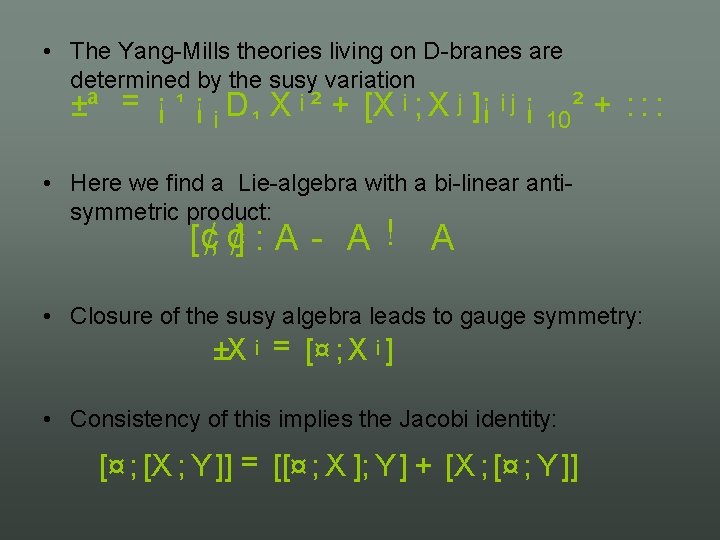
• The Yang Mills theories living on D branes are determined by the susy variation ±ª = ¡ ¹ ¡ i D ¹ X i ² + [X i ; X j ]¡ i j ¡ 10 ² + : : : • Here we find a Lie algebra with a bi linear anti symmetric product: [¢; ¢] : A A ! A • Closure of the susy algebra leads to gauge symmetry: ±X i = [¤ ; X i ] • Consistency of this implies the Jacobi identity: [¤ ; [X ; Y ]] = [[¤ ; X ]; Y ] + [X ; [¤ ; Y ]]
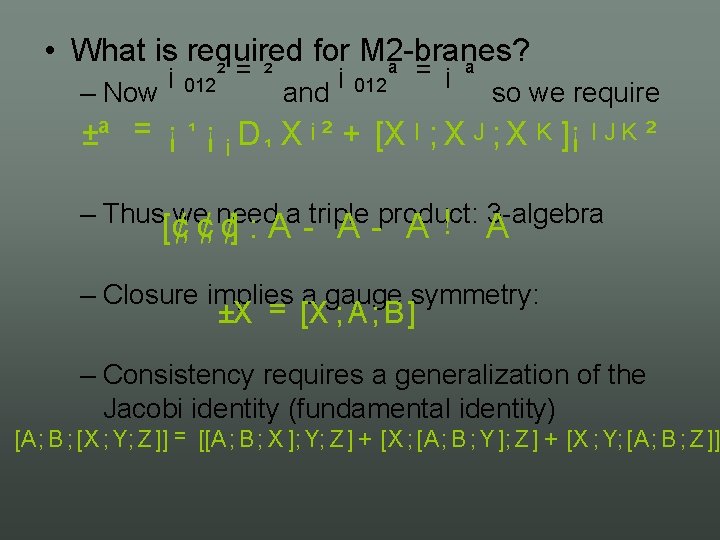
• What is required for M 2 branes? – Now ¡ 012 ² = ² and ¡ 012 ª = ¡ ª so we require ±ª = ¡ ¹ ¡ i D ¹ X i ² + [X I ; X J ; X K ]¡ I J K ² – Thus ¢ we¢ need a triple product: 3 algebra ! ¢ [; ; ]: A A – Closure implies a gauge symmetry: ±X = [X ; A; B ] – Consistency requires a generalization of the Jacobi identity (fundamental identity) [A; B ; [X ; Y; Z ]] = [[A; B ; X ]; Y; Z ] + [X ; [A; B ; Y ]; Z ] + [X ; Y; [A; B ; Z ]]
![• This gives a maximally supersymmetric Lagrangian with SO(8) R symmetry [Bagger, NL]](http://slidetodoc.com/presentation_image_h/93a2b432ee19ac4a80ee56dc7d2c4563/image-35.jpg "• This gives a maximally supersymmetric Lagrangian with SO(8) R symmetry [Bagger, NL]")
• This gives a maximally supersymmetric Lagrangian with SO(8) R symmetry [Bagger, NL] L = 1 i ¡ Tr(D ¹ X I ; D ¹ X I ) + Tr( ª¹ ; ¡ ¹ D ¹ ª ) 2 2 1 i ¹ I J Tr([X I ; X J ; X K ]) 2 + Tr( ª ; ¡ I J X X ª ) ¡ 4 12 ¡ LCS • ‘twisted’ Chern Simons gauge theory ~ L C S » Tr(A ^ d. A~ + 2 A ^ A~ ^ A) 3 • Conformal, parity invariant
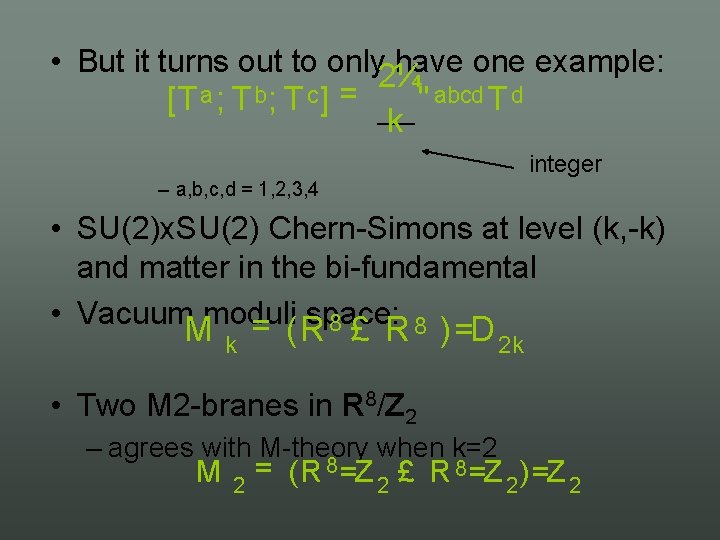
• But it turns out to only 2¼ have one example: " abcd T d [T a ; T b; T c ] = k integer – a, b, c, d = 1, 2, 3, 4 • SU(2)x. SU(2) Chern Simons at level (k, k) and matter in the bi fundamental • Vacuum moduli space: M k = (R 8 £ R 8 )=D 2 k • Two M 2 branes in R 8/Z 2 – agrees with M theory when k=2 M 2 = (R 8 =Z 2 £ R 8 =Z 2 )=Z 2
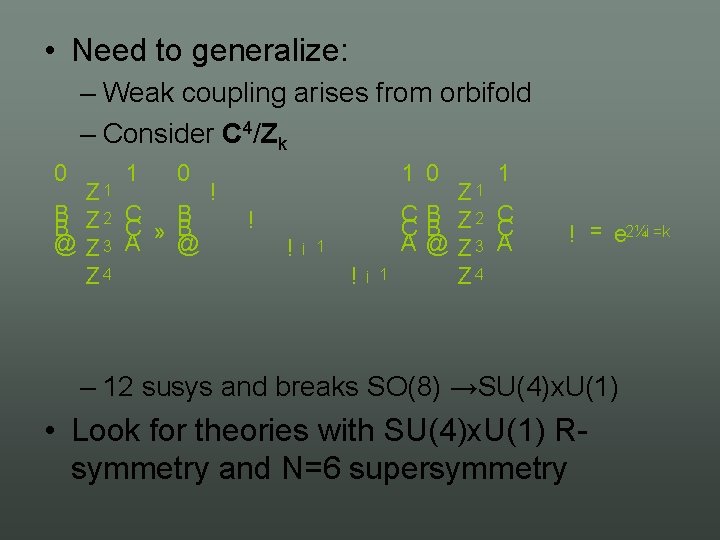
• Need to generalize: – Weak coupling arises from orbifold – Consider C 4/Zk 0 1 0 Z 1 ! B Z 2 C B B C » B @ Z 3 A @ Z 4 1 0 ! ! ¡ 1 1 Z 1 C B Z 2 C CB C A @ Z 3 A Z 4 ! = e 2¼i =k – 12 susys and breaks SO(8) →SU(4)x. U(1) • Look for theories with SU(4)x. U(1) R symmetry and N=6 supersymmetry
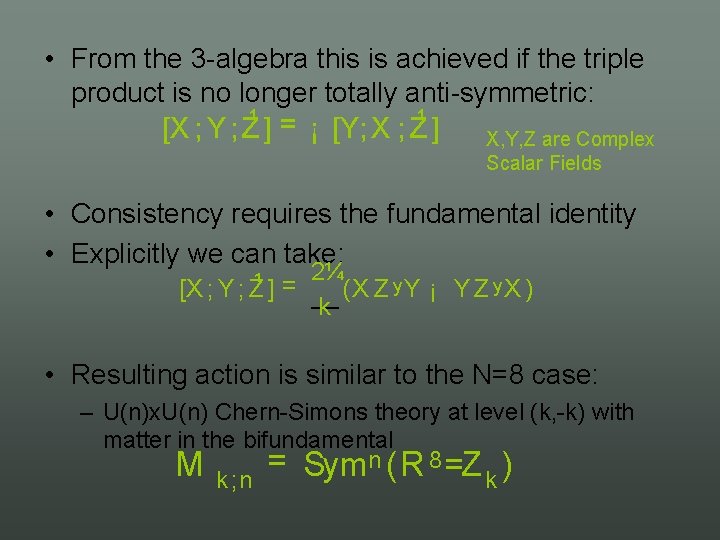
• From the 3 algebra this is achieved if the triple product is no longer totally anti symmetric: [X ; Y ; Z¹ ] = ¡ [Y; X ; Z¹ ] X, Y, Z are Complex Scalar Fields • Consistency requires the fundamental identity • Explicitly we can take: 2¼ ¹ = [X ; Y ; Z ] (X Z y Y ¡ Y Z y X ) k • Resulting action is similar to the N=8 case: – U(n)x. U(n) Chern Simons theory at level (k, k) with matter in the bifundamental M k ; n = Symn (R 8 =Z k )
![• These theories were was first proposed by [Aharony, Bergman, Jafferis and Maldacena]](http://slidetodoc.com/presentation_image_h/93a2b432ee19ac4a80ee56dc7d2c4563/image-39.jpg "• These theories were was first proposed by [Aharony, Bergman, Jafferis and Maldacena]")
• These theories were was first proposed by [Aharony, Bergman, Jafferis and Maldacena] • They gave a brane diagram derivation – Consider the following Hannay Witten picture
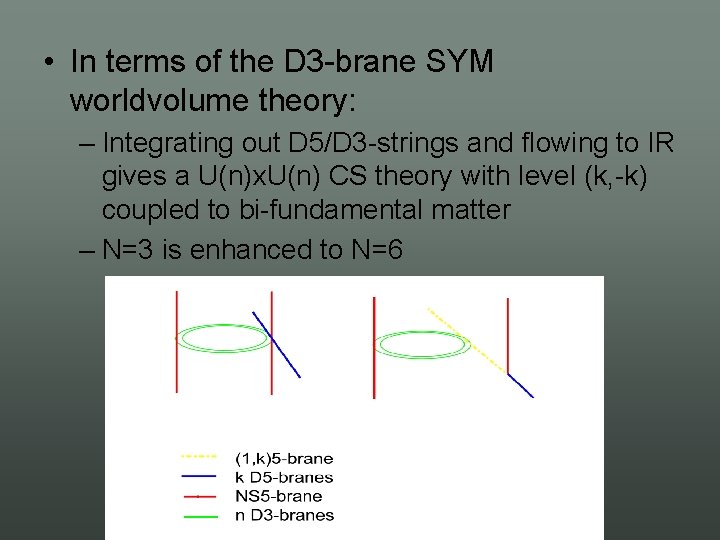
• In terms of the D 3 brane SYM worldvolume theory: – Integrating out D 5/D 3 strings and flowing to IR gives a U(n)x. U(n) CS theory with level (k, k) coupled to bi fundamental matter – N=3 is enhanced to N=6
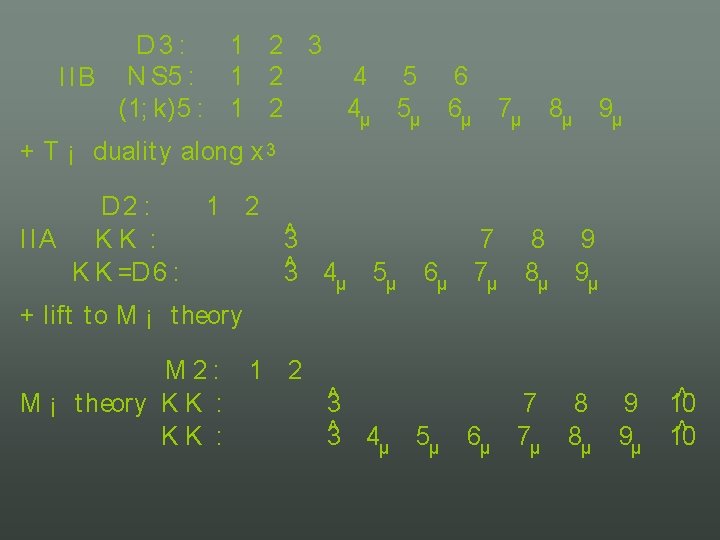
D 3 : 1 2 3 4 I IB N S 5 : 1 2 4µ (1; k)5 : 1 2 5 5µ 6 6µ 7µ 8µ 9µ + T ¡ duality along x 3 D 2 : 1 2 ^3 I IA K K : ^3 4 K K =D 6 : µ 5µ 6µ 7 7µ 8 8µ 9 9µ 6µ 7 7µ 8 8µ + lift t o M ¡ t heory M 2: 1 2 ^3 M ¡ t heory K K : ^3 4 KK : µ 5µ 9 9µ ^ 10
• The final configuration is just n M 2 s in a curved background preserving 3/16 susys. – Metric can be written explicitly – smooth except where the centre's intersect – near horizon limit gives n M 2's in R 8/Zk. – Preserved susy's are enhanced to 12/16. • Note that this works for all n and all k – even k=1, 2 where we expect N=8 susy • Two supersymmetries are not realized in the Lagrangian (strongly coupled)
![• How does one recover D 2 branes from this [Mukhi, Papageorgakis] –](http://slidetodoc.com/presentation_image_h/93a2b432ee19ac4a80ee56dc7d2c4563/image-43.jpg "• How does one recover D 2 branes from this [Mukhi, Papageorgakis] –")
• How does one recover D 2 branes from this [Mukhi, Papageorgakis] – Give a vev to a scalar field v = h. X 48 i k L = k. L 0 (X 4 I ) + L SU ( 2) (X I =6= 8 ; A ¹ ) + O(kv¡ 3 ) a 6 4 v 2 – 8 X a 6 =4 become a dynamical SU(2) gauge field • Similar to a Higg’s effect – g. Y 2 M = v 2 =k
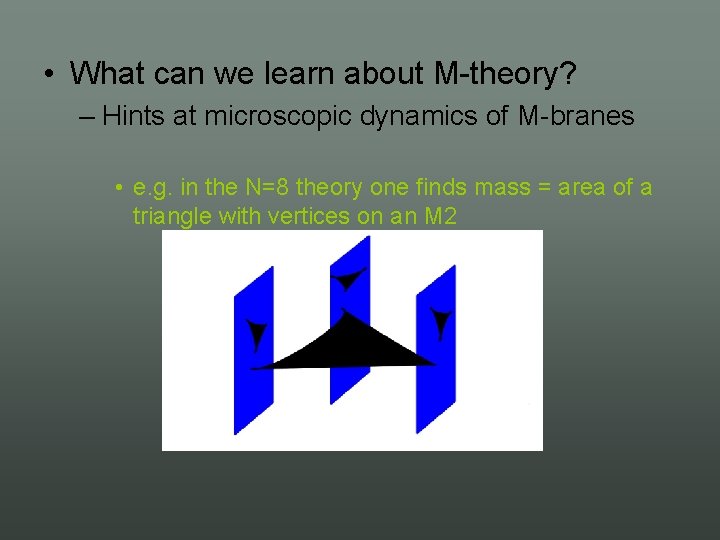
• What can we learn about M theory? – Hints at microscopic dynamics of M branes • e. g. in the N=8 theory one finds mass = area of a triangle with vertices on an M 2
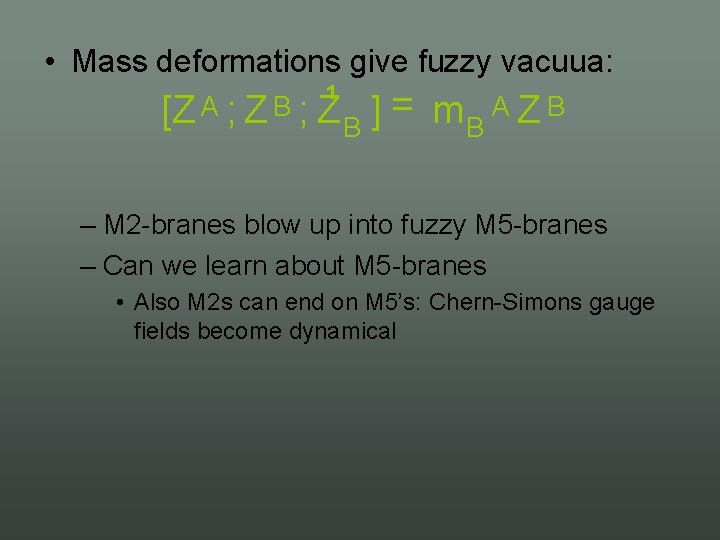
• Mass deformations give fuzzy vacuua: [Z A ; Z B ; Z¹ B ] = m B A Z B – M 2 branes blow up into fuzzy M 5 branes – Can we learn about M 5 branes • Also M 2 s can end on M 5’s: Chern Simons gauge fields become dynamical
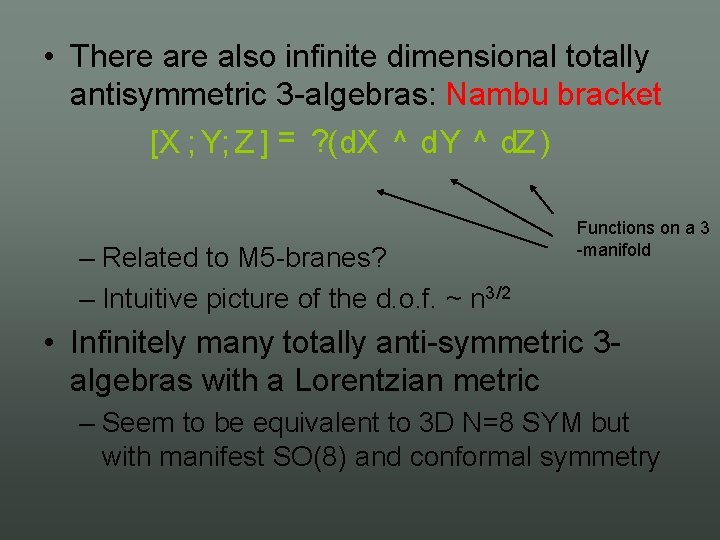
• There also infinite dimensional totally antisymmetric 3 algebras: Nambu bracket [X ; Y; Z ] = ? (d. X ^ d. Y ^ d. Z ) – Related to M 5 branes? – Intuitive picture of the d. o. f. ~ n 3/2 Functions on a 3 manifold • Infinitely many totally anti symmetric 3 algebras with a Lorentzian metric – Seem to be equivalent to 3 D N=8 SYM but with manifest SO(8) and conformal symmetry
Conclusions • I hope to have given a flavour of String Theory and M Theory • D branes are a central to String Theory – Dynamics determined by Yang Mills gauge theory • M branes are poorly understood but there has been much recent progress: – Complete proposal for the effective Lagrangian of n M 2’s in R 8/Zk – Novel highly supersymmetric Chern Simons gauge theories based on a 3 algebra.
- Slides: 47