
Multiple Beam Interference at Dielectric Interfaces n 1
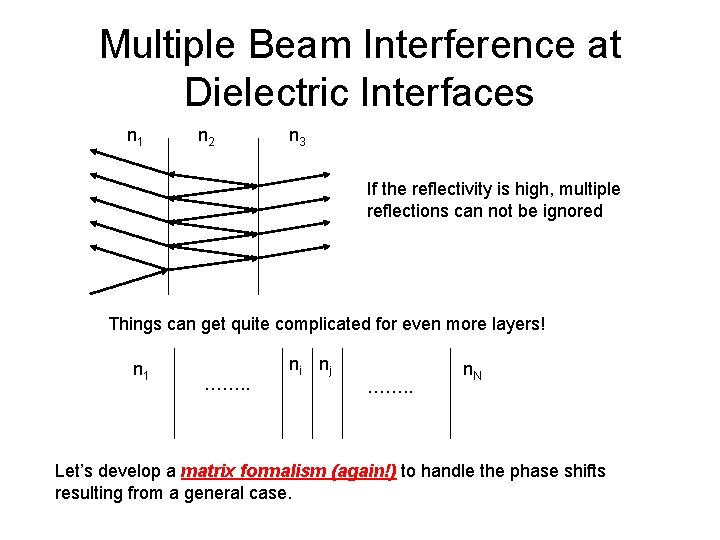
Multiple Beam Interference at Dielectric Interfaces n 1 n 2 n 3 If the reflectivity is high, multiple reflections can not be ignored Things can get quite complicated for even more layers! n 1 ……. . ni nj ……. . n. N Let’s develop a matrix formalism (again!) to handle the phase shifts resulting from a general case.
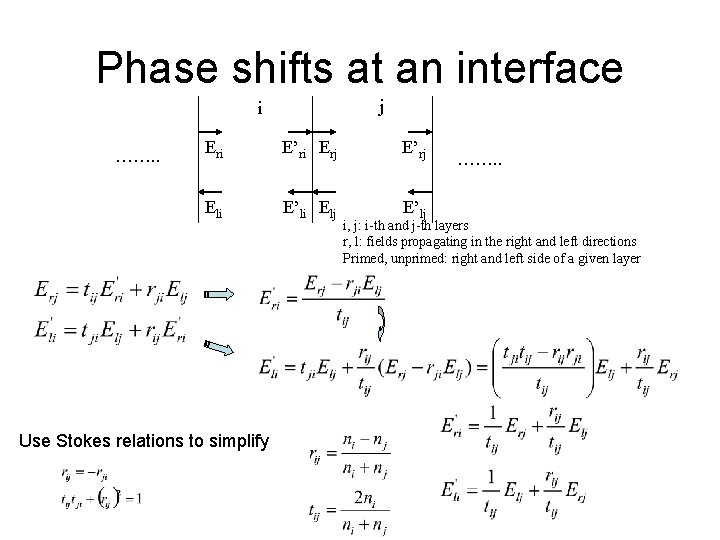
Phase shifts at an interface j i ……. . Eri E’ri Erj E’rj Eli E’li Elj E’lj Use Stokes relations to simplify ……. . i, j: i-th and j-th layers r, l: fields propagating in the right and left directions Primed, unprimed: right and left side of a given layer

Transition matrices Interface transition matrix Now, let’s determine the phase change upon traversing a layer (we will restrict ourselves to normal incidence) phase change upon moving through a j-th layer with index nj is k*d=nj(2 / ) d j Layer propagation matrix
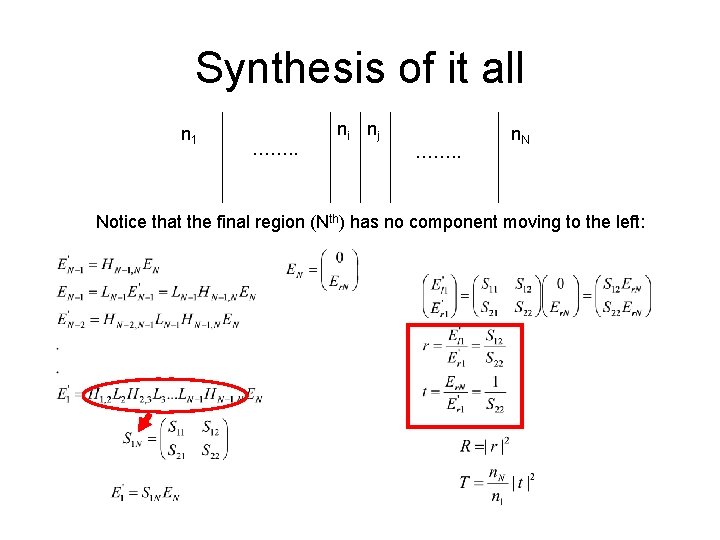
Synthesis of it all n 1 ……. . ni nj ……. . n. N Notice that the final region (Nth) has no component moving to the left:

Application I: Anti-reflection Coating n 1 = 1 n 2 = ? /2 air n 3 = 1. 4 /2 glass d n 1 < n 2 < n 3 Reminder: 180 degree phase shift upon reflection off an interface with a more dense medium. Goal: We want to have a coating of certain thickness so that the destructive interferences between the two rays will give the minimum reflectance for a target wavelength, typically in the middle of visible wavelengths (~550 nm). Why do we need n 1 < n 2 < n 3? The reflectivity of two interfaces should match to provide the maximum cancellation between two light fields of comparable strength. Even if these conditions are satisfied, the reflectance for other wavelengths will be nonzero. Let’s evaluate how much better we can do compared to the regular 4% reflection in the absence of the AR coating. -> Use matrix formalism
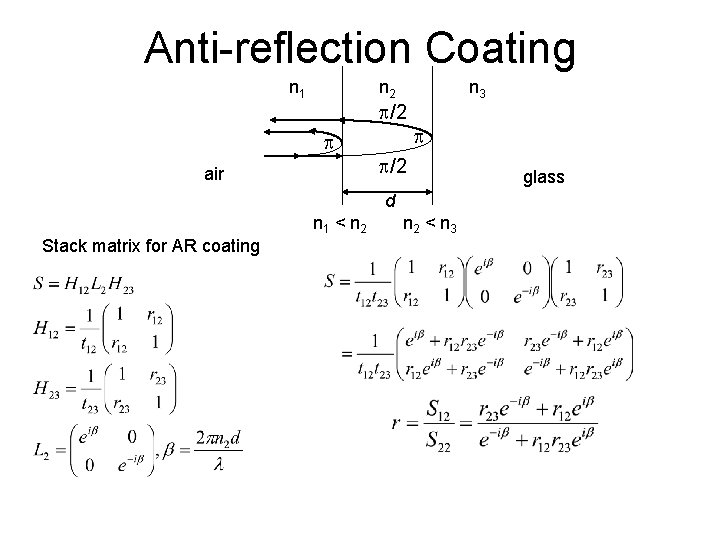
Anti-reflection Coating n 1 n 2 /2 air n 3 /2 d n 1 < n 2 Stack matrix for AR coating n 2 < n 3 glass
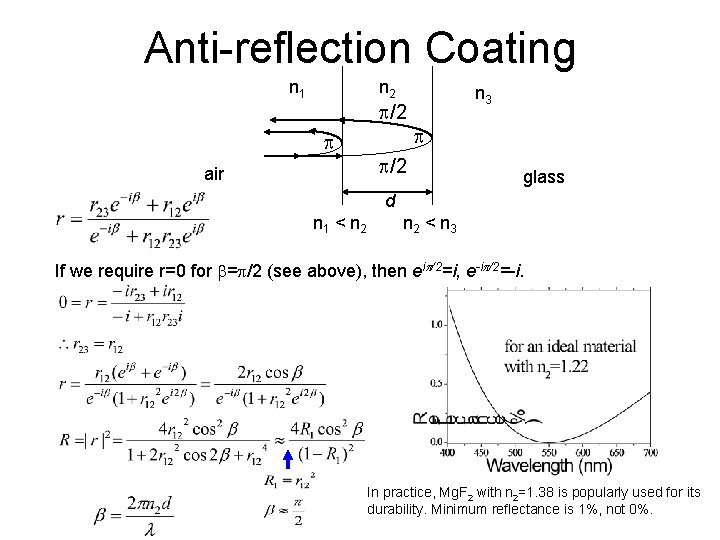
Anti-reflection Coating n 1 n 2 /2 air n 3 /2 glass d n 1 < n 2 < n 3 If we require r=0 for = /2 (see above), then ei /2=i, e-i /2=-i. In practice, Mg. F 2 with n 2=1. 38 is popularly used for its durability. Minimum reflectance is 1%, not 0%.
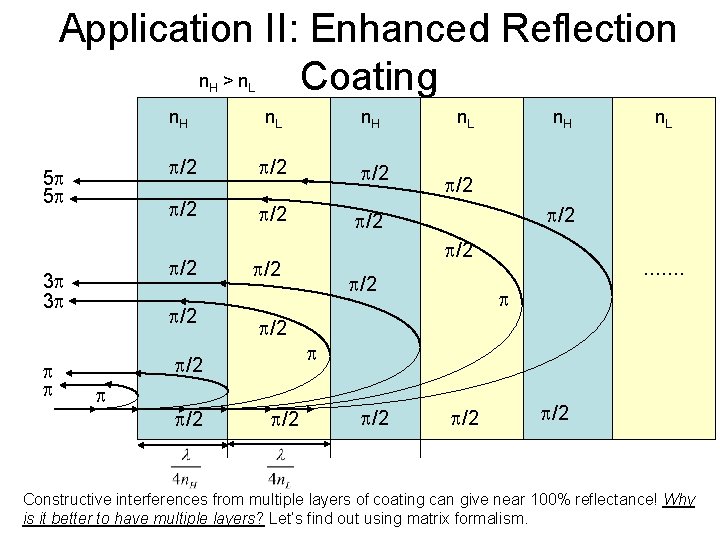
Application II: Enhanced Reflection n >n Coating H 5 5 n. H n. L n. H /2 /2 3 3 L /2 n. H n. L /2 /2 /2 /2 ……. /2 /2 n. L /2 /2 Constructive interferences from multiple layers of coating can give near 100% reflectance! Why is it better to have multiple layers? Let’s find out using matrix formalism.
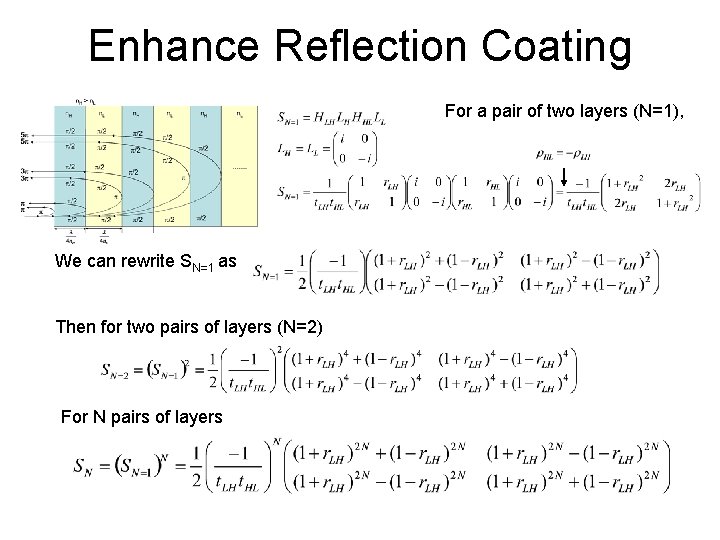
Enhance Reflection Coating For a pair of two layers (N=1), We can rewrite SN=1 as Then for two pairs of layers (N=2) For N pairs of layers

Enhance Reflection Coating For N pairs of layers Let’s simplify Therefore, R can approach 100% for a very large number of N. A laser cavity mirror with 7 layers of Zn. S (n. H=2. 32) and Mg. F 2 (n. L=1. 38) giving a peak reflectance of 99. 7%.
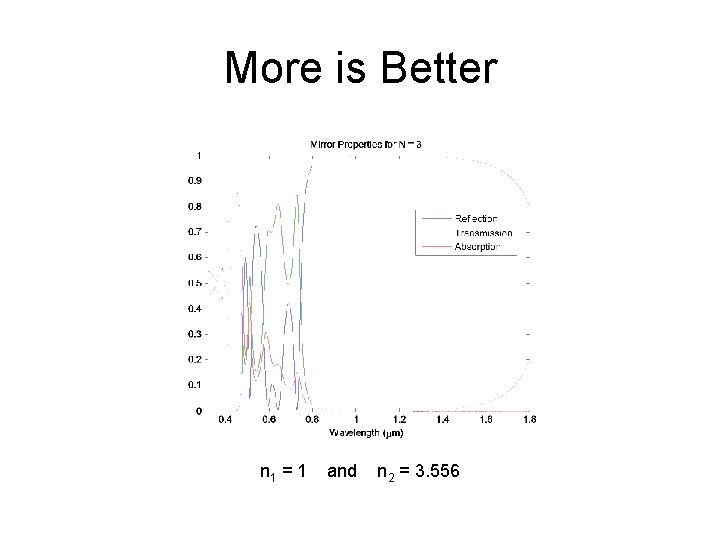
More is Better n 1 = 1 and n 2 = 3. 556
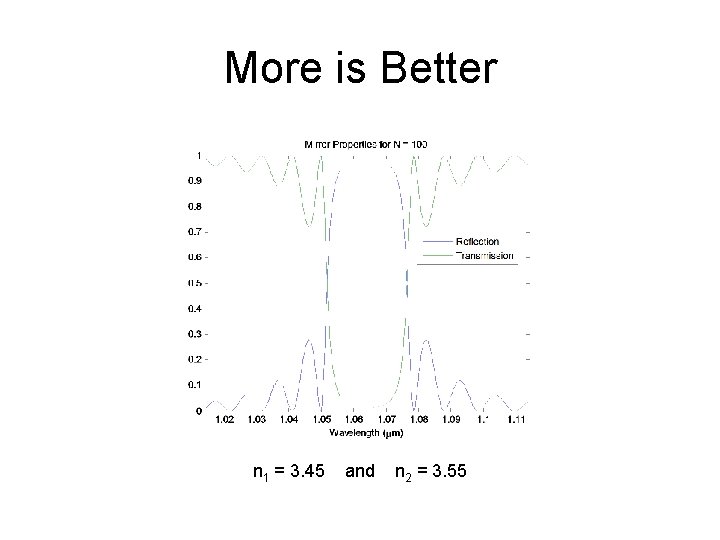
More is Better n 1 = 3. 45 and n 2 = 3. 55

DBRs and DFBs
- Slides: 13