
Multiple Access Techniques for wireless communication 1 l
- Slides: 21
Multiple Access Techniques for wireless communication 1 l Multiple access schemes allow many mobile users to share a finite amount of radio spectrum l High quality of communications must be maintained during the sharing process
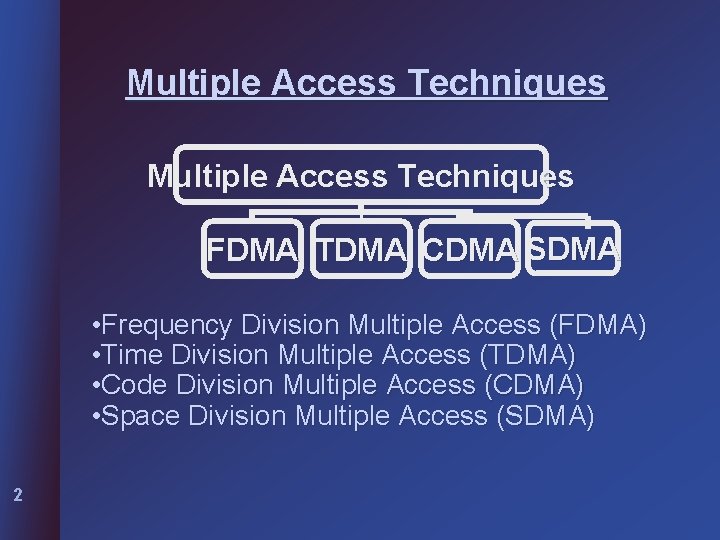
Multiple Access Techniques FDMA TDMA CDMA SDMA • Frequency Division Multiple Access (FDMA) • Time Division Multiple Access (TDMA) • Code Division Multiple Access (CDMA) • Space Division Multiple Access (SDMA) 2
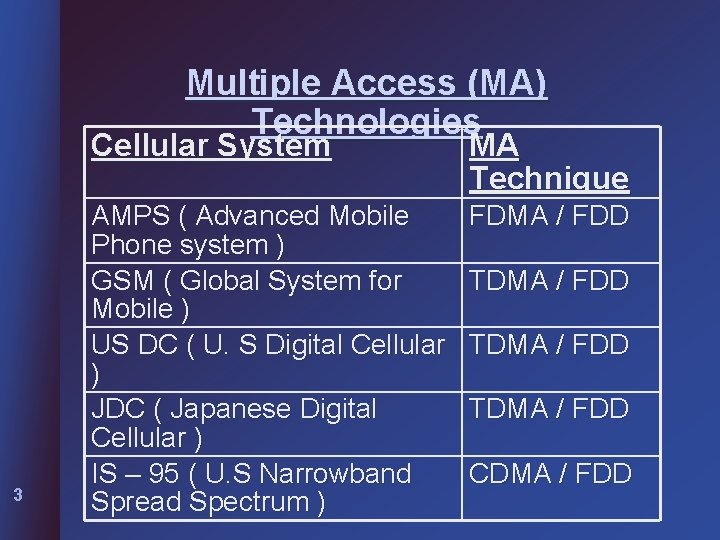
Multiple Access (MA) Technologies 3 Cellular System MA Technique AMPS ( Advanced Mobile Phone system ) GSM ( Global System for Mobile ) US DC ( U. S Digital Cellular ) JDC ( Japanese Digital Cellular ) IS – 95 ( U. S Narrowband Spread Spectrum ) FDMA / FDD TDMA / FDD CDMA / FDD
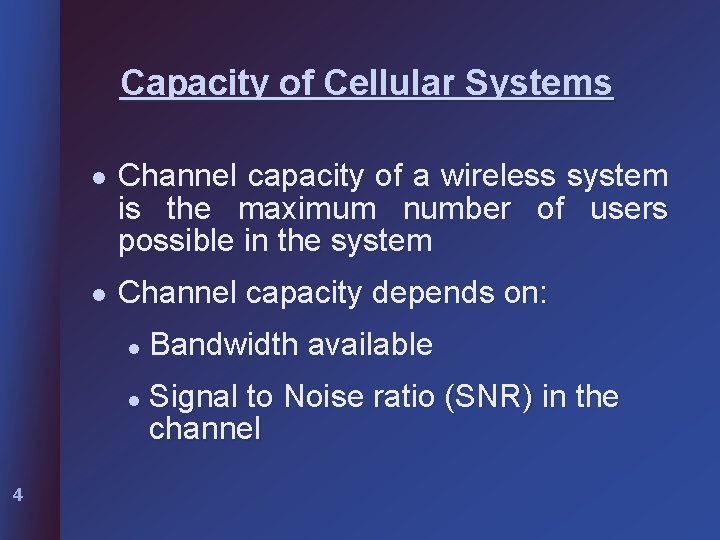
Capacity of Cellular Systems l Channel capacity of a wireless system is the maximum number of users possible in the system l Channel capacity depends on: l l 4 Bandwidth available Signal to Noise ratio (SNR) in the channel
Principle of FDMA Operation 5 l Each user is allocated a unique frequency band or channel. These channels are assigned on demand to users who request service l In FDD, the channel has two frequencies – forward channel & reverse channel
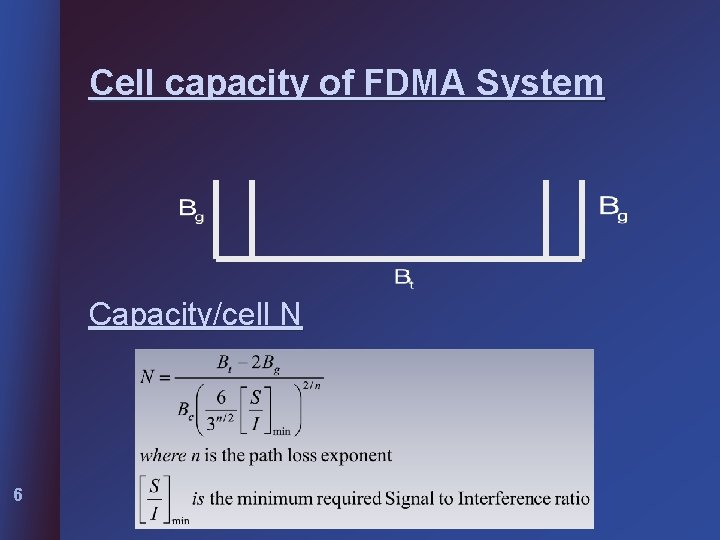
Cell capacity of FDMA System Capacity/cell N 6
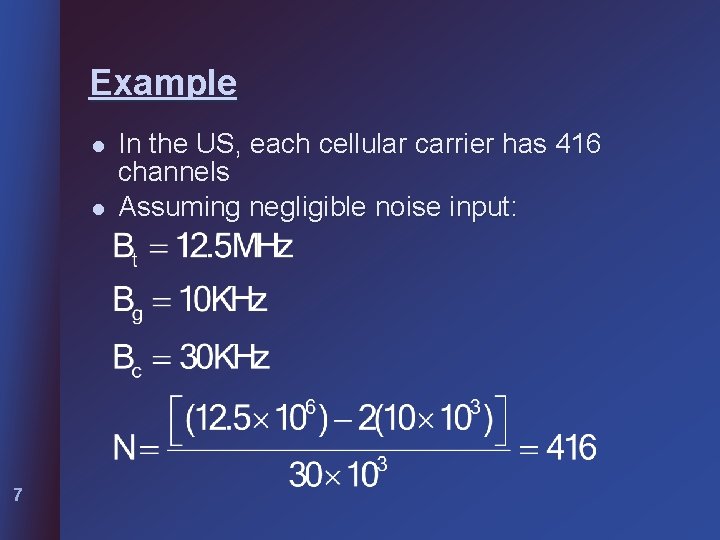
Example l l 7 In the US, each cellular carrier has 416 channels Assuming negligible noise input:
TDMA Operating principle 8 l TDMA systems divide each FDMA channel into time slots l Each user occupies a cyclically repeating time slot l TDMA can allow different number of time slots for separate user
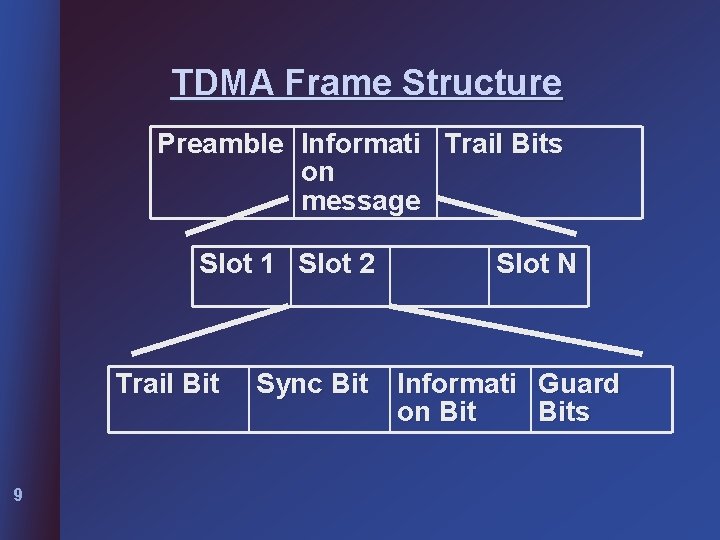
TDMA Frame Structure Preamble Informati Trail Bits on message Slot 1 Slot 2 Trail Bit 9 Slot N Sync Bit Informati Guard on Bits
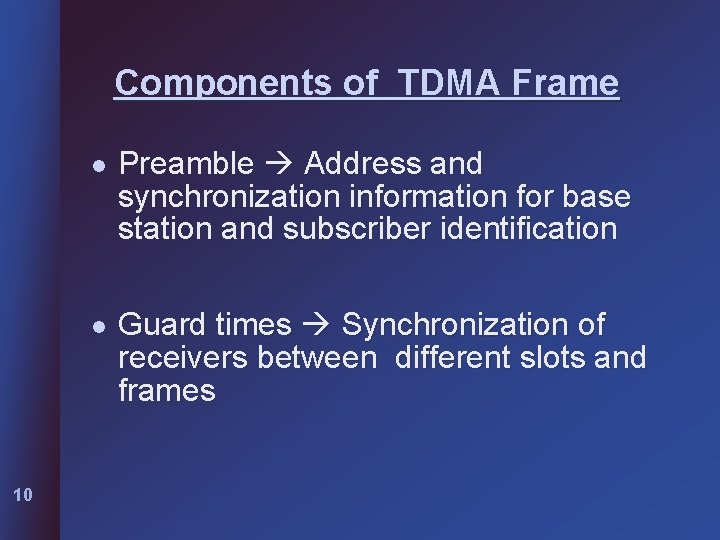
Components of TDMA Frame 10 l Preamble Address and synchronization information for base station and subscriber identification l Guard times Synchronization of receivers between different slots and frames
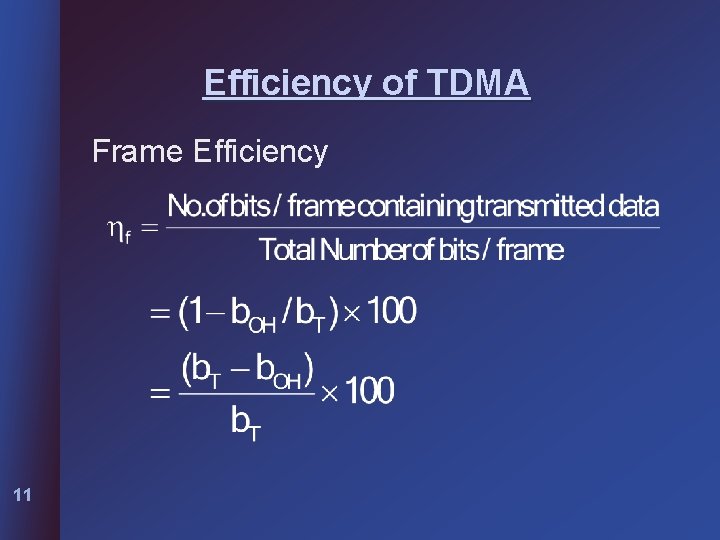
Efficiency of TDMA Frame Efficiency 11
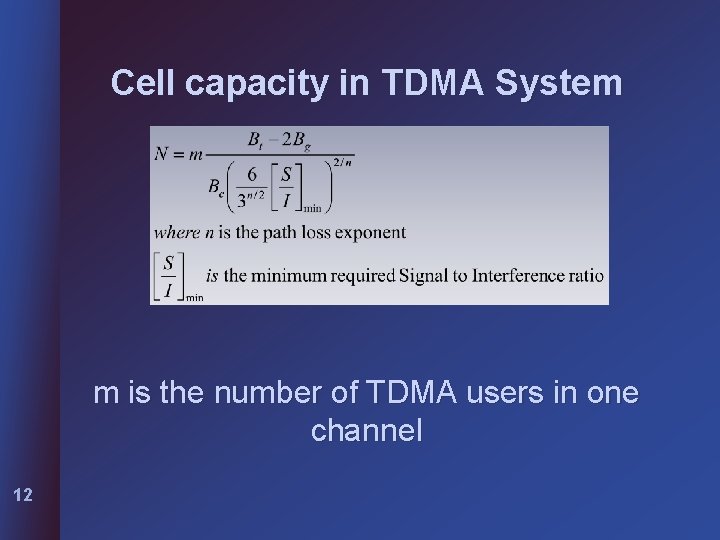
Cell capacity in TDMA System m is the number of TDMA users in one channel 12
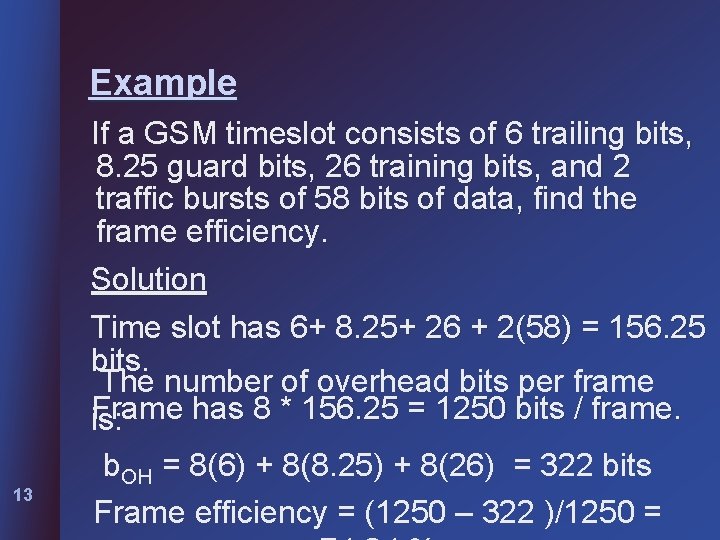
Example If a GSM timeslot consists of 6 trailing bits, 8. 25 guard bits, 26 training bits, and 2 traffic bursts of 58 bits of data, find the frame efficiency. Solution Time slot has 6+ 8. 25+ 26 + 2(58) = 156. 25 bits. The number of overhead bits per frame F is: rame has 8 * 156. 25 = 1250 bits / frame. 13 b. OH = 8(6) + 8(8. 25) + 8(26) = 322 bits Frame efficiency = (1250 – 322 )/1250 =
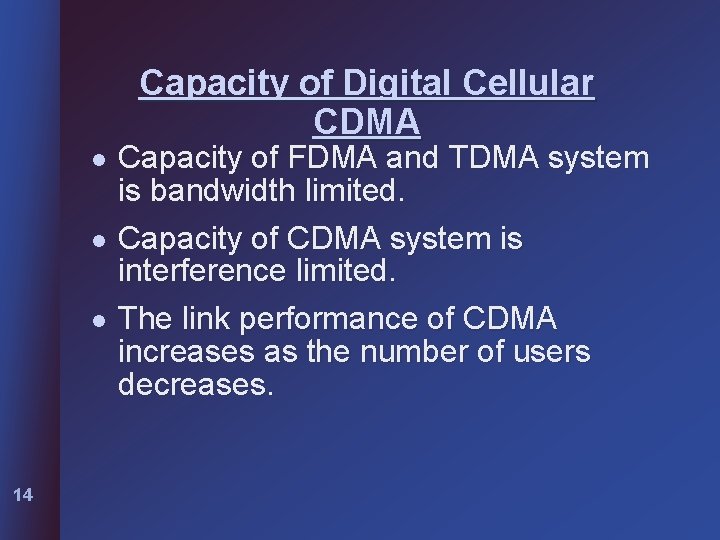
Capacity of Digital Cellular CDMA l l l 14 Capacity of FDMA and TDMA system is bandwidth limited. Capacity of CDMA system is interference limited. The link performance of CDMA increases as the number of users decreases.
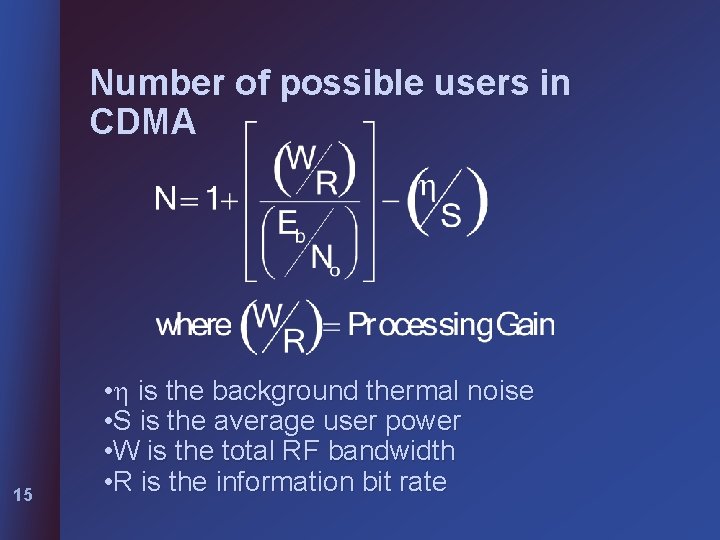
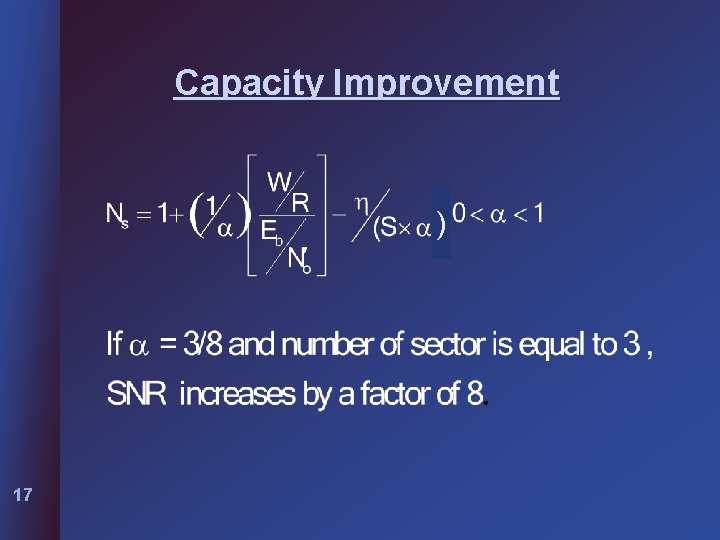
Number of possible users in CDMA 15 • h is the background thermal noise • S is the average user power • W is the total RF bandwidth • R is the information bit rate
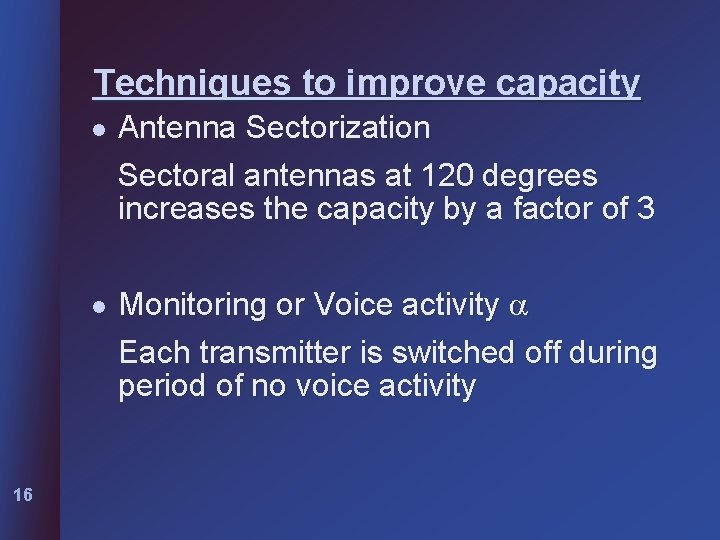
Techniques to improve capacity l l 16 Antenna Sectorization Sectoral antennas at 120 degrees increases the capacity by a factor of 3 Monitoring or Voice activity a Each transmitter is switched off during period of no voice activity
Capacity Improvement ) 17
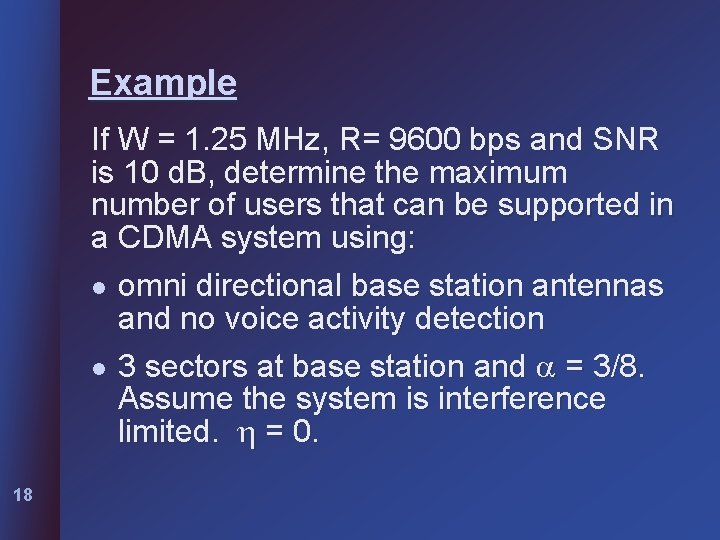
Example If W = 1. 25 MHz, R= 9600 bps and SNR is 10 d. B, determine the maximum number of users that can be supported in a CDMA system using: l omni directional base station antennas and no voice activity detection l 3 sectors at base station and a = 3/8. Assume the system is interference limited. h = 0. 18
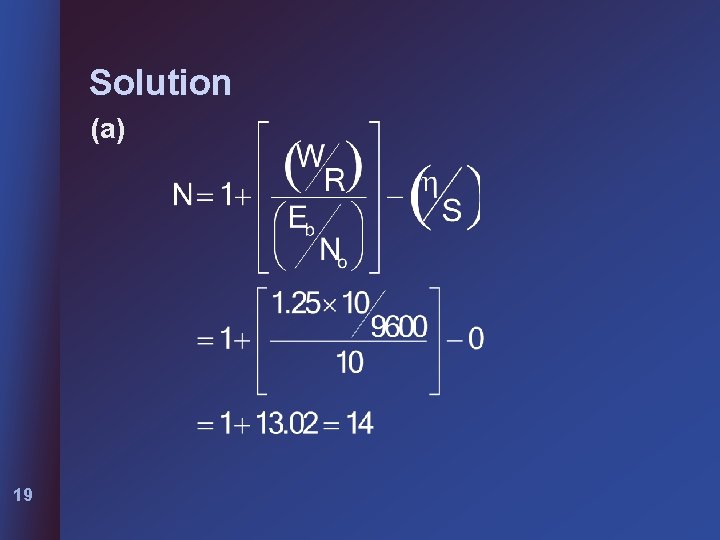
Solution (a) 19
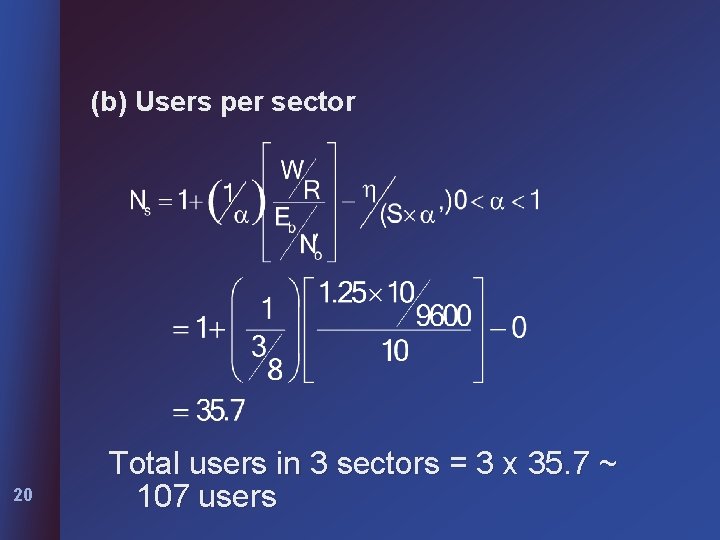
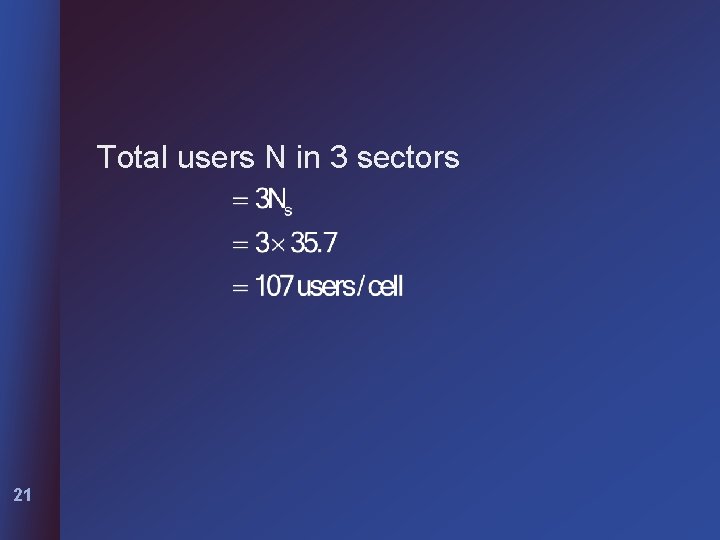
(b) Users per sector 20 Total users in 3 sectors = 3 x 35. 7 ~ 107 users
Total users N in 3 sectors 21