
Multiphoton InnerShell Ionization in Intense EUV FEL Fields
- Slides: 32
Multiphoton (Inner-Shell) Ionization in Intense EUV FEL Fields TPI of Xe (93 e. V) and Kr (46 e. V) John T Costello National Centre for Plasma Science & Technology (NCPST)/ School of Physical Sciences, Dublin City University www. ncpst. ie www. physics. dcu. ie/~jtc VUVX – SLAC / July 19 – 21, 2010
Collaboration XFEL: M. Meyer & P. Radcliffe PTB (Berlin): A. A. Sorokin (now at IOFFE & DESY) & M. Richter DESY (Hamburg): K. Tiedke, S. Düsterer, W. Li, J. Feldhaus & P. Juranić Orsay: D. Cubaynes Queen’s University Belfast: Hugo W. van der Hart (T) Crete: P. Lambropoulos (T) Oulu/GSI: S. Fritzsche (T) DCU: V. Richardson & J. T. Costello Thanks to AG Photon (R Treusch et al. ) & AG Machine (M Yurkov et al. ) � VUVX – SLAC / July 19 – 21, 2010
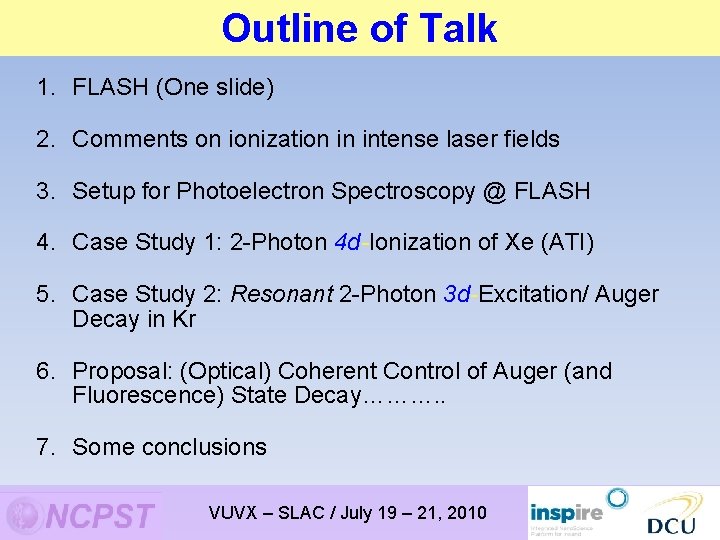
Outline of Talk 1. FLASH (One slide) 2. Comments on ionization in intense laser fields 3. Setup for Photoelectron Spectroscopy @ FLASH 4. Case Study 1: 2 -Photon 4 d-Ionization of Xe (ATI) 5. Case Study 2: Resonant 2 -Photon 3 d-Excitation/ Auger Decay in Kr 6. Proposal: (Optical) Coherent Control of Auger (and Fluorescence) State Decay………. . 7. Some conclusions VUVX – SLAC / July 19 – 21, 2010
DCU Laser Plasma/ AMOP Group 6 laboratory areas focussed on pulsed laser matter interactions (NIR – X-ray/ 30 fs – 30 ns, spectroscopy/ imaging/ PLD) Academic Faculty (5): John T. Costello, Eugene T. Kennedy (Emeritus), Jean-Paul Mosnier, Lampros Nikolopoulos (T) and Paul van Kampen Current Postdocs (3): Dr. Patrick Hayden, Dr. Sateesh Krishnamurty and Dr. Subhash Singh Funded by: SFI - Frontiers and Investigator HEA – PRTLI (Kit) IRCSET (People) EU - Marie Curie (People) Current Ph. D students (8 + 1 + 2): Jack Connolly, Leanne Doughty, Brian Doohan, Colm Fallon, Eanna Mac Carthy, Mossy Kelly, Vincent Richardson, Jiang Xi, Damien Middleton, open position (with LN), Ricarda Laasch (Univ. Hamburg) and Nadia Gambino (Univ. Catania) Recent Ph. Ds: Caroline Banahan, Kevin Kavanagh, Eoin O’Leary, John Dardis, Padraig Hough, Conor Mc. Loughlin, Rick O’Haire, Dave Smith & Tommy Walsh Recent Postdocs: Deirdre Kilbane, Hugo de Luna, Jofre Gutieriez-Pedrogosa, Brendan Doggett, Subo Chakraborti and Jean-Rene Duclere VUVX – SLAC / July 19 – 21, 2010
FLASH: Key Performance Indicators Wavelength – 4. 5 nm to 60 nm Pulse Energy – 20 to 70 µJ Pulse Length – ~10 s fs Photons per Pulse ~1013 Single and Multi-Bunch Mode Ackermann et al. , Nature Photonics 1 336 (2007)
What are the USPs of XFELs in AMOP ? • Ultra-dilute targets • Photo-processes with ultralow cross-sections • Pump and probe experiments (EUV + EUV or EUV + Opt. ) • Single shot measurements • Few-photon single and multiple ionization processes NB 1: Makes inner-shell electrons key actors in non-linear processes for the first time NB 2: Re-asserts primacy of the photon over field effects ! VUVX – SLAC / July 19 – 21, 2010
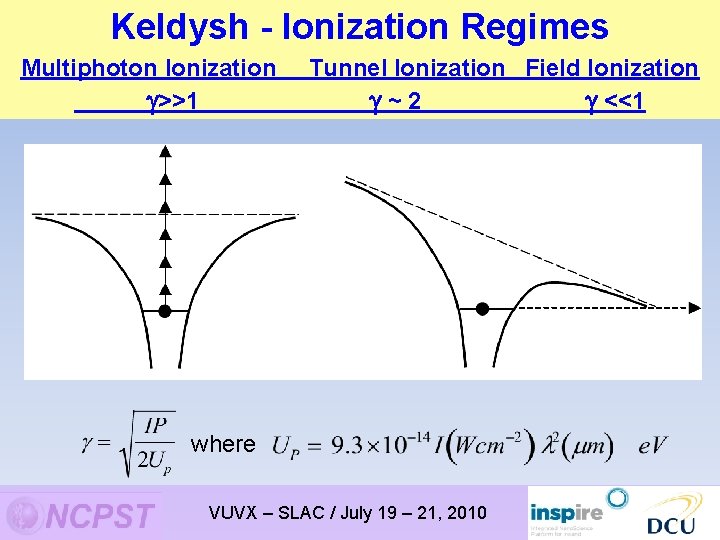
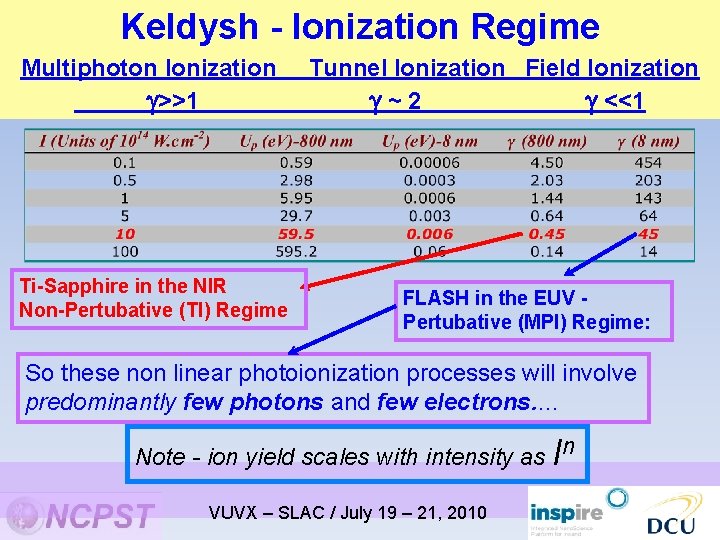
Keldysh - Ionization Regimes Multiphoton Ionization >>1 Tunnel Ionization Field Ionization ~2 <<1 where VUVX – SLAC / July 19 – 21, 2010
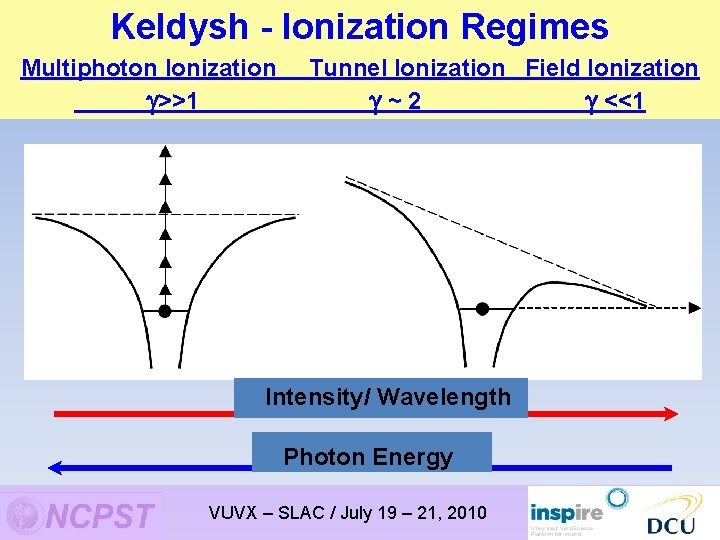
Keldysh - Ionization Regimes Multiphoton Ionization >>1 Tunnel Ionization Field Ionization ~2 <<1 Intensity/ Wavelength Photon Energy VUVX – SLAC / July 19 – 21, 2010
Keldysh - Ionization Regime Multiphoton Ionization >>1 Ti-Sapphire in the NIR Non-Pertubative (TI) Regime Tunnel Ionization Field Ionization ~2 <<1 FLASH in the EUV Pertubative (MPI) Regime: So these non linear photoionization processes will involve predominantly few photons and few electrons. … Note - ion yield scales with intensity as In VUVX – SLAC / July 19 – 21, 2010
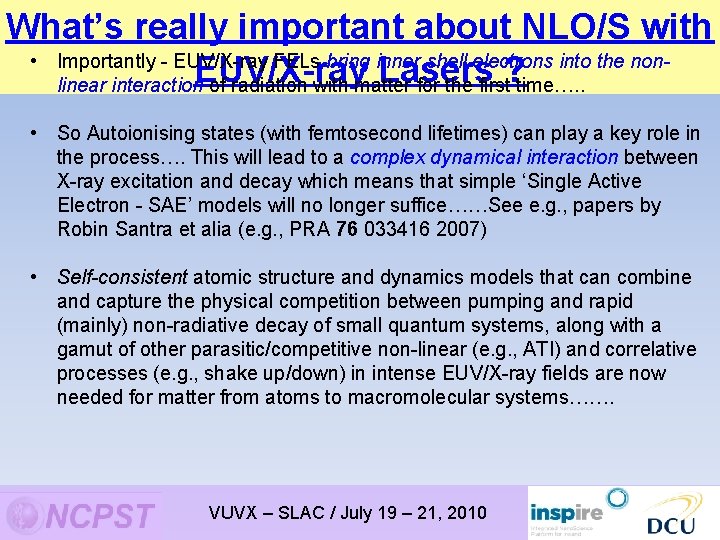
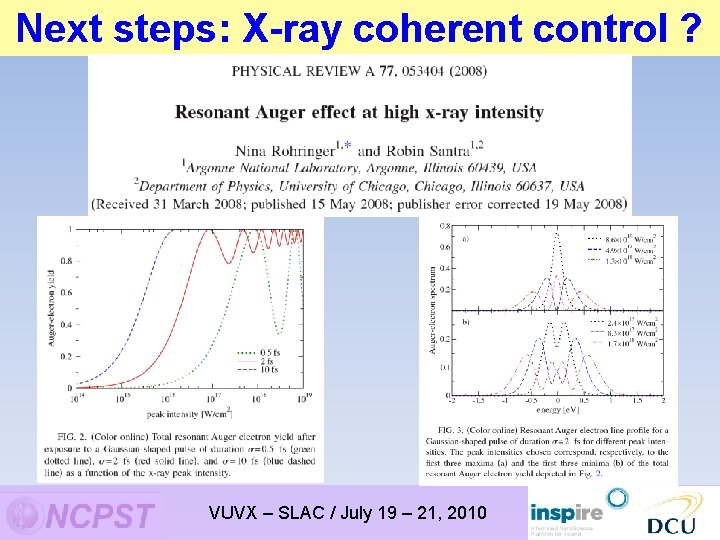
What’s really important about NLO/S with • Importantly - EUV/X-ray FELs bring inner shell electrons into the non. EUV/X-ray Lasers ? linear interaction of radiation with matter for the first time…. . • So Autoionising states (with femtosecond lifetimes) can play a key role in the process…. This will lead to a complex dynamical interaction between X-ray excitation and decay which means that simple ‘Single Active Electron - SAE’ models will no longer suffice……See e. g. , papers by Robin Santra et alia (e. g. , PRA 76 033416 2007) • Self-consistent atomic structure and dynamics models that can combine and capture the physical competition between pumping and rapid (mainly) non-radiative decay of small quantum systems, along with a gamut of other parasitic/competitive non-linear (e. g. , ATI) and correlative processes (e. g. , shake up/down) in intense EUV/X-ray fields are now needed for matter from atoms to macromolecular systems……. VUVX – SLAC / July 19 – 21, 2010
General EUV / XFEL AMOP Refs 1. Photoionization Experiments with the Ultrafast XUV Laser FLASH J. T. Costello, J Phys Conf Ser 88 Art No 012057 (2007) 2. Experiments at FLASH C. Bostedt et al. , Nucl. Inst. Meth. in Res. A 601 108 (2009) 3. Non-linear processes in the interaction of atoms and molecules with intense EUV and X-ray fields from SASE free electron lasers (FELs), N. Berrah et al. , Journal of Modern Optics (2010) (DOI: 10. 1080/09500340. 2010. 487946) VUVX – SLAC / July 19 – 21, 2010
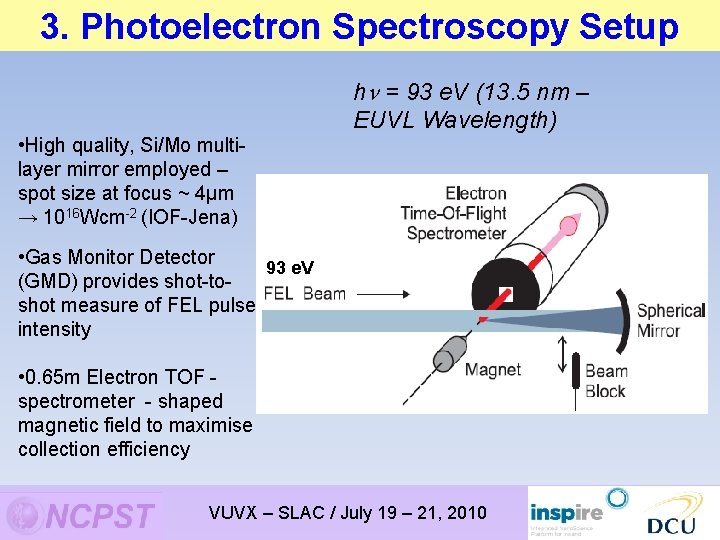
3. Photoelectron Spectroscopy Setup hn = 93 e. V (13. 5 nm – EUVL Wavelength) • High quality, Si/Mo multilayer mirror employed – spot size at focus ~ 4μm → 1016 Wcm-2 (IOF-Jena) • Gas Monitor Detector 93 e. V (GMD) provides shot-toshot measure of FEL pulse intensity • 0. 65 m Electron TOF spectrometer - shaped magnetic field to maximise collection efficiency VUVX – SLAC / July 19 – 21, 2010
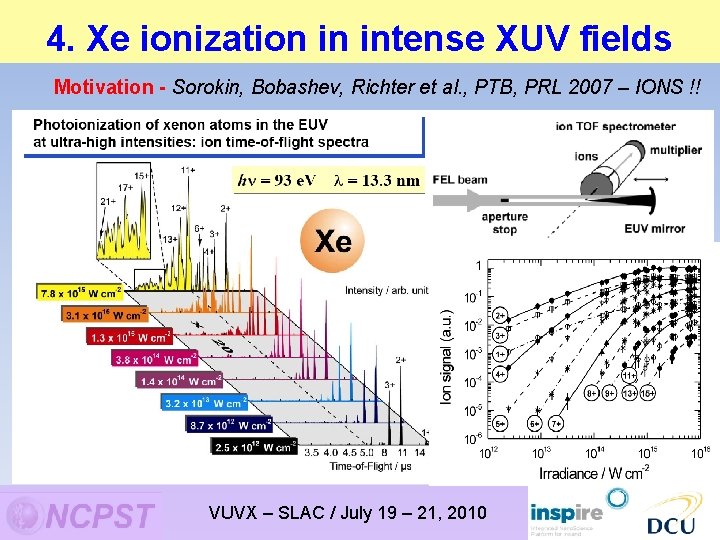
4. Xe ionization in intense XUV fields Motivation - Sorokin, Bobashev, Richter et al. , PTB, PRL 2007 – IONS !! VUVX – SLAC / July 19 – 21, 2010
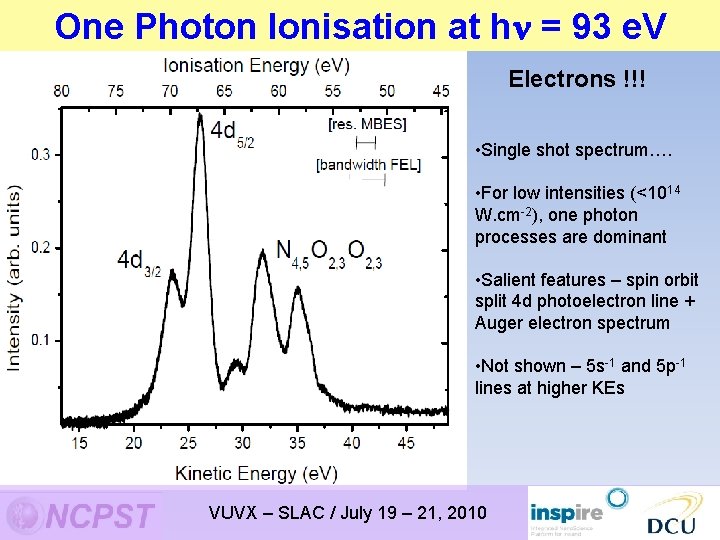
One Photon Ionisation at hn = 93 e. V Electrons !!! • Single shot spectrum…. • For low intensities (<1014 W. cm-2), one photon processes are dominant • Salient features – spin orbit split 4 d photoelectron line + Auger electron spectrum • Not shown – 5 s-1 and 5 p-1 lines at higher KEs VUVX – SLAC / July 19 – 21, 2010
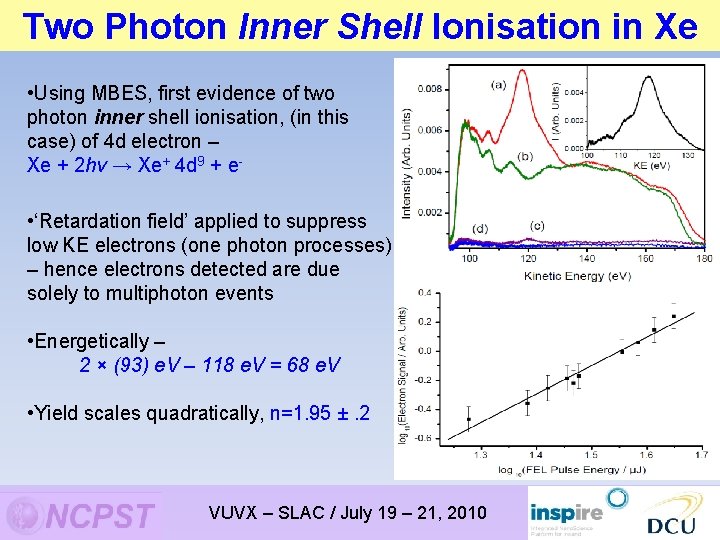
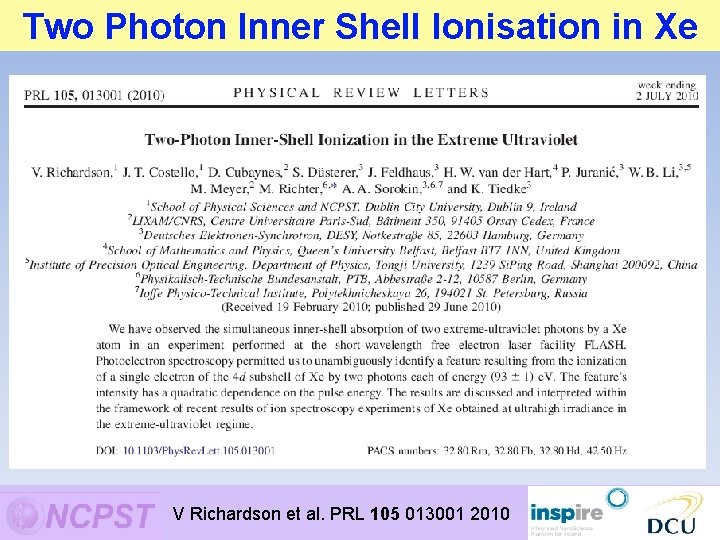
Two Photon Inner Shell Ionisation in Xe • Using MBES, first evidence of two photon inner shell ionisation, (in this case) of 4 d electron – Xe + 2 hv → Xe+ 4 d 9 + e • ‘Retardation field’ applied to suppress low KE electrons (one photon processes) – hence electrons detected are due solely to multiphoton events • Energetically – 2 × (93) e. V – 118 e. V = 68 e. V • Yield scales quadratically, n=1. 95 ±. 2 VUVX – SLAC / July 19 – 21, 2010
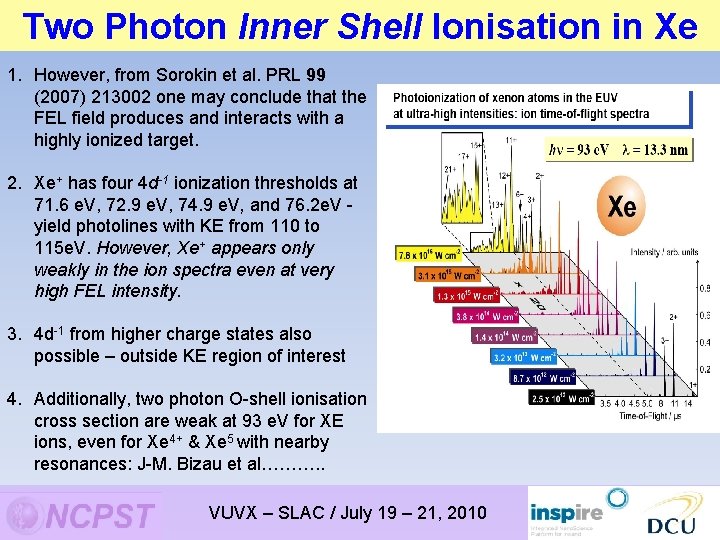
Two Photon Inner Shell Ionisation in Xe 1. However, from Sorokin et al. PRL 99 (2007) 213002 one may conclude that the FEL field produces and interacts with a highly ionized target. 2. Xe+ has four 4 d-1 ionization thresholds at 71. 6 e. V, 72. 9 e. V, 74. 9 e. V, and 76. 2 e. V yield photolines with KE from 110 to 115 e. V. However, Xe+ appears only weakly in the ion spectra even at very high FEL intensity. 3. 4 d-1 from higher charge states also possible – outside KE region of interest 4. Additionally, two photon O-shell ionisation cross section are weak at 93 e. V for XE ions, even for Xe 4+ & Xe 5 with nearby resonances: J-M. Bizau et al………. . VUVX – SLAC / July 19 – 21, 2010
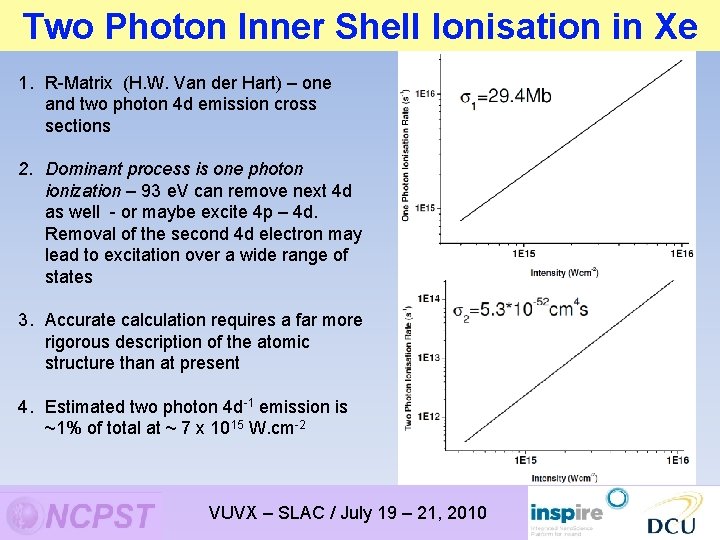
Two Photon Inner Shell Ionisation in Xe 1. R-Matrix (H. W. Van der Hart) – one and two photon 4 d emission cross sections 2. Dominant process is one photon ionization – 93 e. V can remove next 4 d as well - or maybe excite 4 p – 4 d. Removal of the second 4 d electron may lead to excitation over a wide range of states 3. Accurate calculation requires a far more rigorous description of the atomic structure than at present 4. Estimated two photon 4 d-1 emission is ~1% of total at ~ 7 x 10¹⁵ W. cm-2 VUVX – SLAC / July 19 – 21, 2010
Two Photon Inner Shell Ionisation in Xe V Richardson et al. PRL 105 013001 2010
5. Resonant two photon Excitation of Kr 1. To date we have looked at a non-resonant two photon process (sort of ATI really) 2. FEL are wavelength tunable, so one can also explore resonant two photon processes VUVX – SLAC / July 19 – 21, 2010
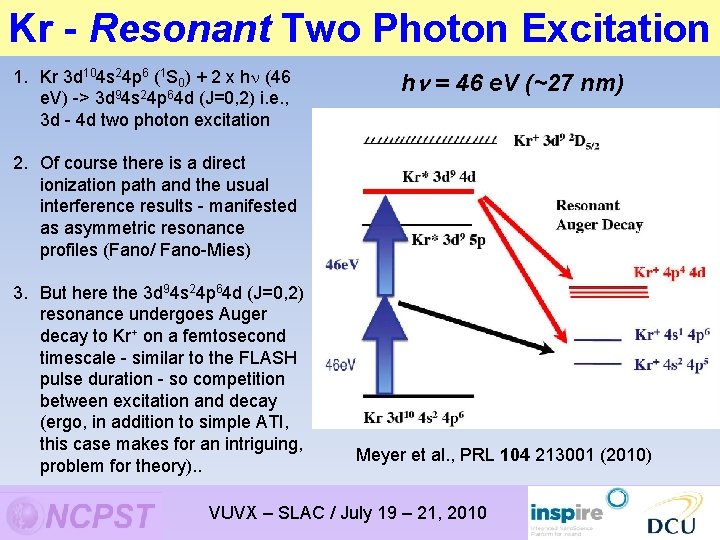
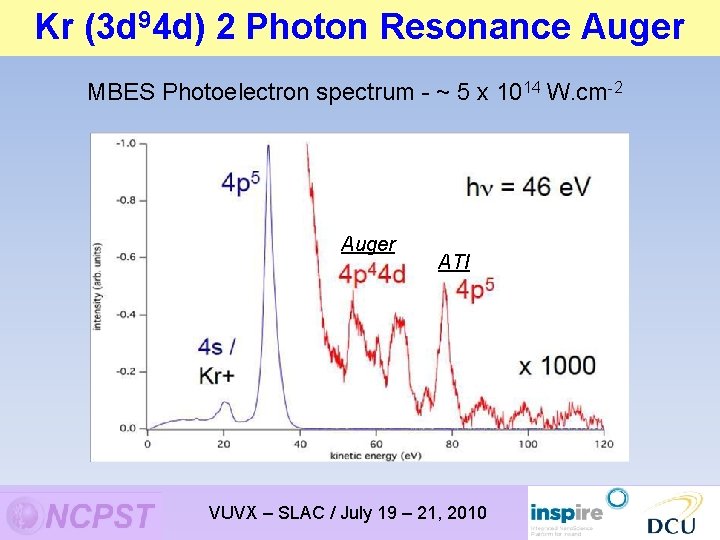
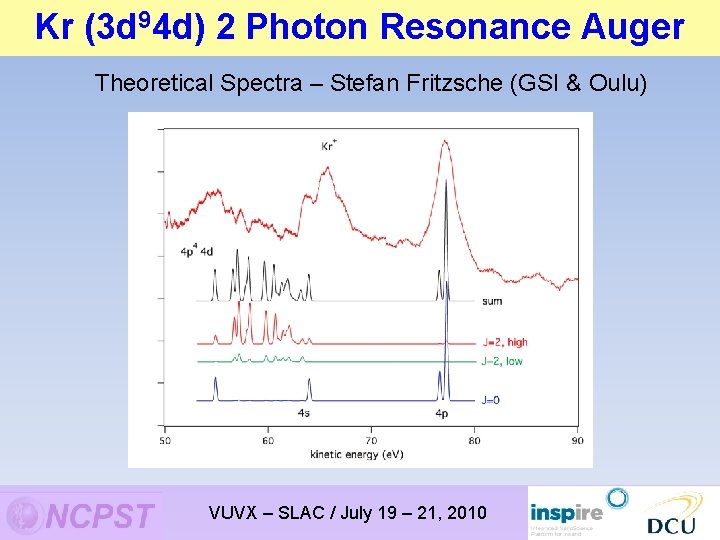
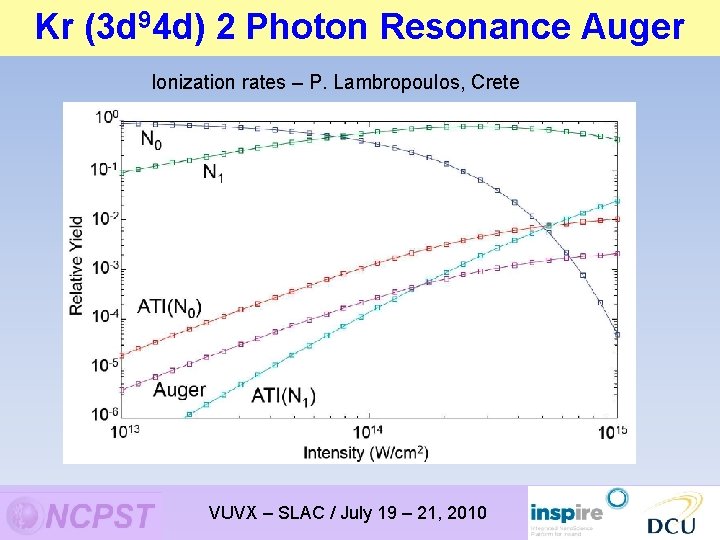
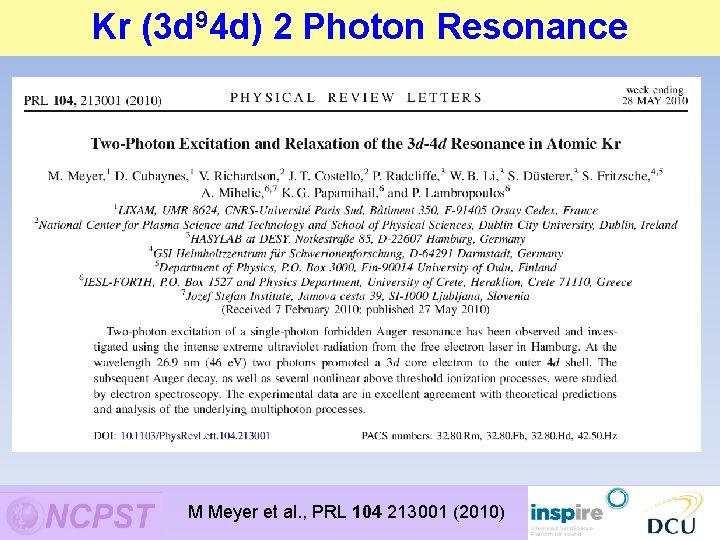
Kr - Resonant Two Photon Excitation 1. Kr 3 d 104 s 24 p 6 (1 S 0) + 2 x h (46 e. V) -> 3 d 94 s 24 p 64 d (J=0, 2) i. e. , 3 d - 4 d two photon excitation hn = 46 e. V (~27 nm) 2. Of course there is a direct ionization path and the usual interference results - manifested as asymmetric resonance profiles (Fano/ Fano-Mies) 3. But here the 3 d 94 s 24 p 64 d (J=0, 2) resonance undergoes Auger decay to Kr+ on a femtosecond timescale - similar to the FLASH pulse duration - so competition between excitation and decay (ergo, in addition to simple ATI, this case makes for an intriguing, problem for theory). . Meyer et al. , PRL 104 213001 (2010) VUVX – SLAC / July 19 – 21, 2010
94 d) 2 Photon Resonance Auger Kr -(3 d Resonant Two Photon Excitation MBES Photoelectron spectrum - ~ 5 x 10¹⁴ W. cm-2 Auger ATI VUVX – SLAC / July 19 – 21, 2010
94 d) 2 Photon Resonance Auger Kr -(3 d Resonant Two Photon Excitation Theoretical Spectra – Stefan Fritzsche (GSI & Oulu) VUVX – SLAC / July 19 – 21, 2010
94 d) 2 Photon Resonance Auger Kr -(3 d Resonant Two Photon Excitation Ionization rates – P. Lambropoulos, Crete VUVX – SLAC / July 19 – 21, 2010
94 d) 2 Photon Resonance Kr (3 d Kr - Resonant Two Photon Excitation M Meyer et al. , PRL 104 213001 (2010)
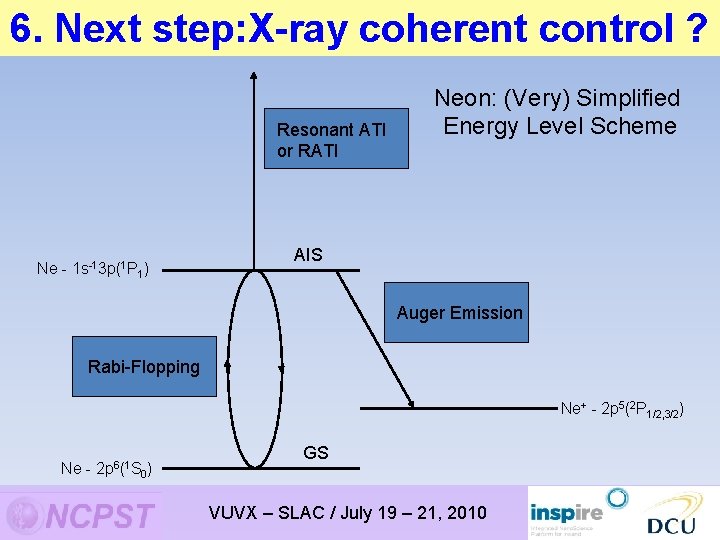
6. Next step: X-ray coherent control ? Resonant ATI or RATI Ne - 1 s-13 p(1 P 1) Neon: (Very) Simplified Energy Level Scheme AIS Auger Emission Rabi-Flopping Ne+ - 2 p 5(2 P 1/2, 3/2) Ne - 2 p 6(1 S 0) GS VUVX – SLAC / July 19 – 21, 2010
Next steps: X-ray coherent control ? VUVX – SLAC / July 19 – 21, 2010
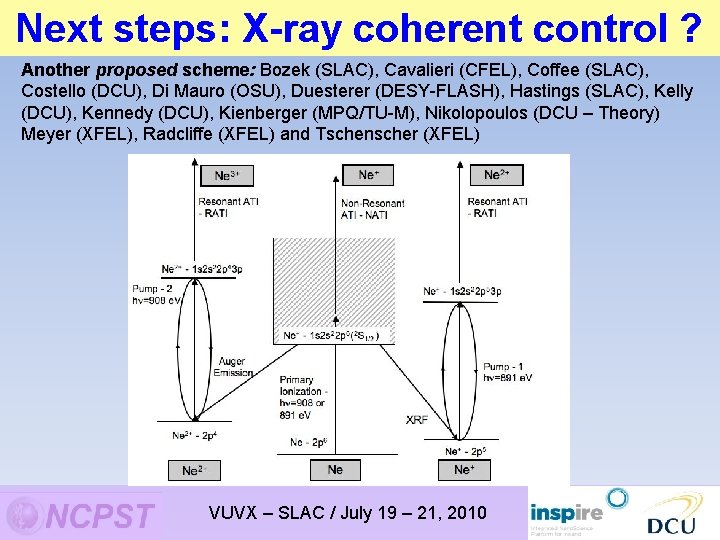
Next steps: X-ray coherent control ? Another proposed scheme: Bozek (SLAC), Cavalieri (CFEL), Coffee (SLAC), Costello (DCU), Di Mauro (OSU), Duesterer (DESY-FLASH), Hastings (SLAC), Kelly (DCU), Kennedy (DCU), Kienberger (MPQ/TU-M), Nikolopoulos (DCU – Theory) Meyer (XFEL), Radcliffe (XFEL) and Tschenscher (XFEL) VUVX – SLAC / July 19 – 21, 2010
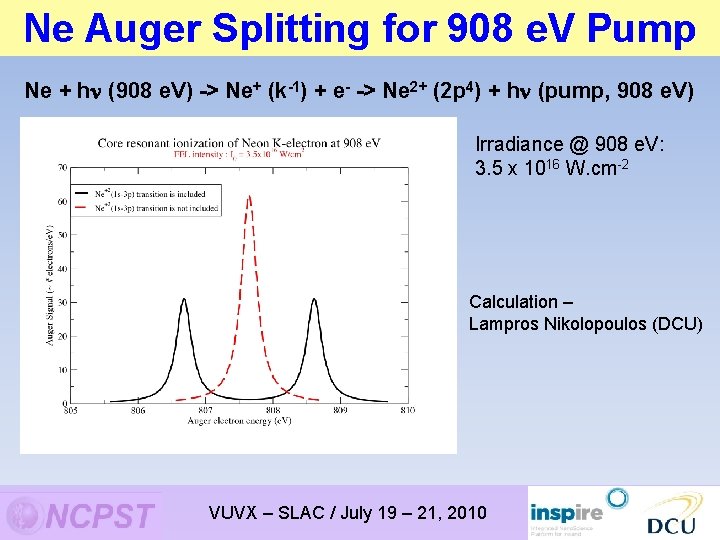
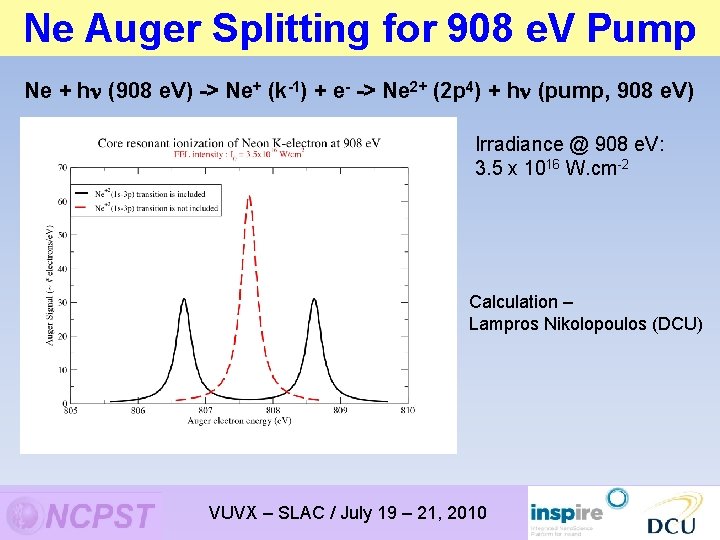
Ne Auger Splitting for 908 e. V Pump Ne + hn (908 e. V) -> Ne+ (k-1) + e- -> Ne 2+ (2 p 4) + hn (pump, 908 e. V) Irradiance @ 908 e. V: 3. 5 x 10¹⁶ W. cm-2 Calculation – Lampros Nikolopoulos (DCU) VUVX – SLAC / July 19 – 21, 2010
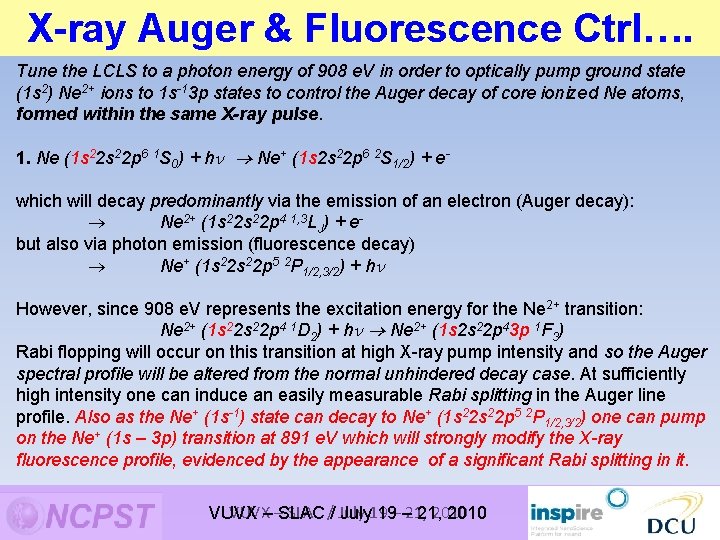
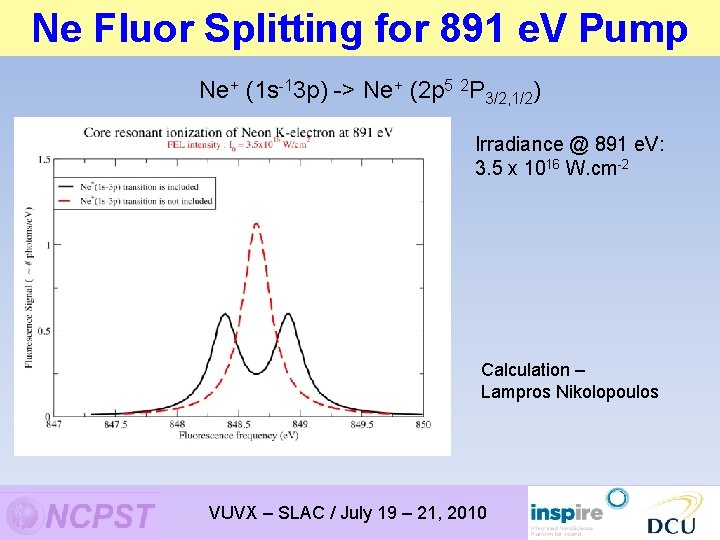
X-ray Next steps: Auger. X-ray & Fluorescence coherent control Ctrl…. ? Tune the LCLS to a photon energy of 908 e. V in order to optically pump ground state (1 s 2) Ne 2+ ions to 1 s-13 p states to control the Auger decay of core ionized Ne atoms, formed within the same X-ray pulse. 1. Ne (1 s 22 p 6 1 S 0) + hn Ne+ (1 s 2 s 22 p 6 2 S 1/2) + ewhich will decay predominantly via the emission of an electron (Auger decay): Ne 2+ (1 s 22 p 4 1, 3 LJ) + ebut also via photon emission (fluorescence decay) Ne+ (1 s 22 p 5 2 P 1/2, 3/2) + hn However, since 908 e. V represents the excitation energy for the Ne 2+ transition: Ne 2+ (1 s 22 p 4 1 D 2) + hn Ne 2+ (1 s 2 s 22 p 43 p 1 F 3) Rabi flopping will occur on this transition at high X-ray pump intensity and so the Auger spectral profile will be altered from the normal unhindered decay case. At sufficiently high intensity one can induce an easily measurable Rabi splitting in the Auger line profile. Also as the Ne+ (1 s-1) state can decay to Ne+ (1 s 22 p 5 2 P 1/2, 3/2) one can pump on the Ne+ (1 s – 3 p) transition at 891 e. V which will strongly modify the X-ray fluorescence profile, evidenced by the appearance of a significant Rabi splitting in it. VUVX– –SLAC // July 2010 VUVX July 19 19– – 21, 2010
Ne Auger Splitting for 908 e. V Pump Ne + hn (908 e. V) -> Ne+ (k-1) + e- -> Ne 2+ (2 p 4) + hn (pump, 908 e. V) Irradiance @ 908 e. V: 3. 5 x 10¹⁶ W. cm-2 Calculation – Lampros Nikolopoulos (DCU) VUVX – SLAC / July 19 – 21, 2010
Ne Fluor Splitting for 891 e. V Pump Ne+ (1 s-13 p) -> Ne+ (2 p 5 2 P 3/2, 1/2) Irradiance @ 891 e. V: 3. 5 x 10¹⁶ W. cm-2 Calculation – Lampros Nikolopoulos VUVX – SLAC / July 19 – 21, 2010
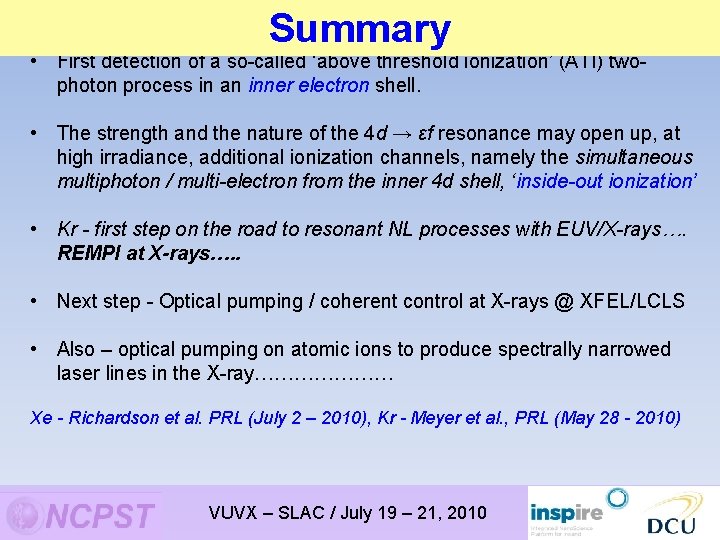
Summary • First detection of a so-called ‘above threshold ionization’ (ATI) twophoton process in an inner electron shell. • The strength and the nature of the 4 d → εf resonance may open up, at high irradiance, additional ionization channels, namely the simultaneous multiphoton / multi-electron from the inner 4 d shell, ‘inside-out ionization’ • Kr - first step on the road to resonant NL processes with EUV/X-rays…. REMPI at X-rays…. . • Next step - Optical pumping / coherent control at X-rays @ XFEL/LCLS • Also – optical pumping on atomic ions to produce spectrally narrowed laser lines in the X-ray………………… Xe - Richardson et al. PRL (July 2 – 2010), Kr - Meyer et al. , PRL (May 28 - 2010) VUVX – SLAC / July 19 – 21, 2010