
Multiphoton absorption and ionization of molecules Technical improvements
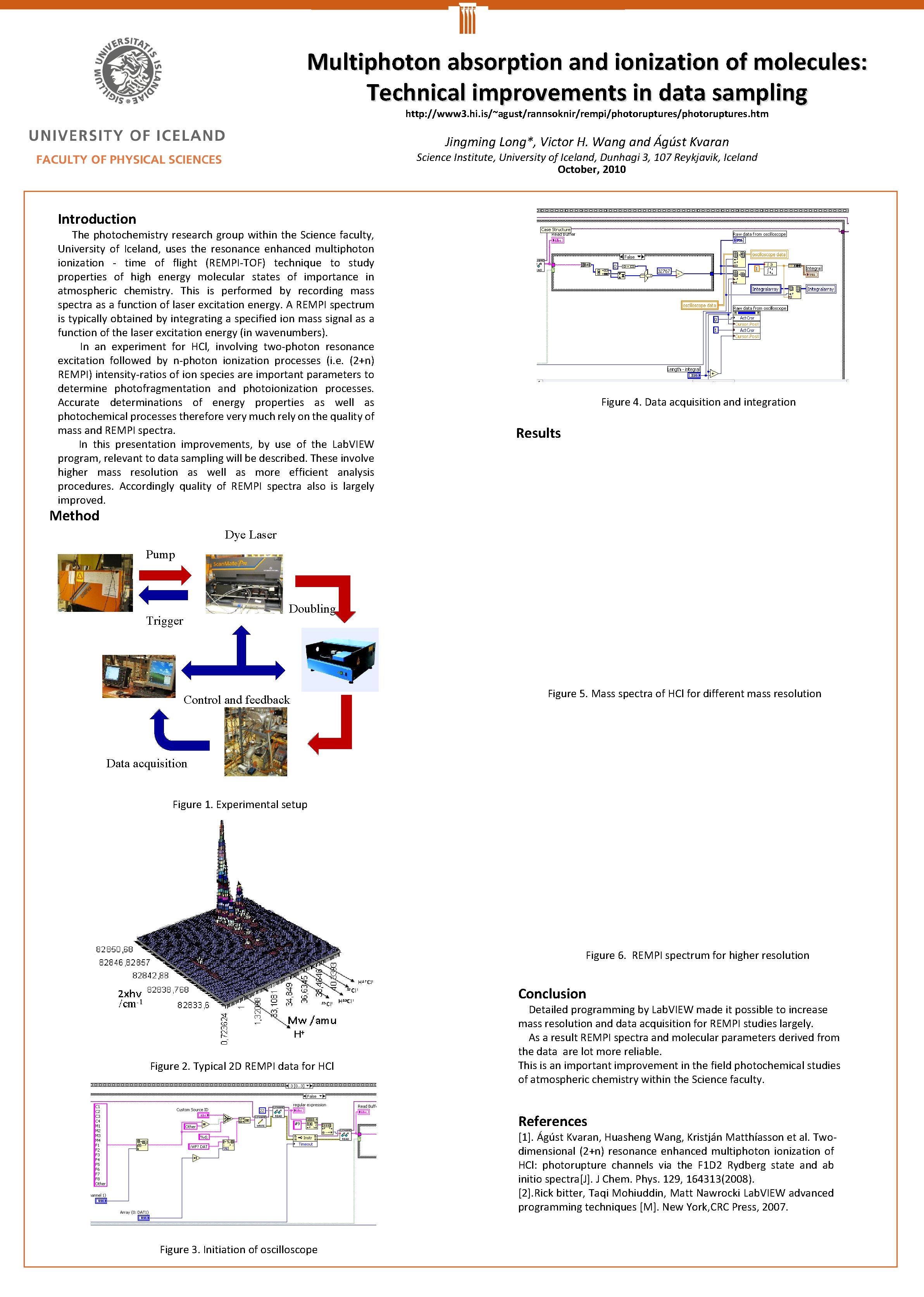
Multiphoton absorption and ionization of molecules: Technical improvements in data sampling http: //www 3. hi. is/~agust/rannsoknir/rempi/photoruptures. htm Jingming Long*, Victor H. Wang and Ágúst Kvaran Science Institute, University of Iceland, Dunhagi 3, 107 Reykjavik, Iceland October, 2010 Introduction The photochemistry research group within the Science faculty, University of Iceland, uses the resonance enhanced multiphoton ionization - time of flight (REMPI-TOF) technique to study properties of high energy molecular states of importance in atmospheric chemistry. This is performed by recording mass spectra as a function of laser excitation energy. A REMPI spectrum is typically obtained by integrating a specified ion mass signal as a function of the laser excitation energy (in wavenumbers). In an experiment for HCl, involving two-photon resonance excitation followed by n-photon ionization processes (i. e. (2+n) REMPI) intensity-ratios of ion species are important parameters to determine photofragmentation and photoionization processes. Accurate determinations of energy properties as well as photochemical processes therefore very much rely on the quality of mass and REMPI spectra. In this presentation improvements, by use of the Lab. VIEW program, relevant to data sampling will be described. These involve higher mass resolution as well as more efficient analysis procedures. Accordingly quality of REMPI spectra also is largely improved. Figure 4. Data acquisition and integration Results Method Dye Laser Pump Doubling Trigger AA A Control and feedback B Figure 5. Mass spectra of HCl for different mass resolution Data acquisition C D Figure 1. Experimental setup Figure 6. REMPI spectrum for higher resolution Conclusion Figure 2. Typical 2 D REMPI data for HCl Detailed programming by Lab. VIEW made it possible to increase mass resolution and data acquisition for REMPI studies largely. As a result REMPI spectra and molecular parameters derived from the data are lot more reliable. This is an important improvement in the field photochemical studies of atmospheric chemistry within the Science faculty. References [1]. Ágúst Kvaran, Huasheng Wang, Kristján Matthíasson et al. Twodimensional (2+n) resonance enhanced multiphoton ionization of HCl: photorupture channels via the F 1 D 2 Rydberg state and ab initio spectra[J]. J Chem. Phys. 129, 164313(2008). [2]. Rick bitter, Taqi Mohiuddin, Matt Nawrocki Lab. VIEW advanced programming techniques [M]. New York, CRC Press, 2007. Figure 3. Initiation of oscilloscope
- Slides: 1