
Multipath Routing in Wireless Mesh Networks Mobile Adhoc
Multipath Routing in Wireless Mesh Networks Mobile Adhoc and Sensor Systems (MASS), 2006 IEEE International Conference on Author: Nagesh S. Nandiraju, Deepti S. Nandiraju, and Dharma P. Agrawal 1
Outline • • • Introduction MMESH Traffic balancing Performance Evaluation Conclusion 2
Introduction(1/2) • Wireless Mesh Networks are envisioned to support the wired backbone with a wireless backbone for providing internet connectivity to residential areas and offices. • Routing protocols designed for Mobile Adhoc Networks (MANETs) primarily concentrate on finding a single best possible route to any destination out of the various paths available. 3
Introduction(2/2) • However in wireless mesh networks, traffic is primarily routed either towards the Internet Gateways (IGWs) or from the IGWs to the Access Points (APs). • Thus, if multiple APs choose the best throughput path towards a gateway, the traffic loads on certain paths and mesh routers increases tremendously thereby deteriorating the overall performance of the network. 4
Multi-path routing in wireless mesh networks (MMESH)(1/3) • Multipath routing is the routing technique of using multiple alternative paths through a network, which can yield a variety of benefits such as fault tolerance, increased bandwidth, or improved security. 5
Multi-path routing in wireless mesh networks (MMESH)(2/3) • This method provides better transmission performance and fault tolerance by providing: -Simultaneous, parallel transport over multiple carriers. -Load balancing over available assets. -Avoidance of path discovery when reassigning an interrupted stream. 6
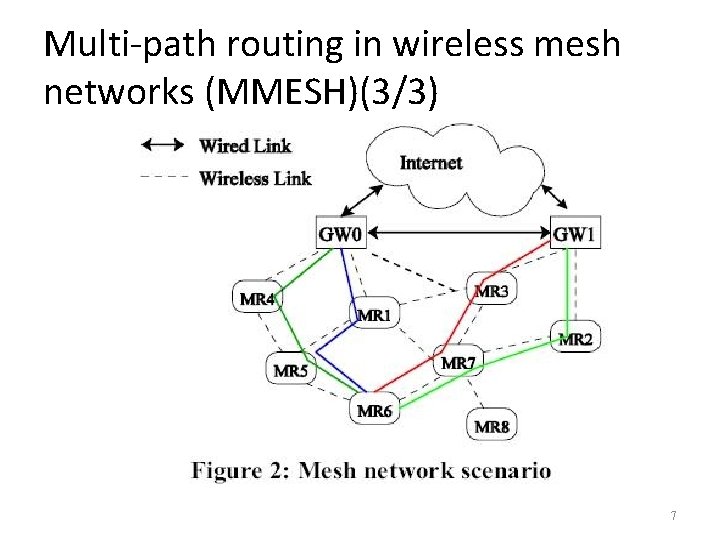
Multi-path routing in wireless mesh networks (MMESH)(3/3) 7
Traffic balancing • Once we have these multiple routes setup, our task is to divide the traffic among these routes to balance the load, without degrading the performance. - Round Robin scheduling - Congestion aware routing 8
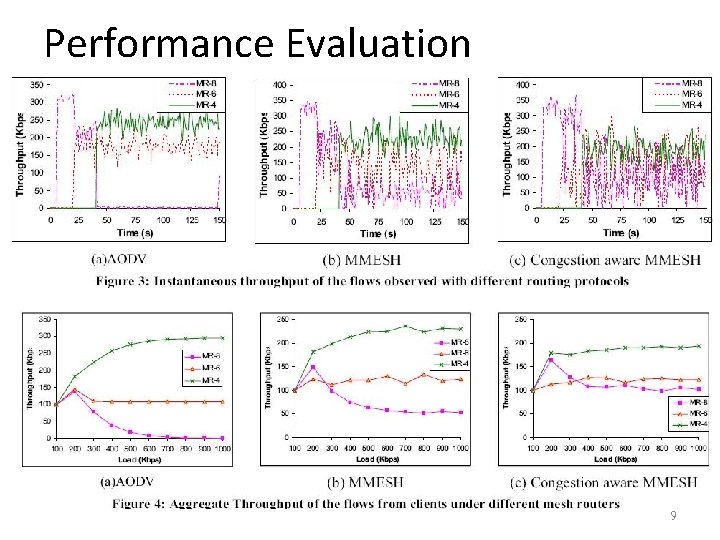
Performance Evaluation 9
Conclusion • This paper introduces the important propose a proactive multipath routing protocol which exploits the multiple routes between the MRs and the gateways to balance traffic load. • Simulation results reveal that single path routing leads to severe packet loss and consequently very low end –to-end throughput for longer hop length flows. 10
- Slides: 10