
MULTIPATH ROUTING A packet by packet multipath routing
MULTI-PATH ROUTING A packet by packet multi-path routing approach 1
OVERVIEW n Multi-path routing (Benefits / Problems) n Multi-Path routing Transport Protocol n Per-hop Packet Distribution n Simulation results 2
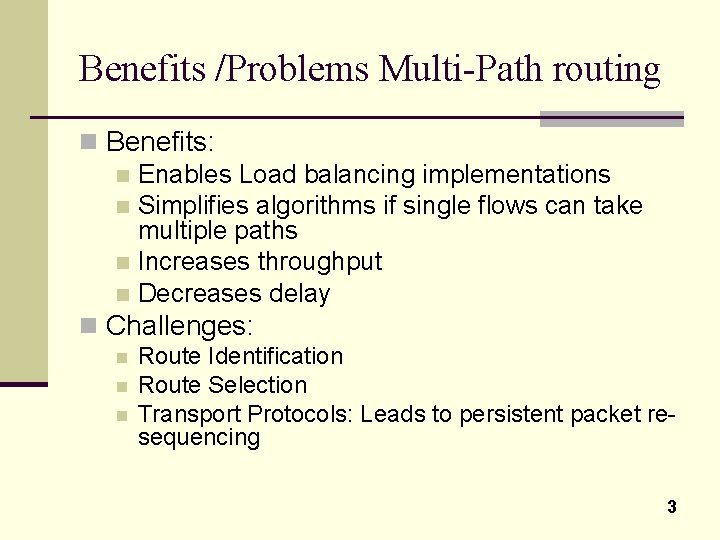
Benefits /Problems Multi-Path routing n Benefits: n Enables Load balancing implementations n Simplifies algorithms if single flows can take multiple paths n Increases throughput n Decreases delay n Challenges: n n n Route Identification Route Selection Transport Protocols: Leads to persistent packet resequencing 3
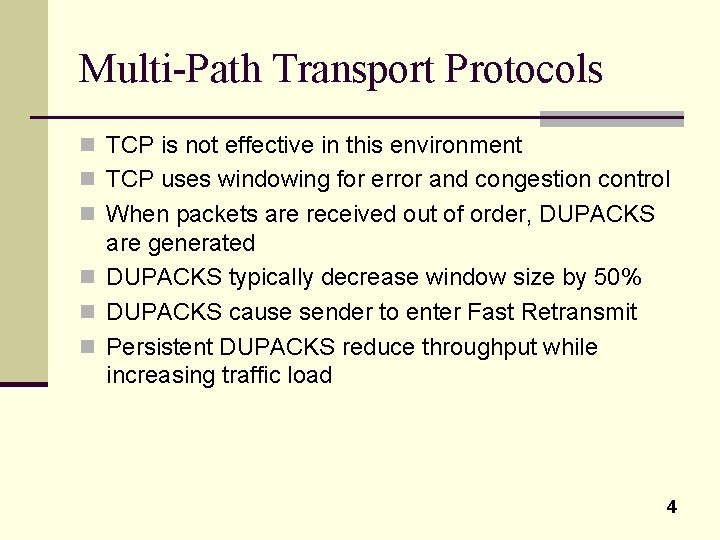
Multi-Path Transport Protocols n TCP is not effective in this environment n TCP uses windowing for error and congestion control n When packets are received out of order, DUPACKS are generated n DUPACKS typically decrease window size by 50% n DUPACKS cause sender to enter Fast Retransmit n Persistent DUPACKS reduce throughput while increasing traffic load 4
Multi Path Transport Protocols n Eifel Algorithm n n Uses time-stamp option to differentiate between transmissions and re-transmissions Restores TCP congestion window to value prior to retransmit when packet received n DSACK n n Uses DSACK option to communicate from receiver to sender Dynamically manipulate dupthresh value n TCP Persistent Reordering n Ignores DUPACKS. Uses timers to identify packet loss 5
Route Selection n Round Robin and pure load balancing not effective n Do not take network conditions into consideration n Minimum Delay Routing n As delay increases, the proportion of traffic distributed to that rout decreases 6
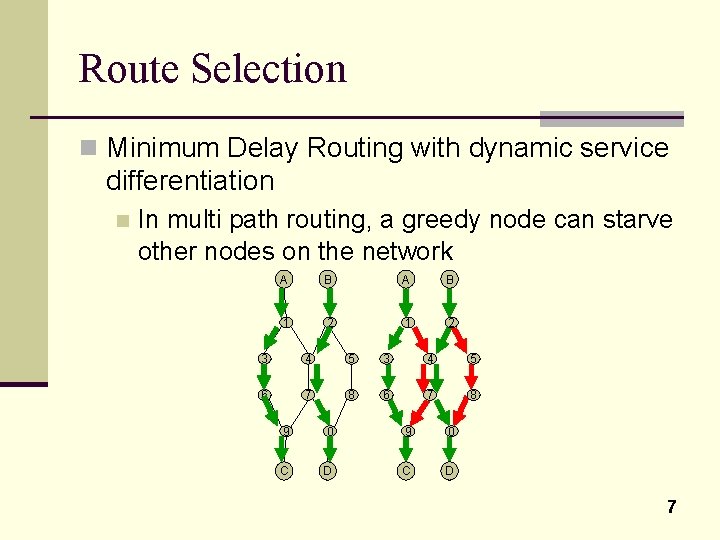
Route Selection n Minimum Delay Routing with dynamic service differentiation n In multi path routing, a greedy node can starve other nodes on the network A B 1 2 3 4 5 6 7 8 9 0 C D 7
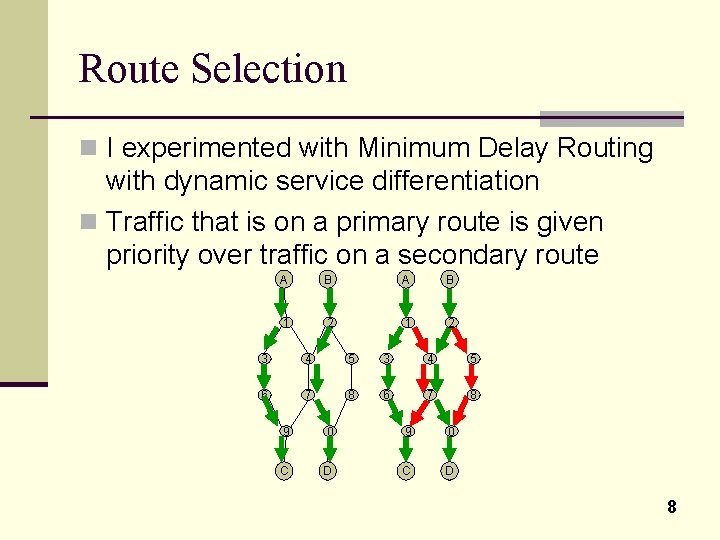
Route Selection n I experimented with Minimum Delay Routing with dynamic service differentiation n Traffic that is on a primary route is given priority over traffic on a secondary route A B 1 2 3 4 5 6 7 8 9 0 C D 8

Simulation Method n Developed Network Simulator software similar to the Click Router Platform n C++ objects represent Nodes and Links n Static Multi-Paths n RR, and Minimum Delay Routing as Route Selection methods n TCP-PR as transport protocol 9
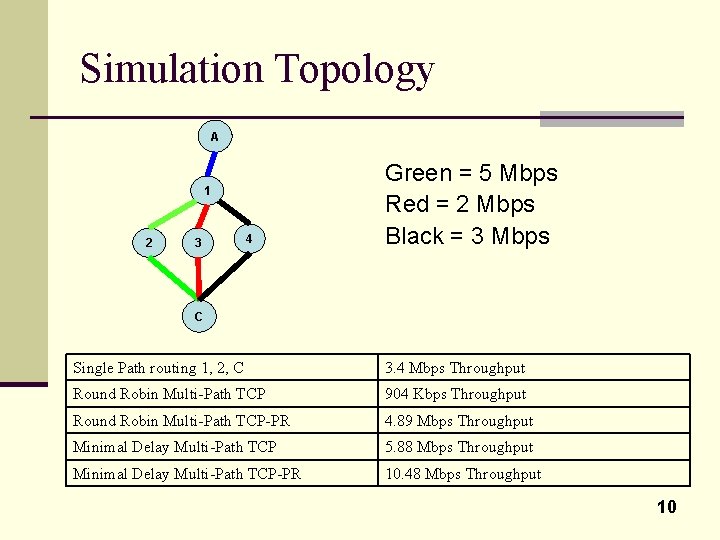
Simulation Topology A 1 2 3 4 Green = 5 Mbps Red = 2 Mbps Black = 3 Mbps C Single Path routing 1, 2, C 3. 4 Mbps Throughput Round Robin Multi-Path TCP 904 Kbps Throughput Round Robin Multi-Path TCP-PR 4. 89 Mbps Throughput Minimal Delay Multi-Path TCP 5. 88 Mbps Throughput Minimal Delay Multi-Path TCP-PR 10. 48 Mbps Throughput 10
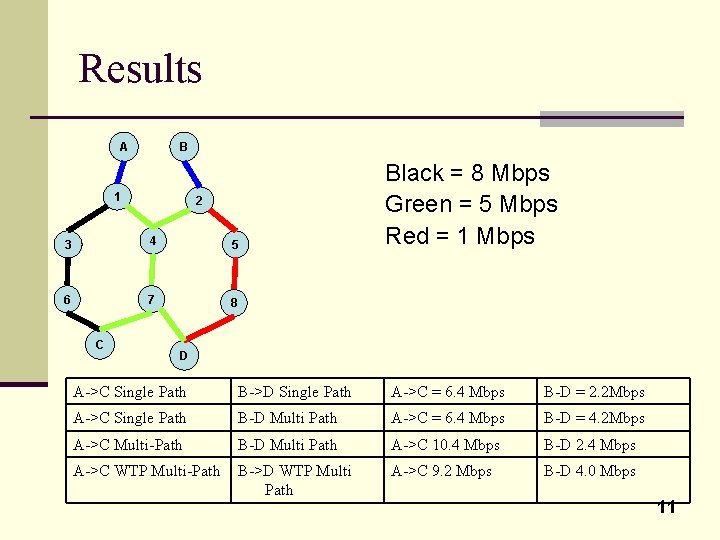
Results A B 1 2 3 4 5 6 7 8 C Black = 8 Mbps Green = 5 Mbps Red = 1 Mbps D A->C Single Path B->D Single Path A->C = 6. 4 Mbps B-D = 2. 2 Mbps A->C Single Path B-D Multi Path A->C = 6. 4 Mbps B-D = 4. 2 Mbps A->C Multi-Path B-D Multi Path A->C 10. 4 Mbps B-D 2. 4 Mbps A->C WTP Multi-Path B->D WTP Multi Path A->C 9. 2 Mbps B-D 4. 0 Mbps 11
References n S. Vutukury and J. J. Garcia-Luna-Aceves. A Simple Approximation to Minimum Delay Routing. Proc. of ACM SIGCOMM, Sept. 1999. n Stephan Bohacek, Joao Hespanha, Junsoo Lee, Chansook Lim, Katia Obraczka. A New TCP for Persistent Packet Reordering. TCP-PR, Accepted for Publication in Transactions on Networking, 2004 n S. Floyd, J. Mahdavi, M. Mathis, and M. Podolsky, “An extension to the selective acknowledgement (SACK) option for TCP. ” RFC 2883, 2000. n R. Ludwig and R. Katz, “The Eifel algorithm: Making TCP robust against spurious retransmissions, ” ACM Computer Communication Review, vol. 30, no. 1, 2000. 12

TCP-PR QUESTIONS? 13
- Slides: 13