
Multinomial Logistic Regression MLR aka polytomousresponse Choice when


- Slides: 8
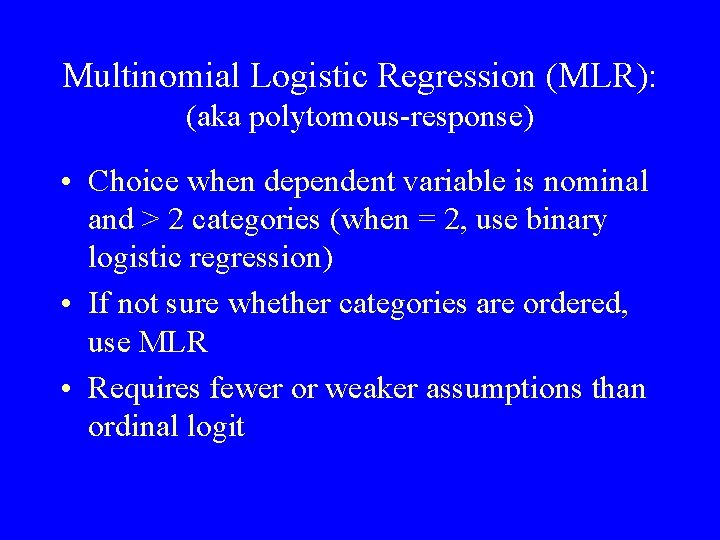
Multinomial Logistic Regression (MLR): (aka polytomous-response) • Choice when dependent variable is nominal and > 2 categories (when = 2, use binary logistic regression) • If not sure whether categories are ordered, use MLR • Requires fewer or weaker assumptions than ordinal logit
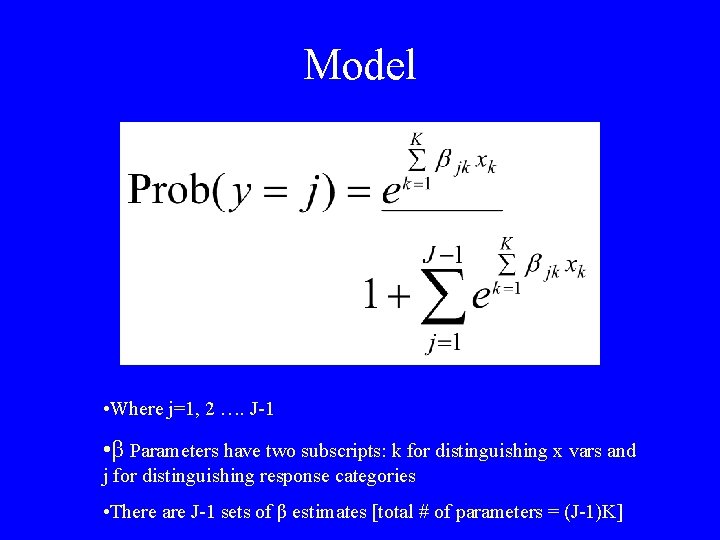
Model • Where j=1, 2 …. J-1 • β Parameters have two subscripts: k for distinguishing x vars and j for distinguishing response categories • There are J-1 sets of β estimates [total # of parameters = (J-1)K]
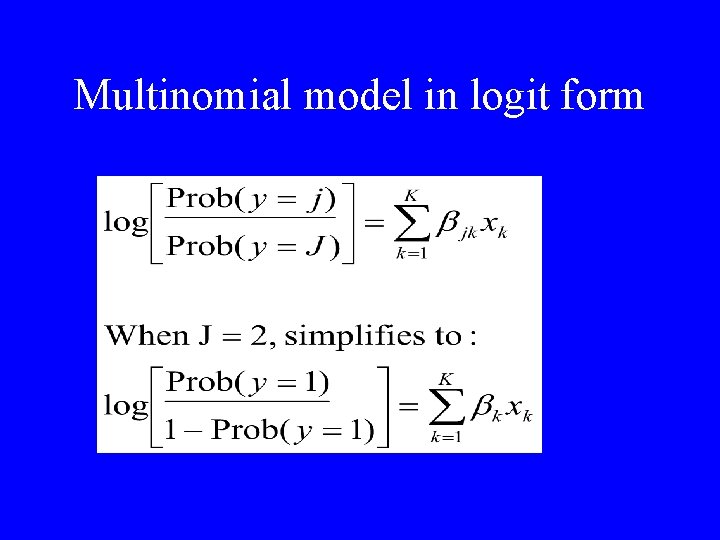
Binary dependent variable, simplifies to:
Probability for reference category
Multinomial model in logit form
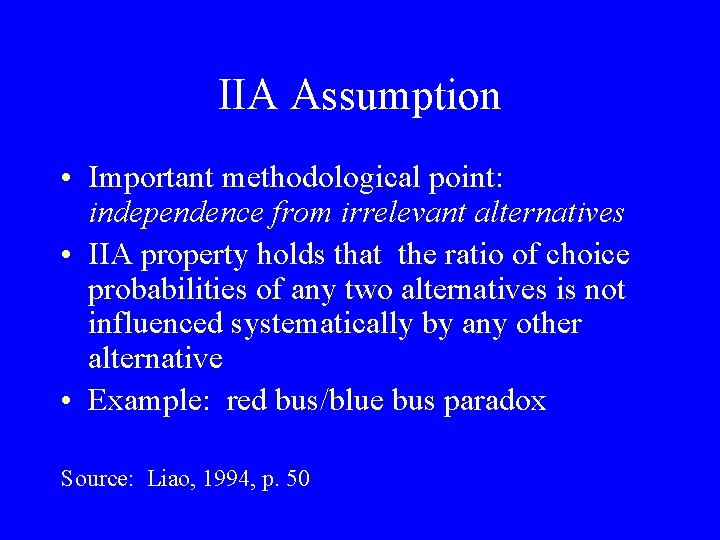
IIA Assumption • Important methodological point: independence from irrelevant alternatives • IIA property holds that the ratio of choice probabilities of any two alternatives is not influenced systematically by any other alternative • Example: red bus/blue bus paradox Source: Liao, 1994, p. 50
Interpretation: MLR (positive coefficients; odds ratios > 1) • Logit coefficients: being black increases the log odds of being in masculine occupations relative to whites • Odds ratios: Blacks are over two times as likely as whites to be in masculine occupations
Interpretation: MLR (negative coefficients; odds ratios <1) • Logit coefficients: being a citizen reduces the log odds of being in masculine occupations relative to whites • Odds ratios: the odds for citizens to be in masculine occupations are only. 678 times as high as those for noncitizens