
Multimodule programming MODEL directive MODEL memorymodel language TINY
![MODEL directive. MODEL memory_model [, language] TINY, SMALL, MEDIUM, COMPACT, LARGE, HUGE, TPASCAL, C,](https://slidetodoc.com/presentation_image_h2/f0d32d524c358c6f45e6468feba484b7/image-2.jpg "MODEL directive. MODEL memory_model [, language] TINY, SMALL, MEDIUM, COMPACT, LARGE, HUGE, TPASCAL, C,")
![The two modules will be separately assembled: TASM MAIN[. ASM] TASM SUB[. ASM] the](https://slidetodoc.com/presentation_image_h2/f0d32d524c358c6f45e6468feba484b7/image-10.jpg "The two modules will be separately assembled: TASM MAIN[. ASM] TASM SUB[. ASM] the")
- Slides: 31
Multi-module programming
MODEL directive. MODEL memory_model [, language] TINY, SMALL, MEDIUM, COMPACT, LARGE, HUGE, TPASCAL, C, CPP, BASIC, FORTRAN, PROLOG and NOLANGUAGE it specifies the segmentation model used by the program it specifies the default conventions for the automatically generated call code, entry code and exit code and the way the global symbols are exported (imported)
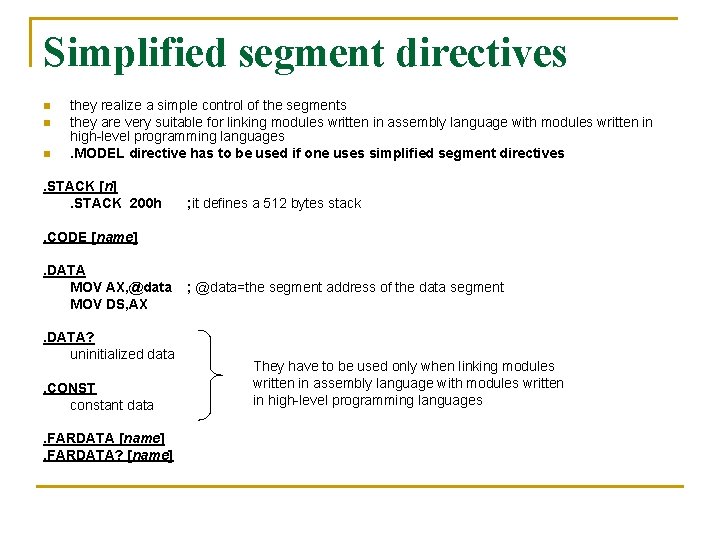
Simplified segment directives n n n they realize a simple control of the segments they are very suitable for linking modules written in assembly language with modules written in high-level programming languages. MODEL directive has to be used if one uses simplified segment directives . STACK [n]. STACK 200 h ; it defines a 512 bytes stack . CODE [name]. DATA MOV AX, @data MOV DS, AX. DATA? uninitialized data. CONST constant data. FARDATA [name]. FARDATA? [name] ; @data=the segment address of the data segment They have to be used only when linking modules written in assembly language with modules written in high-level programming languages
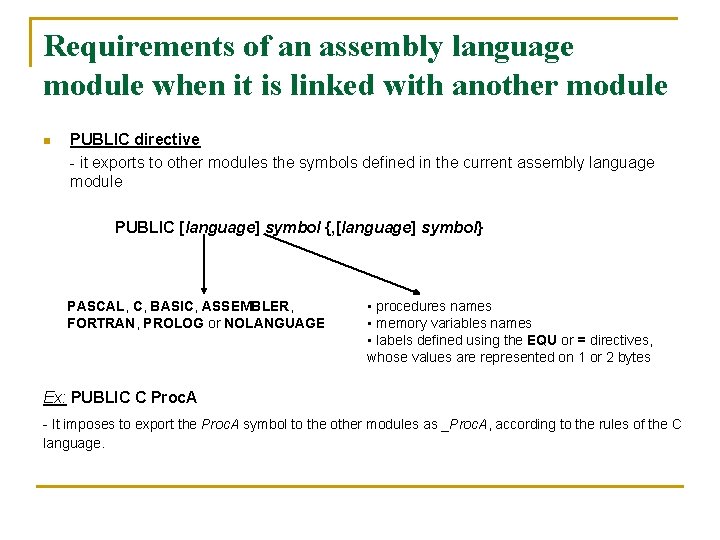
Requirements of an assembly language module when it is linked with another module n PUBLIC directive - it exports to other modules the symbols defined in the current assembly language module PUBLIC [language] symbol {, [language] symbol} PASCAL, C, BASIC, ASSEMBLER, FORTRAN, PROLOG or NOLANGUAGE • procedures names • memory variables names • labels defined using the EQU or = directives, whose values are represented on 1 or 2 bytes Ex: PUBLIC C Proc. A - It imposes to export the Proc. A symbol to the other modules as _Proc. A, according to the rules of the C language.
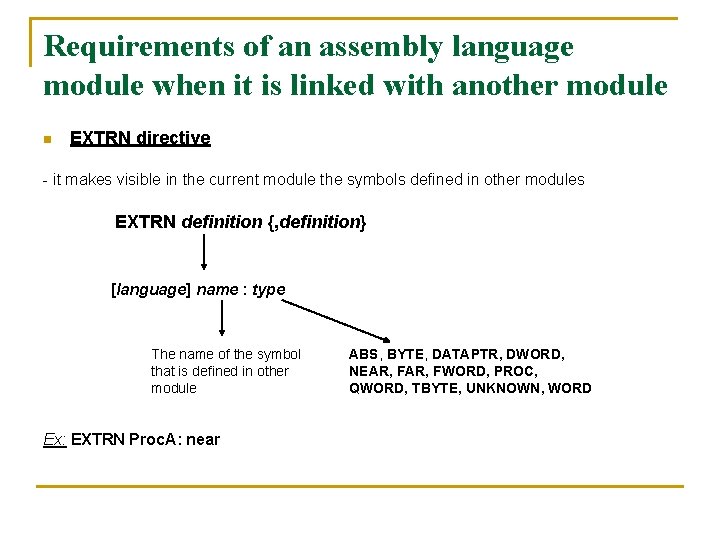
Requirements of an assembly language module when it is linked with another module n EXTRN directive - it makes visible in the current module the symbols defined in other modules EXTRN definition {, definition} [language] name : type The name of the symbol that is defined in other module Ex: EXTRN Proc. A: near ABS, BYTE, DATAPTR, DWORD, NEAR, FWORD, PROC, QWORD, TBYTE, UNKNOWN, WORD
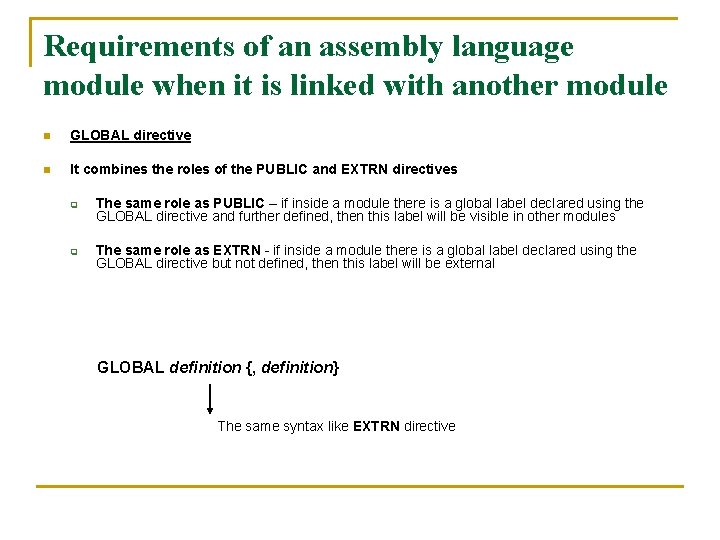
Requirements of an assembly language module when it is linked with another module n GLOBAL directive n It combines the roles of the PUBLIC and EXTRN directives q q The same role as PUBLIC – if inside a module there is a global label declared using the GLOBAL directive and further defined, then this label will be visible in other modules The same role as EXTRN - if inside a module there is a global label declared using the GLOBAL directive but not defined, then this label will be external GLOBAL definition {, definition} The same syntax like EXTRN directive
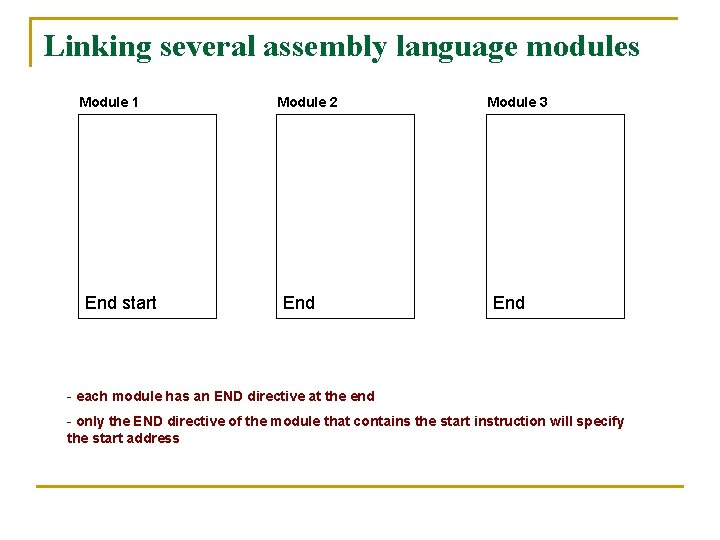
Linking several assembly language modules Module 1 End start Module 2 End Module 3 End - each module has an END directive at the end - only the END directive of the module that contains the start instruction will specify the start address
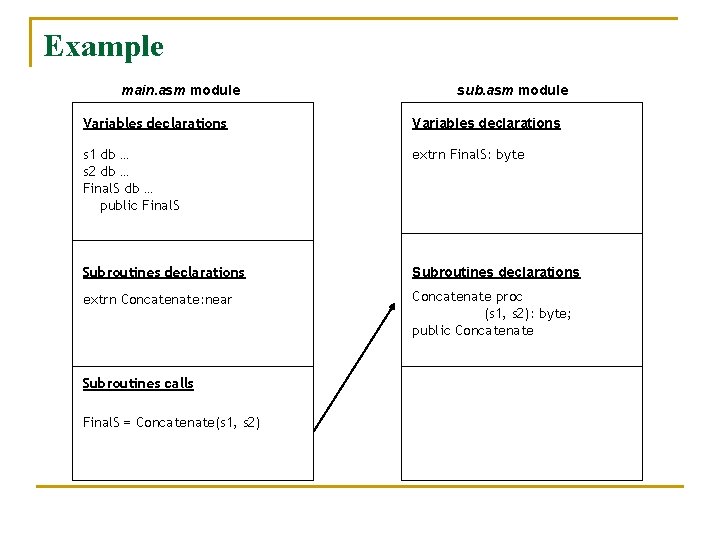
Example main. asm module sub. asm module Variables declarations s 1 db … s 2 db … Final. S db … public Final. S extrn Final. S: byte Subroutines declarations extrn Concatenate: near Concatenate proc (s 1, s 2): byte; public Concatenate Subroutines calls Final. S = Concatenate(s 1, s 2)
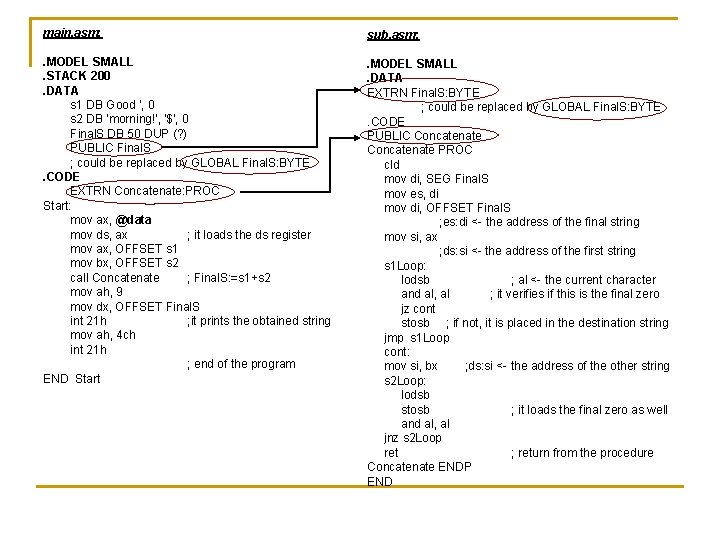
main. asm: sub. asm: . MODEL SMALL. STACK 200. DATA s 1 DB Good ', 0 s 2 DB ‘morning!', '$', 0 Final. S DB 50 DUP (? ) PUBLIC Final. S ; could be replaced by GLOBAL Final. S: BYTE. CODE EXTRN Concatenate: PROC Start: mov ax, @data mov ds, ax ; it loads the ds register mov ax, OFFSET s 1 mov bx, OFFSET s 2 call Concatenate ; Final. S: =s 1+s 2 mov ah, 9 mov dx, OFFSET Final. S int 21 h ; it prints the obtained string mov ah, 4 ch int 21 h ; end of the program END Start . MODEL SMALL. DATA EXTRN Final. S: BYTE ; could be replaced by GLOBAL Final. S: BYTE. CODE PUBLIC Concatenate PROC cld mov di, SEG Final. S mov es, di mov di, OFFSET Final. S ; es: di <- the address of the final string mov si, ax ; ds: si <- the address of the first string s 1 Loop: lodsb ; al <- the current character and al, al ; it verifies if this is the final zero jz cont stosb ; if not, it is placed in the destination string jmp s 1 Loop cont: mov si, bx ; ds: si <- the address of the other string s 2 Loop: lodsb stosb ; it loads the final zero as well and al, al jnz s 2 Loop ret ; return from the procedure Concatenate ENDP END
The two modules will be separately assembled: TASM MAIN[. ASM] TASM SUB[. ASM] the linkedit follows: TLINK MAIN[. OBJ]+SUB[. OBJ] sau TLINK MAIN[. OBJ] SUB[. OBJ] It will results an executable program called main. exe which will print the message “Good morning!".
Linking assembly language modules with modules written in high level programming languages n n n n Requirements of the linkeditor Entering the procedure Keeping the values of some registers Passing and accessing parameters Allocating space for local data (optional) Returning a result (optional) Returning from the procedure
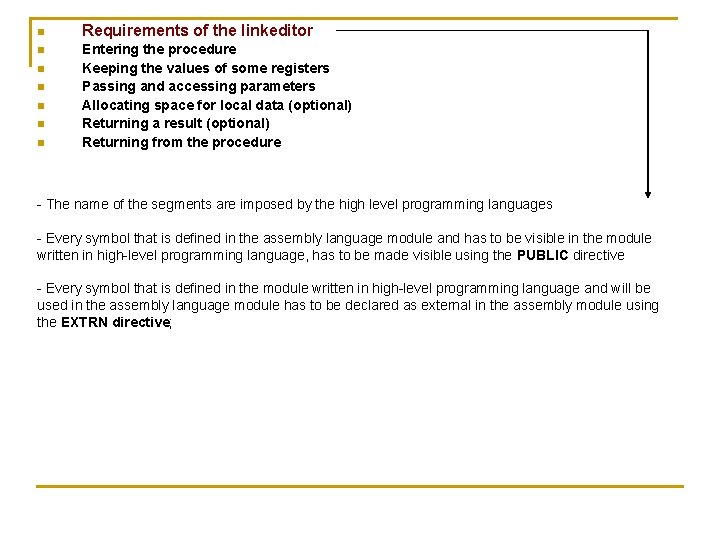
n Requirements of the linkeditor n Entering the procedure Keeping the values of some registers Passing and accessing parameters Allocating space for local data (optional) Returning a result (optional) Returning from the procedure n n n - The name of the segments are imposed by the high level programming languages - Every symbol that is defined in the assembly language module and has to be visible in the module written in high-level programming language, has to be made visible using the PUBLIC directive - Every symbol that is defined in the module written in high-level programming language and will be used in the assembly language module has to be declared as external in the assembly module using the EXTRN directive;
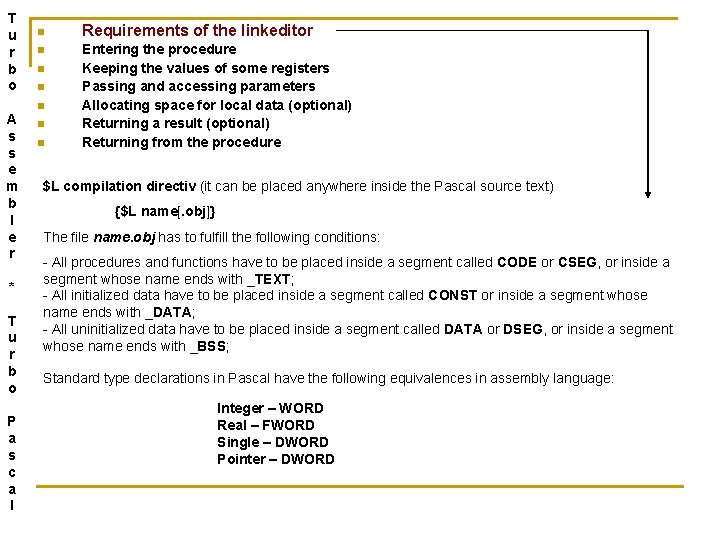
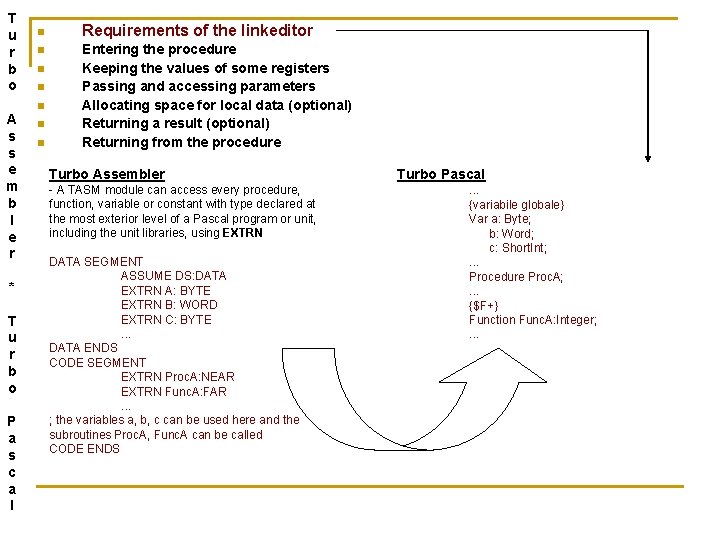
T u r b o A s s e m b l e r * T u r b o P a s c a l n Requirements of the linkeditor n Entering the procedure Keeping the values of some registers Passing and accessing parameters Allocating space for local data (optional) Returning a result (optional) Returning from the procedure n n n $L compilation directiv (it can be placed anywhere inside the Pascal source text) {$L name[. obj]} The file name. obj has to fulfill the following conditions: - All procedures and functions have to be placed inside a segment called CODE or CSEG, or inside a segment whose name ends with _TEXT; - All initialized data have to be placed inside a segment called CONST or inside a segment whose name ends with _DATA; - All uninitialized data have to be placed inside a segment called DATA or DSEG, or inside a segment whose name ends with _BSS; Standard type declarations in Pascal have the following equivalences in assembly language: Integer – WORD Real – FWORD Single – DWORD Pointer – DWORD
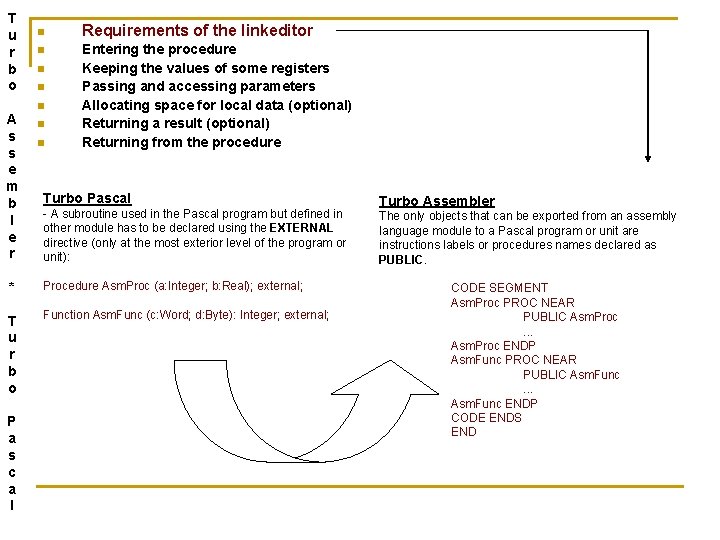
T u r b o A s s e m b l e r n Requirements of the linkeditor n Entering the procedure Keeping the values of some registers Passing and accessing parameters Allocating space for local data (optional) Returning a result (optional) Returning from the procedure n n n Turbo Pascal - A subroutine used in the Pascal program but defined in other module has to be declared using the EXTERNAL directive (only at the most exterior level of the program or unit): * Procedure Asm. Proc (a: Integer; b: Real); external; T u r b o Function Asm. Func (c: Word; d: Byte): Integer; external; P a s c a l Turbo Assembler The only objects that can be exported from an assembly language module to a Pascal program or unit are instructions labels or procedures names declared as PUBLIC. CODE SEGMENT Asm. Proc PROC NEAR PUBLIC Asm. Proc. . . Asm. Proc ENDP Asm. Func PROC NEAR PUBLIC Asm. Func. . . Asm. Func ENDP CODE ENDS END
T u r b o A s s e m b l e r * T u r b o P a s c a l n Requirements of the linkeditor n Entering the procedure Keeping the values of some registers Passing and accessing parameters Allocating space for local data (optional) Returning a result (optional) Returning from the procedure n n n Turbo Assembler - A TASM module can access every procedure, function, variable or constant with type declared at the most exterior level of a Pascal program or unit, including the unit libraries, using EXTRN DATA SEGMENT ASSUME DS: DATA EXTRN A: BYTE EXTRN B: WORD EXTRN C: BYTE. . . DATA ENDS CODE SEGMENT EXTRN Proc. A: NEAR EXTRN Func. A: FAR. . . ; the variables a, b, c can be used here and the subroutines Proc. A, Func. A can be called CODE ENDS Turbo Pascal. . . {variabile globale} Var a: Byte; b: Word; c: Short. Int; . . . Procedure Proc. A; . . . {$F+} Function Func. A: Integer; . . .
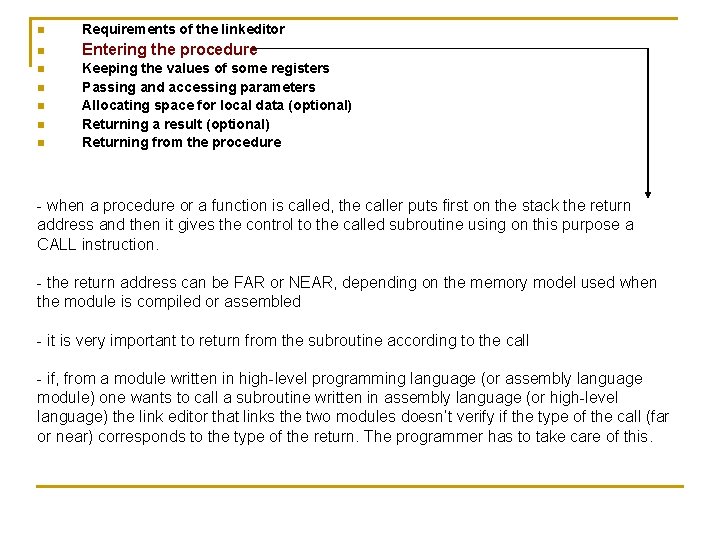
n Requirements of the linkeditor n Entering the procedure n Keeping the values of some registers Passing and accessing parameters Allocating space for local data (optional) Returning a result (optional) Returning from the procedure n n - when a procedure or a function is called, the caller puts first on the stack the return address and then it gives the control to the called subroutine using on this purpose a CALL instruction. - the return address can be FAR or NEAR, depending on the memory model used when the module is compiled or assembled - it is very important to return from the subroutine according to the call - if, from a module written in high-level programming language (or assembly language module) one wants to call a subroutine written in assembly language (or high-level language) the link editor that links the two modules doesn’t verify if the type of the call (far or near) corresponds to the type of the return. The programmer has to take care of this.
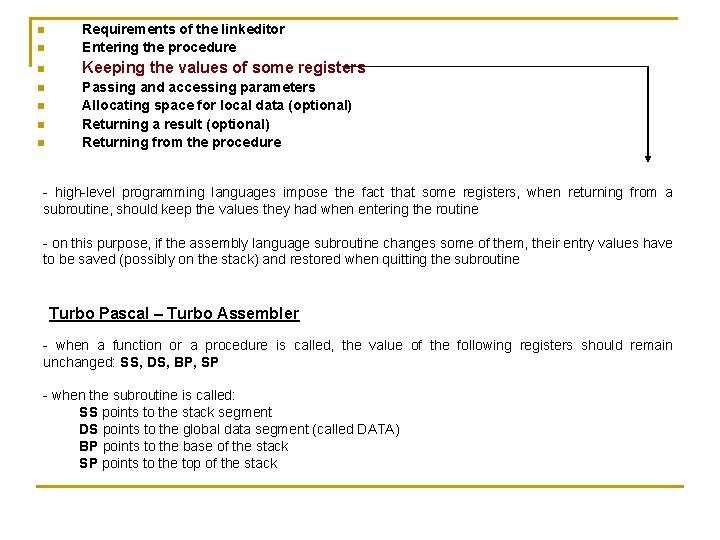
n Requirements of the linkeditor Entering the procedure n Keeping the values of some registers n Passing and accessing parameters Allocating space for local data (optional) Returning a result (optional) Returning from the procedure n n - high-level programming languages impose the fact that some registers, when returning from a subroutine, should keep the values they had when entering the routine - on this purpose, if the assembly language subroutine changes some of them, their entry values have to be saved (possibly on the stack) and restored when quitting the subroutine Turbo Pascal – Turbo Assembler - when a function or a procedure is called, the value of the following registers should remain unchanged: SS, DS, BP, SP - when the subroutine is called: SS points to the stack segment DS points to the global data segment (called DATA) BP points to the base of the stack SP points to the top of the stack
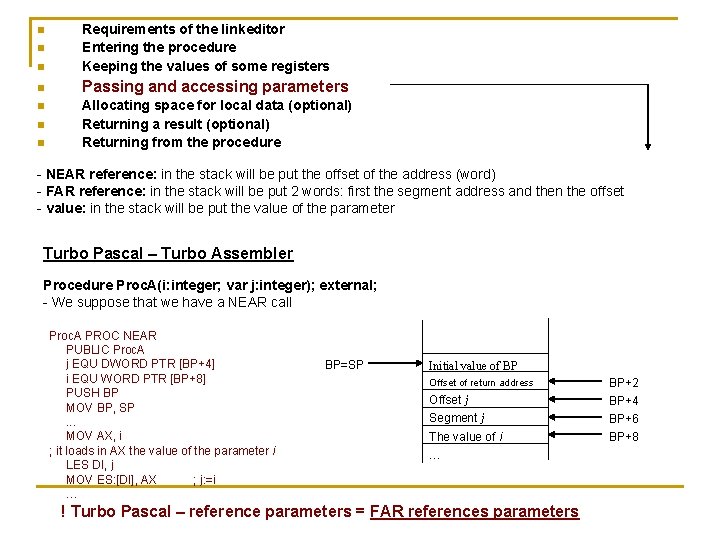
n Requirements of the linkeditor Entering the procedure Keeping the values of some registers n Passing and accessing parameters n Allocating space for local data (optional) Returning a result (optional) Returning from the procedure n n - NEAR reference: in the stack will be put the offset of the address (word) - FAR reference: in the stack will be put 2 words: first the segment address and then the offset - value: in the stack will be put the value of the parameter Turbo Pascal – Turbo Assembler Procedure Proc. A(i: integer; var j: integer); external; - We suppose that we have a NEAR call Proc. A PROC NEAR PUBLIC Proc. A j EQU DWORD PTR [BP+4] i EQU WORD PTR [BP+8] PUSH BP MOV BP, SP. . . MOV AX, i ; it loads in AX the value of the parameter i LES DI, j MOV ES: [DI], AX ; j: =i … BP=SP Initial value of BP Offset of return address Offset j Segment j The value of i … ! Turbo Pascal – reference parameters = FAR references parameters BP+2 BP+4 BP+6 BP+8
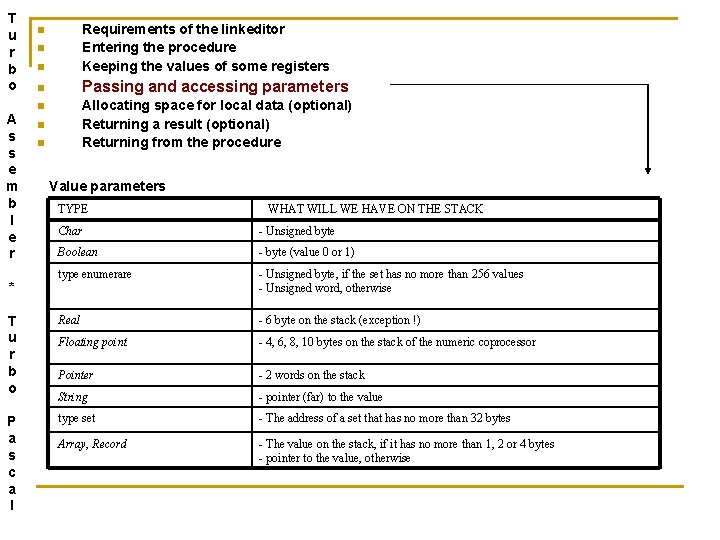
T u r b o A s s e m b l e r n Requirements of the linkeditor Entering the procedure Keeping the values of some registers n Passing and accessing parameters n Allocating space for local data (optional) Returning a result (optional) Returning from the procedure n n Value parameters TYPE WHAT WILL WE HAVE ON THE STACK Char - Unsigned byte Boolean - byte (value 0 or 1) type enumerare - Unsigned byte, if the set has no more than 256 values - Unsigned word, otherwise T u r b o Real - 6 byte on the stack (exception !) Floating point - 4, 6, 8, 10 bytes on the stack of the numeric coprocessor Pointer - 2 words on the stack String - pointer (far) to the value P a s c a l type set - The address of a set that has no more than 32 bytes Array, Record - The value on the stack, if it has no more than 1, 2 or 4 bytes - pointer to the value, otherwise *
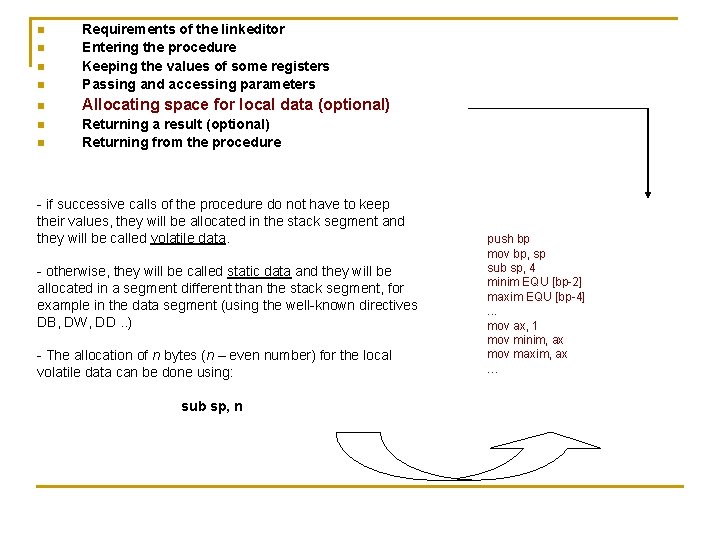
n Requirements of the linkeditor Entering the procedure Keeping the values of some registers Passing and accessing parameters n Allocating space for local data (optional) n Returning a result (optional) Returning from the procedure n n - if successive calls of the procedure do not have to keep their values, they will be allocated in the stack segment and they will be called volatile data. - otherwise, they will be called static data and they will be allocated in a segment different than the stack segment, for example in the data segment (using the well-known directives DB, DW, DD. . ) - The allocation of n bytes (n – even number) for the local volatile data can be done using: sub sp, n push bp mov bp, sp sub sp, 4 minim EQU [bp-2] maxim EQU [bp-4]. . . mov ax, 1 mov minim, ax mov maxim, ax …
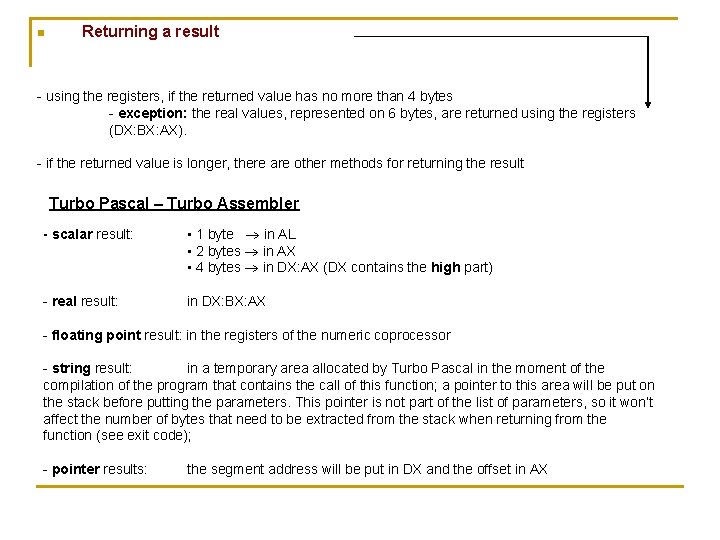
n Returning a result - using the registers, if the returned value has no more than 4 bytes - exception: the real values, represented on 6 bytes, are returned using the registers (DX: BX: AX). - if the returned value is longer, there are other methods for returning the result Turbo Pascal – Turbo Assembler - scalar result: • 1 byte in AL • 2 bytes in AX • 4 bytes in DX: AX (DX contains the high part) - real result: in DX: BX: AX - floating point result: in the registers of the numeric coprocessor - string result: in a temporary area allocated by Turbo Pascal in the moment of the compilation of the program that contains the call of this function; a pointer to this area will be put on the stack before putting the parameters. This pointer is not part of the list of parameters, so it won’t affect the number of bytes that need to be extracted from the stack when returning from the function (see exit code); - pointer results: the segment address will be put in DX and the offset in AX
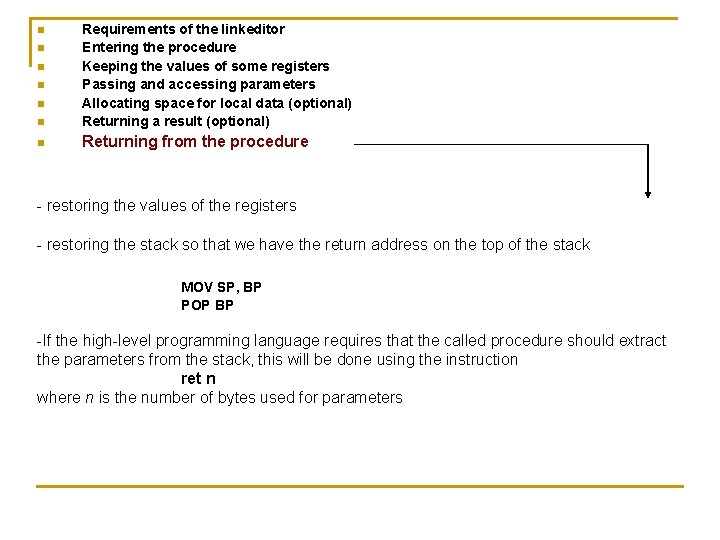
n Requirements of the linkeditor Entering the procedure Keeping the values of some registers Passing and accessing parameters Allocating space for local data (optional) Returning a result (optional) n Returning from the procedure n n n - restoring the values of the registers - restoring the stack so that we have the return address on the top of the stack MOV SP, BP POP BP -If the high-level programming language requires that the called procedure should extract the parameters from the stack, this will be done using the instruction ret n where n is the number of bytes used for parameters
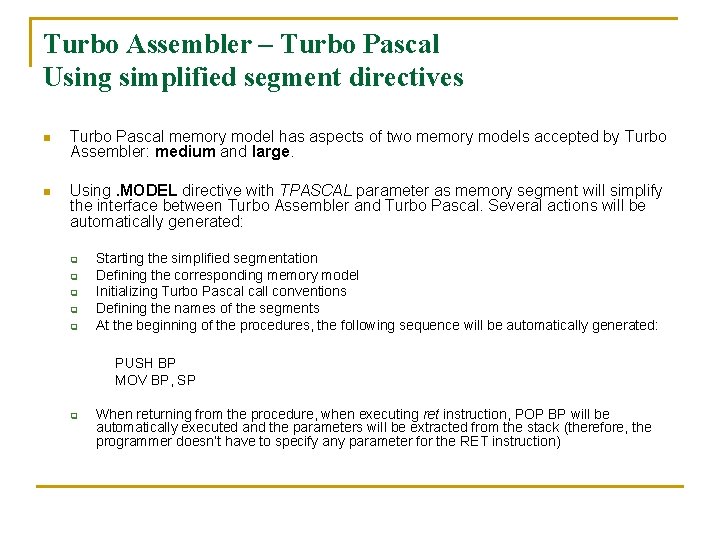
Turbo Assembler – Turbo Pascal Using simplified segment directives n Turbo Pascal memory model has aspects of two memory models accepted by Turbo Assembler: medium and large. n Using. MODEL directive with TPASCAL parameter as memory segment will simplify the interface between Turbo Assembler and Turbo Pascal. Several actions will be automatically generated: q q q Starting the simplified segmentation Defining the corresponding memory model Initializing Turbo Pascal call conventions Defining the names of the segments At the beginning of the procedures, the following sequence will be automatically generated: PUSH BP MOV BP, SP q When returning from the procedure, when executing ret instruction, POP BP will be automatically executed and the parameters will be extracted from the stack (therefore, the programmer doesn’t have to specify any parameter for the RET instruction)
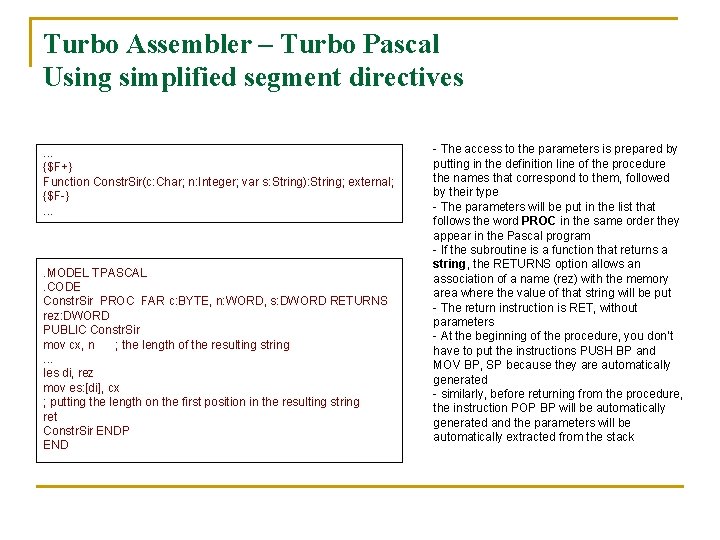
Turbo Assembler – Turbo Pascal Using simplified segment directives. . . {$F+} Function Constr. Sir(c: Char; n: Integer; var s: String): String; external; {$F-}. . MODEL TPASCAL. CODE Constr. Sir PROC FAR c: BYTE, n: WORD, s: DWORD RETURNS rez: DWORD PUBLIC Constr. Sir mov cx, n ; the length of the resulting string. . . les di, rez mov es: [di], cx ; putting the length on the first position in the resulting string ret Constr. Sir ENDP END - The access to the parameters is prepared by putting in the definition line of the procedure the names that correspond to them, followed by their type - The parameters will be put in the list that follows the word PROC in the same order they appear in the Pascal program - If the subroutine is a function that returns a string, the RETURNS option allows an association of a name (rez) with the memory area where the value of that string will be put - The return instruction is RET, without parameters - At the beginning of the procedure, you don’t have to put the instructions PUSH BP and MOV BP, SP because they are automatically generated - similarly, before returning from the procedure, the instruction POP BP will be automatically generated and the parameters will be automatically extracted from the stack
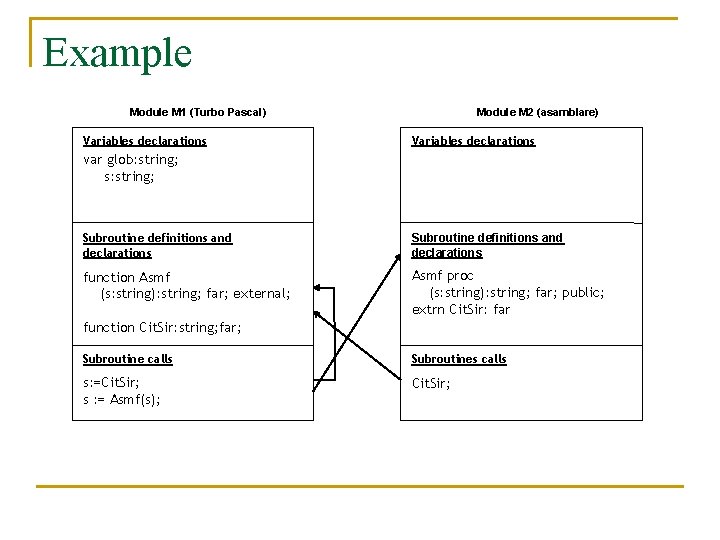
Example Module M 1 (Turbo Pascal) Variables declarations Module M 2 (asamblare) Variables declarations var glob: string; s: string; Subroutine definitions and declarations function Asmf (s: string): string; far; external; Asmf proc (s: string): string; far; public; extrn Cit. Sir: far function Cit. Sir: string; far; Subroutine calls Subroutines calls s: =Cit. Sir; s : = Asmf(s); Cit. Sir;
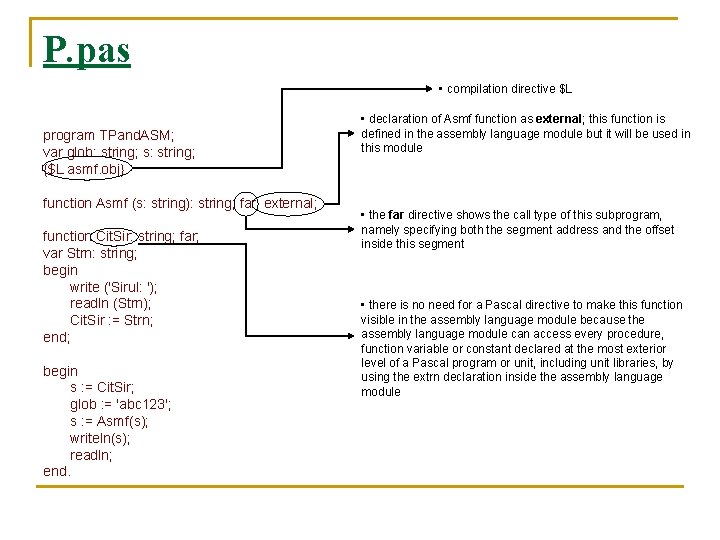
P. pas • compilation directive $L program TPand. ASM; var glob: string; s: string; {$L asmf. obj} function Asmf (s: string): string; far; external; function Cit. Sir: string; far; var Strn: string; begin write ('Sirul: '); readln (Strn); Cit. Sir : = Strn; end; begin s : = Cit. Sir; glob : = 'abc 123'; s : = Asmf(s); writeln(s); readln; end. • declaration of Asmf function as external; this function is defined in the assembly language module but it will be used in this module • the far directive shows the call type of this subprogram, namely specifying both the segment address and the offset inside this segment • there is no need for a Pascal directive to make this function visible in the assembly language module because the assembly language module can access every procedure, function variable or constant declared at the most exterior level of a Pascal program or unit, including unit libraries, by using the extrn declaration inside the assembly language module
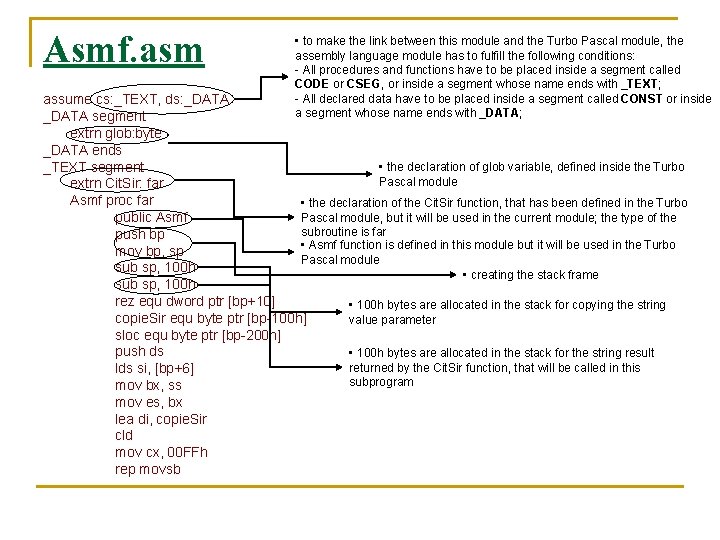
Asmf. asm • to make the link between this module and the Turbo Pascal module, the assembly language module has to fulfill the following conditions: - All procedures and functions have to be placed inside a segment called CODE or CSEG, or inside a segment whose name ends with _TEXT; - All declared data have to be placed inside a segment called CONST or inside a segment whose name ends with _DATA; assume cs: _TEXT, ds: _DATA segment extrn glob: byte _DATA ends • the declaration of glob variable, defined inside the Turbo _TEXT segment Pascal module extrn Cit. Sir: far Asmf proc far • the declaration of the Cit. Sir function, that has been defined in the Turbo Pascal module, but it will be used in the current module; the type of the public Asmf subroutine is far push bp • Asmf function is defined in this module but it will be used in the Turbo mov bp, sp Pascal module sub sp, 100 h • creating the stack frame sub sp, 100 h rez equ dword ptr [bp+10] • 100 h bytes are allocated in the stack for copying the string copie. Sir equ byte ptr [bp-100 h] value parameter sloc equ byte ptr [bp-200 h] push ds • 100 h bytes are allocated in the stack for the string result returned by the Cit. Sir function, that will be called in this lds si, [bp+6] subprogram mov bx, ss mov es, bx lea di, copie. Sir cld mov cx, 00 FFh rep movsb
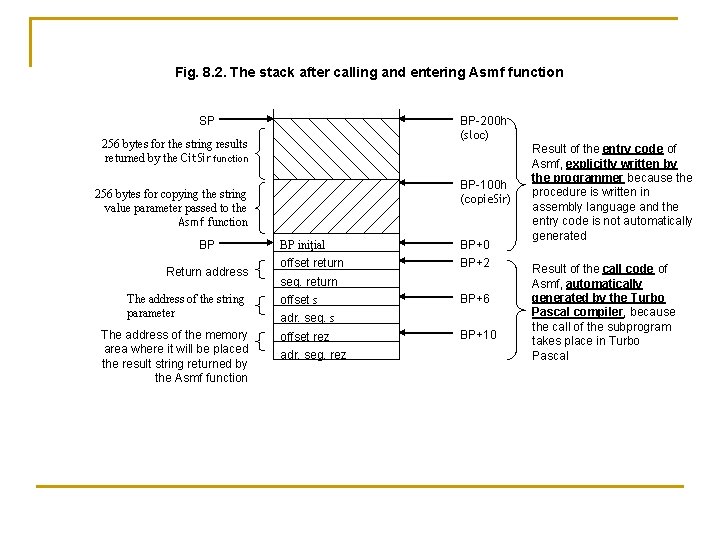
Fig. 8. 2. The stack after calling and entering Asmf function SP BP-200 h (sloc) 256 bytes for the string results returned by the Cit. Sir function BP-100 h (copie. Sir) 256 bytes for copying the string value parameter passed to the Asmf function BP Return address The address of the string parameter The address of the memory area where it will be placed the result string returned by the Asmf function BP iniţial offset return BP+0 BP+2 seg. return offset s BP+6 adr. seg. s offset rez adr. seg. rez BP+10 Result of the entry code of Asmf, explicitly written by the programmer because the procedure is written in assembly language and the entry code is not automatically generated Result of the call code of Asmf, automatically generated by the Turbo Pascal compiler, because the call of the subprogram takes place in Turbo Pascal
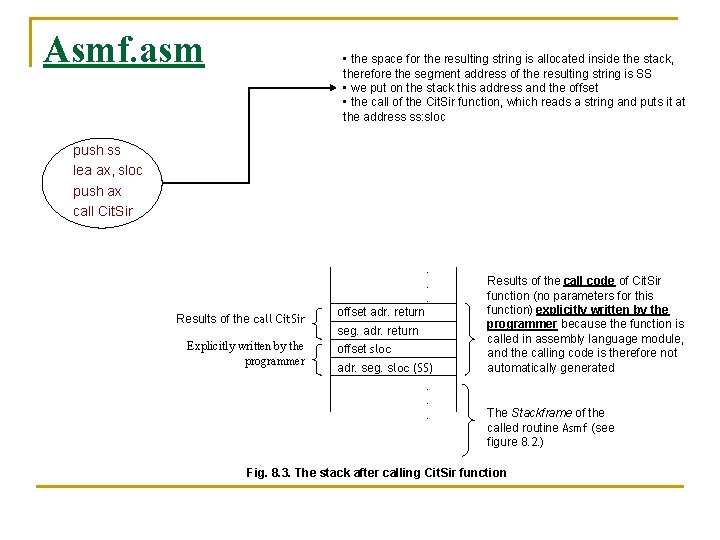
Asmf. asm • the space for the resulting string is allocated inside the stack, therefore the segment address of the resulting string is SS • we put on the stack this address and the offset • the call of the Cit. Sir function, which reads a string and puts it at the address ss: sloc push ss lea ax, sloc push ax call Cit. Sir . . . Results of the call Cit. Sir Explicitly written by the programmer offset adr. return seg. adr. return offset sloc adr. seg. sloc (SS). . . Results of the call code of Cit. Sir function (no parameters for this function) explicitly written by the programmer because the function is called in assembly language module, and the calling code is therefore not automatically generated The Stackframe of the called routine Asmf (see figure 8. 2. ) Fig. 8. 3. The stack after calling Cit. Sir function
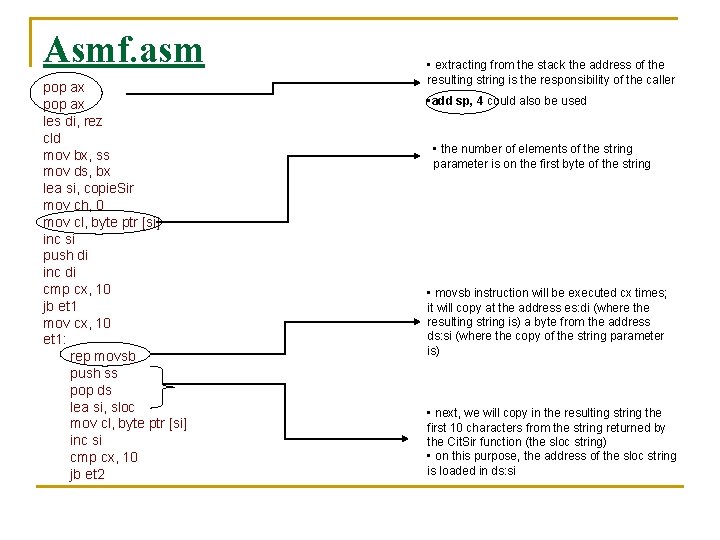
Asmf. asm pop ax les di, rez cld mov bx, ss mov ds, bx lea si, copie. Sir mov ch, 0 mov cl, byte ptr [si] inc si push di inc di cmp cx, 10 jb et 1 mov cx, 10 et 1: rep movsb push ss pop ds lea si, sloc mov cl, byte ptr [si] inc si cmp cx, 10 jb et 2 • extracting from the stack the address of the resulting string is the responsibility of the caller • add sp, 4 could also be used • the number of elements of the string parameter is on the first byte of the string • movsb instruction will be executed cx times; it will copy at the address es: di (where the resulting string is) a byte from the address ds: si (where the copy of the string parameter is) • next, we will copy in the resulting string the first 10 characters from the string returned by the Cit. Sir function (the sloc string) • on this purpose, the address of the sloc string is loaded in ds: si
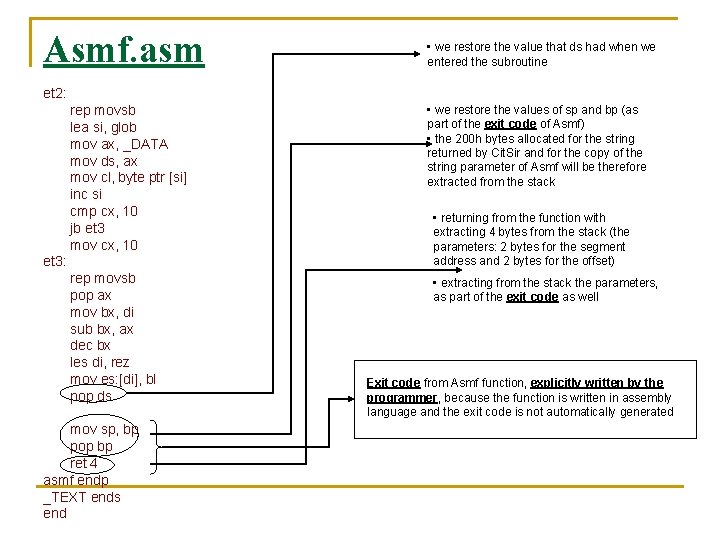
Asmf. asm • we restore the value that ds had when we entered the subroutine et 2: rep movsb lea si, glob mov ax, _DATA mov ds, ax mov cl, byte ptr [si] inc si cmp cx, 10 jb et 3 mov cx, 10 et 3: rep movsb pop ax mov bx, di sub bx, ax dec bx les di, rez mov es: [di], bl pop ds mov sp, bp pop bp ret 4 asmf endp _TEXT ends end • we restore the values of sp and bp (as part of the exit code of Asmf) • the 200 h bytes allocated for the string returned by Cit. Sir and for the copy of the string parameter of Asmf will be therefore extracted from the stack • returning from the function with extracting 4 bytes from the stack (the parameters: 2 bytes for the segment address and 2 bytes for the offset) • extracting from the stack the parameters, as part of the exit code as well Exit code from Asmf function, explicitly written by the programmer, because the function is written in assembly language and the exit code is not automatically generated