
Multimodal Therapy ARNOLD LAZARUS Connection to Social Work
- Slides: 13
Multimodal Therapy ARNOLD LAZARUS
Connection to Social Work n n n Evidence-based Assumes “parity” Avoids diagnostic labels Acknowledges multiple dimensions Acknowledge interactions among dimensions
MMT’s Assumption about People n People: n n n Move Feel Sense Imagine Think Relate interpersonally
Personality and MMT n Personalities are products of n n n n Behaviors Affective processes Sensations Images Cognitions Interpersonal relationships Biological functions
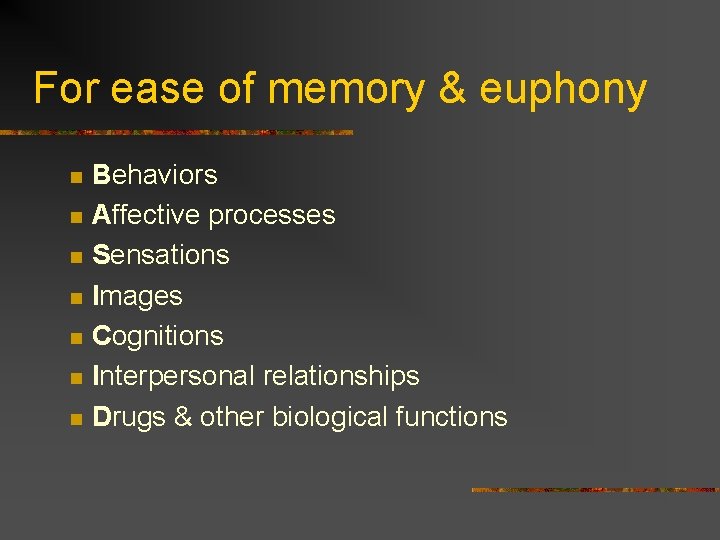
For ease of memory & euphony n n n n Behaviors Affective processes Sensations Images Cognitions Interpersonal relationships Drugs & other biological functions
Further Assumptions n n Thorough, detailed assessment is essential to effective treatment. An assessment schema should be: n n n Easy to remember Easy to use Point the way to effective interventions
More Assumptions n n n The BASIC ID schema meets the criteria for a good schema Systematically addressing each of the 7 modalities is comprehensive Addressing problems in the 7 modalities will lead to progress
Theoretical Background n n Classical conditioning Operant conditioning Social learning theory Cognitive theory
MMT and the Unconscious n n n The “unconscious” as an entity is iffy. People have different degrees of selfawareness. Unrecognized stimuli can influence thoughts, feelings, and behaviors.
Basic Concepts n n n n Classical and operant conditioning Modeling and vicarious processes Private events Nonconscious processes Defensive reactions Communication Metacommunication
Functional Analysis n Identify n n Antecedent stimuli Organismic (mediating) variables Response (observable) variables Consequences
Second-order BASIC IDs n The BASIC ID analysis can be applied to any problem identified on the first BASIC ID analysis.
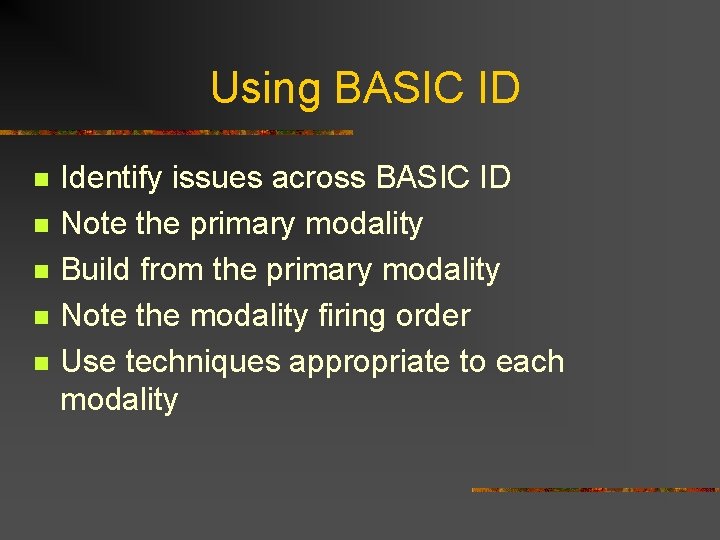
Using BASIC ID n n n Identify issues across BASIC ID Note the primary modality Build from the primary modality Note the modality firing order Use techniques appropriate to each modality