
Multimodal Integration Transforming our learning DIEGO SUREZ ROJAS
- Slides: 15
Multimodal Integration Transforming our learning DIEGO SUÁREZ ROJAS MSW/PH. D. STUDENT AT BOSTON COLLEGE SCHOOL OF SOCIAL WORK DIRECTOR OF LABORATORIO EN MOVIMIENTO
Overview What is multimodal integration? Why is it important for education, health, and social justice? How does it look like for field education?
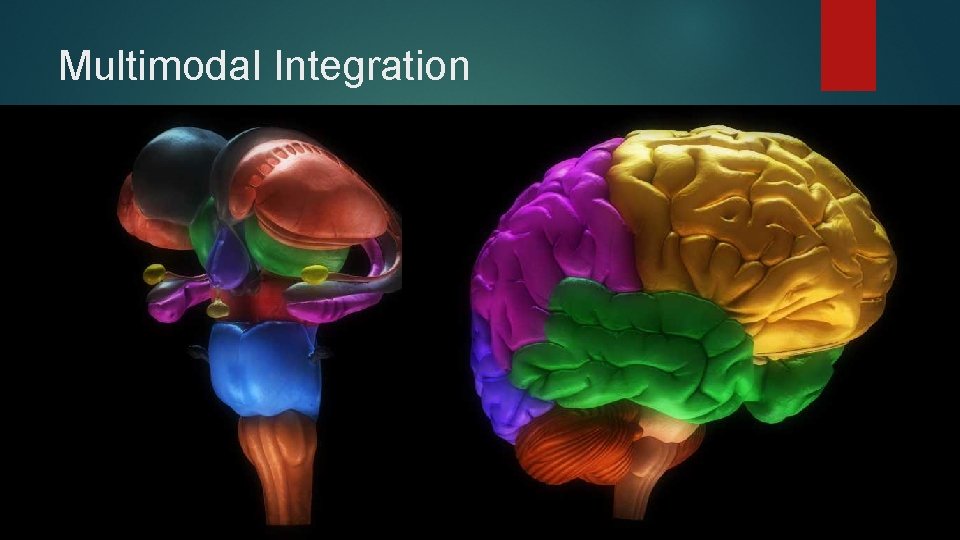
Multimodal Integration
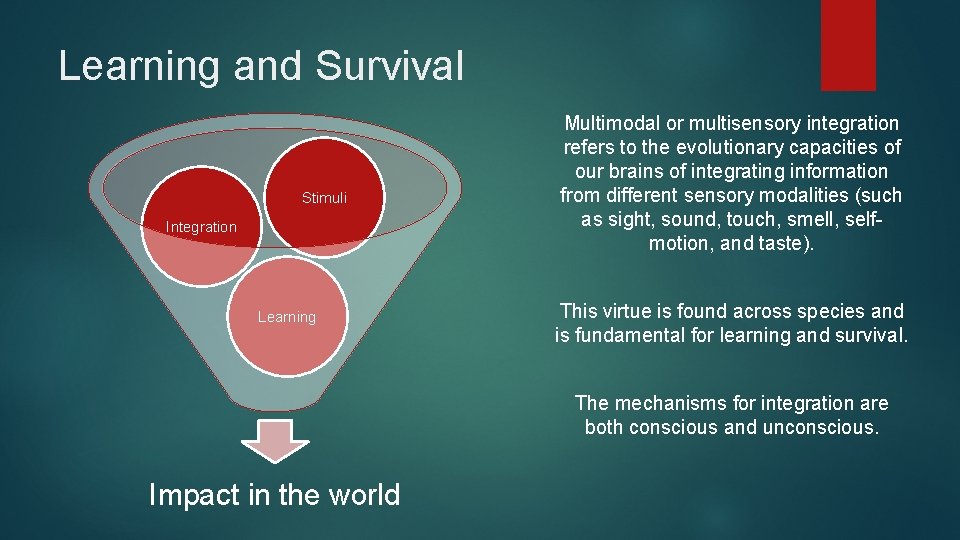
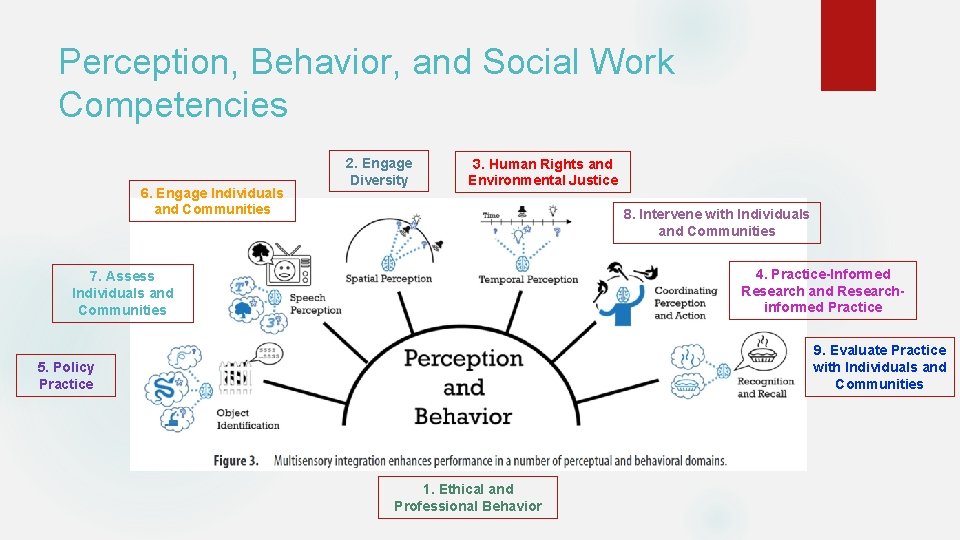
Learning and Survival Stimuli Integration Learning Multimodal or multisensory integration refers to the evolutionary capacities of our brains of integrating information from different sensory modalities (such as sight, sound, touch, smell, selfmotion, and taste). This virtue is found across species and is fundamental for learning and survival. The mechanisms for integration are both conscious and unconscious. Impact in the world
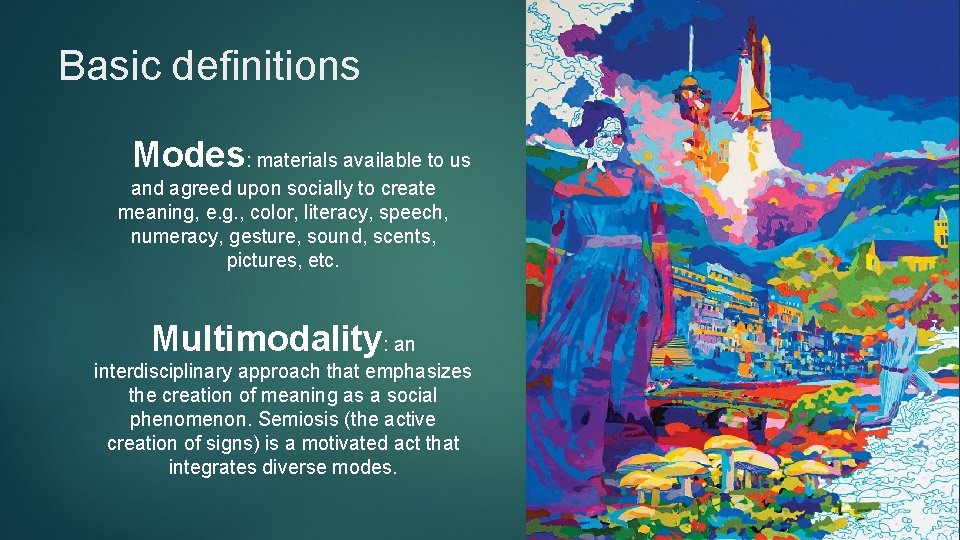
Basic definitions Modes: materials available to us and agreed upon socially to create meaning, e. g. , color, literacy, speech, numeracy, gesture, sound, scents, pictures, etc. Multimodality: an interdisciplinary approach that emphasizes the creation of meaning as a social phenomenon. Semiosis (the active creation of signs) is a motivated act that integrates diverse modes.
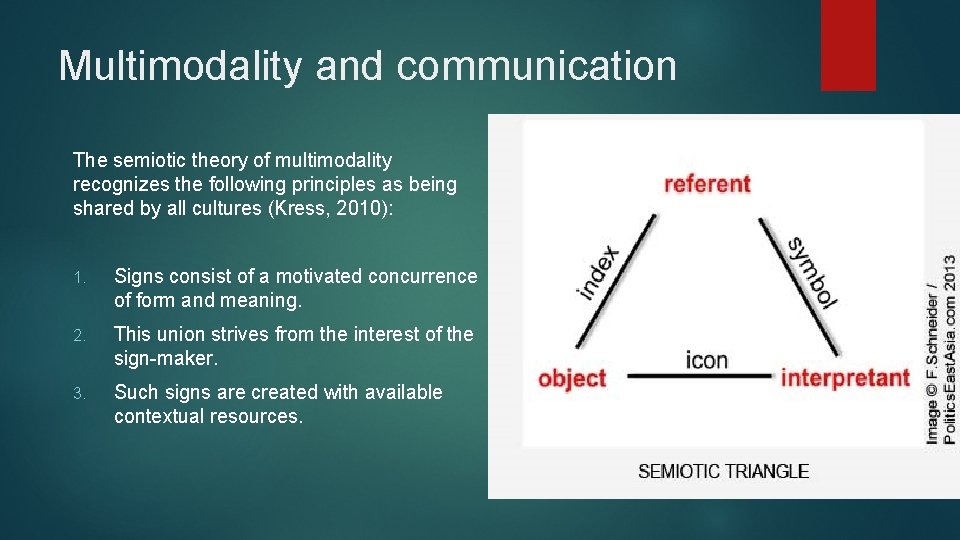
Multimodality and communication The semiotic theory of multimodality recognizes the following principles as being shared by all cultures (Kress, 2010): 1. Signs consist of a motivated concurrence of form and meaning. 2. This union strives from the interest of the sign-maker. 3. Such signs are created with available contextual resources.
Perception, Behavior, and Social Work Competencies 6. Engage Individuals and Communities 2. Engage Diversity 3. Human Rights and Environmental Justice 8. Intervene with Individuals and Communities 4. Practice-Informed Research and Researchinformed Practice 7. Assess Individuals and Communities 9. Evaluate Practice with Individuals and Communities 5. Policy Practice 1. Ethical and Professional Behavior
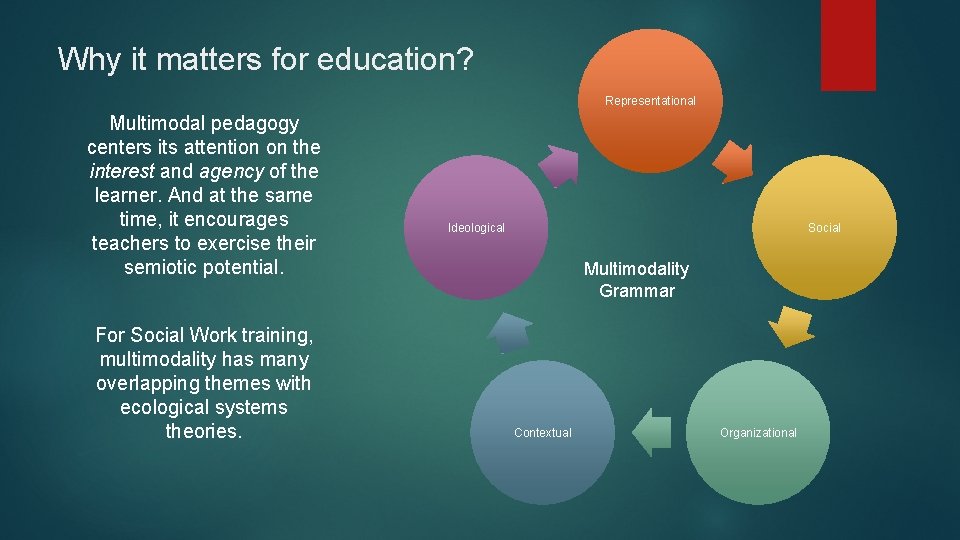
Why it matters for education? Representational Multimodal pedagogy centers its attention on the interest and agency of the learner. And at the same time, it encourages teachers to exercise their semiotic potential. For Social Work training, multimodality has many overlapping themes with ecological systems theories. Ideological Social Multimodality Grammar Contextual Organizational
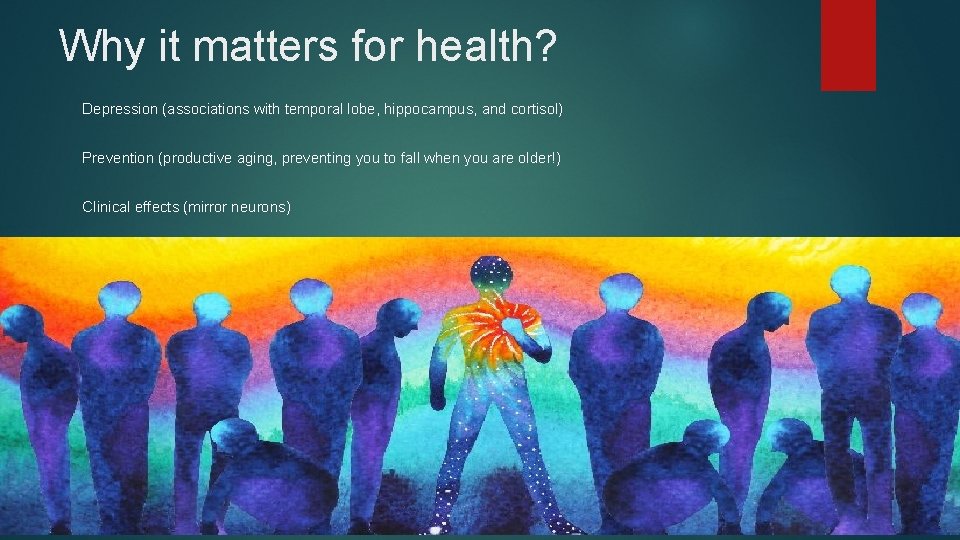
Why it matters for health? Depression (associations with temporal lobe, hippocampus, and cortisol) Prevention (productive aging, preventing you to fall when you are older!) Clinical effects (mirror neurons)
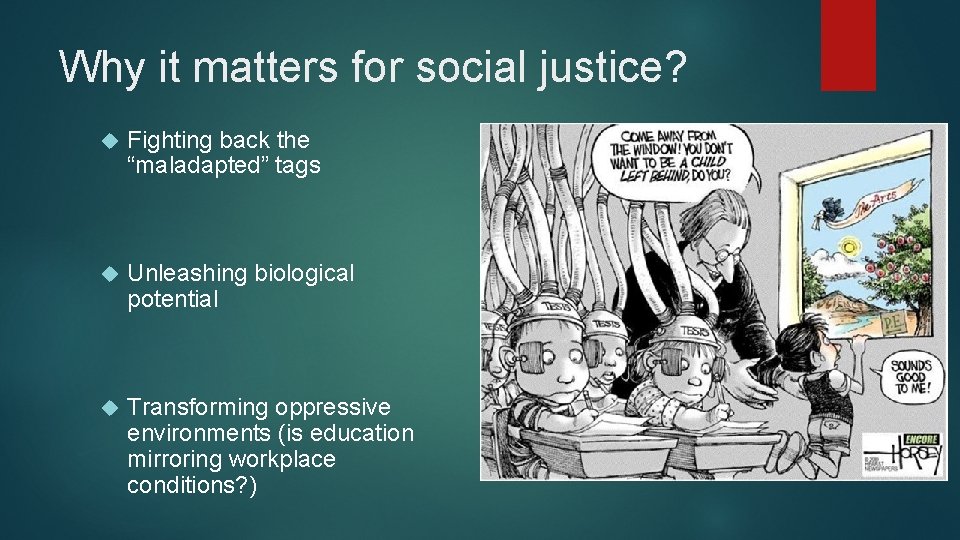
Why it matters for social justice? Fighting back the “maladapted” tags Unleashing biological potential Transforming oppressive environments (is education mirroring workplace conditions? )
How does it look like? Principles Criticality: how modes and semiotic resources allow building an argument? What does each piece bring to the table? Cultivate creativity: : recognize five fundamental dispositions for the creative process: persistent, imaginative, collaborative, disciplined, and inquisitive. Holistic: a rubric can lead to “multimodal decomposition, ” i. e. , students will stop seeing the integration of semiotic modes and resources. Therefore, we will be back into unimodal practice: let’s follow a recipe without considering the overall piece. Valuing Multimodality: giving due credit to multimodality in terms of grading. Moreover, emphasize the creation of meaning.
Suggestions Compare and Contrast Venn Diagram Courses/Field Placement (or other format) Painting a Significant Field Placement Experience Dance Expression (Individual or Group) Field Challenges/Successes
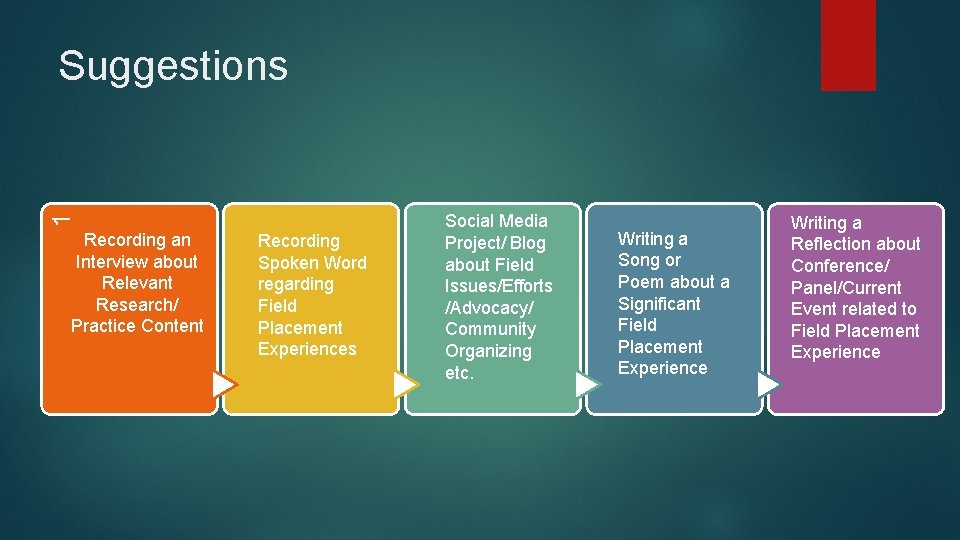
1 Suggestions Recording an Interview about Relevant Research/ Practice Content Recording Spoken Word regarding Field Placement Experiences Social Media Project/ Blog about Field Issues/Efforts /Advocacy/ Community Organizing etc. Writing a Song or Poem about a Significant Field Placement Experience Writing a Reflection about Conference/ Panel/Current Event related to Field Placement Experience
References Kress, G. (2005). Before writing: Rethinking the paths to literacy: Routledge. Kress, G. (2009). Assessment in the perspective of a social semiotic theory of multimodal teaching and learning. In Educational assessment in the 21 st century (pp. 19 -41): Springer. Kress, G. R. (2010). Multimodality: A social semiotic approach to contemporary communication: Taylor & Francis. Romero, L. M. , Dickens, M. J. , & Cyr, N. E. (2009). The reactive scope model—a new model integrating homeostasis, allostasis, and stress. Hormones and behavior, 55(3), 375 -389. Ross, J. , Curwood, J. S. , & Bell, A. (2020). A multimodal assessment framework for higher education. E-Learning and Digital Media, 2042753020927201. Sapolsky, R. M. (2001). Depression, antidepressants, and the shrinking hippocampus. Proceedings of the National Academy of Sciences, 98(22), 12320 -12322. Sapolsky, R. M. (2004). Why zebras don't get ulcers: The acclaimed guide to stress, stress-related diseases, and coping: Holt paperbacks. Singh, I. (2012). Human development, nature and nurture: Working beyond the divide. Bio. Societies, 7(3), 308 -321. Spencer, M. B. (2007). Phenomenology and ecological systems theory: Development of diverse groups. Handbook of child psychology, 1. Stein, B. E. , & Stanford, T. R. (2008). Multisensory integration: current issues from the perspective of the single neuron. Nature reviews neuroscience, 9(4), 255 -266. Stein, B. E. , Stanford, T. R. , & Rowland, B. A. (2020). Multisensory integration and the society for neuroscience: then and now. Journal of Neuroscience, 40(1), 3 -11.
Images "Magic Mushrooms 2. 0: Induced Synesthesia, with Spaceship Launches, and a Child-Like Mind" by jurvetson is licensed with CC BY 2. 0. To view a copy of this license, visit https: //creativecommons. org/licenses/by/2. 0/ "Brain Art" by Ars Electronica is licensed with CC BY-NC-ND 2. 0. To view a copy of this license, visit https: //creativecommons. org/licenses/by-nc-nd/2. 0/ Fall 2018 Art 1010 at Brooklyn College, Prof. Gwendolyn Shaw https: //www. mentalhealthtoday. co. uk/how-to-use-art-to-boost-mental-health-in-inpatientunits