
Multimedia Networking Lab 1 NETWORK AWARE ENERGYEFFICIENT COMMUNICATION
Multimedia & Networking Lab 1 NETWORK AWARE ENERGYEFFICIENT COMMUNICATION PROTOCOL (NAEEC) FOR HETEROGENEOUS WIRELESS SENSOR NETWORKS By : Manoj K. Garg Advisor : Dr. Balakrishnan Prabhakaran A Clustering Protocol
Overview 2 Introduction Problem Statement Related Work System Model Propose NAEEC Protocol Simulation Results Our Contribution Future Work Multimedia & Networking Lab
3 Homogeneous Vs Heterogeneous WSN Wireless sensor networks (WSN) Large number of distributed sensor Nodes works in cooperation Application: Surveillance, machine failure diagnosis, and chemical/ biological detection Homogeneous sensor networks Sensor nodes with identical characteristics Most common characteristics: Power, Processing, Storage and Radio capabilities Heterogeneous sensor networks Sensor nodes with different level of common characteristics Multimedia & Networking Lab
Motivation 4 Applications for Heterogeneous WSN Re-energization of sensor networks Practical constraints such as Cost Different energy or resources consumption Sensor nodes are energy critical Small battery size Embedded batteries, difficult recharging or changing procedures Wireless transmission costlier than local computation Multimedia & Networking Lab
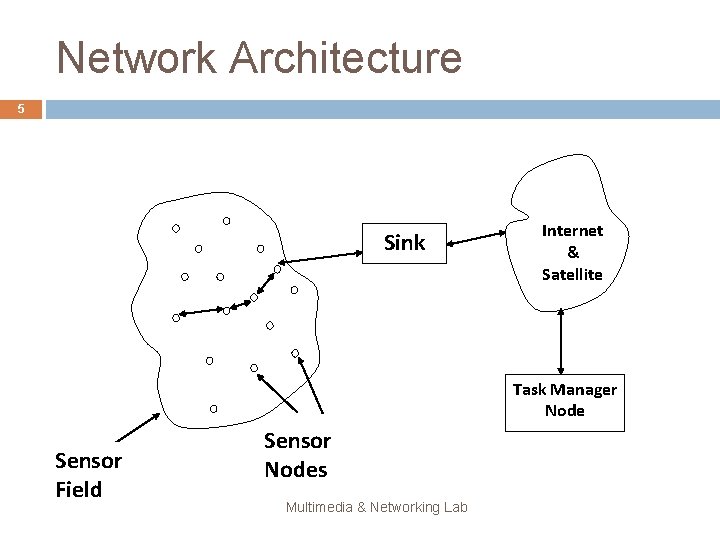
Network Architecture 5 Sink Internet & Satellite Task Manager Node Sensor Field Sensor Nodes Multimedia & Networking Lab
Problem Statement 6 Direct transmission Muti-hop transmission Nodes near the sink acts as relay with very high probability Nodes near to the sink die first TDMA technique Nodes that are far away from the sink would die first Transmission is random Large number of sensor nodes The clustering schemes Homogeneous clustering scheme doe snot result an optimize solution We need to design an new clustering protocol with the MAC layer support to save the sensor’s energy in heterogeneous wireless sensor networks Multimedia & Networking Lab
Related Work – LEACH 7 LEACH (Low Energy Adaptive clustering Hierarchy) Advantage A clustering protocol for homogeneous/heterogeneous SN A probabilistic method Based on residual energy relative to the current system energy Distribute the cluster-head load Avoid the need for global network knowledge. Disadvantage Doesn't guarantee that high energy/resources nodes always be chosen as cluster-head Doesn’t control the number and even placement of clusterheads Multimedia & Networking Lab
8 Related Work – SEP, DEEC, SWEET SEP , DEEC , SWEET Variation of LEACH Work effectively for heterogeneous networks None of them targets the efficient cluster-head placement problem of LEACH Do not reduce the initial high energy requirement and the number of dead nodes formed over time Multimedia & Networking Lab
9 Related Work – other algorithms Based on two types of sensor nodes type-I and type-II. Type-II sensor nodes Type-I sensor nodes More powerful. Fewer in number. Called overlay sensors. Normal sensor nodes. Report to the overlay nodes. The system model Assumes pre-estimated fraction, and position of overlay sensor nodes. No applicable when node heterogeneity is a result of the operation of the sensor network and not a choice of optimal network setting. Multimedia & Networking Lab
System Model 10 Large number of small-sized nodes. Fraction of nodes (α) are equipped with the additional energy. The nodes are uniquely numbered, randomly distributed and not mobile. Nodes can control their transmission power levels and have the capability to directly reach the sink. Sink is not energy-limited and is located at the center of sensor networks. The coordinates of the sink is known to every node in the network. Multimedia & Networking Lab
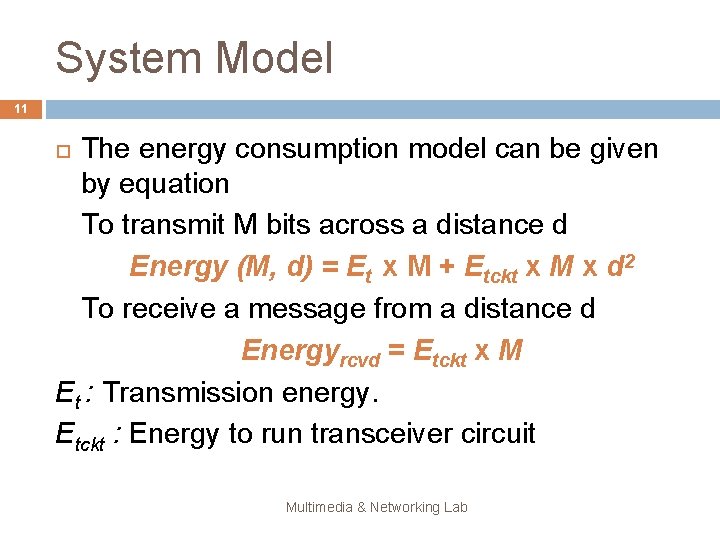
System Model 11 The energy consumption model can be given by equation To transmit M bits across a distance d Energy (M, d) = Et x M + Etckt x M x d 2 To receive a message from a distance d Energyrcvd = Etckt x M Et : Transmission energy. Etckt : Energy to run transceiver circuit Multimedia & Networking Lab
NAEEC - Introduction 12 Network operates in rounds. Length application specific Distribute the node role, and further the cluster-head role Reflect the network changes on the protocol execution Executed in the beginning of a round to build the initial intelligent infrastructure. Consist of phases namely setup phase, configuration phase and execution phase. Each phase consists of a number of sub-phases Fixed length Number of sub-phases depends on the termination condition achieved in a phase. Multimedia & Networking Lab
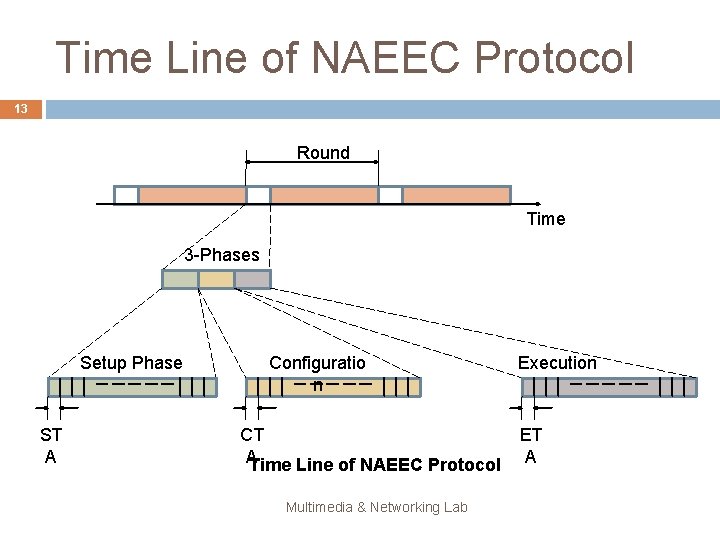
Time Line of NAEEC Protocol 13 Round Time 3 -Phases Setup Phase ST A Configuratio n CT ATime Line of NAEEC Protocol Multimedia & Networking Lab Execution ET A
Types of messages 14 Introduction message Energy Level (EL) value Node Id Reply message Node Id Beacon message Time slot information Multimedia & Networking Lab
NAEEC - Setup Phase 15 Use threshold value to divide the nodes into Candidate cluster-head Non-cluster head Candidate cluster-head: Broadcast introduction message. Receive introduction message from other nodes. Non cluster-head: Receive introduction message Node stores EL value. Look for the node with highest EL value. Multimedia & Networking Lab
16 NAEEC - Setup Phase continue… At End of Setup Phase: Division of Candidate cluster-head nodes Cluster Heads (A): Sensor nodes directly communicating with the sink or base station. Cluster Heads (B): Sensor nodes communicate with level (A) Cluster Heads. Each node knows its next hop communicating node. Multimedia & Networking Lab
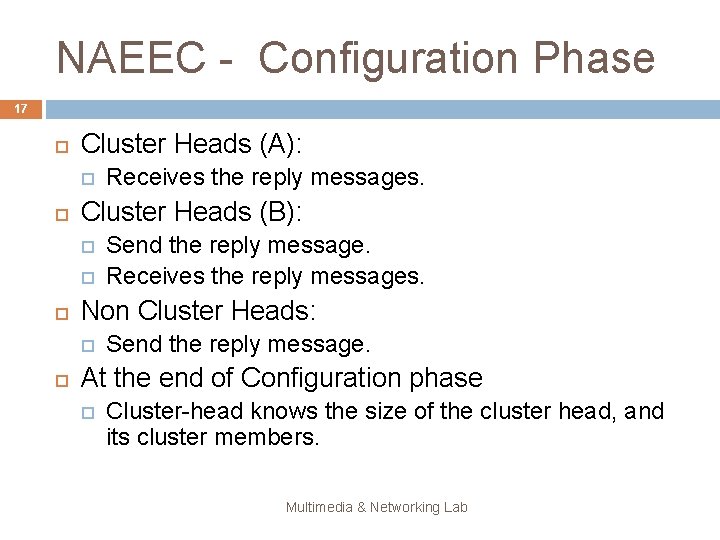
NAEEC - Configuration Phase 17 Cluster Heads (A): Cluster Heads (B): Send the reply message. Receives the reply messages. Non Cluster Heads: Receives the reply messages. Send the reply message. At the end of Configuration phase Cluster-head knows the size of the cluster head, and its cluster members. Multimedia & Networking Lab
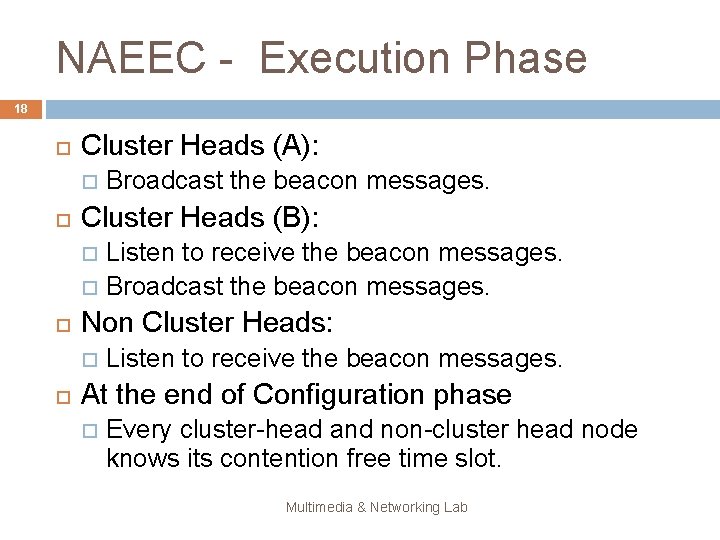
NAEEC - Execution Phase 18 Cluster Heads (A): Cluster Heads (B): Listen to receive the beacon messages. Broadcast the beacon messages. Non Cluster Heads: Broadcast the beacon messages. Listen to receive the beacon messages. At the end of Configuration phase Every cluster-head and non-cluster head node knows its contention free time slot. Multimedia & Networking Lab
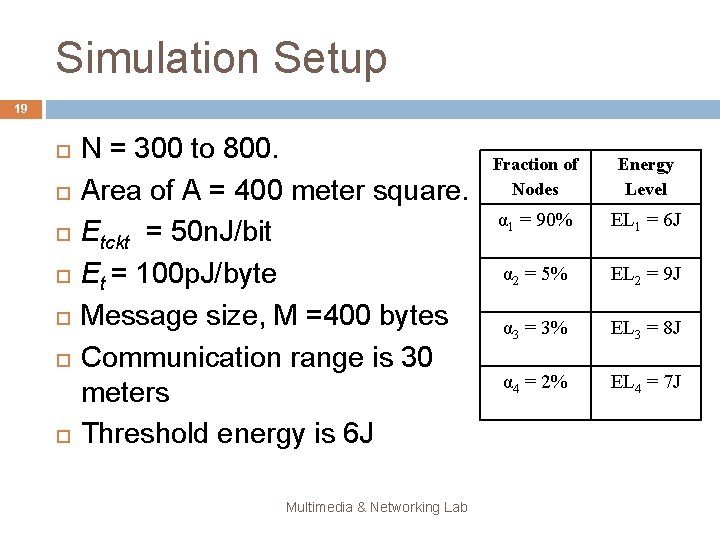
Simulation Setup 19 N = 300 to 800. Area of A = 400 meter square. Etckt = 50 n. J/bit Et = 100 p. J/byte Message size, M =400 bytes Communication range is 30 meters Threshold energy is 6 J Multimedia & Networking Lab Fraction of Nodes Energy Level α 1 = 90% EL 1 = 6 J α 2 = 5% EL 2 = 9 J α 3 = 3% EL 3 = 8 J α 4 = 2% EL 4 = 7 J
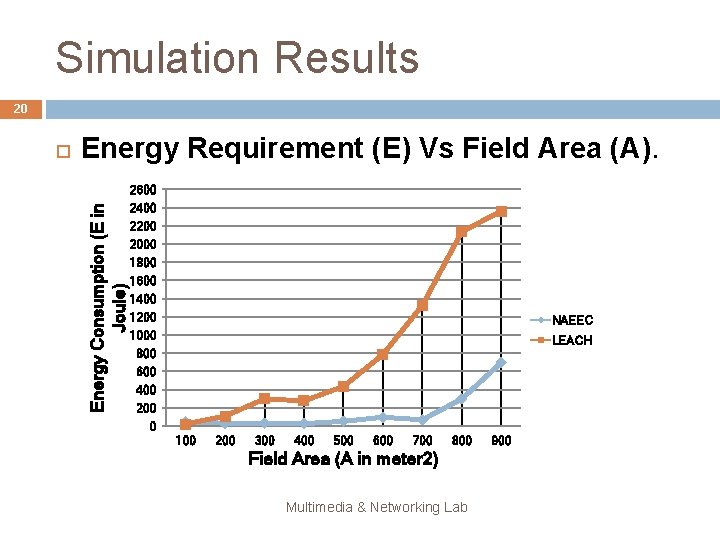
Simulation Results 20 Energy Requirement (E) Vs Field Area (A). 2600 Energy Consumption (E in Joule) 2400 2200 2000 1800 1600 1400 1200 NAEEC 1000 LEACH 800 600 400 200 0 100 200 300 400 500 600 700 800 Field Area (A in meter 2) Multimedia & Networking Lab 900
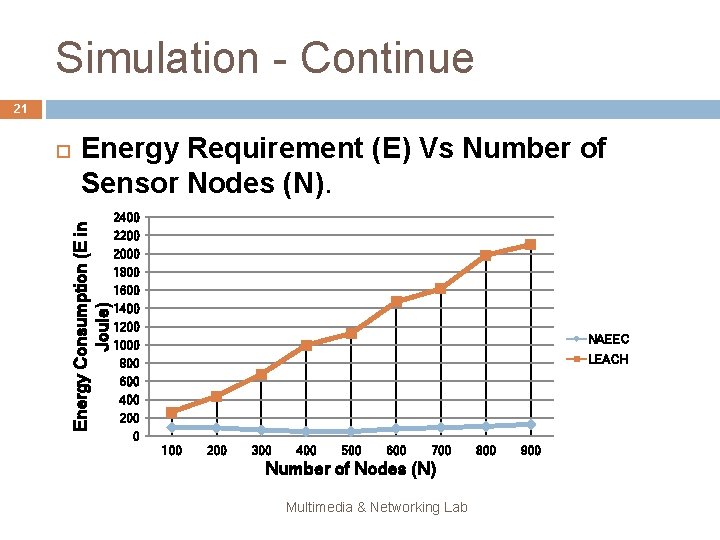
Simulation - Continue 21 Energy Requirement (E) Vs Number of Sensor Nodes (N). Energy Consumption (E in Joule) 2400 2200 2000 1800 1600 1400 1200 NAEEC 1000 LEACH 800 600 400 200 0 100 200 300 400 500 600 700 Number of Nodes (N) Multimedia & Networking Lab 800 900
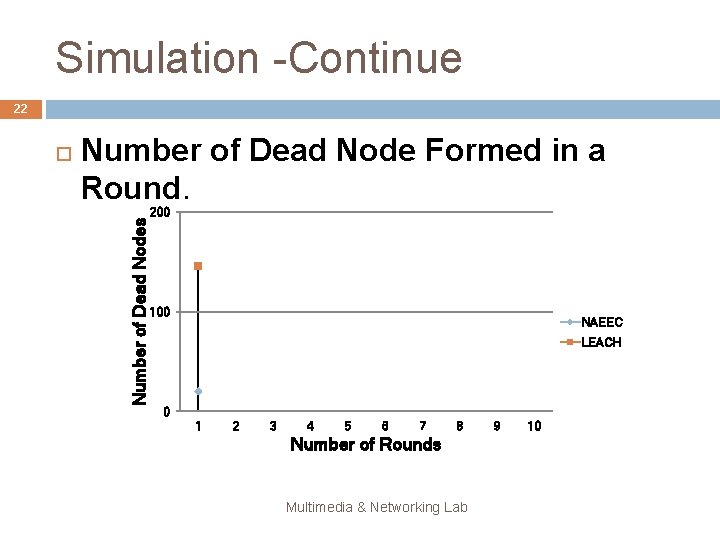
Simulation -Continue 22 Number of Dead Node Formed in a Round. Number of Dead Nodes Number of Rounds Multimedia & Networking Lab
Conclusion 23 Proposed an energy-efficient deterministic distributed clustering algorithm for heterogeneous wireless sensor networks. Unlike LEACH and other heterogeneous clustering protocols, NAEEC provides: Efficient distribution of cluster-heads Reduce the energy requirement Number of dead nodes formed over time. Multimedia & Networking Lab
Our Contribution 24 A distributed deterministic clustering protocol that Evaluates and compares the node characteristics with its neighbors to decide its role in the network. Always makes sure that the high energy nodes are chosen as cluster-heads. Provide efficient distribution of sensor nodes. Reduces the number of dead nodes formed over time. Multimedia & Networking Lab
Future Work 25 Designing of the MAC layer We are working on the MAC layer design that support the execution of the NAEEC protocol. Multimedia & Networking Lab
26 Appendix Multimedia & Networking Lab
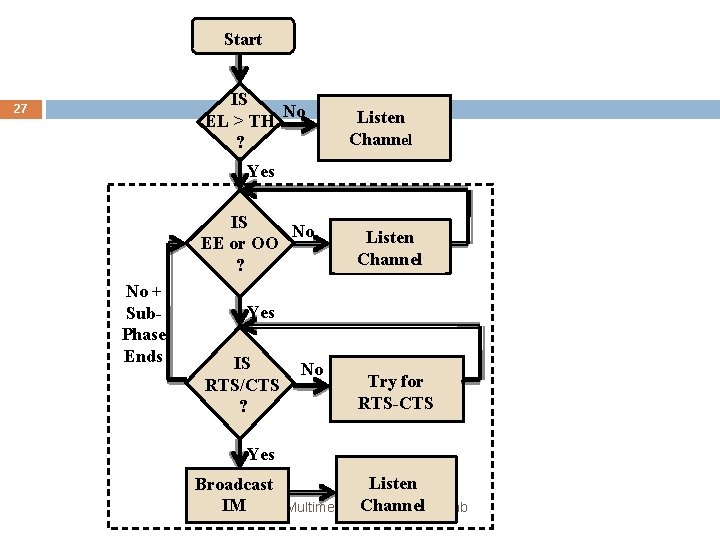
Start IS No EL > TH ? 27 Listen Channel Yes IS No EE or OO ? No + Sub. Phase Ends Listen Channel Yes IS RTS/CTS ? No Try for RTS-CTS Yes Broadcast IM Listen Multimedia &Channel Networking Lab
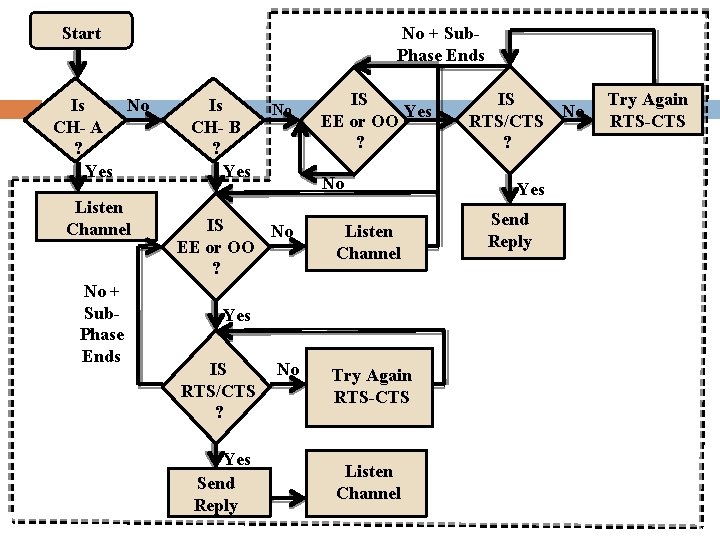
Start No Is CH- A ? Yes Listen Channel No + Sub. Phase Ends Is CH- B ? Yes No IS Yes EE or OO ? No IS No EE or OO ? Listen Channel Yes IS RTS/CTS ? Yes Send Reply No Try Again RTS-CTS Listen Channel IS No RTS/CTS ? Yes Send Reply Try Again RTS-CTS
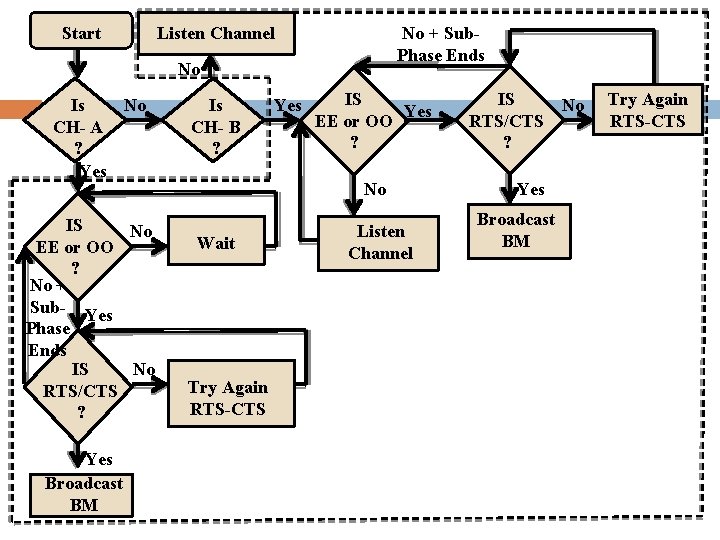
Start Listen Channel No + Sub. Phase Ends No No Is CH- A ? Yes IS No EE or OO ? No + Sub- Yes Phase Ends IS No RTS/CTS ? Yes Broadcast BM Is CH- B ? Wait Try Again RTS-CTS Yes IS Yes EE or OO ? IS No RTS/CTS ? No Yes Listen Channel Broadcast BM Try Again RTS-CTS
30 Thank you!! Questions Multimedia & Networking Lab
- Slides: 30