
MULTILINGUAL MULTICULTURAL EDUCATION DEPARTMENT Constructive Conversation Skills Across
- Slides: 31
MULTILINGUAL & MULTICULTURAL EDUCATION DEPARTMENT Constructive Conversation Skills Across Content Areas HOW MIGHT WE USE THESE SKILLS IN OTHER CONTENT AREAS? LOS ANGELES UNIFIED SCHOOL DISTRICT
Objectives 1. Gain a better understanding of Constructive Conversation Skills. 2. Apply the Conversation Protocol to academic content. 3. Consider how this protocol can build students’ academic language. MULTILINGUAL AND MULTICULTURAL EDUCATION DEPARTMENT
Ask Questions! “Applying Constructive Conversation skills in all content areas will lead to greater access to the content. ” MULTILINGUAL AND MULTICULTURAL EDUCATION DEPARTMENT
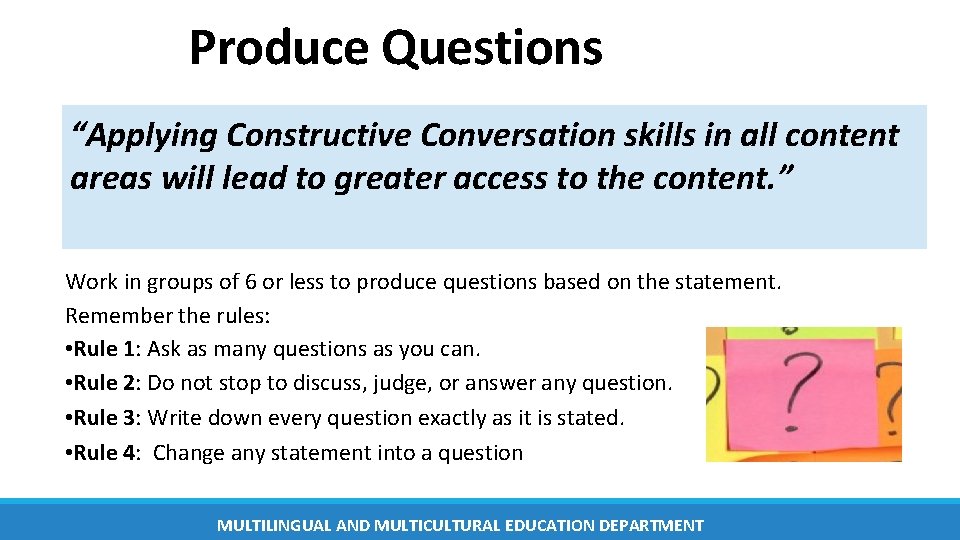
Produce Questions “Applying Constructive Conversation skills in all content areas will lead to greater access to the content. ” Work in groups of 6 or less to produce questions based on the statement. Remember the rules: • Rule 1: Ask as many questions as you can. • Rule 2: Do not stop to discuss, judge, or answer any question. • Rule 3: Write down every question exactly as it is stated. • Rule 4: Change any statement into a question MULTILINGUAL AND MULTICULTURAL EDUCATION DEPARTMENT
Prioritize Questions As a group use Constructive Conversations Skills to determine one question you want/need to answer first. MULTILINGUAL AND MULTICULTURAL EDUCATION DEPARTMENT
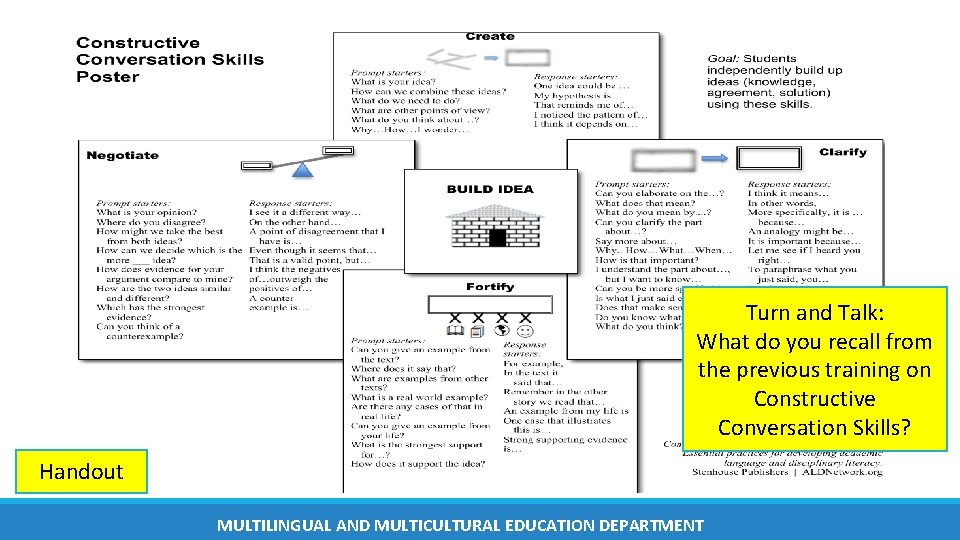
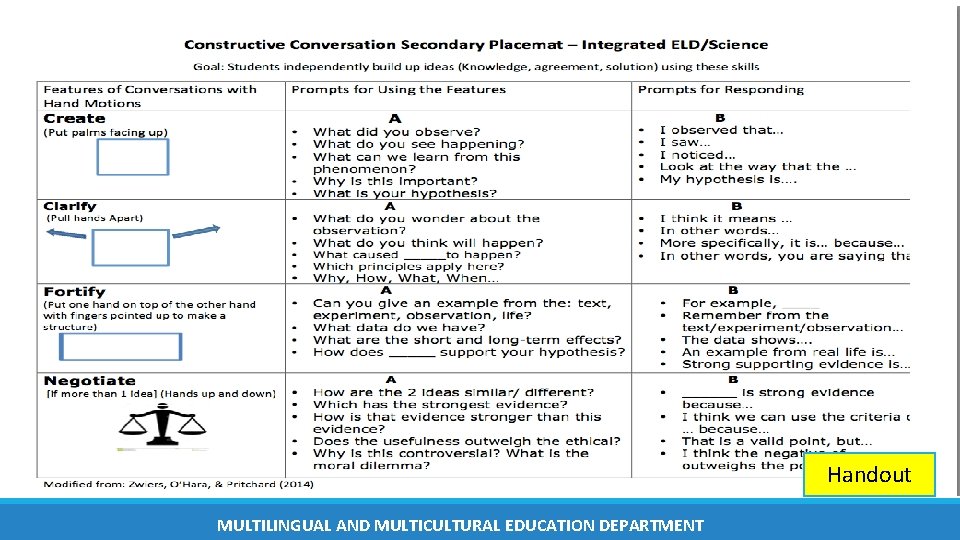
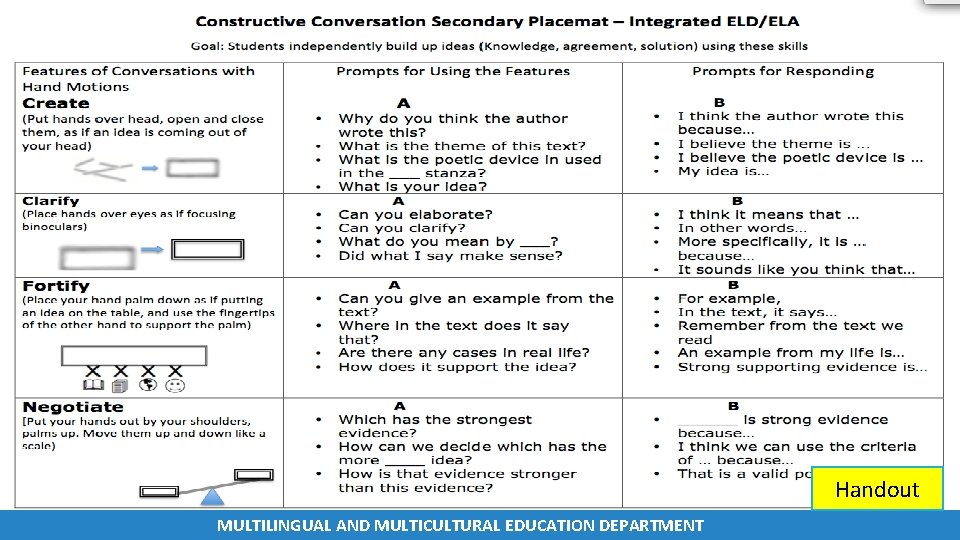
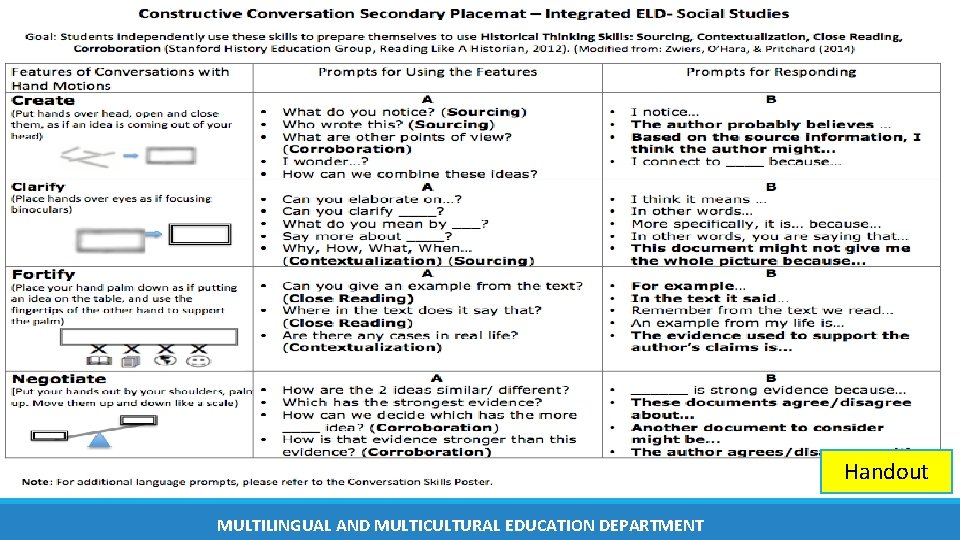
Turn and Talk: What do you recall from the previous training on Constructive Conversation Skills? Handout MULTILINGUAL AND MULTICULTURAL EDUCATION DEPARTMENT
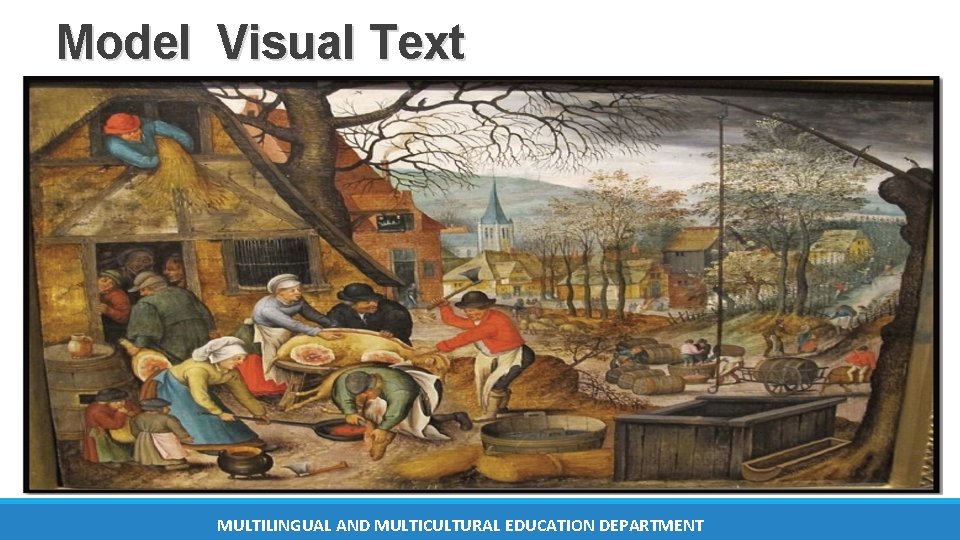
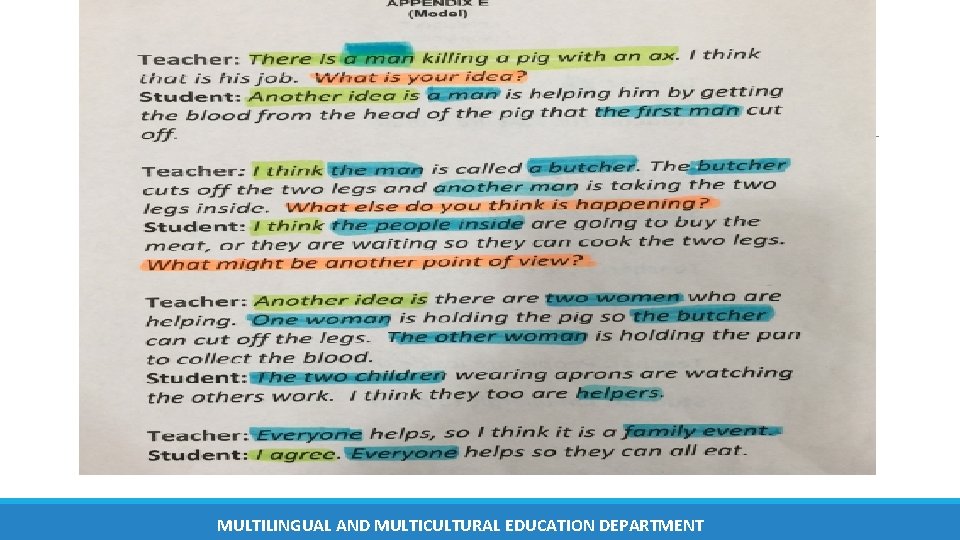
Model Visual Text MULTILINGUAL AND MULTICULTURAL EDUCATION DEPARTMENT
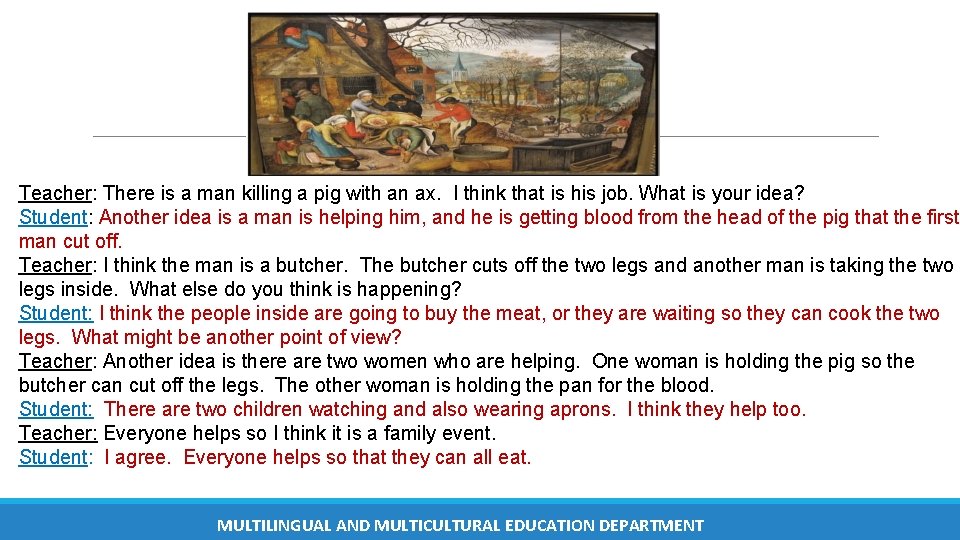
Teacher: There is a man killing a pig with an ax. I think that is his job. What is your idea? Student: Another idea is a man is helping him, and he is getting blood from the head of the pig that the first man cut off. Teacher: I think the man is a butcher. The butcher cuts off the two legs and another man is taking the two legs inside. What else do you think is happening? Student: I think the people inside are going to buy the meat, or they are waiting so they can cook the two legs. What might be another point of view? Teacher: Another idea is there are two women who are helping. One woman is holding the pig so the butcher can cut off the legs. The other woman is holding the pan for the blood. Student: There are two children watching and also wearing aprons. I think they help too. Teacher: Everyone helps so I think it is a family event. Student: I agree. Everyone helps so that they can all eat. MULTILINGUAL AND MULTICULTURAL EDUCATION DEPARTMENT
MULTILINGUAL AND MULTICULTURAL EDUCATION DEPARTMENT
In your content group: 1. Create and Clarify ◦ Using the questions and the visual text, create and clarify ideas around the question. 2. Once you create and clarify, read article or watch video 3. As a group fortify and negotiate the answer to the question. MULTILINGUAL AND MULTICULTURAL EDUCATION DEPARTMENT
Handout MULTILINGUAL AND MULTICULTURAL EDUCATION DEPARTMENT
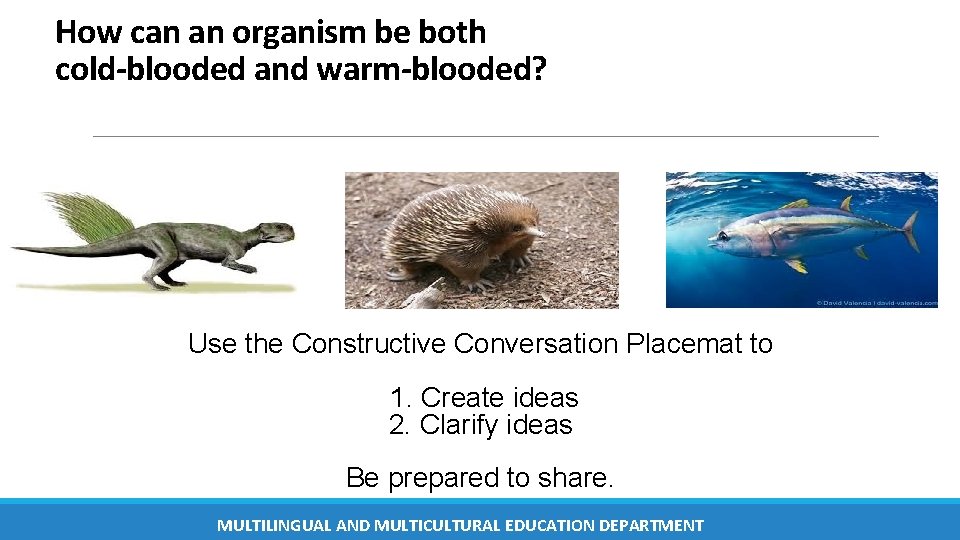
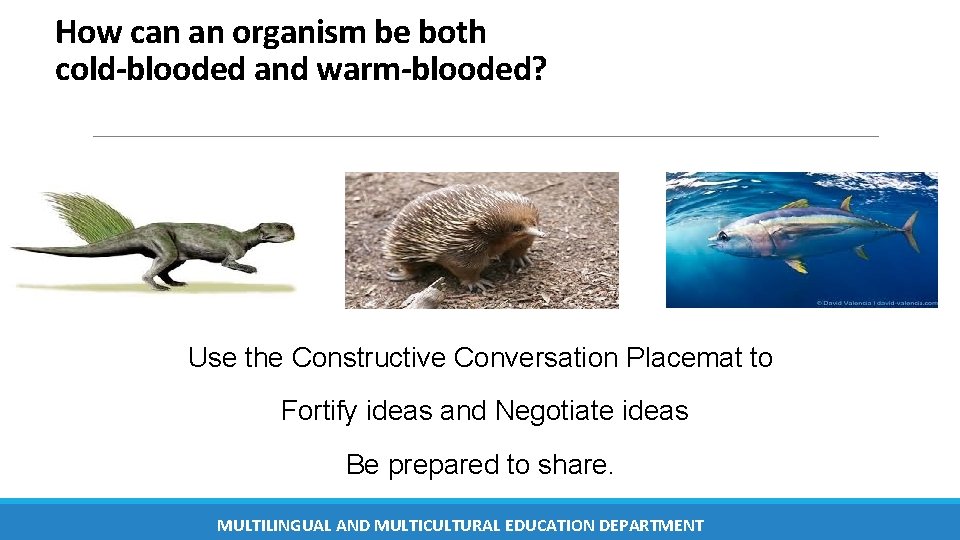
How can an organism be both cold-blooded and warm-blooded? Use the Constructive Conversation Placemat to 1. Create ideas 2. Clarify ideas Be prepared to share. MULTILINGUAL AND MULTICULTURAL EDUCATION DEPARTMENT
Were dinosaurs cold-blooded or warm-blooded? • Scientists still haven't settled the hot debate over whether dinosaurs were warm-blooded like birds and mammals or cold blooded like reptiles, fish and amphibians. • And some research suggests that dinos may be somewhere in between�. • The following video explains the mesothermy theory, which may help explain how the giant prehistoric creatures could have stayed active in cold weather--when cold blooded animals could not have--and conserve energy when needed. MULTILINGUAL AND MULTICULTURAL EDUCATION DEPARTMENT
Could dinosaurs have been warm-blooded? https: //www. youtube. com/watch? v=xd. U 6 q. Wd. F-a. I MULTILINGUAL AND MULTICULTURAL EDUCATION DEPARTMENT
How can an organism be both cold-blooded and warm-blooded? Use the Constructive Conversation Placemat to Fortify ideas and Negotiate ideas Be prepared to share. MULTILINGUAL AND MULTICULTURAL EDUCATION DEPARTMENT
Handout MULTILINGUAL AND MULTICULTURAL EDUCATION DEPARTMENT
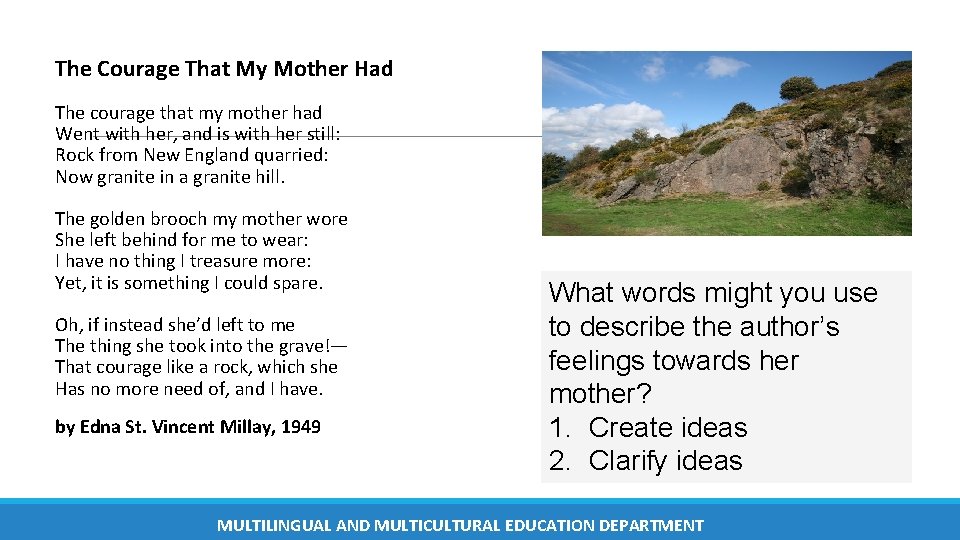
The Courage That My Mother Had The courage that my mother had Went with her, and is with her still: Rock from New England quarried: Now granite in a granite hill. The golden brooch my mother wore She left behind for me to wear: I have no thing I treasure more: Yet, it is something I could spare. Oh, if instead she’d left to me The thing she took into the grave!— That courage like a rock, which she Has no more need of, and I have. by Edna St. Vincent Millay, 1949 What words might you use to describe the author’s feelings towards her mother? 1. Create ideas 2. Clarify ideas MULTILINGUAL AND MULTICULTURAL EDUCATION DEPARTMENT
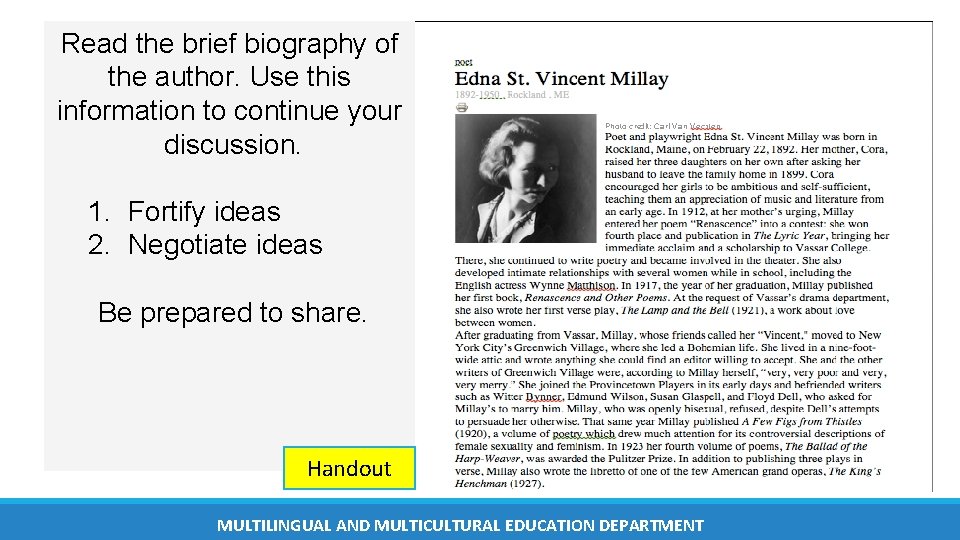
Read the brief biography of the author. Use this information to continue your discussion. 1. Fortify ideas 2. Negotiate ideas Be prepared to share. Handout MULTILINGUAL AND MULTICULTURAL EDUCATION DEPARTMENT
Handout MULTILINGUAL AND MULTICULTURAL EDUCATION DEPARTMENT
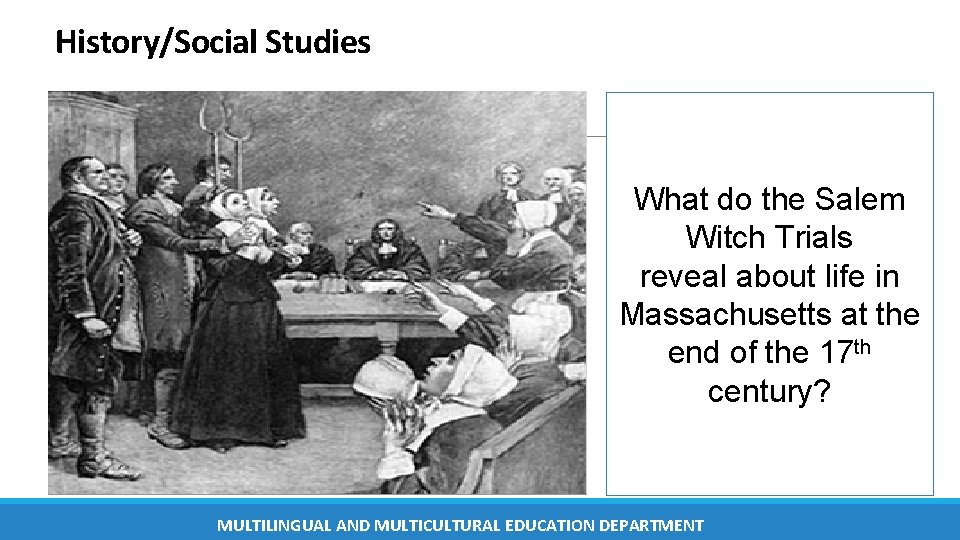
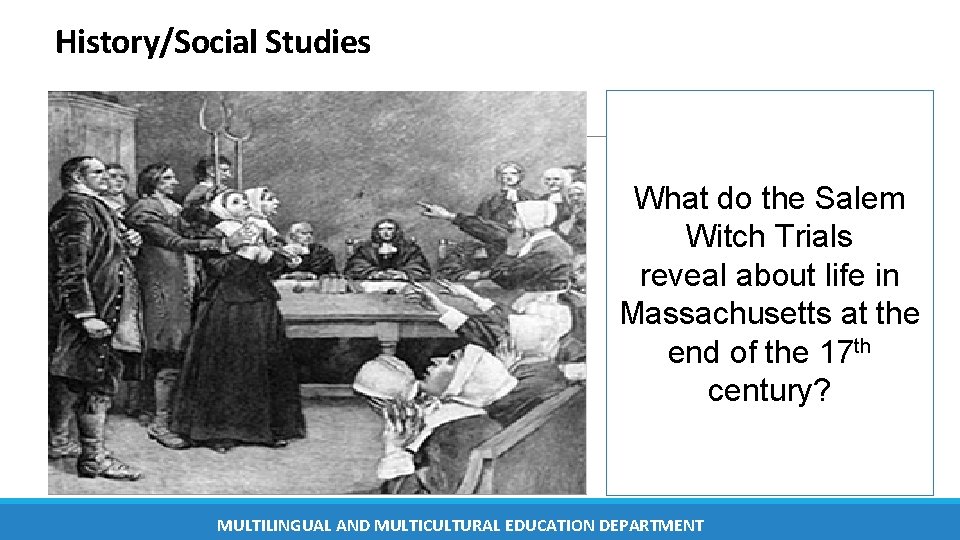
History/Social Studies What do the Salem Witch Trials reveal about life in Massachusetts at the end of the 17 th century? MULTILINGUAL AND MULTICULTURAL EDUCATION DEPARTMENT
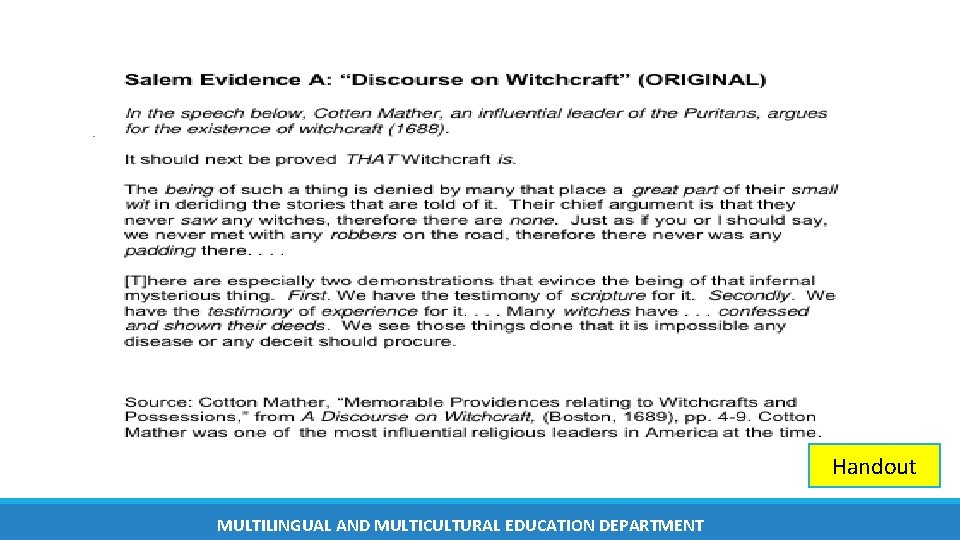
Handout MULTILINGUAL AND MULTICULTURAL EDUCATION DEPARTMENT
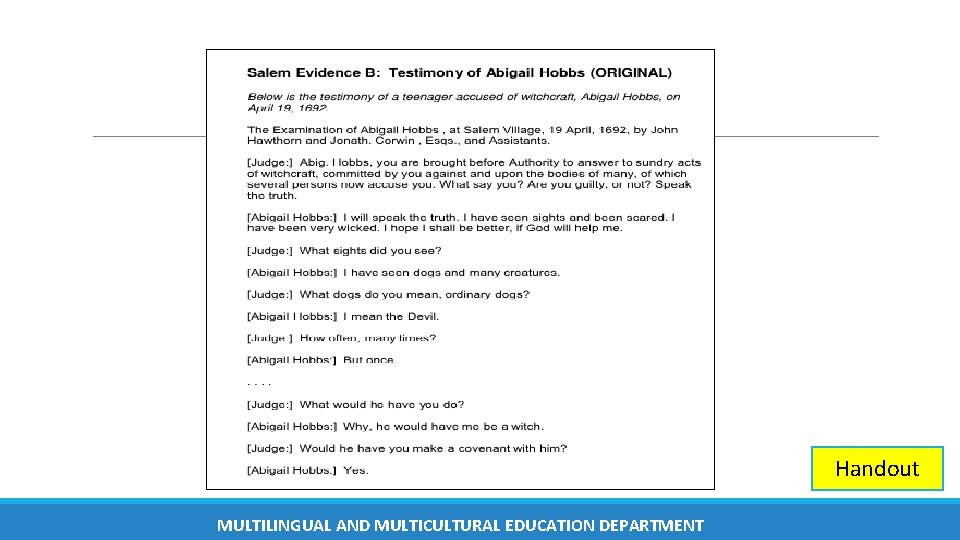
Handout MULTILINGUAL AND MULTICULTURAL EDUCATION DEPARTMENT
History/Social Studies What do the Salem Witch Trials reveal about life in Massachusetts at the end of the 17 th century? MULTILINGUAL AND MULTICULTURAL EDUCATION DEPARTMENT
Handout MULTILINGUAL AND MULTICULTURAL EDUCATION DEPARTMENT
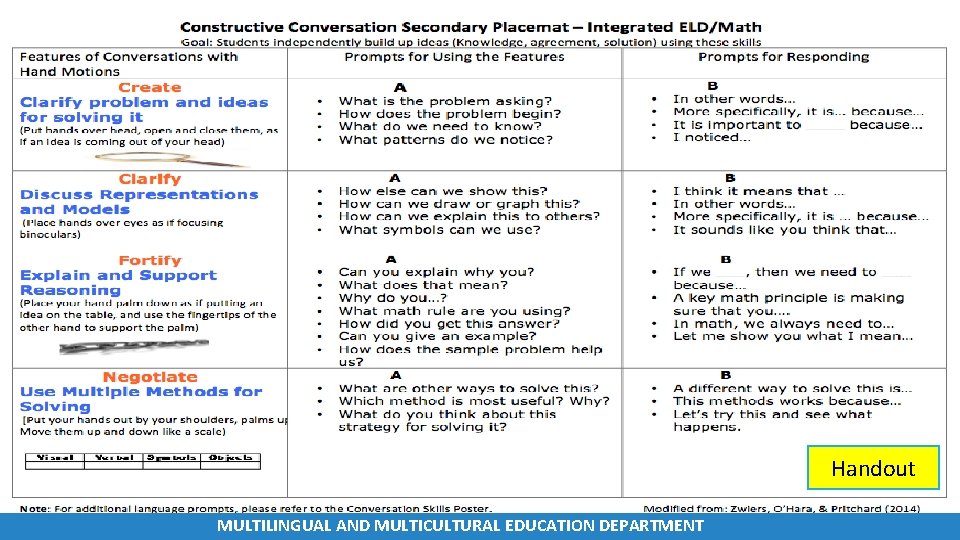
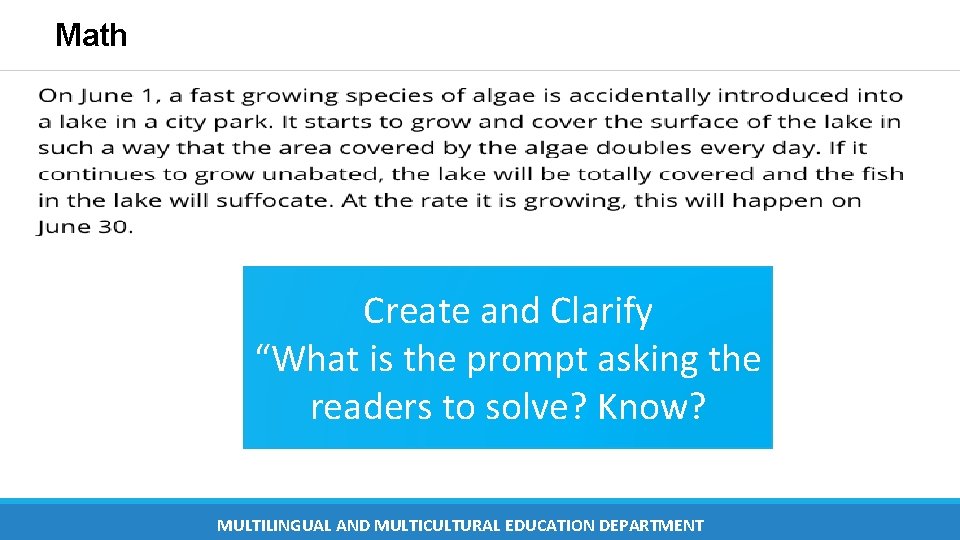
Math Create and Clarify “What is the prompt asking the readers to solve? Know? MULTILINGUAL AND MULTICULTURAL EDUCATION DEPARTMENT
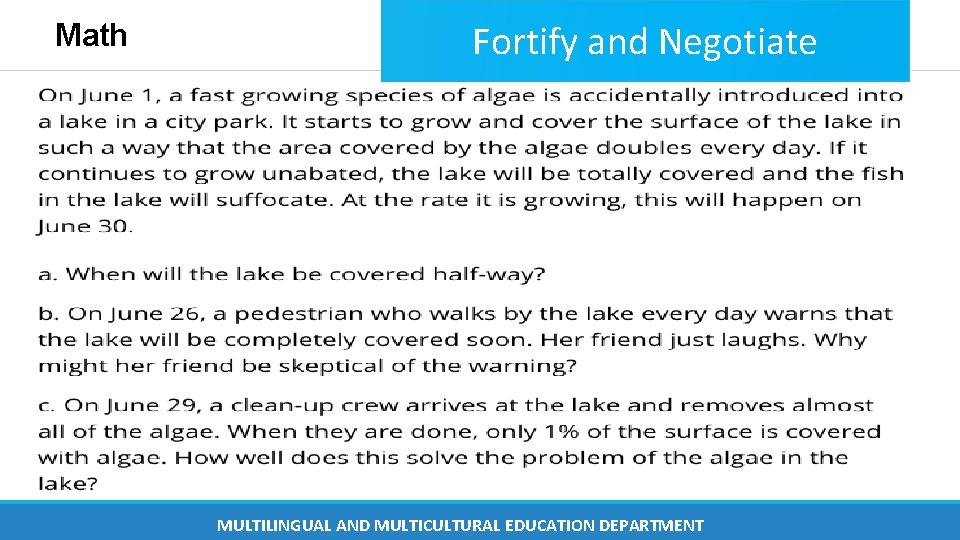
Math Fortify and Negotiate MULTILINGUAL AND MULTICULTURAL EDUCATION DEPARTMENT
Breakout into content groups MULTILINGUAL AND MULTICULTURAL EDUCATION DEPARTMENT
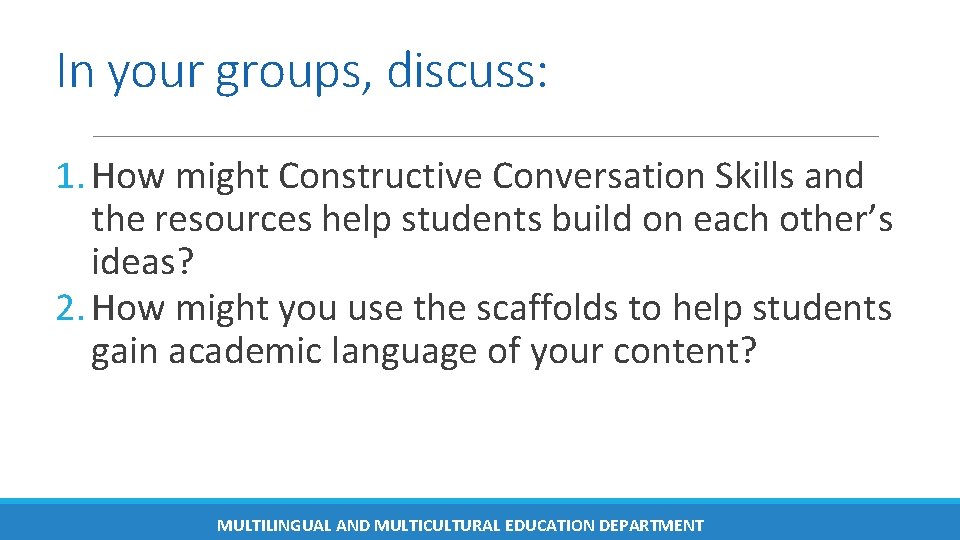
In your groups, discuss: 1. How might Constructive Conversation Skills and the resources help students build on each other’s ideas? 2. How might you use the scaffolds to help students gain academic language of your content? MULTILINGUAL AND MULTICULTURAL EDUCATION DEPARTMENT
Eye Contact Partner Stand up, make eye contact with another person in another content area: this will be your “Eye Contact Partner” Discuss the following with your Eye Contact partner: How might Constructive Conversation Skills and the resources help students build on each other’s ideas? How might you use the scaffolds to help students gain academic language of your content? MULTILINGUAL AND MULTICULTURAL EDUCATION DEPARTMENT
ELD Standards Connection Part I 6. Reading/viewing closely Explain ideas, phenomena, processes, and text relationships (e. g. , compare/ contrast, cause/effect, problem/solution) based on close reading of a variety of grade-level texts and viewing of multimedia, with light support. a. Part I. A. Collaborative 1. Exchanging Information/Ideas Contribute to class, group, and partner discussions by following turntaking rules, asking relevant questions, affirming others, adding relevant information and evidence, paraphrasing key ideas, building on responses, and providing useful feedback.
Back to the Question. . Applying Constructive Conversation skills in all content areas will lead to greater access to the content. How will you apply this learning in your instruction? MULTILINGUAL AND MULTICULTURAL EDUCATION DEPARTMENT