
Multilinear Systems and Invariant Theory in the Context
- Slides: 44
Multi-linear Systems and Invariant Theory in the Context of Computer Vision and Graphics Class 4: Mutli-View 3 D-from-2 D CS 329 Stanford University Amnon Shashua Class 4 1
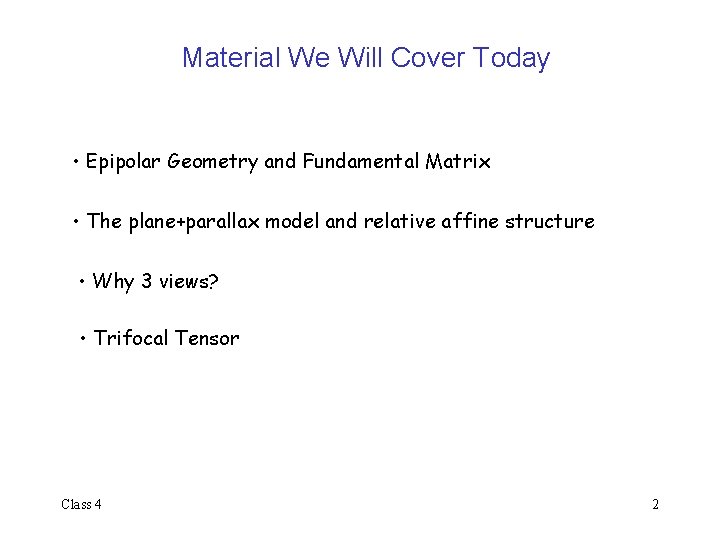
Material We Will Cover Today • Epipolar Geometry and Fundamental Matrix • The plane+parallax model and relative affine structure • Why 3 views? • Trifocal Tensor Class 4 2
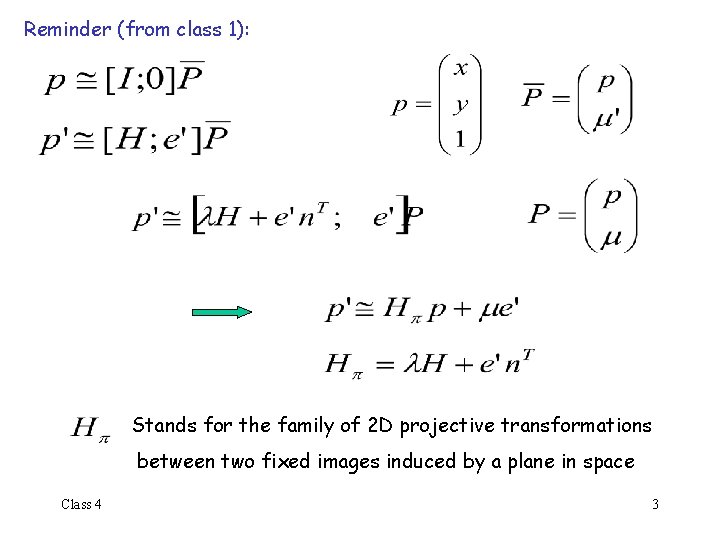
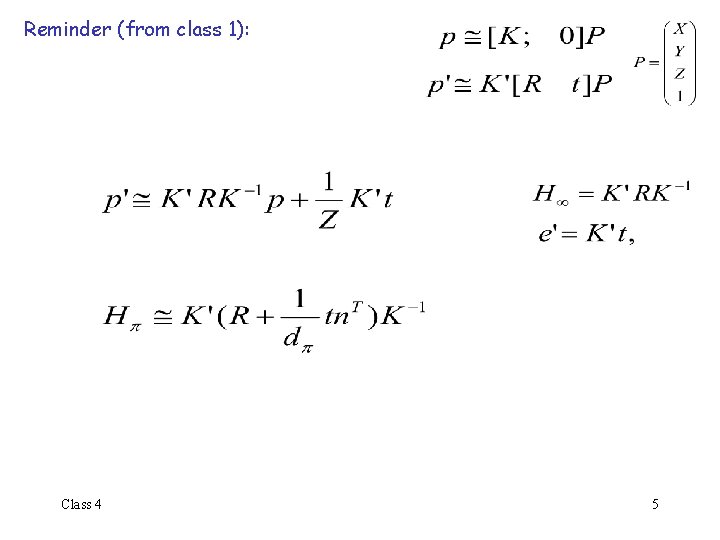
Reminder (from class 1): Stands for the family of 2 D projective transformations between two fixed images induced by a plane in space Class 4 3
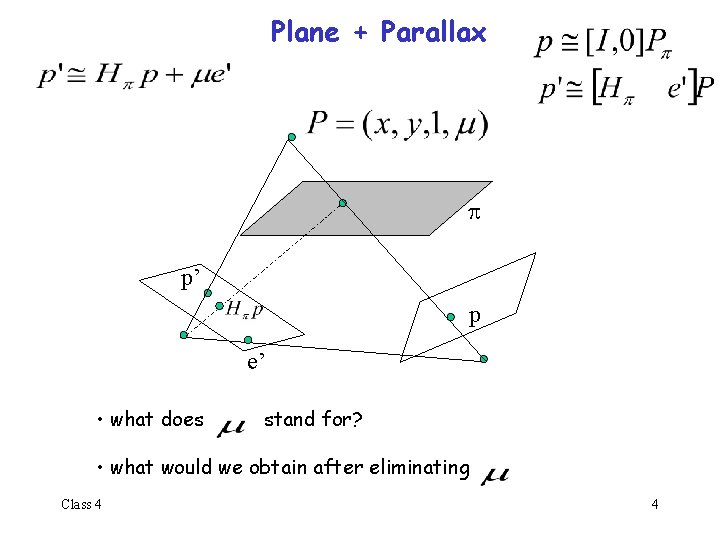
Plane + Parallax p’ p e’ • what does stand for? • what would we obtain after eliminating Class 4 4
Reminder (from class 1): Class 4 5
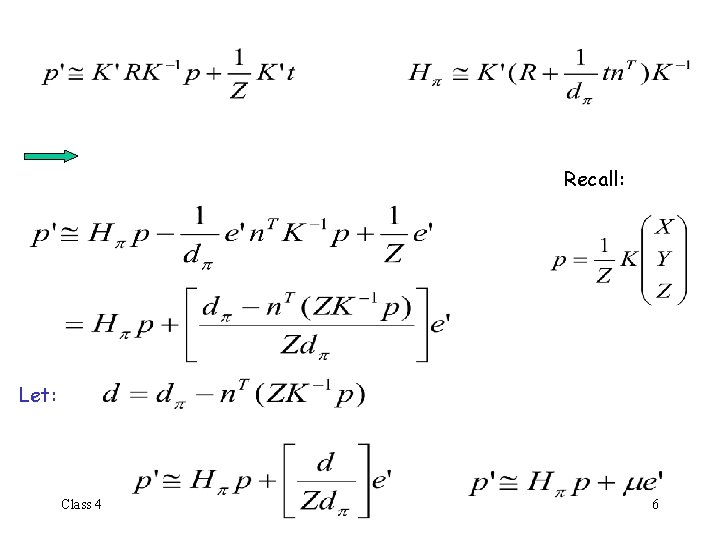
Recall: Let: Class 4 6
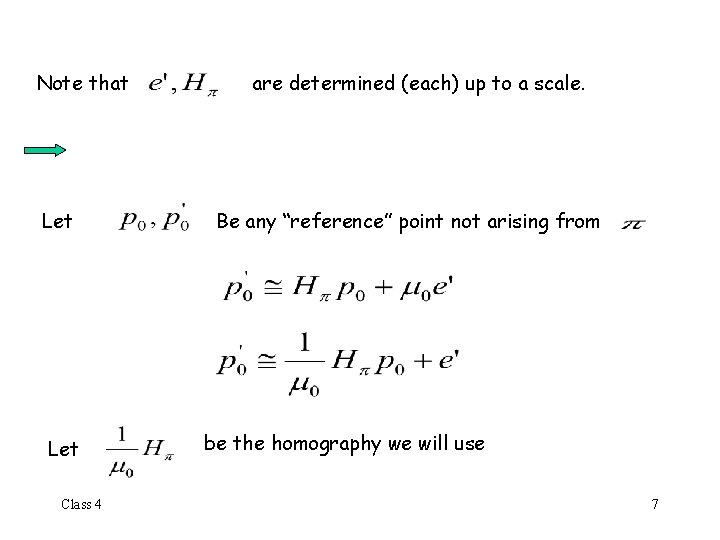
Note that Let Class 4 are determined (each) up to a scale. Be any “reference” point not arising from be the homography we will use 7
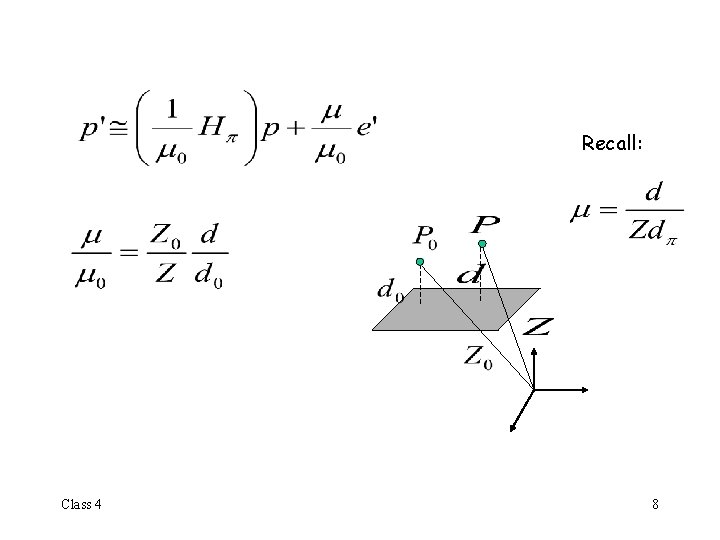
Recall: Class 4 8
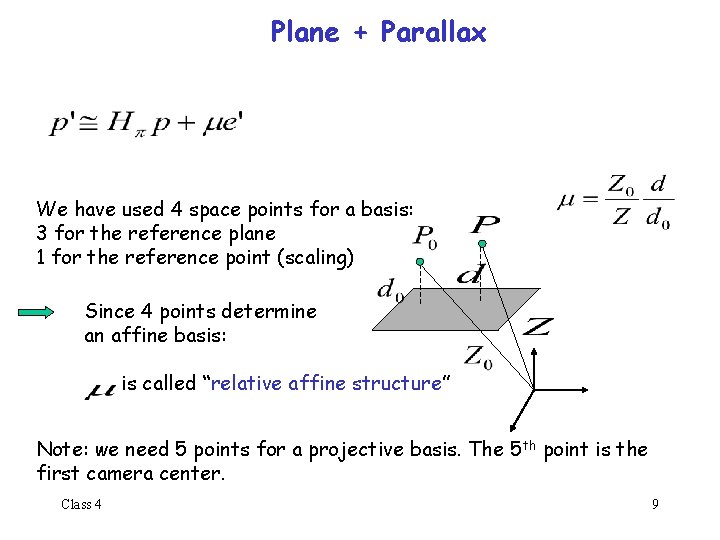
Plane + Parallax We have used 4 space points for a basis: 3 for the reference plane 1 for the reference point (scaling) Since 4 points determine an affine basis: is called “relative affine structure” Note: we need 5 points for a projective basis. The 5 th point is the first camera center. Class 4 9
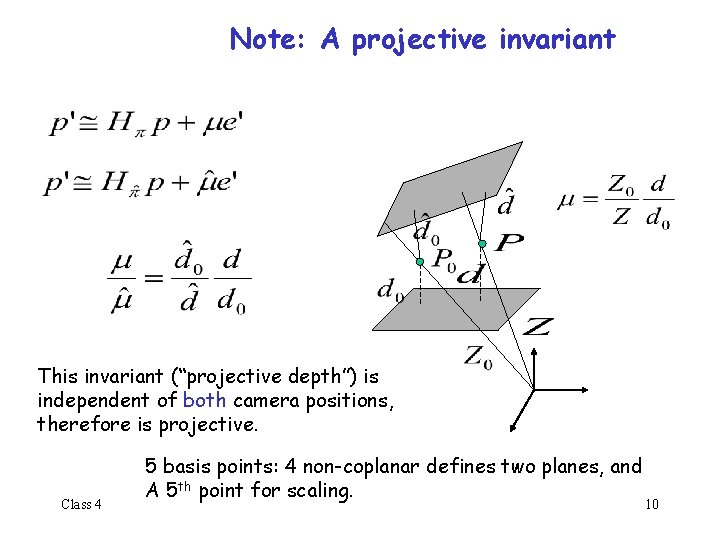
Note: A projective invariant This invariant (“projective depth”) is independent of both camera positions, therefore is projective. Class 4 5 basis points: 4 non-coplanar defines two planes, and A 5 th point for scaling. 10
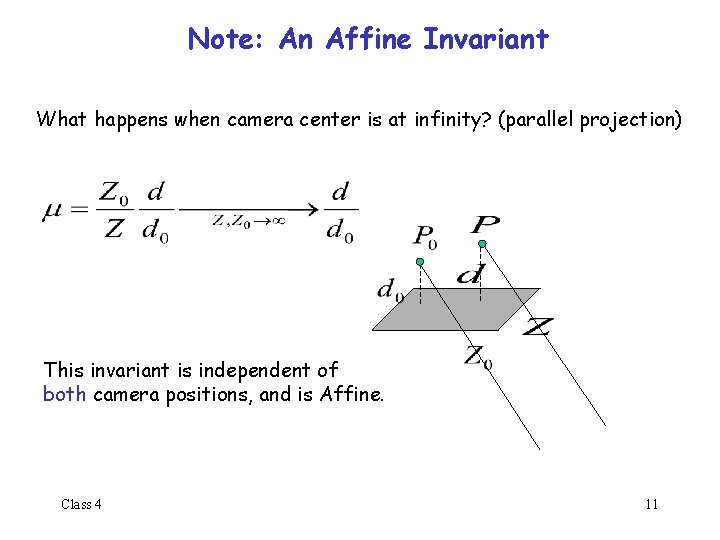
Note: An Affine Invariant What happens when camera center is at infinity? (parallel projection) This invariant is independent of both camera positions, and is Affine. Class 4 11
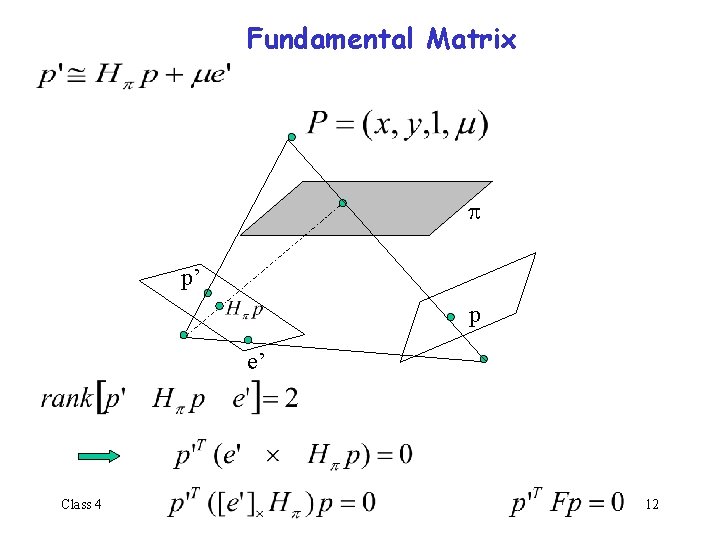
Fundamental Matrix p’ p e’ Class 4 12
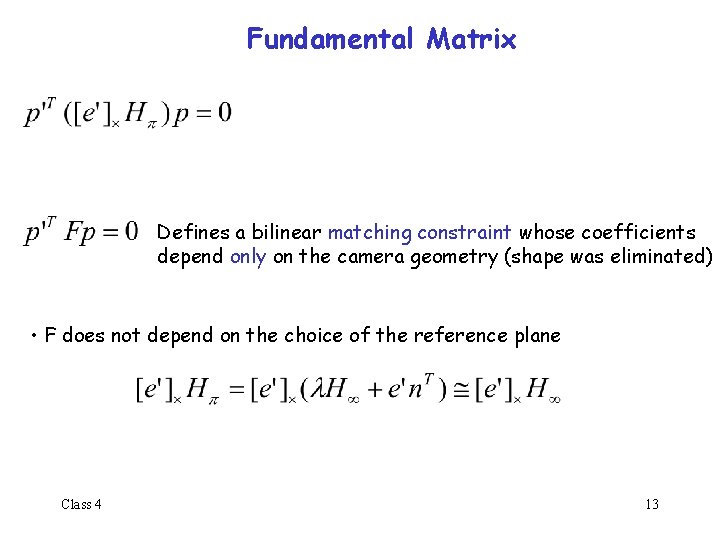
Fundamental Matrix Defines a bilinear matching constraint whose coefficients depend only on the camera geometry (shape was eliminated) • F does not depend on the choice of the reference plane Class 4 13
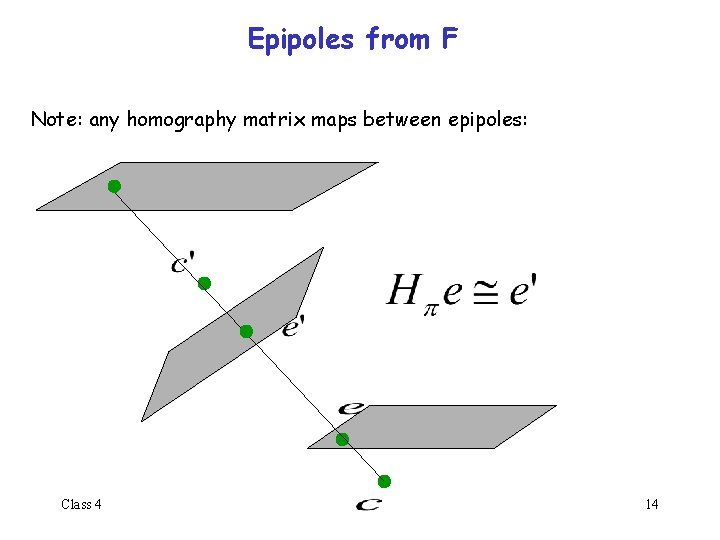
Epipoles from F Note: any homography matrix maps between epipoles: Class 4 14
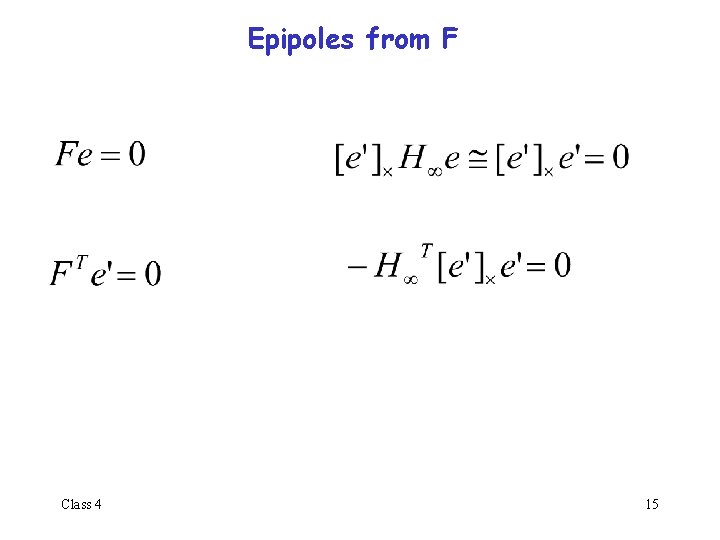
Epipoles from F Class 4 15
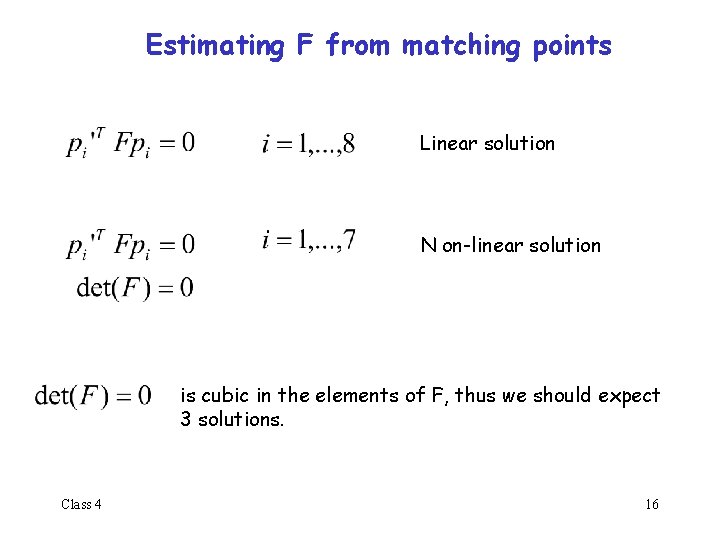
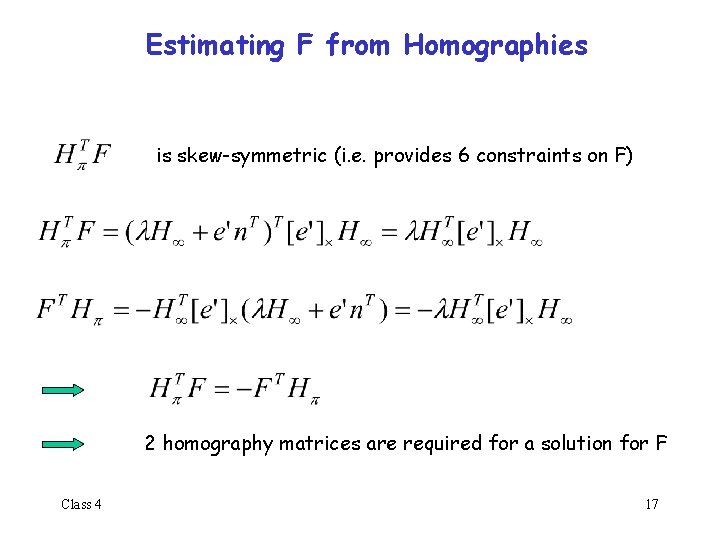
Estimating F from matching points Linear solution N on-linear solution is cubic in the elements of F, thus we should expect 3 solutions. Class 4 16
Estimating F from Homographies is skew-symmetric (i. e. provides 6 constraints on F) 2 homography matrices are required for a solution for F Class 4 17
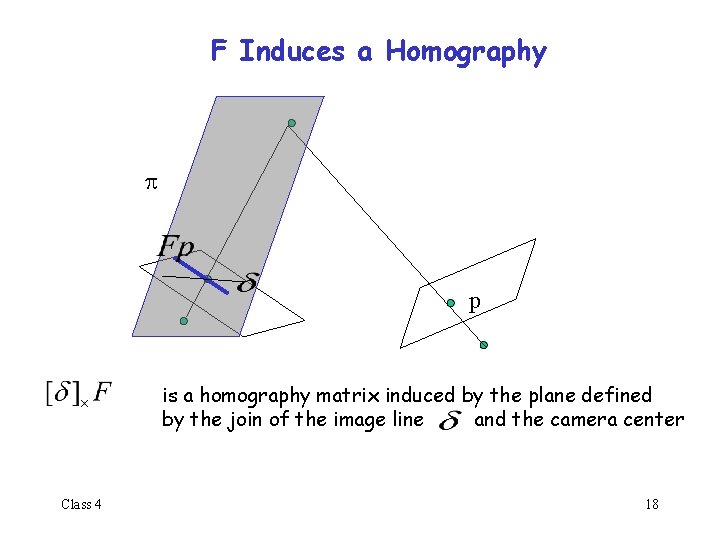
F Induces a Homography p is a homography matrix induced by the plane defined by the join of the image line and the camera center Class 4 18
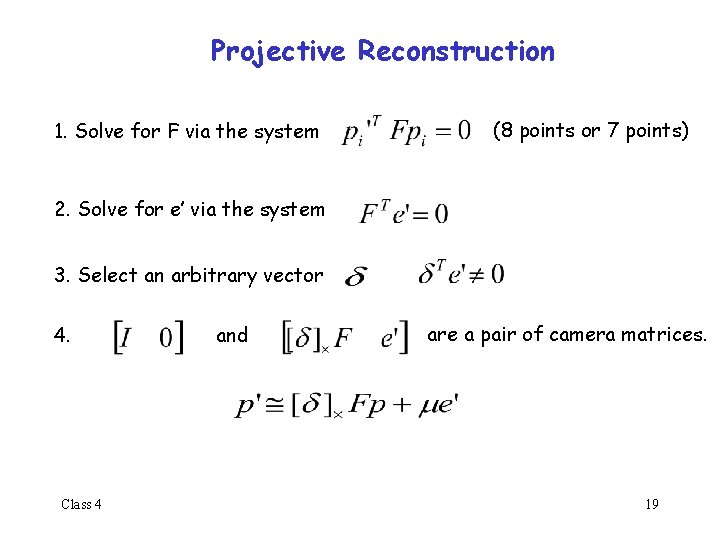
Projective Reconstruction 1. Solve for F via the system (8 points or 7 points) 2. Solve for e’ via the system 3. Select an arbitrary vector 4. Class 4 and are a pair of camera matrices. 19
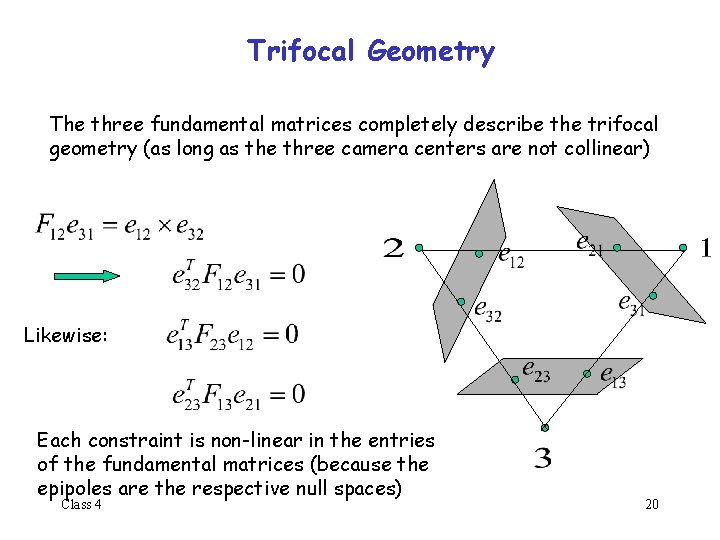
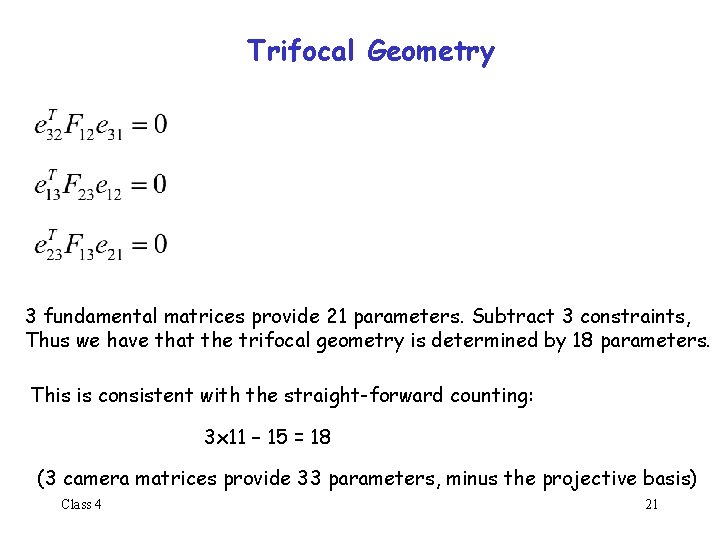
Trifocal Geometry The three fundamental matrices completely describe the trifocal geometry (as long as the three camera centers are not collinear) Likewise: Each constraint is non-linear in the entries of the fundamental matrices (because the epipoles are the respective null spaces) Class 4 20
Trifocal Geometry 3 fundamental matrices provide 21 parameters. Subtract 3 constraints, Thus we have that the trifocal geometry is determined by 18 parameters. This is consistent with the straight-forward counting: 3 x 11 – 15 = 18 (3 camera matrices provide 33 parameters, minus the projective basis) Class 4 21
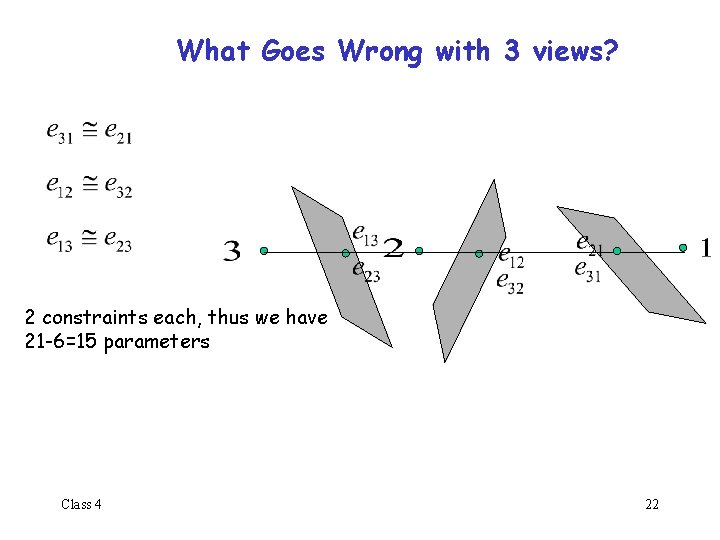
What Goes Wrong with 3 views? 2 constraints each, thus we have 21 -6=15 parameters Class 4 22
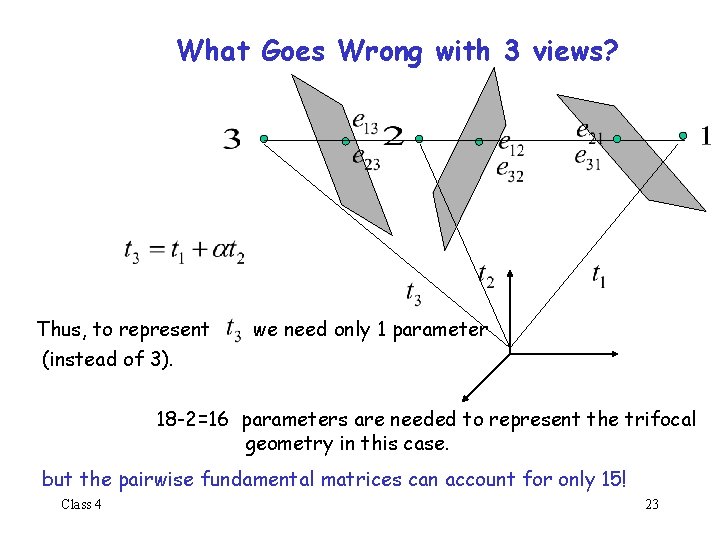
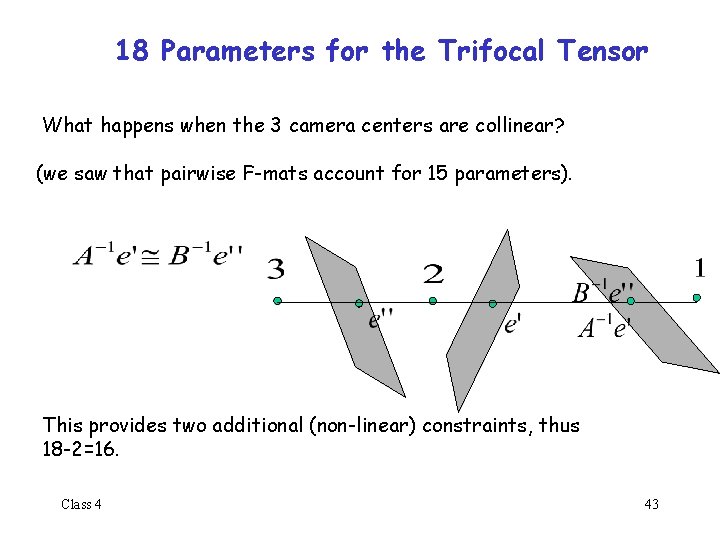
What Goes Wrong with 3 views? Thus, to represent (instead of 3). we need only 1 parameter 18 -2=16 parameters are needed to represent the trifocal geometry in this case. but the pairwise fundamental matrices can account for only 15! Class 4 23
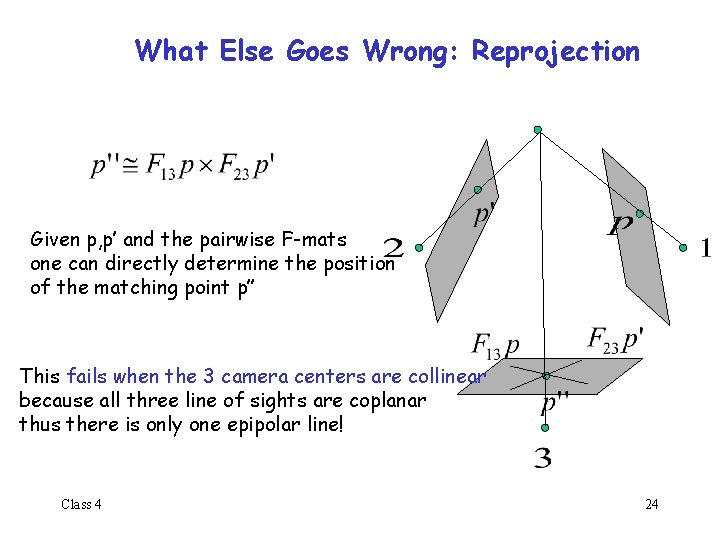
What Else Goes Wrong: Reprojection Given p, p’ and the pairwise F-mats one can directly determine the position of the matching point p’’ This fails when the 3 camera centers are collinear because all three line of sights are coplanar thus there is only one epipolar line! Class 4 24
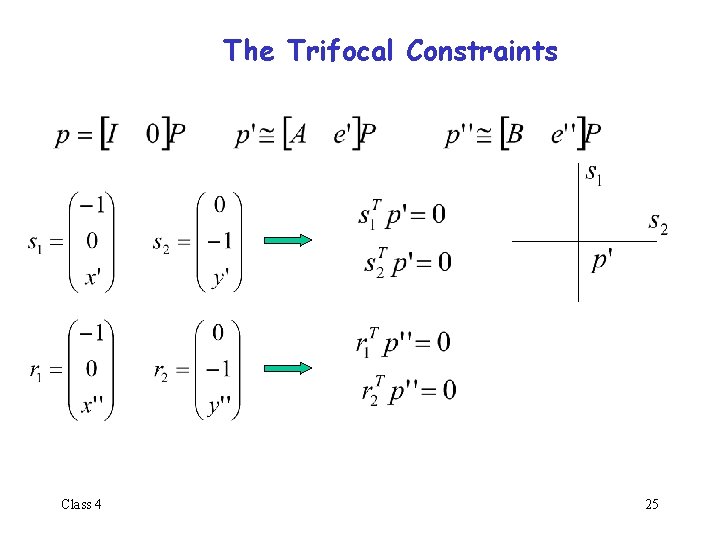
The Trifocal Constraints Class 4 25
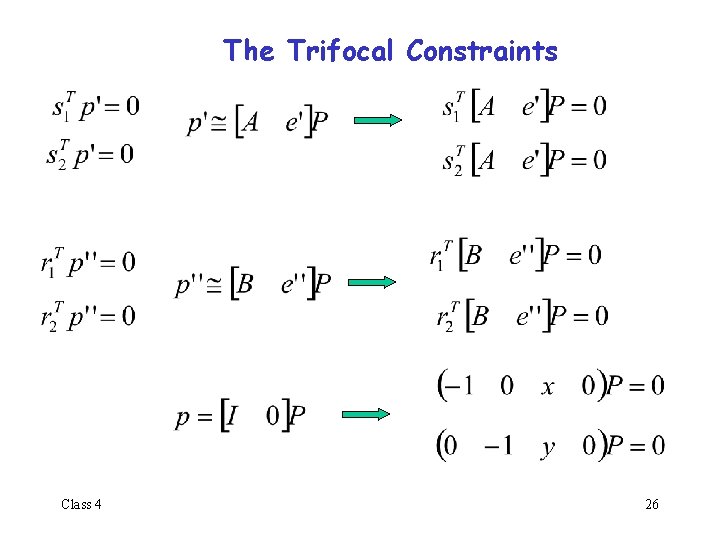
The Trifocal Constraints Class 4 26
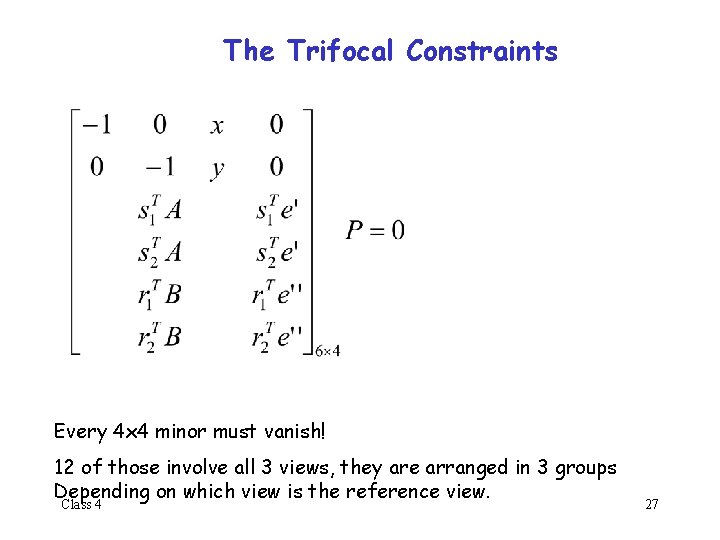
The Trifocal Constraints Every 4 x 4 minor must vanish! 12 of those involve all 3 views, they are arranged in 3 groups Depending on which view is the reference view. Class 4 27
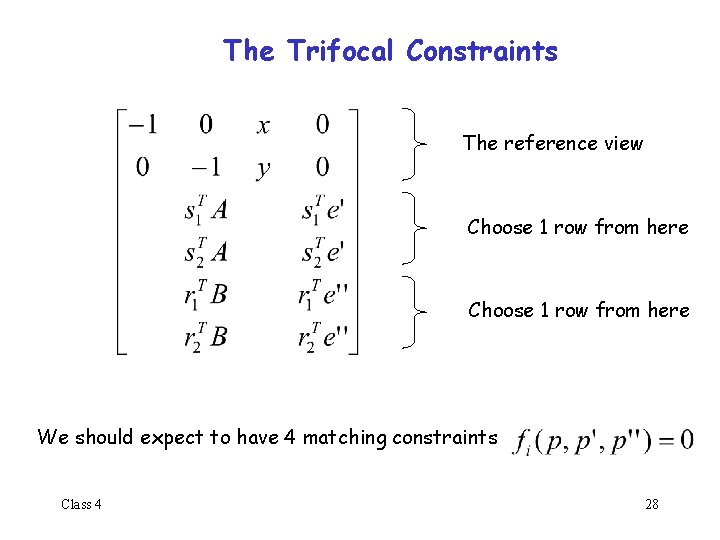
The Trifocal Constraints The reference view Choose 1 row from here We should expect to have 4 matching constraints Class 4 28
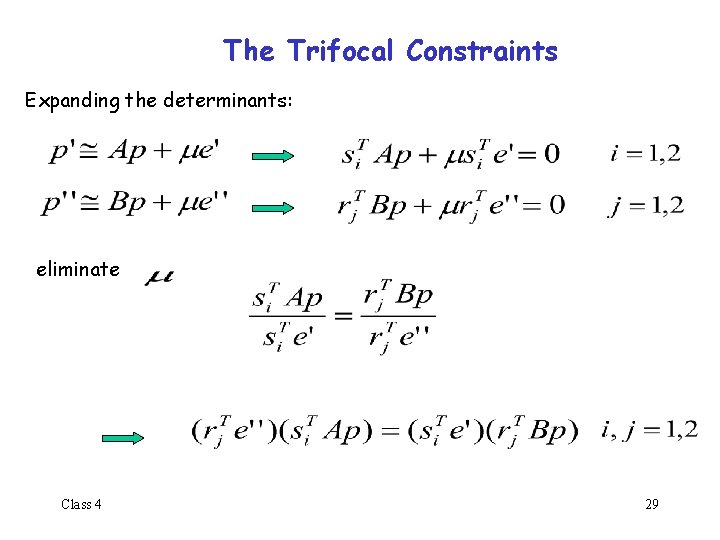
The Trifocal Constraints Expanding the determinants: eliminate Class 4 29
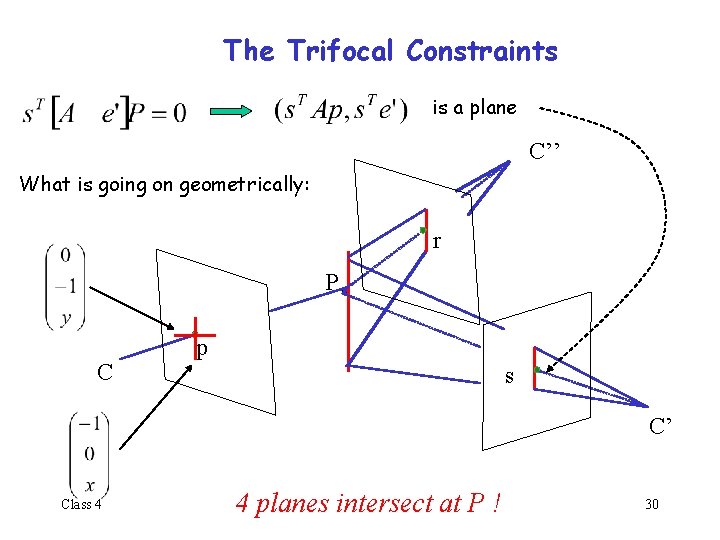
The Trifocal Constraints is a plane C’’ What is going on geometrically: r P C p s C’ Class 4 4 planes intersect at P ! 30
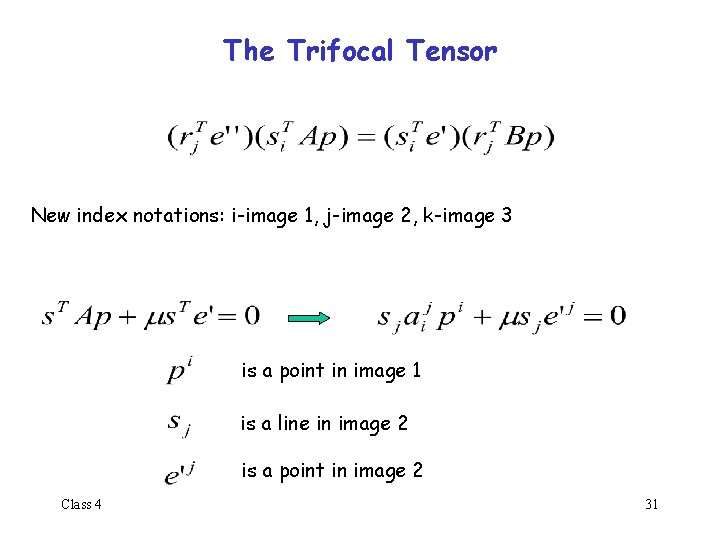
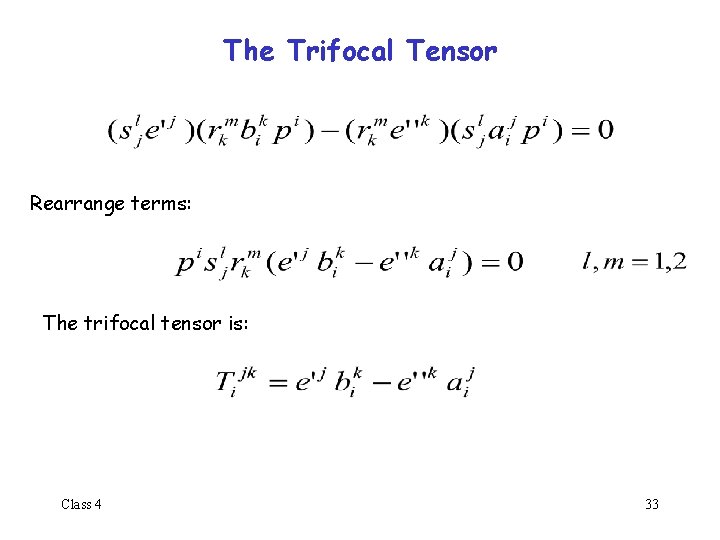
The Trifocal Tensor New index notations: i-image 1, j-image 2, k-image 3 is a point in image 1 is a line in image 2 is a point in image 2 Class 4 31
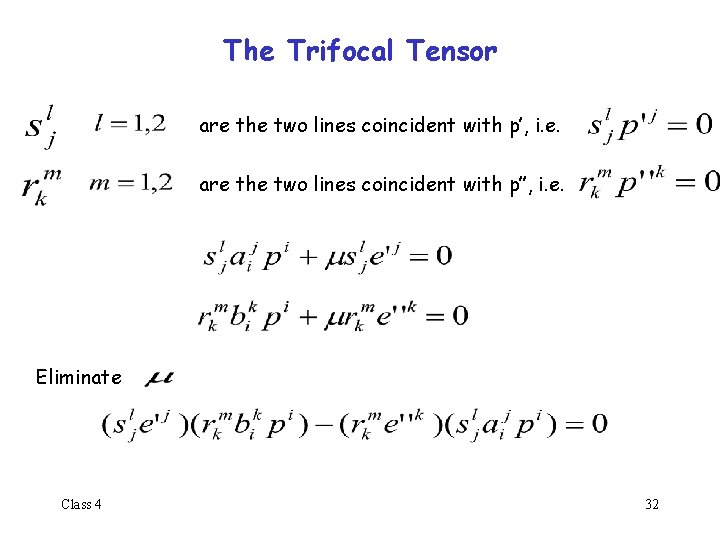
The Trifocal Tensor are the two lines coincident with p’, i. e. are the two lines coincident with p’’, i. e. Eliminate Class 4 32
The Trifocal Tensor Rearrange terms: The trifocal tensor is: Class 4 33
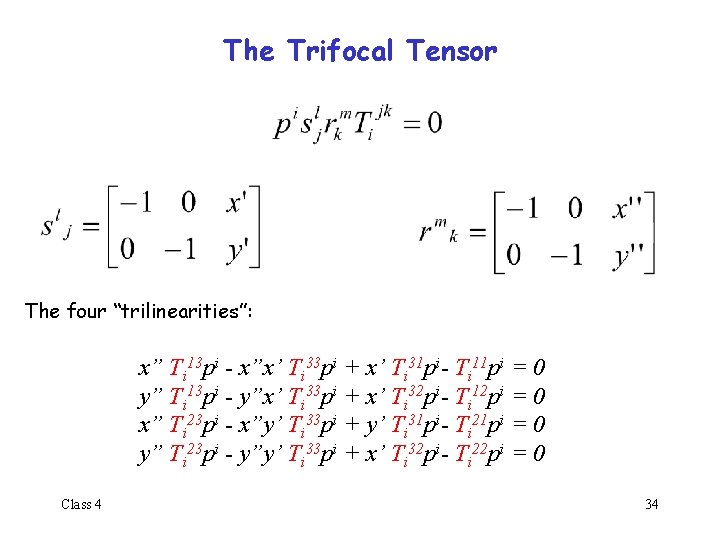
The Trifocal Tensor The four “trilinearities”: x” Ti 13 pi - x”x’ Ti 33 pi + x’ Ti 31 pi- Ti 11 pi = 0 y” Ti 13 pi - y”x’ Ti 33 pi + x’ Ti 32 pi- Ti 12 pi = 0 x” Ti 23 pi - x”y’ Ti 33 pi + y’ Ti 31 pi- Ti 21 pi = 0 y” Ti 23 pi - y”y’ Ti 33 pi + x’ Ti 32 pi- Ti 22 pi = 0 Class 4 34
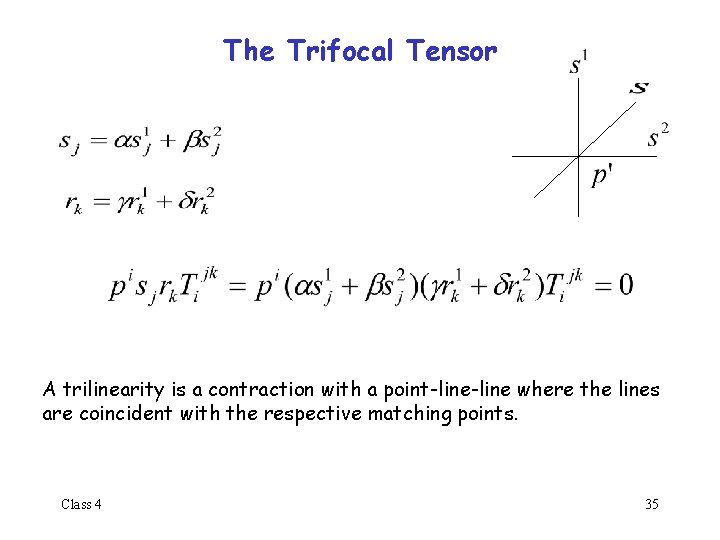
The Trifocal Tensor A trilinearity is a contraction with a point-line where the lines are coincident with the respective matching points. Class 4 35
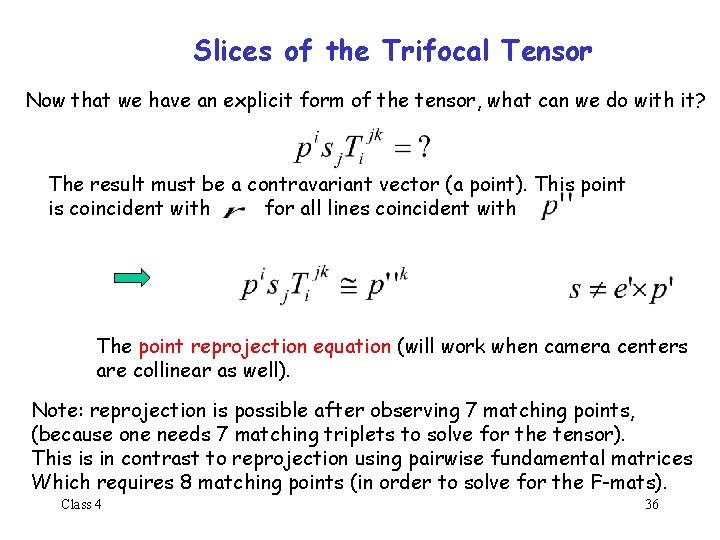
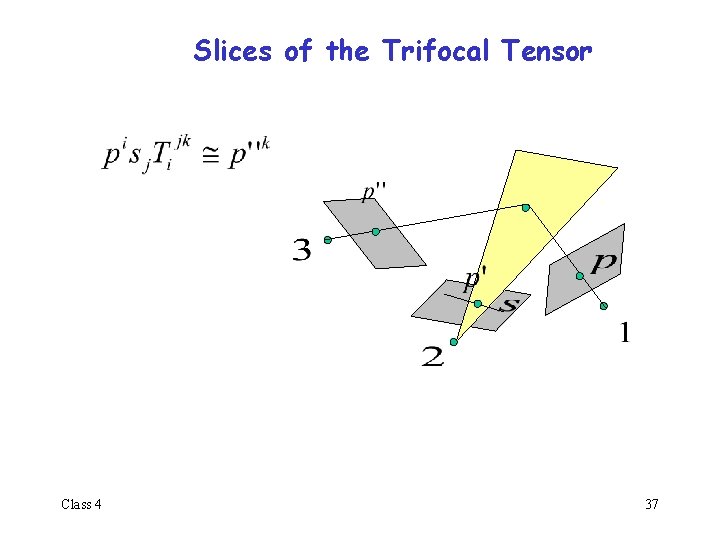
Slices of the Trifocal Tensor Now that we have an explicit form of the tensor, what can we do with it? The result must be a contravariant vector (a point). This point is coincident with for all lines coincident with The point reprojection equation (will work when camera centers are collinear as well). Note: reprojection is possible after observing 7 matching points, (because one needs 7 matching triplets to solve for the tensor). This is in contrast to reprojection using pairwise fundamental matrices Which requires 8 matching points (in order to solve for the F-mats). Class 4 36
Slices of the Trifocal Tensor Class 4 37
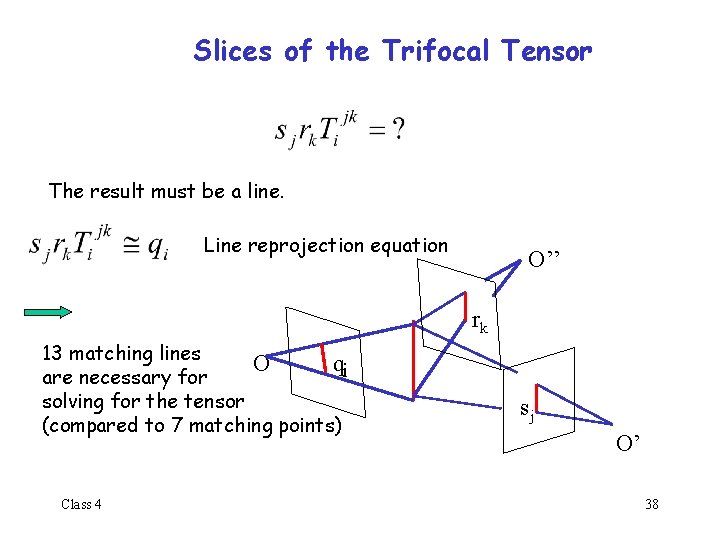
Slices of the Trifocal Tensor The result must be a line. Line reprojection equation O’’ rk 13 matching lines qi O are necessary for solving for the tensor (compared to 7 matching points) Class 4 sj O’ 38
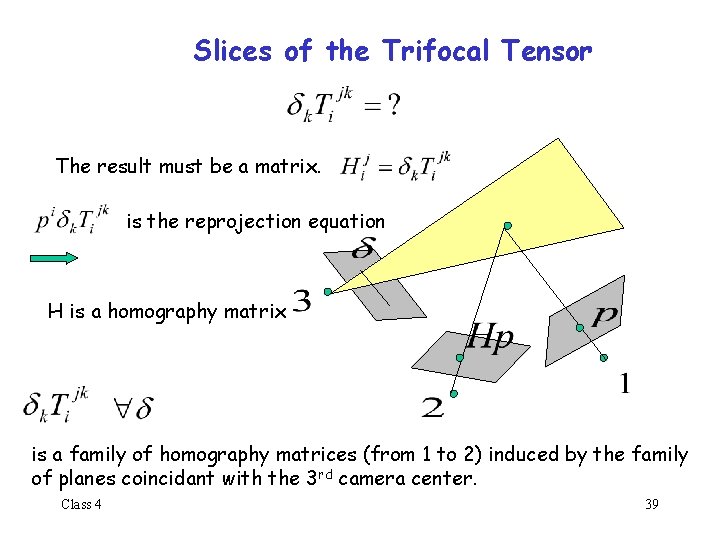
Slices of the Trifocal Tensor The result must be a matrix. is the reprojection equation H is a homography matrix is a family of homography matrices (from 1 to 2) induced by the family of planes coincidant with the 3 rd camera center. Class 4 39
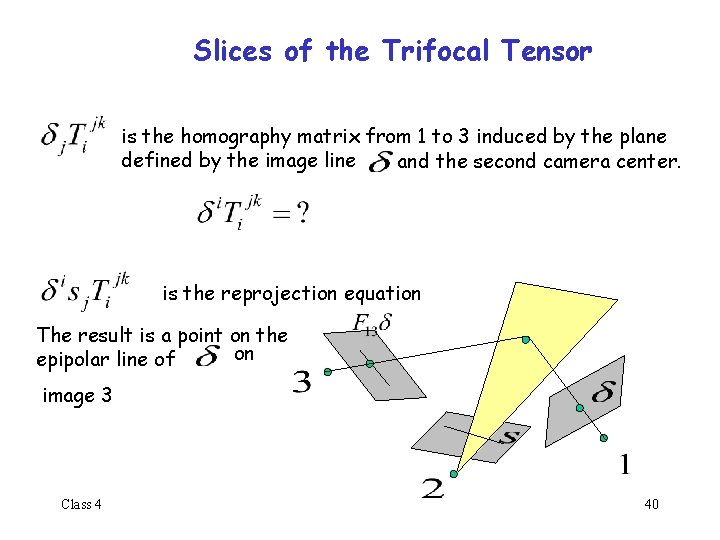
Slices of the Trifocal Tensor is the homography matrix from 1 to 3 induced by the plane defined by the image line and the second camera center. is the reprojection equation The result is a point on the on epipolar line of image 3 Class 4 40
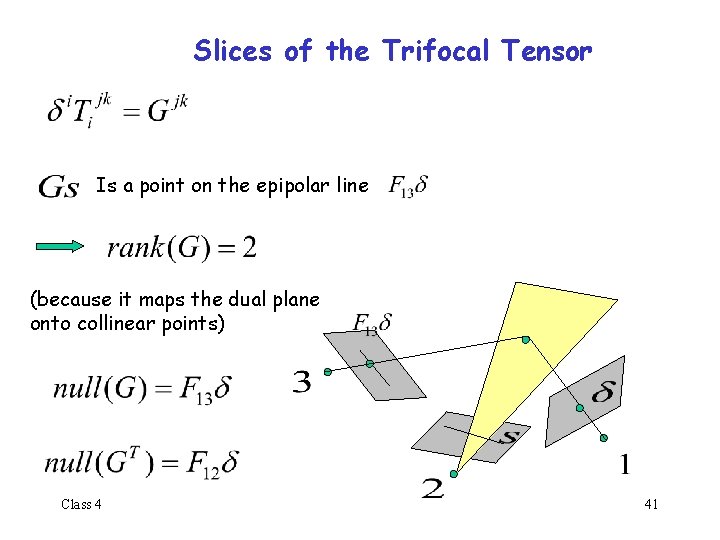
Slices of the Trifocal Tensor Is a point on the epipolar line (because it maps the dual plane onto collinear points) Class 4 41
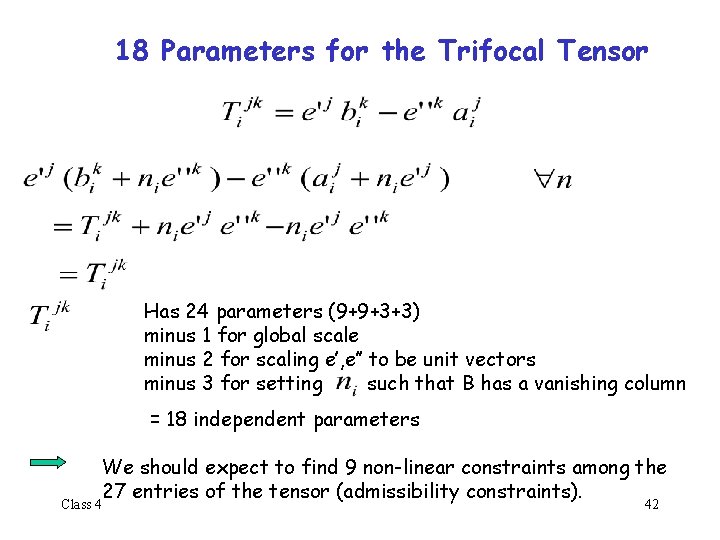
18 Parameters for the Trifocal Tensor Has 24 parameters (9+9+3+3) minus 1 for global scale minus 2 for scaling e’, e’’ to be unit vectors minus 3 for setting such that B has a vanishing column = 18 independent parameters We should expect to find 9 non-linear constraints among the 27 entries of the tensor (admissibility constraints). Class 4 42
18 Parameters for the Trifocal Tensor What happens when the 3 camera centers are collinear? (we saw that pairwise F-mats account for 15 parameters). This provides two additional (non-linear) constraints, thus 18 -2=16. Class 4 43
Items not Covered in Class • Degenerate configurations (Linear Line Complex, Quartic Curve) • The source of the 9 admissibility constraints (come from the homography slices). • Concatenation of trifocal tensors along a sequence • Quadrifocal tensor (and its relation to the homography tensor) Class 4 44