
Multilevel Human Brain Modeling Rancho Santa Fe 93006
Multi-level Human Brain Modeling Rancho Santa Fe 9/30/06 Jerome Swartz The Swartz Foundation
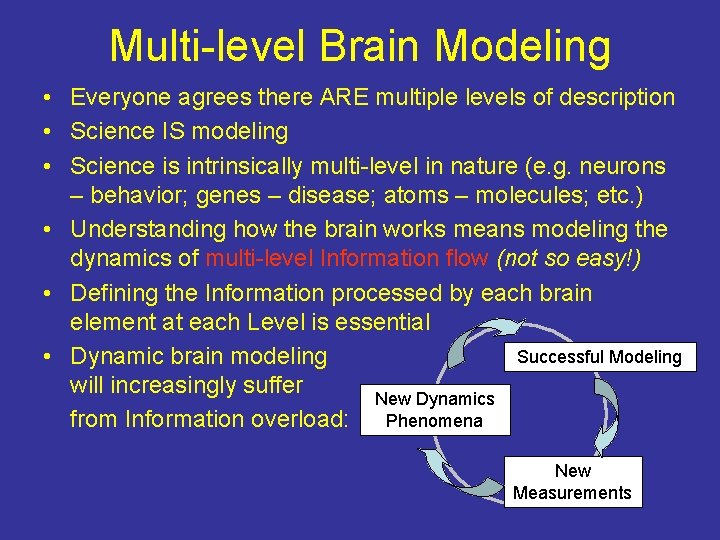
Multi-level Brain Modeling • Everyone agrees there ARE multiple levels of description • Science IS modeling • Science is intrinsically multi-level in nature (e. g. neurons – behavior; genes – disease; atoms – molecules; etc. ) • Understanding how the brain works means modeling the dynamics of multi-level Information flow (not so easy!) • Defining the Information processed by each brain element at each Level is essential Successful Modeling • Dynamic brain modeling will increasingly suffer New Dynamics Phenomena from Information overload: New Measurements
Brain Research Must Be Multi-level • Brains are active and multi-scale/multi-level • The dominant multi-level model: the computer’s physical/ logical hierarchy (viz OSI computer ‘stack’ multi-level description) • Scientific collaboration is needed – – Across spatial scales Across time scales Across measurement techniques Across models • Current field borders should not remain boundaries …Curtail Scale Chauvinism!
Level Chauvinism is Endemic… • Dirac on discovering the positron: “the rest is chemistry”… molecular structure is an epiphenomenon! • Systems neuroscience & neural networks: ‘the molecular level is implementational detail’… neural oscillations are epiphenomena • Genetics/Evolutionary Psychology: genetic basis for behavior • Cognitive Psychology: largely ignores the brain itself • Almost everyone: quantum phenomena are irrelevant to biology To progress beyond this, we must ask if there any invariant mathematical principles underlying biological multiple level interaction
Multi-level Modeling Futures I • To understand, both theoretically and practically, how brains support behavior and experience • To model brain / behavior dynamics as Active requires: – Better behavioral measures and modeling – Better brain dynamic imaging / analysis – Better joint brain / behavior analysis • Today’s (‘hardcore’ neurobiological) large scale computational models do not (yet) explain cognitive functions and complex behavior…. Stay tuned! • Circuit modelers mostly work on simple *physiological phenomena* that don’t directly translate into behavioral performance • Theorists interested in cognition predominantly use abstract mathematical models that are not constrained by neurobiology … the next research frontiers
Multi-level Modeling Futures II • Microcircuit models of cognitive processes (relating microscopic-to-macroscopic) to link the biology of synapses and neurons to behavior through network dynamics • Cognitive-type circuit models detailed enough to account for neuronal data and high-level enough to reproduce behavioral events correlated to EEG and f. MRI measurement and provide a unified framework • Linear filter models are powerful for sensory processing, but cognitive-type computations involving nonlinear dynamical systems, multiple attractors, bifurcations, etc. , will play an important role
Multi-level Modeling Futures III • How do top-down ‘cognitive’ signals interact with bottomup external stimuli? How do signals flow in a reciprocal loop between thalamocortical sensory circuits and working memory/‘decision’ circuits • Another challenge is to expand circuit modeling to largescale brain networks with interconnected areas/‘modules’
Multi-level Open Questions I • Is there a corresponding (comparable? ) temporal scale to our spatially-scaled Multi-level description ? • At what time scales does Information flow between levels (how fast up & down? )? • Are local field synchronies multi-scale? • Do local fields index shape synchronicity? • Are there any direct relationships between these processes and nonconscious/conscious mental processing…. e. g. ‘Aha!’/‘eureka’; ‘REST’; selective attention; decision-making; problem solving; etc.
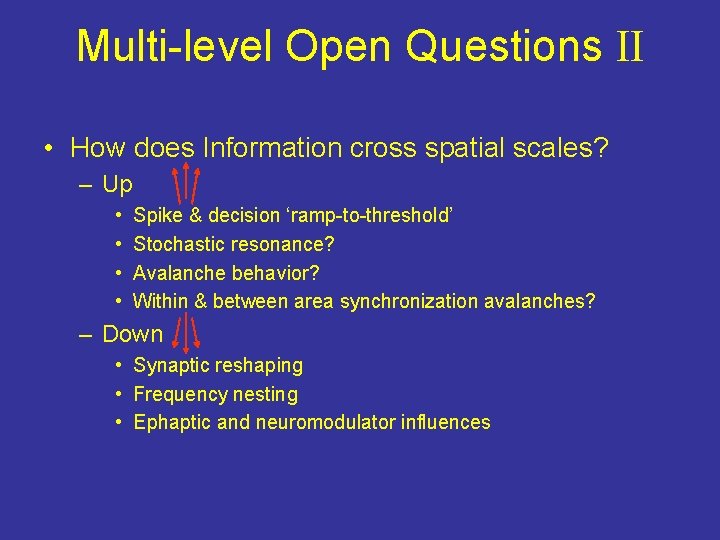
Multi-level Open Questions II • How does Information cross spatial scales? – Up • • Spike & decision ‘ramp-to-threshold’ Stochastic resonance? Avalanche behavior? Within & between area synchronization avalanches? – Down • Synaptic reshaping • Frequency nesting • Ephaptic and neuromodulator influences
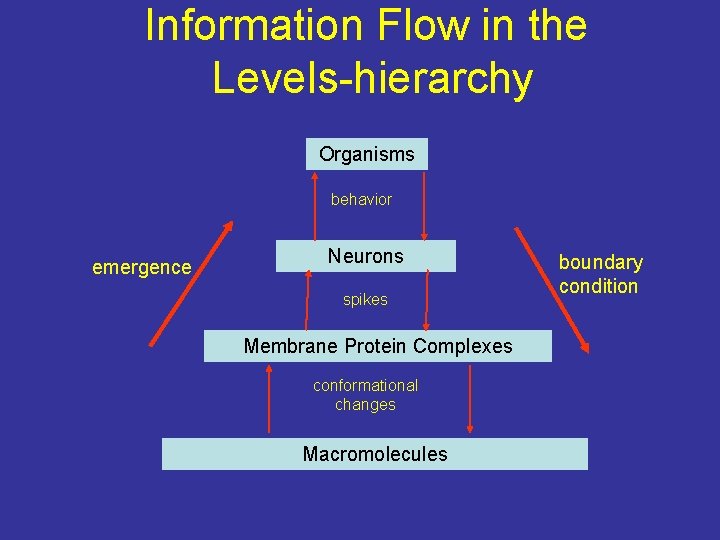
Information Flow in the Levels-hierarchy Organisms behavior emergence Neurons spikes Membrane Protein Complexes conformational changes Macromolecules boundary condition
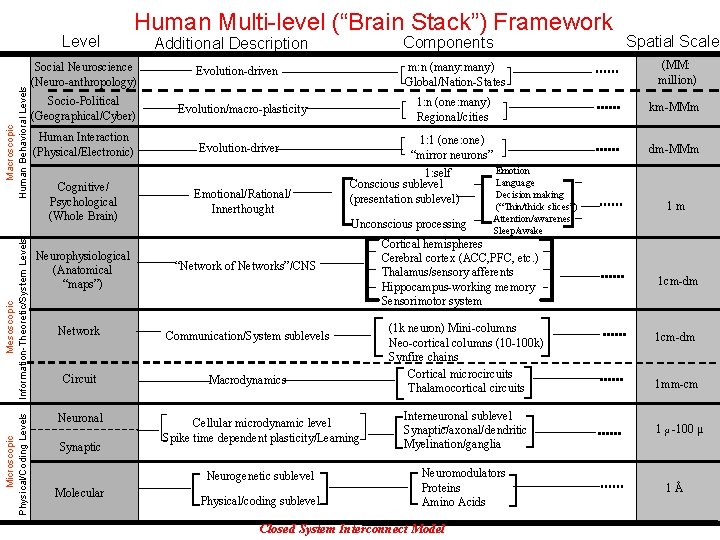
Macroscopic Human Behavioral Levels Mesoscopic Information-Theoretic/System Levels Microscopic Physical/Coding Levels Components Additional Description Social Neuroscience (Neuro-anthropology) Socio-Political (Geographical/Cyber) Evolution/macro-plasticity Human Interaction (Physical/Electronic) Evolution-driver Cognitive/ Psychological (Whole Brain) [ Emotional/Rational/ Innerthought “Network of Networks”/CNS Network Communication/System sublevels Circuit Macrodynamics Synaptic Molecular [ [ Unconscious processing Neurophysiological (Anatomical “maps”) Neuronal [ [ Emotion Language Decision making (“Thin/thick slices”) Attention/awareness Sleep/awake ] ] (1 k neuron) Mini-columns Neo-cortical columns (10 -100 k) Synfire chains Cortical microcircuits Thalamocortical circuits [ ][ ] [ Physical/coding sublevel dm-MMm Cortical hemispheres Cerebral cortex (ACC, PFC, etc. ) Thalamus/sensory afferents Hippocampus-working memory Sensorimotor system [ Cellular microdynamic level Spike time dependent plasticity/Learning Neurogenetic sublevel km-MMm 1: 1 (one: one) [ “mirror neurons” ] 1: self Conscious sublevel (presentation sublevel) ] ] ] Interneuronal sublevel Synaptic/axonal/dendritic Myelination/ganglia Neuromodulators Proteins Amino Acids Closed System Interconnect Model Spatial Scale (MM: million) m: n (many: many) [Global/Nation-States ] (one: many) [ 1: n Regional/cities ] Evolution-driven [ Level Human Multi-level (“Brain Stack”) Framework 1 m 1 cm-dm 1 mm-cm 1 μ -100 μ 1Å
- Slides: 11