
MultiLevel and MultiScale Interactive Visualization Method for Enhancing
- Slides: 1
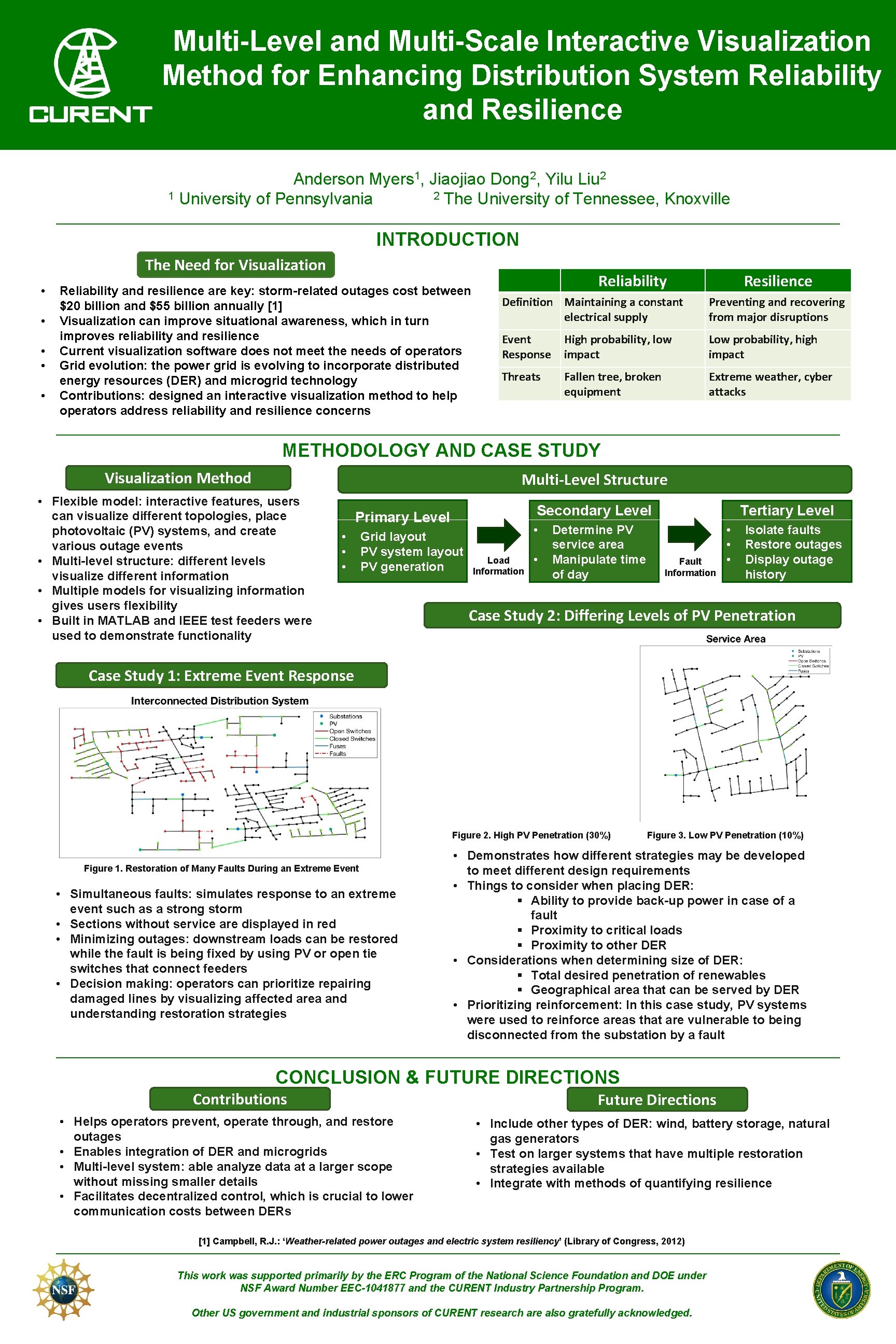
Multi-Level and Multi-Scale Interactive Visualization Method for Enhancing Distribution System Reliability and Resilience Anderson Myers 1, Jiaojiao Dong 2, Yilu Liu 2 1 University of Pennsylvania 2 The University of Tennessee, Knoxville INTRODUCTION The Need for Visualization • • • Reliability and resilience are key: storm-related outages cost between $20 billion and $55 billion annually [1] Visualization can improve situational awareness, which in turn improves reliability and resilience Current visualization software does not meet the needs of operators Grid evolution: the power grid is evolving to incorporate distributed energy resources (DER) and microgrid technology Contributions: designed an interactive visualization method to help operators address reliability and resilience concerns Reliability Resilience Definition Maintaining a constant electrical supply Preventing and recovering from major disruptions Event Response High probability, low impact Low probability, high impact Threats Fallen tree, broken equipment Extreme weather, cyber attacks METHODOLOGY AND CASE STUDY Visualization Method Multi-Level Structure • Flexible model: interactive features, users can visualize different topologies, place photovoltaic (PV) systems, and create various outage events • Multi-level structure: different levels visualize different information • Multiple models for visualizing information gives users flexibility • Built in MATLAB and IEEE test feeders were used to demonstrate functionality Secondary Level Primary Level • • • Grid layout PV system layout PV generation • Load Information • Determine PV service area Manipulate time of day Tertiary Level Fault Information • • • Isolate faults Restore outages Display outage history Case Study 2: Differing Levels of PV Penetration Case Study 1: Extreme Event Response Figure 2. High PV Penetration (30%) Figure 1. Restoration of Many Faults During an Extreme Event • Simultaneous faults: simulates response to an extreme event such as a strong storm • Sections without service are displayed in red • Minimizing outages: downstream loads can be restored while the fault is being fixed by using PV or open tie switches that connect feeders • Decision making: operators can prioritize repairing damaged lines by visualizing affected area and understanding restoration strategies Figure 3. Low PV Penetration (10%) • Demonstrates how different strategies may be developed to meet different design requirements • Things to consider when placing DER: § Ability to provide back-up power in case of a fault § Proximity to critical loads § Proximity to other DER • Considerations when determining size of DER: § Total desired penetration of renewables § Geographical area that can be served by DER • Prioritizing reinforcement: In this case study, PV systems were used to reinforce areas that are vulnerable to being disconnected from the substation by a fault CONCLUSION & FUTURE DIRECTIONS Contributions • Helps operators prevent, operate through, and restore outages • Enables integration of DER and microgrids • Multi-level system: able analyze data at a larger scope without missing smaller details • Facilitates decentralized control, which is crucial to lower communication costs between DERs Future Directions • Include other types of DER: wind, battery storage, natural gas generators • Test on larger systems that have multiple restoration strategies available • Integrate with methods of quantifying resilience [1] Campbell, R. J. : ‘Weather-related power outages and electric system resiliency’ (Library of Congress, 2012) This work was supported primarily by the ERC Program of the National Science Foundation and DOE under NSF Award Number EEC-1041877 and the CURENT Industry Partnership Program. Other US government and industrial sponsors of CURENT research are also gratefully acknowledged.