
MultiIon Injector Linac Design Progress Summary B Mustapha
Multi-Ion Injector Linac Design – Progress Summary B. Mustapha and Z. Conway Physics Division, Argonne National Laboratory JLEIC Accelerator R&D Meeting, April 20, 2017
Progress Summary q Different Linac Sections Designed (LEBTs, RFQs, IH-FODO & SRF Linac) q First End-to-End Simulations Revealed q Issues from large emittance of polarized light ions q Possible Solutions 1) Beam Collimation in the LEBT probably lower current & more pulses 2) Use H+/D+ instead of H-/D- Booster injection losses & larger emittance q Solution #1 Adopted q q q Collimation of Polarized Light Ions at the Source/LEBT The RFQ injection energy raised from 15 to 20 ke. V/u Longer RFQ bunching section to capture most of the deuteron beam The IH-DTL aperture increased from 1. 3 to 1. 5 cm to avoid deuteron losses End-to-End Simulation (Re-done) B. Mustapha Progress in the Multi-Ion Injector Linac Design JLEIC Collaboration Meeting, April 3, 2017 2
Future Work § Further optimizations if possible? § Design the stripper section, optimize the location as function of energy and desired charge state to minimize straggling effects § Large scale end-to-end simulations including machine errors to check the robustness of the design and determine the tolerances B. Mustapha Progress in the Multi-Ion Injector Linac Design JLEIC Collaboration Meeting, April 3, 2017 3
First End-to-End Simulations End-to-end simulations are important to study the cumulative effects of the lattice on the beam including realistic beam distributions and emittance growth from space charge and non-linear effects … B. Mustapha Progress in the Multi-Ion Injector Linac Design JLEIC Collaboration Meeting, April 3, 2017 4
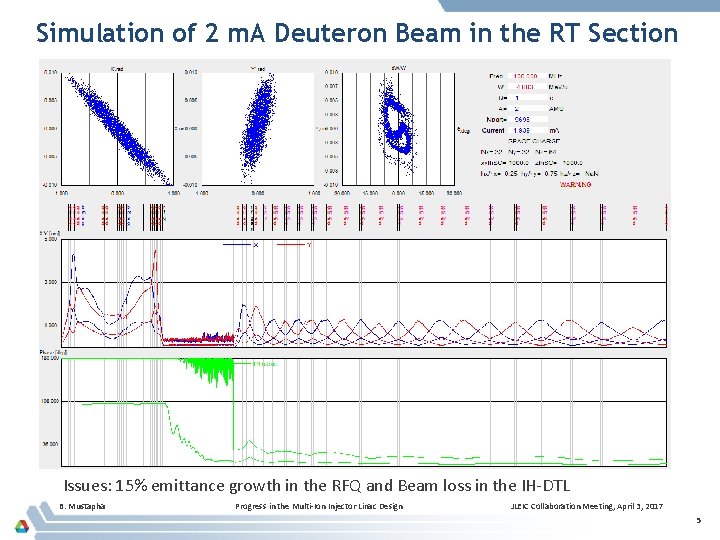
Simulation of 2 m. A Deuteron Beam in the RT Section Issues: 15% emittance growth in the RFQ and Beam loss in the IH-DTL B. Mustapha Progress in the Multi-Ion Injector Linac Design JLEIC Collaboration Meeting, April 3, 2017 5
End-to-End Simulations … Revealing q In this case, deuteron beam simulation in the RT section showed a significant emittance growth in the RFQ and some beam loss in the IH-DTL, not observed when simulated separately Design iteration for the light-ion front-end q The main difficulty in the design of the light-ion injector is the large emittances of polarized H-/D- beams from ABPIS type source. (~ 2*π mm. mrad for 90% of the beam, Ref. V. Dudnikov) much larger beam size than in typical injectors emittance growth and beam loss B. Mustapha Progress in the Multi-Ion Injector Linac Design JLEIC Collaboration Meeting, April 3, 2017 6
Possible Solutions … q Solution #1 q Collimate the beam at the source to produce a 2 m. A beam with ~ 1 π mm. mrad, selecting only the beam core … (This is possible, ABPIS source can provide up to 4 m. A, Ref. A. Sy). q The original front-end was designed for 2 m. A in ~ 2 π mm. mrad. The collimated beam with 2 m. A in ~ 1 π mm. mrad will have higher space charge density. Higher injection energy to the RFQ to control space charge effects q Possibly a higher-energy RFQ for light ions injecting to the second DTL tank. q Solution #2 q Use polarized H+/D+ instead of H-/D-, H+/D+ sources can deliver higher current in smaller emittance, Ref. V Dudnikov q BUT this may complicate the injection to the Booster (direct injection) … B. Mustapha Progress in the Multi-Ion Injector Linac Design JLEIC Collaboration Meeting, April 3, 2017 7
Implementing Solution #1 B. Mustapha Progress in the Multi-Ion Injector Linac Design JLEIC Collaboration Meeting, April 3, 2017 8
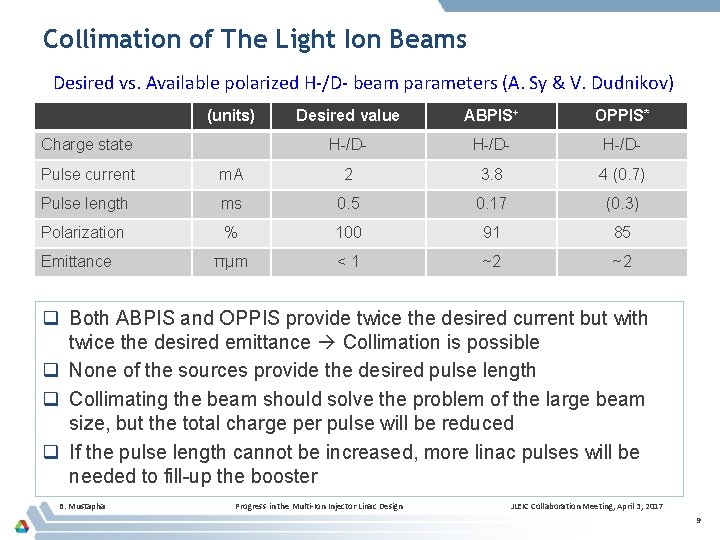
Collimation of The Light Ion Beams Desired vs. Available polarized H-/D- beam parameters (A. Sy & V. Dudnikov) (units) Charge state Desired value ABPIS+ OPPIS* H-/D- Pulse current m. A 2 3. 8 4 (0. 7) Pulse length ms 0. 5 0. 17 (0. 3) Polarization % 100 91 85 πμm <1 ~2 ~2 Emittance q Both ABPIS and OPPIS provide twice the desired current but with twice the desired emittance Collimation is possible q None of the sources provide the desired pulse length q Collimating the beam should solve the problem of the large beam size, but the total charge per pulse will be reduced q If the pulse length cannot be increased, more linac pulses will be needed to fill-up the booster B. Mustapha Progress in the Multi-Ion Injector Linac Design JLEIC Collaboration Meeting, April 3, 2017 9
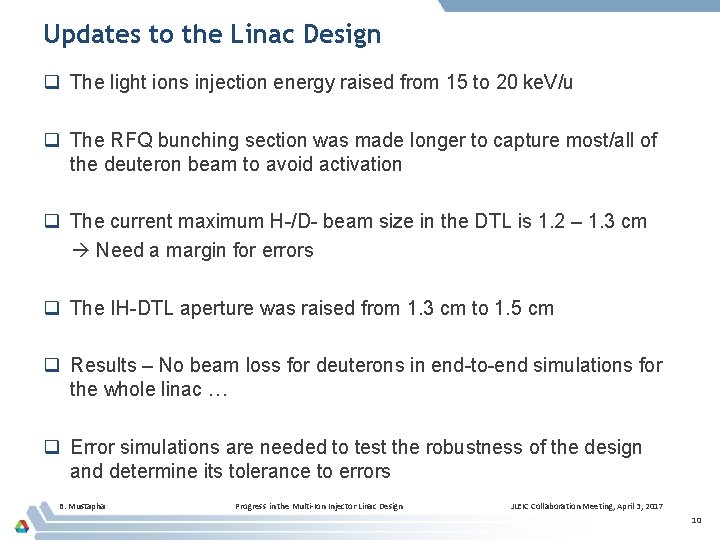
Updates to the Linac Design q The light ions injection energy raised from 15 to 20 ke. V/u q The RFQ bunching section was made longer to capture most/all of the deuteron beam to avoid activation q The current maximum H-/D- beam size in the DTL is 1. 2 – 1. 3 cm Need a margin for errors q The IH-DTL aperture was raised from 1. 3 cm to 1. 5 cm q Results – No beam loss for deuterons in end-to-end simulations for the whole linac … q Error simulations are needed to test the robustness of the design and determine its tolerance to errors B. Mustapha Progress in the Multi-Ion Injector Linac Design JLEIC Collaboration Meeting, April 3, 2017 10
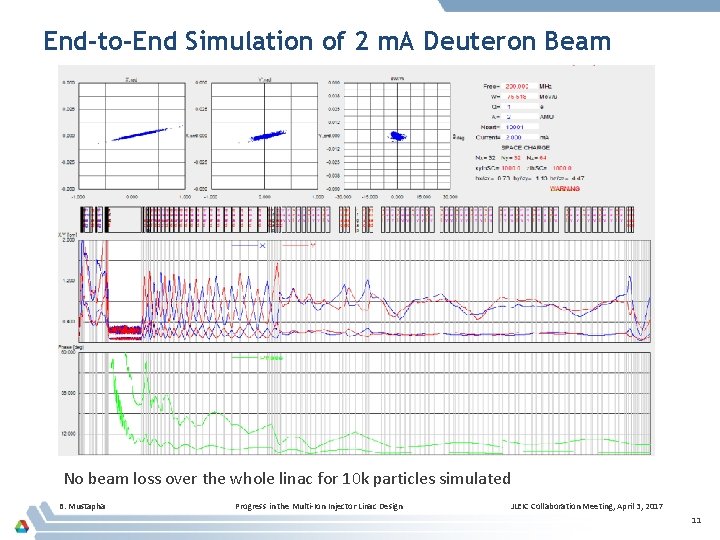
End-to-End Simulation of 2 m. A Deuteron Beam No beam loss over the whole linac for 10 k particles simulated B. Mustapha Progress in the Multi-Ion Injector Linac Design JLEIC Collaboration Meeting, April 3, 2017 11
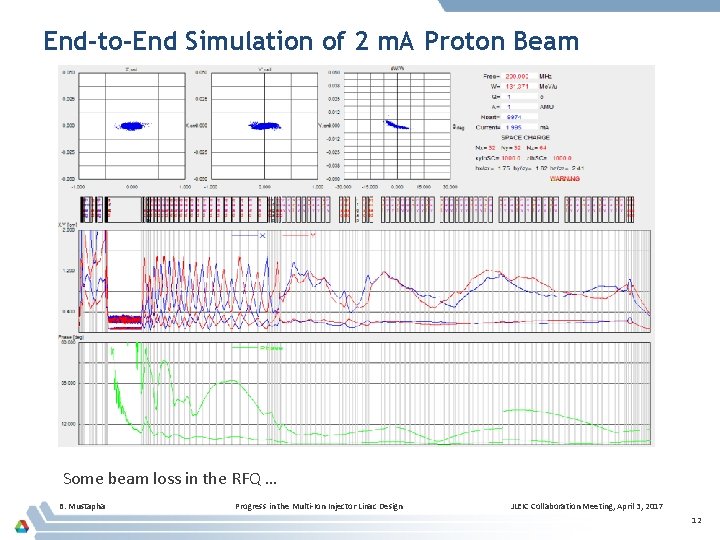
End-to-End Simulation of 2 m. A Proton Beam Some beam loss in the RFQ … B. Mustapha Progress in the Multi-Ion Injector Linac Design JLEIC Collaboration Meeting, April 3, 2017 12
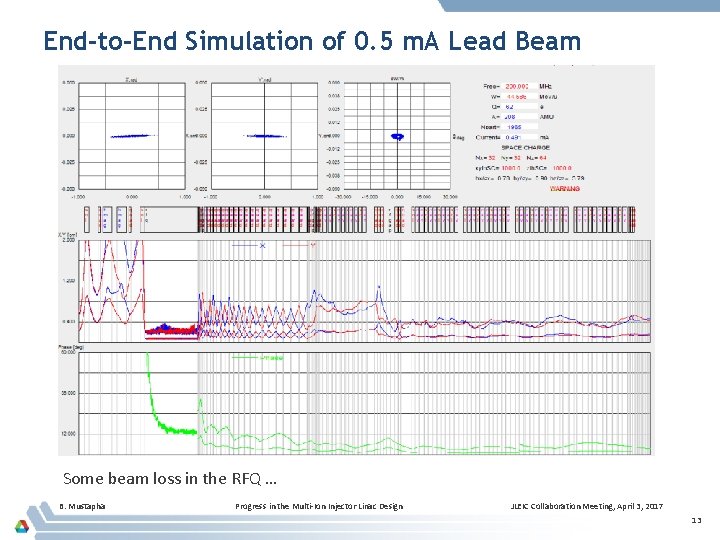
End-to-End Simulation of 0. 5 m. A Lead Beam Some beam loss in the RFQ … B. Mustapha Progress in the Multi-Ion Injector Linac Design JLEIC Collaboration Meeting, April 3, 2017 13
What’s Next? q Design of the stripper section, optimize the location as function of energy and desired charge state and minimize straggling effects … q Error simulations to check the robustness of the design and determine the tolerances q Future R&D Topics q Dynamic vacuum issues, has to do with the injection charge state and interaction with residual gas in the booster. q Beam formation with possible more pulses from the linac – long pulses are better for the operation of a pulsed SRF linac. q Spin tracking and dynamics in the Linac, especially in the solenoids q… B. Mustapha Progress in the Multi-Ion Injector Linac Design JLEIC Collaboration Meeting, April 3, 2017 14
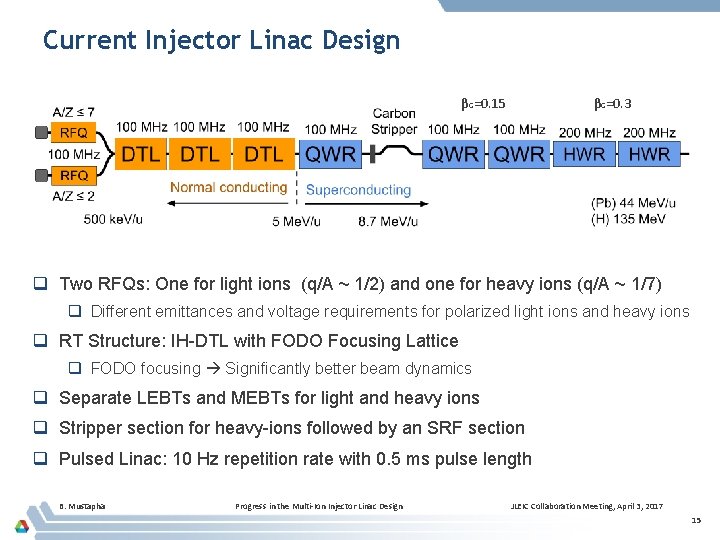
Current Injector Linac Design βG=0. 15 βG=0. 3 q Two RFQs: One for light ions (q/A ~ 1/2) and one for heavy ions (q/A ~ 1/7) q Different emittances and voltage requirements for polarized light ions and heavy ions q RT Structure: IH-DTL with FODO Focusing Lattice q FODO focusing Significantly better beam dynamics q Separate LEBTs and MEBTs for light and heavy ions q Stripper section for heavy-ions followed by an SRF section q Pulsed Linac: 10 Hz repetition rate with 0. 5 ms pulse length B. Mustapha Progress in the Multi-Ion Injector Linac Design JLEIC Collaboration Meeting, April 3, 2017 15
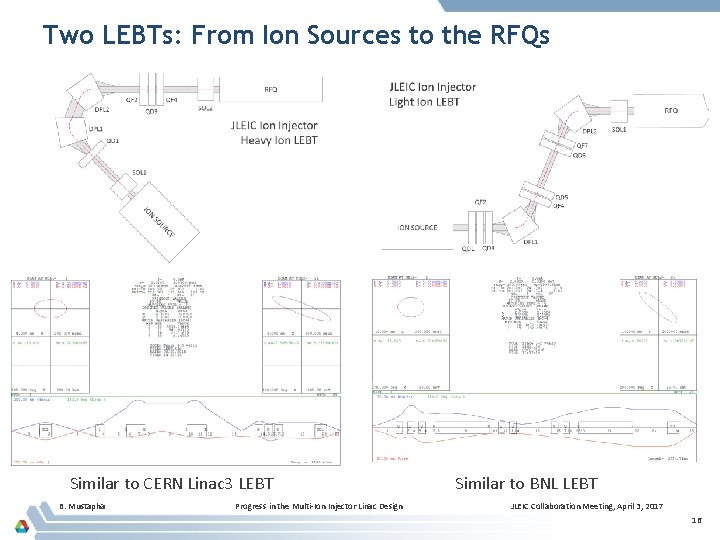
Two LEBTs: From Ion Sources to the RFQs Similar to CERN Linac 3 LEBT B. Mustapha Progress in the Multi-Ion Injector Linac Design Similar to BNL LEBT JLEIC Collaboration Meeting, April 3, 2017 16
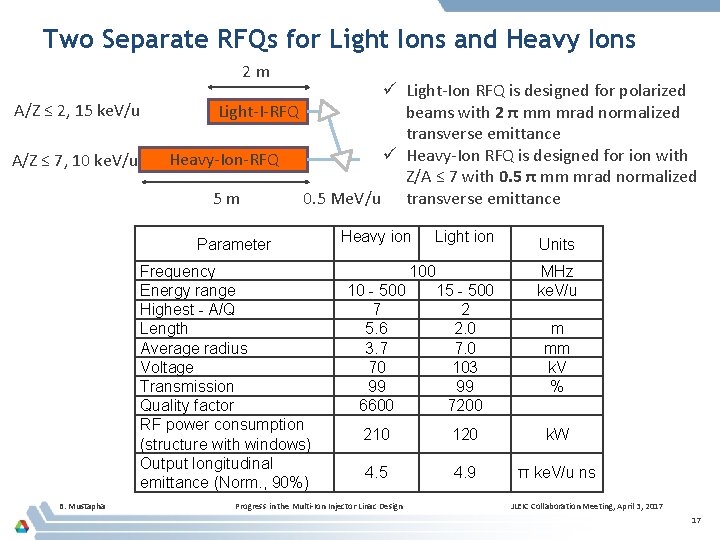
Two Separate RFQs for Light Ions and Heavy Ions 2 m A/Z ≤ 2, 15 ke. V/u A/Z ≤ 7, 10 ke. V/u ü Light-Ion RFQ is designed for polarized Light-I-RFQ beams with 2 π mm mrad normalized transverse emittance ü Heavy-Ion RFQ is designed for ion with Heavy-Ion-RFQ Z/A ≤ 7 with 0. 5 π mm mrad normalized 5 m 0. 5 Me. V/u transverse emittance Parameter Frequency Energy range Highest - A/Q Length Average radius Voltage Transmission Quality factor RF power consumption (structure with windows) Output longitudinal emittance (Norm. , 90%) B. Mustapha Heavy ion Light ion 100 10 - 500 15 - 500 7 2 5. 6 2. 0 3. 7 7. 0 70 103 99 99 6600 7200 Units MHz ke. V/u m mm k. V % 210 120 k. W 4. 5 4. 9 π ke. V/u ns Progress in the Multi-Ion Injector Linac Design JLEIC Collaboration Meeting, April 3, 2017 17
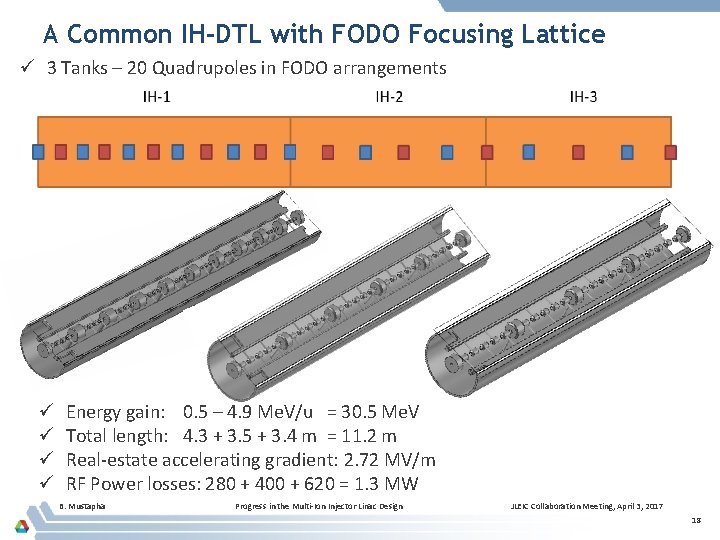
A Common IH-DTL with FODO Focusing Lattice ü 3 Tanks – 20 Quadrupoles in FODO arrangements ü ü Energy gain: 0. 5 – 4. 9 Me. V/u = 30. 5 Me. V Total length: 4. 3 + 3. 5 + 3. 4 m = 11. 2 m Real-estate accelerating gradient: 2. 72 MV/m RF Power losses: 280 + 400 + 620 = 1. 3 MW B. Mustapha Progress in the Multi-Ion Injector Linac Design JLEIC Collaboration Meeting, April 3, 2017 18
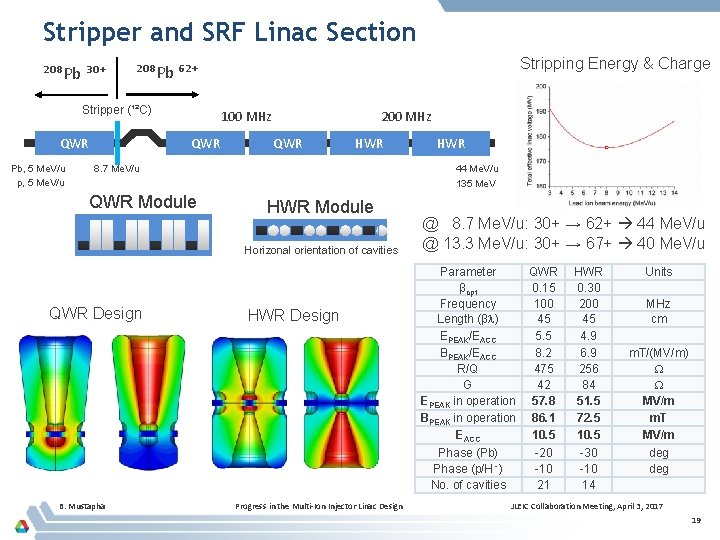
Stripper and SRF Linac Section ²⁰⁸Pb ³⁰⁺ Stripper (¹²C) QWR Pb, 5 Me. V/u p, 5 Me. V/u Stripping Energy & Charge ²⁰⁸Pb ⁶²⁺ 200 MHz 100 MHz QWR HWR 8. 7 Me. V/u QWR Module 44 Me. V/u 135 Me. V HWR Module Horizonal orientation of cavities QWR Design B. Mustapha HWR Design Progress in the Multi-Ion Injector Linac Design @ 8. 7 Me. V/u: 30+ → 62+ 44 Me. V/u @ 13. 3 Me. V/u: 30+ → 67+ 40 Me. V/u Parameter βopt Frequency Length (β ) EPEAK/EACC BPEAK/EACC R/Q G EPEAK in operation BPEAK in operation EACC Phase (Pb) Phase (p/H⁻) No. of cavities QWR 0. 15 100 45 5. 5 8. 2 475 42 57. 8 86. 1 10. 5 -20 -10 21 HWR 0. 30 200 45 4. 9 6. 9 256 84 51. 5 72. 5 10. 5 -30 -10 14 Units MHz cm m. T/(MV/m) MV/m m. T MV/m deg JLEIC Collaboration Meeting, April 3, 2017 19
- Slides: 19