
MultiGenre Project Casey Britton Megan Fitzsimmons Alexander Florez
Multi-Genre Project Casey Britton, Megan Fitzsimmons, Alexander Florez, Samantha Mc. Gregor, Danielle Petricca, & Amanda Wright
Purpose ◍ Students use creative writing with the intent of informing younger students on how to “survive” middle school through a performance. ◍ This will help the students improve upon their fluency, writing, and speaking skills.
Game Plan Day 1 -What is Readers Theatre? -Intro -Video of people doing it Day 2 -Practice with script Day 3 -Brainstorming our own Readers Theatre project Day 4 Day 5 -Character -Make script development activity -What statement do you want to make? Day 6 -Make script Day 7 -Make script Day 8 -Model revisions -Peer Review Day 9 -Revise -”Table Read” Day 11 -Rehearsal Day 12 -Final Dress Rehearsal Day 13 -Performance Day 14 -Reflection 3 Day 10 -Blocking -Transitions -Making props
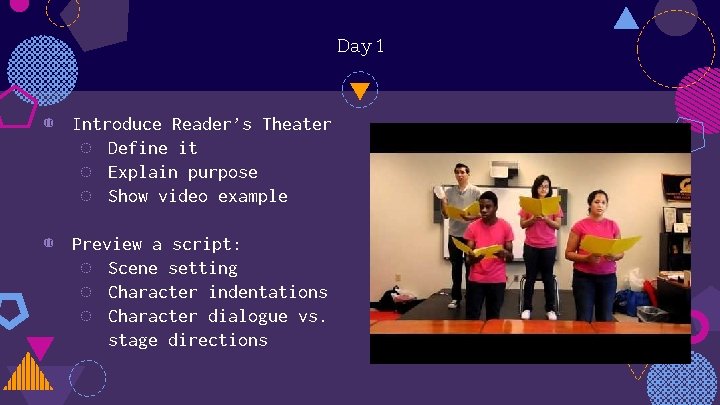
Day 1 ◍ Introduce Reader’s Theater ◌ Define it ◌ Explain purpose ◌ Show video example ◍ Preview a script: ◌ Scene setting ◌ Character indentations ◌ Character dialogue vs. stage directions
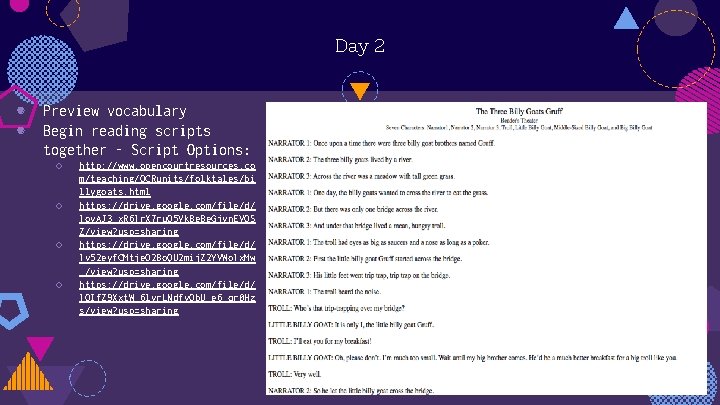
Day 2 ◍ ◍ Preview vocabulary Begin reading scripts together - Script Options: ◌ ◌ http: //www. opencourtresources. co m/teaching/OCRunits/folktales/bi llygoats. html https: //drive. google. com/file/d/ 1 oy. AJ 3_x. R 61 r. X 7 ru. O 5 Vk. Be. Gjvn. EVOS Z/view? usp=sharing https: //drive. google. com/file/d/ 1 v 52 eyf. CMtje. O 2 Bo. QU 2 mij. Z 2 YVWo 1 x. Mw _/view? usp=sharing https: //drive. google. com/file/d/ 1 QIf. Z 9 Xxt. W_6 lyr. LNdfv. Ob. U_e 6_qr 0 Hz s/view? usp=sharing
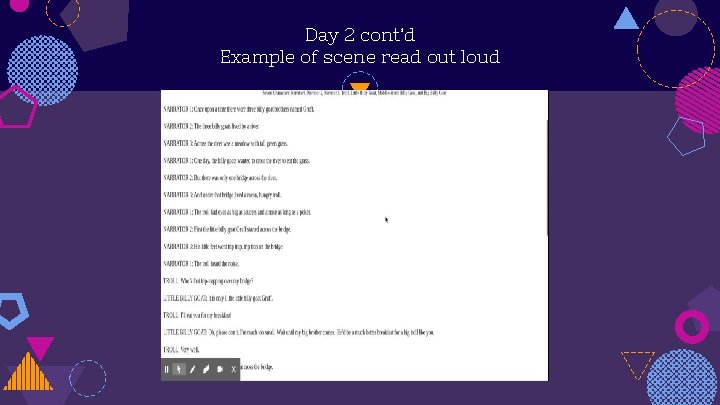
Day 2 cont’d Example of scene read out loud
Day 3 ◍ Brainstorm our own Reader’s Theater project. ◍ Group will get together and discuss what we will do, what characters we will use, how we will present it, and what genres we will show. ◍ Example ideas of skits: sports telecaster speaking about playing sports in middle school, tiktok dances about middle school trends, PSA about bullying in middle school, and etc. ◍ Genres of skits will be informative, narrative, and persuasive.
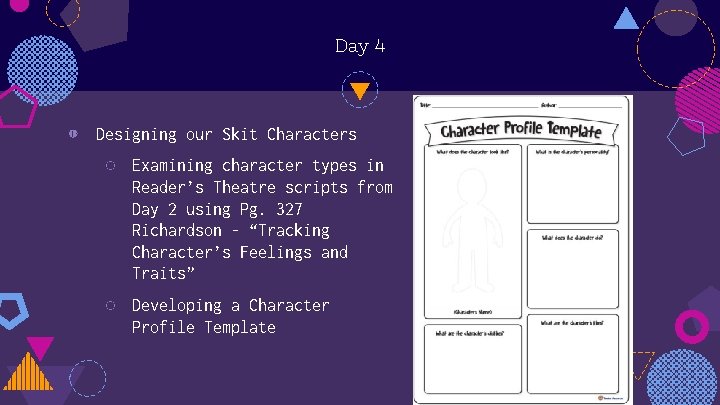
Day 4 ◍ Designing our Skit Characters ◌ Examining character types in Reader’s Theatre scripts from Day 2 using Pg. 327 Richardson - “Tracking Character’s Feelings and Traits” ◌ Developing a Character Profile Template
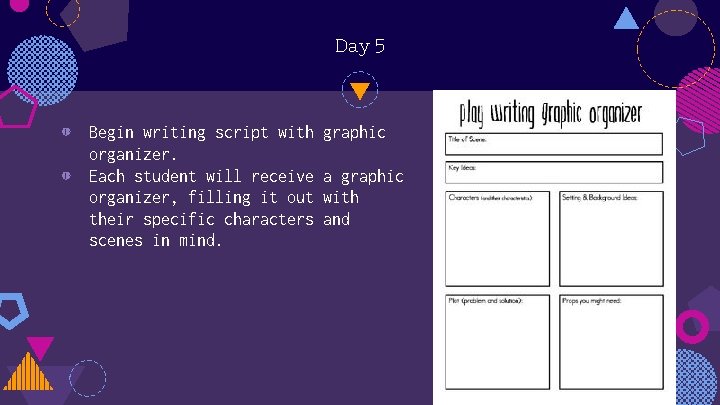
Day 5 ◍ ◍ Begin writing script with organizer. Each student will receive organizer, filling it out their specific characters scenes in mind. graphic a graphic with and
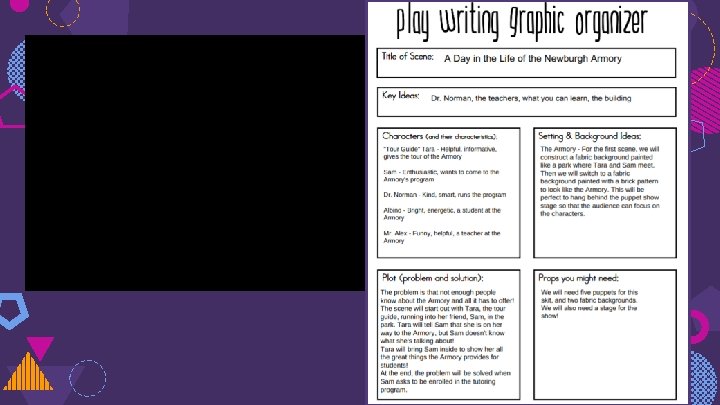
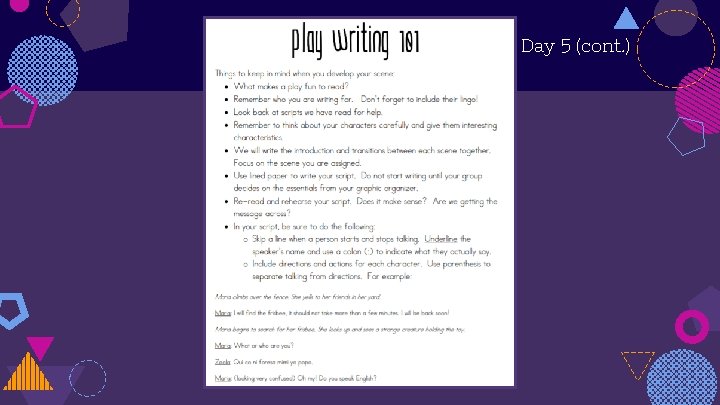
Day 5 (cont. )
Day 6 ◍ Continue writing script. ◍ Students will have writing conferences with tutors and each other to share ideas and ask for feedback.
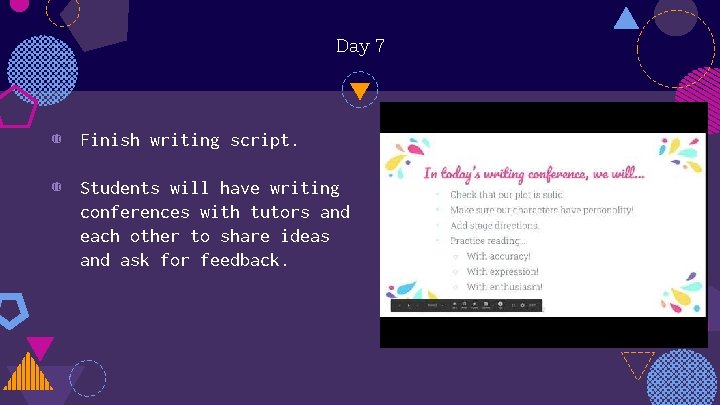
Day 7 ◍ Finish writing script. ◍ Students will have writing conferences with tutors and each other to share ideas and ask for feedback.
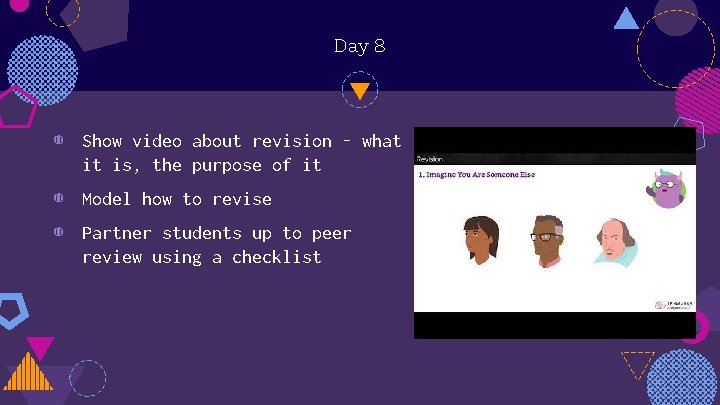
Day 8 ◍ Show video about revision - what it is, the purpose of it ◍ Model how to revise ◍ Partner students up to peer review using a checklist
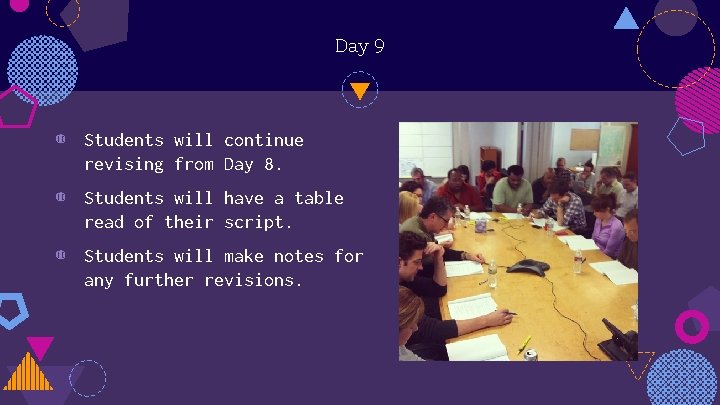
Day 9 ◍ Students will continue revising from Day 8. ◍ Students will have a table read of their script. ◍ Students will make notes for any further revisions.
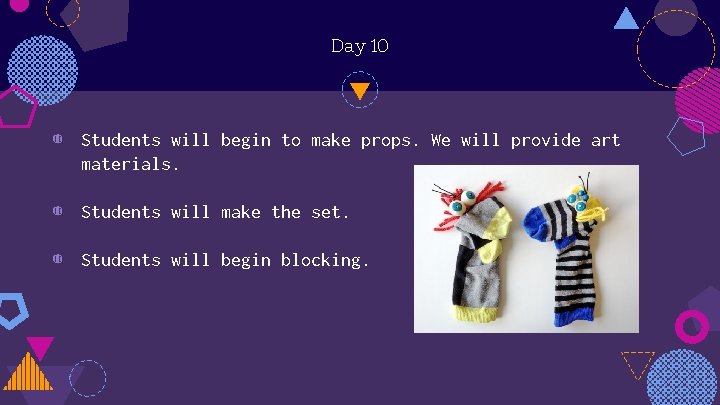
Day 10 ◍ Students will begin to make props. We will provide art materials. ◍ Students will make the set. ◍ Students will begin blocking.
Day 11 ◍ Students will rehearse their play, accepting feedback from the tutors. ◍ They will use this feedback when rehearsing one more time, tomorrow.
Day 12 ◍ Dress rehearsal! ◍ Ironing out kinks and last minute details.
Day 13 ◍ Performance day! ◍ Students will perform their play for all students and tutors in the literacy program. ◍ Students can ask audience: ➔ What are 3 things you learned? ➔ What are 2 things you want to know more about? ➔ What is 1 question you have for the cast?
Day 14 ◍ Students will reflect on their Reader’s Theater experience ◌ Will discuss as a group and individually ◍ Example Discussion Questions: How did it go? How did you do writing your skit? How was your performance? What were your strengths in this project? What could you keep working on? Would you do anything differently if you could present again?
Additional Research & Resources http: //www. practicalteacherresearch. com/upl oads/5/6/2/4/56249715/jtar_miner 1. pdf
Individual Assignment (1/4) At first, our group was considering a puppet show. We were very interested in a Reader’s Theater because it provided a built in opportunity to produce and present a final product. It would increase reading comprehension and fluency, plus, we had a few performer teachers in the group. Finally, after working through multiple mentor texts, we expected to work with the students to write scripts, allowing us to work through a few writing genres such as narrative, informative, and persuasive. We wanted built in revision days to work through a few writing traits, as well. After discussing a puppet show for a little while, we realized we should probably ask the students what they wanted! Some liked the idea of a puppet show while others wanted to be acting with their whole selves, not just their hands. Eventually, we worked towards the idea of a variety show, a collection of rehearsed sketches, monologues, and improvised games, giving our students a range to pick from. They discussed topics they liked such as an Armory commercial, a news anchor setup, how to survive middle school, and so on. Shy students could still perform in a puppet show, while outgoing students could shine in the spotlight. Artistic students could make puppets, costumes, and posters while others worked on scripts. Ultimately, we picked the Reader’s Theater unit because we could build overlapping content to improve reading comprehension and writing and motivate students through the allure of artistic side projects and a final live performance.
Individual Assignment (2/4) Our mentor texts were a combination of content we liked and content we had access to. Given the time, I would have written a few two-person scenes to use as mentor texts, as I believe it would be more manageable for students to pair off and rehearse. This would give the students a feel for the process: the repetitive running of lines, the inflection of tone, the development of vocabulary, and, inevitably, the increased comprehension. Instead, we used what we had access to. “Three Billy Goats Gruff” had a script and a pre-recorded video we could use as an example for a final product. It’s a familiar story, and it would set expectations. We added “Summer of Riley” and “A Dirty Job” because they had a wide collection of characters and revolved around characters that were younger. There were roles for shy students that only needed to rehearse a few lines, as well as roles for outgoing students that wanted to be main characters. All of the mentor texts provided opportunities for students to infer emotions and think critically about character decisions. They wouldn’t get to simply read their lines in a monotone voice.
Individual Assignment (3/4) In person, our group of teachers would have modeled a final performance to set expectations for the students. We would have loved to demonstrate reading lines with intonation, inflection, feeling, expression, intention, and everything that goes into embodying a character and understanding their objectives. Unfortunately, A PANDEMIC ENSUED! But, here we are. Instead, we included a video recording of “Billy Goats Gruff” to provide context and expectations. Knowing what the final product might look like at the very beginning of a project is key. No one wants to work on something and then find out they’re headed towards the wrong goal. It also demonstrates a little vulnerability as a teacher, letting students know that we’re willing to put ourselves out there and perform as well. We also included a short recording of how to fill out a play-writing graphic organizer. We felt that was the starting point of brainstorming, so it was a key element to understand. We expected to work with students to brainstorm scenes and bits for the variety show, and this graphic organizer would be the beginning of it all.
Individual Assignment (4/4) The decisions we made were consistently based on research. Using Readers Theater was initially prompted by our Duke et al readings. “The most authentic purpose for dramatic genres is publication or performance outside of the school” (Duke et al, 2012, p. 118). We wanted an authentic project for the students to express themselves through readings, writings, and performance. The same chapter expresses the importance of using mentor texts to explicitly teach genre features and strategies. Strategies for short stories or novels are ineffective for dramatic pieces. We also gave students a chance to brainstorm what they wanted to write about, since, “Students are engaged when they are writing stories that appeal to their peers” (Duke et al, 2012, p. 15). Within the writing activities, we made sure that no piece was a mode in isolation. We understood that narrative, informative, and persuasive pieces use each other’s features on occasion. Culham explains, “. . . it’s important for the writer to have a dominant mode in mind… weaving in other modes at carefully timed moments can bring the piece to life” (2018, p. 66). Even our use of graphic organizers, designed to focus students’ writing, has research to back it. Culham explains, “. . . allow [students] time for planning and prewriting - thinking about and organizing ideas ahead of time” (2018, p. 61). By the end of the project, our students would have had opportunities to improve reading comprehension and writing, overlapping writing modes and developing purpose with an
Individual Assignment - Citations Duke, N. K. , Caughlan, S. , Juzwik, M. M. , & Martin, N. M. (2012) Reading and writing genre with purpose in K-8 classrooms. Portsmouth, NH: Heinemann. Culham, R. (2018). Teaching writing well: How to assess writing, invigorate instruction and rethink revision. Portsmouth, NH: Stenhouse Publishers.
- Slides: 26