
Multifactor Monitoring of Hybrid LaserArc Welding Applications First
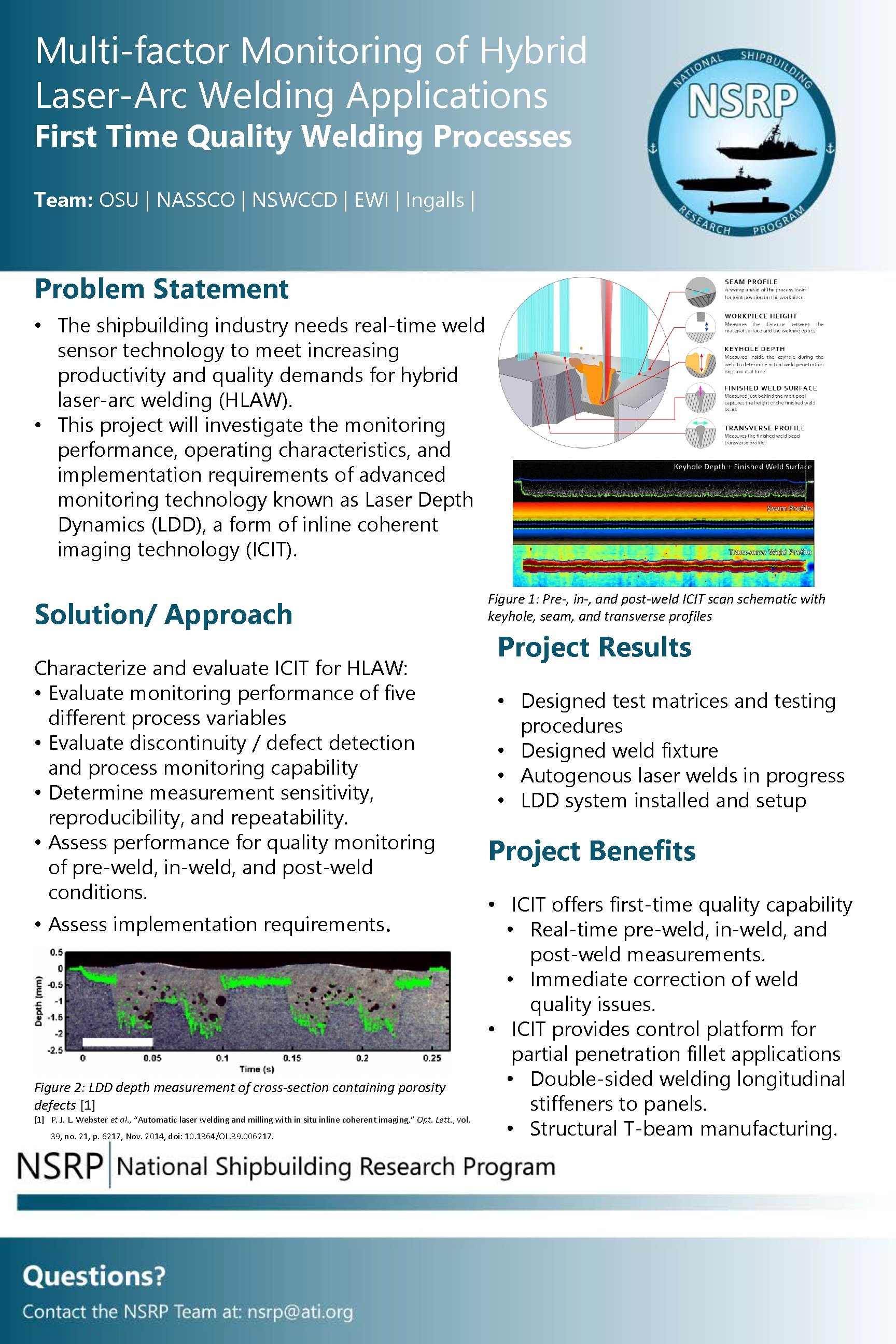
Multi-factor Monitoring of Hybrid Laser-Arc Welding Applications First Time Quality Welding Processes Team: OSU | NASSCO | NSWCCD | EWI | Ingalls | Problem Statement • The shipbuilding industry needs real-time weld sensor technology to meet increasing productivity and quality demands for hybrid laser-arc welding (HLAW). • This project will investigate the monitoring performance, operating characteristics, and implementation requirements of advanced monitoring technology known as Laser Depth Dynamics (LDD), a form of inline coherent imaging technology (ICIT). Solution/ Approach Characterize and evaluate ICIT for HLAW: • Evaluate monitoring performance of five different process variables • Evaluate discontinuity / defect detection and process monitoring capability • Determine measurement sensitivity, reproducibility, and repeatability. • Assess performance for quality monitoring of pre-weld, in-weld, and post-weld conditions. • Assess implementation requirements. Figure 2: LDD depth measurement of cross-section containing porosity defects [1] P. J. L. Webster et al. , “Automatic laser welding and milling with in situ inline coherent imaging, ” Opt. Lett. , vol. 39, no. 21, p. 6217, Nov. 2014, doi: 10. 1364/OL. 39. 006217. Figure 1: Pre-, in-, and post-weld ICIT scan schematic with keyhole, seam, and transverse profiles Project Results • Designed test matrices and testing procedures • Designed weld fixture • Autogenous laser welds in progress • LDD system installed and setup Project Benefits • ICIT offers first-time quality capability • Real-time pre-weld, in-weld, and post-weld measurements. • Immediate correction of weld quality issues. • ICIT provides control platform for partial penetration fillet applications • Double-sided welding longitudinal stiffeners to panels. • Structural T-beam manufacturing.
- Slides: 1