
Multidisciplinary Team Identification and Evaluation of Child Maltreatment

- Slides: 26
Multidisciplinary Team Identification and Evaluation of Child Maltreatment Aaron J. Miller, MD, MPA, FAAP
Learning Objectives • The participant will be able to: • Explain the different roles and responsibilities of medical and other health professionals, social services, law enforcement, education/schools, NGOs and other agencies. • Discuss the medical, psychosocial and safety benefits of interagency coordination. • List common barriers to interagency coordination and consider effective steps to create lasting improvements in coordination. • Recognize the signs and symptoms of compassion fatigue/secondary trauma.
Disclaimer What should happen: Medical, social, and law enforcement professionals know all the laws and policies and follow them always. What often happens: Professionals don’t know the laws, or don’t care, or have numerous barriers to doing the right thing.
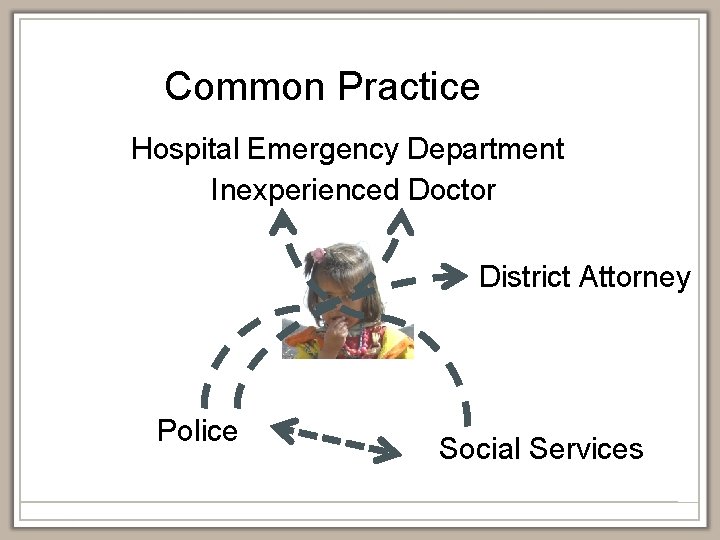
Common Practice Hospital Emergency Department Inexperienced Doctor District Attorney Police Social Services
Case Discussion • 5 -year-old girl told mom that her father touched her vagina and is then brought to one of our agencies.
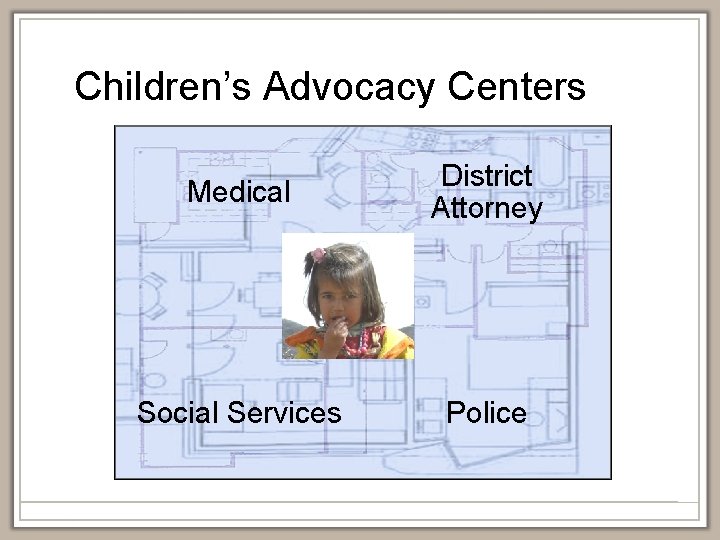
Children’s Advocacy Centers Medical District Attorney Social Services Police
Medical, Psychosocial and Safety Benefits of Interagency Coordination • Bring medical, legal, and social services to one centre to prevent secondary victimization of children • Helps ensure that more of the child victims brought to police also receive a medical evaluation • Two-way mirror forensic interviews • Fewer interviews = less traumatic and fewer inconsistencies • Experienced interviewer = greater ability to get the truth • Experienced health provider • Administers HIV post-exposure prophylaxis if <72 hours • Can testify in court that a normal exam is expected
Medical, Psychosocial and Safety Benefits of Interagency Coordination • Experienced social worker • Performs assessments and follows through on safety plan • Experienced police and prosecutors • Conduct thorough investigations in a child-friendly manner • Provide therapy for children or have established referral networks • Full standards for Children’s Advocacy Center established by National Children’s Alliance, Washington, D. C. , USA
Working Jointly With Others • Understand respect the child protection roles, responsibilities, policies and practices of other agencies and professionals, and cooperate with them. • Be clear about your own role and responsibilities in protecting children and young people, and be ready to explain this to colleagues and other professionals. Source: Protecting Children and Young People: The Responsibility of All Doctors. General Medical
Working Jointly With Others • Make sure you have effective systems for communicating with health visitors, child protection leads and other statutory agencies, either on a regular basis or as the need arises. You must know who to contact and how to contact them. • If you are asked to take part in child protection procedures, you must cooperate fully. This should include going to child protection conferences, strategy meetings and case reviews to provide information and give your opinion.
Working Jointly With Others • If meetings are called at short notice or at inconvenient times, you should still try to go. If this is not possible, you must try to provide relevant information about the child or young person and their family to the meeting, via a written report or phone call. (General Medical Council, 2012)
How do you do this work?
Same question asked differently: How can we open ourselves to the children - show as much care and support as a close friend or family member, yet not feel as much anguish, so that we have energy to care for the next family?
Compassion Fatigue • Compassion Fatigue: a physical, emotional and spiritual fatigue or exhaustion that takes over a person and causes decline in his/her ability to experience joy or to feel and care for others. (Figley, 1995; Friedman, 2002) • Also referred to as secondary trauma, vicarious trauma and burnout.
Compassion Fatigue • Prolonged occurrence of the natural behaviors and emotions that arise from knowing about a traumatizing event experienced by another. • a one-way street in which individuals are giving out a great deal of energy and compassion to others over a period of time, yet aren’t able to get enough personal support to reassure themselves that the world is a hopeful place.
Compassion Fatigue: Signs & Symptoms • Biological • Psychological • Social
Compassion Fatigue: Biological Signs & Symptoms • • Increased use of drugs and alcohol Sweating, Rapid breathing Increased blood sugar levels Increased illnesses Hypertension/high blood pressure Gastrointestinal complaints � Brittle nails, dull hair, hot flashes
Compassion Fatigue: Biological Signs & Symptoms • • Weight changes: over- or under-eating Migraine headaches Fatigue/chronically tired Cracked teeth/grinding teeth Panic attacks Physical appearance change Sleep Disturbances
Compassion Fatigue: Psychological Signs & Symptoms • • Feelings of dread Anguished “survivor” guilt Feelings of having given up Feelings of evilness and impending doom • Anger, less ability to feel joy • Increased irritability • Horror, inescapable shock
Compassion Fatigue: Psychological Signs & Symptoms • Decreased concentration/unable to focus • Depression, sleep disturbances • Low self-esteem, exhaustion • Crying for no apparent reason • Apathy or use of dark humor • Poor impulse control • Relapse to addictions
Compassion Fatigue: Social Signs & Symptoms • • Terrorization and elimination Burnout, Chronic lateness Workaholism Inability to maintain balance and objectivity • Blaming, Cast out • Learned-helplessness
Compassion Fatigue: Social Signs & Symptoms • • • Vulnerability Isolation Stuck in negativity, Cynical Divorce/interpersonal problems Withdrawal from activities Promiscuity
Compassion Fatigue: Prevention • Maintain balance between personal life and work • Activities, ways to relax, getting enough sleep • Strong relationships with family/friends • Organizational culture • Should allow us to feel comfortable to admit we need help • Monitor caseload • Working on a team: having colleagues to talk with • Education on compassion fatigue helps us recognize the signs early in ourselves and our colleagues
Compassion Fatigue: Treatment • If you are experiencing the symptoms and you are deprived of sleep, take a day off, rest, and make sure to eat normally. • Consider meeting for a few sessions with a therapist who is experienced in treating trauma.
References • Protecting Children and Young People: The Responsibility of All Doctors. General Medical Council, United Kingdom: 2012. available at: http: //www. gmcuk. org/static/documents/content/Child_protection_ -_English_0712. pdf • Osofsky, J. D. , Putnam, F. W. , Lederman, C. S. (2008). How to maintain emotional health when working with trauma. Juvenile and Family Court Journal. 59, 4: 91 -102.
References • A complete list studies that demonstrate the efficacy of Children’s Advocacy Centers is available from the National Children’s Advocacy Center: http: //www. nationalcac. org/childabuse-library-online/evid-based-prac. html