
Multidisciplinary Senior Design I Problem Definition Review Preparation
Multidisciplinary Senior Design I Problem Definition Review Preparation Marcos Esterman, Associate Professor Industrial and Systems Engineering Department Rochester Institute of Technology marcos. esterman@rit. edu
Agenda n n n Questions to be Answered by the Problem Review Goals of the Problem Definition Review Mechanics of the Review q An Example
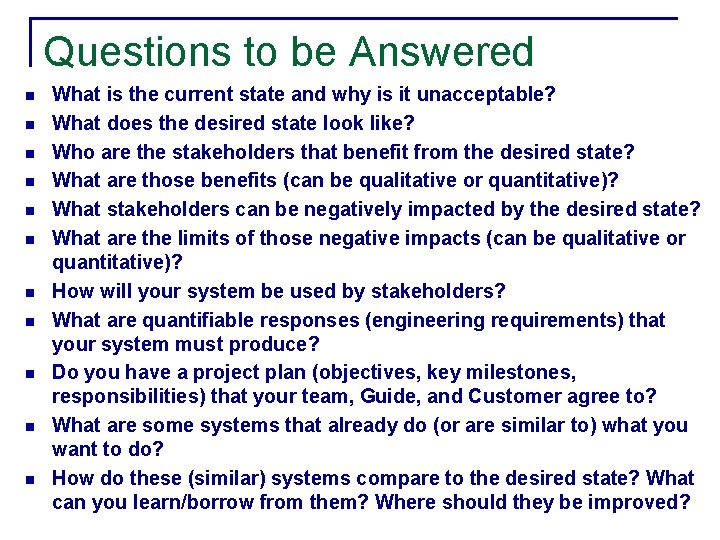
Questions to be Answered n n n What is the current state and why is it unacceptable? What does the desired state look like? Who are the stakeholders that benefit from the desired state? What are those benefits (can be qualitative or quantitative)? What stakeholders can be negatively impacted by the desired state? What are the limits of those negative impacts (can be qualitative or quantitative)? How will your system be used by stakeholders? What are quantifiable responses (engineering requirements) that your system must produce? Do you have a project plan (objectives, key milestones, responsibilities) that your team, Guide, and Customer agree to? What are some systems that already do (or are similar to) what you want to do? How do these (similar) systems compare to the desired state? What can you learn/borrow from them? Where should they be improved?
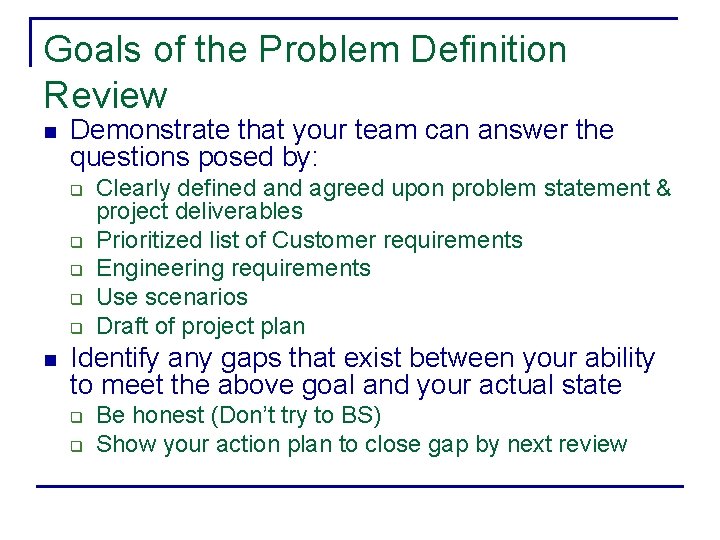
Goals of the Problem Definition Review n Demonstrate that your team can answer the questions posed by: q q q n Clearly defined and agreed upon problem statement & project deliverables Prioritized list of Customer requirements Engineering requirements Use scenarios Draft of project plan Identify any gaps that exist between your ability to meet the above goal and your actual state q q Be honest (Don’t try to BS) Show your action plan to close gap by next review

MECHANICS OF THE REVIEW
P 13026: Portable Ventilator Derek Zielinski Daniel Fenton Chris Freeman Kennedy Kong Melissa Harrison Marie Revekant Ryan Muckel David Engell Roberto Castilla Zavala. Associate Eric Professor Welch Marcos Esterman, Industrial and Systems Engineering Department Rochester Institute of Technology marcos. esterman@rit. edu
Agenda n n n n Introduce Team Project Background Problem statement & project deliverables Use scenarios Prioritized list of needs (customer rqmts) Engineering requirements Draft of project plan
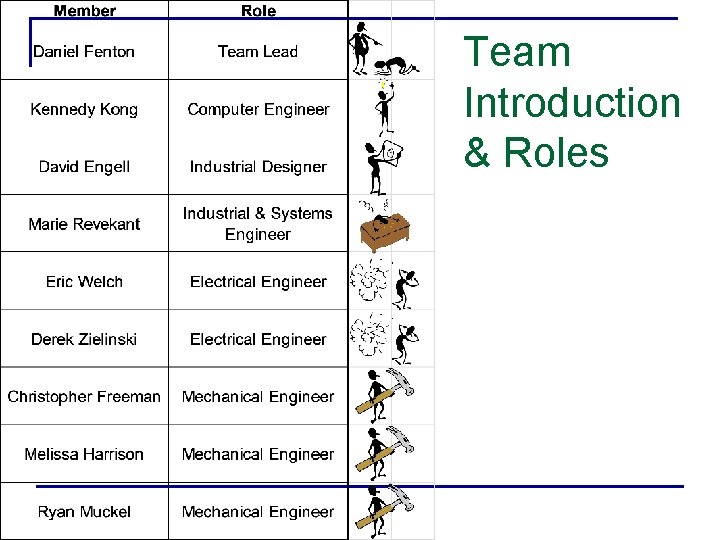
Team Introduction & Roles
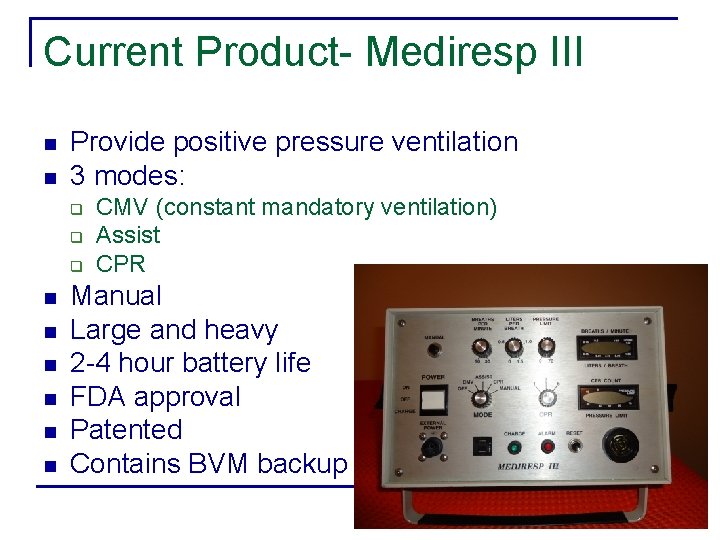
Current Product- Mediresp III n n Provide positive pressure ventilation 3 modes: q q q n n n CMV (constant mandatory ventilation) Assist CPR Manual Large and heavy 2 -4 hour battery life FDA approval Patented Contains BVM backup
What is a PEV? n A Portable Emergency Ventilator (PEV) is a device that can provide mechanical ventilation to a person who is incapable of breathing on their own q q Volume controlled Pressure controlled Spontaneously controlled Negative pressure controlled
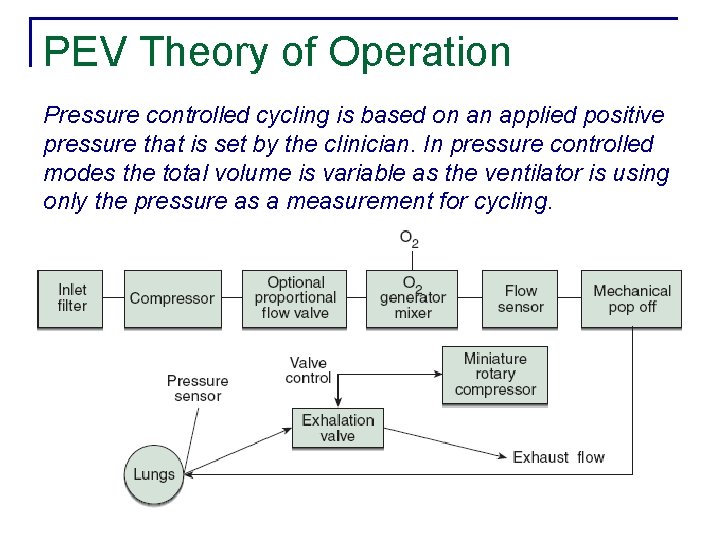
PEV Theory of Operation Pressure controlled cycling is based on an applied positive pressure that is set by the clinician. In pressure controlled modes the total volume is variable as the ventilator is using only the pressure as a measurement for cycling.
P 13026 Problem Statement n Current State q n Desired State q q n A prototype was developed in 1990 that is too heavy, consumes to much energy and is not easy to use. The device should not interfere with first responders’ abilities to administer life-saving measures. A functional prototype which can be marketed to companies and ultimately be manufactured Project Goals q q Analyze the current design and the patent database Identify opportunities n n n lighter more energy efficient easier to use more feedback and control to the user Constraints q Consistent with the intellectual property and FDA approvals
Additional Project Deliverables n n Functional prototype which can be marketed to companies and can be the basis for a product that will ultimately be manufactured Appropriate design, test, manufacturing and supply chain documentation to support transition to a manufactured product Test data verifying correct operation Designs alternatives q q n Other possible configurations Other possible use environments User’s guide for operation
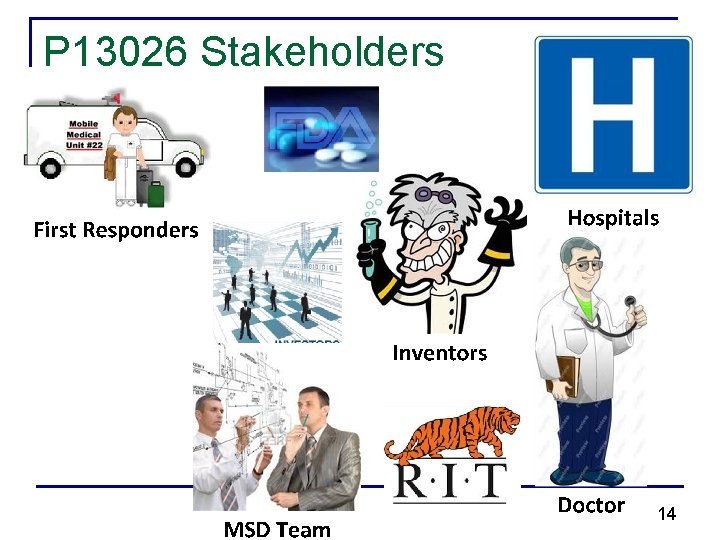
P 13026 Stakeholders 14
Use Scenarios Considered n n n Scenario 1: Unresponsive patient, heart beating but not breathing – PEV assist and transport to hospital Scenario 2: Unresponsive patient, heart beating but not breathing – PEV assist and administer life-saving measure X Scenario 3: Unresponsive patient, heart not beating and not breathing – PEV assist and CPR
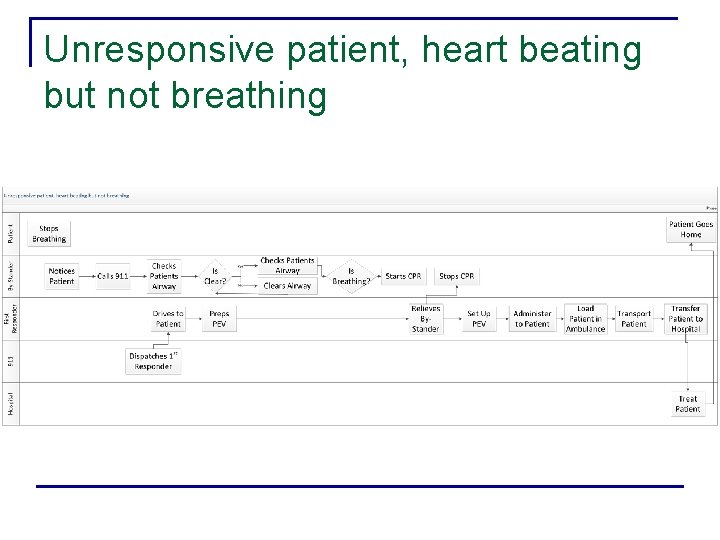
Unresponsive patient, heart beating but not breathing
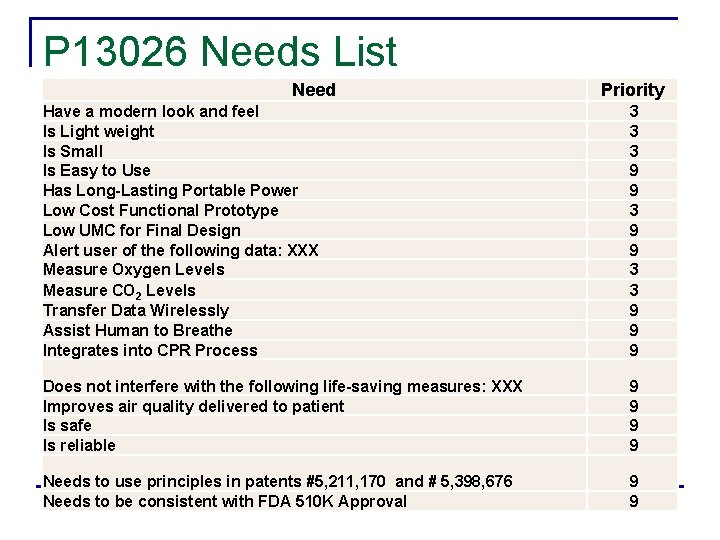
P 13026 Needs List Need Priority Have a modern look and feel Is Light weight Is Small Is Easy to Use Has Long-Lasting Portable Power Low Cost Functional Prototype Low UMC for Final Design Alert user of the following data: XXX Measure Oxygen Levels Measure CO 2 Levels Transfer Data Wirelessly Assist Human to Breathe Integrates into CPR Process 3 3 3 9 9 9 Does not interfere with the following life-saving measures: XXX Improves air quality delivered to patient Is safe Is reliable 9 9 Needs to use principles in patents #5, 211, 170 and # 5, 398, 676 Needs to be consistent with FDA 510 K Approval 9 9
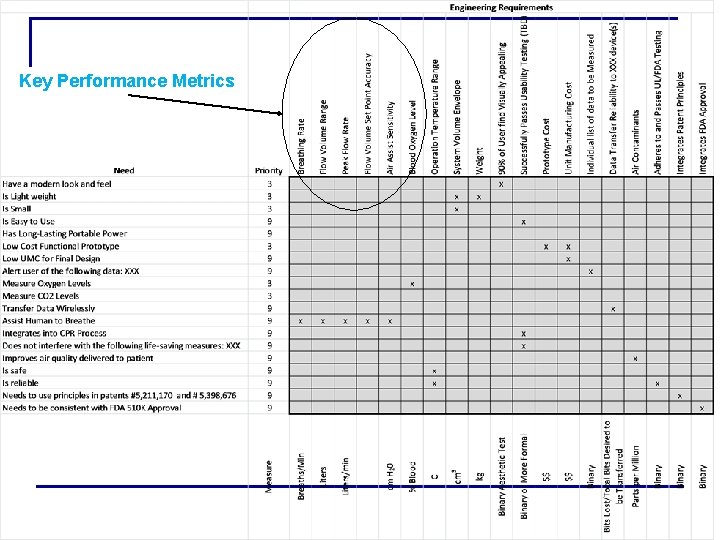
Key Performance Metrics
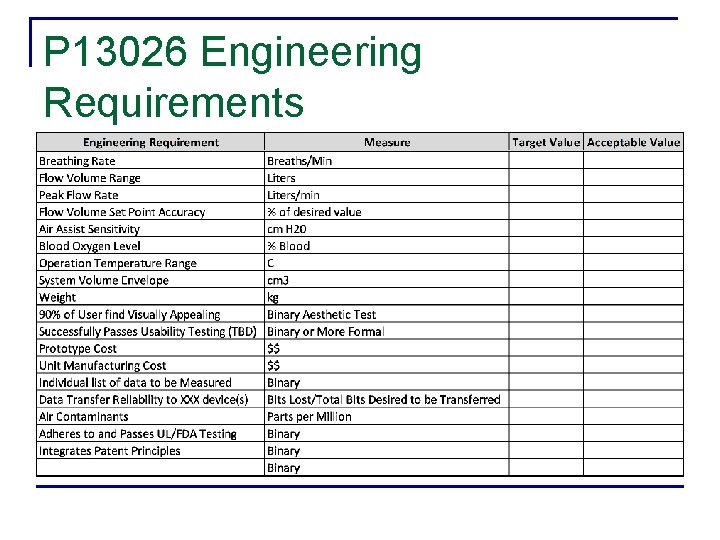
P 13026 Engineering Requirements
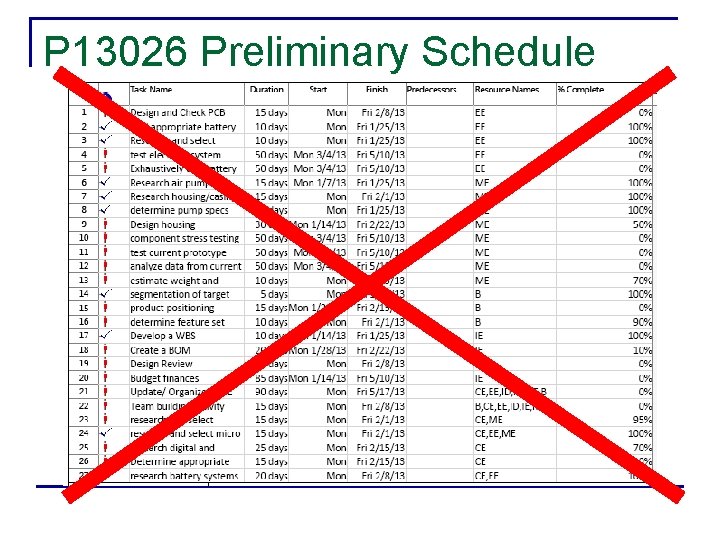
P 13026 Preliminary Schedule
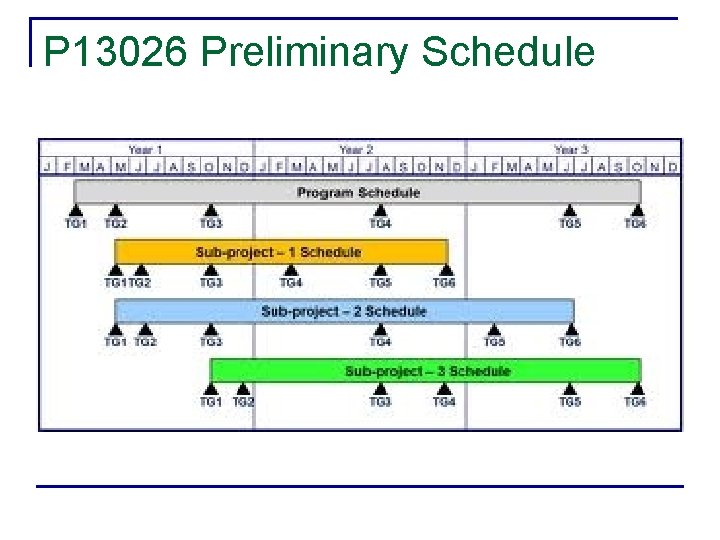
P 13026 Preliminary Schedule
Issue & Corrective Actions n n Please highlight any gaps Identify action plans to close them
- Slides: 22