
Multidimensional Views of Childhood Psychosis and Multimodal Treatment
- Slides: 39
Multidimensional Views of Childhood Psychosis and Multimodal Treatment James B. Mc. Carthy, Ph. D. , ABPP Pace University
Etiology Psychosis evolves from multidimensional, developmental pathways and the poorly understood interaction of genetic vulnerabilities and environmental stressors.
Fundamental Concepts 1. Psychotic symptoms may or may not constitute psychotic disorders. Discrete psychotic symptoms are fairly common in childhood psychiatric disorders. The largest community prevalence study indicated that up to 4. 5% of youth had isolated psychotic symptoms. 2. Psychosis represents a fluctuating state, not a stable trait. Psychotic disorders are often accompanied by impairment.
3. Diagnosis and treatment planning requires psychiatric and psychological assessments and detailed developmental histories. 4. Research includes studies of high risk groups, the continuum of psychosis, and treatment and outcome studies.
5. Developmental differences occur in symptoms, but there is a continuity of psychotic disorders from childhood to adolescence to adulthood. 6. Mood disorders with psychosis are the most prevalent diagnostic category. Treatment studies show only modest success rates and considerable variability.
7. The continuum of psychosis includes attenuated (psychotic-like) symptoms, brief psychotic symptoms, prodromal and syndromal psychotic symptoms. 8. The conversion to psychosis and treatment outcome studies are crucial areas for research. What factors influence the conversion to psychosis and lead to long-term positive outcomes?
Important Representative Studies often don’t include: comorbidity culture/race chronicity cognitive variables
Early Onset Psychotic Disorders Mc. Clellan, et al. (1999) compared the outcome of adolescents with Schizophrenia(SC), Bipolar Disorder (BP), Psychosis NOS (NES) over two years.
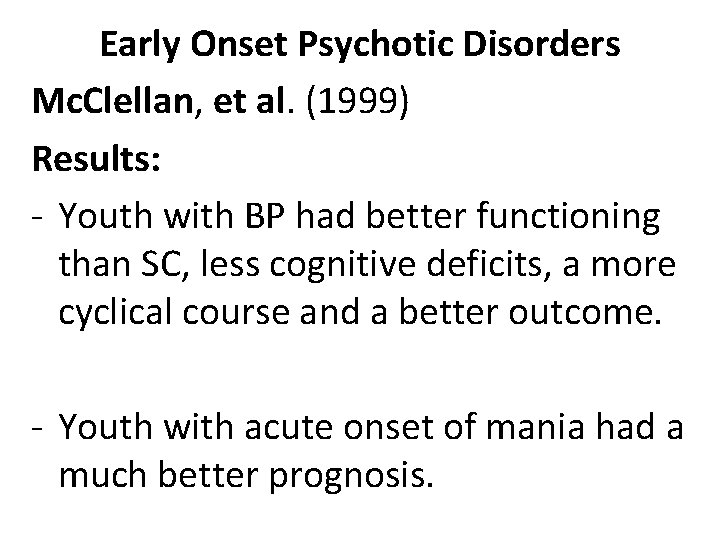
Early Onset Psychotic Disorders Mc. Clellan, et al. (1999) Results: - Youth with BP had better functioning than SC, less cognitive deficits, a more cyclical course and a better outcome. - Youth with acute onset of mania had a much better prognosis.
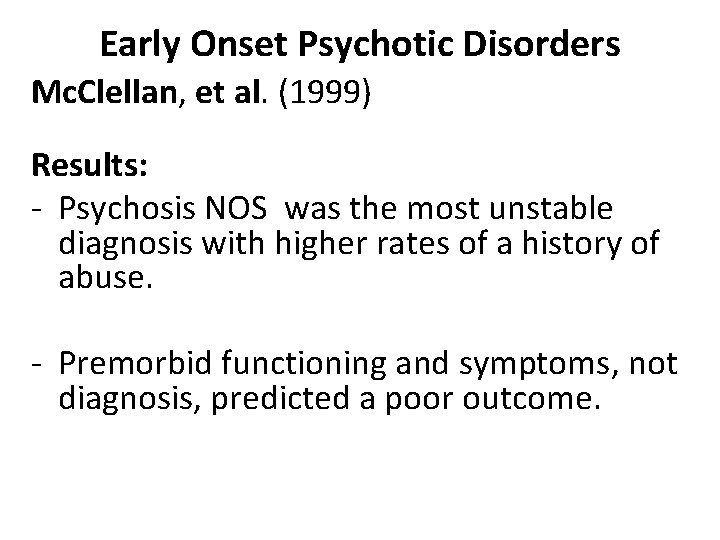
Early Onset Psychotic Disorders Mc. Clellan, et al. (1999) Results: - Psychosis NOS was the most unstable diagnosis with higher rates of a history of abuse. - Premorbid functioning and symptoms, not diagnosis, predicted a poor outcome.
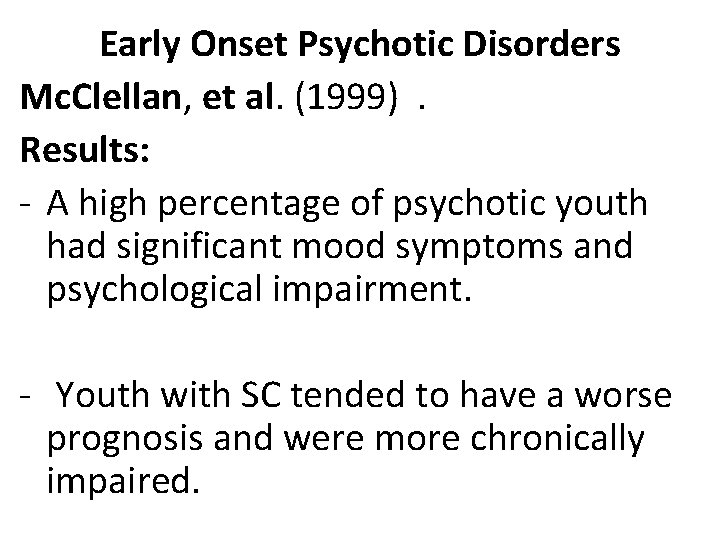
Early Onset Psychotic Disorders Mc. Clellan, et al. (1999). Results: - A high percentage of psychotic youth had significant mood symptoms and psychological impairment. - Youth with SC tended to have a worse prognosis and were more chronically impaired.
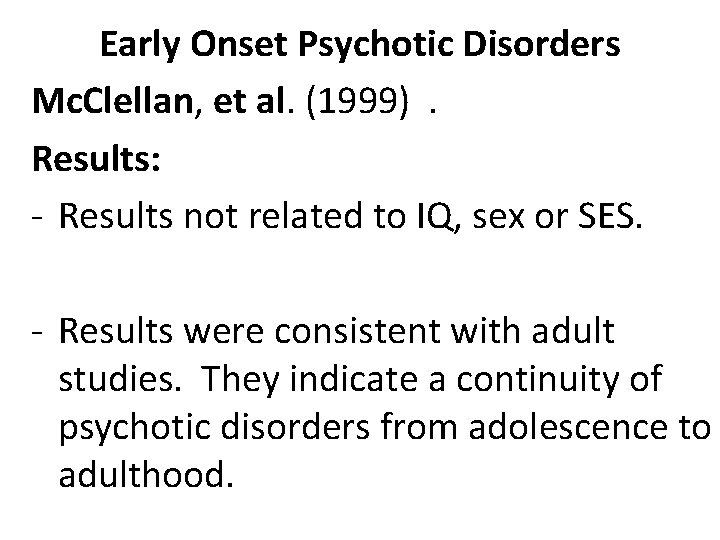
Early Onset Psychotic Disorders Mc. Clellan, et al. (1999). Results: - Results not related to IQ, sex or SES. - Results were consistent with adult studies. They indicate a continuity of psychotic disorders from adolescence to adulthood.
Premorbid Functioning Mc. Clellan, et al. (2003) compared patients with early SC, BP and Psychosis NOS. Results: - All three groups had premorbid behavior and academic problems. - Those with SC had the worst premorbid social, cognitive and academic functioning.
Premorbid Functioning Mc. Clellan, et al. (2003) Results: - Those with SC had more developmental delays (speech and language), obstetrical complications and prematurity. - The cognitive deficits associated with SC predicted later negative symptoms and associated withdrawal.
Adolescent vs Adult onset of Psychosis Ballageer, et. al. (2005) compared symptoms, diagnosis, treatment in groups of adolescents with psychotic disorders. Results: - Higher incorrect diagnosis in adolescents with SC. - Adolescent onset psychosis - more difficult to diagnose. - Adolescents had longer delays for treatment, worse premorbid functioning, and more negative symptoms.
Bipolar Disorder and Psychosis Studies suggest: - Mood disorders (with psychosis) are the most common psychosis in adolescents. - Severity of BP is associated with psychosis - Adolescent-onset BP might be more chronic than in adults with BP. - Acute onset is often involved with a better outcome.
Mood Disorders with Psychosis Psychotic features are more common with mood disorders than nonaffective psychoses. Some studies show that over 50% of adolescents with Bipolar Disorder develop psychotic features. Diagnosis of mood disorders with psychosis can be difficult in children and adolescents. Comorbidities are common MDD: Dysthymia, Anxiety Disorders, CD, & ADHD BD: ADHD, Anxiety Disorders
Mood Disorders with Psychosis MDD is much more commons in children and adolescents than BD. MDD: Hallucinations and delusions reflect sad affect, and anhedonia guilt and persecution. BD: Hallucinations and delusions often reflect manic states with mood congruent delusions of grandiosity.
Mood Disorders with Psychosis Severe Major Depression in adolescents correlated with: • • Greater likelihood of psychotic symptoms Greater suicidality Greater risk of switching - Bipolar Disorder Increased likelihood of reoccurrence
Childhood & Adolescent Onset Summary: COS/AOS psychotic illnesses have a similar course and prognostic factors and are continuous with adult-onset psychotic disorders but have tremendous individual variability.
Need for Research on Psychotherapy & Combined Psychotherapy with Medication Psychotherapy - Maintaining a therapeutic relationship and supportive services are essential. - Psychotherapy aims to improve reality testing, to identify stressors, to address anxiety, nonpsychotic symptoms, functioning deficits, and to improve self-reflection, relatedness and the acceptance of support and family intervention.
Need for Research on Psychotherapy & Combined Psychotherapy with Medication Psychotherapy - Value of cognitive behavior therapy, family focused therapy and the awareness of psychodynamic principles. Medication - Need for controlled trials. - Need for studies of augmentation therapy.
Innovative Intervention Research
Use of Multidimensional Foster Care with High Risk Youth Poultan, et. al. (2014) Placement in specially trained foster homes of 166 very high risk 13 -17 year old girls with histories of abuse, neglect, and predisposition for severe disorders. Results: Over 24 months, the treatment group had 50% less psychotic symptoms than the comparison group.
Use of Multidimensional Foster Care with High Risk Youth Poultan, et. al. (2014) Key features: By addressing behavioral problems and placing youth in specially trained foster homes that reinforce positive behavior, there can be a reduction in comorbid psychotic symptoms.
Use of Family - Focused Treatment Miklowitz, et. al. (2014) 14 -21 year olds with mild positive and negative psychotic symptoms were given either six months of family focused therapy or three psychoeducation sessions.
Use of Family - Focused Treatment Miklowitz, et. al. (2014) Results: - Family-focused therapy led to more improvement in attenuated positive symptoms. - Negative symptoms improved with either intervention. - Results were independent of medication.
Use of Family - Focused Treatment Miklowitz, et. al. (2014) Key features: Work on stress reduction, problem solving, family support, and improving family communication all might help reduce the possibility of conversion to psychosis.
Limitations of Contemporary Research • Studies of psychosis in children and adolescents often don’t include comorbidity, cognition, race/culture, and histories of trauma. • There are few innovative psychotherapy approaches and effective new medications. • Research is needed on very long term effects of antipsychotics on children’s health and development.
Limitations of Contemporary Research • Need for more randomized trials, studies that assess combining medication with different forms of therapy. • Need for long term follow-up for children and adolescents with psychotic disorders.
Current Study Mc. Carthy, J. , Weiss, S. R. , Segovich, K. T. and Barbot, B. (2015). Impact of psychotic symptoms on cognitive functioning in child and adolescent psychiatric inpatients with severe mood disorders. (submitted) Comparison of FS IQ scores, attention, working memory, and processing speed differences between patient groups with Mood Disorder (NES), Bipolar Disorder and Major Depressive Disorder with and without psychosis.
Results: - No significant differences in cognitive weaknesses between subjects with Major Depression and psychosis and those with Bipolar Disorder and psychosis. - Very significant interaction between severe mood disorders with psychotic features and lower full scale IQ’s and deficits in attention.
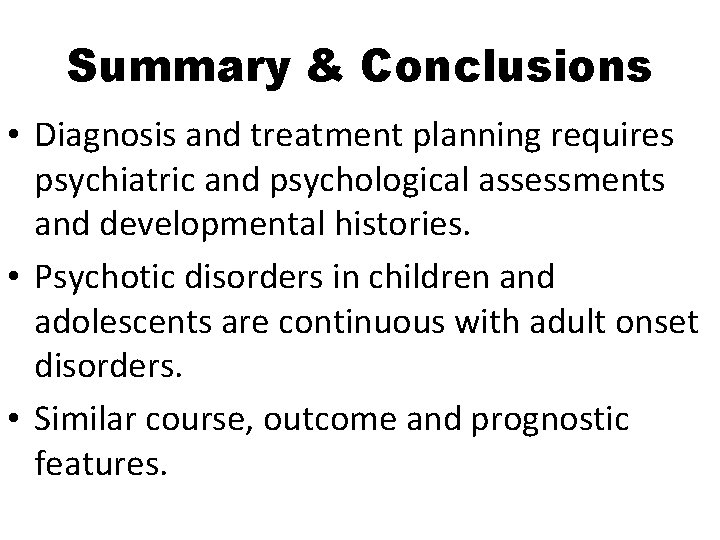
Summary & Conclusions • Diagnosis and treatment planning requires psychiatric and psychological assessments and developmental histories. • Psychotic disorders in children and adolescents are continuous with adult onset disorders. • Similar course, outcome and prognostic features.
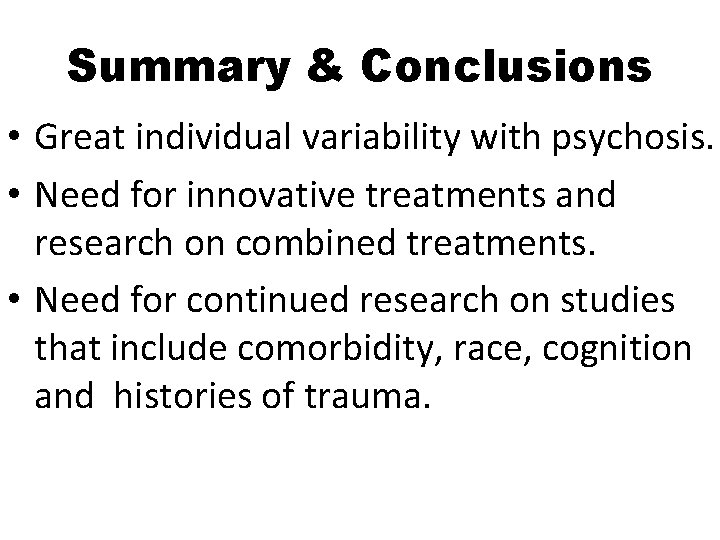
Summary & Conclusions • Great individual variability with psychosis. • Need for innovative treatments and research on combined treatments. • Need for continued research on studies that include comorbidity, race, cognition and histories of trauma.
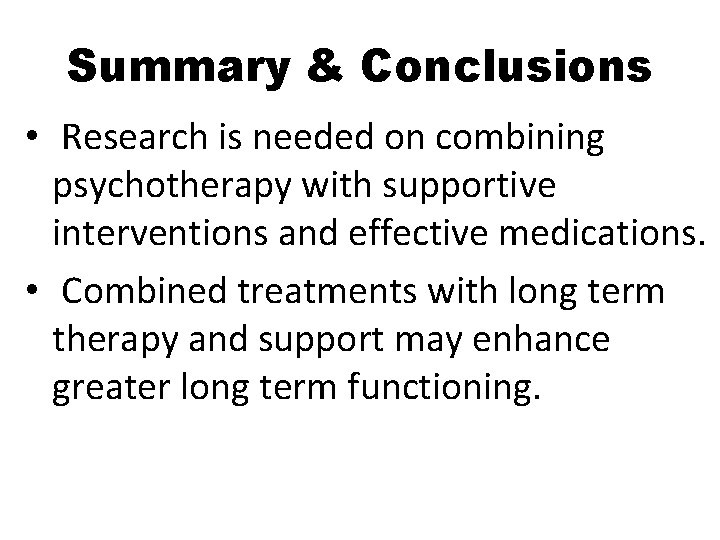
Summary & Conclusions • Research is needed on combining psychotherapy with supportive interventions and effective medications. • Combined treatments with long term therapy and support may enhance greater long term functioning.
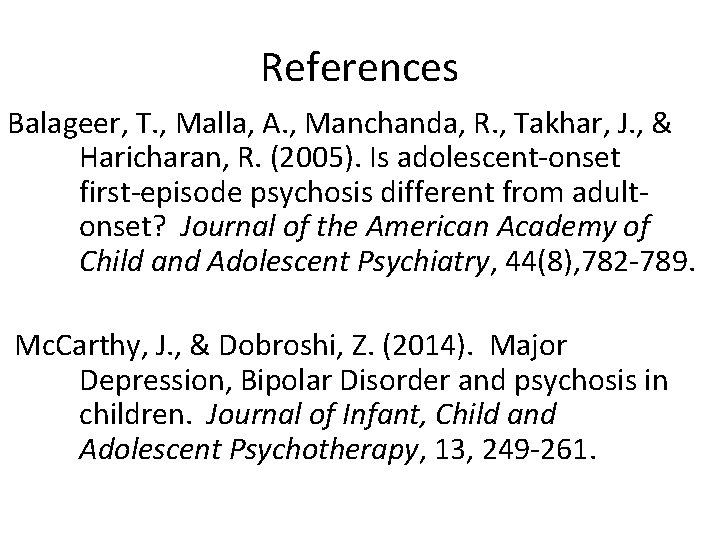
References Balageer, T. , Malla, A. , Manchanda, R. , Takhar, J. , & Haricharan, R. (2005). Is adolescent-onset first-episode psychosis different from adultonset? Journal of the American Academy of Child and Adolescent Psychiatry, 44(8), 782 -789. Mc. Carthy, J. , & Dobroshi, Z. (2014). Major Depression, Bipolar Disorder and psychosis in children. Journal of Infant, Child and Adolescent Psychotherapy, 13, 249 -261.
References Mc. Carthy, J. , & Libby, V. G. (2016). Limitations of research on psychosis in childhood and adolescence: Current controversies and future directions. Journal of Mental Disorders and Treatment, 2(1), 1 -4. doi. org/10. 4172/2471 x. 100016 Mc. Clellan, J. , Mc. Curry, C. , Snell, J. , & Du. Bose, A. (1999) Early-onset psychotic disorders: Course and outcome over a 2 year period. Journal of the American Academy of Child and Adolescent Psychiatry, 38(11), 3380 -1388.
Mc. Clellan, J. , Brieger, D. , Mc. Curry, C. , & Hlastala, S. A. (2003) Premorbid functioning in early-onset psychotic disorders. Journal of the American Academy of Child & Adolescent Psychiatry, 42(6), 666 -672. Miklowitz, D. (2012)Family-focused treatment for children and adolescents with Bipolar Disorder. Israeli Journal of Psychiatry & Related Sciences, 49(2), 95 -101.
Poulton, R. , Van. Ryzin, M. J. , Harold, G. T. , Chamberlain, P. , Fowler, D. Cannon, M. et al. (2014). Effect of multidimensional treatment foster care on psychotic symptoms in girls. Journal of the American Academy of Child & Adolescent Psychiatry, 53(12), 1279 -1287.