
Multidimensional Range Search Static collection of records No
- Slides: 30
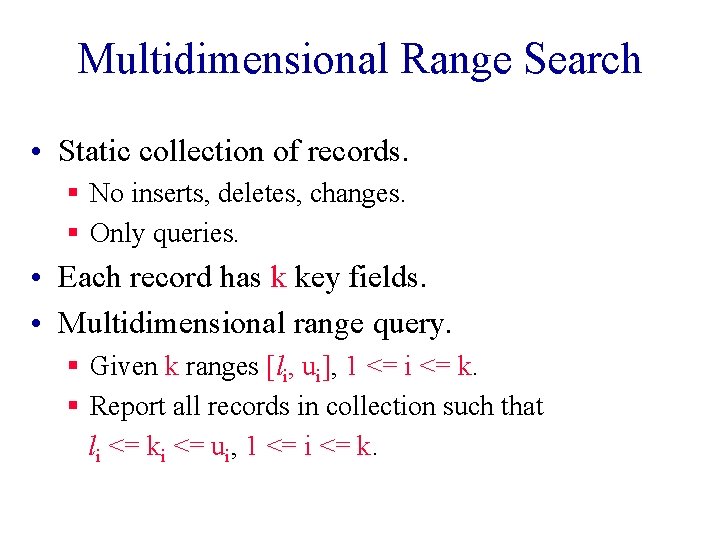
Multidimensional Range Search • Static collection of records. § No inserts, deletes, changes. § Only queries. • Each record has k key fields. • Multidimensional range query. § Given k ranges [li, ui], 1 <= i <= k. § Report all records in collection such that li <= ki <= ui, 1 <= i <= k.
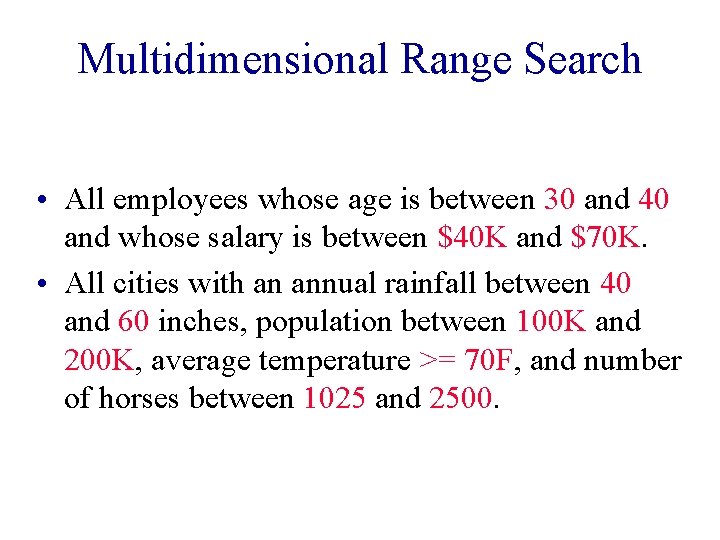
Multidimensional Range Search • All employees whose age is between 30 and 40 and whose salary is between $40 K and $70 K. • All cities with an annual rainfall between 40 and 60 inches, population between 100 K and 200 K, average temperature >= 70 F, and number of horses between 1025 and 2500.
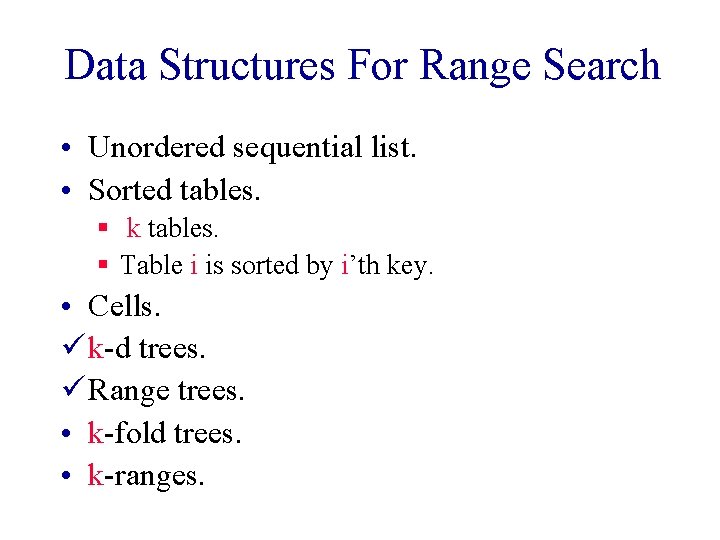
Data Structures For Range Search • Unordered sequential list. • Sorted tables. § k tables. § Table i is sorted by i’th key. • Cells. ü k-d trees. ü Range trees. • k-fold trees. • k-ranges.
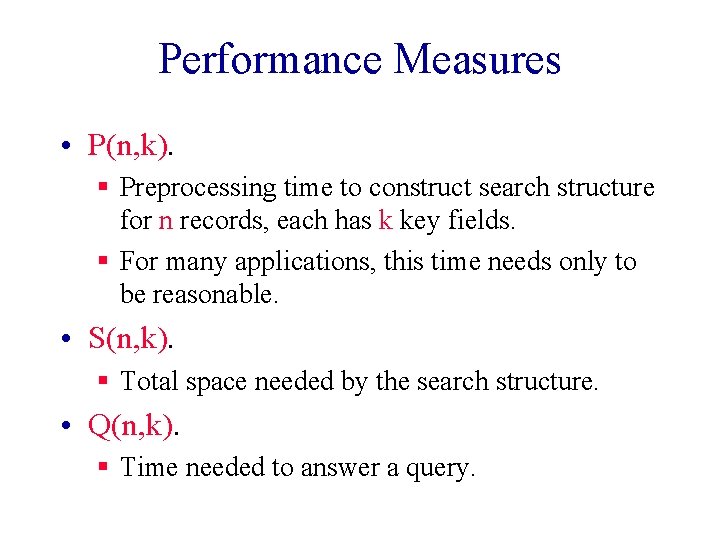
Performance Measures • P(n, k). § Preprocessing time to construct search structure for n records, each has k key fields. § For many applications, this time needs only to be reasonable. • S(n, k). § Total space needed by the search structure. • Q(n, k). § Time needed to answer a query.
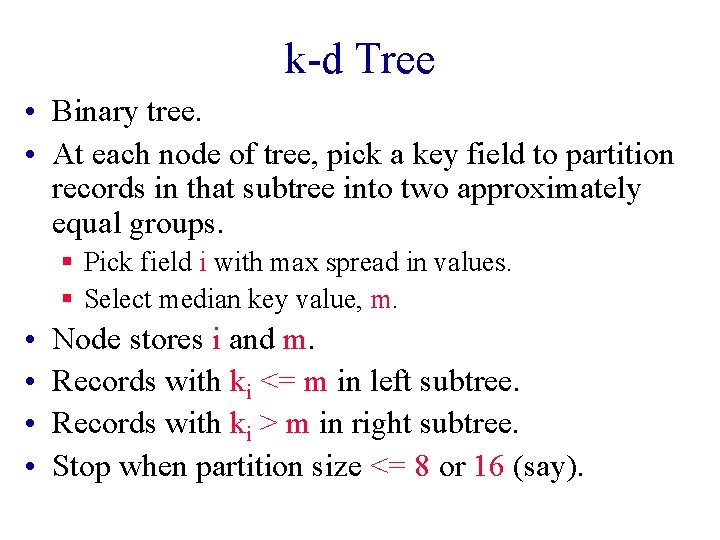
k-d Tree • Binary tree. • At each node of tree, pick a key field to partition records in that subtree into two approximately equal groups. § Pick field i with max spread in values. § Select median key value, m. • • Node stores i and m. Records with ki <= m in left subtree. Records with ki > m in right subtree. Stop when partition size <= 8 or 16 (say).
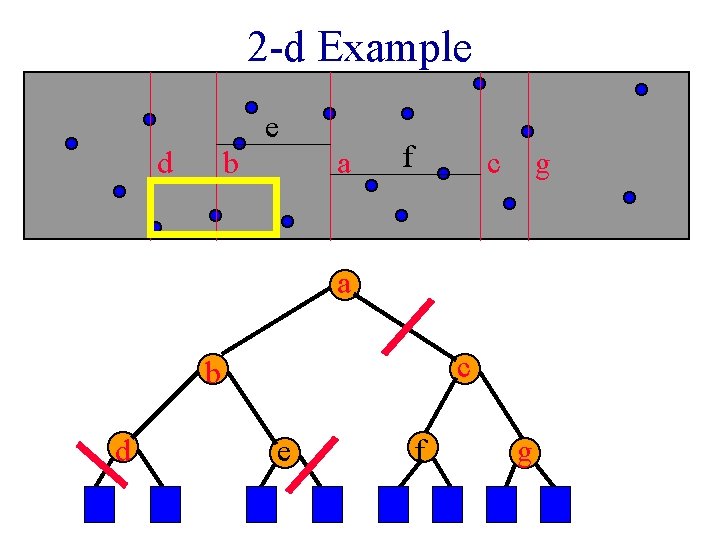
2 -d Example e d b a f c g a c b d e f g
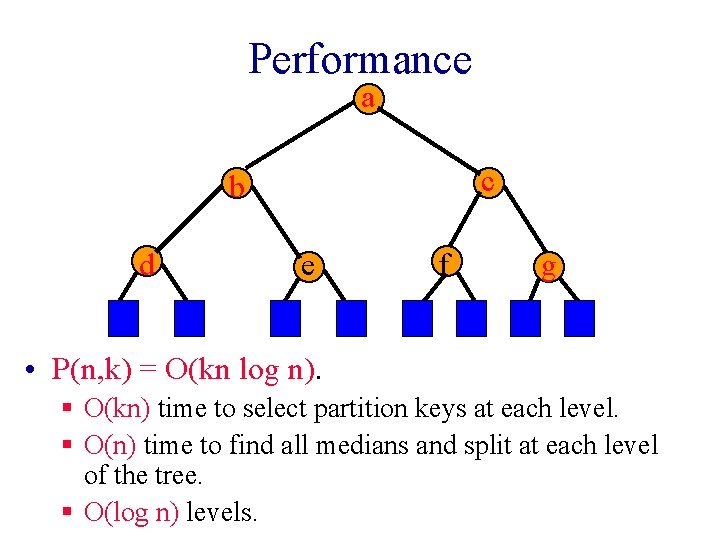
Performance a c b d e f g • P(n, k) = O(kn log n). § O(kn) time to select partition keys at each level. § O(n) time to find all medians and split at each level of the tree. § O(log n) levels.
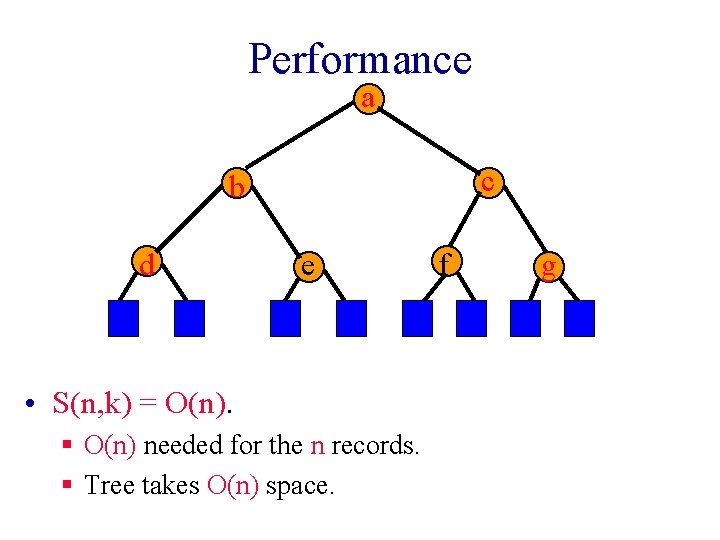
Performance a c b d e • S(n, k) = O(n). § O(n) needed for the n records. § Tree takes O(n) space. f g
Performance • Q(n, k) depends on shape of query. § O(n 1 -1/k + s), k > 1, where s is number of records that satisfy the query. Bound on worst-case query time. § O(log n + s), average time when query is almost cubical and a small fraction of the n records satisfy the query. § O(s), average time when query is almost cubical and a large fraction of the n records satisfy the query.
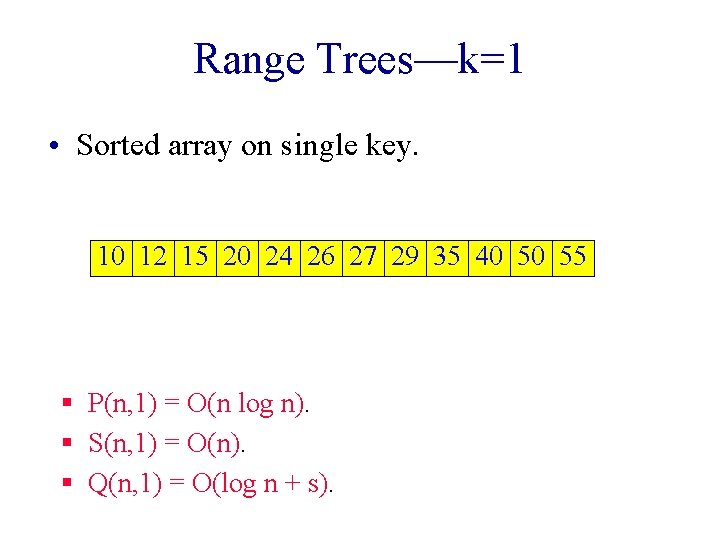
Range Trees—k=1 • Sorted array on single key. 10 12 15 20 24 26 27 29 35 40 50 55 § P(n, 1) = O(n log n). § S(n, 1) = O(n). § Q(n, 1) = O(log n + s).
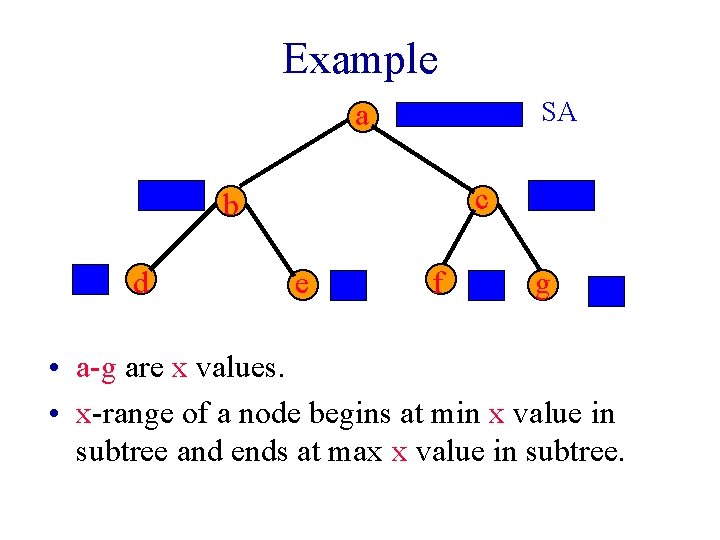
Range Trees—k=2 • Let the two key fields be x and y. • Binary search tree on x. • x value used in a node is the median x value for all records in that subtree. • Records with x value <= median are in left subtree. • Records with larger x value in right subtree.
Range Trees—k=2 • Each node has a sorted array on y of all records in the subtree. § Root has sorted array of all n records. § Left and right subtrees, each have a sorted array of about n/2 records. • Stop partitioning when # records in a partition is small enough (say 8).
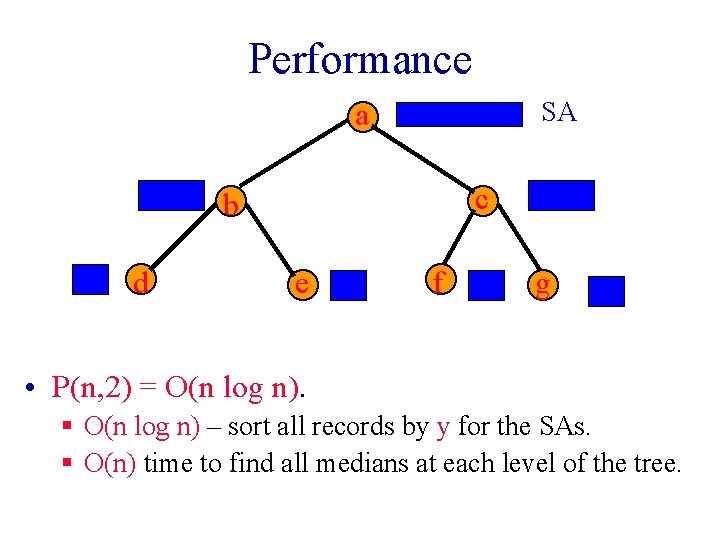
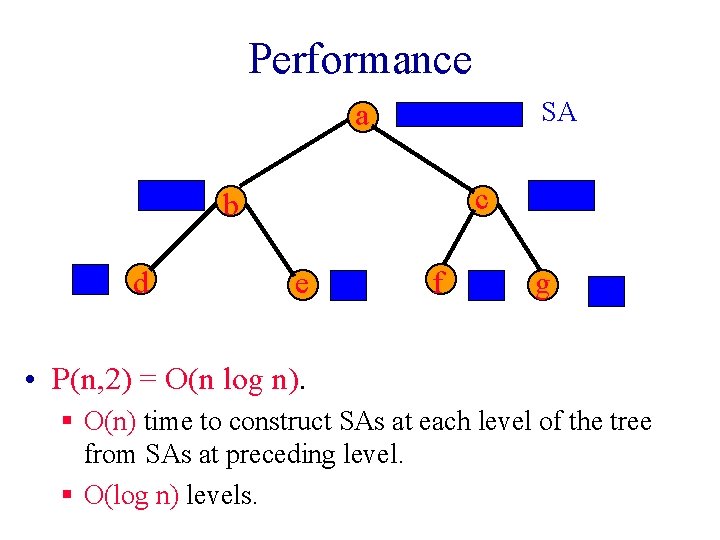
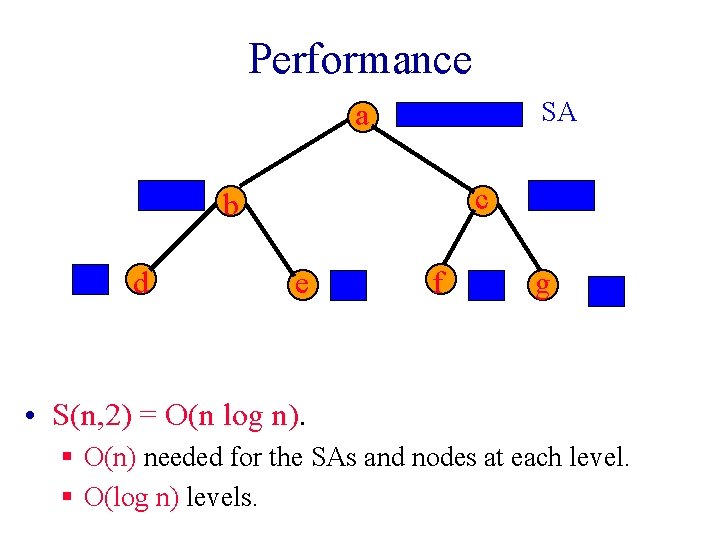
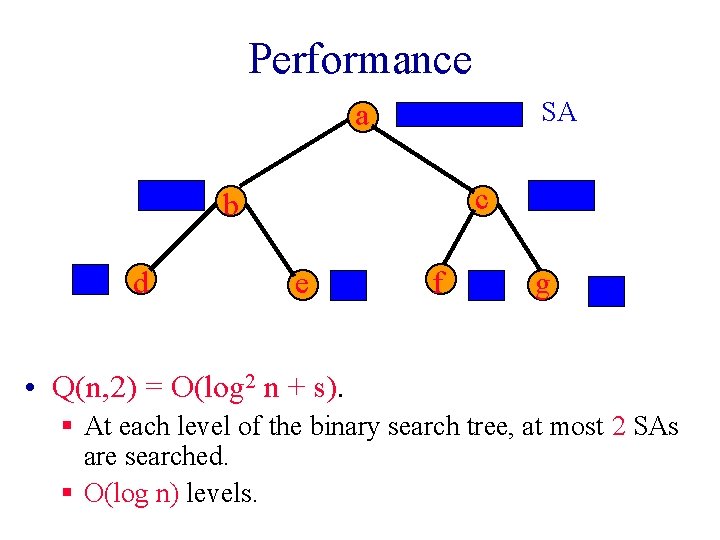
Example SA a c b d e f g • a-g are x values. • x-range of a node begins at min x value in subtree and ends at max x value in subtree.
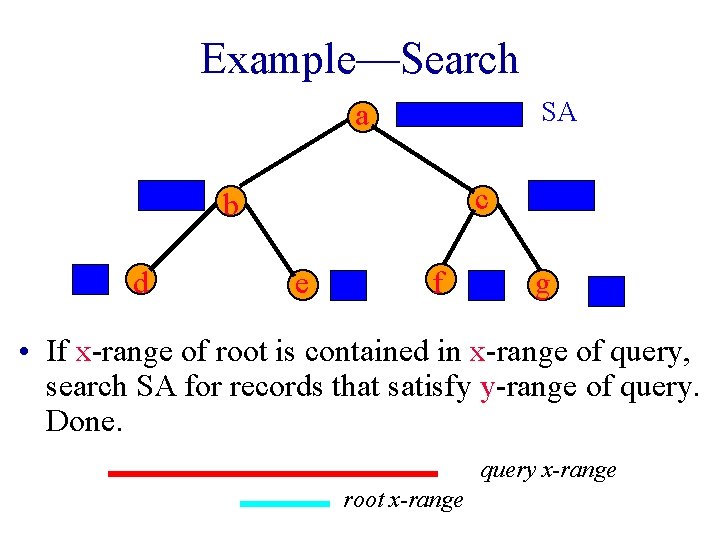
Example—Search SA a c b d e f g • If x-range of root is contained in x-range of query, search SA for records that satisfy y-range of query. Done. query x-range root x-range
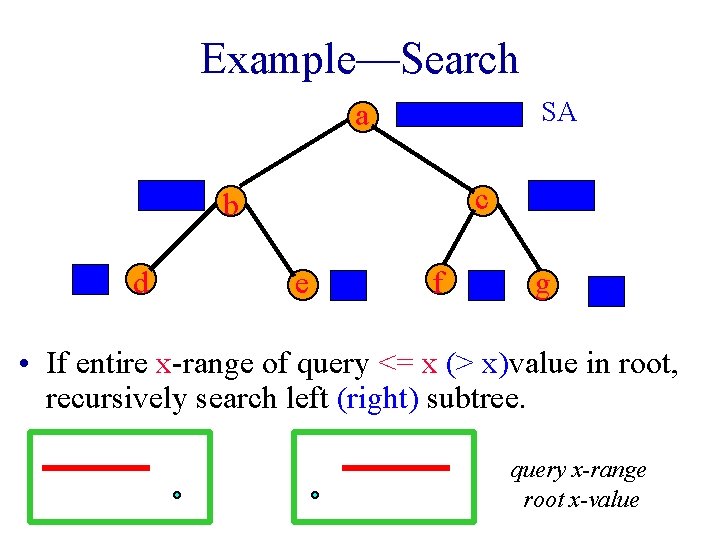
Example—Search SA a c b d e f g • If entire x-range of query <= x (> x)value in root, recursively search left (right) subtree. query x-range root x-value
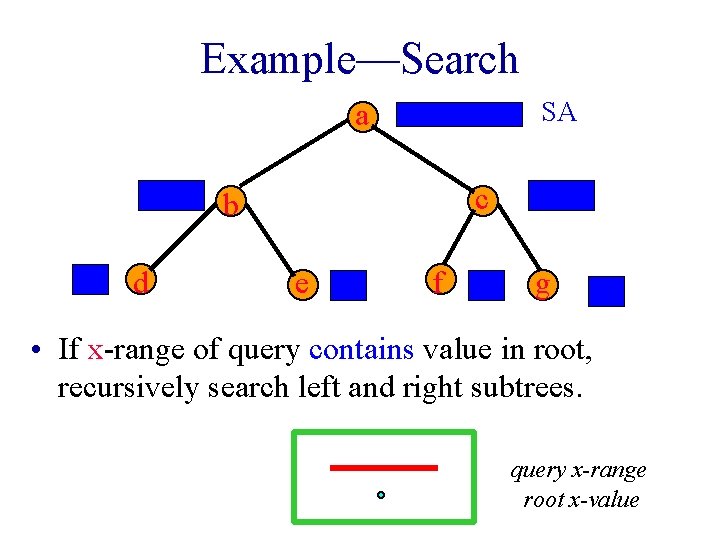
Example—Search SA a c b d e f g • If x-range of query contains value in root, recursively search left and right subtrees. query x-range root x-value
Performance SA a c b d e f g • P(n, 2) = O(n log n). § O(n log n) – sort all records by y for the SAs. § O(n) time to find all medians at each level of the tree.
Performance SA a c b d e f g • P(n, 2) = O(n log n). § O(n) time to construct SAs at each level of the tree from SAs at preceding level. § O(log n) levels.
Performance SA a c b d e f g • S(n, 2) = O(n log n). § O(n) needed for the SAs and nodes at each level. § O(log n) levels.
Performance SA a c b d e f g • Q(n, 2) = O(log 2 n + s). § At each level of the binary search tree, at most 2 SAs are searched. § O(log n) levels.
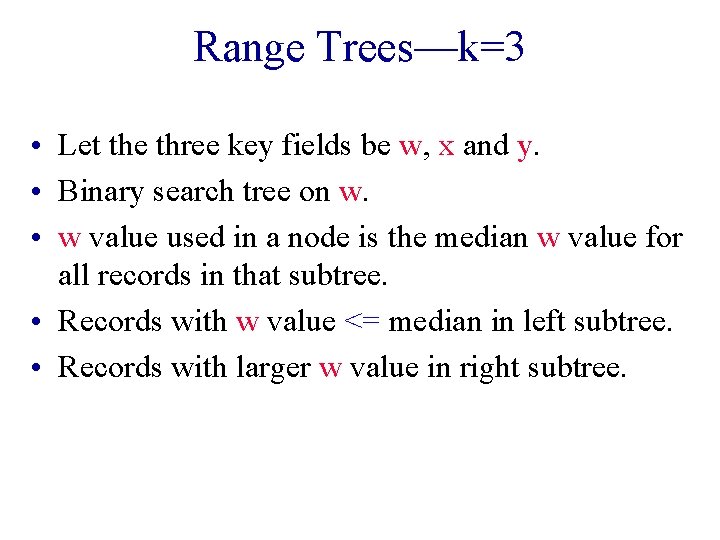
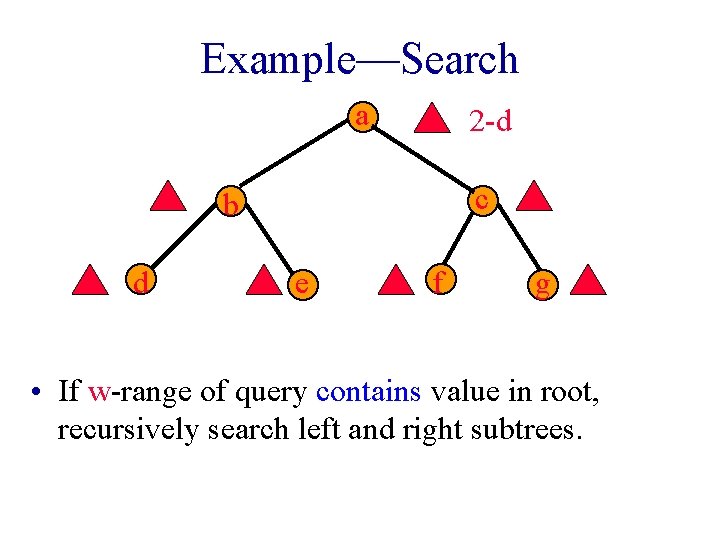
Range Trees—k=3 • Let the three key fields be w, x and y. • Binary search tree on w. • w value used in a node is the median w value for all records in that subtree. • Records with w value <= median in left subtree. • Records with larger w value in right subtree.
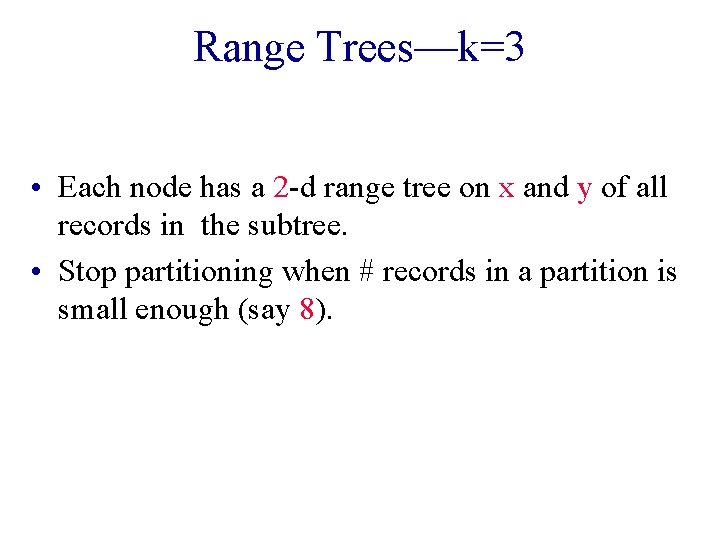
Range Trees—k=3 • Each node has a 2 -d range tree on x and y of all records in the subtree. • Stop partitioning when # records in a partition is small enough (say 8).
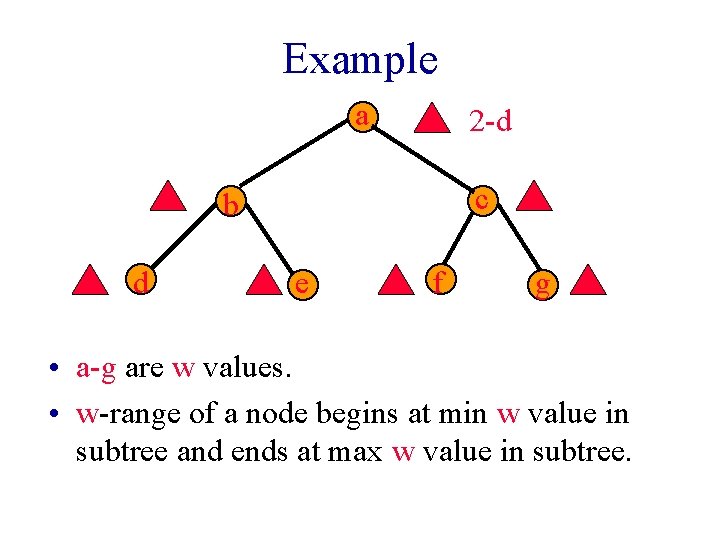
Example a 2 -d c b d e f g • a-g are w values. • w-range of a node begins at min w value in subtree and ends at max w value in subtree.
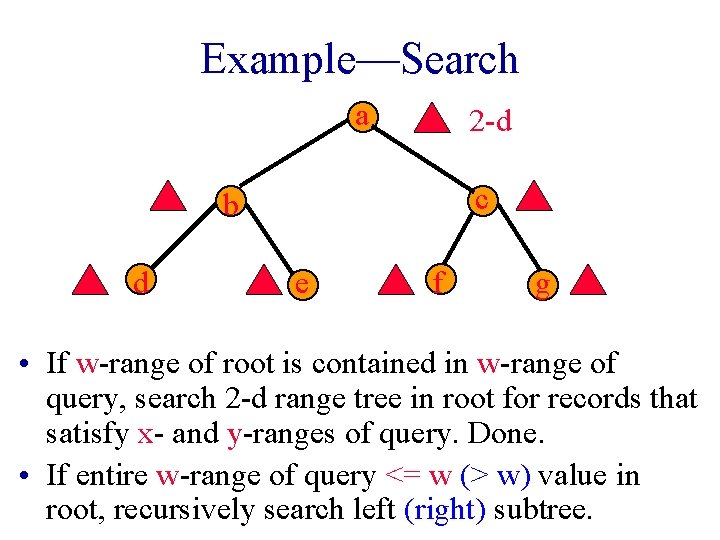
Example—Search a 2 -d c b d e f g • If w-range of root is contained in w-range of query, search 2 -d range tree in root for records that satisfy x- and y-ranges of query. Done. • If entire w-range of query <= w (> w) value in root, recursively search left (right) subtree.
Example—Search a 2 -d c b d e f g • If w-range of query contains value in root, recursively search left and right subtrees.
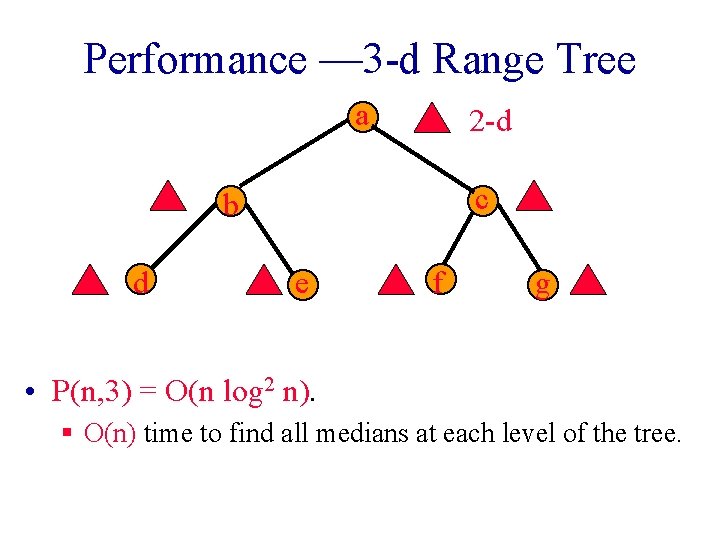
Performance — 3 -d Range Tree a 2 -d c b d e f g • P(n, 3) = O(n log 2 n). § O(n) time to find all medians at each level of the tree.
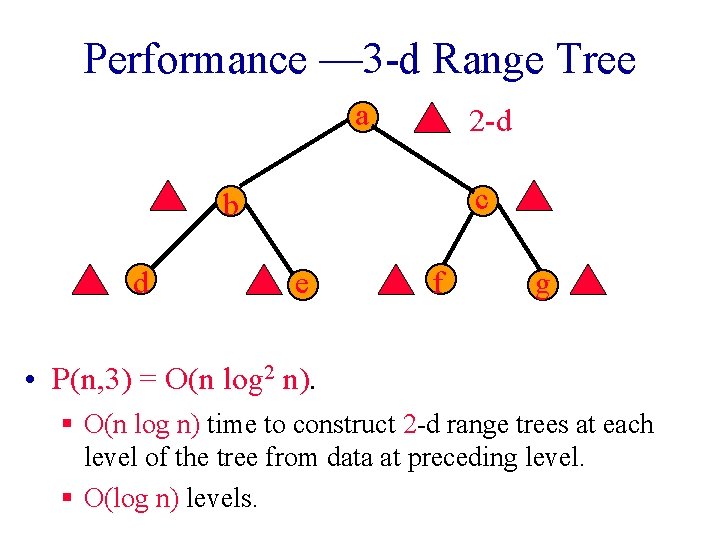
Performance — 3 -d Range Tree a 2 -d c b d e f g • P(n, 3) = O(n log 2 n). § O(n log n) time to construct 2 -d range trees at each level of the tree from data at preceding level. § O(log n) levels.
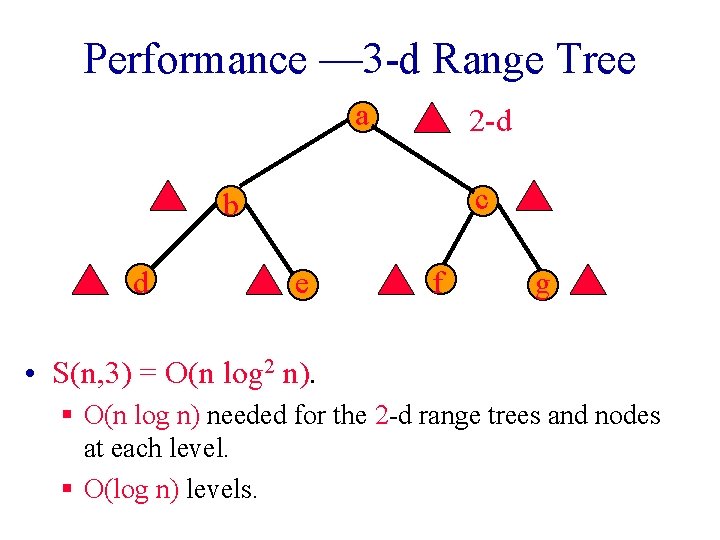
Performance — 3 -d Range Tree a 2 -d c b d e f g • S(n, 3) = O(n log 2 n). § O(n log n) needed for the 2 -d range trees and nodes at each level. § O(log n) levels.
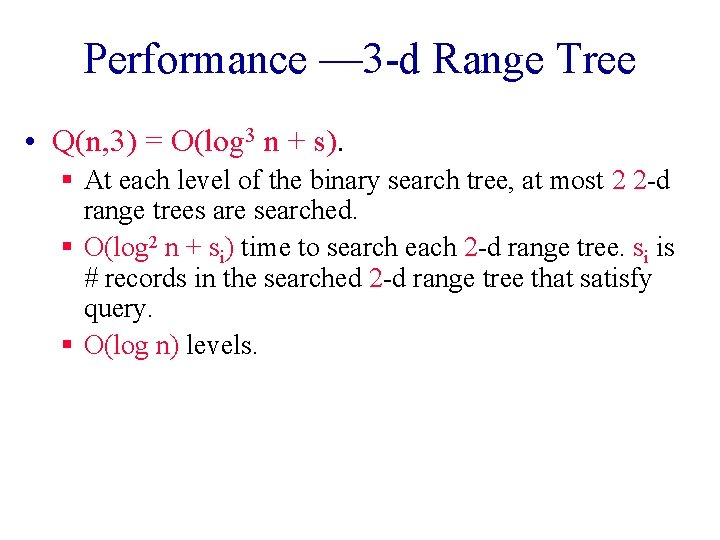
Performance — 3 -d Range Tree • Q(n, 3) = O(log 3 n + s). § At each level of the binary search tree, at most 2 2 -d range trees are searched. § O(log 2 n + si) time to search each 2 -d range tree. si is # records in the searched 2 -d range tree that satisfy query. § O(log n) levels.
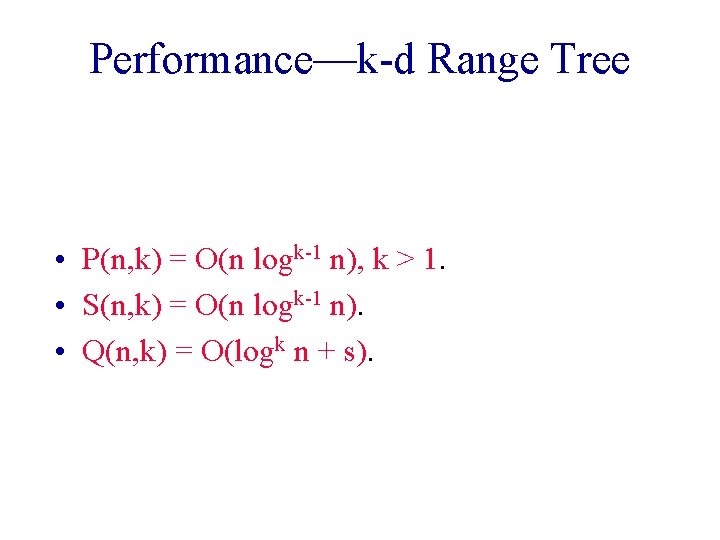
Performance—k-d Range Tree • P(n, k) = O(n logk-1 n), k > 1. • S(n, k) = O(n logk-1 n). • Q(n, k) = O(logk n + s).