
Multidimensional poverty measurement A human rights based approach
Multidimensional poverty measurement: A human rights based approach The case of Mexico April, 2011 www. coneval. gob. mx
Content CONEVAL Human Rights Approach to Multidimensional Poverty Measurement in Mexico Research Agenda

CONEVAL

CONEVAL Social Development Law (2004) Evaluation of Social Development Policy CONEVAL • Public institution • Academic researchers • Technical autonomy Multidimensional Poverty Measurement
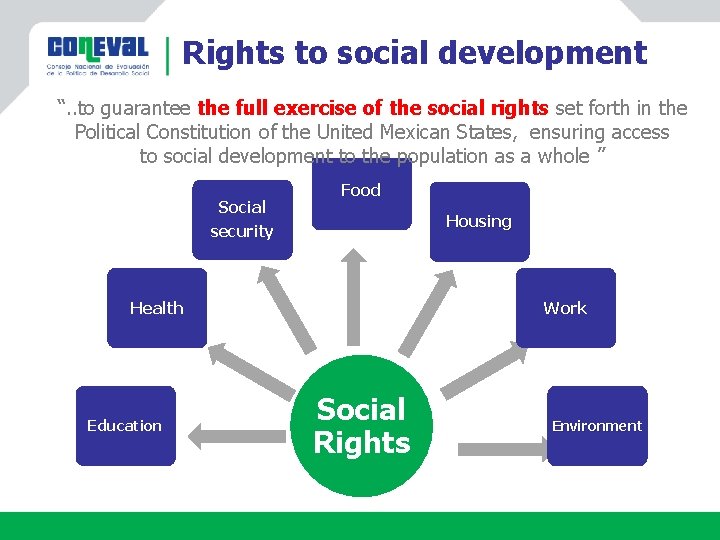
Rights to social development “. . to guarantee the full exercise of the social rights set forth in the Political Constitution of the United Mexican States, ensuring access to social development to the population as a whole ” Social Food Housing security Health Education Work Social Rights Environment
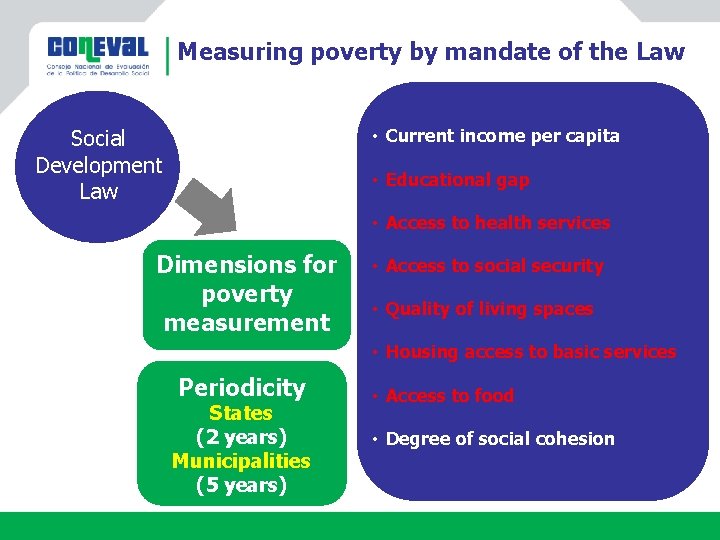
Measuring poverty by mandate of the Law • Current income per capita Social Development Law • Educational gap • Access to health services Dimensions for poverty measurement • Access to social security • Quality of living spaces • Housing access to basic services Periodicity States (2 years) Municipalities (5 years) • Access to food • Degree of social cohesion
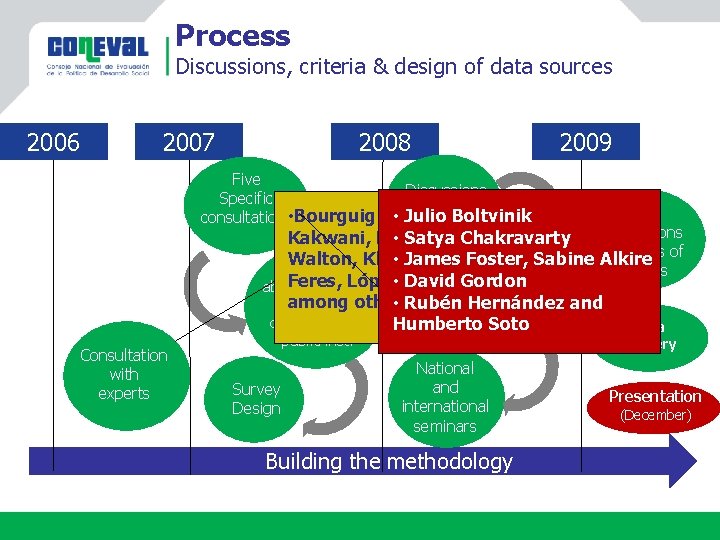
Process Discussions, criteria & design of data sources 2006 2007 2008 2009 Five Discussions Specific • Julioof. Boltvinik consultations • Bourguignon, Thorbecke, proposals Final discussions Kakwani, Lustig, Skoufias, • Satya Chakravarty & results of Walton, Khander, Reddy, • James Foster, Sabine Alkire Consultation studies Consultation with experts Feres, López-Calva, …Data • David Gordon about indicators, among others. • Rubén Collection Hernández thresholds, questions with Humberto Soto public inst. Survey Design National and international seminars Building the methodology and Data delivery Presentation (December)
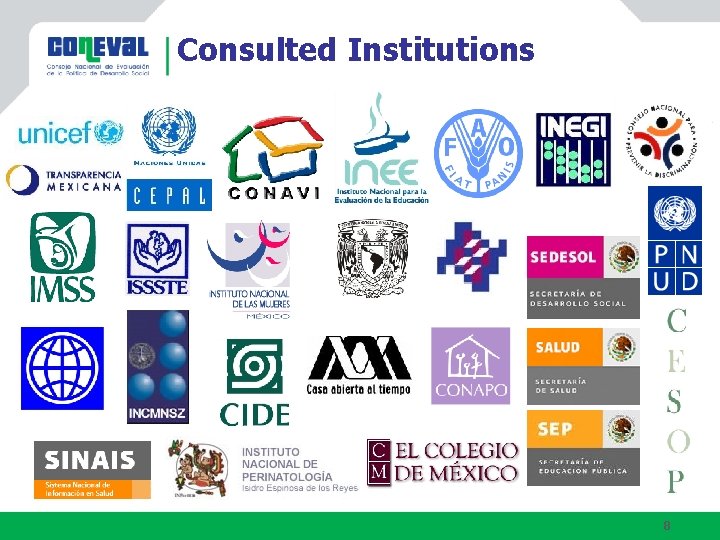
Consulted Institutions 8
Human Rights Approach to Multidimensional Poverty
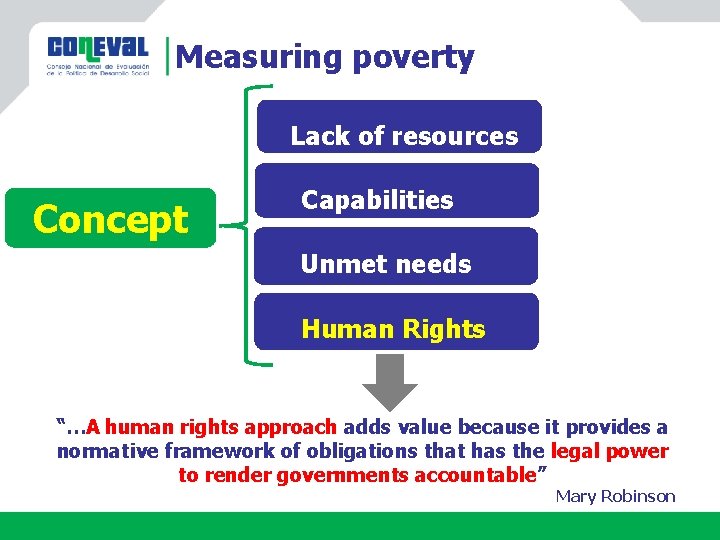
Measuring poverty Lack of resources Concept Capabilities Unmet needs Human Rights “…A human rights approach adds value because it provides a normative framework of obligations that has the legal power to render governments accountable” Mary Robinson
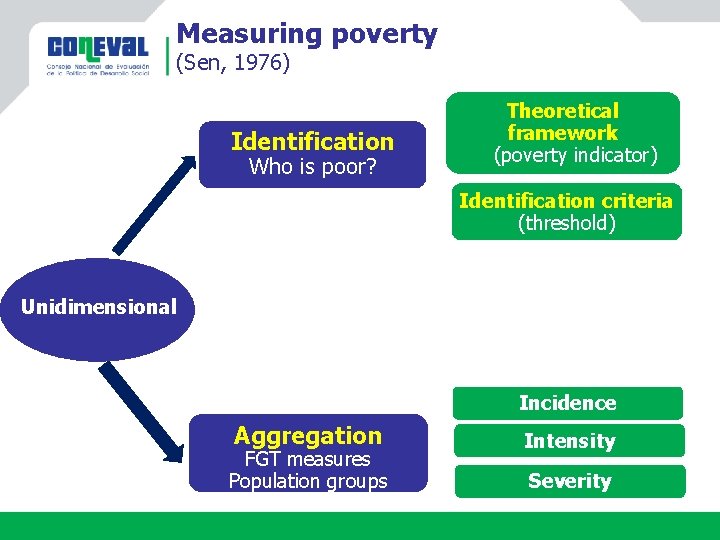
Measuring poverty (Sen, 1976) Identification Who is poor? Theoretical framework (poverty indicator) Identification criteria (threshold) Unidimensional Incidence Aggregation FGT measures Population groups Intensity Severity

Measuring poverty Relevant dimensions Multidimensional • Thresholds • Dual cut-off method Relative importance Each specific dimension Overall cut-off Weighting

Principles of human rights Indivisible All rights have equal Universal status and cannot Inalienable be positioned in a Universal hierarchical order Interdependent Everybody is Indivisible entitled to them Interrelated Absolute Inherent Inviolable Irreversible Progressive Interdependent Unfulfillment of any right affects the others
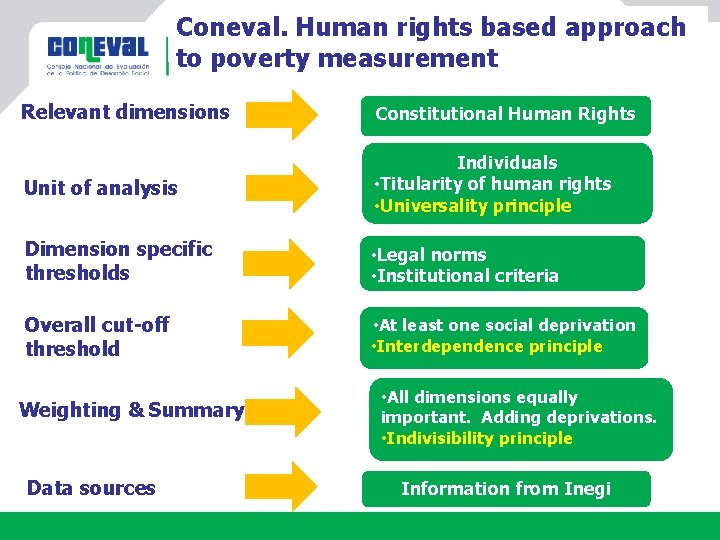
Coneval. Human rights based approach to poverty measurement Relevant dimensions Constitutional Human Rights Unit of analysis Individuals • Titularity of human rights • Universality principle Dimension specific thresholds • Legal norms • Institutional criteria Overall cut-off threshold • At least one social deprivation • Interdependence principle Weighting & Summary Data sources • All dimensions equally important. Adding deprivations. • Indivisibility principle Information from Inegi

Multidimensional Poverty Measurement in Mexico
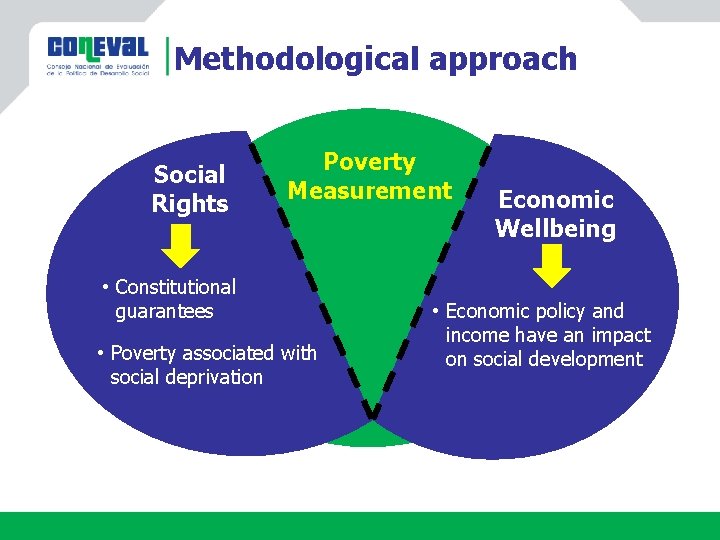
Methodological approach Social Rights Poverty Measurement • Constitutional guarantees • Poverty associated with social deprivation Economic Wellbeing • Economic policy and income have an impact on social development
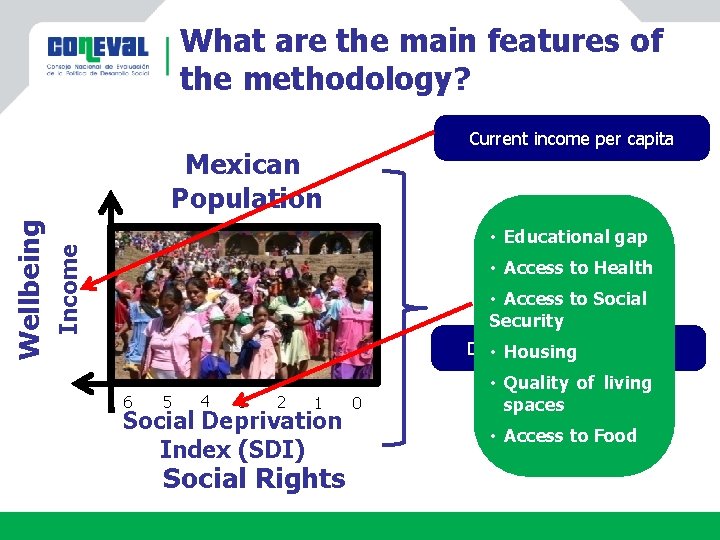
What are the main features of the methodology? Current income per capita • Educational gap Income Wellbeing Mexican Population • Access to Health • Access to Social Territorial Security Degree of social cohesion • Housing 6 5 4 3 2 1 Social Deprivation Index (SDI) Social Rights 0 • Quality of living spaces • Access to Food
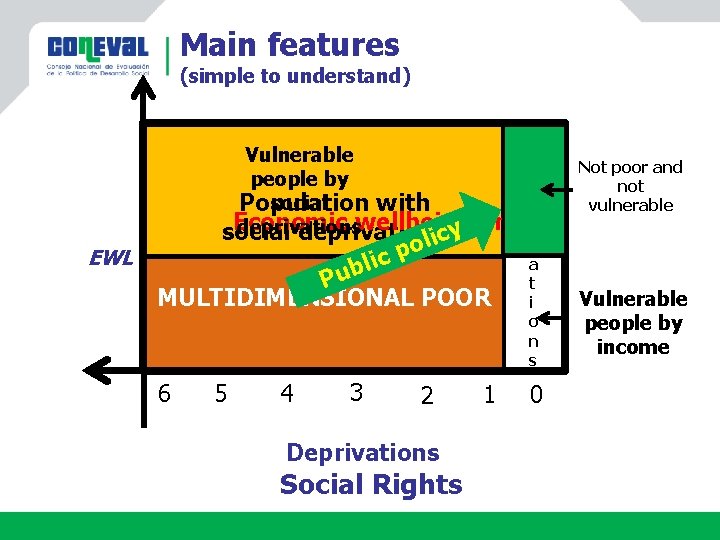
Main features (simple to understand) Without EWL Vulnerable people by social Population with Economic wellbeing deprivations social deprivations cy oli p ic line l b u P MULTIDIMENSIONAL POOR 6 5 4 3 2 Deprivations Social Rights 1 D e p r i v a t i o n s 0 Not poor and not vulnerable Vulnerable people by income
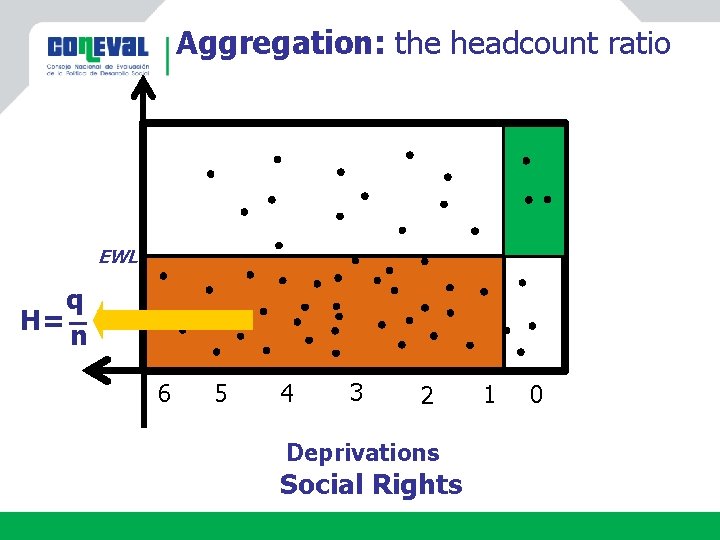
Aggregation: the headcount ratio Sin EWL q H= _ n 6 5 4 3 2 Deprivations Social Rights 1 0
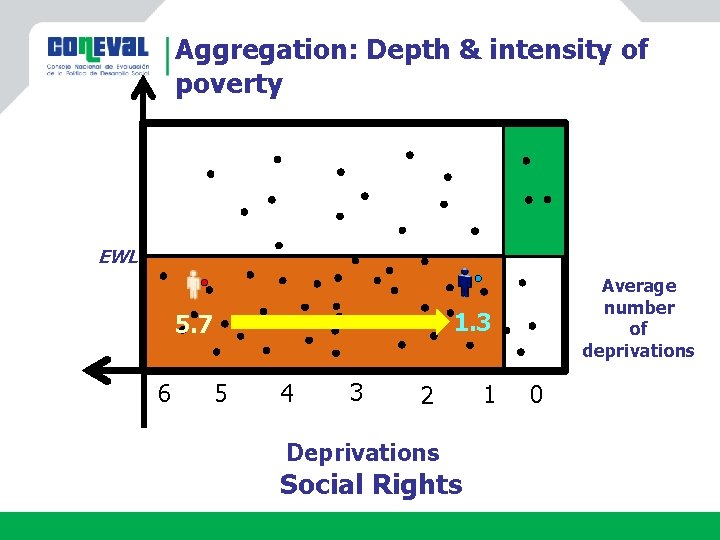
Aggregation: Depth & intensity of poverty Sin EWL 1. 3 5. 7 6 Average number of deprivations 5 4 3 2 Deprivations Social Rights 1 0

Results
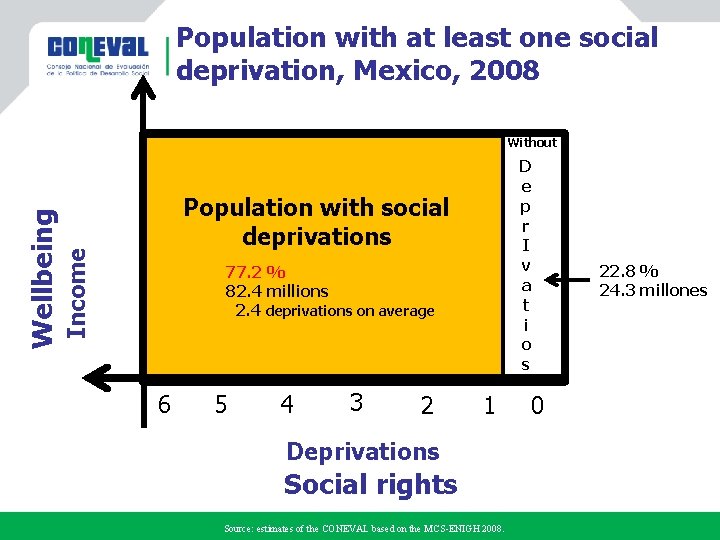
Population with at least one social deprivation, Mexico, 2008 D e p r I v a t i o s Population with social deprivations Income Wellbeing Without 77. 2 % 82. 4 millions 2. 4 deprivations on average 6 5 4 3 2 1 Deprivations Social rights Source: estimates of the CONEVAL based on the MCS-ENIGH 2008. 0 22. 8 % 24. 3 millones
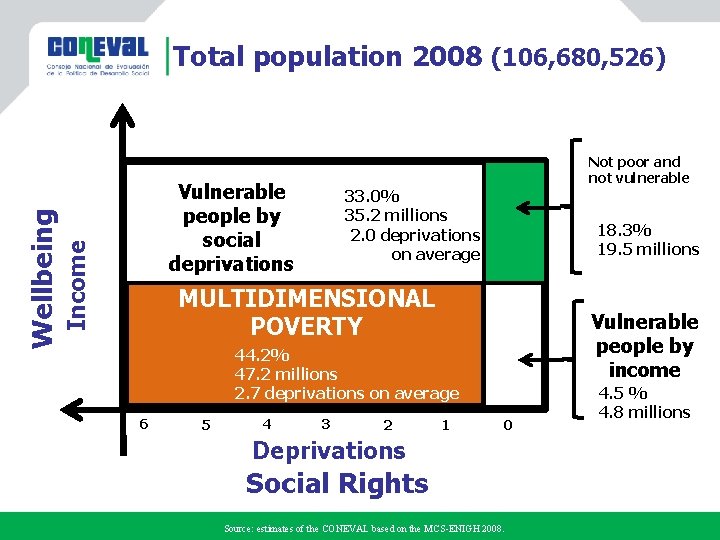
Vulnerable people by social deprivations Income Wellbeing Total population 2008 (106, 680, 526) Not poor and not vulnerable 33. 0% 35. 2 millions 2. 0 deprivations on average 18. 3% 19. 5 millions MODERATE POVERTY MULTIDIMENSIONAL POVERTY EXTREME POVERTY 6 5 Vulnerable people by income 44. 2% 47. 2 millions 2. 7 deprivations on average 4 3 2 1 0 Deprivations Social Rights Source: estimates of the CONEVAL based on the MCS-ENIGH 2008. 4. 5 % 4. 8 millions
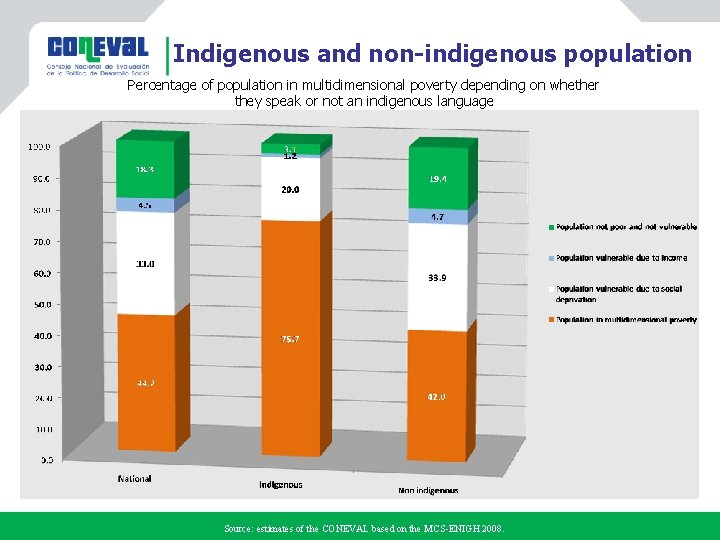
Indigenous and non-indigenous population Percentage of population in multidimensional poverty depending on whether they speak or not an indigenous language Source: estimates of the CONEVAL based on the MCS-ENIGH 2008.
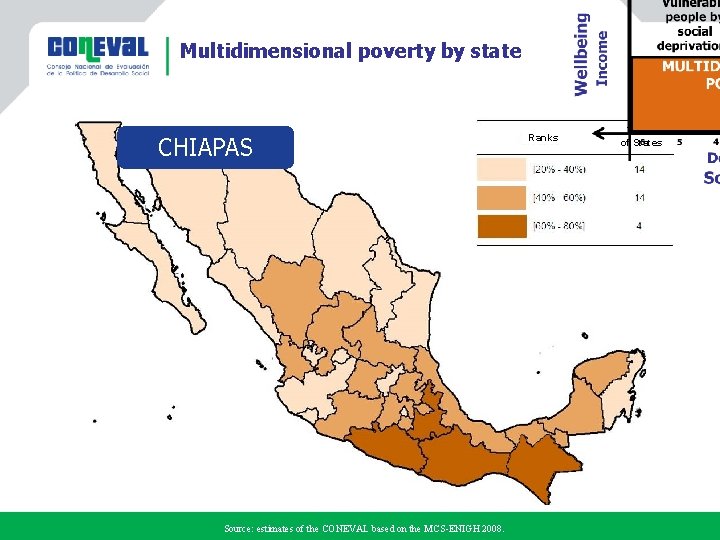
Multidimensional poverty by state CHIAPAS Source: estimates of the CONEVAL based on the MCS-ENIGH 2008. Ranks Total of States
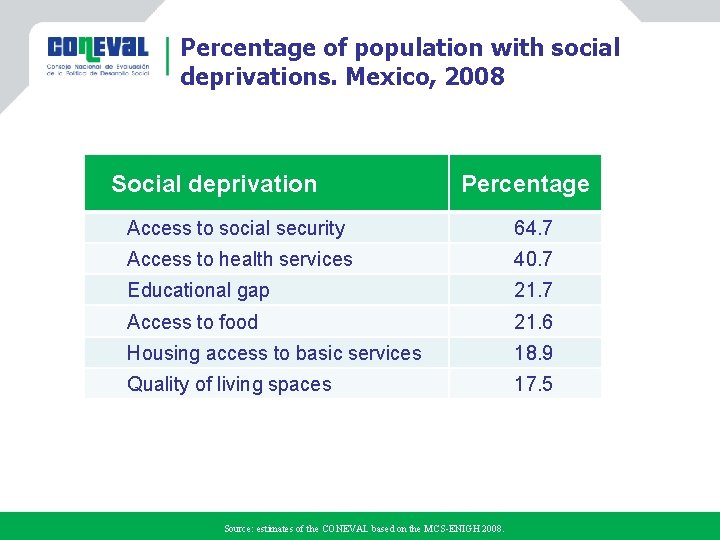
Percentage of population with social deprivations. Mexico, 2008 Social deprivation Percentage Access to social security 64. 7 Access to health services 40. 7 Educational gap 21. 7 Access to food 21. 6 Housing access to basic services 18. 9 Quality of living spaces 17. 5 Source: estimates of the CONEVAL based on the MCS-ENIGH 2008.
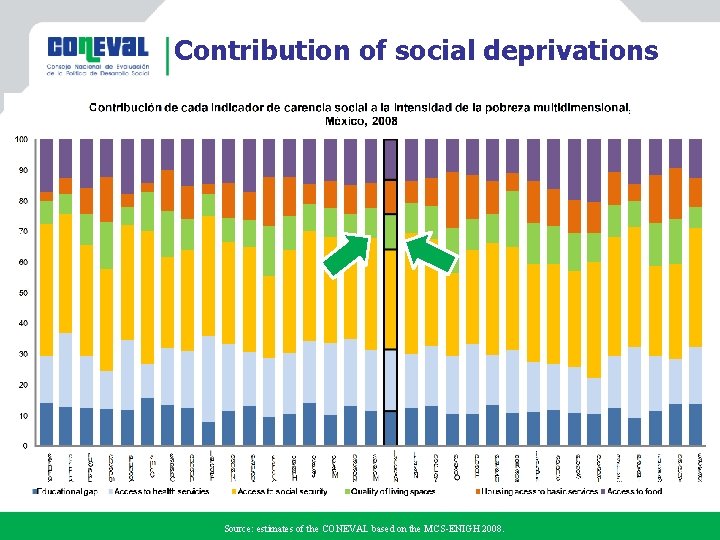
Contribution of social deprivations Source: estimates of the CONEVAL based on the MCS-ENIGH 2008.
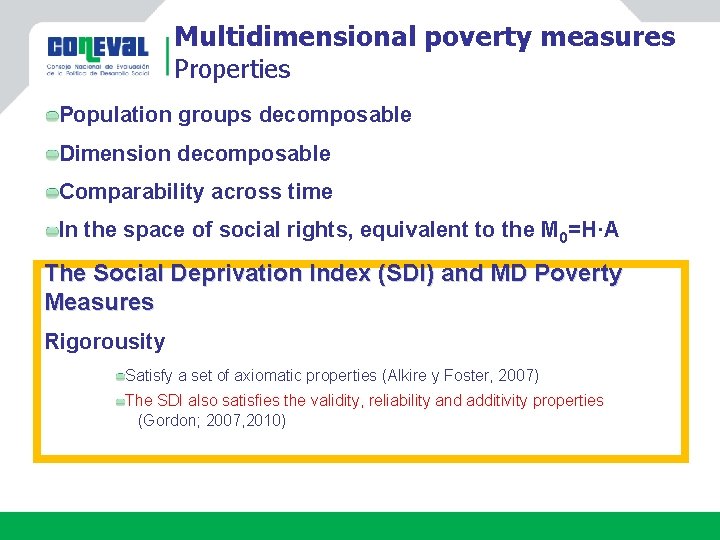
Multidimensional poverty measures Properties Population groups decomposable Dimension decomposable Comparability across time In the space of social rights, equivalent to the M 0=H·A The Social Deprivation Index (SDI) and MD Poverty Measures Rigorousity Satisfy a set of axiomatic properties (Alkire y Foster, 2007) The SDI also satisfies the validity, reliability and additivity properties (Gordon; 2007, 2010)

Research Agenda
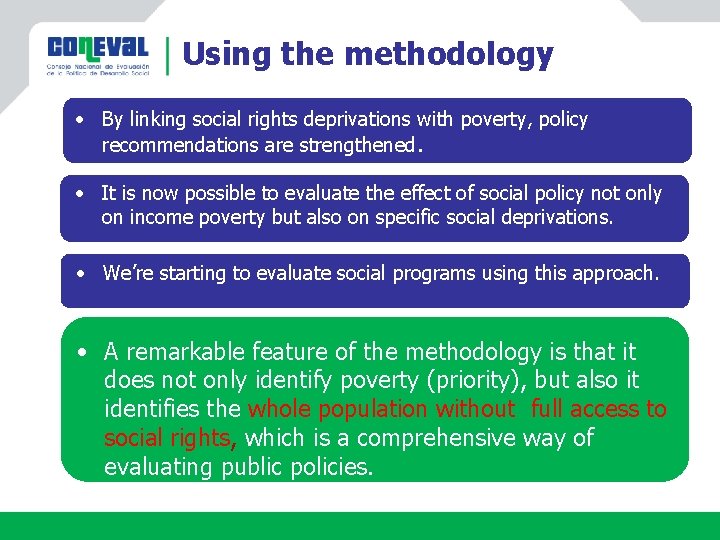
Using the methodology • By linking social rights deprivations with poverty, policy recommendations are strengthened. • It is now possible to evaluate the effect of social policy not only on income poverty but also on specific social deprivations. • We’re starting to evaluate social programs using this approach. • A remarkable feature of the methodology is that it does not only identify poverty (priority), but also it identifies the whole population without full access to social rights, which is a comprehensive way of evaluating public policies.
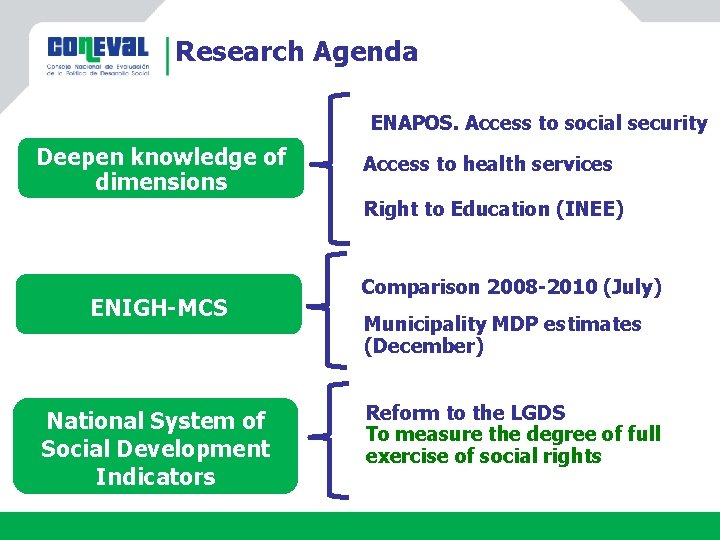
Research Agenda ENAPOS. Access to social security Deepen knowledge of dimensions Access to health services Right to Education (INEE) ENIGH-MCS National System of Social Development Indicators Comparison 2008 -2010 (July) Municipality MDP estimates (December) Reform to the LGDS To measure the degree of full exercise of social rights

Thank you!

Contact information www. coneval. gob. mx Consejo Nacional de Evaluación de la Política de Desarrollo Social (CONEVAL) Boulevard Adolfo López Mateos No. 160 Col. San Ángel Inn, Delegación Álvaro Obregón, C. P. 01060, México, D. F. Ricardo Aparicio Director, Poverty Analysis E-mail: rcaparicio@coneval. gob. mx

SUPPORTING SLIDES

EXAMPLES
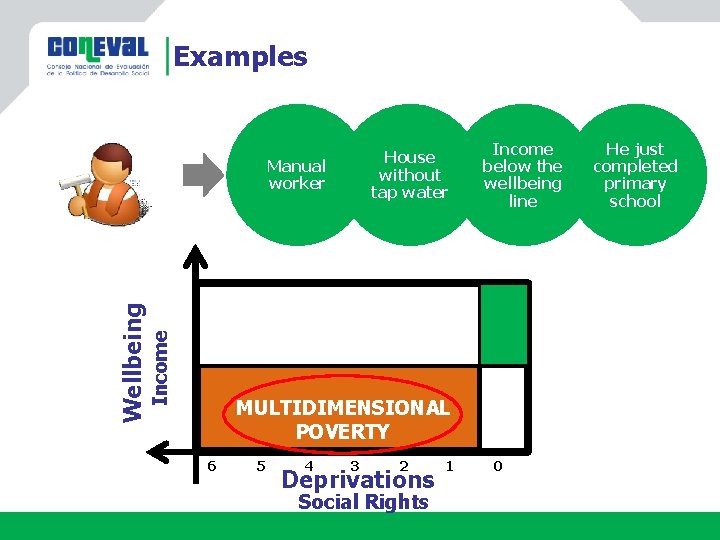
Examples House without tap water Income Wellbeing Manual worker Income below the wellbeing line MODERATE POVERTY MULTIDIMENSIONAL EXTREME POVERTY 6 5 4 3 2 Deprivations Social Rights 1 0 He just completed primary school
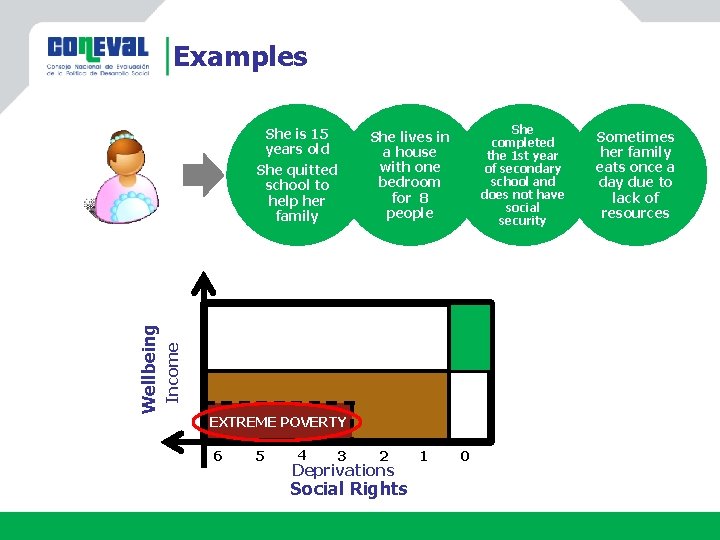
Examples She is 15 years old Income Wellbeing She quitted school to help her family She completed the 1 st year of secondary school and does not have social security She lives in a house with one bedroom for 8 people POBREZA MODERADA EXTREME POVERTY POBREZA EXTREMA 4 6 5 3 2 Deprivations Social Rights 1 0 Sometimes her family eats once a day due to lack of resources
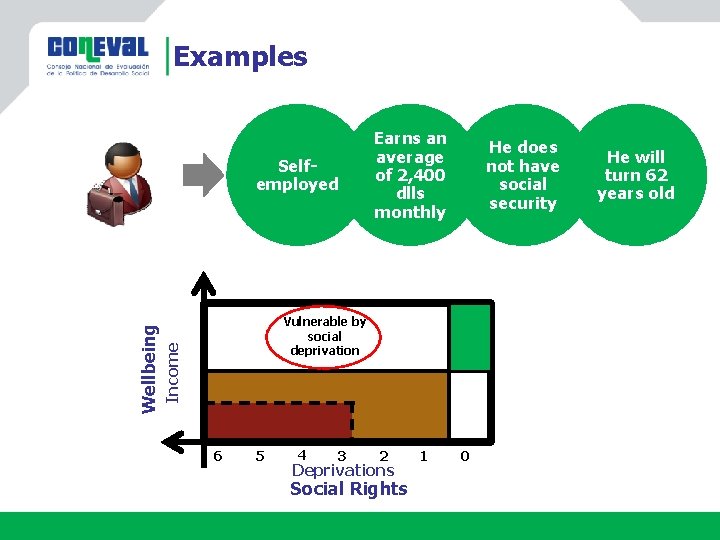
Examples He does not have social security Vulnerable by social deprivation Income Wellbeing Selfemployed Earns an average of 2, 400 dlls monthly 6 5 4 3 2 Deprivations Social Rights 1 0 He will turn 62 years old
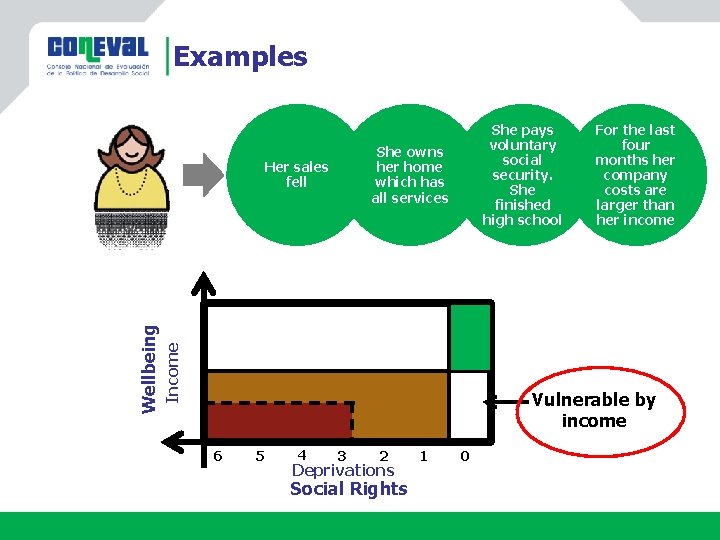
Examples She owns her home which has all services Income Her sales fell Wellbeing She pays voluntary social security. She finished high school For the last four months her company costs are larger than her income Vulnerable by income 6 5 4 3 2 Deprivations Social Rights 1 0
USING THE METHODOLOGY FOR PUBLIC POLICY
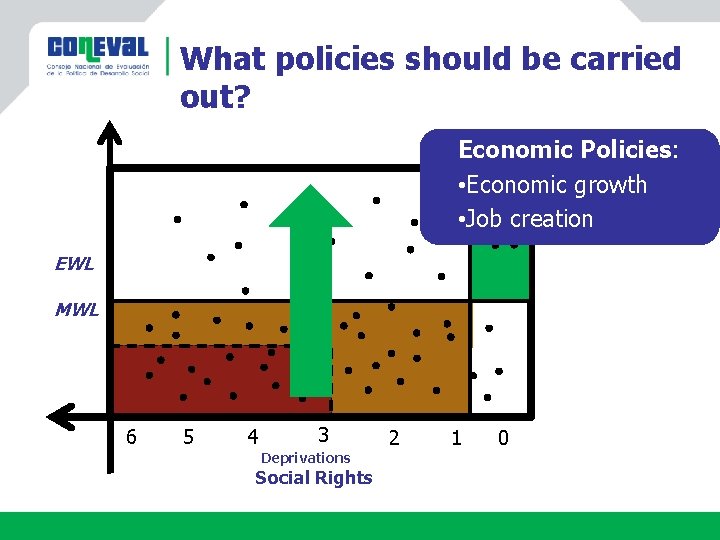
What policies should be carried out? Economic Policies: • Economic growth Sin • Job creation EWL MWL 6 5 4 3 Deprivations Social Rights 2 1 0
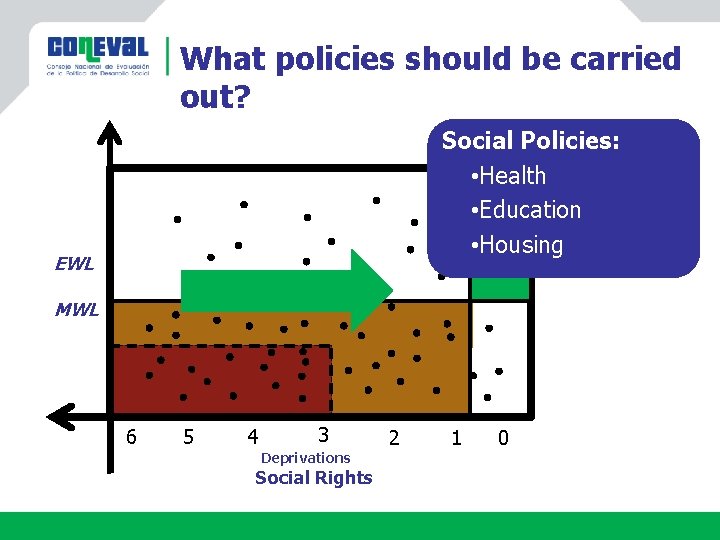
What policies should be carried out? Social Policies: • Health Sin • Education • Housing EWL MWL 6 5 4 3 Deprivations Social Rights 2 1 0
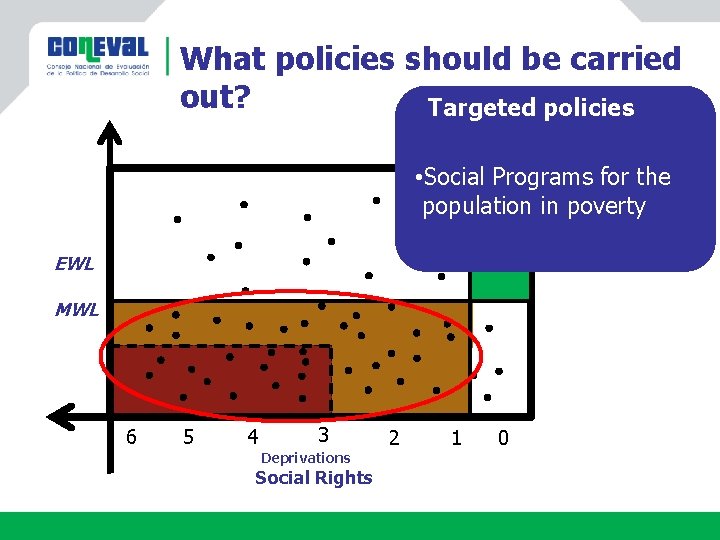
What policies should be carried out? Targeted policies • Social. Sin Programs for the population in poverty EWL MWL 6 5 4 3 Deprivations Social Rights 2 1 0
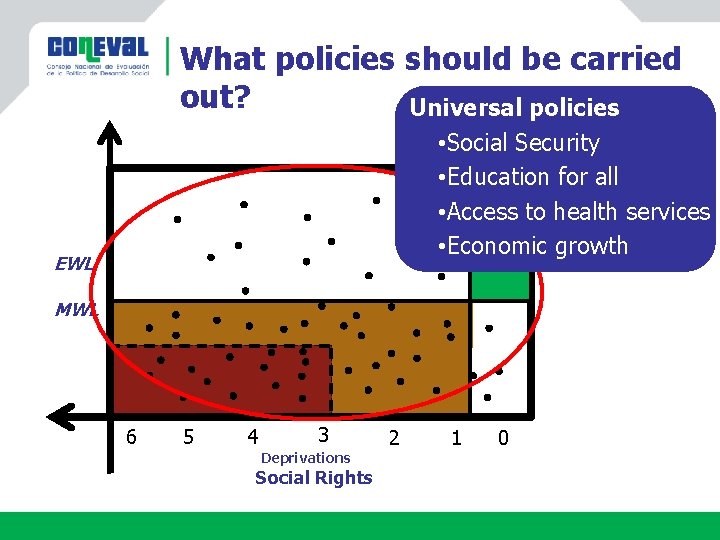
What policies should be carried out? Universal policies • Social Security • Education for all Sin • Access to health services • Economic growth EWL MWL 6 5 4 3 Deprivations Social Rights 2 1 0

THRESHOLDS
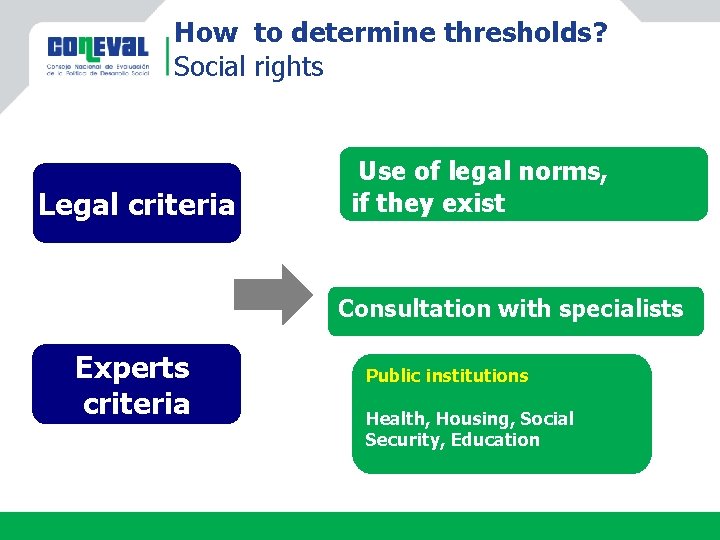
How to determine thresholds? Social rights Legal criteria Use of legal norms, if they exist Consultation with specialists Experts criteria Public institutions Health, Housing, Social Security, Education
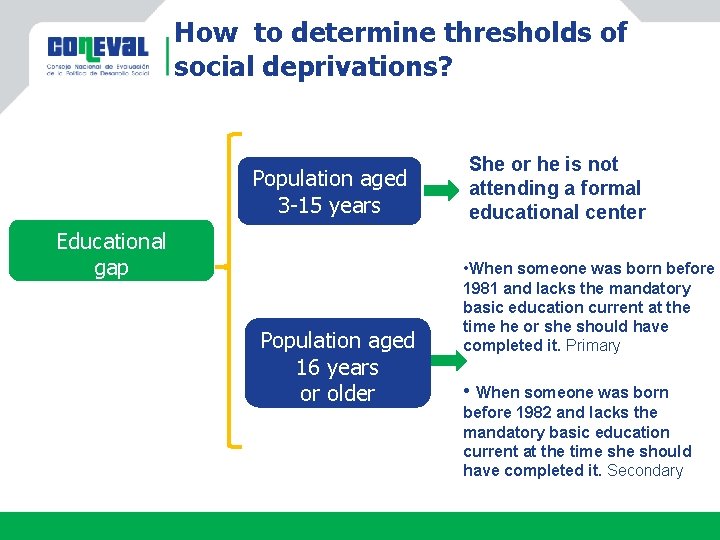
How to determine thresholds of social deprivations? Population aged 3 -15 years Educational gap Population aged 16 years or older She or he is not attending a formal educational center • When someone was born before 1981 and lacks the mandatory basic education current at the time he or she should have completed it. Primary • When someone was born before 1982 and lacks the mandatory basic education current at the time should have completed it. Secondary
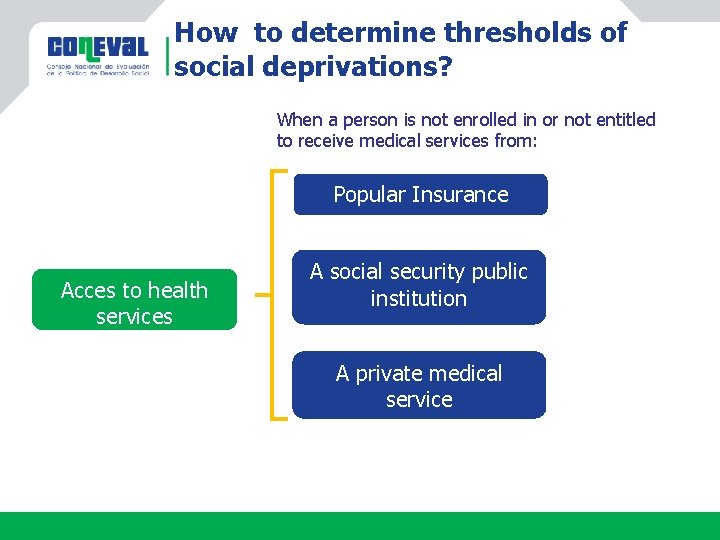
How to determine thresholds of social deprivations? When a person is not enrolled in or not entitled to receive medical services from: Popular Insurance Acces to health services A social security public institution A private medical service
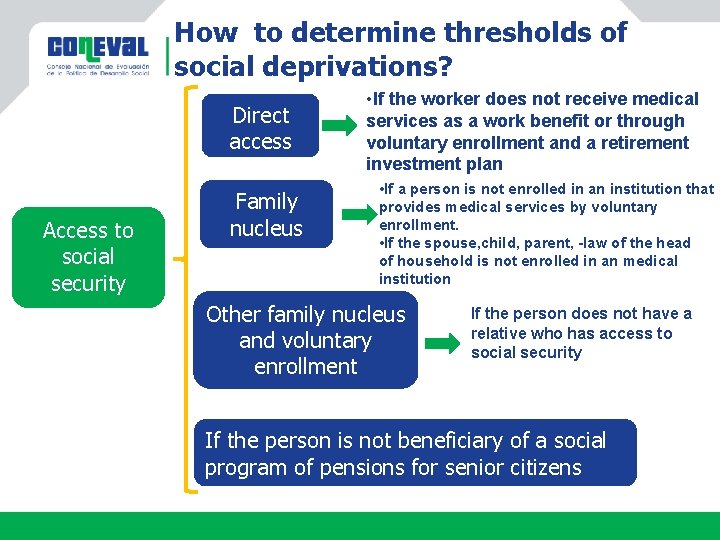
How to determine thresholds of social deprivations? Direct access Access to social security Family nucleus • If the worker does not receive medical services as a work benefit or through voluntary enrollment and a retirement investment plan • If a person is not enrolled in an institution that provides medical services by voluntary enrollment. • If the spouse, child, parent, -law of the head of household is not enrolled in an medical institution Other family nucleus and voluntary enrollment If the person does not have a relative who has access to social security If the person is not beneficiary of a social program of pensions for senior citizens
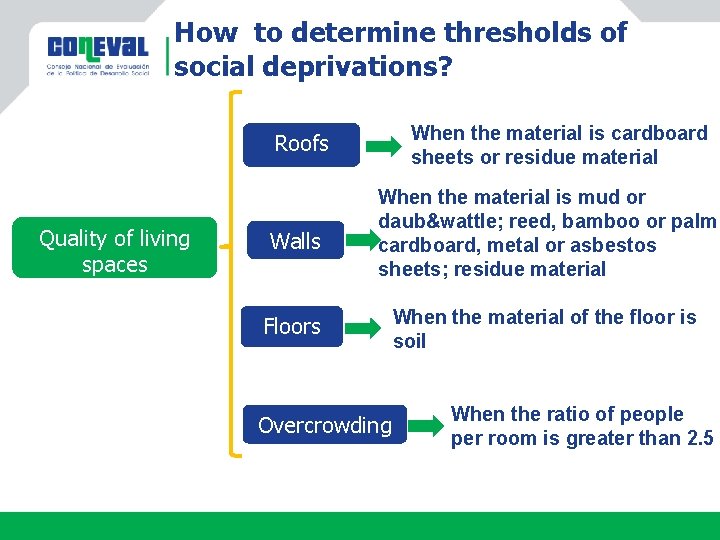
How to determine thresholds of social deprivations? When the material is cardboard sheets or residue material Roofs Quality of living spaces Walls When the material is mud or daub&wattle; reed, bamboo or palm; cardboard, metal or asbestos sheets; residue material Floors Overcrowding When the material of the floor is soil When the ratio of people per room is greater than 2. 5
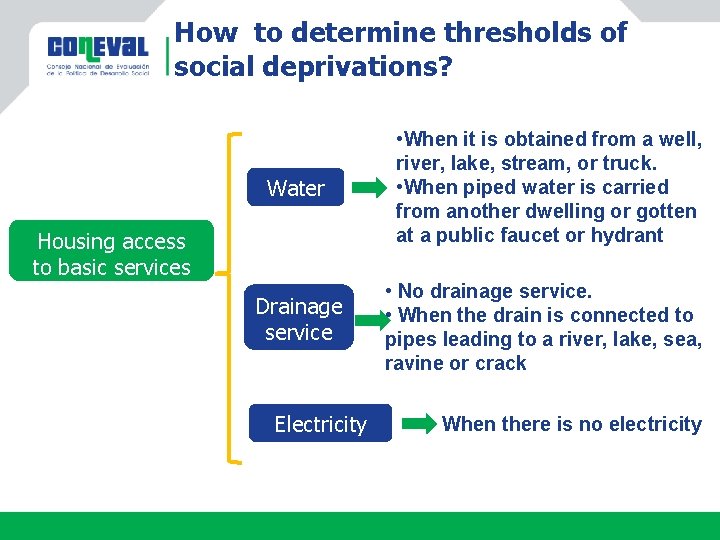
How to determine thresholds of social deprivations? Water • When it is obtained from a well, river, lake, stream, or truck. • When piped water is carried from another dwelling or gotten at a public faucet or hydrant Drainage service • No drainage service. • When the drain is connected to pipes leading to a river, lake, sea, ravine or crack Housing access to basic services Electricity When there is no electricity
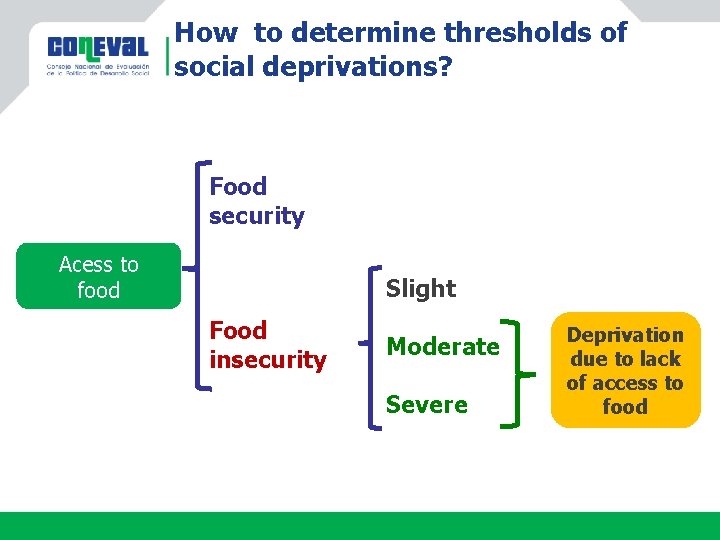
How to determine thresholds of social deprivations? Food security Acess to food Slight Food insecurity Moderate Severe Deprivation due to lack of access to food
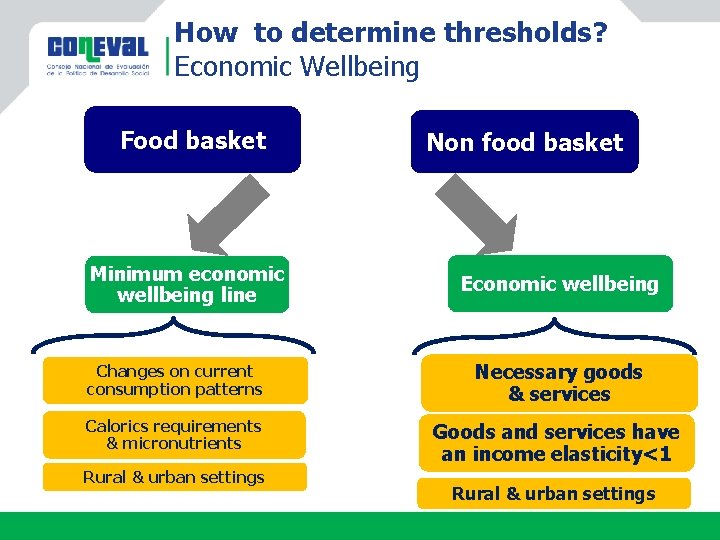
How to determine thresholds? Economic Wellbeing Food basket Minimum economic wellbeing line Non food basket Economic wellbeing Changes on current consumption patterns Necessary goods & services Calorics requirements & micronutrients Goods and services have an income elasticity<1 Rural & urban settings
- Slides: 53