
Multidimensional Mass Spectrometry Methods for Synthetic Polymer Analysis
![Hybrid material [PAA‒VG 2]m + Pt. BA VG 2 Cu(I) DMF TFA [Pt. BA‒VG](https://slidetodoc.com/presentation_image_h/0b8e473229bbc8cf166012e4055e5b6a/image-23.jpg "Hybrid material [PAA‒VG 2]m + Pt. BA VG 2 Cu(I) DMF TFA [Pt. BA‒VG")
![Hybrid material / [PAA‒VG 2]m m/z 3000 PAA–VG 2 ESI-IM-MS 2000 NH 4 OAc](https://slidetodoc.com/presentation_image_h/0b8e473229bbc8cf166012e4055e5b6a/image-24.jpg "Hybrid material / [PAA‒VG 2]m m/z 3000 PAA–VG 2 ESI-IM-MS 2000 NH 4 OAc")
![Hybrid material / [PAA‒VG 2]m ESI-IM-MS 1000 1100 1354. 21 1050 1318. 18 1246.](https://slidetodoc.com/presentation_image_h/0b8e473229bbc8cf166012e4055e5b6a/image-25.jpg "Hybrid material / [PAA‒VG 2]m ESI-IM-MS 1000 1100 1354. 21 1050 1318. 18 1246.")
![Hybrid material / [PAA‒VG 2]m [PAA 10‒VG 2]1 m/z 1030 [M+2 H]2+ ESI-IM-MS 5.](https://slidetodoc.com/presentation_image_h/0b8e473229bbc8cf166012e4055e5b6a/image-26.jpg "Hybrid material / [PAA‒VG 2]m [PAA 10‒VG 2]1 m/z 1030 [M+2 H]2+ ESI-IM-MS 5.")
![Hybrid material / [PAA‒VG 2]m Architecture? linear ? intramolecular azide click rxn. cyclic ?](https://slidetodoc.com/presentation_image_h/0b8e473229bbc8cf166012e4055e5b6a/image-27.jpg "Hybrid material / [PAA‒VG 2]m Architecture? linear ? intramolecular azide click rxn. cyclic ?")
![Hybrid material / [Pt. BAn‒VG 2]1 Architecture ESI-IM-MS 10 510 Collision cross-section (Å2) 2+](https://slidetodoc.com/presentation_image_h/0b8e473229bbc8cf166012e4055e5b6a/image-28.jpg "Hybrid material / [Pt. BAn‒VG 2]1 Architecture ESI-IM-MS 10 510 Collision cross-section (Å2) 2+")
![Multidimensional MS [interfaced separation & mass analysis methodologies] in polymer and materials science Information](https://slidetodoc.com/presentation_image_h/0b8e473229bbc8cf166012e4055e5b6a/image-29.jpg "Multidimensional MS [interfaced separation & mass analysis methodologies] in polymer and materials science Information")
- Slides: 30
Multidimensional Mass Spectrometry Methods for Synthetic Polymer Analysis Chrys Wesdemiotis The University of Akron, Departments of Chemistry and Polymer Science, Akron, OH 44325 International Summit on Current Trends in Mass Spectrometry July 13 -15, 2015 New Orleans, USA 1
New ionization methods (MALDI, ESI, DESI, APCI) have enabled the MS analysis of a wide range of synthetic polymers and are now widely used to determine: the compositional heterogeneity of new polymers the identify of chain end groups molecular weight distributions functionality distributions detection of minor products with exceptionally high sensitivity Structural identification or confirmation - Insight on polymerization mechanisms - Assessment of commercial viability 3
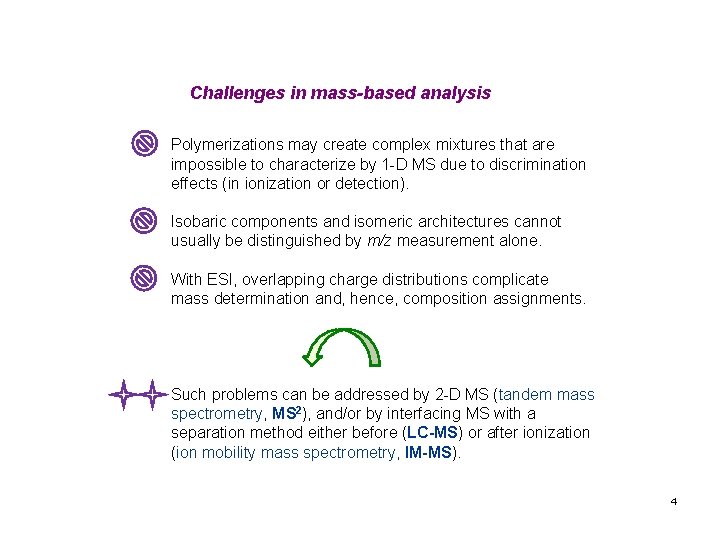
Challenges in mass-based analysis Polymerizations may create complex mixtures that are impossible to characterize by 1 -D MS due to discrimination effects (in ionization or detection). Isobaric components and isomeric architectures cannot usually be distinguished by m/z measurement alone. With ESI, overlapping charge distributions complicate mass determination and, hence, composition assignments. Such problems can be addressed by 2 -D MS (tandem mass spectrometry, MS 2), and/or by interfacing MS with a separation method either before (LC-MS) or after ionization (ion mobility mass spectrometry, IM-MS). 4
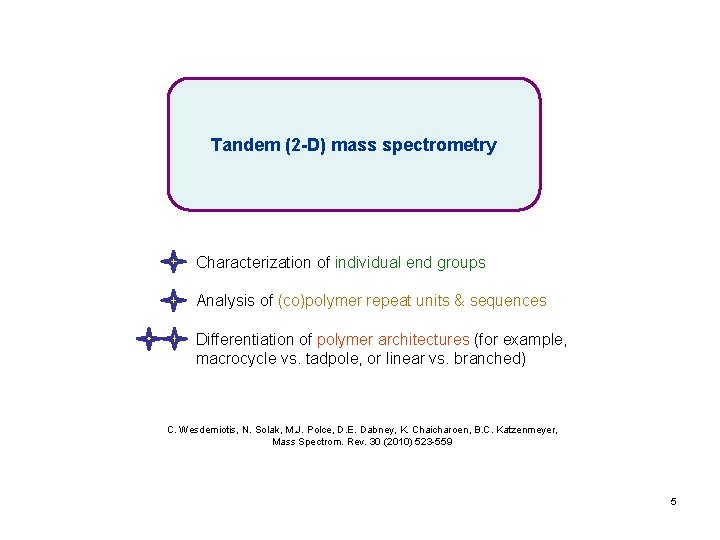
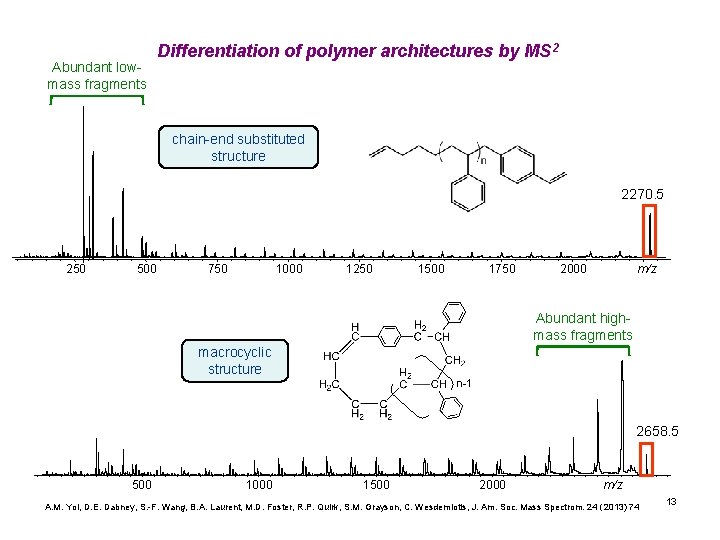
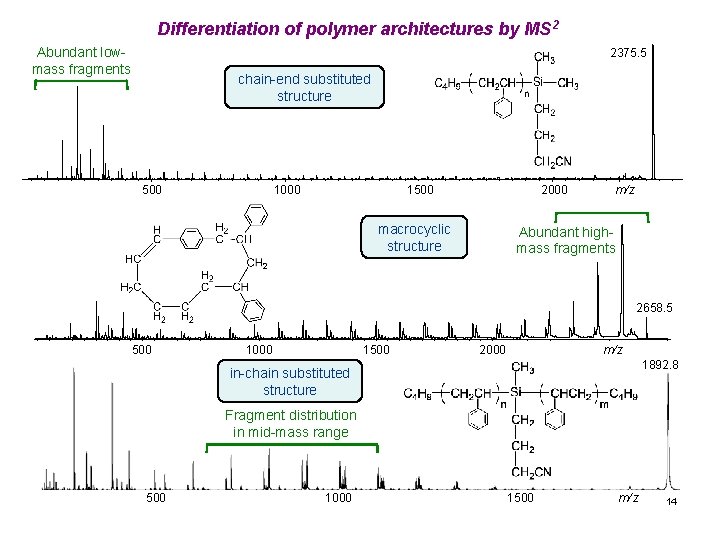
Tandem (2 -D) mass spectrometry Characterization of individual end groups Analysis of (co)polymer repeat units & sequences Differentiation of polymer architectures (for example, macrocycle vs. tadpole, or linear vs. branched) C. Wesdemiotis, N. Solak, M. J. Polce, D. E. Dabney, K. Chaicharoen, B. C. Katzenmeyer, Mass Spectrom. Rev. 30 (2010) 523 -559 5
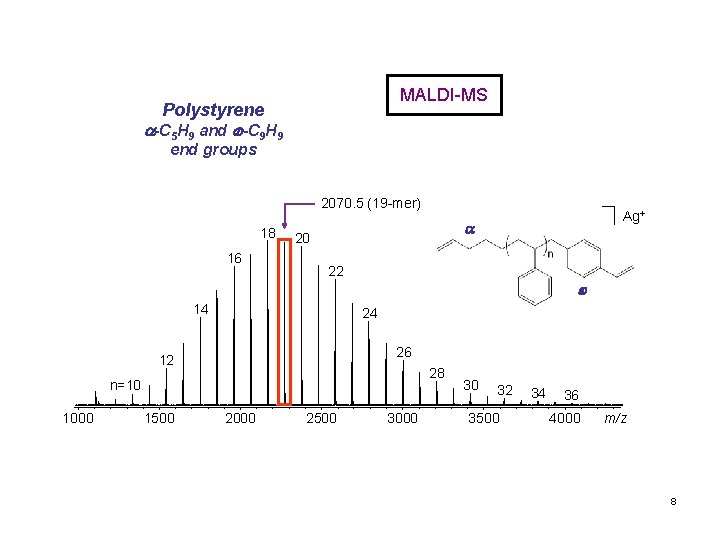
MALDI-MS Polystyrene -C 5 H 9 and -C 9 H 9 end groups 2070. 5 (19 -mer) 18 16 Ag+ 20 22 14 24 26 12 28 n=10 1000 1500 2000 2500 30 32 3500 34 36 4000 m/z 8
Abundant lowmass fragments Differentiation of polymer architectures by MS 2 chain-end substituted structure 2270. 5 250 500 750 1000 1250 1500 1750 2000 m/z Abundant highmass fragments macrocyclic structure n-1 2658. 5 500 1000 1500 2000 m/z A. M. Yol, D. E. Dabney, S. -F. Wang, B. A. Laurent, M. D. Foster, R. P. Quirk, S. M. Grayson, C. Wesdemiotis, J. Am. Soc. Mass Spectrom. 24 (2013) 74 13
Differentiation of polymer architectures by MS 2 Abundant lowmass fragments 2375. 5 chain-end substituted structure 500 1000 2000 macrocyclic structure m/z Abundant highmass fragments 2658. 5 500 1000 1500 m/z 2000 1892. 8 in-chain substituted structure Fragment distribution in mid-mass range 500 1000 1500 m/z 14
Chromatographic separation (Most efficient for amphiphilic polymers) 15
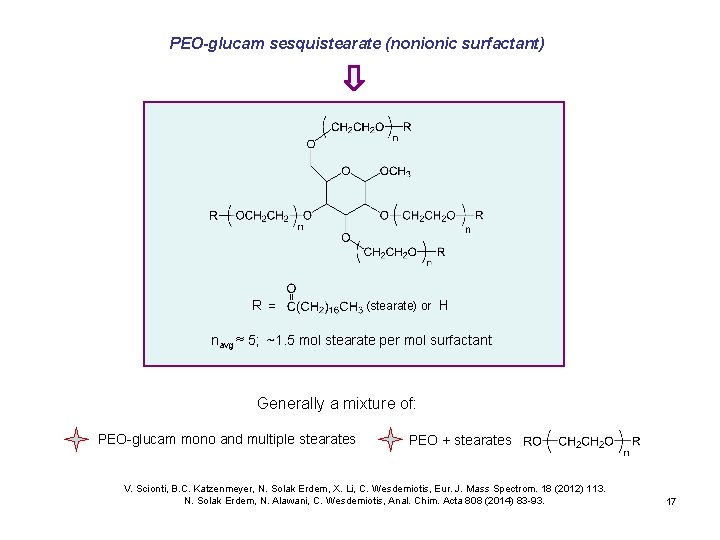
PEO-glucam sesquistearate (nonionic surfactant) R = (stearate) or H navg ≈ 5; ~1. 5 mol stearate per mol surfactant Generally a mixture of: PEO-glucam mono and multiple stearates PEO + stearates V. Scionti, B. C. Katzenmeyer, N. Solak Erdem, X. Li, C. Wesdemiotis, Eur. J. Mass Spectrom. 18 (2012) 113. N. Solak Erdem, N. Alawani, C. Wesdemiotis, Anal. Chim. Acta 808 (2014) 83 -93. 17
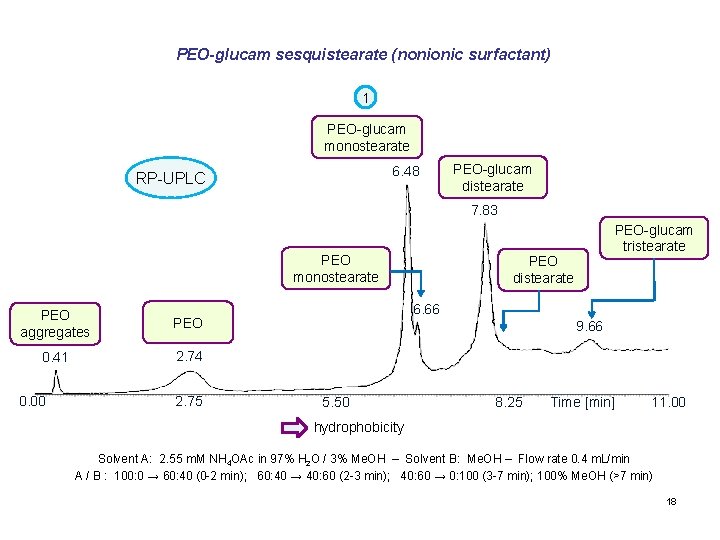
PEO-glucam sesquistearate (nonionic surfactant) 1 PEO-glucam monostearate 6. 48 RP-UPLC PEO-glucam distearate 7. 83 PEO monostearate PEO aggregates PEO 0. 41 2. 74 0. 00 2. 75 PEO-glucam tristearate PEO distearate 6. 66 9. 66 5. 50 8. 25 Time [min] 11. 00 hydrophobicity Solvent A: 2. 55 m. M NH 4 OAc in 97% H 2 O / 3% Me. OH – Solvent B: Me. OH – Flow rate 0. 4 m. L/min A / B : 100: 0 → 60: 40 (0 -2 min); 60: 40 → 40: 60 (2 -3 min); 40: 60 → 0: 100 (3 -7 min); 100% Me. OH (>7 min) 18
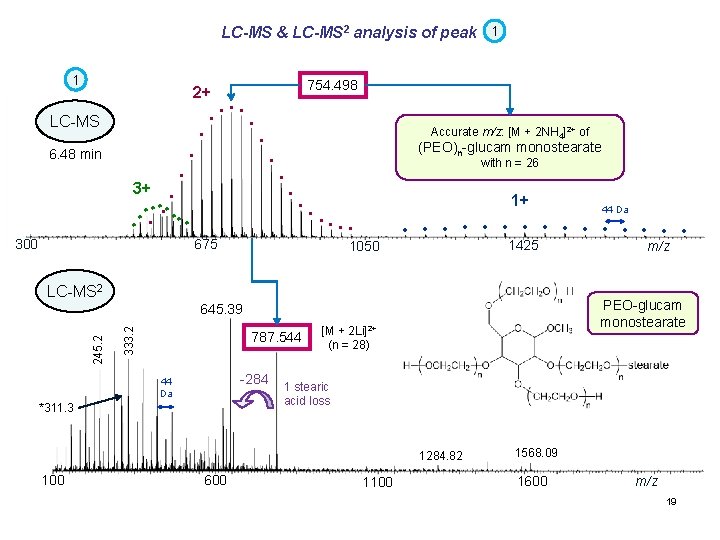
LC-MS & LC-MS 2 analysis of peak 1 1 754. 498 2+ LC-MS 6. 48 min with n = 26 300 (PEO)n-glucam monostearate 3+ Accurate m/z: [M + 2 NH 4]2+ of 1+ 44 Da 675 ✚ ✚ ✚ ✚ 1425 1050 LC-MS 2 245. 2 333. 2 -284 44 Da *311. 3 [M + 2 Li]2+ (n = 28) 600 ✚ ✚ 1100 ✚ m/z 1 stearic acid loss 1284. 82 100 ✚ PEO-glucam monostearate 645. 39 787. 544 ✚ 1568. 09 1600 m/z 19
Faster separation with ion mobility mass spectrometry (IM-MS) 21
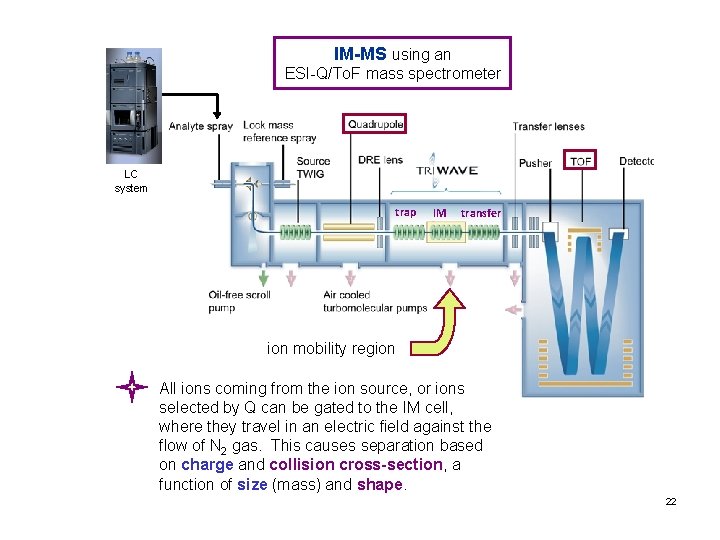
IM-MS using an ESI-Q/To. F mass spectrometer LC system trap IM transfer ion mobility region All ions coming from the ion source, or ions selected by Q can be gated to the IM cell, where they travel in an electric field against the flow of N 2 gas. This causes separation based on charge and collision cross-section, a function of size (mass) and shape. 22
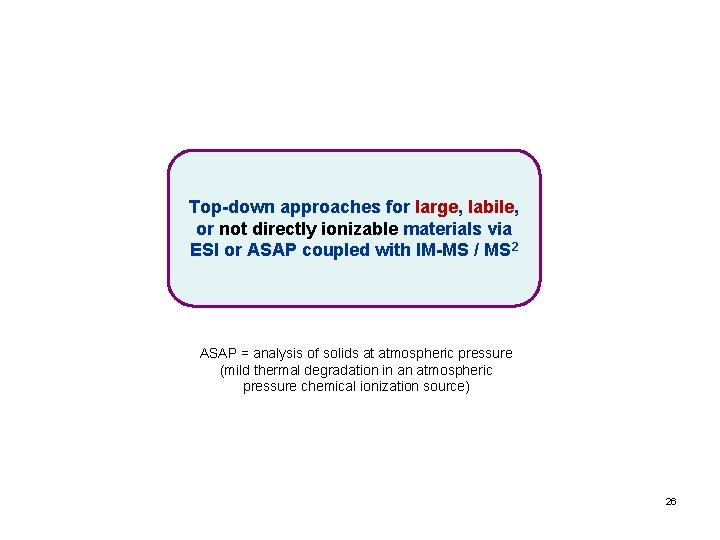
Top-down approaches for large, labile, or not directly ionizable materials via ESI or ASAP coupled with IM-MS / MS 2 ASAP = analysis of solids at atmospheric pressure (mild thermal degradation in an atmospheric pressure chemical ionization source) 26
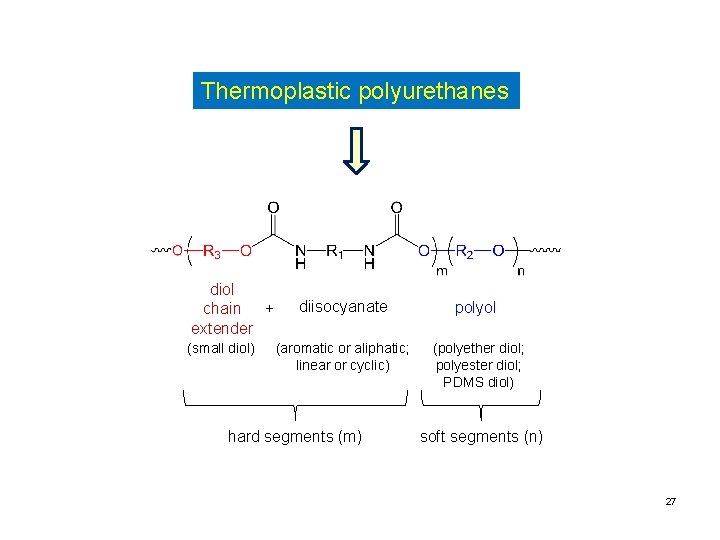
Thermoplastic polyurethanes diol chain + extender (small diol) diisocyanate polyol (aromatic or aliphatic; linear or cyclic) (polyether diol; polyester diol; PDMS diol) hard segments (m) soft segments (n) 27
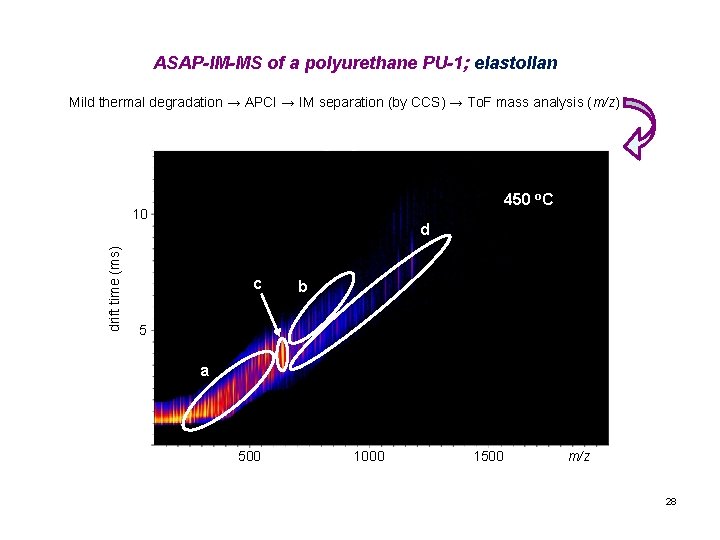
ASAP-IM-MS of a polyurethane PU-1; elastollan Mild thermal degradation → APCI → IM separation (by CCS) → To. F mass analysis (m/z) 450 o. C drift time (ms) 10 d c b 5 a 500 1000 1500 m/z 28
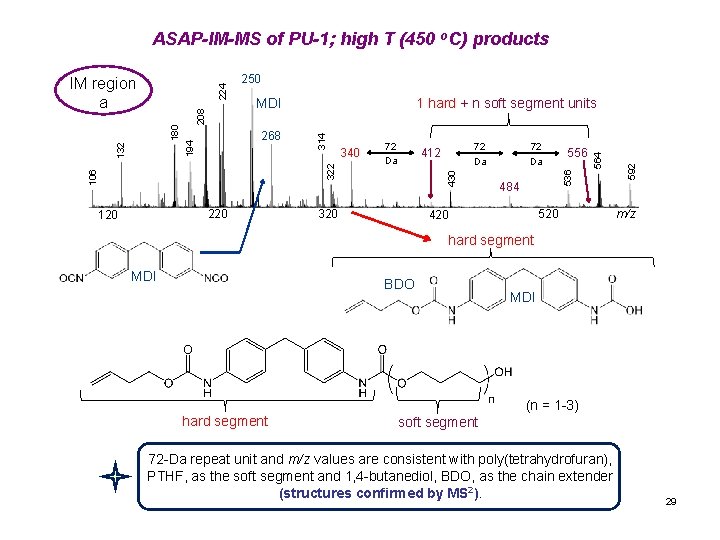
ASAP-IM-MS of PU-1; high T (450 o. C) products 320 72 Da 556 484 520 420 592 72 Da 412 536 72 Da 430 322 106 220 120 340 564 1 hard + n soft segment units MDI 314 208 250 268 194 132 180 224 IM region a m/z hard segment MDI BDO MDI (n = 1 -3) hard segment soft segment 72 -Da repeat unit and m/z values are consistent with poly(tetrahydrofuran), PTHF, as the soft segment and 1, 4 -butanediol, BDO, as the chain extender (structures confirmed by MS 2). 29
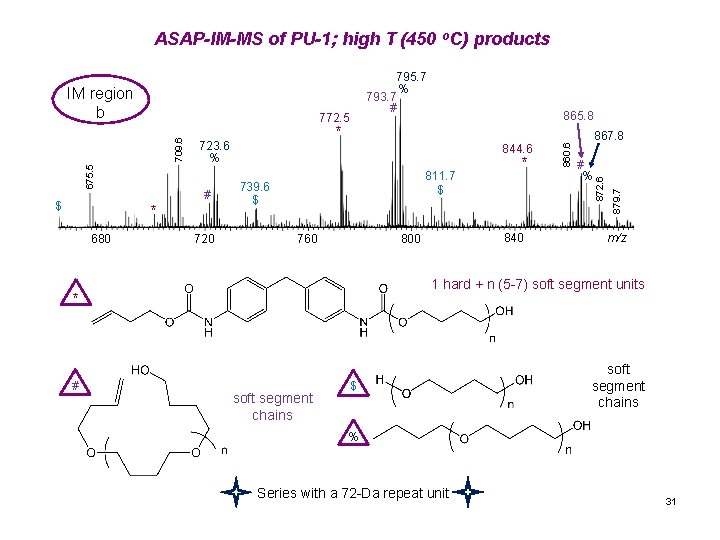
ASAP-IM-MS of PU-1; high T (450 o. C) products 795. 7 % 680 720 844. 6 811. 7 $ 739. 6 $ 760 840 800 # % m/z 1 hard + n (5 -7) soft segment units * # * 867. 8 879. 7 * * 723. 6 % # 865. 8 872. 6 709. 6 772. 5 675. 5 $ 793. 7 # 860. 6 IM region b soft segment chains $ soft segment chains % Series with a 72 -Da repeat unit 31
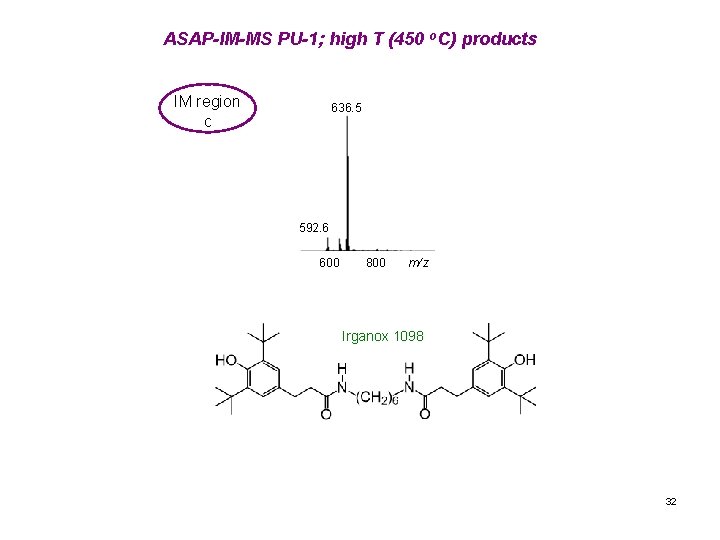
ASAP-IM-MS PU-1; high T (450 o. C) products IM region c 636. 5 592. 6 600 800 m/z Irganox 1098 32
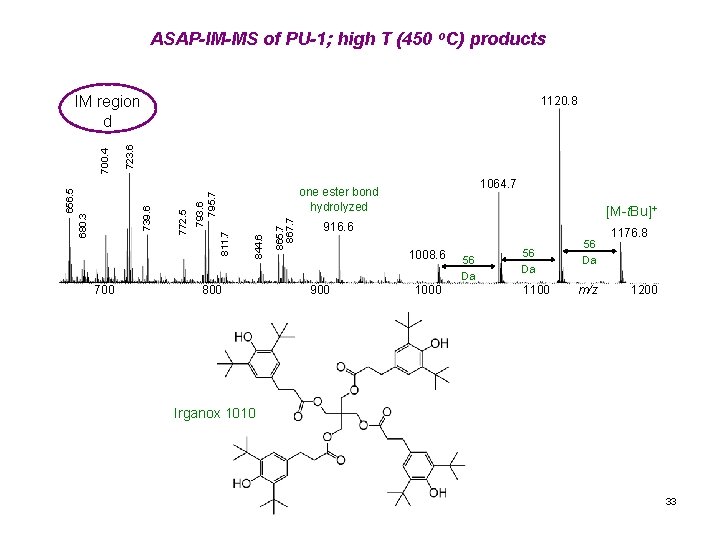
ASAP-IM-MS of PU-1; high T (450 o. C) products 700 1120. 8 1064. 7 844. 6 811. 7 800 865. 7 867. 7 one ester bond hydrolyzed 793. 6 795. 7 772. 5 723. 6 739. 6 656. 5 680. 3 700. 4 IM region d [M-t. Bu]+ 916. 6 1008. 6 900 1000 56 Da 1100 56 Da m/z 1176. 8 1200 Irganox 1010 33
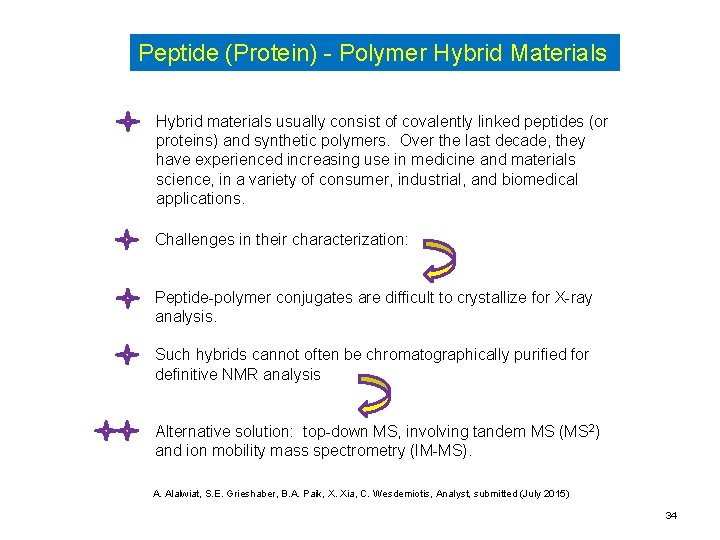
Peptide (Protein) - Polymer Hybrid Materials Hybrid materials usually consist of covalently linked peptides (or proteins) and synthetic polymers. Over the last decade, they have experienced increasing use in medicine and materials science, in a variety of consumer, industrial, and biomedical applications. Challenges in their characterization: Peptide-polymer conjugates are difficult to crystallize for X-ray analysis. Such hybrids cannot often be chromatographically purified for definitive NMR analysis Alternative solution: top-down MS, involving tandem MS (MS 2) and ion mobility mass spectrometry (IM-MS). A. Alalwiat, S. E. Grieshaber, B. A. Paik, X. Xia, C. Wesdemiotis, Analyst, submitted (July 2015) 34
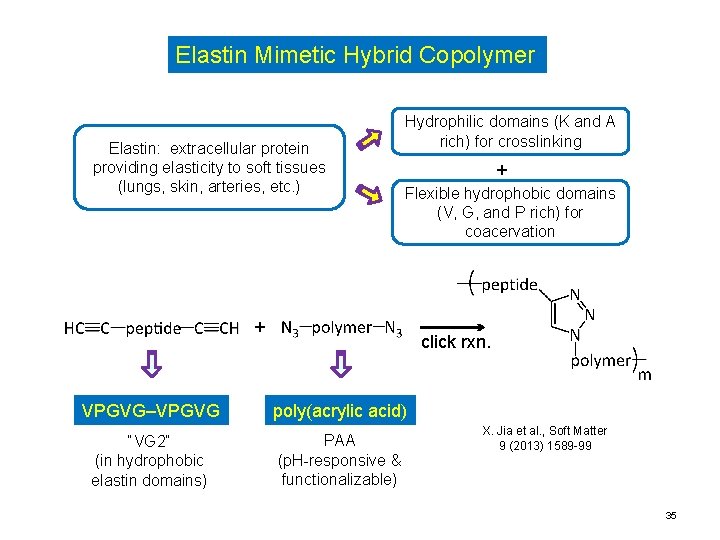
Elastin Mimetic Hybrid Copolymer Elastin: extracellular protein providing elasticity to soft tissues (lungs, skin, arteries, etc. ) Hydrophilic domains (K and A rich) for crosslinking + Flexible hydrophobic domains (V, G, and P rich) for coacervation + click rxn. VPGVG–VPGVG poly(acrylic acid) “VG 2” (in hydrophobic elastin domains) PAA (p. H-responsive & functionalizable) X. Jia et al. , Soft Matter 9 (2013) 1589 -99 35
Hybrid material [PAA‒VG 2]m + Pt. BA VG 2 Cu(I) DMF TFA [Pt. BA‒VG 2]m [PAA‒VG 2]m 36
Hybrid material / [PAA‒VG 2]m m/z 3000 PAA–VG 2 ESI-IM-MS 2000 NH 4 OAc (p. H = 6. 64) + 1% Me. OH 3+ 2+ 1000 PAA (n+) PAA–Pt. BA–VG 2 (n+) 2 4 6 8 drift time (ms) IM-MS removes chemical noise and separates the desired amphiphilic hybrid both by charge state as well as from incompletely hydrolyzed hybrid and unreacted polymer to enable conclusive compositional characterization. 38
Hybrid material / [PAA‒VG 2]m ESI-IM-MS 1000 1100 1354. 21 1050 1318. 18 1246. 14 1210. 14 1200 1282. 14 1040 1030 1174. 12 1138. 10 1102. 07 1066. 07 1030. 06 994. 03 958. 02 922. 00 895. 97 1066. 07 1030. 06 2+ 900 PAA 11 PAA 10 1060 1070 m/z [M+2 H]2+ m/z ESI-IM-MS provides conclusive evidence for the formation of hybrid material with one constituent PAA–VG 2 block, [PAA–VG 2]1: Multiple blocks? 40
Hybrid material / [PAA‒VG 2]m [PAA 10‒VG 2]1 m/z 1030 [M+2 H]2+ ESI-IM-MS 5. 42 [PAA 10‒VG 2]2 6. 95 [M+4 H]4+ [PAA 10+K]+ & [PAA 24+Na+K]2+ 3. 88 IM-MS on mass-selected ions confirms the formation of a multiblock hybrid copolymer. 0. 00 2. 50 5. 00 7. 50 10. 00 [PAA 12‒VG 2]1 m/z 1102 [M+2 H]2+ 5. 96 [PAA 12‒VG 2]2 [M+4 H]4+ drift time (ms) 4. 06 7. 13 [PAA 11+K]+ & [PAA 26+Na+K]2+ 0. 00 2. 50 5. 00 7. 50 10. 00 drift time (ms) 41
Hybrid material / [PAA‒VG 2]m Architecture? linear ? intramolecular azide click rxn. cyclic ? 42
Hybrid material / [Pt. BAn‒VG 2]1 Architecture ESI-IM-MS 10 510 Collision cross-section (Å2) 2+ ions 490 8 470 450 430 410 calcd. , linear architecture 7 6 calcd. , cyclic architecture calcd. , n= measured 4 390 Power(calcd. , linear architecture) 370 Power(calcd. , cyclic architecture) 350 900 1000 1100 1200 1300 m/z With all chain lengths, the measured CCS matches the one calculated for the macrocyclic architecture, indicating that all possible 3+2 cycloadditions have taken place (only triazole and no azide / alkyne functionalities). 43
Multidimensional MS [interfaced separation & mass analysis methodologies] in polymer and materials science Information about polymer architecture and sequence from MS 2 studies. Interactive LC is particularly useful for the separation of mixtures whose components differ significantly in polarity. On the other hand, IM separation is most effective for the separation of differently shaped polymers and ideally suitable for the analysis of labile/reactive/ weakly bound polymers (e. g. , hybrid materials & supramolecular polymers). Slow thermal degradation interfaced with IM-MS leads to composition and structure insight on complex polymers that cannot be desorbed/ionized and are difficult to analyze otherwise. Top-down MS with IM-MS and MS 2 removes the need of high purity for structural characterization (as needed in XRD and NMR). Collision cross-sections add a further dimension of structural differentiation & identification. Significant improvement in the microstructure characterization of synthetic macromolecules. 46
Acknowledgements Dr. Nilufer Erdem (Tubitak, Turkey) Dr. Bryan Katzenmeyer (Valspar) Dr. Aleer M. Yol (FDA) Dr. Nadrah Alawani (Aramco) Dr. Xiaopeng Li (Texas State U) Ahlam Alalwiat Lydia Cool Selim Gerislioglu Quirk - Cheng - Newkome Pugh - Foster - Puskas - Jana Weiss research groups NSF OBR The University of Akron Go. Jo Lubrizol Goodyear Omnova Solutions Foundation Dr. Xinqiao Jia (U Delaware) Dr. Sarah Grieshaber (U Delaware) Bradford Paik (U Delaware) 47