
Multidimensional Clustering Analysis Ex Cluster on Information features
- Slides: 23
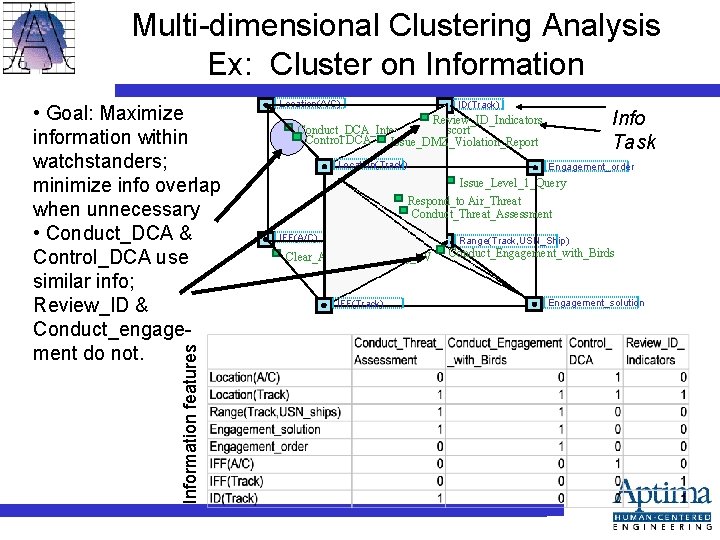
Multi-dimensional Clustering Analysis Ex: Cluster on Information features • Goal: Maximize information within watchstanders; minimize info overlap when unnecessary • Conduct_DCA & Control_DCA use similar info; Review_ID & Conduct_engagement do not. Location(A/C) ID(Track) Info Task Review_ID_Indicators Conduct_DCA_Intercept_&_Escort Control DCA Issue_DMZ_Violation_Report Location(Track) Engagement_order Issue_Level_1_Query Respond_to Air_Threat Conduct_Threat_Assessment IFF(A/C) Range(Track, USN_Ship) Clear_Aircraft_Departing_CV IFF(Track) Conduct_Engagement_with_Birds Engagement_solution
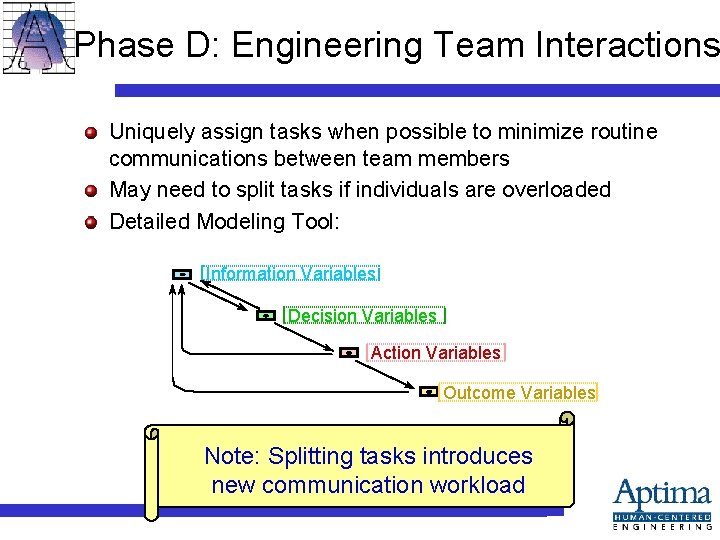
Phase D: Engineering Team Interactions Uniquely assign tasks when possible to minimize routine communications between team members May need to split tasks if individuals are overloaded Detailed Modeling Tool: Information Variables Decision Variables Action Variables Outcome Variables Note: Splitting tasks introduces new communication workload
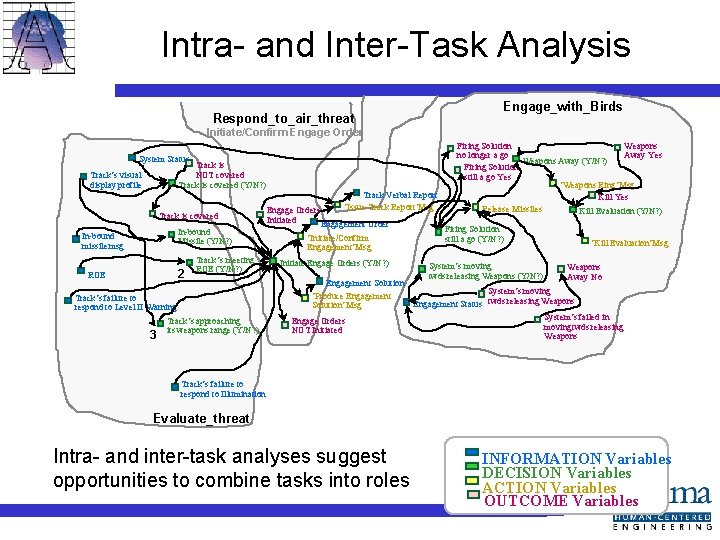
Intra- and Inter-Task Analysis Engage_with_Birds Respond_to_air_threat Initiate/Confirm Engage Order System Status Track is NOT covered Track is covered (Y/N? ) Track’s visual display profile Track is covered In-bound Missile (Y/N? ) In-bound missile msg 2 ROE Track’s meeting ROE (Y/N? ) Track’s failure to respond to Level II Warning 3 Track’s approaching its weapons range (Y/N? ) Track Verbal Report ‘Issue Track Report’Msg Engage Orders Initiated Engagement Order ‘Initiate/Confirm Engagement’Msg Initiate Engage Orders (Y/N? ) Engagement Solution ‘Produce Engagement Solution’Msg Engage Orders NOT Initiated Firing Solution Weapons no longer a go Away Yes Weapons Away (Y/N? ) Firing Solution still a go Yes ‘Weapons Ring’Msg Kill Yes Release Missiles Kill Evaluation (Y/N? ) Firing Solution still a go (Y/N? ) System’s moving twds releasing Weapons (Y/N? ) ‘Kill Evaluation’Msg Weapons Away No System’s moving Engagement Status twds releasing Weapons System’s failed in movingtwds releasing Weapons Track’s failure to respond to Illumination Evaluate_threat Intra- and inter-task analyses suggest opportunities to combine tasks into roles INFORMATION Variables DECISION Variables ACTIONOUTCOME Variables
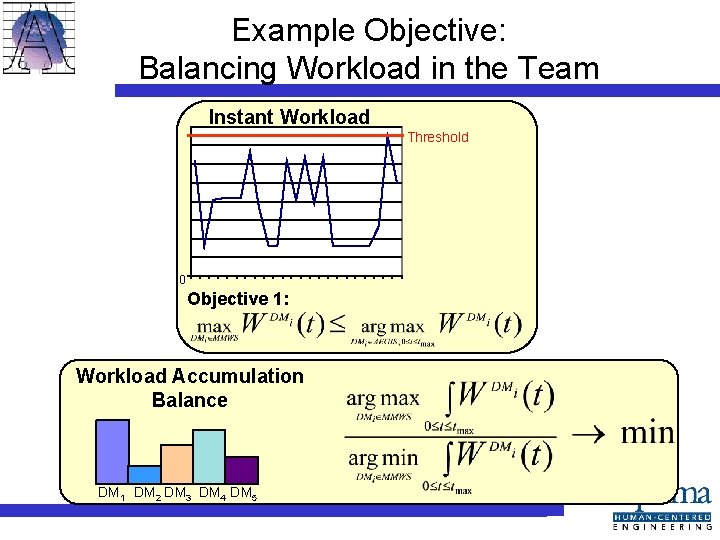
Example Objective: Balancing Workload in the Team Instant Workload Threshold 0 Objective 1: Workload Accumulation Balance DM 1 DM 2 DM 3 DM 4 DM 5
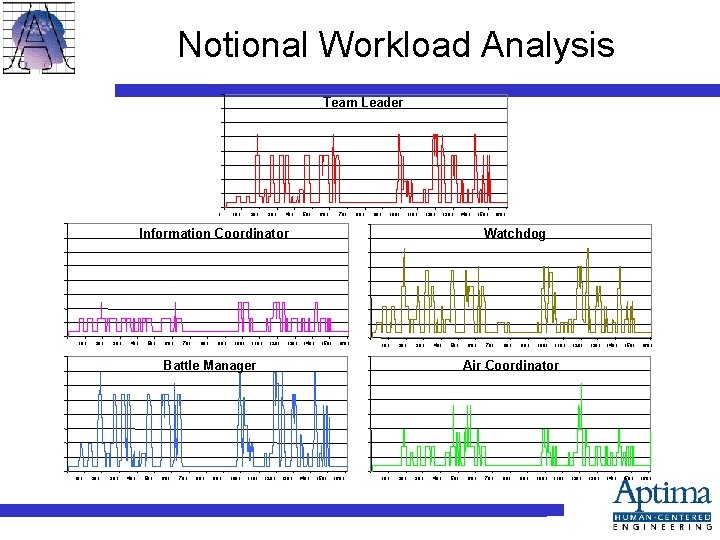
Notional Workload Analysis Team Leader 1 101 201 301 401 501 601 701 801 901 1001 1101 1201 1301 1401 Information Coordinator 101 201 301 401 501 601 701 801 901 1001 1101 1201 1301 201 301 401 501 601 701 801 901 1001 1101 1601 Watchdog 1401 1501 1601 101 201 301 401 501 Battle Manager 101 1501 601 701 801 901 1001 1101 1201 1301 1401 1501 1601 Air -Coordinator 1201 1301 1401 1501 1601 101 201 301 401 501 601 701 801 901 1001 1101 1201 1301
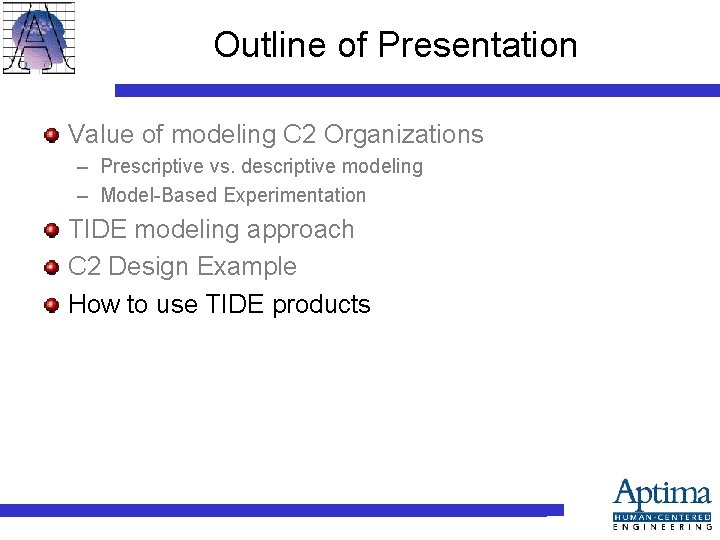
Outline of Presentation Value of modeling C 2 Organizations – Prescriptive vs. descriptive modeling – Model-Based Experimentation TIDE modeling approach C 2 Design Example: AWACS How to use TIDE products
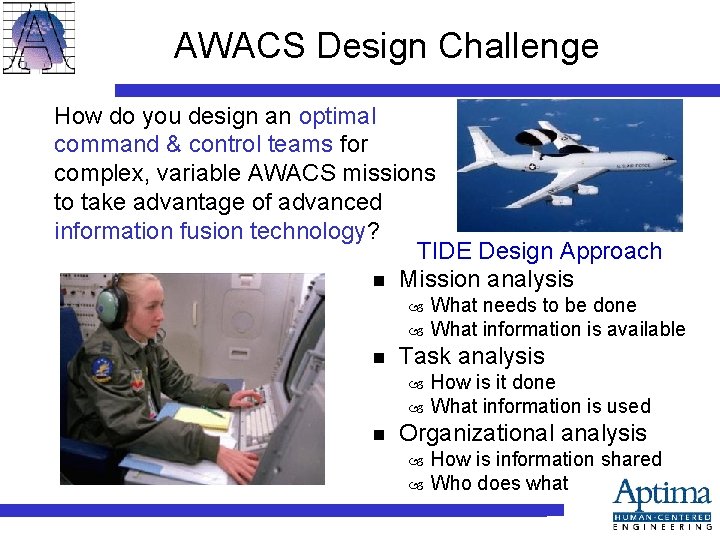
AWACS Design Challenge How do you design an optimal command & control teams for complex, variable AWACS missions to take advantage of advanced information fusion technology? TIDE Design Approach n Mission analysis n Task analysis n What needs to be done What information is available How is it done What information is used Organizational analysis How is information shared Who does what
Example: AWACS Crew Optimization Human-Centered Re-Engineering of AWACS Command Control Teams (REAC 2 T) – Phase III SBIR Project funded by AWACS System Program Office ESC, Hanscom AFB Demonstrate proven, scientific approach to C 2 team design in AWACS domain – Team Integrated Design Environment (TIDE) Present ACC/Wing with proof-of-concept for crew optimization – Evaluate impact of information fusion on mission performance and operator functions – Introduce optimized team structures to enhance mission performance
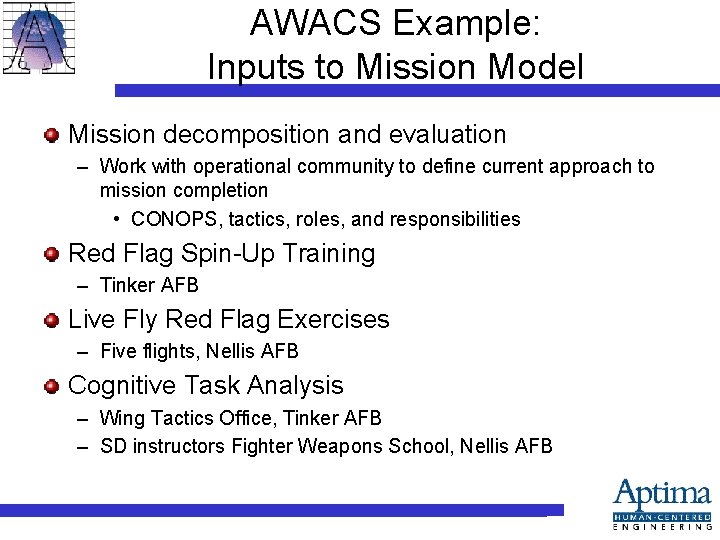
AWACS Example: Inputs to Mission Model Mission decomposition and evaluation – Work with operational community to define current approach to mission completion • CONOPS, tactics, roles, and responsibilities Red Flag Spin-Up Training – Tinker AFB Live Fly Red Flag Exercises – Five flights, Nellis AFB Cognitive Task Analysis – Wing Tactics Office, Tinker AFB – SD instructors Fighter Weapons School, Nellis AFB
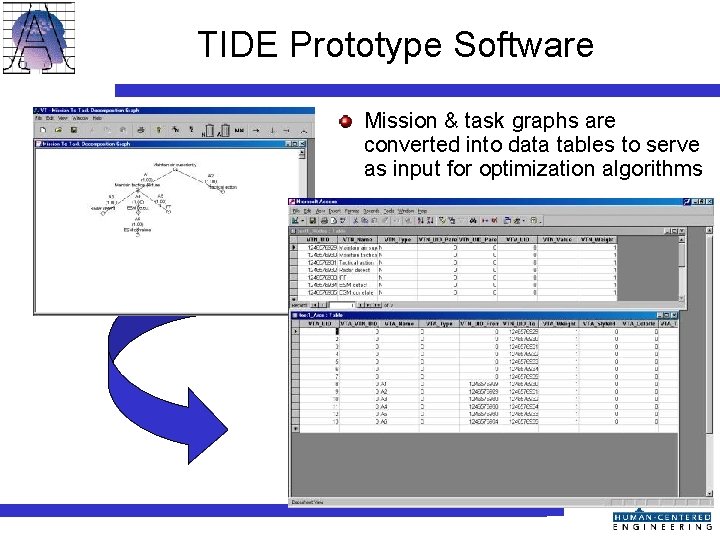
TIDE Prototype Software Mission & task graphs are converted into data tables to serve as input for optimization algorithms
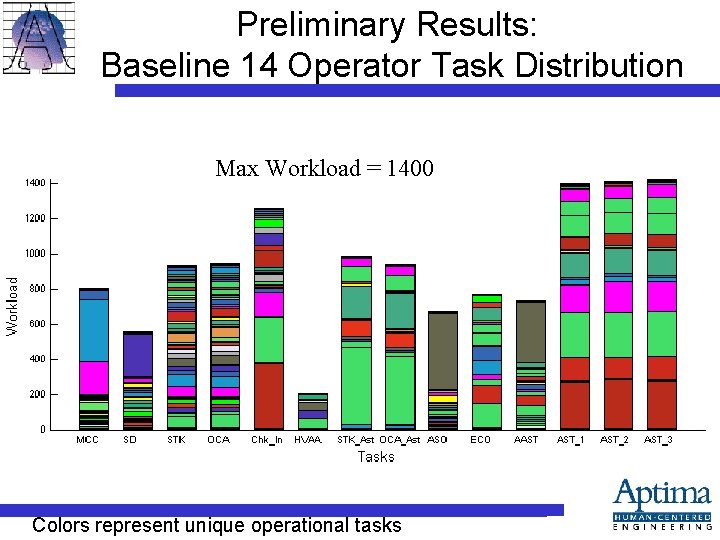
Preliminary Results: Baseline 14 Operator Task Distribution Max Workload = 1400 Colors represent unique operational tasks
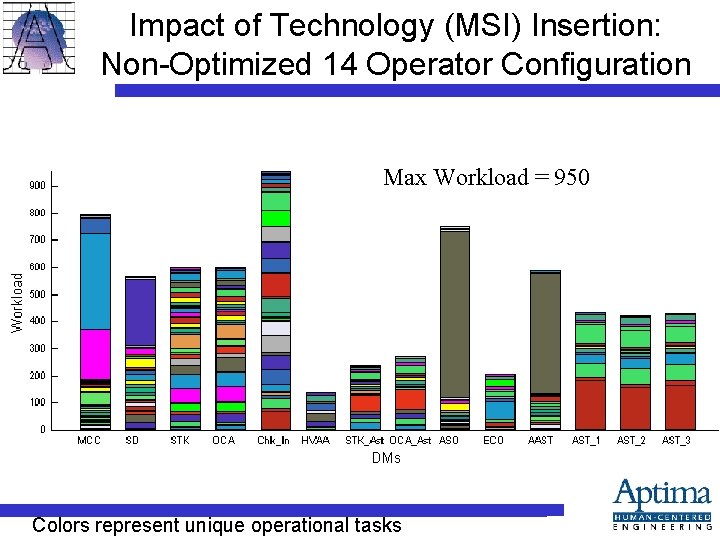
Impact of Technology (MSI) Insertion: Non-Optimized 14 Operator Configuration Max Workload = 950 Colors represent unique operational tasks
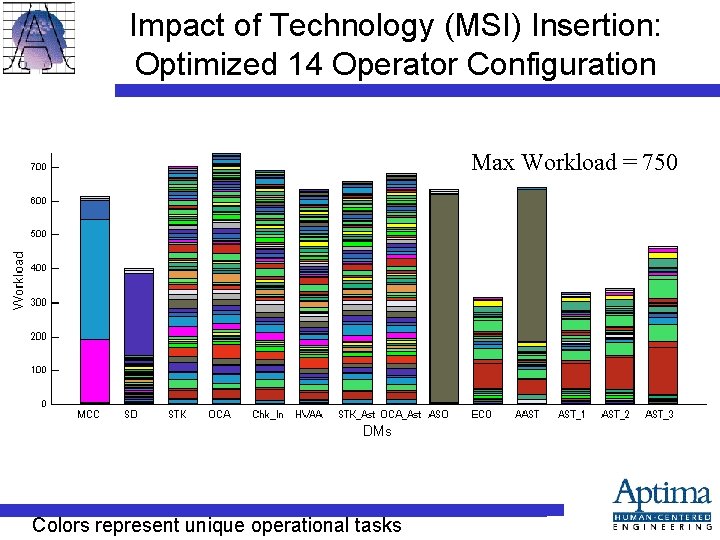
Impact of Technology (MSI) Insertion: Optimized 14 Operator Configuration Max Workload = 750 Colors represent unique operational tasks
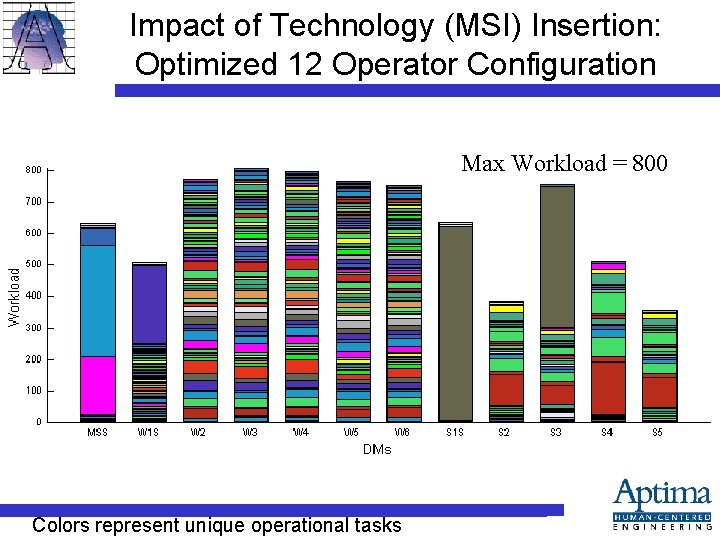
Impact of Technology (MSI) Insertion: Optimized 12 Operator Configuration Max Workload = 800 Colors represent unique operational tasks
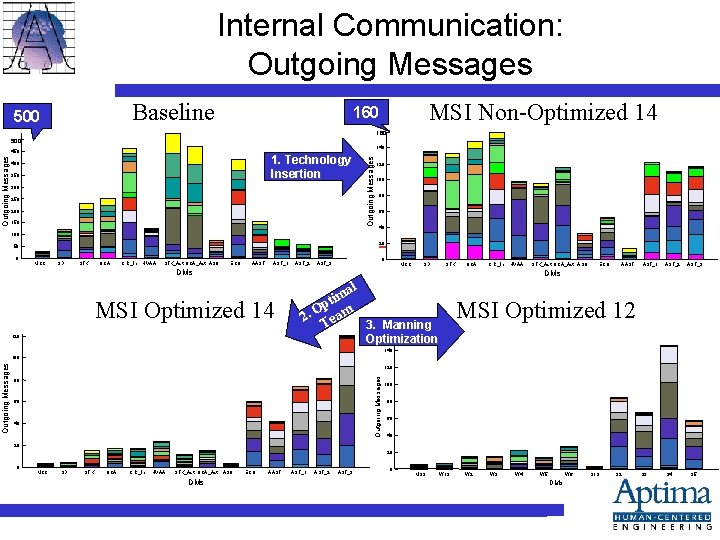
Internal Communication: Outgoing Messages Baseline 500 MSI Non-Optimized 14 160 500 Outgoing Messages 1. Technology Insertion 400 350 300 250 200 150 Outgoing Messages 140 450 120 100 80 60 40 100 20 50 0 MCC SD STK OCA Chk_In HVAA STK_Ast OCA_Ast ASO ECO AAST AST_1 AST_2 0 AST_3 MCC SD STK OCA Chk_In HVAA DMs STK_Ast OCA_Ast ASO ECO AAST AST_1 AST_2 AST_3 DMs MSI Optimized 14 al m i t Op am. 2 Te 3. Manning MSI Optimized 12 Optimization 120 140 120 Outgoing Messages 100 80 60 40 20 20 0 MCC SD STK OCA Chk_In HVAA STK_Ast OCA_Ast ASO DMs ECO AAST AST_1 AST_2 AST_3 0 MSS W 1 S W 2 W 3 W 4 W 5 W 6 DMs S 1 S S 2 S 3 S 4 S 5
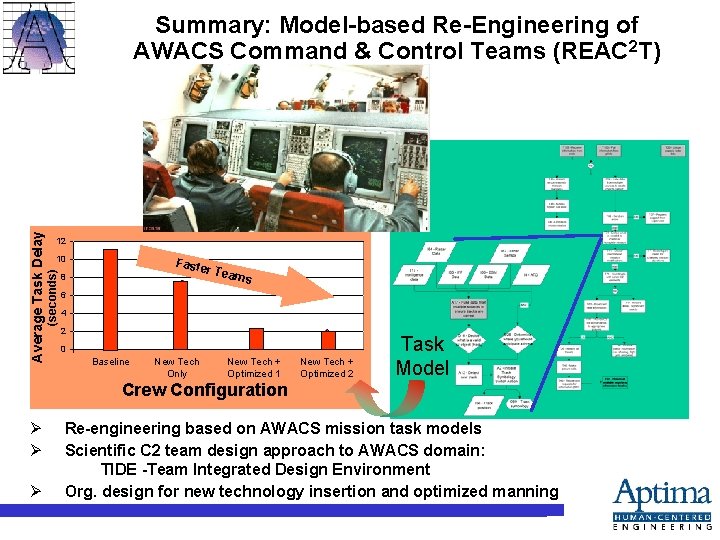
12 10 (seconds) Average Task Delay Summary: Model-based Re-Engineering of AWACS Command & Control Teams (REAC 2 T) Faste r Tea 8 ms 6 4 2 0 Baseline New Tech Only New Tech + Optimized 1 New Tech + Optimized 2 Task Model Crew Configuration Ø Ø Ø Re-engineering based on AWACS mission task models Scientific C 2 team design approach to AWACS domain: TIDE -Team Integrated Design Environment Org. design for new technology insertion and optimized manning
Outline of Presentation Value of modeling C 2 Organizations – Prescriptive vs. descriptive modeling – Model-Based Experimentation TIDE modeling approach C 2 Design Example How to use TIDE products
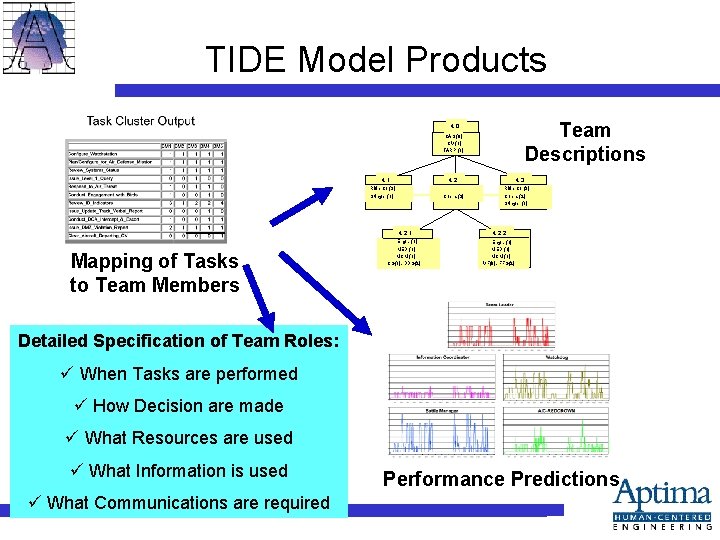
TIDE Model Products Team Descriptions 4. 0 CAS (8) CV (1) TARP (1) 4. 1 4. 2 Rifle Co (3) Stinger (1) Mapping of Tasks to Team Members Cobra (2) 4. 3 Rifle Co (3) Cobra (2) Stinger (1) 4. 2. 1 4. 2. 2 Eng. (1) MED (1) MCM (1) CG(1), DDG(2) Eng. (1) MED (1) MCM (1) VF(8), FFG(2) Detailed Specification of Team Roles: ü When Tasks are performed ü How Decision are made ü What Resources are used ü What Information is used ü What Communications are required Performance Predictions
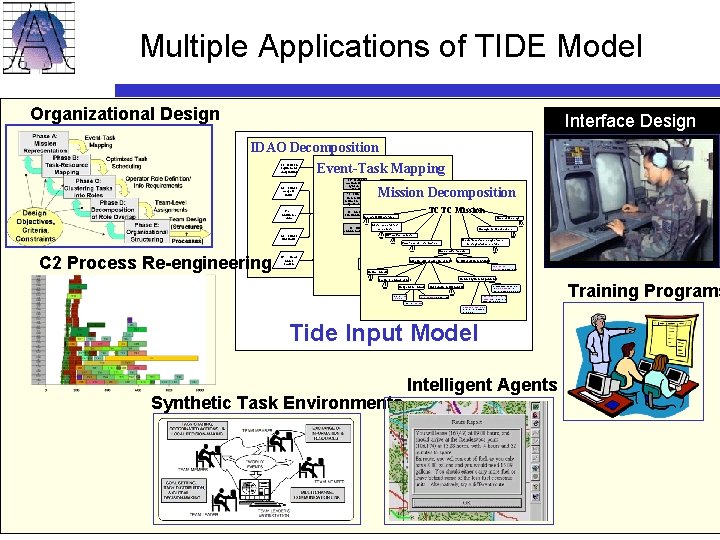
Multiple Applications of TIDE Model Organizational Design Interface Design IDAO Decomposition I 19 - Mission requirements and priorities Event-Task Mapping A 22 - Monitor the T 36 - Maintain air picture accurate track / symbology correlation I 49 - Fighter weapons status I 17 Intelligence data I 41 - Fighter fuel status C 2 Process Re-engineering I 51 - Threat/ target location T 19 - Fuse data from multiple sources to locate objects (detect) AND T 95 - Monitor airspace Mission Task Decomposition T 42 - Make picture calls D 4 - Decide how to T 22 use - Interpret / available air Filter information Operate MCS systems and ground T 86 - Provide resources target location Surveillance/detect T 20 - Utilize air objects organic radar data OR AND ID/track air objects A 31 - Target the threat O 14 - Commit pair fighters T 43 - Respond to requests for information (RFI) T 24 - Provide all available amplifying information (tracks) Define Threats TCTC Mission Record keeping Manage ATO execution T 102 - Receive Pass/receive information from pilots Create/maintain recognizable & integrated air picture Respond to threats T 56 Airborne - Receive(C 2 of airborne assets) mission effectiveness / BDA Decide to engage or not T 47 - Distribute mission status Respond to Threats Identify Threat Locations ATSO (self preservation) ASK FOR INPUT to ATSO (self-preservation) Monitor system for jamming Respond to pop -up targets Analyze system resources to locate jammers while Monitoring system for jamming Execute electronic counter measures while Monitoring system for jamming Direct weapons to target/threat Identify Threat type Broadcast jammer location while Monitoring system for jamming Time on Target (To. T) Tide Input Model Synthetic Task Environments Intelligent Agents Training Programs
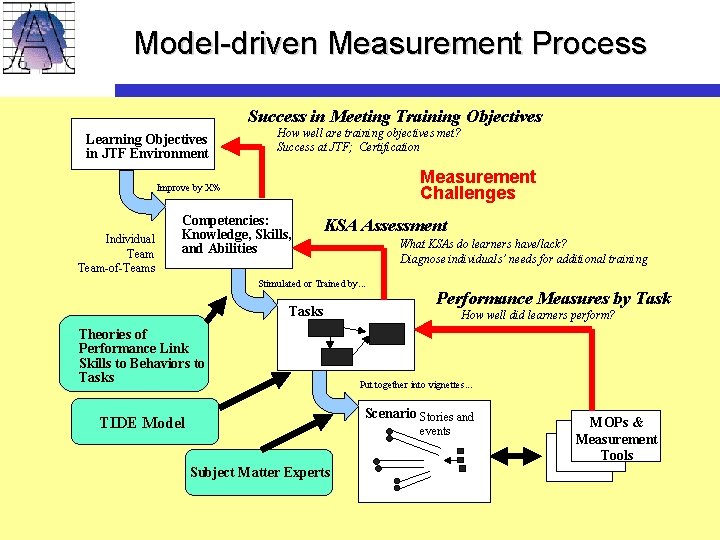
Model-driven Measurement Process Success in Meeting Training Objectives Learning Objectives in JTF Environment How well are training objectives met? Success at JTF; Certification Measurement Challenges Improve by X% Individual Team-of-Teams Competencies: Knowledge, Skills, and Abilities KSA Assessment What KSAs do learners have/lack? Diagnose individuals’ needs for additional training Stimulated or Trained by. . . Tasks Theories of Performance Link Skills to Behaviors to Tasks Performance Measures by Task How well did learners perform? Put together into vignettes. . . Scenario Stories and TIDE Model events Subject Matter Experts MOPs & Measurement Tools
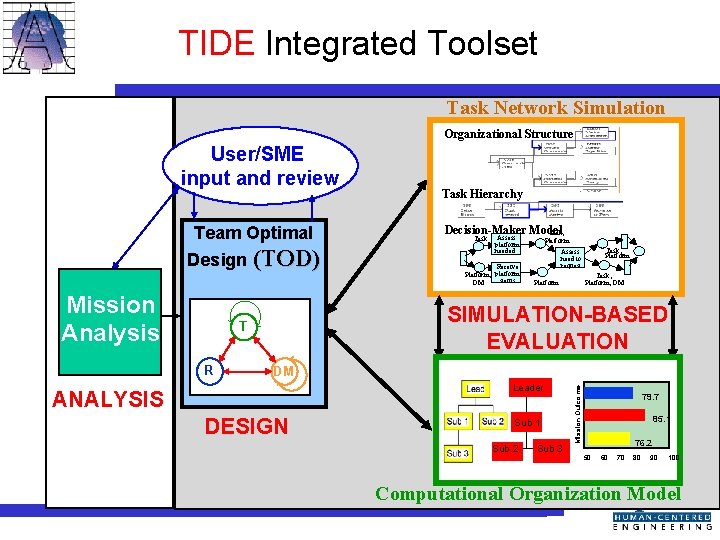
TIDE Integrated Toolset Task Network Simulation Organizational Structure User/SME input and review Team Optimal Design (TOD) Task Assess platform needed Receive Platform, platform status DM Platform Task, Platform Assess need to request Task, Platform, DM Platform SIMULATION-BASED EVALUATION T R Decision-Maker Model Task, DM Leader ANALYSIS DESIGN Sub 1 Sub 2 Sub 3 Mission Outcome Mission Analysis Task Hierarchy 79. 7 85. 1 76. 2 50 60 70 80 90 100 Computational Organization Model
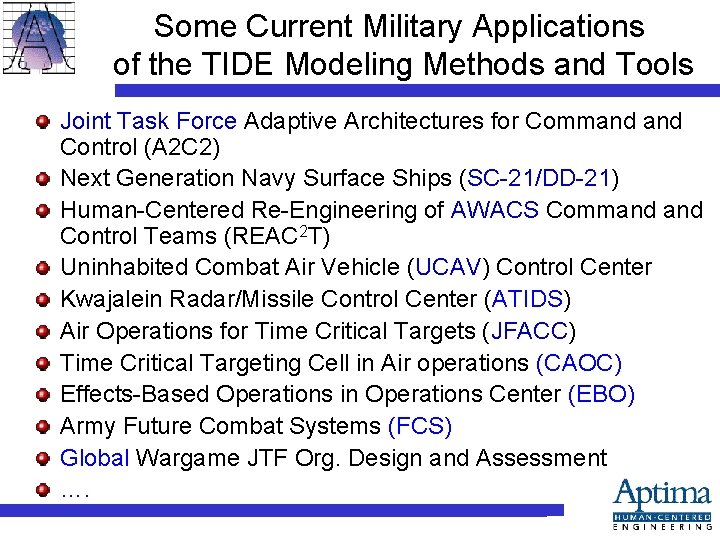
Some Current Military Applications of the TIDE Modeling Methods and Tools Joint Task Force Adaptive Architectures for Command Control (A 2 C 2) Next Generation Navy Surface Ships (SC-21/DD-21) Human-Centered Re-Engineering of AWACS Command Control Teams (REAC 2 T) Uninhabited Combat Air Vehicle (UCAV) Control Center Kwajalein Radar/Missile Control Center (ATIDS) Air Operations for Time Critical Targets (JFACC) Time Critical Targeting Cell in Air operations (CAOC) Effects-Based Operations in Operations Center (EBO) Army Future Combat Systems (FCS) Global Wargame JTF Org. Design and Assessment ….
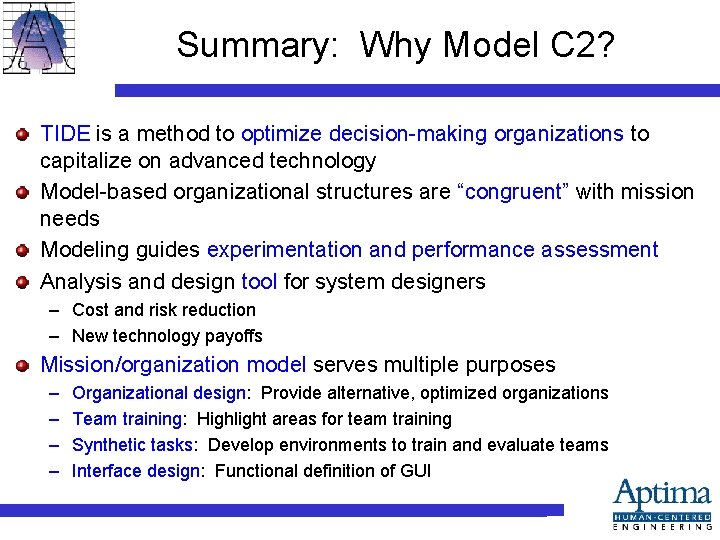
Summary: Why Model C 2? TIDE is a method to optimize decision-making organizations to capitalize on advanced technology Model-based organizational structures are “congruent” with mission needs Modeling guides experimentation and performance assessment Analysis and design tool for system designers – Cost and risk reduction – New technology payoffs Mission/organization model serves multiple purposes – – Organizational design: Provide alternative, optimized organizations Team training: Highlight areas for team training Synthetic tasks: Develop environments to train and evaluate teams Interface design: Functional definition of GUI