
Multicultural Project Native Americans By Crystal Riches Origination
Multicultural Project Native Americans By: Crystal Riches
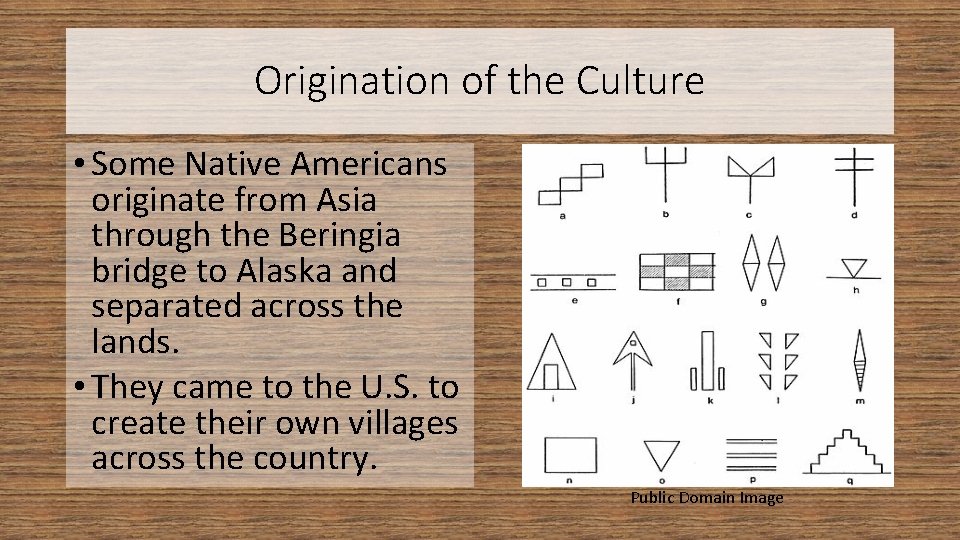
Origination of the Culture • Some Native Americans originate from Asia through the Beringia bridge to Alaska and separated across the lands. • They came to the U. S. to create their own villages across the country. Public Domain Image
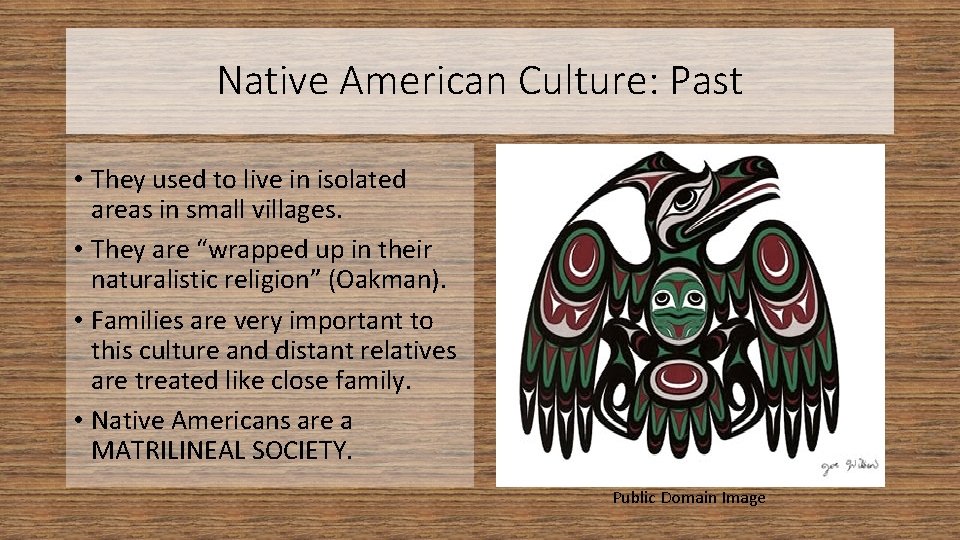
Native American Culture: Past • They used to live in isolated areas in small villages. • They are “wrapped up in their naturalistic religion” (Oakman). • Families are very important to this culture and distant relatives are treated like close family. • Native Americans are a MATRILINEAL SOCIETY. Public Domain Image
Native American Culture: Past (contd) • Utah Tribes: a. Ute b. Paiute c. Goshute d. Shoshone e. Navajo f. Cherokee g. Iroquois • There are many different tribes around North America. • Most Native Americans were very focused on artwork and it varied based upon which tribe you belonged to. • They had quite gender separate roles in the family. • They came to Utah due to a gradual separation of tribes and settled in what now is called Utah.
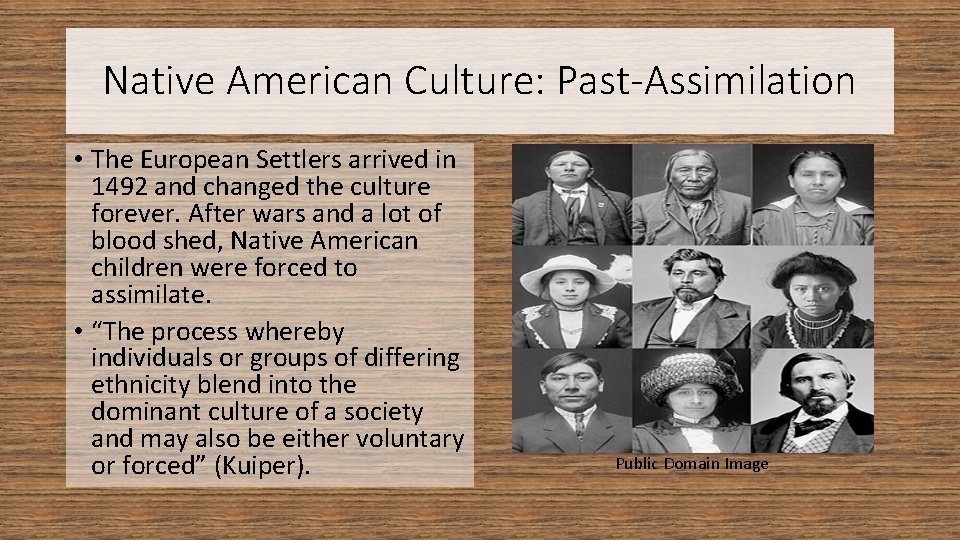
Native American Culture: Past-Assimilation • The European Settlers arrived in 1492 and changed the culture forever. After wars and a lot of blood shed, Native American children were forced to assimilate. • “The process whereby individuals or groups of differing ethnicity blend into the dominant culture of a society and may also be either voluntary or forced” (Kuiper). Public Domain Image
Types of Houses: Past versus Present Past • • • Wigwam Igloo Teepee Long house Grass House • • • Chickees Adobe Earthen House Plank house Brush House Past • Reservations in the South Western United States • Log homes around the country • Regular homes around the country Most Native Americans no longer live a lifestyle close to their ancestors partly due to assimilation, but also due to the increase of technology, population and other reasons.
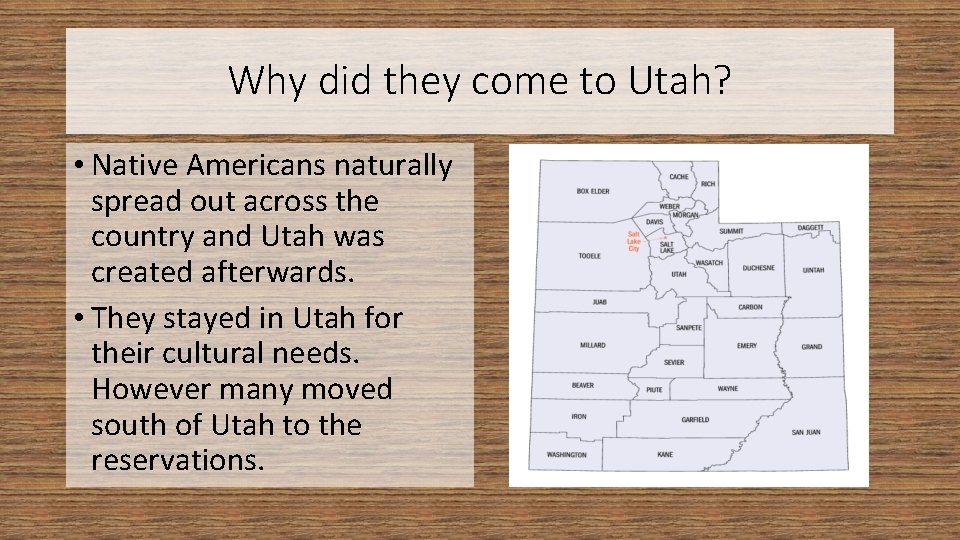
Why did they come to Utah? • Native Americans naturally spread out across the country and Utah was created afterwards. • They stayed in Utah for their cultural needs. However many moved south of Utah to the reservations.
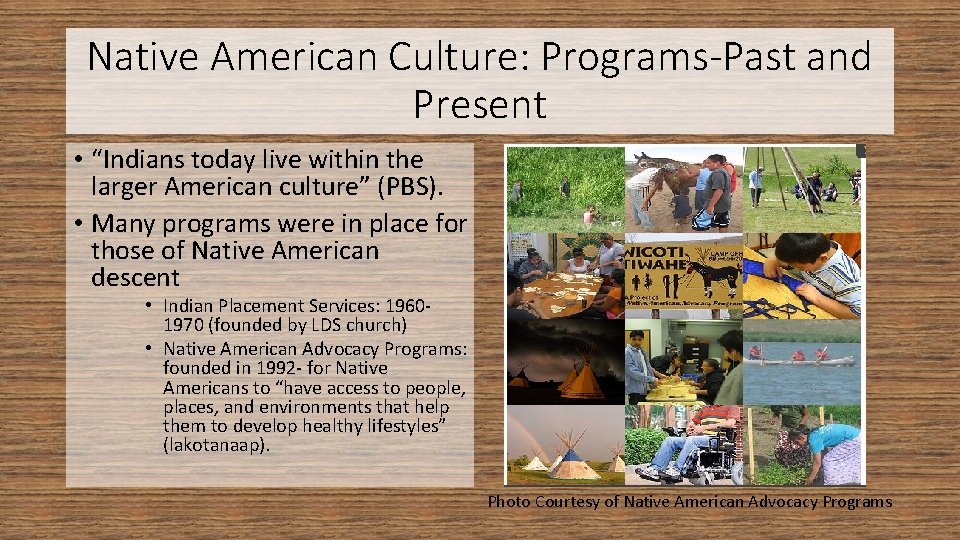
Native American Culture: Programs-Past and Present • “Indians today live within the larger American culture” (PBS). • Many programs were in place for those of Native American descent • Indian Placement Services: 19601970 (founded by LDS church) • Native American Advocacy Programs: founded in 1992 - for Native Americans to “have access to people, places, and environments that help them to develop healthy lifestyles” (lakotanaap). Photo Courtesy of Native American Advocacy Programs
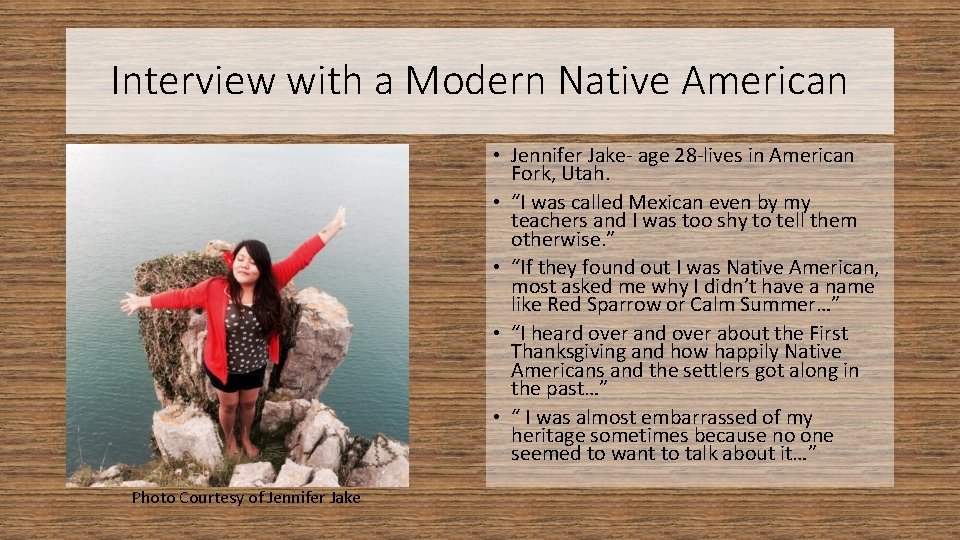
Interview with a Modern Native American • Jennifer Jake- age 28 -lives in American Fork, Utah. • “I was called Mexican even by my teachers and I was too shy to tell them otherwise. ” • “If they found out I was Native American, most asked me why I didn’t have a name like Red Sparrow or Calm Summer…” • “I heard over and over about the First Thanksgiving and how happily Native Americans and the settlers got along in the past…” • “ I was almost embarrassed of my heritage sometimes because no one seemed to want to talk about it…” Photo Courtesy of Jennifer Jake
Interview with Modern Native American Photo Courtesy of Jennifer Jake “If I could change anything from my education it would be the sugar coated history of the Native Americans…” “I want to be able to represent my heritage with pride. I want others to be proud too. ” “I would want people to ask me what I know and what I have learned about my ancestors…” “I would tell the teachers to get to know ALL of the students before making judgements. Get to know what they need in the classroom to succeed. ”
How to Approach Native Americans in the Classroom • Cultural Norms • Taught that schools teach a sugar coated version of history regarding their culture • Males have a dominant role • They try and keep their past language alive • Most currently come from poverty stricken homes • Most come from abusive families • Most have some sort of affiliation with drugs or alcohol. • Classroom Ideas • Teach as true to the history as possible. • Allow the students to represent their culture in the way they choose • Allow some control in the classroom with their learning • Allow time for the learning to happen, similar to those from poverty-stricken homes. • Provide ample amounts of praise for their work.
Lesson Plan to teach others about Native American Cultures • STANDARD 1: Students will understand cultural factors that shape a community. • OBJECTIVE: Explain how selected indigenous cultures of the Americas have changed over time. • REZBIZ_0707_Rev. pdf • Navajos_on_a_donkey. jpeg • Navajo_Woman_Weaving_a_Rug. j pg • Intermountain_Indian_School__Brigham_City. jpg
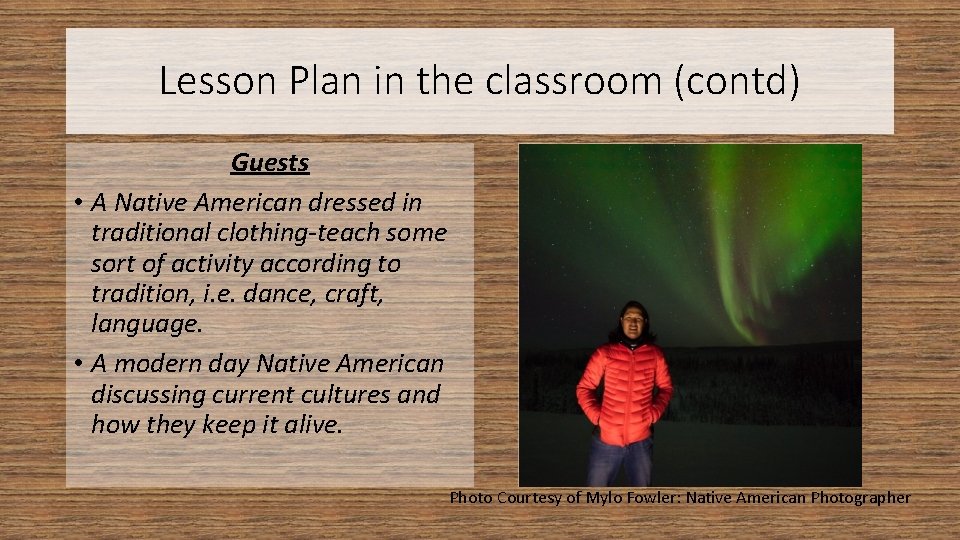
Lesson Plan in the classroom (contd) Guests • A Native American dressed in traditional clothing-teach some sort of activity according to tradition, i. e. dance, craft, language. • A modern day Native American discussing current cultures and how they keep it alive. Photo Courtesy of Mylo Fowler: Native American Photographer
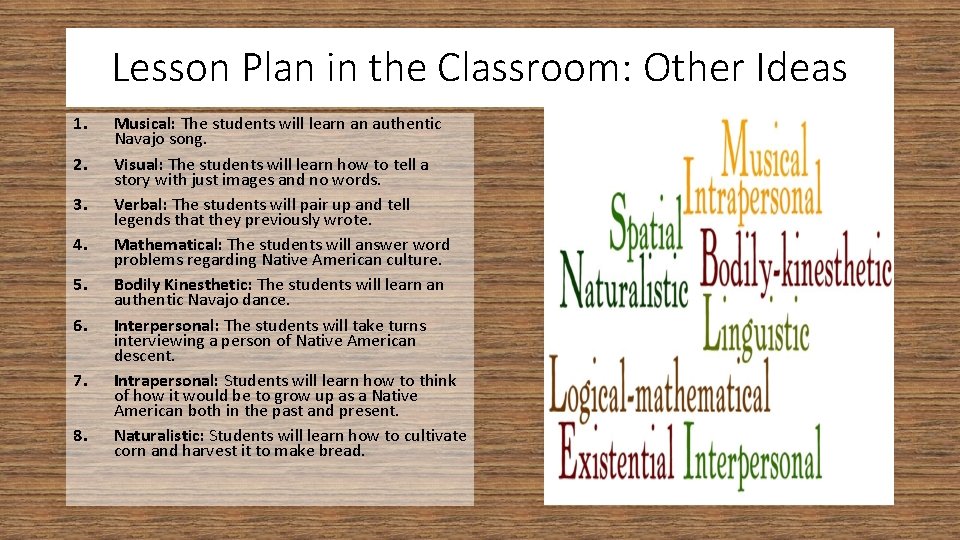
Lesson Plan in the Classroom: Other Ideas 1. 2. 3. 4. 5. 6. 7. 8. Musical: The students will learn an authentic Navajo song. Visual: The students will learn how to tell a story with just images and no words. Verbal: The students will pair up and tell legends that they previously wrote. Mathematical: The students will answer word problems regarding Native American culture. Bodily Kinesthetic: The students will learn an authentic Navajo dance. Interpersonal: The students will take turns interviewing a person of Native American descent. Intrapersonal: Students will learn how to think of how it would be to grow up as a Native American both in the past and present. Naturalistic: Students will learn how to cultivate corn and harvest it to make bread.
Lesson Plan in the classroom (contd) Compare and Contrast of Roles • The students will take the role they focused on and find the equivalent in the modern day and do a Venn diagram comparing the two. Venn Diagram • Make a Prediction of How These Roles Will Change in the Future • Each student will get with a partner and make predictions about how this role will change in the future if at all. • They will then write in their journals of their findings from the last few lessons.
References De Hoyos, Genevieve. (1992). Indian Student Placement Services. BYU Online Index. Retrieved from: http: //eom. byu. edu/index. php/Indian_Student_Placement_Services Genet, Am J Hum. (1996). NCBI. Origin and evolution of Native American mt. DNA variation: a reappraisal. Indian Country Diaries. (n. d. ) Revitalizing Native American Cultures. Retrieved from: http: //www. pbs. org/indiancountry/challenges/cultures. html Kuiper, Kathleen. (2006). The Rosen Publishing Group. Native American Culture, (p 110 -120). Oakman, James Jr. (2016). Proceedings of the Annual Conference of the Western College Reading Association. Native American Culture. Sleeter, Christine E. (2001). Preparing Teachers for Culturally Diverse Schools. Journal of Teaching Education.
- Slides: 16