
Multicore Acceleration of the Complex Ambiguity Function D
Multicore Acceleration of the Complex Ambiguity Function D. P. Enright, E. M. Dashofy, M. Au. Yeung, R. S. Boughton, J. M. Clark, and R. Scrofano, Jr. The Aerospace Corporation 2350 E. El Segundo Blvd. El Segundo, CA 90245 -4691 {Douglas. P. Enright, edashofy, mauyeung, RScott. Boughton, JMatt. Clark, Ronald. Scrofano}@aero. org High Performance Embedded Computing (HPEC) Workshop 23 -25 September 2008 DISTRIBUTION STATEMENT: Approved for public release; distribution is unlimited. © The Aerospace Corporation 2008
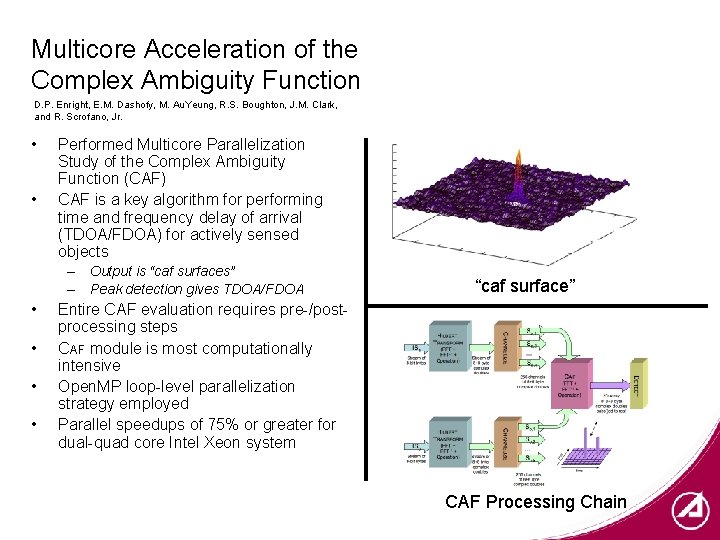
Multicore Acceleration of the Complex Ambiguity Function D. P. Enright, E. M. Dashofy, M. Au. Yeung, R. S. Boughton, J. M. Clark, and R. Scrofano, Jr. • • Performed Multicore Parallelization Study of the Complex Ambiguity Function (CAF) CAF is a key algorithm for performing time and frequency delay of arrival (TDOA/FDOA) for actively sensed objects – Output is “caf surfaces” – Peak detection gives TDOA/FDOA • • “caf surface” Entire CAF evaluation requires pre-/postprocessing steps CAF module is most computationally intensive Open. MP loop-level parallelization strategy employed Parallel speedups of 75% or greater for dual-quad core Intel Xeon system CAF Processing Chain
Computational Kernels & Parallelization Strategy • Four Modules – Pre-/Post-processing: HILBERTTRANSFORM, CHANNELIZE, DETECT • Computational Kernels: Multiple independent FFTs, FIR filters – CAF: Computationally most intensive • Computational Kernel: Multiple independent cross-correlations utilizing FFTs caf surface • Parallelization Strategy – Large amounts of loop-level parallelism with multiple FFTs performed in parallel and no data-dependencies between loop iterations within HILBERTTRANSFORM and CHANNELIZE modules • Ideal loop-structure for Open. MP omp parallel for iterative workshare construct – CAF and DETECT modules enclosed by doubly-nested outer for-loop with multiple large FFTs performed in parallel and no data-dependencies between loop iterations • Ideal loop-structure for Open. MP omp parallel for iterative workshare construct
Workload-Driven Evaluation • To assess efficacy of parallelization effort and the parallel scalability of the dualquad core system – Workload was parameterized • Scaling input size from 6. 25 MS to 31. 25 MS in steps of 6. 25 MS (1 MS = 220 samples) – Observed linear-scaling in uni-processor runtime • Processing a Nominal Surface case, i. e. culled number of caf surfaces, and All Surface case, i. e. all possible caf surfaces – Two Workload-Driven metrics calculated • Workload-Constrained (WC) metric – Ability of parallel system to minimize overall wall-clock time • Modified Linear-Scaled Workload Time-Constrained (MLSWTC) metric – Ability of parallel system to maintain a uni-core runtime as workload is increased in proportion to number of parallel resouces (cores) – ubism is the upper-bound input size multiple of base input size (5 for study) – Modification of “scaled-speedup” model of Gustafson[1] Gustafson, J. L. , “Reevaluating Amdahl’s Law”, Comm. ACM, v. 31, no. 5, p. 532 -533 (1988)
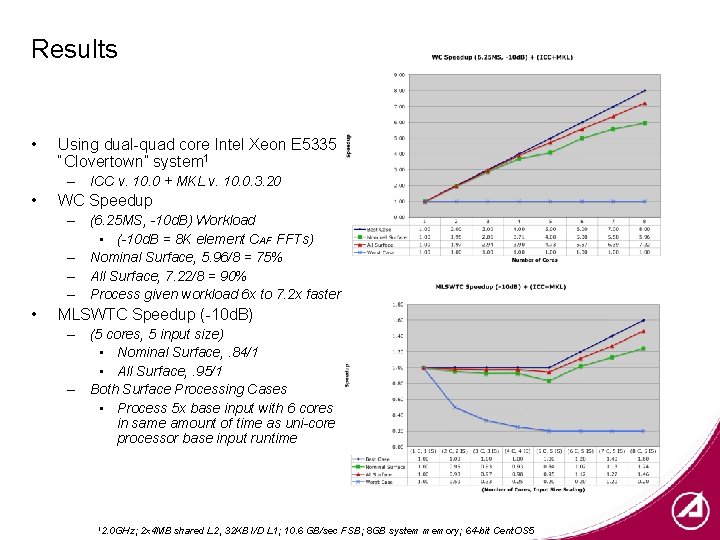
Results • Using dual-quad core Intel Xeon E 5335 “Clovertown” system 1 – ICC v. 10. 0 + MKL v. 10. 0. 3. 20 • WC Speedup – (6. 25 MS, -10 d. B) Workload • (-10 d. B = 8 K element CAF FFTs) – Nominal Surface, 5. 96/8 = 75% – All Surface, 7. 22/8 = 90% – Process given workload 6 x to 7. 2 x faster • MLSWTC Speedup (-10 d. B) – (5 cores, 5 input size) • Nominal Surface, . 84/1 • All Surface, . 95/1 – Both Surface Processing Cases • Process 5 x base input with 6 cores in same amount of time as uni-core processor base input runtime 12. 0 GHz; 2 x 4 MB shared L 2, 32 KB I/D L 1; 10. 6 GB/sec FSB; 8 GB system memory; 64 -bit Cent. OS 5
- Slides: 5