
Multicolor High Gain FEL driven by seeded microbunching
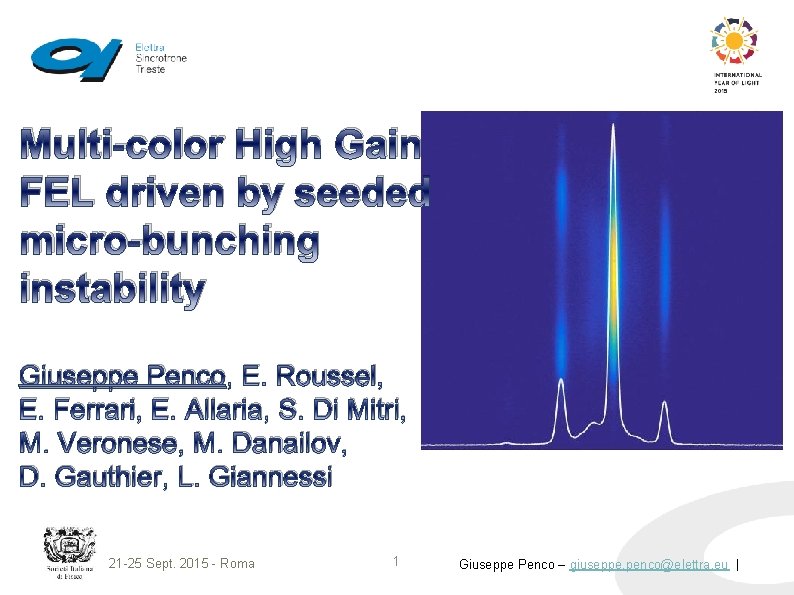
Multi-color High Gain FEL driven by seeded micro-bunching instability Giuseppe Penco, E. Roussel, E. Ferrari, E. Allaria, S. Di Mitri, M. Veronese, M. Danailov, D. Gauthier, L. Giannessi 21 -25 Sept. 2015 - Roma 1 Giuseppe Penco – giuseppe. penco@elettra. eu |
Outline § Seeded Free electron Laser § Microbunching instability: How fix it… § …. how use it § Experiment at FERMI FEL in Trieste (submitted to Phys Rev. Lett. ) 21 -25 Sept. 2015 - Roma 2 Giuseppe Penco – giuseppe. penco@elettra. eu |
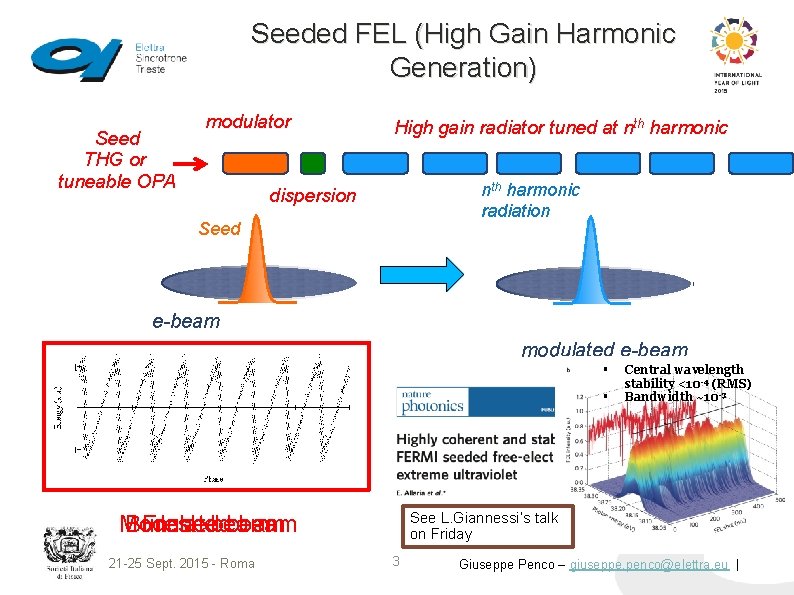
Seeded FEL (High Gain Harmonic Generation) Seed THG or tuneable OPA modulator High gain radiator tuned at nth harmonic radiation dispersion Seed e-beam modulated e-beam § § See L. Giannessi’s talk on Friday Modulated Bunched Fresh beam 21 -25 Sept. 2015 - Roma Central wavelength stability <10 -4 (RMS) Bandwidth ~10 -3 3 Giuseppe Penco – giuseppe. penco@elettra. eu |
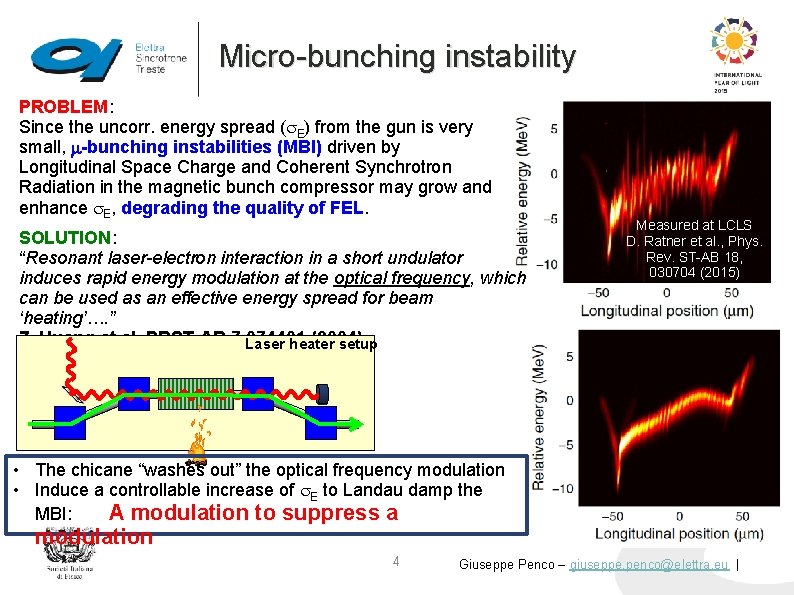
Micro-bunching instability PROBLEM: Since the uncorr. energy spread (s. E) from the gun is very small, m-bunching instabilities (MBI) driven by Longitudinal Space Charge and Coherent Synchrotron Radiation in the magnetic bunch compressor may grow and enhance s. E, degrading the quality of FEL. SOLUTION: “Resonant laser-electron interaction in a short undulator induces rapid energy modulation at the optical frequency, which can be used as an effective energy spread for beam ‘heating’…. ” Z. Huang et al. PRST-AB 7 Laser 074401 (2004). heater setup Measured at LCLS D. Ratner et al. , Phys. Rev. ST-AB 18, 030704 (2015) LH , 3, 4 • The chicane “washes out” the optical frequency modulation • Induce a controllable increase of s. E to Landau damp the MBI: A modulation to suppress a modulation 4 Giuseppe Penco – giuseppe. penco@elettra. eu |
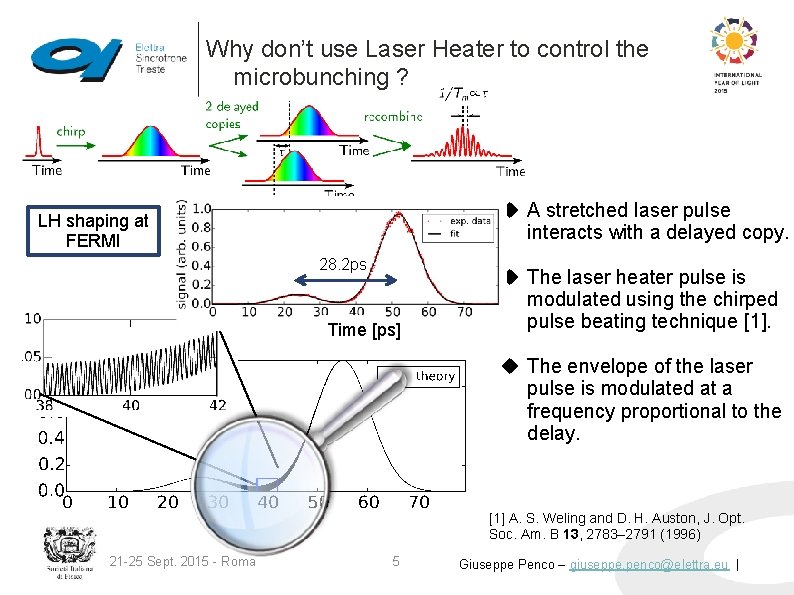
Why don’t use Laser Heater to control the microbunching ? u A stretched laser pulse interacts with a delayed copy. LH shaping at FERMI 28. 2 ps Time [ps] u The laser heater pulse is modulated using the chirped pulse beating technique [1]. u The envelope of the laser pulse is modulated at a frequency proportional to the delay. [1] A. S. Weling and D. H. Auston, J. Opt. Soc. Am. B 13, 2783– 2791 (1996) 21 -25 Sept. 2015 - Roma 5 Giuseppe Penco – giuseppe. penco@elettra. eu |
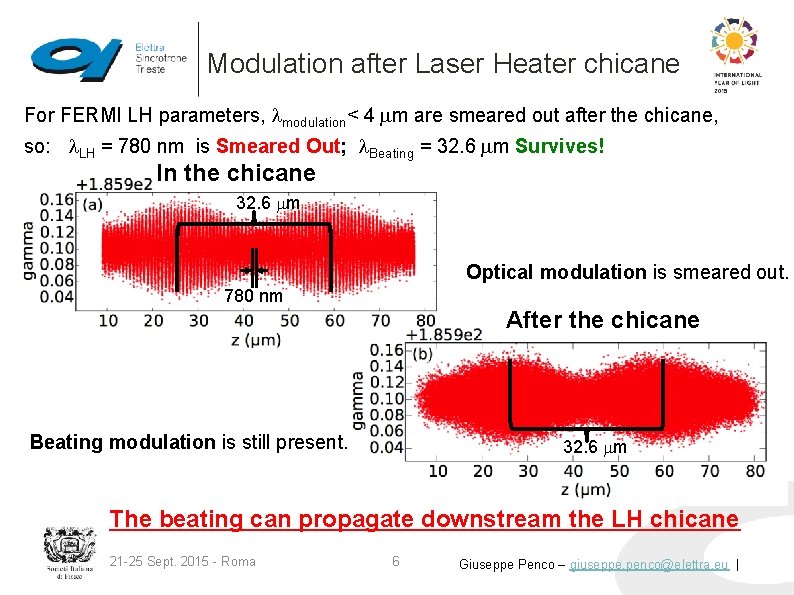
Modulation after Laser Heater chicane For FERMI LH parameters, lmodulation< 4 mm are smeared out after the chicane, so: l. LH = 780 nm is Smeared Out; l. Beating = 32. 6 mm Survives! In the chicane 32. 6 mm Optical modulation is smeared out. 780 nm After the chicane Beating modulation is still present. 32. 6 mm The beating can propagate downstream the LH chicane 21 -25 Sept. 2015 - Roma 6 Giuseppe Penco – giuseppe. penco@elettra. eu |
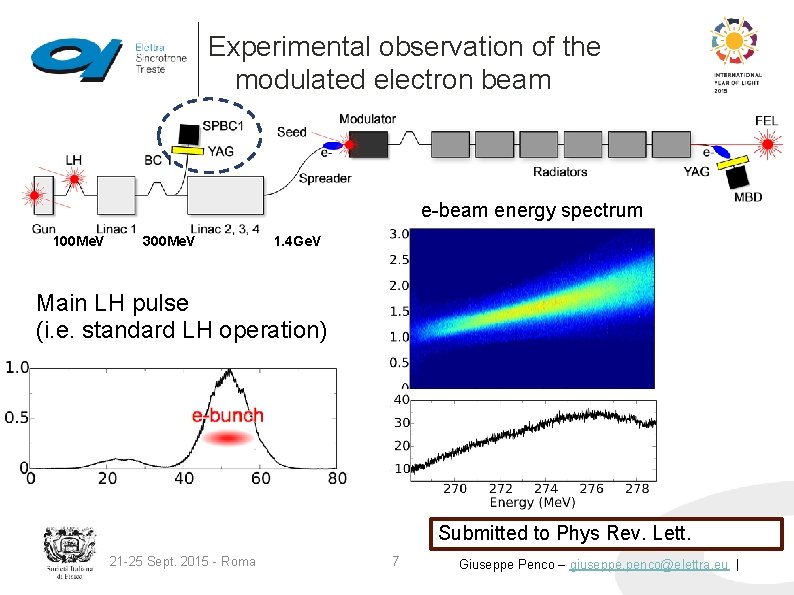
Experimental observation of the modulated electron beam e-beam energy spectrum 100 Me. V 300 Me. V 1. 4 Ge. V Main LH pulse (i. e. standard LH operation) Submitted to Phys Rev. Lett. 21 -25 Sept. 2015 - Roma 7 Giuseppe Penco – giuseppe. penco@elettra. eu |
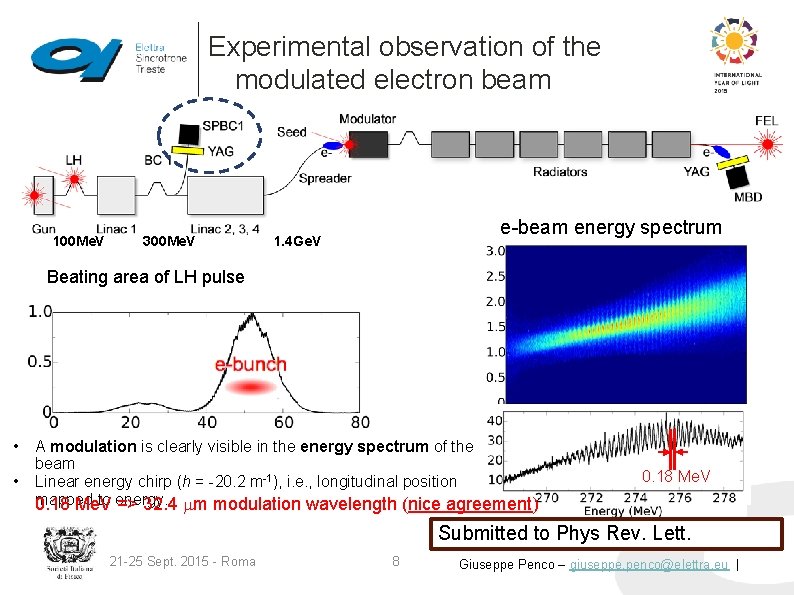
Experimental observation of the modulated electron beam 100 Me. V 300 Me. V e-beam energy spectrum 1. 4 Ge. V Beating area of LH pulse • • A modulation is clearly visible in the energy spectrum of the beam Linear energy chirp (h = -20. 2 m-1), i. e. , longitudinal position mapped to energy. 0. 18 Me. V => 32. 4 mm modulation wavelength (nice agreement) 0. 18 Me. V Submitted to Phys Rev. Lett. 21 -25 Sept. 2015 - Roma 8 Giuseppe Penco – giuseppe. penco@elettra. eu |
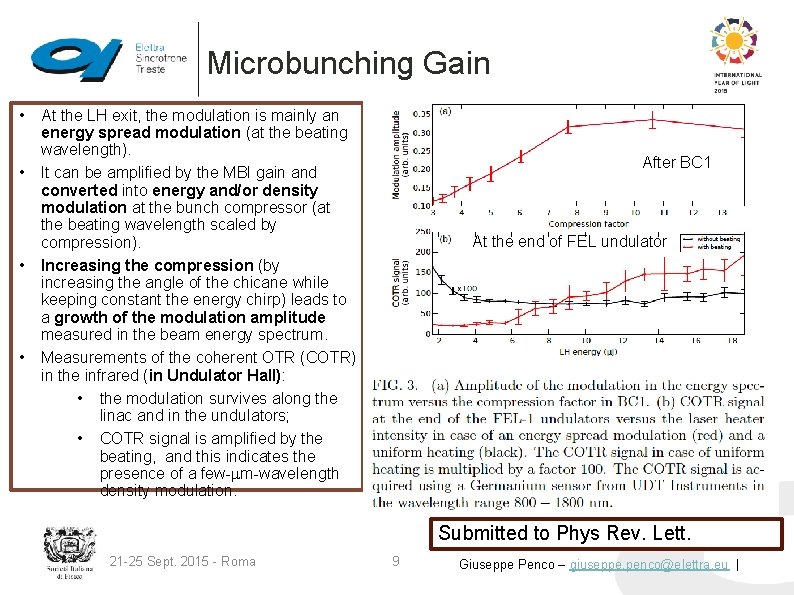
Microbunching Gain • • At the LH exit, the modulation is mainly an energy spread modulation (at the beating wavelength). It can be amplified by the MBI gain and converted into energy and/or density modulation at the bunch compressor (at the beating wavelength scaled by compression). Increasing the compression (by increasing the angle of the chicane while keeping constant the energy chirp) leads to a growth of the modulation amplitude measured in the beam energy spectrum. Measurements of the coherent OTR (COTR) in the infrared (in Undulator Hall): • the modulation survives along the linac and in the undulators; • COTR signal is amplified by the beating, and this indicates the presence of a few-mm-wavelength density modulation. After BC 1 At the end of FEL undulator Submitted to Phys Rev. Lett. 21 -25 Sept. 2015 - Roma 9 Giuseppe Penco – giuseppe. penco@elettra. eu |
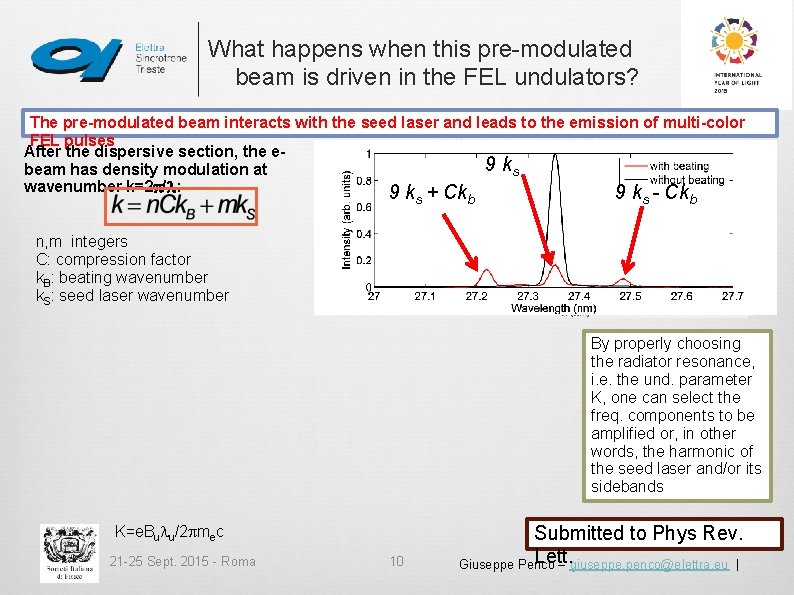
What happens when this pre-modulated beam is driven in the FEL undulators? The pre-modulated beam interacts with the seed laser and leads to the emission of multi-color FEL pulses After the dispersive section, the e 9 ks beam has density modulation at wavenumber k=2 p/l: 9 k + Ck 9 k - Ck s b n, m integers C: compression factor k. B: beating wavenumber k. S: seed laser wavenumber By properly choosing the radiator resonance, i. e. the und. parameter K, one can select the freq. components to be amplified or, in other words, the harmonic of the seed laser and/or its sidebands K=e. Bulu/2 pmec 21 -25 Sept. 2015 - Roma 10 Submitted to Phys Rev. Lett. Giuseppe Penco – giuseppe. penco@elettra. eu |
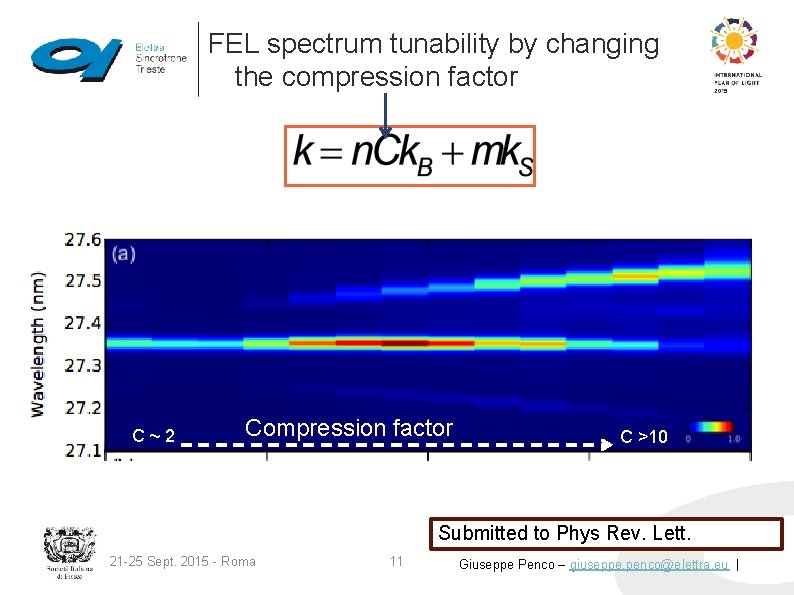
FEL spectrum tunability by changing the compression factor C~2 Compression factor C >10 Submitted to Phys Rev. Lett. 21 -25 Sept. 2015 - Roma 11 Giuseppe Penco – giuseppe. penco@elettra. eu |
Conclusion q We have demonstrated the possibility to seed the electron beam before compression, with a long wavelength modulation induced by the Laser Heater q The modulation is sustained and amplified by the MBI gain and can be propagated to the undulators q The seeded FEL spectrum can be controlled by this modulation, offering the possibility to generate multi-color FEL pulses, with spectral properties (as bandwidth and central wavelength stability) preserved. q This multi-color FEL is tunable by choosing the radiator resonance, the compression factor and by changing the beating frequency (acting on the laser heater pulses temporal separation). Microbunching instability conversion: From an issue to a possibility to control the FEL spectrum. 12 Giuseppe Penco – giuseppe. penco@elettra. eu |
Thank You 13 Giuseppe Penco – giuseppe. penco@elettra. eu |

14
- Slides: 14