
Multicast Algorithms in Service Overlay Networks Dario Pompili

- Slides: 17
Multicast Algorithms in Service Overlay Networks Dario Pompili*, Luca Lopez^, Caterina Scoglio+ *dario@ece. gatech. edu, ^lopez. luca@gmail. com, +caterina@eece. ksu. edu *Broadband Wireless Networking Laboratory Georgia Institute of Technology, Atlanta, GA 30332, USA ^Dipartimento di Informatica e Sistemistica University “La Sapienza, ” Rome 00184, Italy +Department of Electrical and Computer Engineering Kansas State University, Manhattan, KS 66506, USA Infocom 2006, April 23 -29 11 D. Pompili, L. Lopez, C. Scoglio, Multicast Algorithms in Service Overlay Networks, Infocom 2006
Outline Ø An Introduction to Overlay Networks Ø Native Network vs. Virtual Overlay Network Ø Unicast vs. Multicast Transmissions Ø Multicast Applications Ø Proposed Overlay Multicast Algorithms: DIMRO and DIMRO-GS Ø Performance Evaluation Ø Conclusions and Future Work 22 D. Pompili, L. Lopez, C. Scoglio, Multicast Algorithms in Service Overlay Networks, Infocom 2006
An Introduction to Overlay Networks Ø Overlay routing enhances IP network reliability and performance by forwarding traffic through intermediate overlay nodes [1 -3]. This way, – It can bypass congestion – It can overcome transient outages Ø Past research [4, 5] focused on techniques for: – Building overlay networks – Evaluating their performance [1] H. Zhang, J. Kurose, and D. Towsley, “Can an overlay compensate for a careless underlay? ” in Proceedings of IEEE INFOCOM 2006, Barcelona, Spain, Apr. 2006 [2] Y. Zhu, C. Dovrolis, and M. Ammar, “Dynamic overlay routing based on available bandwidth estimation: A simulation study, ” To appear in the Computer Networks Journal, 2006 [3] S. Y. Shi and J. S. Turner, “Routing in overlay multicast networks, ” in Proceedings of IEEE INFOCOM 2002, New York, NY, USA, June 2002 [4] D. Andersen, H. Balakrishnan, M. Kaashoek, and R. Morris, “Resilient overlay networks, ” in Proceedings of ACM Symposium on Operating Systems Principles, Banff, Canada, Oct. 2001 [5] A. Nakao, L. Peterson, and A. Bavier, “A routing underlay for overlay networks, ” in Proceedings of ACM SIGCOMM, Karlsruhe, Germany, Aug. 2003 33 D. Pompili, L. Lopez, C. Scoglio, Multicast Algorithms in Service Overlay Networks, Infocom 2006
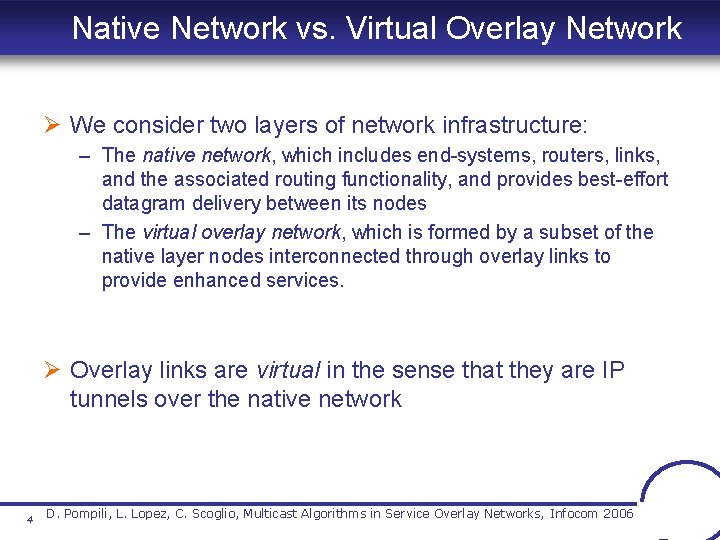
Native Network vs. Virtual Overlay Network Ø We consider two layers of network infrastructure: – The native network, which includes end-systems, routers, links, and the associated routing functionality, and provides best-effort datagram delivery between its nodes – The virtual overlay network, which is formed by a subset of the native layer nodes interconnected through overlay links to provide enhanced services. Ø Overlay links are virtual in the sense that they are IP tunnels over the native network 44 D. Pompili, L. Lopez, C. Scoglio, Multicast Algorithms in Service Overlay Networks, Infocom 2006
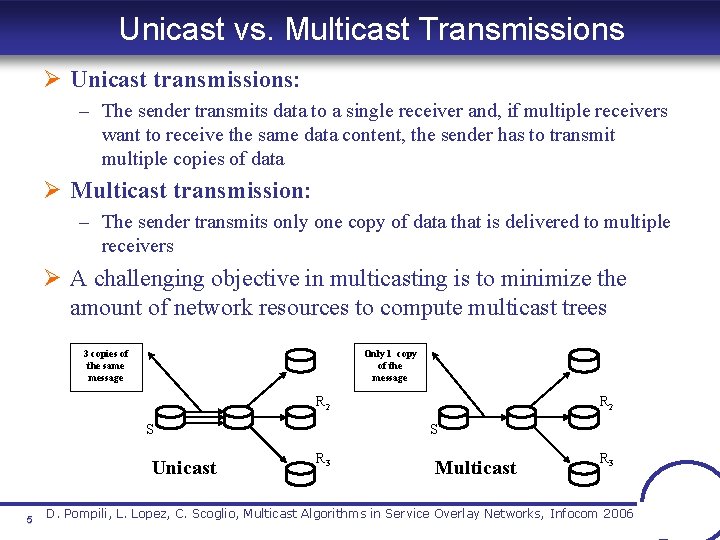
Unicast vs. Multicast Transmissions Ø Unicast transmissions: – The sender transmits data to a single receiver and, if multiple receivers want to receive the same data content, the sender has to transmit multiple copies of data Ø Multicast transmission: – The sender transmits only one copy of data that is delivered to multiple receivers Ø A challenging objective in multicasting is to minimize the amount of network resources to compute multicast trees 3 copies of the same message Only 1 copy of the message R 2 S Unicast 55 R 2 S R 3 Multicast R 3 D. Pompili, L. Lopez, C. Scoglio, Multicast Algorithms in Service Overlay Networks, Infocom 2006
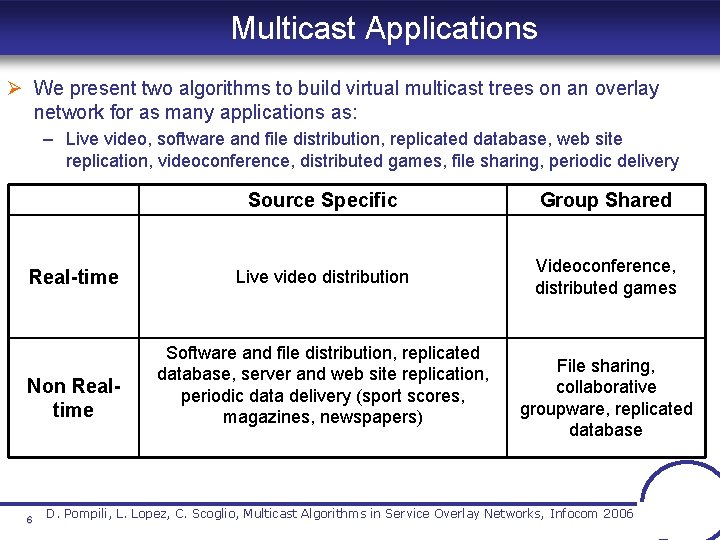
Multicast Applications Ø We present two algorithms to build virtual multicast trees on an overlay network for as many applications as: – Live video, software and file distribution, replicated database, web site replication, videoconference, distributed games, file sharing, periodic delivery Source Specific Group Shared Real-time Live video distribution Videoconference, distributed games Non Realtime Software and file distribution, replicated database, server and web site replication, periodic data delivery (sport scores, magazines, newspapers) 66 File sharing, collaborative groupware, replicated database D. Pompili, L. Lopez, C. Scoglio, Multicast Algorithms in Service Overlay Networks, Infocom 2006
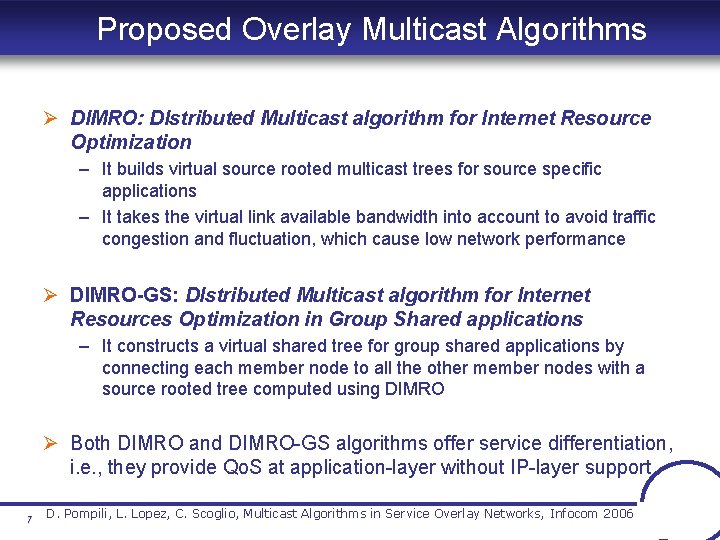
Proposed Overlay Multicast Algorithms Ø DIMRO: DIstributed Multicast algorithm for Internet Resource Optimization – It builds virtual source rooted multicast trees for source specific applications – It takes the virtual link available bandwidth into account to avoid traffic congestion and fluctuation, which cause low network performance Ø DIMRO-GS: DIstributed Multicast algorithm for Internet Resources Optimization in Group Shared applications – It constructs a virtual shared tree for group shared applications by connecting each member node to all the other member nodes with a source rooted tree computed using DIMRO Ø Both DIMRO and DIMRO-GS algorithms offer service differentiation, i. e. , they provide Qo. S at application-layer without IP-layer support 77 D. Pompili, L. Lopez, C. Scoglio, Multicast Algorithms in Service Overlay Networks, Infocom 2006
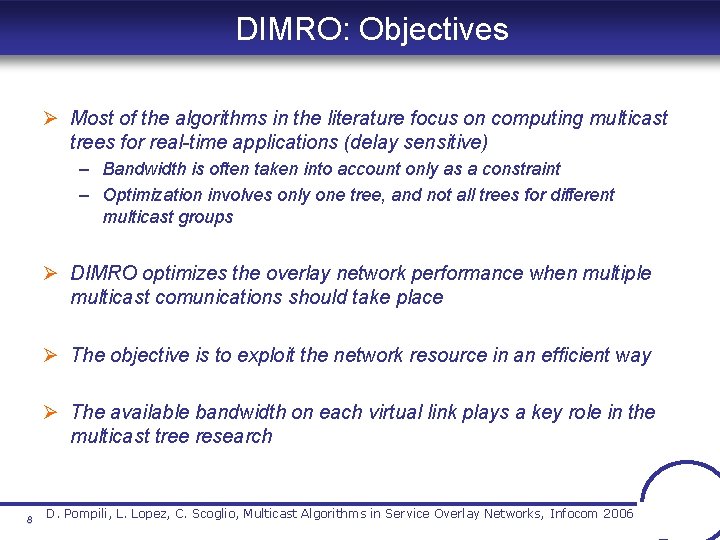
DIMRO: Objectives Ø Most of the algorithms in the literature focus on computing multicast trees for real-time applications (delay sensitive) – Bandwidth is often taken into account only as a constraint – Optimization involves only one tree, and not all trees for different multicast groups Ø DIMRO optimizes the overlay network performance when multiple multicast comunications should take place Ø The objective is to exploit the network resource in an efficient way Ø The available bandwidth on each virtual link plays a key role in the multicast tree research 88 D. Pompili, L. Lopez, C. Scoglio, Multicast Algorithms in Service Overlay Networks, Infocom 2006
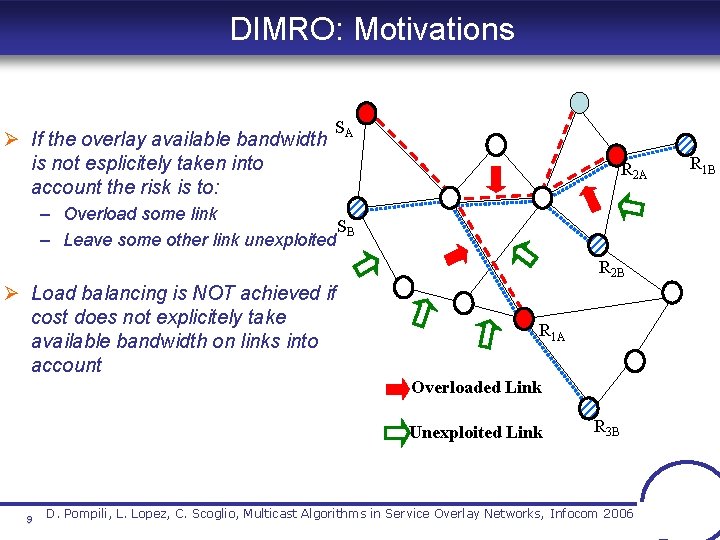
DIMRO: Motivations Ø If the overlay available bandwidth is not esplicitely taken into account the risk is to: SA R 2 A – Overload some link SB – Leave some other link unexploited R 2 B Ø Load balancing is NOT achieved if cost does not explicitely take available bandwidth on links into account R 1 A Overloaded Link Unexploited Link 99 R 3 B D. Pompili, L. Lopez, C. Scoglio, Multicast Algorithms in Service Overlay Networks, Infocom 2006 R 1 B
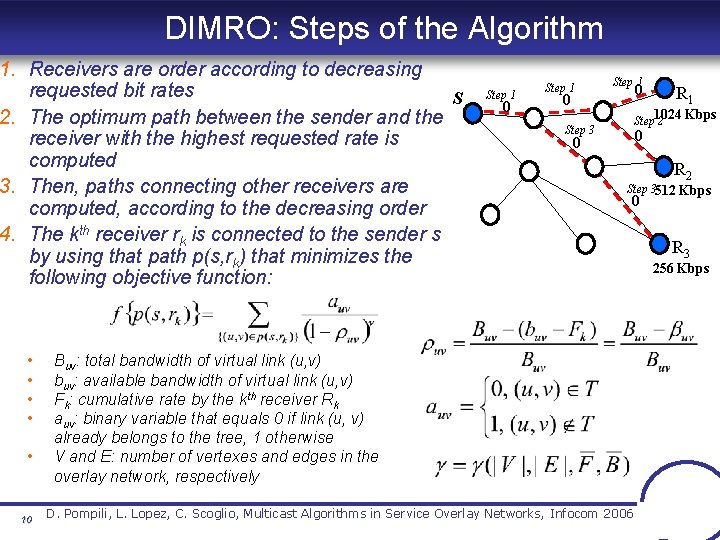
DIMRO: Steps of the Algorithm 1. Receivers are order according to decreasing requested bit rates S 2. The optimum path between the sender and the receiver with the highest requested rate is computed 3. Then, paths connecting other receivers are computed, according to the decreasing order 4. The kth receiver rk is connected to the sender s by using that path p(s, rk) that minimizes the following objective function: • • • 10 10 Step 1 0 0 R 1 1024 Kbps Step 2 Step 3 0 0 R 2 Step 3512 Kbps 0 Buv: total bandwidth of virtual link (u, v) buv: available bandwidth of virtual link (u, v) Fk: cumulative rate by the kth receiver Rk auv: binary variable that equals 0 if link (u, v) already belongs to the tree, 1 otherwise V and E: number of vertexes and edges in the overlay network, respectively D. Pompili, L. Lopez, C. Scoglio, Multicast Algorithms in Service Overlay Networks, Infocom 2006 R 3 256 Kbps
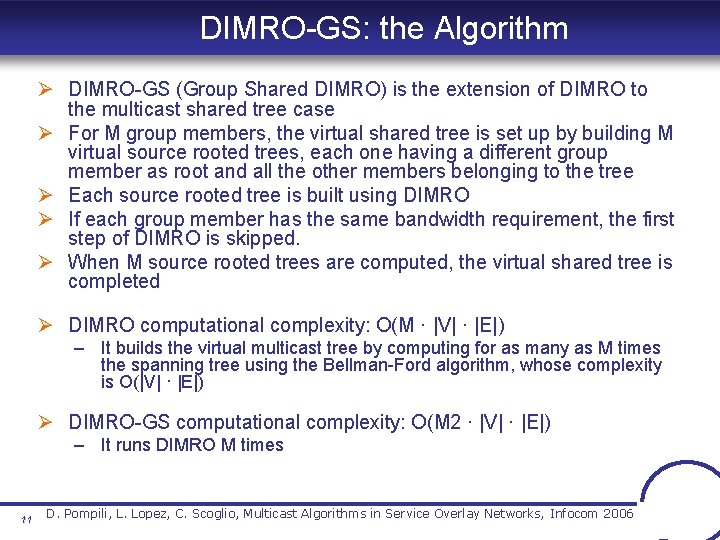
DIMRO-GS: the Algorithm Ø DIMRO-GS (Group Shared DIMRO) is the extension of DIMRO to the multicast shared tree case Ø For M group members, the virtual shared tree is set up by building M virtual source rooted trees, each one having a different group member as root and all the other members belonging to the tree Ø Each source rooted tree is built using DIMRO Ø If each group member has the same bandwidth requirement, the first step of DIMRO is skipped. Ø When M source rooted trees are computed, the virtual shared tree is completed Ø DIMRO computational complexity: O(M · |V| · |E|) – It builds the virtual multicast tree by computing for as many as M times the spanning tree using the Bellman-Ford algorithm, whose complexity is O(|V| · |E|) Ø DIMRO-GS computational complexity: O(M 2 · |V| · |E|) – It runs DIMRO M times 11 11 D. Pompili, L. Lopez, C. Scoglio, Multicast Algorithms in Service Overlay Networks, Infocom 2006
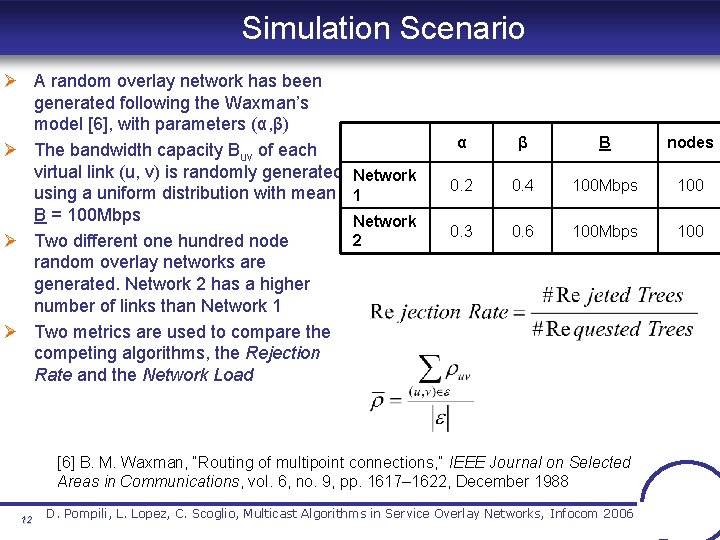
Simulation Scenario Ø A random overlay network has been generated following the Waxman’s model [6], with parameters (α, β) Ø The bandwidth capacity Buv of each virtual link (u, v) is randomly generated using a uniform distribution with mean B = 100 Mbps Ø Two different one hundred node random overlay networks are generated. Network 2 has a higher number of links than Network 1 Ø Two metrics are used to compare the competing algorithms, the Rejection Rate and the Network Load α β B nodes Network 1 0. 2 0. 4 100 Mbps 100 Network 2 0. 3 0. 6 100 Mbps 100 [6] B. M. Waxman, “Routing of multipoint connections, ” IEEE Journal on Selected Areas in Communications, vol. 6, no. 9, pp. 1617– 1622, December 1988 12 12 D. Pompili, L. Lopez, C. Scoglio, Multicast Algorithms in Service Overlay Networks, Infocom 2006
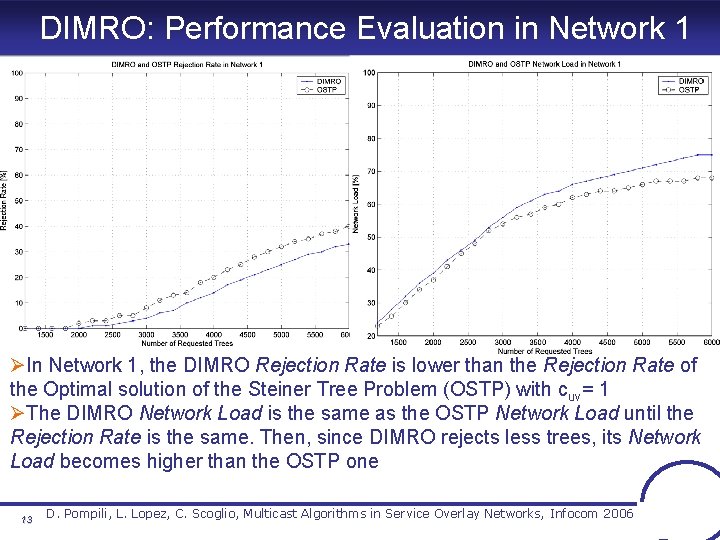
DIMRO: Performance Evaluation in Network 1 ØIn Network 1, the DIMRO Rejection Rate is lower than the Rejection Rate of the Optimal solution of the Steiner Tree Problem (OSTP) with cuv= 1 ØThe DIMRO Network Load is the same as the OSTP Network Load until the Rejection Rate is the same. Then, since DIMRO rejects less trees, its Network Load becomes higher than the OSTP one 13 13 D. Pompili, L. Lopez, C. Scoglio, Multicast Algorithms in Service Overlay Networks, Infocom 2006
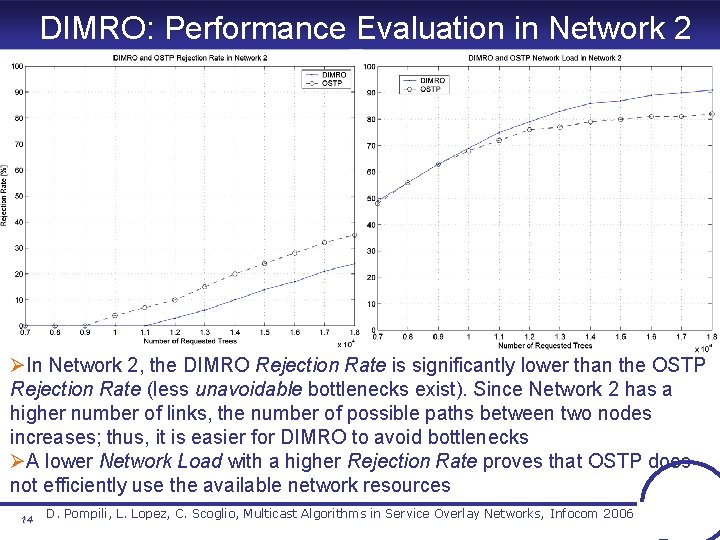
DIMRO: Performance Evaluation in Network 2 ØIn Network 2, the DIMRO Rejection Rate is significantly lower than the OSTP Rejection Rate (less unavoidable bottlenecks exist). Since Network 2 has a higher number of links, the number of possible paths between two nodes increases; thus, it is easier for DIMRO to avoid bottlenecks ØA lower Network Load with a higher Rejection Rate proves that OSTP does not efficiently use the available network resources 14 14 D. Pompili, L. Lopez, C. Scoglio, Multicast Algorithms in Service Overlay Networks, Infocom 2006
DIMRO-GS: Performance Evaluation in Network 1 ØWhen the Number of Requested Trees increases, the FTM Rejection Rate becomes significantly higher than the one of DIMRO-GS, since FTM uses a higher amount of network resources ØIn fact, when the Number of Requested Trees increases, the FTM Network Load becomes significantly higher than the DIMRO-GS Network Load 15 15 D. Pompili, L. Lopez, C. Scoglio, Multicast Algorithms in Service Overlay Networks, Infocom 2006
DIMRO-GS: Performance Evaluation in Network 2 ØNetwork resources saturate later when DIMRO-GS is used, which causes a lower Rejection Rate ØIn Network 2, DIMRO-GS achieves a lower Rejection Rate and Network Load ØNote that in Network 1 bottlenecks do not allow to efficiently exploit all network resources 16 16 D. Pompili, L. Lopez, C. Scoglio, Multicast Algorithms in Service Overlay Networks, Infocom 2006
Conclusions and Future Work ØTwo algorithms for multicast applications in service overlay networks were presented ØThe first builds virtual source rooted multicast trees for source specific applications ØThe second constructs a virtual shared tree for group shared applications ØTheir objective is to achieve traffic balancing on the overlay network so as to avoid traffic congestion and fluctuation, which cause low network performance ØThe algorithms actively probe the underlay network and compute virtual multicast trees by dynamically selecting the least loaded available paths on the overlay network ØFuture research will focus on dynamic multicast groups, and on the interactions between overlay and underlay networks 17 17 D. Pompili, L. Lopez, C. Scoglio, Multicast Algorithms in Service Overlay Networks, Infocom 2006