
Multiagent simulation From air to urban traffic modeling
Multi-agent simulation: From air to urban traffic modeling Michal Pechoucek Czech Technical University in Prague pechoucek@fel. cvut. cz, www. agents. cz
Agents briefly (one slide only) - multi-agent system is a decentralized multi-actor (software) system, often geographically distributed whose behavior is defined and implemented by means of complex, peer-to-peer interaction among autonomous, rational and deliberative entities. - autonomous agent is a special kind of a intelligent software program that is capable of highly autonomous rational action, aimed at achieving the private objective of the agent – can exists on its own but often is a component of a multi-agent system – agent is autonomous, reactive, proactive and social - agent technology is software technology supporting the development of the autonomous agents and multi-agent systems agent-based computing is a special research domain, subfield of computer science and artificial intelligence that studies the concepts of autonomous agents - agent researchers study problems of integration, communication, reasoning and knowledge representation, competition (games) and cooperation (robotics), agent oriented software engineering, …

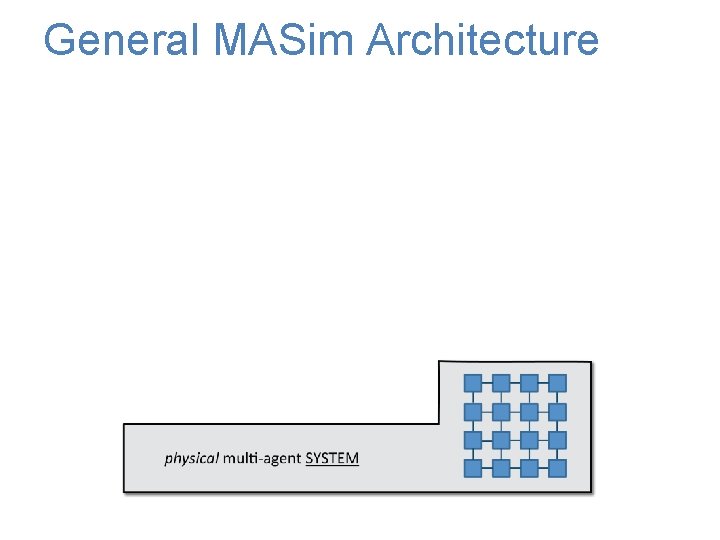
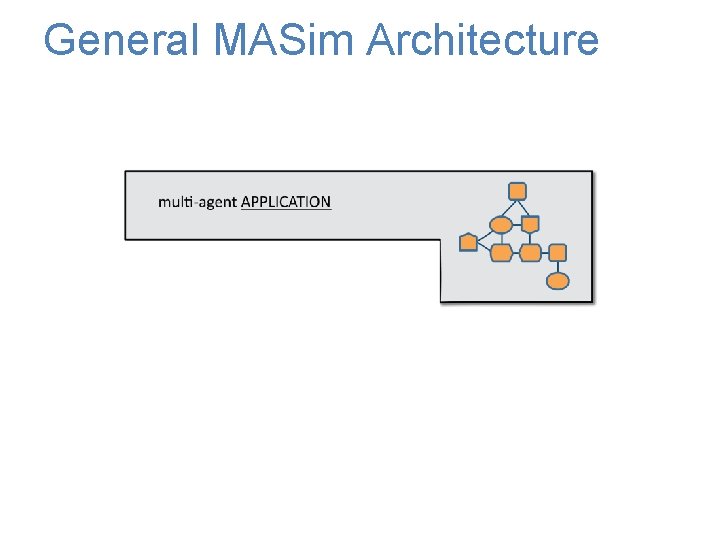
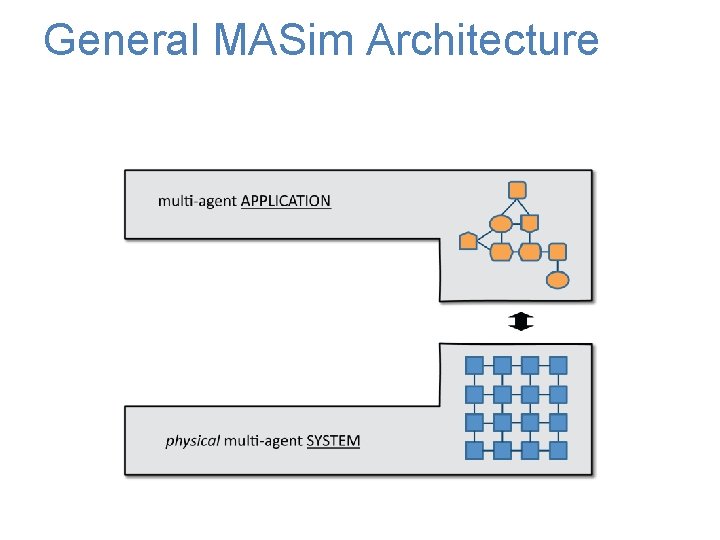
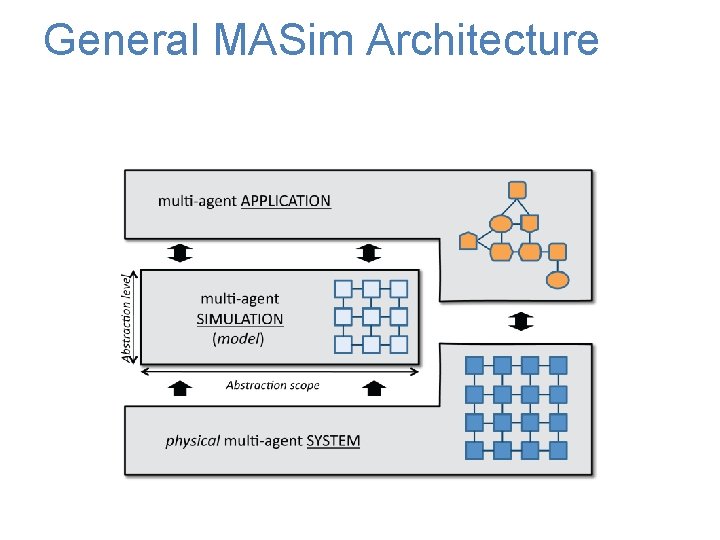
Multi-agent application is a software system, functionality of which is given by interaction among autonomous software/hardware/human components. But also a monolithic software application that is autonomously operating within a community of autonomously acting software applications, hardware systems or human individuals. Currently, multi-agent simulation – multi-agent software system simulating a behavior of other multi-agent system (SW, HW, human), is used either: – for studying properties of real multiagent systems that can be hardly observed (such as crowd behavior in emergency situation, cancer cells reproduction modeling or. . . ) or – for testing various multiagent application before they are used in physical systems (such as various robotics and autonomous systems applications, methods for urban traffic control or testing various security applications).
Multi-agent application is a software system, functionality of which is given by interaction among autonomous software/hardware/human components. But also a monolithic software application that is autonomously operating within a community of autonomously acting software applications, hardware systems or human individuals. – there are several good examples of this to have happened e. g. Lost. Wax Aeorogility, Glacsweb (Glacier sensor network), FAMS (Federal Air Marshals Services), Rockwell shipboard automation of a chilling system, London taxi scheduling

Multi-agent application is a software system, functionality of which is given by interaction among autonomous software/hardware/human components. But also a monolithic software application that is autonomously operating within a community of autonomously acting software applications, hardware systems or human individuals. Intelligent systems based application still do not fully leverage the potential of the multi-agent technologies due to: – Potential still not believable – lack of case-studies, lack of convincing quantitative argument – Limits on scalability and fidelity – early demos are not believed to scale up to industrial requirements – High costs & high risks – deployment is costy and benefits not certain
Multi-agent simulation Agent-based computing have been used: 1. Design paradigm – the concept of decentralized, interacting, socially aware, autonomous entities as underlying software paradigm (often deployed only in parts, where it suits the application) 2. Source of technologies – algorithms, models, techniques architectures, protocols but also software packages that facilitate development of multi-agent systems 3. Simulation concept – a specialized software technology that allows simulation of natural multi-agent systems, based on (1) and (2). We suggest: • using (3) for development the combination of (1) and (2) supporting development of multi-agent applications
General MASim Architecture
General MASim Architecture
General MASim Architecture
General MASim Architecture
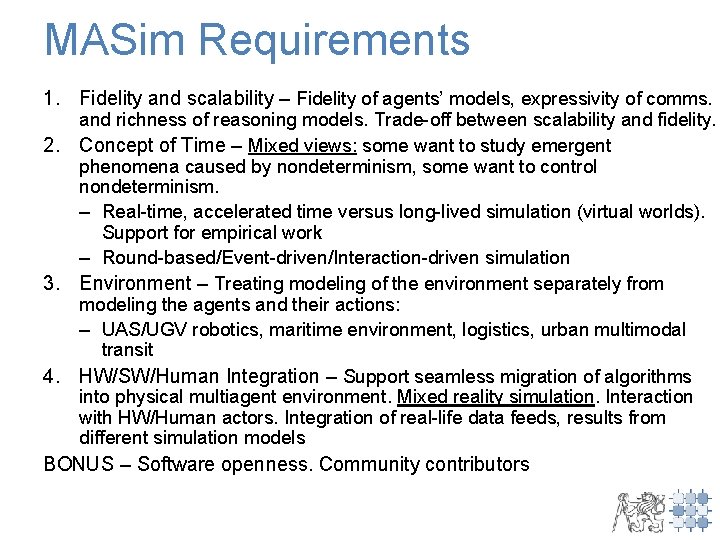
MASim Requirements 1. Fidelity and scalability – Fidelity of agents’ models, expressivity of comms. and richness of reasoning models. Trade-off between scalability and fidelity. 2. Concept of Time – Mixed views: some want to study emergent phenomena caused by nondeterminism, some want to control nondeterminism. – Real-time, accelerated time versus long-lived simulation (virtual worlds). Support for empirical work – Round-based/Event-driven/Interaction-driven simulation 3. Environment – Treating modeling of the environment separately from modeling the agents and their actions: – UAS/UGV robotics, maritime environment, logistics, urban multimodal transit 4. HW/SW/Human Integration – Support seamless migration of algorithms into physical multiagent environment. Mixed reality simulation. Interaction with HW/Human actors. Integration of real-life data feeds, results from different simulation models BONUS – Software openness. Community contributors
ATG in-house MASim Environment • In house built ATG infrastructures that are in part meeting the listed requirements:
ATG in-house MASim Environment • In house built ATG infrastructures that are in part meeting the listed requirements: – AGLOBE SIMULATION: JADE-like fully fledged multi-agent platform and development environment (JAVA-based) + supports agent mobility + special tailored for high scalability (due to natural decentralization) + provides specialized environment simulation component (XSIMULATION) + suitable for seamless distribution for parallel computing + suitable for hardware integration and partial/hybrid simulation + can be used as is for robotics - high software development rump-up time
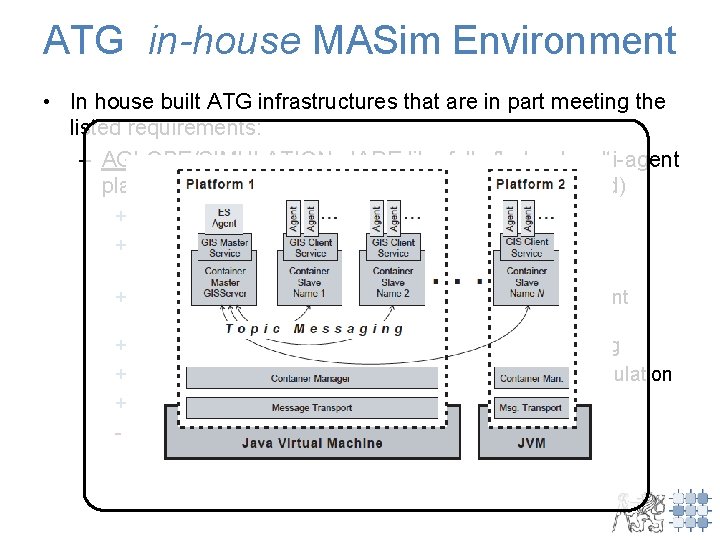
ATG in-house MASim Environment • In house built ATG infrastructures that are in part meeting the listed requirements: – AGLOBE/SIMULATION: JADE-like fully fledged multi-agent platform and development environment (JAVA-based) + supports agent mobility + special tailored for high scalability (due to natural decentralization) + provides specialized environment simulation component (XSIMULATION) + suitable for seamless distribution for parallel computing + suitable for hardware integration and partial/hybrid simulation + can be used as is for robotics - high software development rump-up time
ATG in-house MASim Environment • In house built ATG infrastructures that are in part meeting the listed requirements: – AGLOBE SIMULATION: JADE-like fully fledged multi-agent platform and development environment (JAVA-based) + supports agent mobility + special tailored for high scalability (due to natural decentralization) + provides specialized environment simulation component (XSIMULATION) + + + - suitable for seamless distribution for parallel computing suitable for hardware integration and partial/hybrid simulation can be used as is for robotics high software development rump-up time used by IHMC, FAA, FL 3 XX, BAE Systems, CADANCE Design Systems, US Air. Force, US Army, TU-MUNICH.
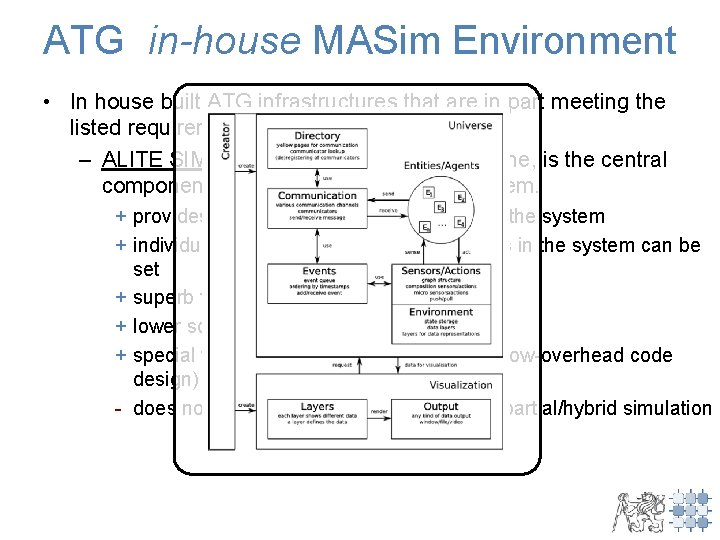
ATG in-house MASim Environment • In house built ATG infrastructures that are in part meeting the listed requirements: – ALITE SIMULATION: The simulation engine, is the central component of any ALITE multi-agent system. + provides full control of non-determinism in the system + individual probability distributions of events in the system can be set + superb for tests and experiments + lower software development rump-up time + special tailored for high scalability (due to low-overhead code design) - does not support hardware migration and partial/hybrid simulation
ATG in-house MASim Environment • In house built ATG infrastructures that are in part meeting the listed requirements: – ALITE SIMULATION: The simulation engine, is the central component of any ALITE multi-agent system. + provides full control of non-determinism in the system + individual probability distributions of events in the system can be set + superb for tests and experiments + lower software development rump-up time + special tailored for high scalability (due to low-overhead code design) - does not support hardware migration and partial/hybrid simulation
ATG in-house MASim Environment • In house built ATG infrastructures that are in part meeting the listed requirements: – ALITE SIMULATION: The simulation engine, is the central component of any ALITE multi-agent system. + + + - provides full control of non-determinism in the system individual probability distributions of events in the system can be set superb for tests and experiments lower software development rump-up time special tailored for high scalability (due to low-overhead code design) does not support hardware migration and partial/hybrid simulation
ATG in-house MASim Environment • In house built ATG infrastructures that are in part meeting the listed requirements: – ALITE SIMULATION: The simulation engine, is the central component of any ALITE multi-agent system. + + + - provides full control of non-determinism in the system individual probability distributions of events in the system can be set superb for tests and experiments lower software development rump-up time special tailored for high scalability (due to low-overhead code design) does not support hardware migration and partial/hybrid simulation used within the projects funded by US ARMY CERDEC, ONR and IBM
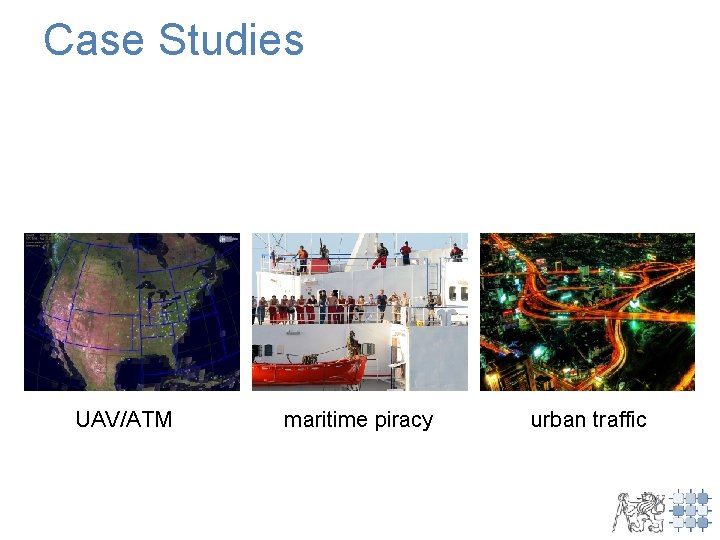
Case Studies UAV/ATM maritime piracy urban traffic
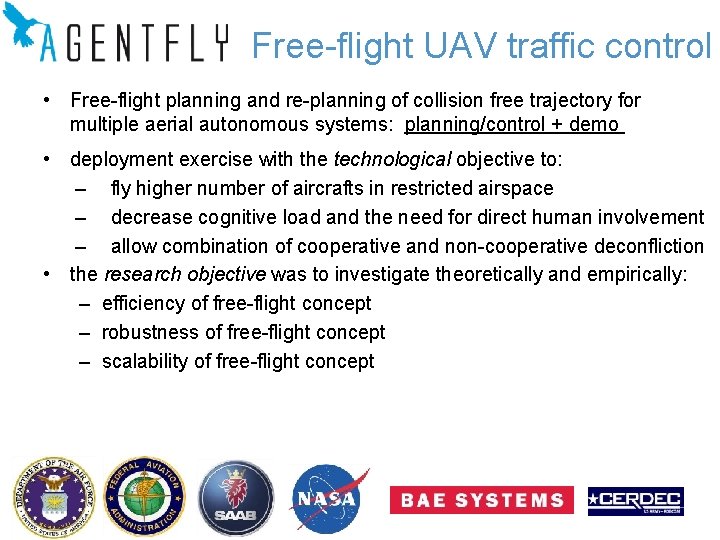
Free-flight UAV traffic control • Free-flight planning and re-planning of collision free trajectory for multiple aerial autonomous systems: planning/control + demo • deployment exercise with the technological objective to: – fly higher number of aircrafts in restricted airspace – decrease cognitive load and the need for direct human involvement – allow combination of cooperative and non-cooperative deconfliction • the research objective was to investigate theoretically and empirically: – efficiency of free-flight concept – robustness of free-flight concept – scalability of free-flight concept
Free-flight UAV traffic control • Free-flight planning and re-planning of collision free trajectory for multiple aerial autonomous systems: planning/control + demo • Technical approach: – Scalable multi-agent simulation of a high number of the deliberative, computational entities. – Negotiation-based decentralized coordination - computational capability to transform the set of time specific waypoints into a smooth trajectory – Efficient and fast planning algorithms - computational capability to transform the set of time specific waypoints into a smooth trajectory » Accelerated A* planners » Distributed planning linked with deconfliction capability
Accelerated A* (AA*) Algorithm • State-of-the-art (briefly): – Fast: Rapid Random Trees (RRT), Random Walk Planners (RWP) and Randomized Potential Fields (RPF) – Optimal: Vector fields and potential fields • AA* provides sub-optimal trajectory with given distance to optimum • More than 1000 times faster than A* algorithm • AA* concept: – adaptive sampling (q = p, 2*p, 4*p, 8*p, 16*p, 32*p, 64*p, …) • rare sampling density in open spaces / higher density closer to obstacles • removes trade-off between speed and search precision 41 – progressive path smoothing – every generated path is smoothed – similarity checks – used for OPEN and CLOSED operations – heuristic function – based on Dubin car
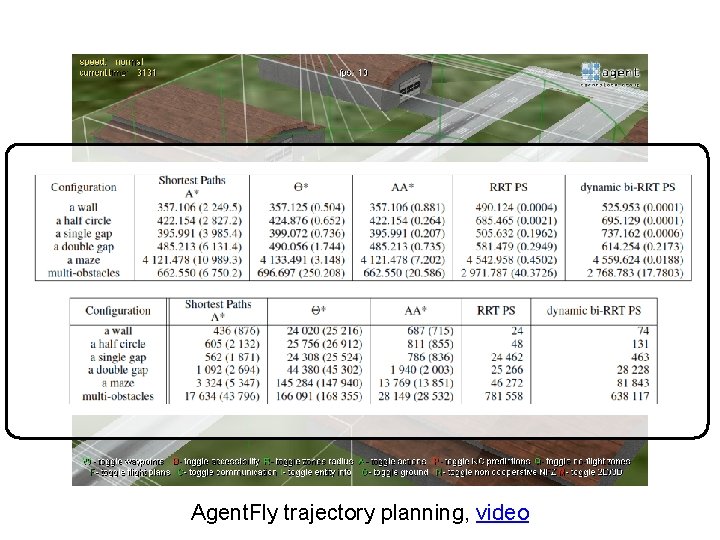
Agent. Fly trajectory planning, video
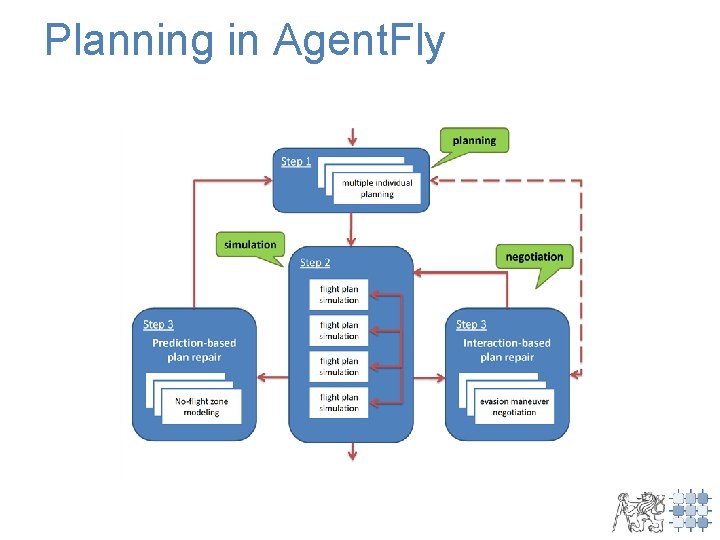
Planning in Agent. Fly
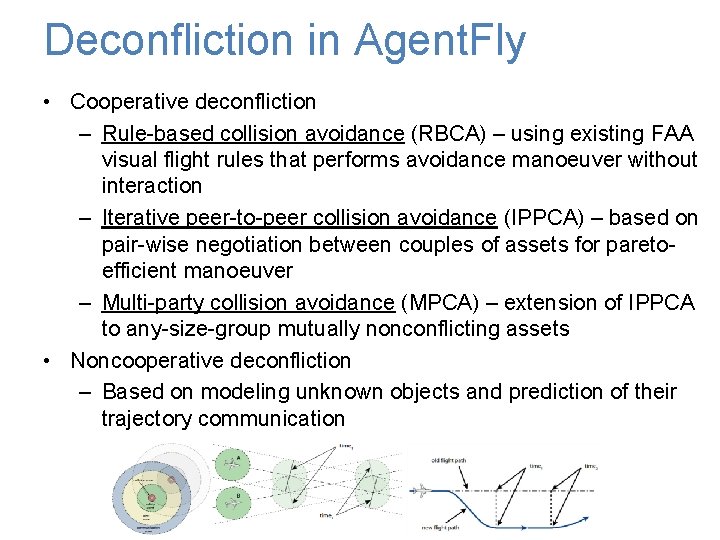
Deconfliction in Agent. Fly • Cooperative deconfliction – Rule-based collision avoidance (RBCA) – using existing FAA visual flight rules that performs avoidance manoeuver without interaction – Iterative peer-to-peer collision avoidance (IPPCA) – based on pair-wise negotiation between couples of assets for paretoefficient manoeuver – Multi-party collision avoidance (MPCA) – extension of IPPCA to any-size-group mutually nonconflicting assets • Noncooperative deconfliction – Based on modeling unknown objects and prediction of their trajectory communication
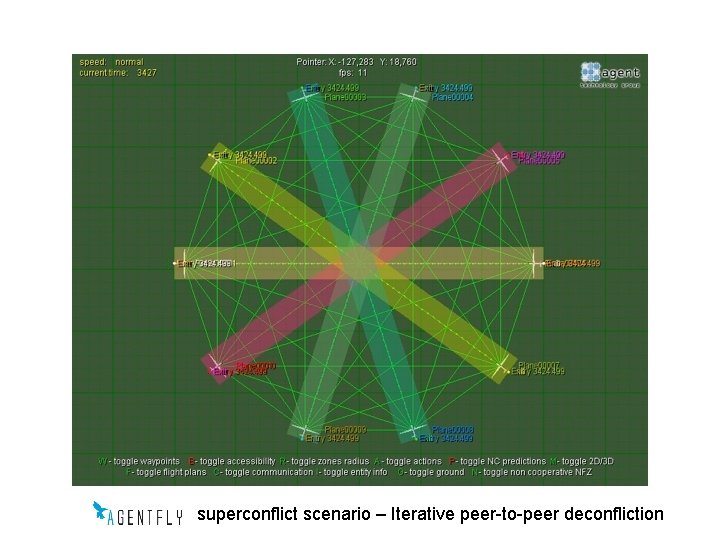
superconflict scenario – Iterative peer-to-peer deconfliction
superconflict – mixed multi-algorithm deconfliction, video
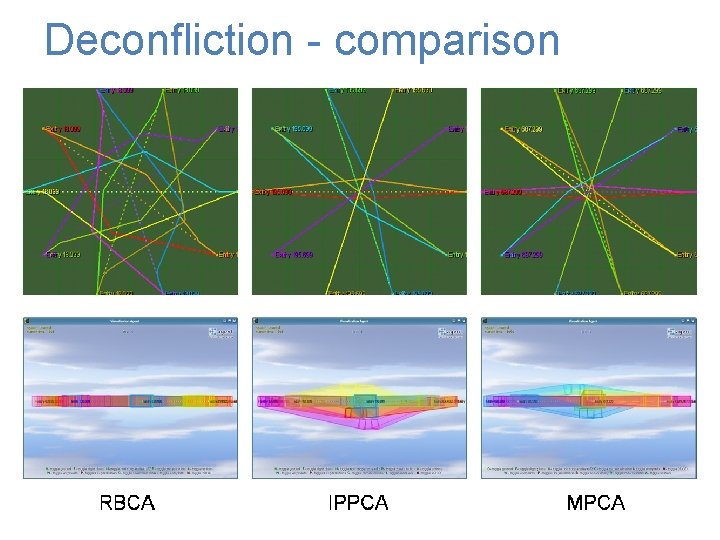
Deconfliction - comparison
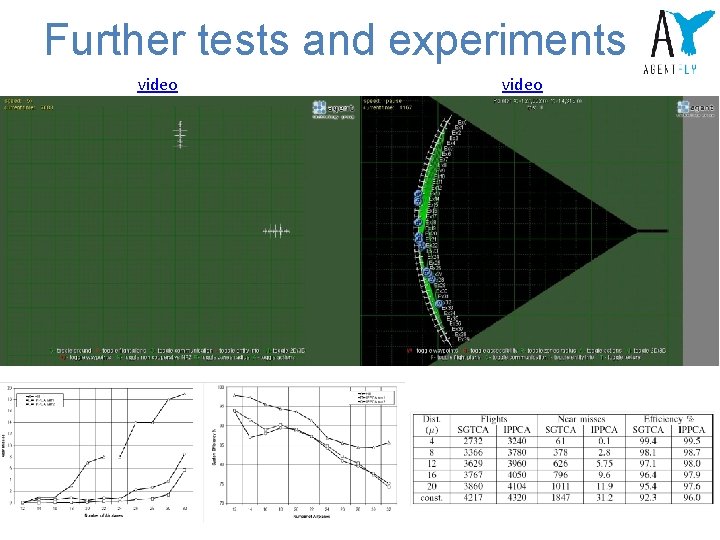
Further tests and experiments video
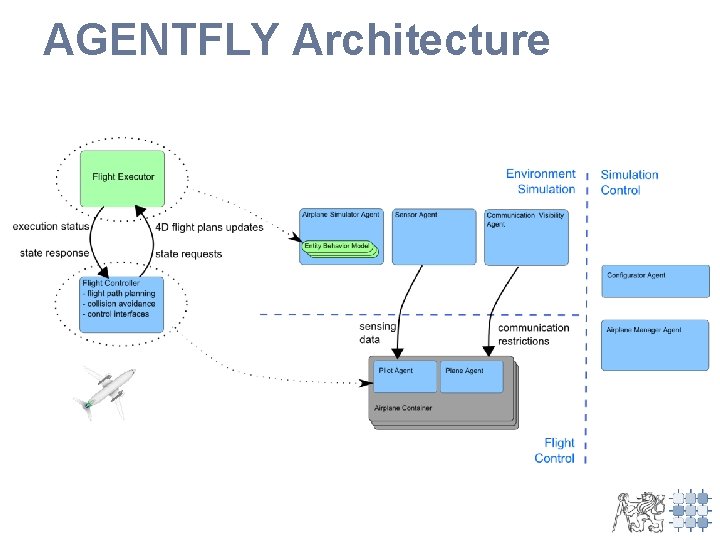
AGENTFLY Architecture
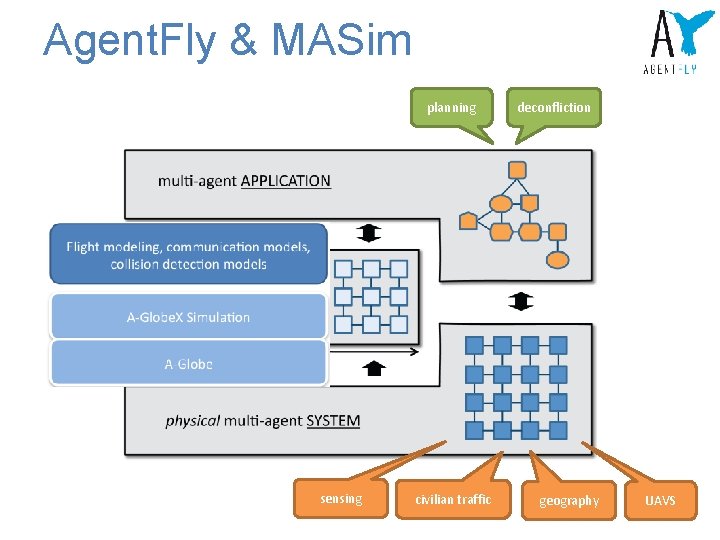
Agent. Fly & MASim planning sensing civilian traffic deconfliction geography UAVS


Accelerated A* (AA*) Algorithm • Highly efficient optimization-based search method • Provides sub-optimal trajectory with guaranteed difference to the optimal one • More than 1000 times faster than A* algorithm • AA* concept: – adaptive sampling (q = p, 2*p, 4*p, 8*p, 16*p, 32*p, 64*p, …) • rare sampling density in open spaces / higher density closer to obstacles • removes trade-off between speed and search precision – progressive path smoothing – every generated path is smoothed – similarity checks – used for OPEN and CLOSED operations – heuristic function – based on Dubin car • AA* challenge: – Speed/operation is given by the number of obstacles in the space in • (i) intersections test and (ii) adaptive sampling 53
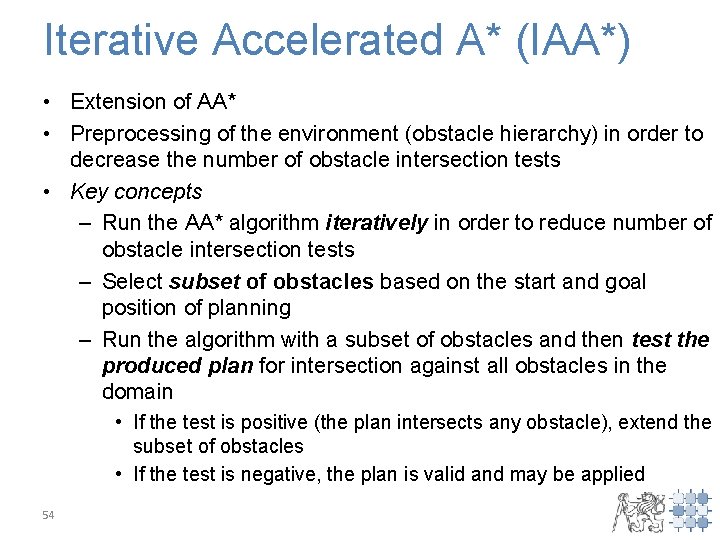
Iterative Accelerated A* (IAA*) • Extension of AA* • Preprocessing of the environment (obstacle hierarchy) in order to decrease the number of obstacle intersection tests • Key concepts – Run the AA* algorithm iteratively in order to reduce number of obstacle intersection tests – Select subset of obstacles based on the start and goal position of planning – Run the algorithm with a subset of obstacles and then test the produced plan for intersection against all obstacles in the domain • If the test is positive (the plan intersects any obstacle), extend the subset of obstacles • If the test is negative, the plan is valid and may be applied 54
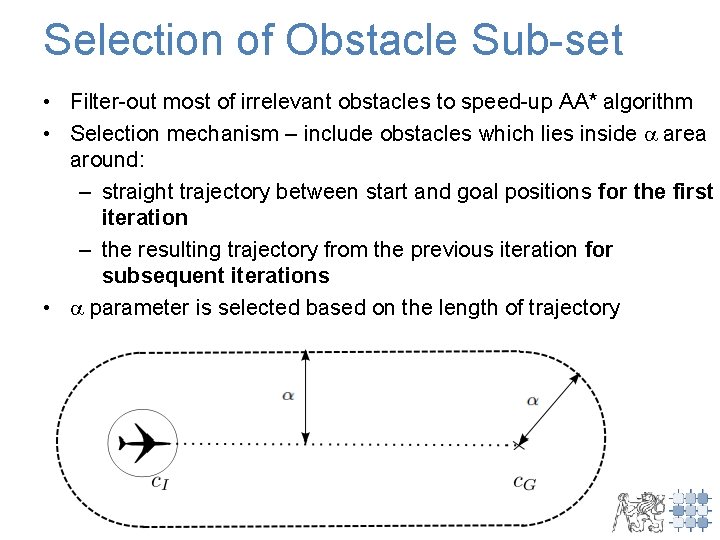
Selection of Obstacle Sub-set • Filter-out most of irrelevant obstacles to speed-up AA* algorithm • Selection mechanism – include obstacles which lies inside a area around: – straight trajectory between start and goal positions for the first iteration – the resulting trajectory from the previous iteration for subsequent iterations • a parameter is selected based on the length of trajectory
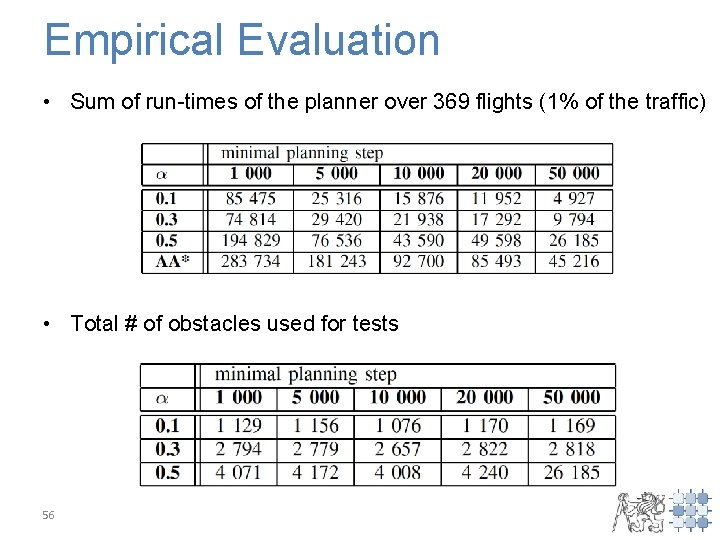
Empirical Evaluation • Sum of run-times of the planner over 369 flights (1% of the traffic) • Total # of obstacles used for tests 56
AGENTC Adversarial Modeling and Reasoning in the Maritime Domain Michal Jakob, Ondřej Vaněk, Štěpán Urban, Petr Benda and Michal Pěchouček (PI) Agent Technology Center Dept. of Cybernetics, FEE, Czech Technical University Prague, Czech Republic http: //agents. felk. cvut. cz Supported by the Office Of Naval Research grant no. N 00014 -09 -1 -0537
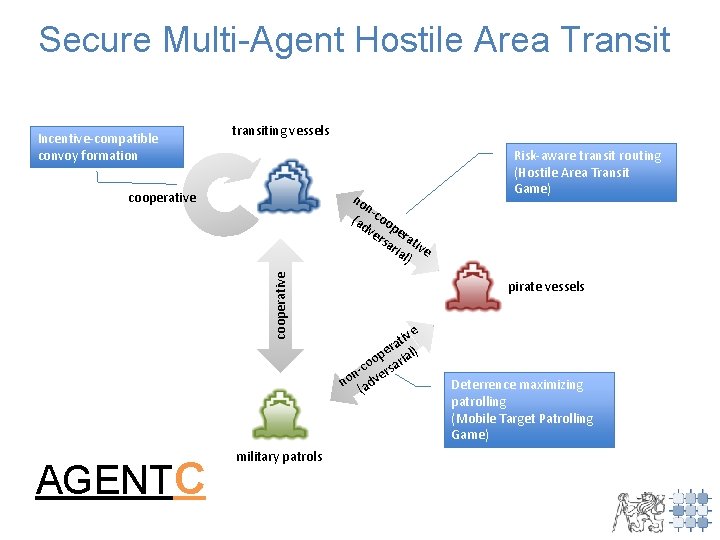
Secure Multi-Agent Hostile Area Transit Incentive-compatible convoy formation transiting vessels no n(ad coo ve per rsa at ria ive l) cooperative AGENTC military patrols Risk-aware transit routing (Hostile Area Transit Game) pirate vessels e tiv a r pe rial) o o a n-c vers o n (ad Deterrence maximizing patrolling (Mobile Target Patrolling Game)
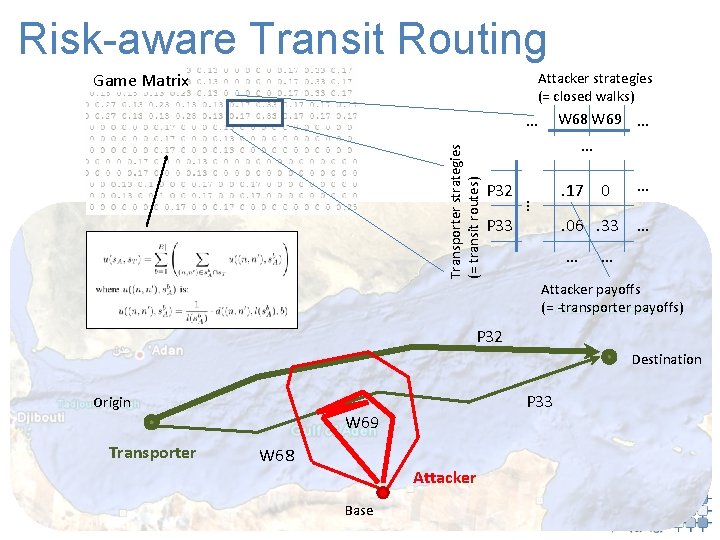
Risk-aware Transit Routing Game Matrix Attacker strategies (= closed walks) W 68 W 69 … … P 32 … Transporter strategies (= transit routes) … . 17 0 … . 06. 33 … P 33 … … Attacker payoffs (= -transporter payoffs) P 32 Destination Origin Transporter P 33 W 69 W 68 Attacker Base
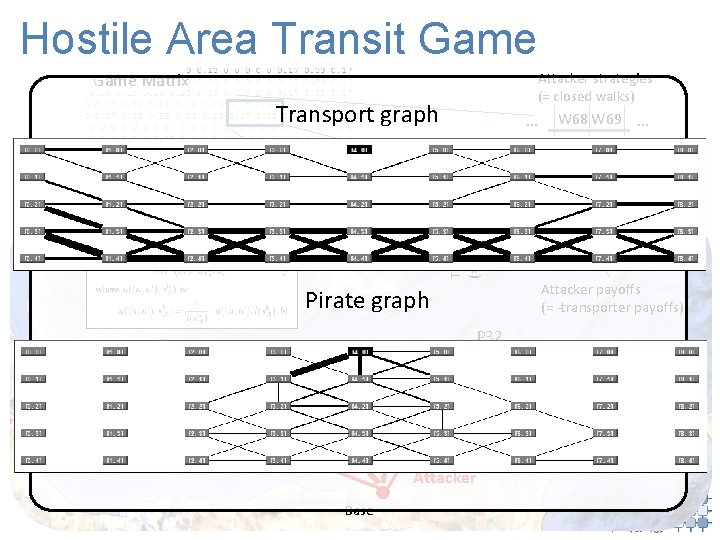
Hostile Area Transit Game Matrix Attacker strategies (= closed walks) Transport graph W 68 W 69 … … P 32 … Transporter strategies (= transit routes) … . 17 0 … . 06. 33 … P 33 … … Attacker payoffs (= -transporter payoffs) Pirate graph P 32 Destination Origin Transporter P 33 W 69 W 68 Attacker Base
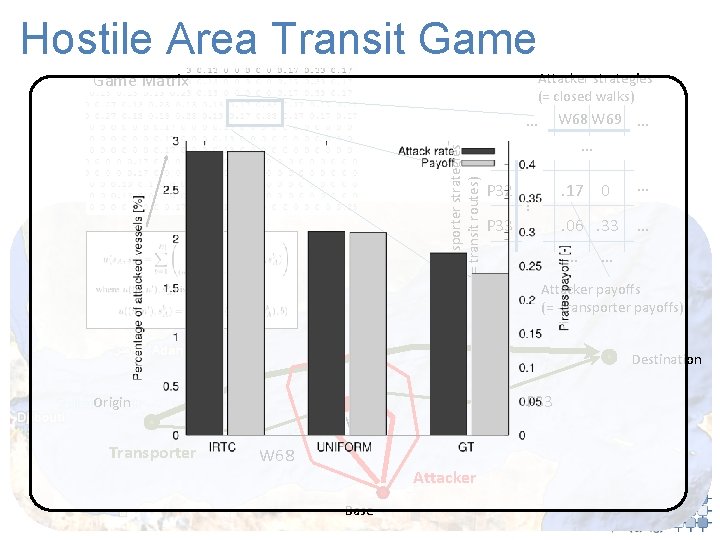
Hostile Area Transit Game Matrix Attacker strategies (= closed walks) W 68 W 69 … … P 32 … Transporter strategies (= transit routes) … . 17 0 … . 06. 33 … P 33 … … Attacker payoffs (= -transporter payoffs) P 32 Destination Origin Transporter P 33 W 69 W 68 Attacker Base
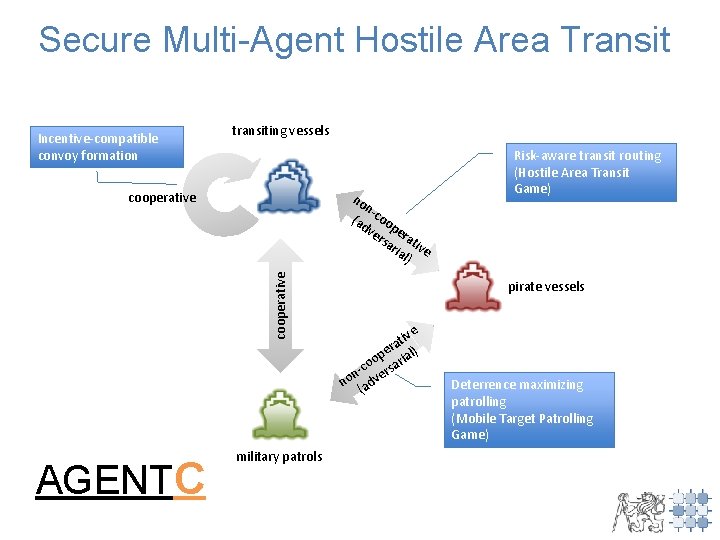
Secure Multi-Agent Hostile Area Transit Incentive-compatible convoy formation transiting vessels no n(ad coo ve per rsa at ria ive l) cooperative AGENTC military patrols Risk-aware transit routing (Hostile Area Transit Game) pirate vessels e tiv a r pe rial) o o a n-c vers o n (ad Deterrence maximizing patrolling (Mobile Target Patrolling Game)
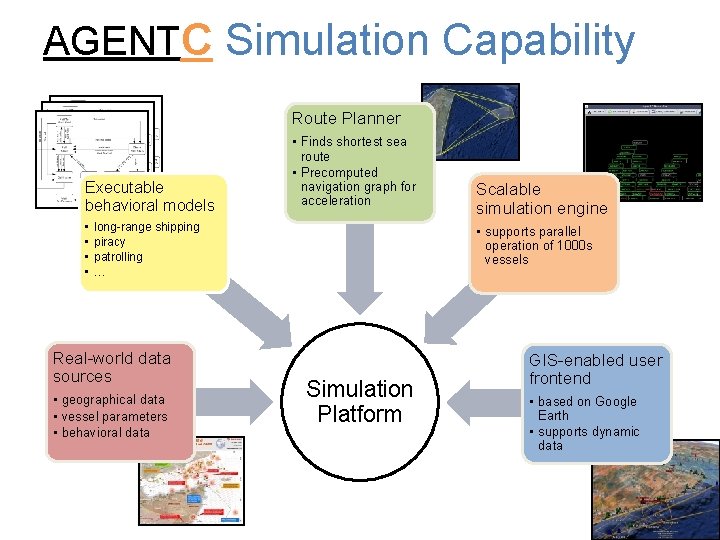
AGENTC Simulation Capability Route Planner Executable behavioral models • • • Finds shortest sea route • Precomputed navigation graph for acceleration long-range shipping piracy patrolling … Real-world data sources • geographical data • vessel parameters • behavioral data Scalable simulation engine • supports parallel operation of 1000 s vessels Simulation Platform GIS-enabled user frontend • based on Google Earth • supports dynamic data
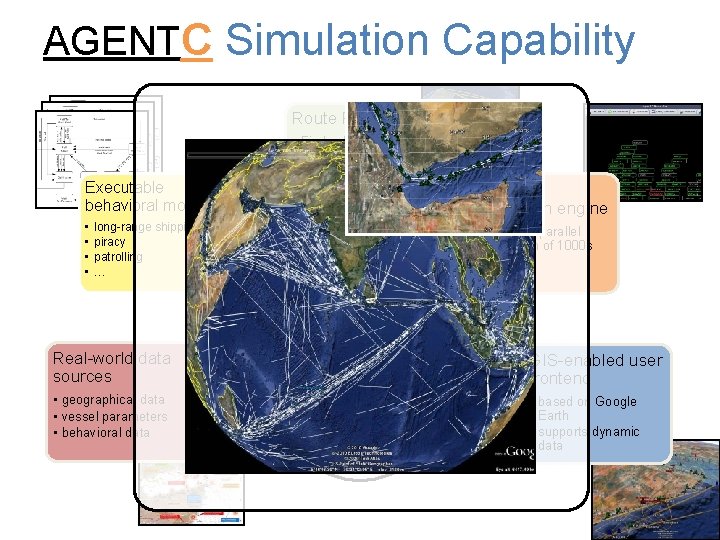
AGENTC Simulation Capability Route Planner Executable behavioral models • • • Finds shortest sea route • Precomputed navigation graph for acceleration long-range shipping piracy patrolling … Real-world data sources • geographical data • vessel parameters • behavioral data Scalable simulation engine • supports parallel operation of 1000 s vessels Simulation Platform GIS-enabled user frontend • based on Google Earth • supports dynamic data
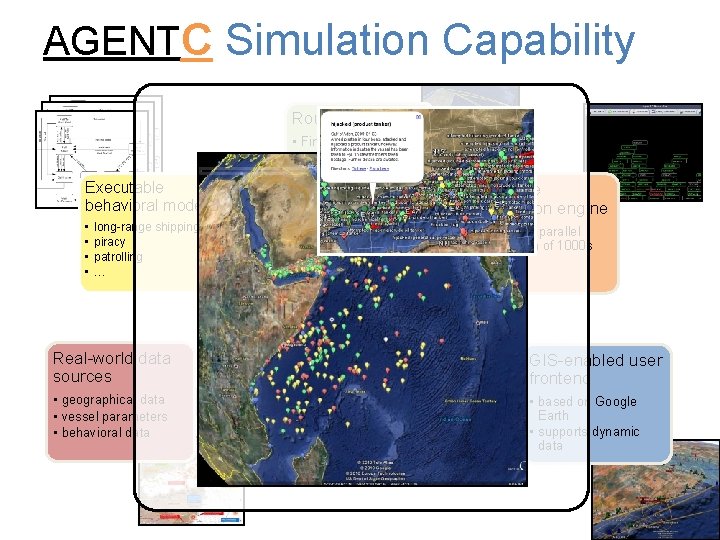
AGENTC Simulation Capability Route Planner Executable behavioral models • • • Finds shortest sea route • Precomputed navigation graph for acceleration long-range shipping piracy patrolling … Real-world data sources • geographical data • vessel parameters • behavioral data Scalable simulation engine • supports parallel operation of 1000 s vessels Simulation Platform GIS-enabled user frontend • based on Google Earth • supports dynamic data
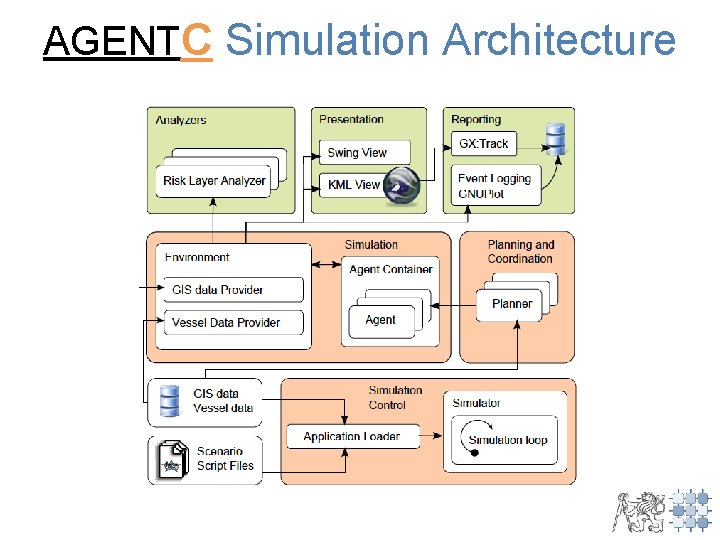
AGENTC Simulation Architecture
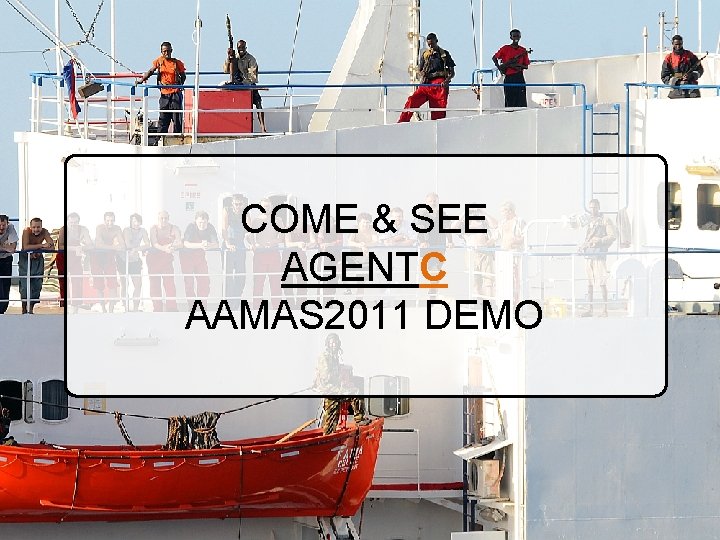
COME & SEE AGENTC AAMAS 2011 DEMO

MASim Suitable Application Areas • Agents/Actors exhibit intelligent (deliberative) behavior, including learning, adaptation and strategic reasoning • Agent’s behavior has non-smooth/discrete dynamics with thresholds, if-then rules, observation-based and interactionbased triggers etc. • Interactions between agents are complex, nonlinear, discontinuous, or discrete; network-effects apply – Topology of the interactions is heterogeneous and complex • Population is heterogeneous and large scale • Space is crucial and the agents' positions are not fixed • System-level equations are not known, hard to reconstruct, do not exist or computational intractable 70
Agent. POLIS – Traffic Model • Large-scale multi-agent model of urban mixed transport • Based on activity-rich urban citizen lifecycle model, bottom-up model • Multiple transport modes – individual cars, bikes, mass public transport (metro, trams, buses) – real lines and approximate schedules • Tested with 100 k agents but further scale-up possible • In parts funded by IBM, government grant awarded (rejected by IBM) • Will be used for experimenting with Prague metro fare-evaders project 71
Agent. POLIS – Traffic Model • Traffic modeling: Model traffic demand distribution to aid infrastructure planning and understand the impact of policy decisions • 3 principal approaches: trip-based, activity-based, agent-based. • GOALS: – Study agents strategic behavior with respect to mixed-modal choice of various means of transport and various times of transport in context of their social and individual activities – By means of incentives, design methods for optimization – Car-pooling, request-based bus services, cab sharing, zipcars, etc. – Also used for studying railway fare enforcement methods 72
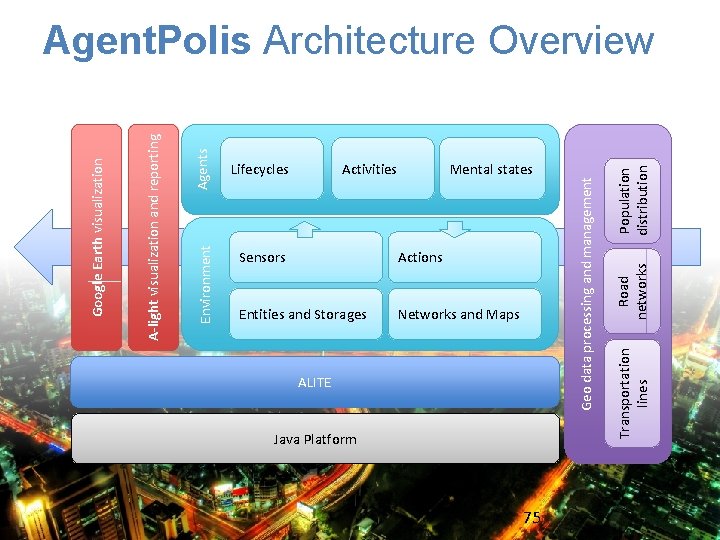
Environment Agents A-light visualization and reporting Google Earth visualization Lifecycles Activities Mental states Sensors Actions Entities and Storages Networks and Maps ALITE 75 Transportation lines Java Platform Road networks Population distribution Geo data processing and management Agent. Polis Architecture Overview
Agent. POLIS DEMO

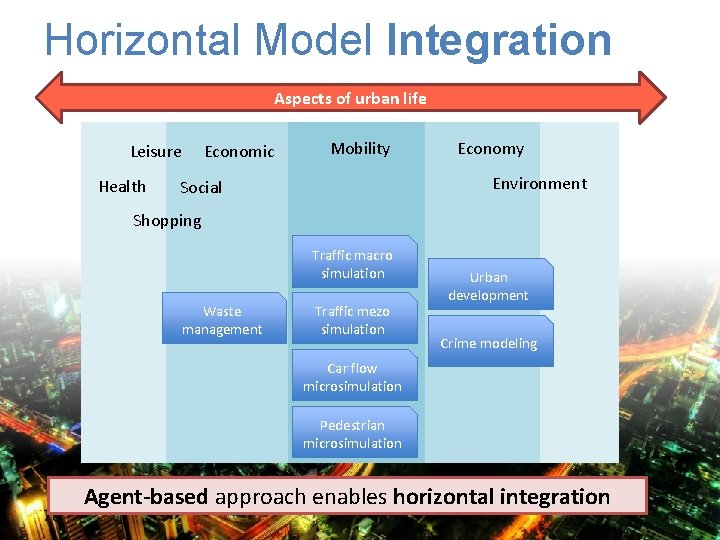
Horizontal Model Integration Aspects of urban life Leisure Health Economic Mobility Economy Environment Social Shopping Traffic macro simulation Waste management Traffic mezo simulation Urban development Crime modeling Car flow microsimulation Pedestrian microsimulation 78 Agent-based approach enables horizontal integration
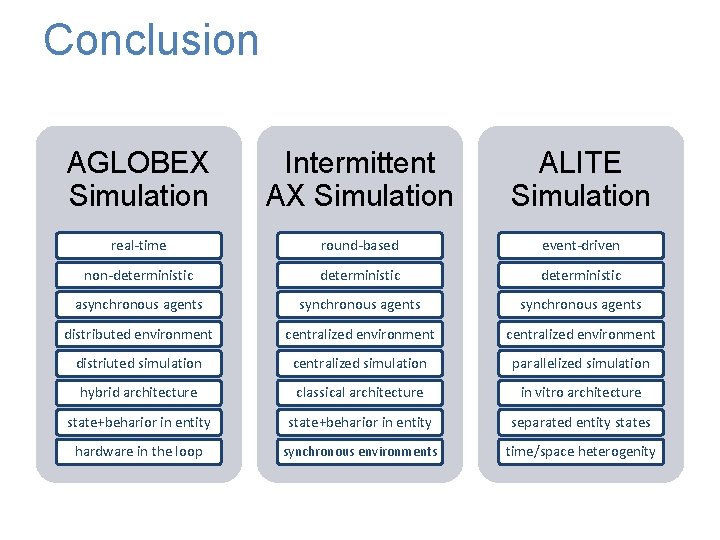
Conclusion AGLOBEX Simulation Intermittent AX Simulation ALITE Simulation real-time round-based event-driven non-deterministic asynchronous agents distributed environment centralized environment distriuted simulation centralized simulation parallelized simulation hybrid architecture classical architecture in vitro architecture state+beharior in entity separated entity states hardware in the loop synchronous environments time/space heterogenity
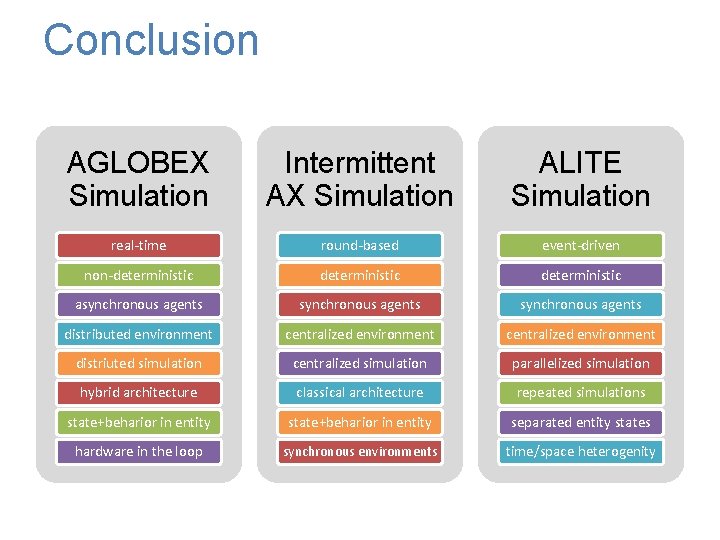
Conclusion AGLOBEX Simulation Intermittent AX Simulation ALITE Simulation real-time round-based event-driven non-deterministic asynchronous agents distributed environment centralized environment distriuted simulation centralized simulation parallelized simulation hybrid architecture classical architecture repeated simulations state+beharior in entity separated entity states hardware in the loop synchronous environments time/space heterogenity
- Slides: 60