
Multiagent Models in Economics a new tool for
- Slides: 24
Multi-agent Models in Economics - a new tool for a new paradigm - Yoshinori Shiozawa (Osaka City University)
Contents: n n n 1. Introduction 2. The state of the art of the economic science 3. The need for a paradigm shift 4. The merits of multi-agent models 5. The challenge of the U-Mart project 6. Some theoretical problems and difficulties to overcome
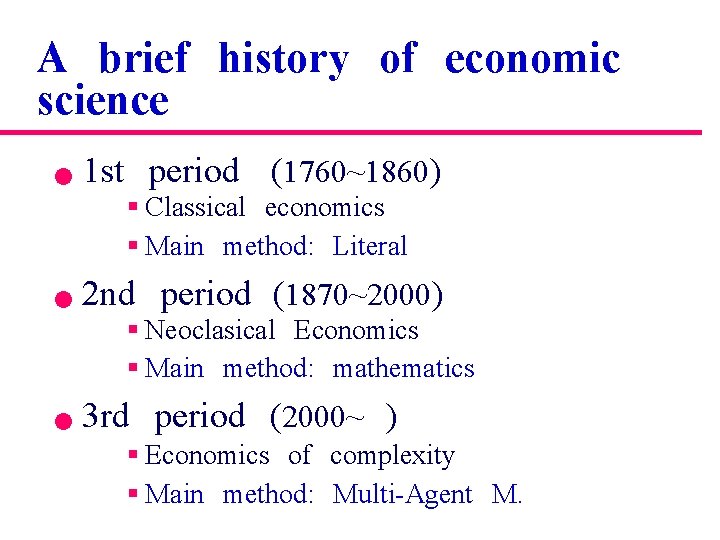
A brief history of economic science n 1 st period (1760~1860) § Classical economics § Main method: Literal n 2 nd period (1870~2000) § Neoclasical Economics § Main method: mathematics n 3 rd period (2000~ ) § Economics of complexity § Main method: Multi-Agent M.
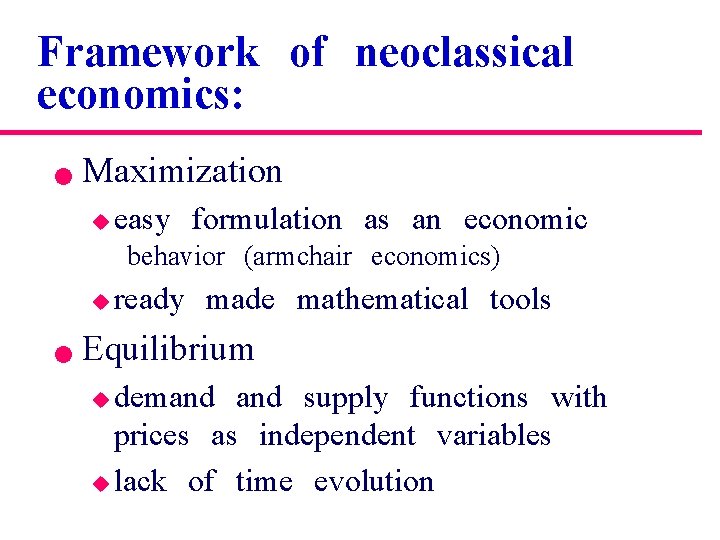
Framework of neoclassical economics: n Maximization u easy formulation as an economic behavior (armchair economics) u n ready made mathematical tools Equilibrium demand supply functions with prices as independent variables u lack of time evolution u
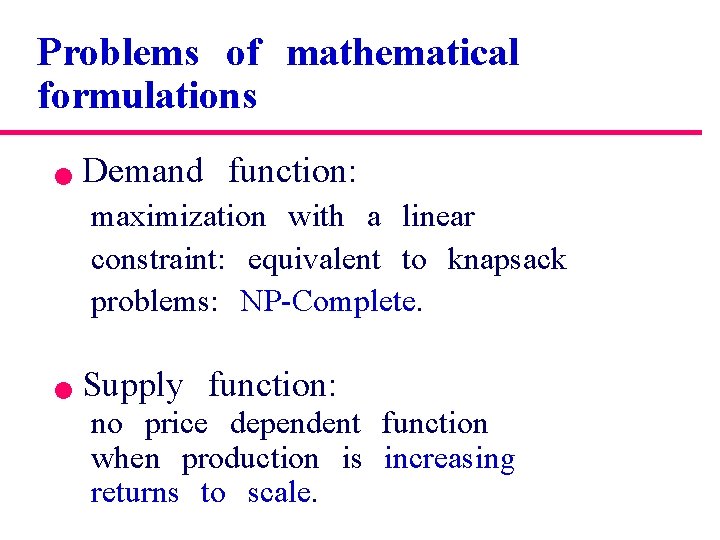
Problems of mathematical formulations n Demand function: maximization with a linear constraint: equivalent to knapsack problems: NP-Complete. n Supply function: no price dependent function when production is increasing returns to scale.
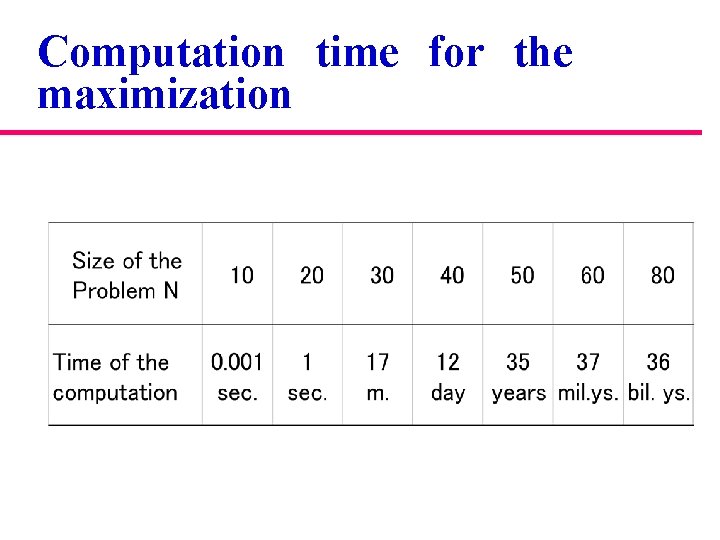
Computation time for the maximization
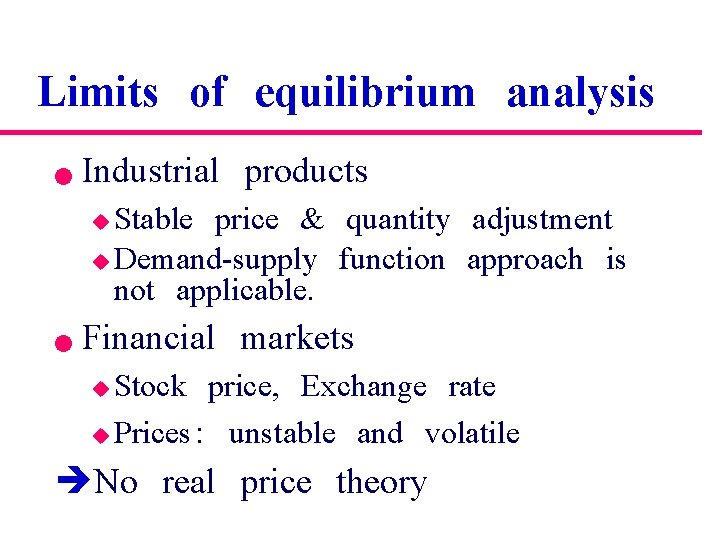
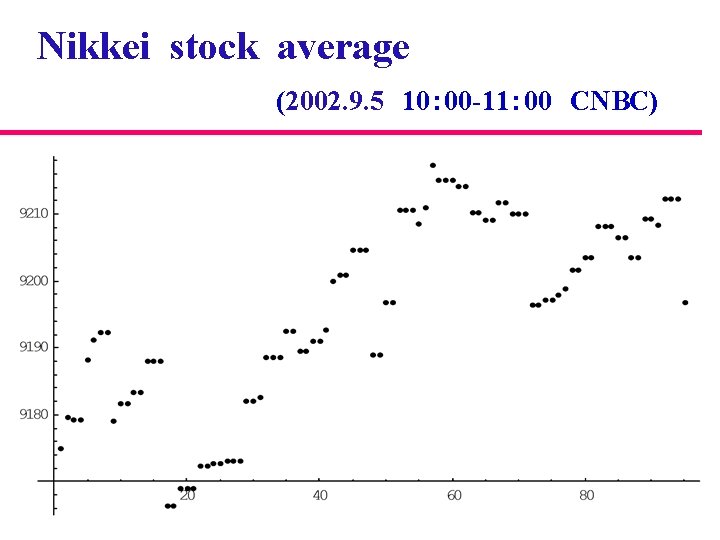
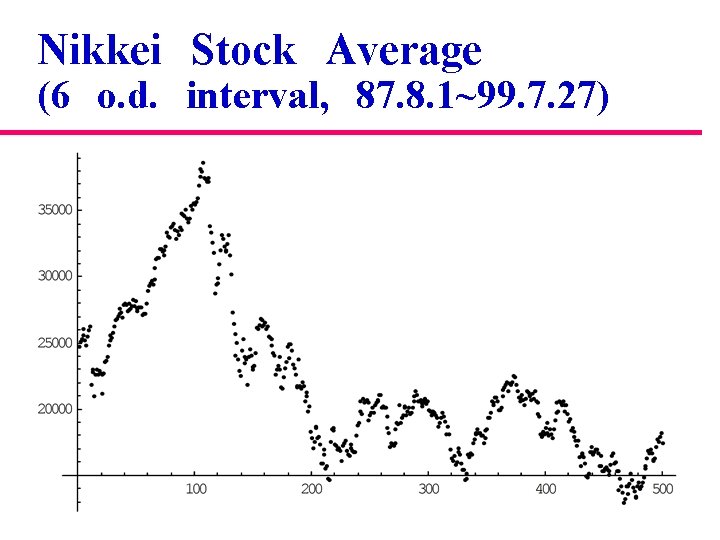
Limits of equilibrium analysis n Industrial products Stable price & quantity adjustment u Demand-supply function approach is not applicable. u n Financial markets Stock price, Exchange rate u Prices: unstable and volatile u èNo real price theory
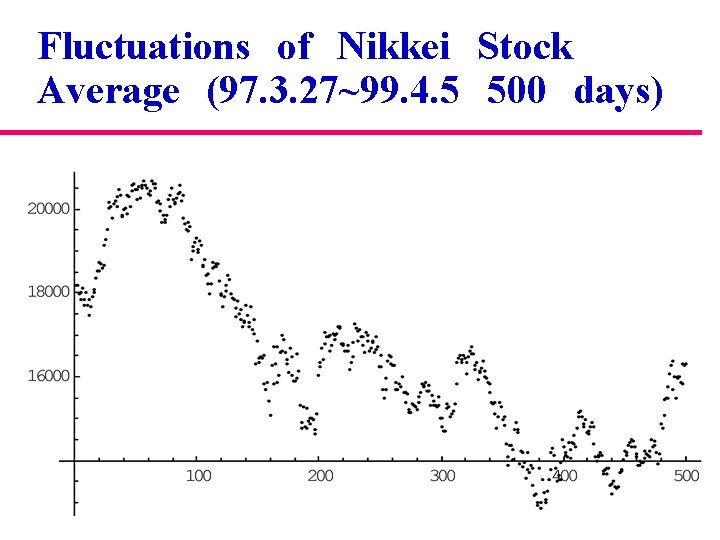
Fluctuations of Nikkei Stock Average (97. 3. 27~99. 4. 5 500 days)
Nikkei stock average (2002. 9. 5 10: 00 -11: 00 CNBC)
Nikkei Stock Average (6 o. d. interval, 87. 8. 1~99. 7. 27)
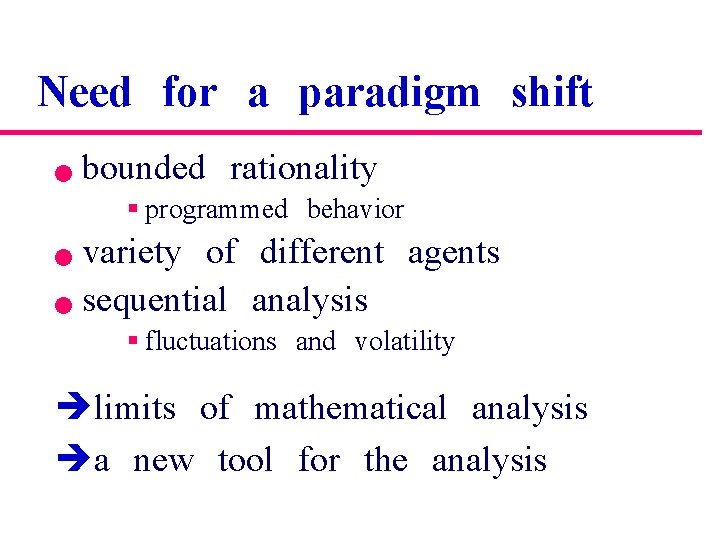
Need for a paradigm shift n bounded rationality § programmed behavior variety of different agents n sequential analysis n § fluctuations and volatility èlimits of mathematical analysis èa new tool for the analysis
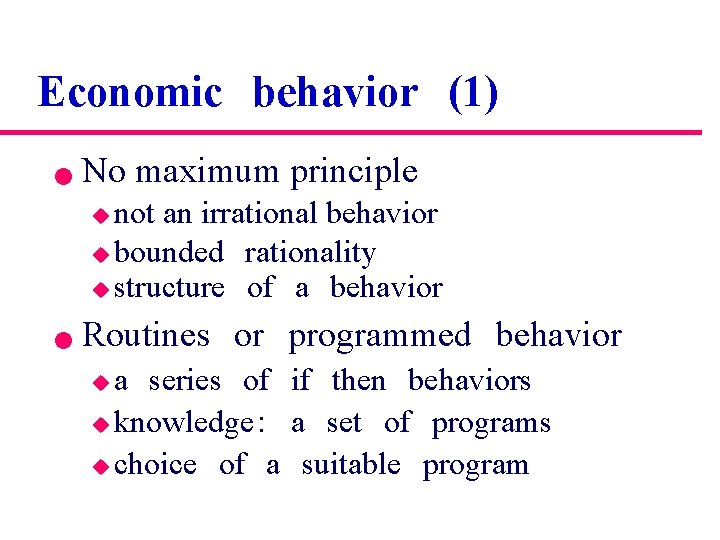
Economic behavior (1) n No maximum principle not an irrational behavior u bounded rationality u structure of a behavior u n Routines or programmed behavior a series of if then behaviors u knowledge: a set of programs u choice of a suitable program u
Economic behaviors (2) n Simplest cases: u C-D transformation çProf. Yoshida (Chuo U. ) u Rule: If (conditions), then (action). çClassifier system of Holland n Evolution of behaviors Evolutionary economics u Genetic algorithm u
Multi-agent model analysis n characteristics of agents programmed behavior èan agent with behavioral programs u n different agents can generate different types of behaviors èbehavior with different parameters u n mutual interactions u no equilibrium situation
U-Mart project: An open common test bed for market experiments n Close collaboration of economists and engineers n A grounding to the reality n Human and machine agents at the equal footing n
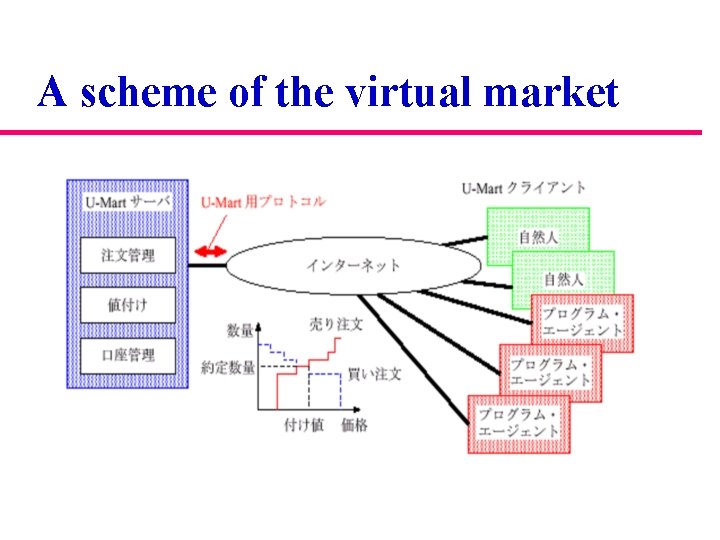
A scheme of the virtual market
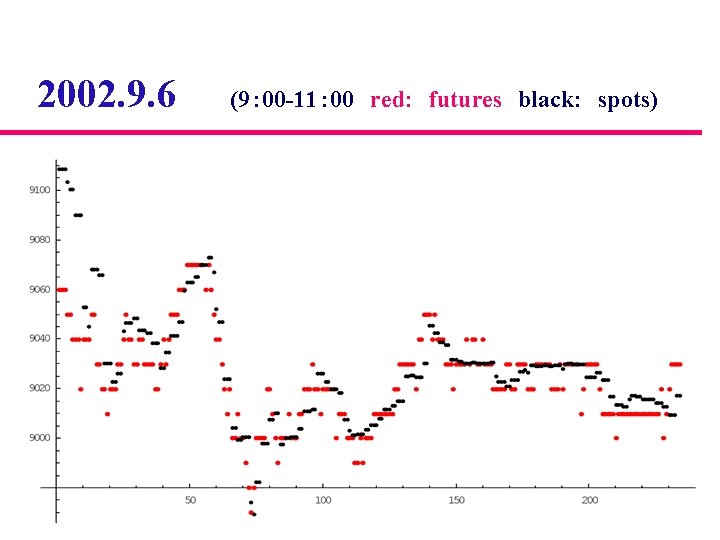
2002. 9. 6 (9: 00 -11: 00 red: futures black: spots)
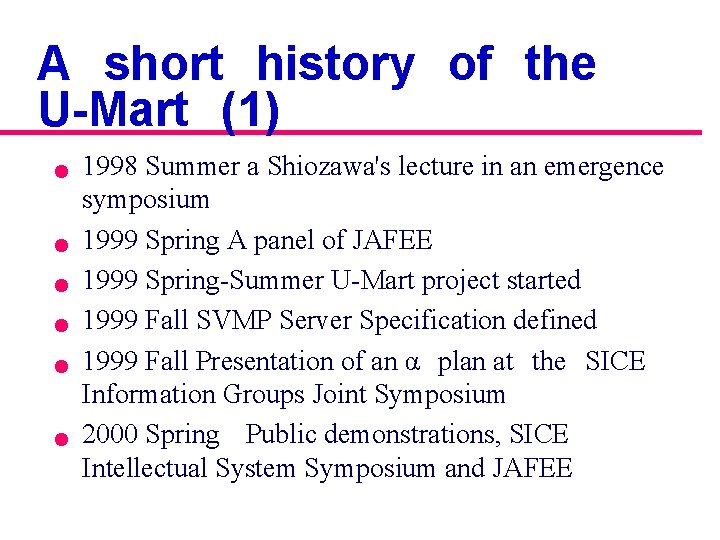
A short history of the U-Mart (1) n n n 1998 Summer a Shiozawa's lecture in an emergence symposium 1999 Spring A panel of JAFEE 1999 Spring-Summer U-Mart project started 1999 Fall SVMP Server Specification defined 1999 Fall Presentation of an α plan at the SICE Information Groups Joint Symposium 2000 Spring Public demonstrations, SICE Intellectual System Symposium and JAFEE
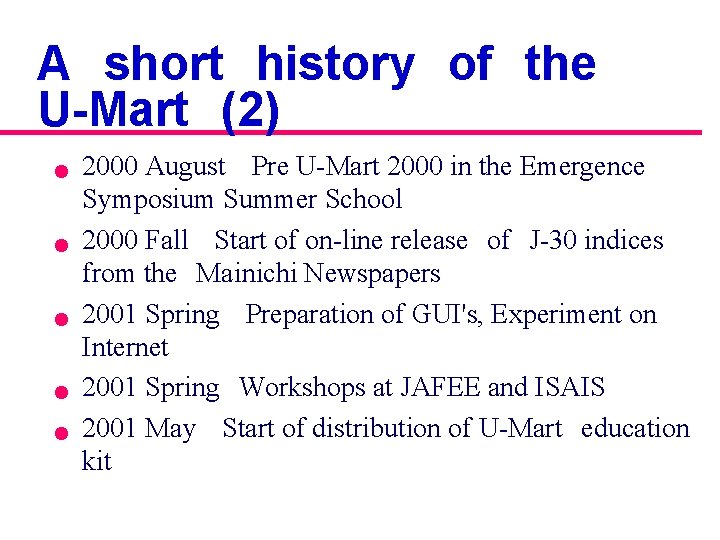
A short history of the U-Mart (2) n n n 2000 August Pre U-Mart 2000 in the Emergence Symposium Summer School 2000 Fall Start of on-line release of J-30 indices from the Mainichi Newspapers 2001 Spring Preparation of GUI's, Experiment on Internet 2001 Spring Workshops at JAFEE and ISAIS 2001 May Start of distribution of U-Mart education kit
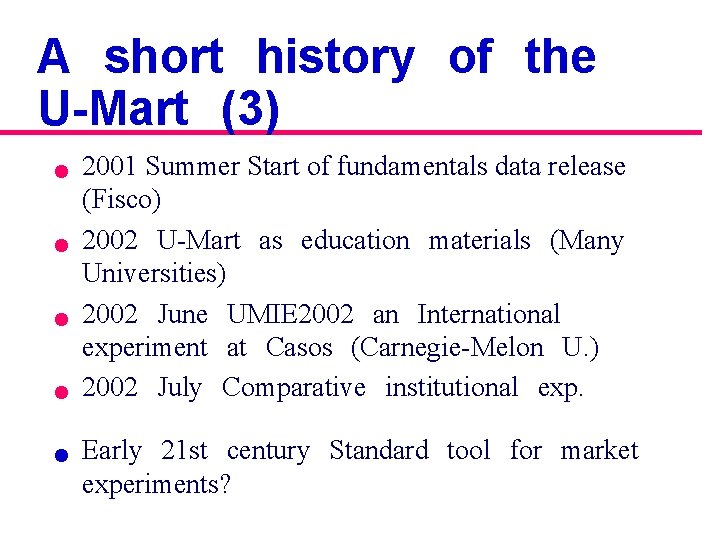
A short history of the U-Mart (3) n n n 2001 Summer Start of fundamentals data release (Fisco) 2002 U-Mart as education materials (Many Universities) 2002 June UMIE 2002 an International experiment at Casos (Carnegie-Melon U. ) 2002 July Comparative institutional exp. Early 21 st century Standard tool for market experiments?
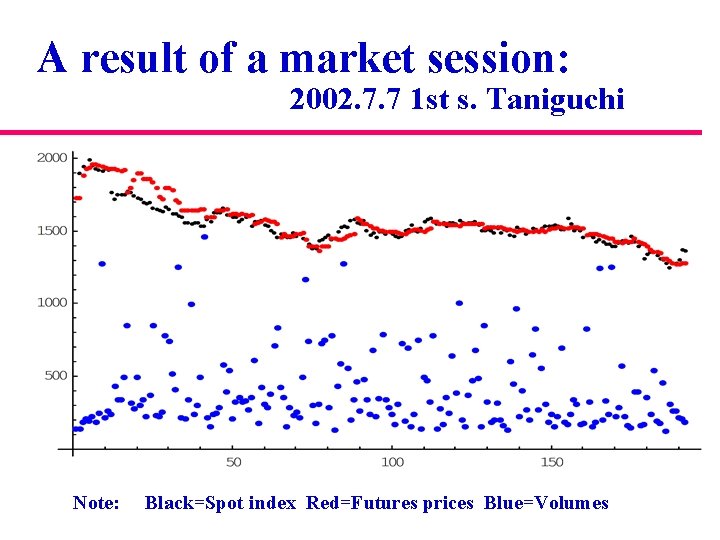
A result of a market session: 2002. 7. 7 1 st s. Taniguchi Note: Black=Spot index Red=Futures prices Blue=Volumes
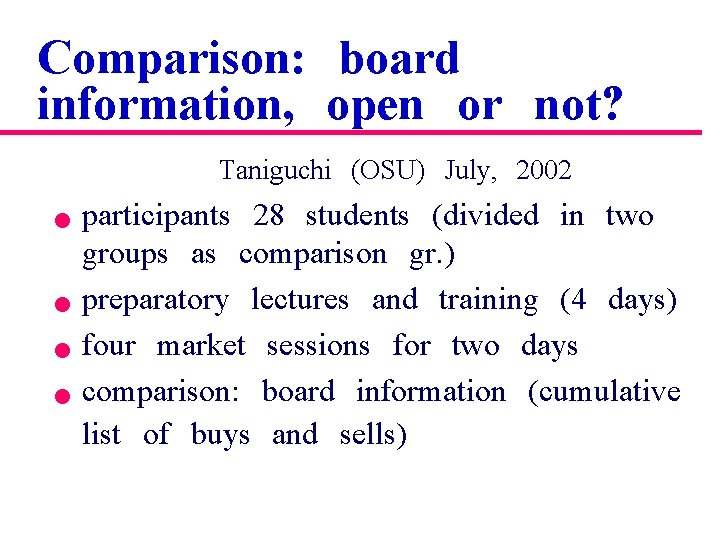
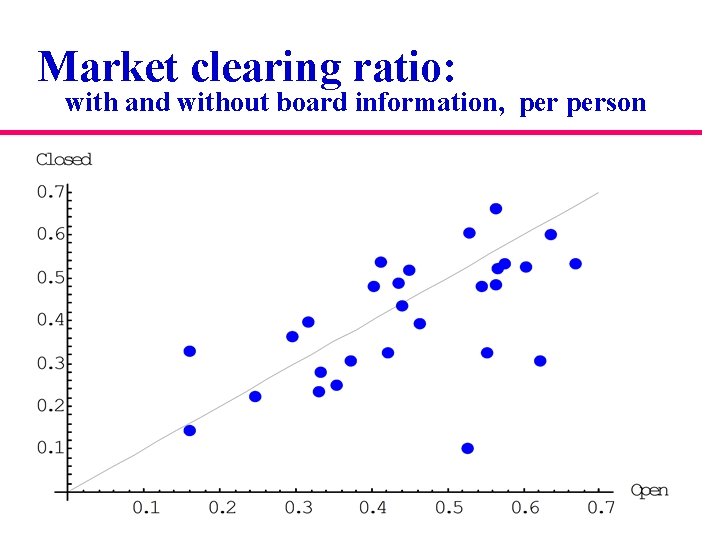
Comparison: board information, open or not? Taniguchi (OSU) July, 2002 n n participants 28 students (divided in two groups as comparison gr. ) preparatory lectures and training (4 days) four market sessions for two days comparison: board information (cumulative list of buys and sells)
Market clearing ratio: with and without board information, person
Some useful references: n U-Mart Web Page: http: //www. u-mart. econ. kyoto-u. ac. jp/ u UMIE 2002 u U-Mart Kit (in Japanese) u etc. n Shiozawa's Web Page: http: //www. shiozawa. net/