
Multi systemic Therapy for social emotional and behavioral
Multi systemic Therapy for social, emotional, and behavioral problems in youth aged 10 -17 (Review) Littell JH, Popa M, Forsythe B. Multisystemic Therapy for social, emotional, and behavioral problems in youth aged 10 -17. Cochrane Database of Systematic Reviews 2005, Issue 4. Art. No. : CD 004797. DOI: 10. 1002/14651858. CD 004797. pub 4. The Cochrane Collaboration

Multi Systemic Therapy n Multi systemic Therapy (MST) is an intensive, home-based intervention for families of youth with social, emotional, and behavioral problems. Masters-level therapists engage family members in identifying and changing individual, family, and environmental factors thought to contribute to problem behavior. Intervention may include efforts to improve communication, parenting skills, peer relations, school performance, and social networks.
Objectives n To provide unbiased estimates of the impacts of MST with youth and families on 1. restrictive out-of-home living arrangements, 2. crime and delinquency, and 3. other behavioral and psychosocial outcomes.
Search strategy n Electronic searches were made of bibliographic databases (including the Cochrane Library, C 2 -SPECTR, Psyc. INFO, Science Direct and Sociological Abstracts) as well as government and professional websites.

Time period and Place n n from 1985 to January 2003 Data is retrieved from USA, Canada and Norway
Inclusion Criteria n n 1. 2. 3. n Studies where youth (age 10 -17) with social, emotional, and/or behavioral problems were randomized to licensed MST programs or other conditions (usual services or alternative treatments) and that included their family members. These youth may be at risk of out-of-home placement. Participants include: abused, neglected, and dependent children and youth who may be at risk of foster care or other out-of-home placements in child welfare settings; children and youth with mental health problems who may be at risk of psychiatric hospitalization; and delinquent youth at risk of incarceration or placement in residential treatment settings. The review was limited to experimental studies in which participants were randomly assigned to groups. Studies using other group designs were identified, but not included. There were no publication or language restrictions.
Outcome Measures n n n Behavioral outcomes included antisocial behavior (as measured by arrest or conviction of a criminal offense), drug use (self-reports and drug tests), and school attendance. Psychosocial outcomes included measures of psychiatric symptoms (on standardized scales), school performance (teacher reports), peer relations (self-reports and parent or teacher reports), and self esteem. Family outcomes include living arrangements for children and youth (primarily in-home versus outof-home care) and qualities of family functioning (e. g. , adaptability, cohesion).
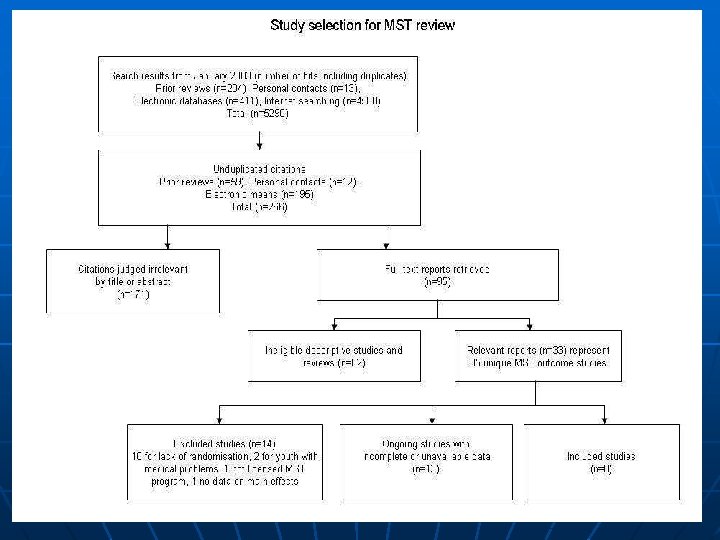
Data Review n n n Two reviewers independently reviewed 266 titles and abstracts; 95 full-text reports were retrieved, and 35 unique studies were identified. Two reviewers independently read all study reports for inclusion. Eight studies were eligible for inclusion. Two reviewers independently assessed study quality and extracted data from these studies.
Main results n The most rigorous (intent-to-treat) analysis found no significant differences between MST and usual services in restrictive out-of-home placements and arrests or convictions. Pooled results that include studies with data of varying quality tend to favor MST, but these relative effects are not significantly different from zero. The study sample size is small and effects are not consistent across studies; hence, it is not clear whether MST has clinically significant advantages over other services.
- Slides: 10