
Multi Sectoral Issues in Nutritional Assessment with Examples

- Slides: 20
Multi Sectoral Issues in Nutritional Assessment with Examples from Health Sectors Dr. SK Roy MBBS, M. Sc. Nutr (London), Dip-in-Biotech(UNU), Ph. D(London), FRCP (Edin)
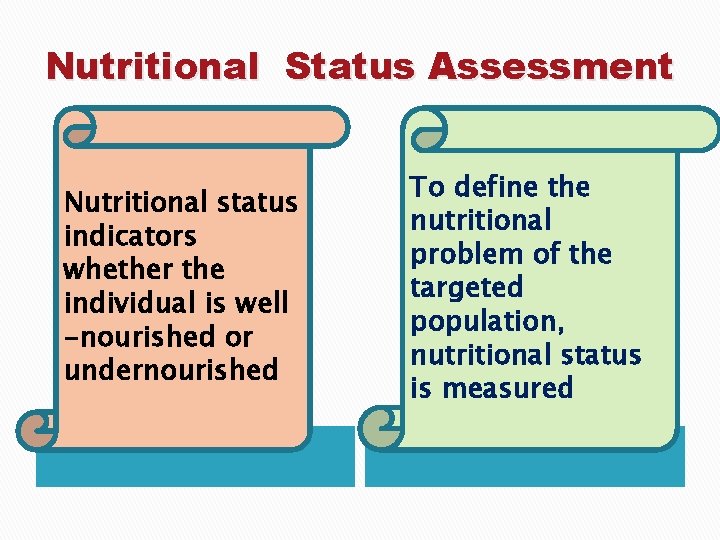
Nutritional Status Assessment Nutritional status indicators whether the individual is well -nourished or undernourished To define the nutritional problem of the targeted population, nutritional status is measured
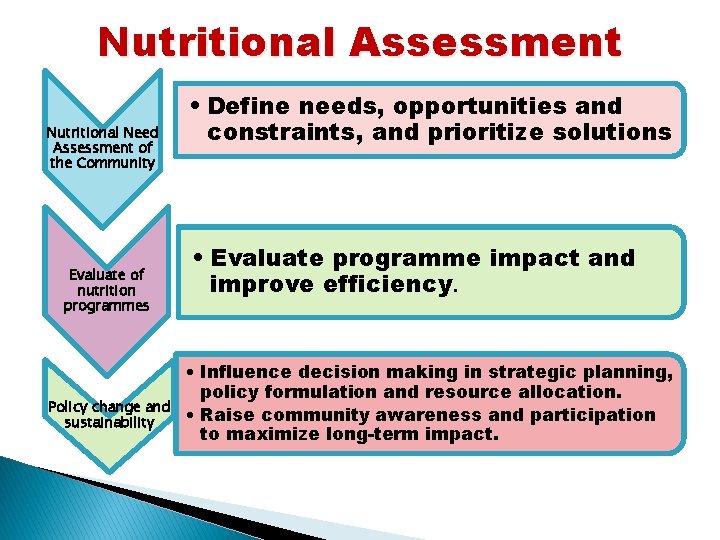
Nutritional Assessment Nutritional Need Assessment of the Community Evaluate of nutrition programmes Policy change and sustainability • Define needs, opportunities and constraints, and prioritize solutions • Evaluate programme impact and improve efficiency. • Influence decision making in strategic planning, policy formulation and resource allocation. • Raise community awareness and participation to maximize long-term impact.
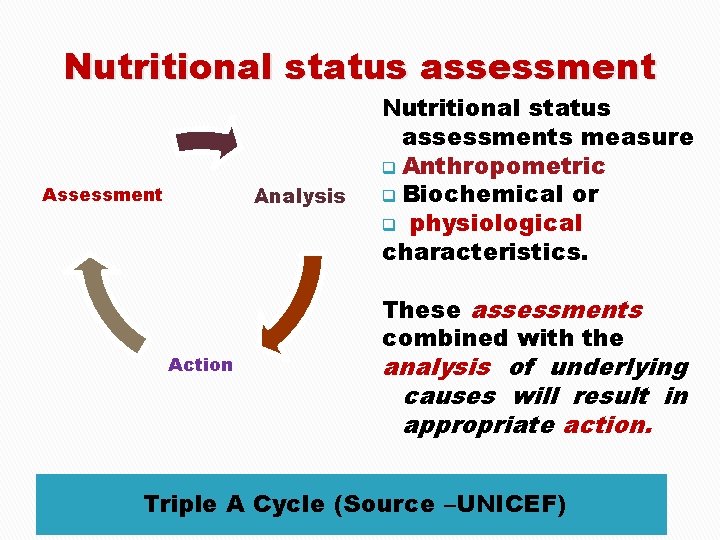
Nutritional status assessment Analysis Action Nutritional status assessments measure q Anthropometric q Biochemical or q physiological characteristics. These assessments combined with the analysis of underlying causes will result in appropriate action. Triple A Cycle (Source –UNICEF)
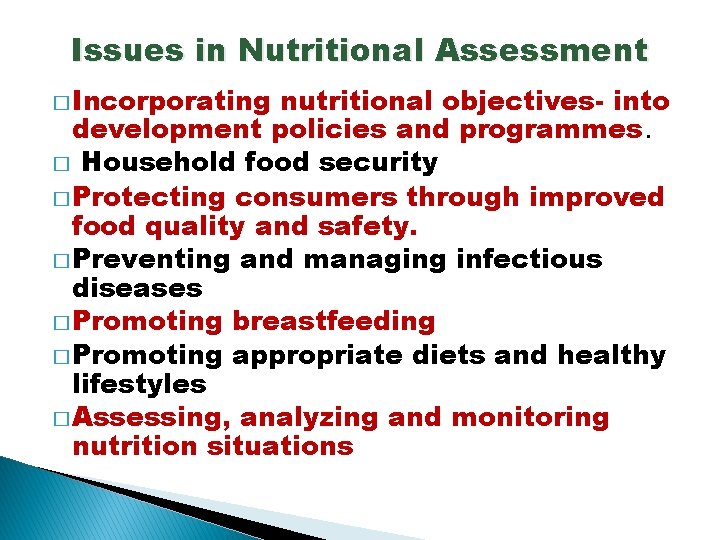
Issues in Nutritional Assessment � Incorporating nutritional objectives- into development policies and programmes. � Household food security � Protecting consumers through improved food quality and safety. � Preventing and managing infectious diseases � Promoting breastfeeding � Promoting appropriate diets and healthy lifestyles � Assessing, analyzing and monitoring nutrition situations
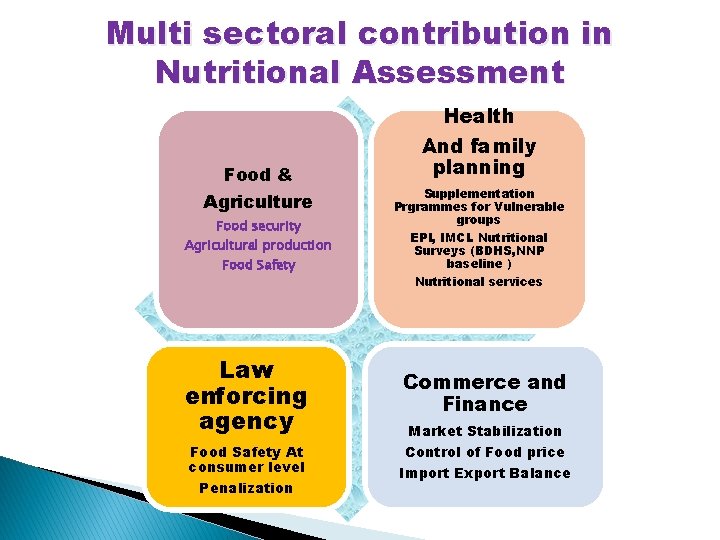
Multi sectoral contribution in Nutritional Assessment Food & Agriculture Food security Agricultural production Food Safety Law enforcing agency Food Safety At consumer level Penalization Health And family planning Supplementation Prgrammes for Vulnerable groups EPI, IMCI. Nutritional Surveys (BDHS, NNP baseline ) Nutritional services Commerce and Finance Market Stabilization Control of Food price Import Export Balance
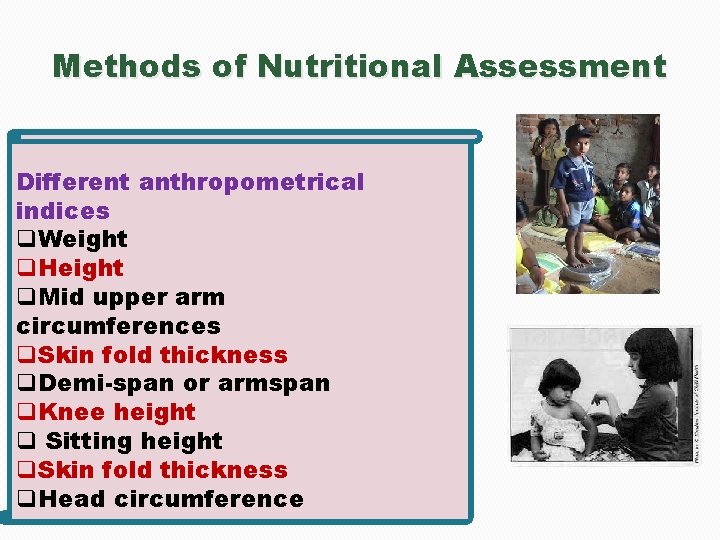
Methods of Nutritional Assessment Different anthropometrical indices q. Weight q. Height q. Mid upper arm circumferences q. Skin fold thickness q. Demi-span or armspan q. Knee height q Sitting height q. Skin fold thickness q. Head circumference
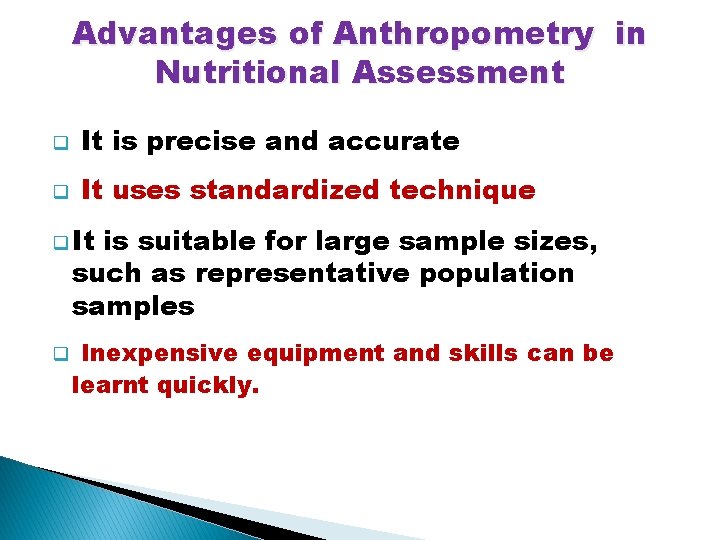
Advantages of Anthropometry in Nutritional Assessment q It is precise and accurate q It uses standardized technique q It is suitable for large sample sizes, such as representative population samples q Inexpensive equipment and skills can be learnt quickly.
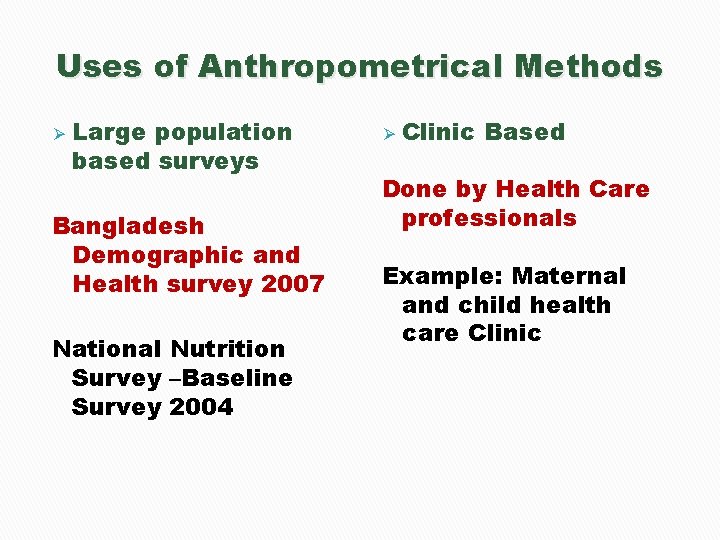
Uses of Anthropometrical Methods Ø Large population based surveys Bangladesh Demographic and Health survey 2007 National Nutrition Survey –Baseline Survey 2004 Ø Clinic Based Done by Health Care professionals Example: Maternal and child health care Clinic
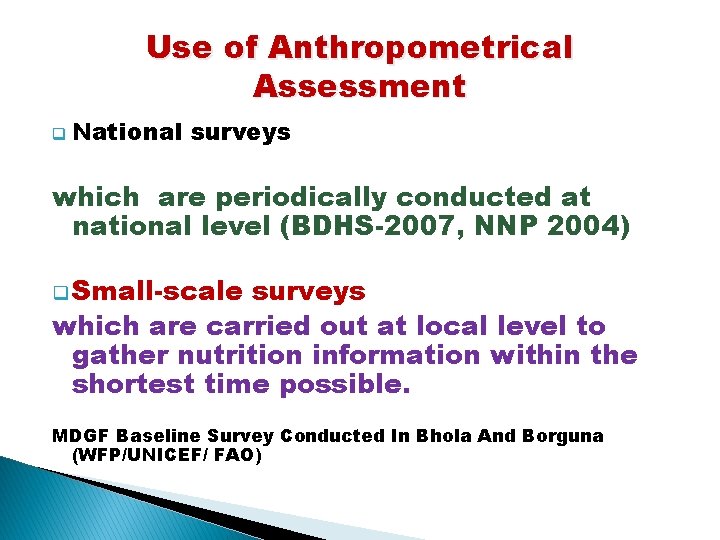
Use of Anthropometrical Assessment q National surveys which are periodically conducted at national level (BDHS-2007, NNP 2004) q Small-scale surveys which are carried out at local level to gather nutrition information within the shortest time possible. MDGF Baseline Survey Conducted In Bhola And Borguna (WFP/UNICEF/ FAO)
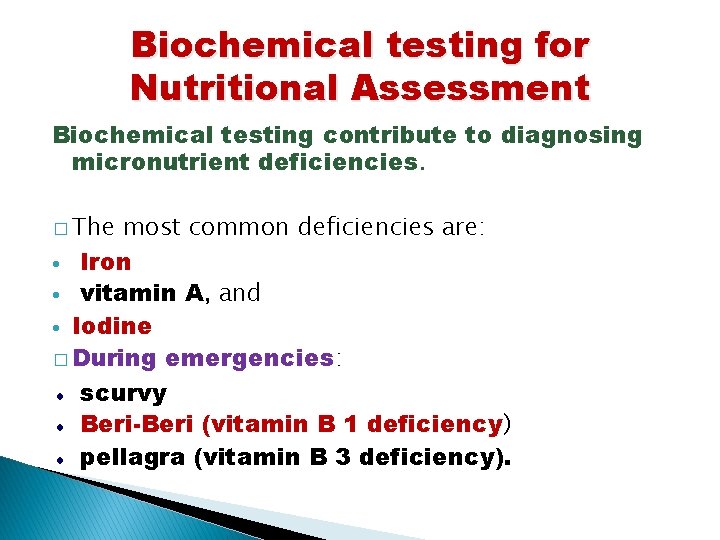
Biochemical testing for Nutritional Assessment Biochemical testing contribute to diagnosing micronutrient deficiencies. � The most common deficiencies are: • Iron • vitamin A, and • Iodine � During emergencies: scurvy Beri-Beri (vitamin B 1 deficiency) pellagra (vitamin B 3 deficiency).
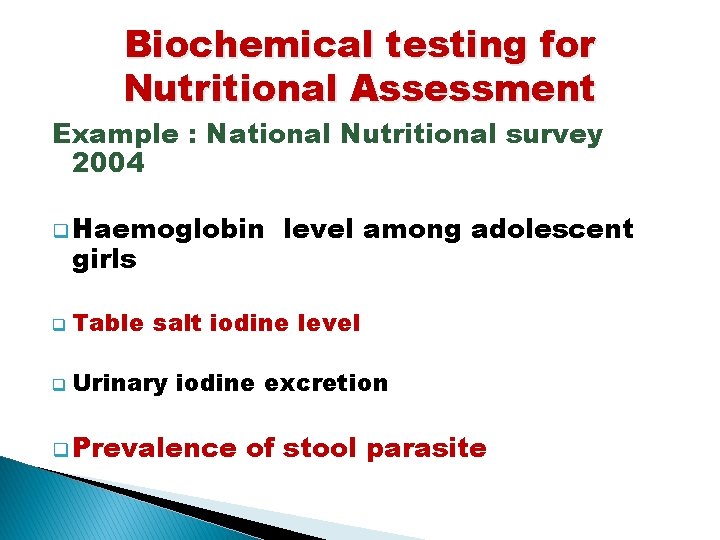
Biochemical testing for Nutritional Assessment Example : National Nutritional survey 2004 q Haemoglobin girls level among adolescent q Table salt iodine level q Urinary iodine excretion q Prevalence of stool parasite
Indirect correlates of Nutritional Status Information on food intake may help � to better understand the causes of malnutrition and � can also be used as a proxy for nutritional outcome.
Food Intake Surveys Food intake or consumption surveys assess � the types and amounts of food eaten. This can be represented in terms of daily energy and nutrient intake person. � May involve weighing amounts of food eaten or using dietary recall. Difficulties: � labour-intensive � time consuming and costly. � Dietary recall are more dependent on memory. � The analysis of food intake surveys requires high level of skills � the use of specific software � availability of a food composition table.
Food Intake Surveys � Advantages: provide invaluable information on quantities, diet quality and q on whether energy and nutrient intake are being met. q This type of assessment is undertaken in stable contexts where more information is needed about dietary causes of malnutrition. q
DIETARY DIVERSITY SCORES � � � Dietary diversity (DD) scores is a proxy of nutritional quality of the diet. The DD scores consists of a simple count of the number of food groups consumed by an individual or a household over a given period of time. The assumption is that the higher the score, the better the quality of the diet. Assessing DD is useful to evaluate the impact of a wide range of programmes on dietary quality. Examples are livelihoods and crop diversification, nutrition education, school and homestead gardens.
DIETARY DIVERSITY SCORES q These assessments may be carried out in stable situations where there is a known problem of lack of dietary diversity and where efforts to improve agricultural diversification in order to improve diet have been ongoing for many years. q The DD assessment can also be used in emergency contexts, where shock can adversely impact the quality of the diet.
FOOD BASKET MONITORING (FBM) Carried out at q food distribution sites q q q camp situations, e. g. among refugees in order to ensure that food distribution systems are operating optimally to help identify any risk of nutrition problems, especially micronutrient deficiency diseases.
FOOD BASKET MONITORING (FBM) q q Where camp populations are dependent on long-term food aid, FBM is critical, especially where the ration diversity is limited and where there is an absence of micronutrient rich foods in the ration, e. g. fortified Corn Soy Blend. Computer programmes to calculate micronutrient content of food rations are available.
THANK YOU VERY MUCH