
Multi Area OSPF Carl Bergenhem 030404 carlbergenhem com
Multi Area OSPF Carl Bergenhem - 030404 carl@bergenhem. com Session Number Version 2002 -1 © 2002, Svenska-CNAP Halmstad University 1
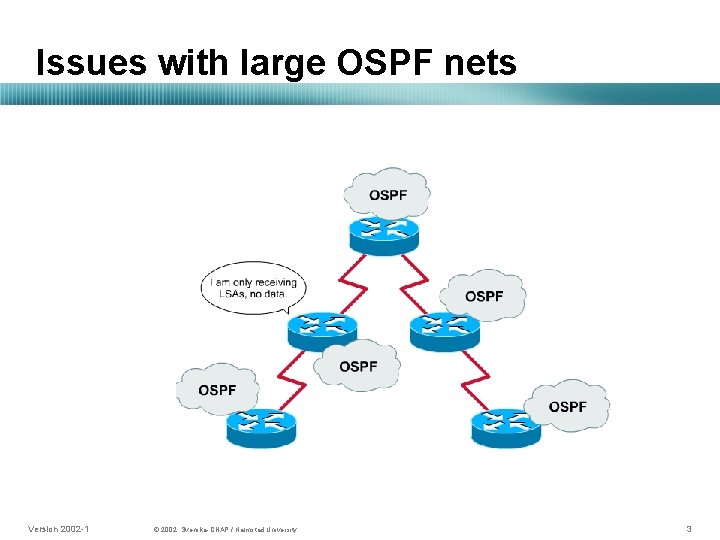
Issues with large OSPF nets • Frequent SPF calculations • Large routing table • Large link-state table (topological database) Version 2002 -1 © 2002, Svenska-CNAP / Halmstad University. 2
Issues with large OSPF nets Version 2002 -1 © 2002, Svenska-CNAP / Halmstad University. 3
OSPF uses “Areas” • Hierarchical – separate large internetworks (autonomous system) into smaller internetworks, called areas. • Routing between the areas (called inter-area routing), • Routing within an area: intra-area • But many of the smaller internal routing operations are restricted within an area. • Hide unnecessary information, e. g. summarise Version 2002 -1 © 2002, Svenska-CNAP / Halmstad University. 4
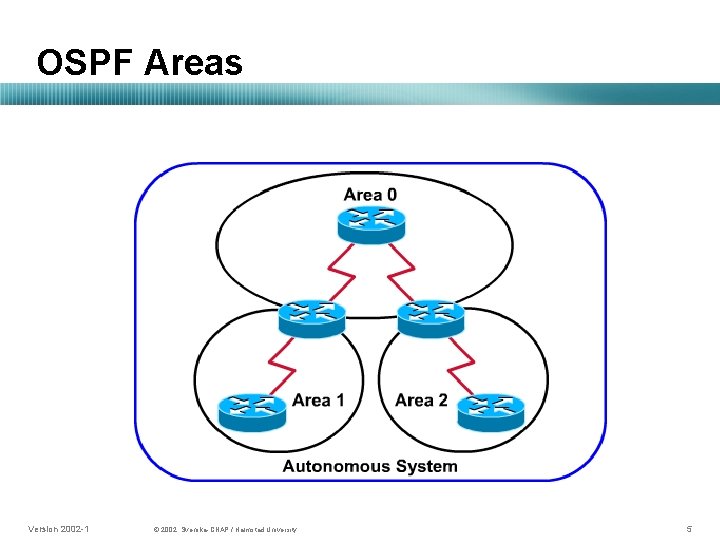
OSPF Areas Version 2002 -1 © 2002, Svenska-CNAP / Halmstad University. 5
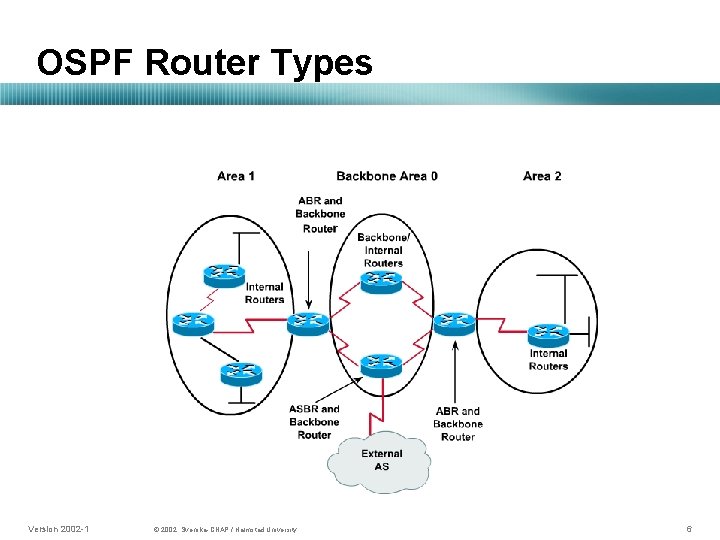
OSPF Router Types Version 2002 -1 © 2002, Svenska-CNAP / Halmstad University. 6
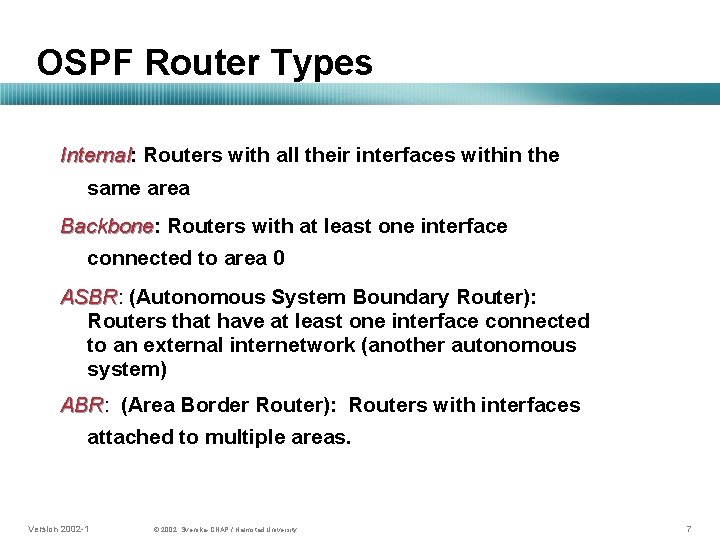
OSPF Router Types Internal: Internal Routers with all their interfaces within the same area Backbone: Backbone Routers with at least one interface connected to area 0 ASBR: ASBR (Autonomous System Boundary Router): Routers that have at least one interface connected to an external internetwork (another autonomous system) ABR: ABR (Area Border Router): Routers with interfaces attached to multiple areas. Version 2002 -1 © 2002, Svenska-CNAP / Halmstad University. 7
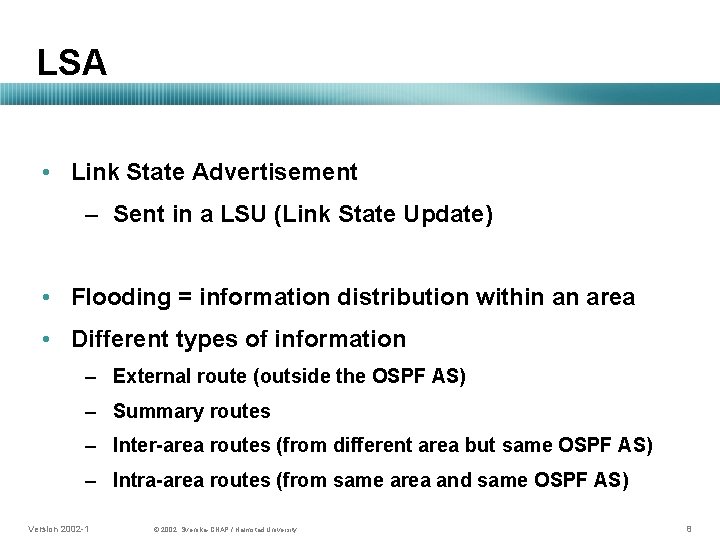
LSA • Link State Advertisement – Sent in a LSU (Link State Update) • Flooding = information distribution within an area • Different types of information – External route (outside the OSPF AS) – Summary routes – Inter-area routes (from different area but same OSPF AS) – Intra-area routes (from same area and same OSPF AS) Version 2002 -1 © 2002, Svenska-CNAP / Halmstad University. 8
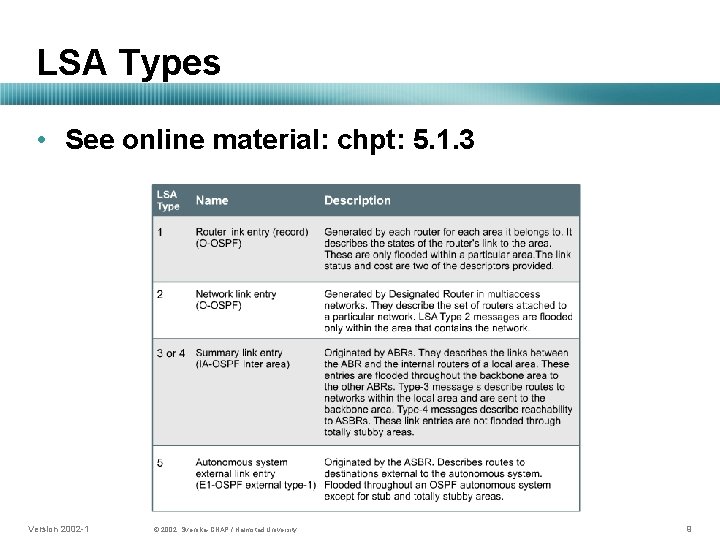
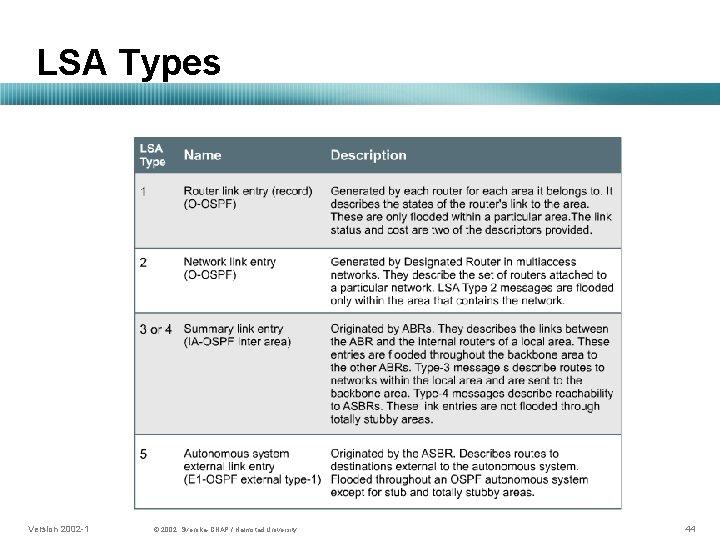
LSA Types • See online material: chpt: 5. 1. 3 Version 2002 -1 © 2002, Svenska-CNAP / Halmstad University. 9
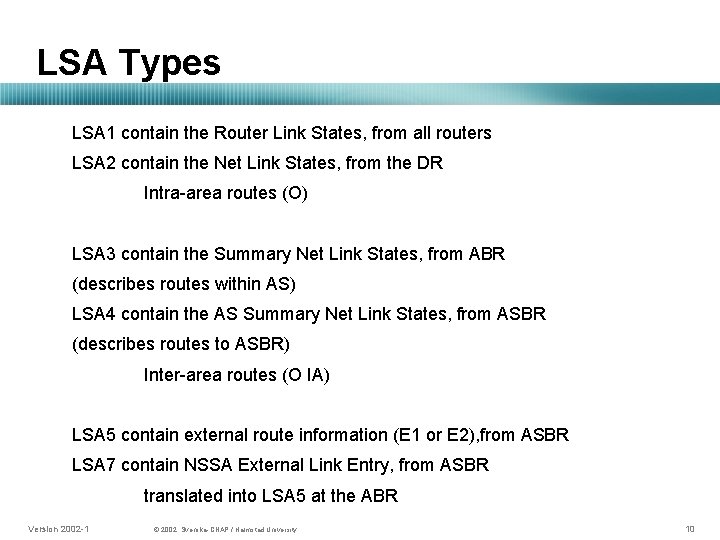
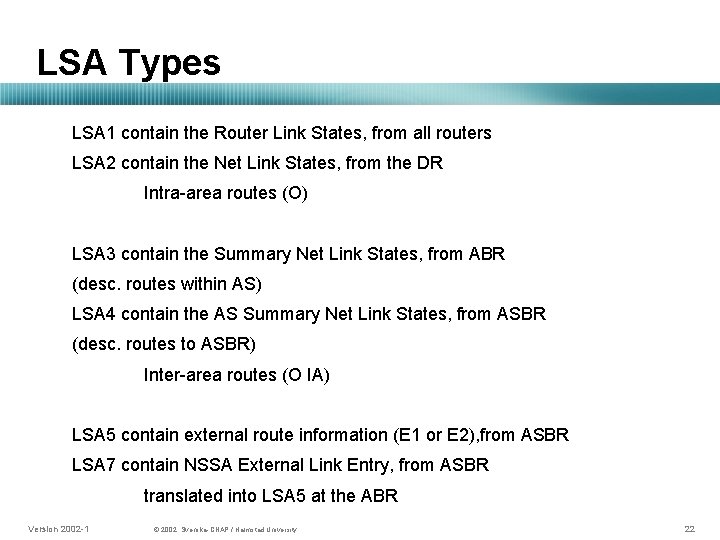
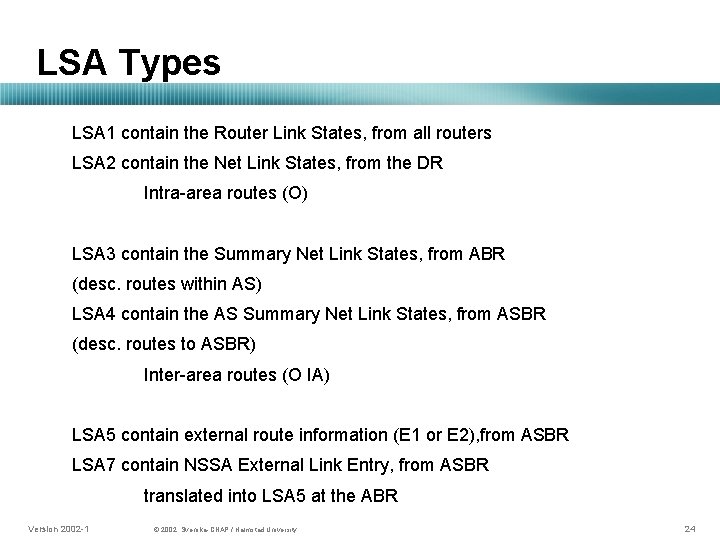
LSA Types LSA 1 contain the Router Link States, from all routers LSA 2 contain the Net Link States, from the DR Intra-area routes (O) LSA 3 contain the Summary Net Link States, from ABR (describes routes within AS) LSA 4 contain the AS Summary Net Link States, from ASBR (describes routes to ASBR) Inter-area routes (O IA) LSA 5 contain external route information (E 1 or E 2), from ASBR LSA 7 contain NSSA External Link Entry, from ASBR translated into LSA 5 at the ABR Version 2002 -1 © 2002, Svenska-CNAP / Halmstad University. 10
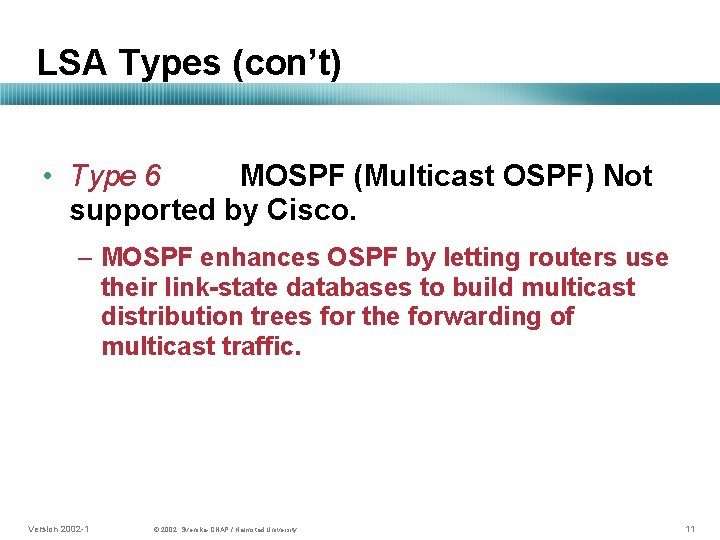
LSA Types (con’t) • Type 6 MOSPF (Multicast OSPF) Not supported by Cisco. – MOSPF enhances OSPF by letting routers use their link-state databases to build multicast distribution trees for the forwarding of multicast traffic. Version 2002 -1 © 2002, Svenska-CNAP / Halmstad University. 11
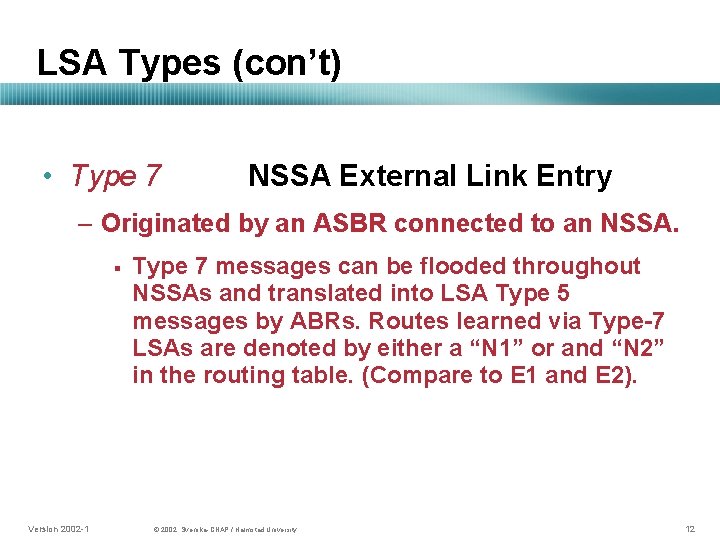
LSA Types (con’t) • Type 7 NSSA External Link Entry – Originated by an ASBR connected to an NSSA. § Version 2002 -1 Type 7 messages can be flooded throughout NSSAs and translated into LSA Type 5 messages by ABRs. Routes learned via Type-7 LSAs are denoted by either a “N 1” or and “N 2” in the routing table. (Compare to E 1 and E 2). © 2002, Svenska-CNAP / Halmstad University. 12
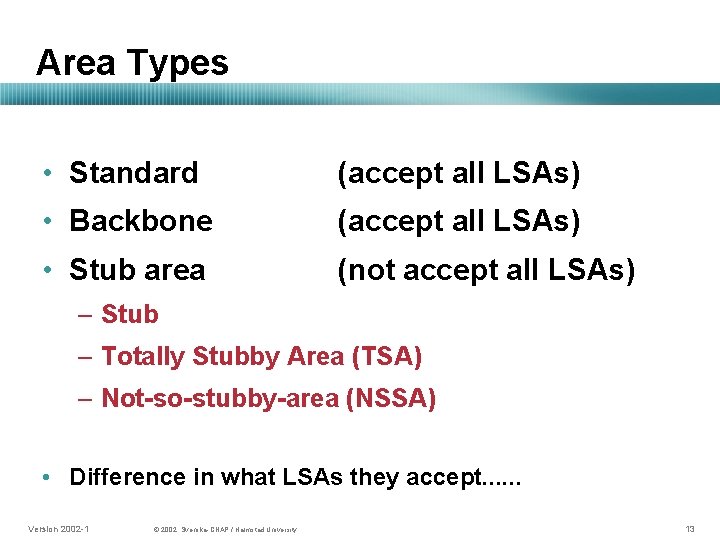
Area Types • Standard (accept all LSAs) • Backbone (accept all LSAs) • Stub area (not accept all LSAs) – Stub – Totally Stubby Area (TSA) – Not-so-stubby-area (NSSA) • Difference in what LSAs they accept. . . Version 2002 -1 © 2002, Svenska-CNAP / Halmstad University. 13

Area Types Default route External (type 5) routes Accepted Summary (type 3, 4) routes Version 2002 -1 © 2002, Svenska-CNAP / Halmstad University. Default route 14
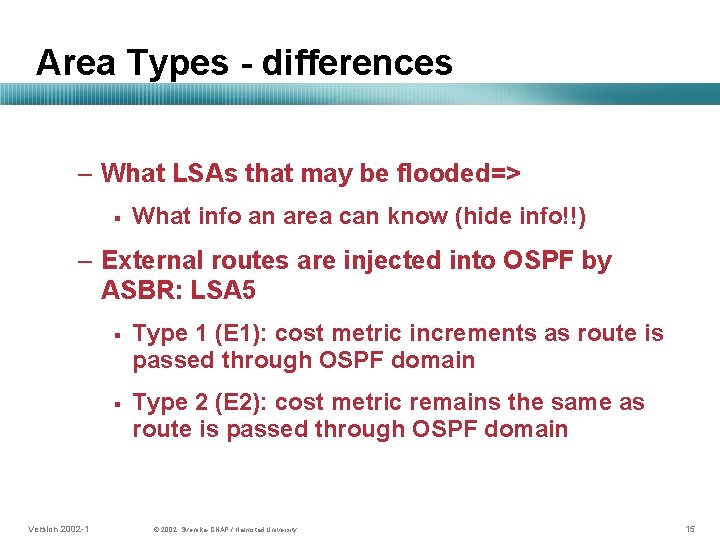
Area Types - differences – What LSAs that may be flooded=> § What info an area can know (hide info!!) – External routes are injected into OSPF by ASBR: LSA 5 Version 2002 -1 § Type 1 (E 1): cost metric increments as route is passed through OSPF domain § Type 2 (E 2): cost metric remains the same as route is passed through OSPF domain © 2002, Svenska-CNAP / Halmstad University. 15
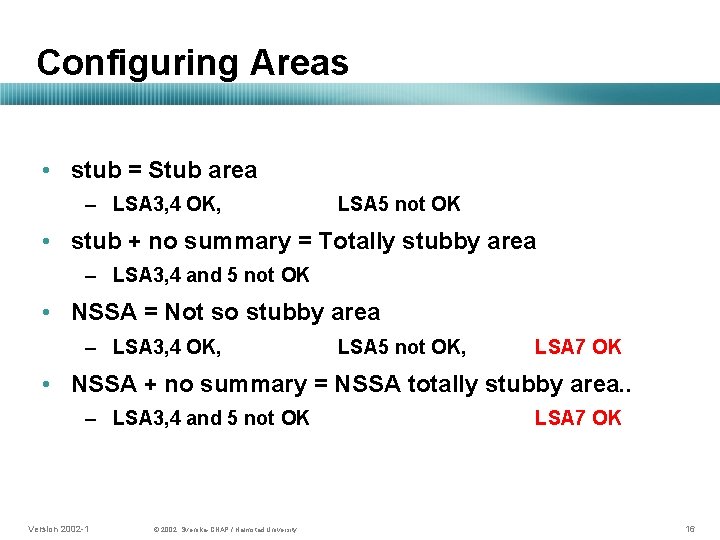
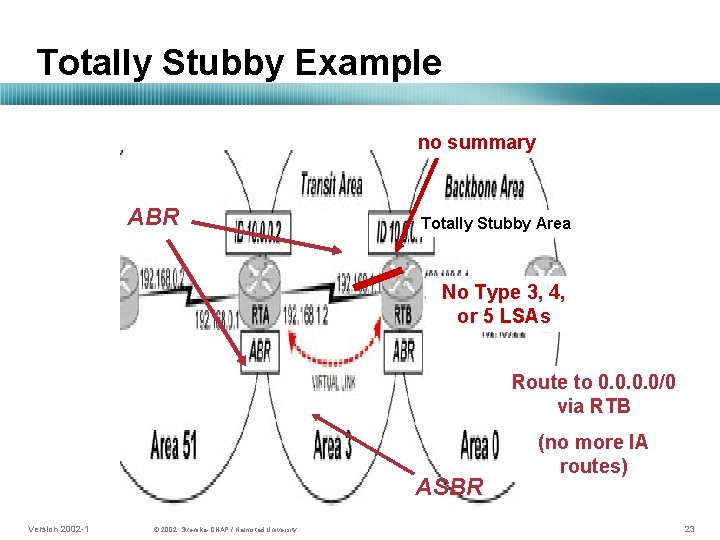
Configuring Areas • stub = Stub area – LSA 3, 4 OK, LSA 5 not OK • stub + no summary = Totally stubby area – LSA 3, 4 and 5 not OK • NSSA = Not so stubby area – LSA 3, 4 OK, LSA 5 not OK, LSA 7 OK • NSSA + no summary = NSSA totally stubby area. . – LSA 3, 4 and 5 not OK Version 2002 -1 © 2002, Svenska-CNAP / Halmstad University. LSA 7 OK 16
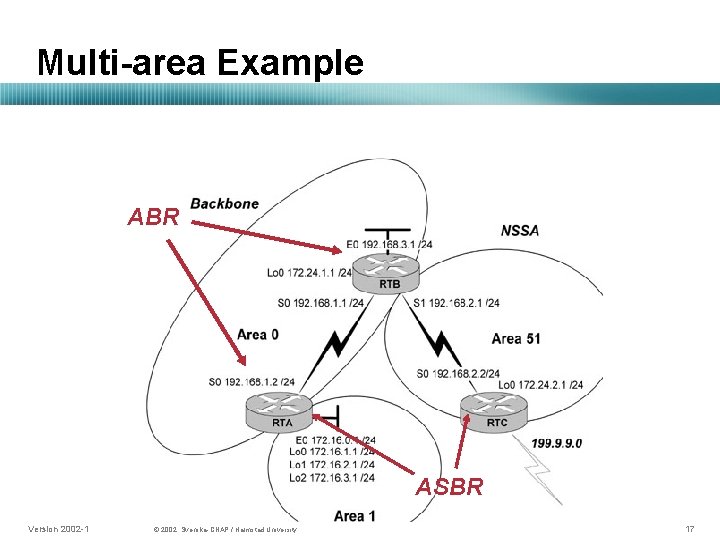
Multi-area Example ABR RIP ASBR Version 2002 -1 © 2002, Svenska-CNAP / Halmstad University. 17
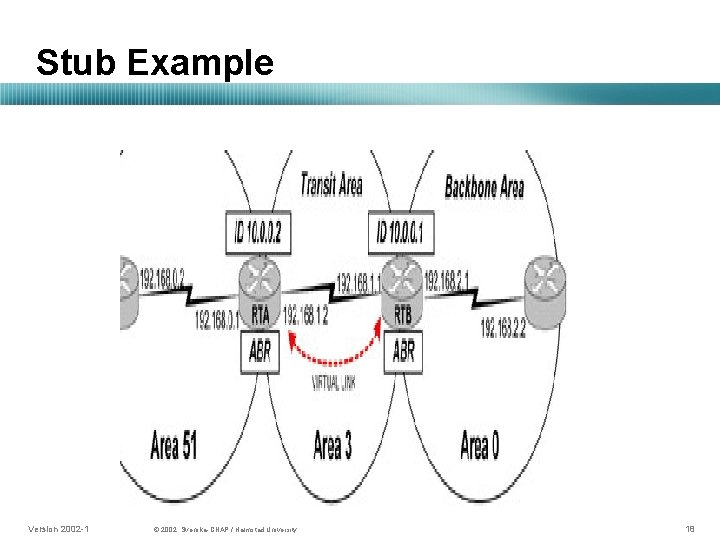
Stub Example Version 2002 -1 © 2002, Svenska-CNAP / Halmstad University. 18
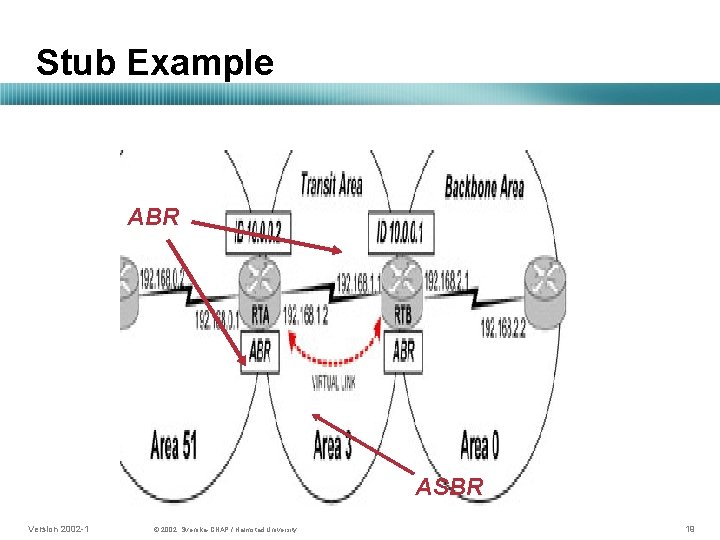
Stub Example ABR ASBR Version 2002 -1 © 2002, Svenska-CNAP / Halmstad University. 19
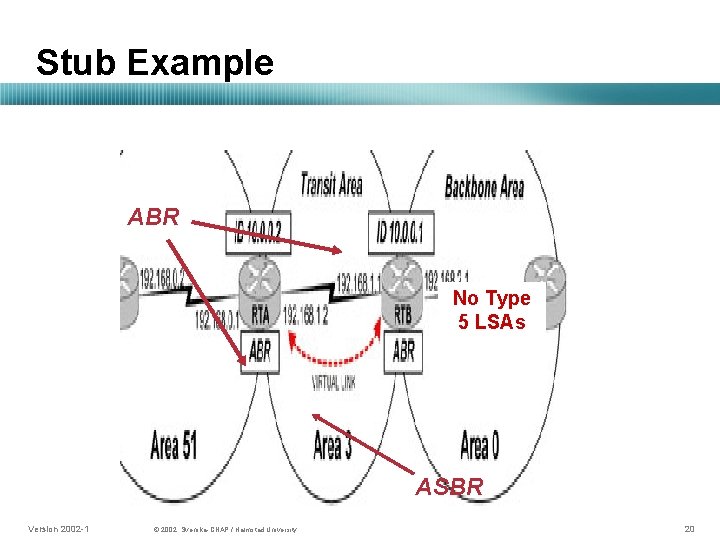
Stub Example ABR No Type 5 LSAs ASBR Version 2002 -1 © 2002, Svenska-CNAP / Halmstad University. 20
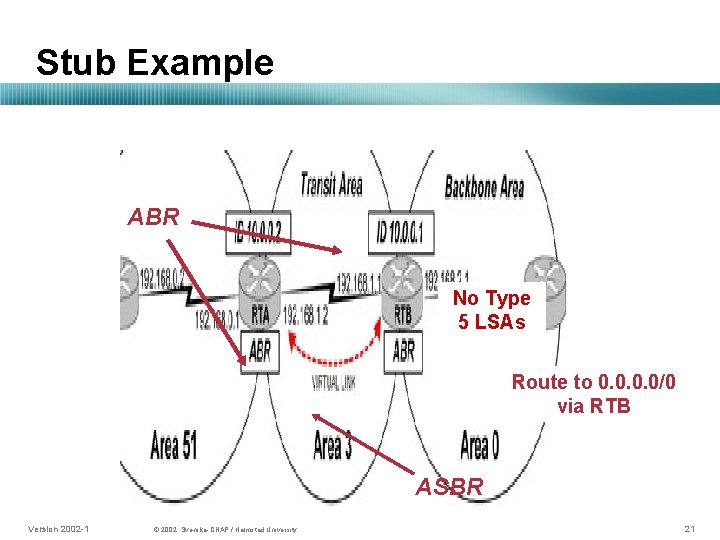
Stub Example ABR No Type 5 LSAs Route to 0. 0/0 via RTB ASBR Version 2002 -1 © 2002, Svenska-CNAP / Halmstad University. 21
LSA Types LSA 1 contain the Router Link States, from all routers LSA 2 contain the Net Link States, from the DR Intra-area routes (O) LSA 3 contain the Summary Net Link States, from ABR (desc. routes within AS) LSA 4 contain the AS Summary Net Link States, from ASBR (desc. routes to ASBR) Inter-area routes (O IA) LSA 5 contain external route information (E 1 or E 2), from ASBR LSA 7 contain NSSA External Link Entry, from ASBR translated into LSA 5 at the ABR Version 2002 -1 © 2002, Svenska-CNAP / Halmstad University. 22
Totally Stubby Example no summary ABR Totally Stubby Area No Type 3, 4, or 5 LSAs Route to 0. 0/0 via RTB ASBR Version 2002 -1 © 2002, Svenska-CNAP / Halmstad University. (no more IA routes) 23
LSA Types LSA 1 contain the Router Link States, from all routers LSA 2 contain the Net Link States, from the DR Intra-area routes (O) LSA 3 contain the Summary Net Link States, from ABR (desc. routes within AS) LSA 4 contain the AS Summary Net Link States, from ASBR (desc. routes to ASBR) Inter-area routes (O IA) LSA 5 contain external route information (E 1 or E 2), from ASBR LSA 7 contain NSSA External Link Entry, from ASBR translated into LSA 5 at the ABR Version 2002 -1 © 2002, Svenska-CNAP / Halmstad University. 24
NSSA Example Version 2002 -1 © 2002, Svenska-CNAP / Halmstad University. 25
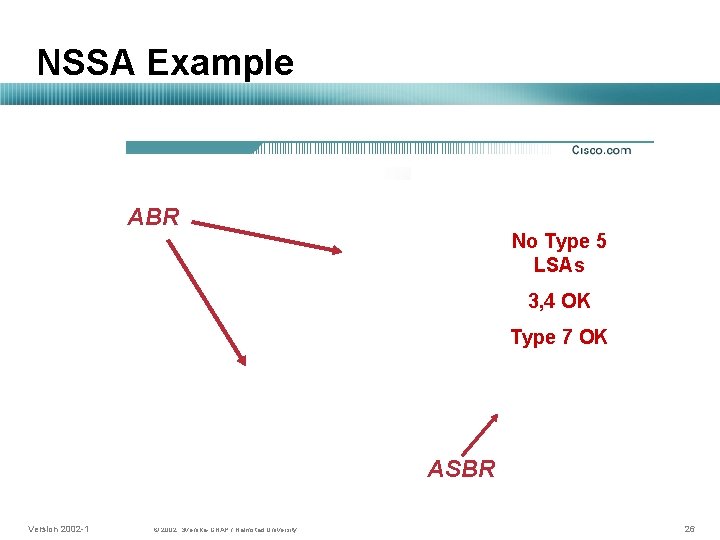
NSSA Example ABR No Type 5 LSAs 3, 4 OK Type 7 OK ASBR Version 2002 -1 © 2002, Svenska-CNAP / Halmstad University. 26
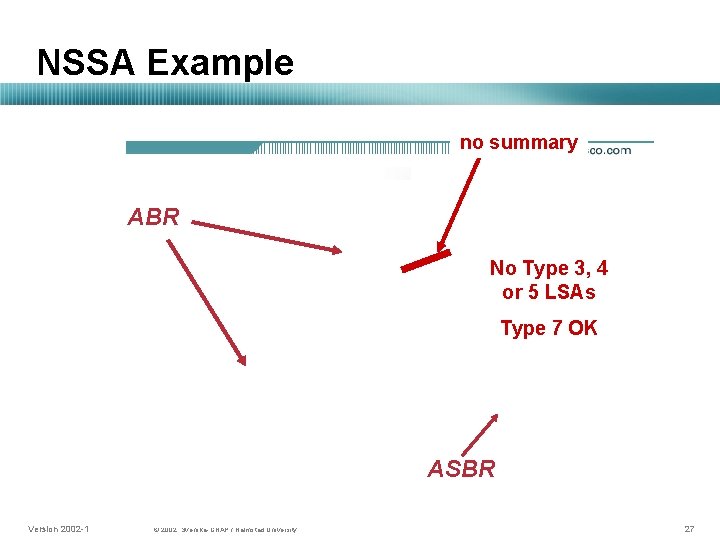
NSSA Example no summary ABR No Type 3, 4 or 5 LSAs Type 7 OK ASBR Version 2002 -1 © 2002, Svenska-CNAP / Halmstad University. 27
LSA Types (con’t) • Type 7 NSSA External Link Entry – Originated by an ASBR connected to an NSSA. § Version 2002 -1 Type 7 messages can be flooded throughout NSSAs and translated into LSA Type 5 messages by ABRs. Routes learned via Type-7 LSAs are denoted by either a “N 1” or and “N 2” in the routing table. (Compare to E 1 and E 2). © 2002, Svenska-CNAP / Halmstad University. 28
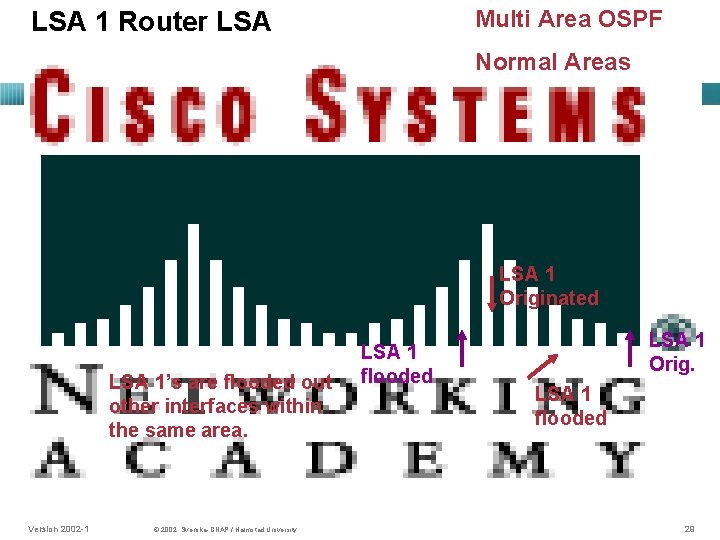
Multi Area OSPF LSA 1 Router LSA Normal Areas LSA 1 Originated LSA 1’s are flooded out other interfaces within the same area. Version 2002 -1 © 2002, Svenska-CNAP / Halmstad University. LSA 1 flooded LSA 1 Orig. LSA 1 flooded 29
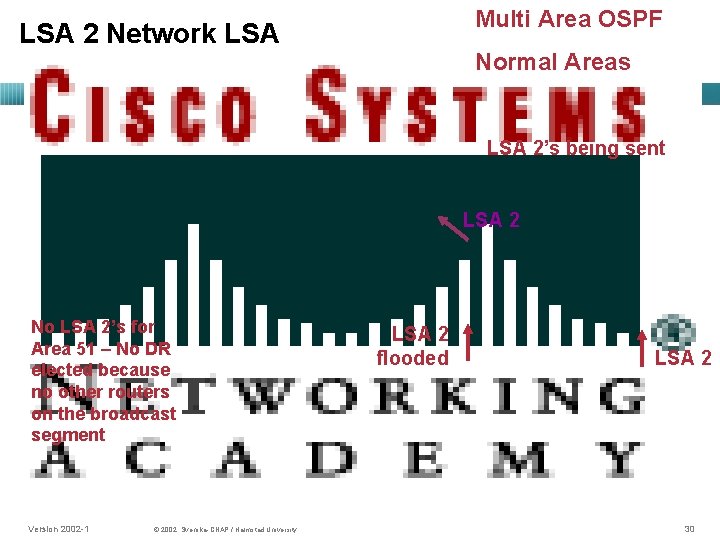
Multi Area OSPF LSA 2 Network LSA Normal Areas LSA 2’s being sent LSA 2 No LSA 2’s for Area 51 – No DR elected because no other routers on the broadcast segment Version 2002 -1 © 2002, Svenska-CNAP / Halmstad University. LSA 2 flooded LSA 2 30
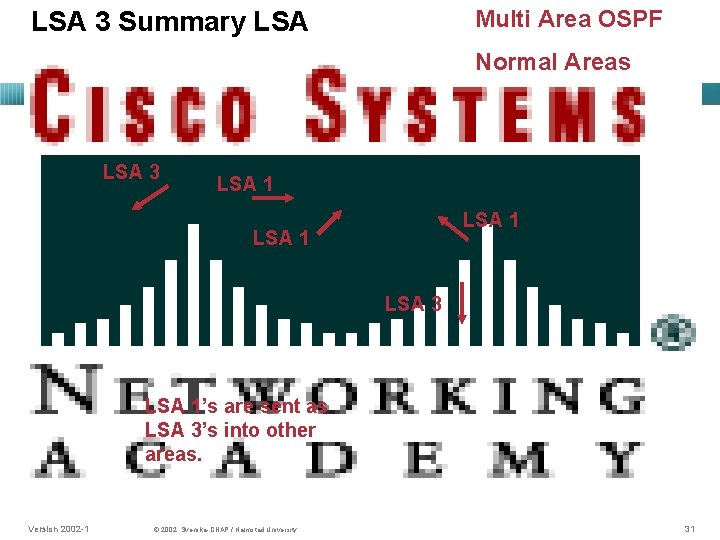
Multi Area OSPF LSA 3 Summary LSA Normal Areas LSA 3 LSA 1 LSA 3 LSA 1’s are sent as LSA 3’s into other areas. Version 2002 -1 © 2002, Svenska-CNAP / Halmstad University. 31
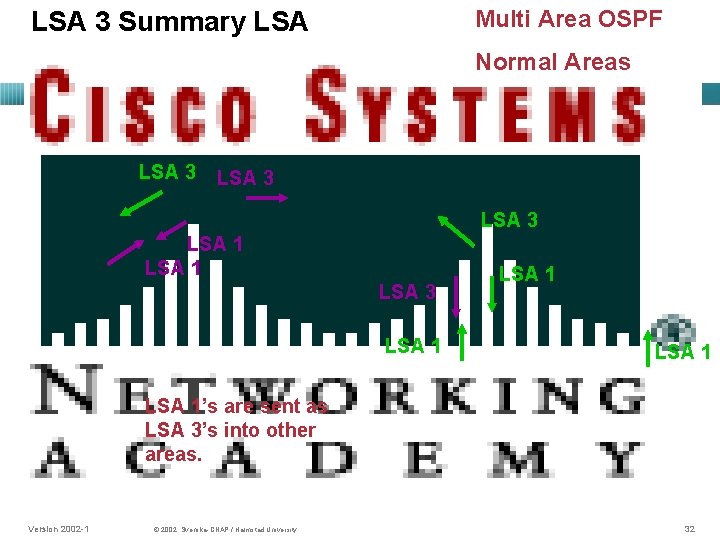
Multi Area OSPF LSA 3 Summary LSA Normal Areas LSA 3 LSA 1 LSA 1’s are sent as LSA 3’s into other areas. Version 2002 -1 © 2002, Svenska-CNAP / Halmstad University. 32
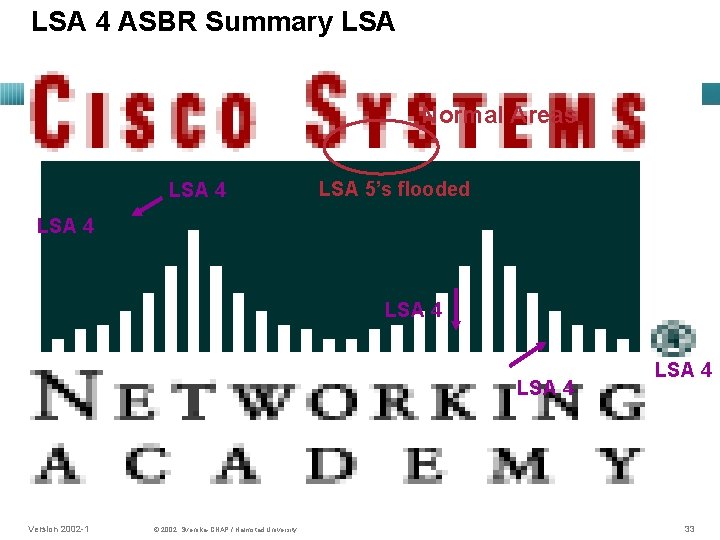
LSA 4 ASBR Summary LSA Normal Areas LSA 4 LSA 5’s flooded LSA 4 Version 2002 -1 © 2002, Svenska-CNAP / Halmstad University. LSA 4 33
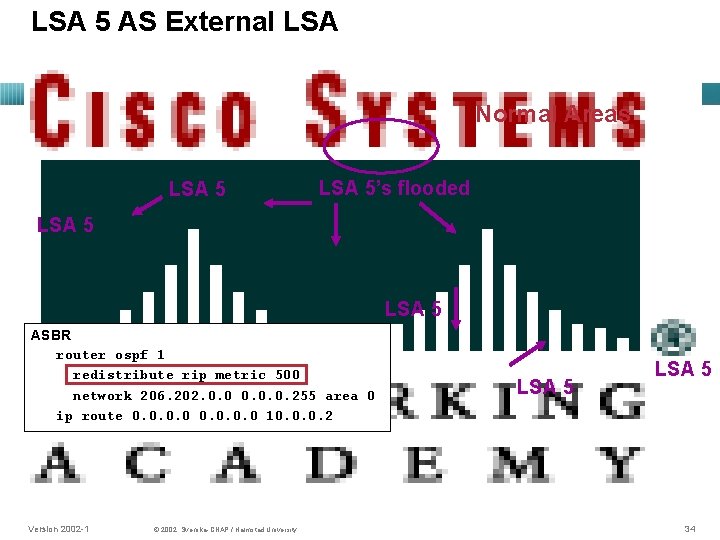
LSA 5 AS External LSA Normal Areas LSA 5’s flooded LSA 5 ASBR router ospf 1 redistribute rip metric 500 network 206. 202. 0. 0. 0. 255 area 0 ip route 0. 0 10. 0. 0. 2 Version 2002 -1 © 2002, Svenska-CNAP / Halmstad University. LSA 5 34
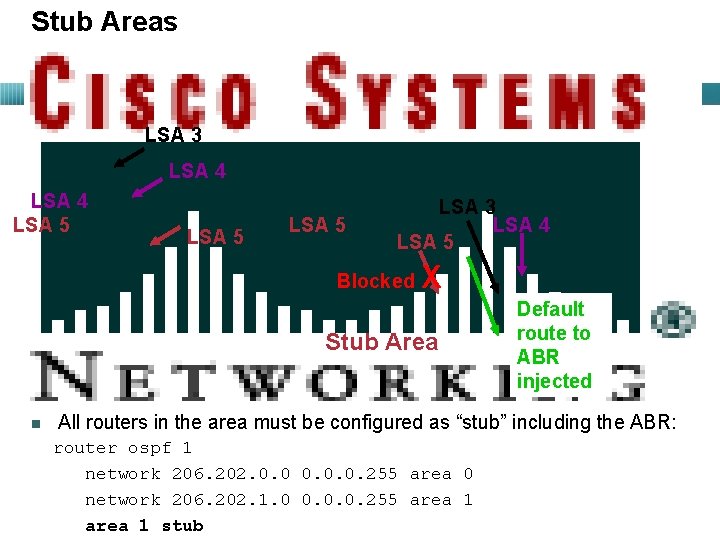
Stub Areas LSA 3 LSA 4 LSA 5 LSA 3 LSA 4 LSA 5 Blocked X Stub Area n Default route to ABR injected All routers in the area must be configured as “stub” including the ABR: router ospf 1 network 206. 202. 0. 0. 0. 255 area 0 network 206. 202. 1. 0 0. 0. 0. 255 area 1 Version 2002 -1 area 1 stub © 2002, Svenska-CNAP / Halmstad University. 35
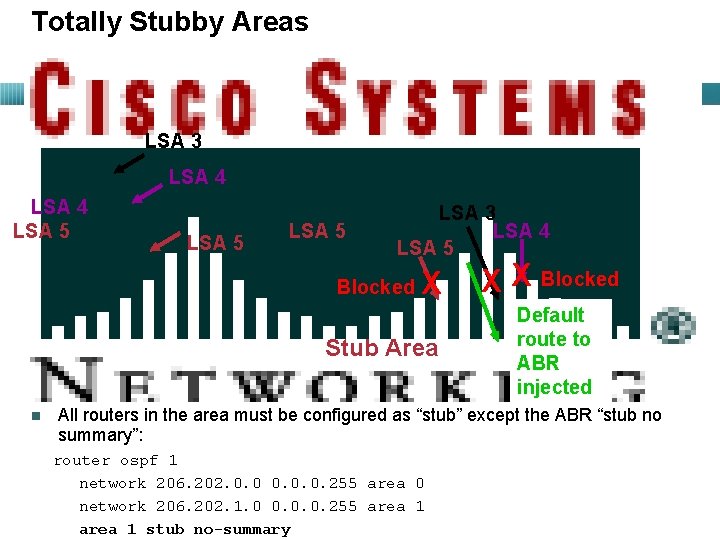
Totally Stubby Areas LSA 3 LSA 4 LSA 5 LSA 3 LSA 4 LSA 5 Blocked X Stub Area n X X Blocked Default route to ABR injected All routers in the area must be configured as “stub” except the ABR “stub no summary”: router ospf 1 network 206. 202. 0. 0. 0. 255 area 0 network 206. 202. 1. 0 0. 0. 0. 255 area 1 Version 2002 -1 © 2002, Svenska-CNAP / Halmstad University. area 1 stub no-summary 36
Virtual Links Version 2002 -1 © 2002, Svenska-CNAP / Halmstad University. 37
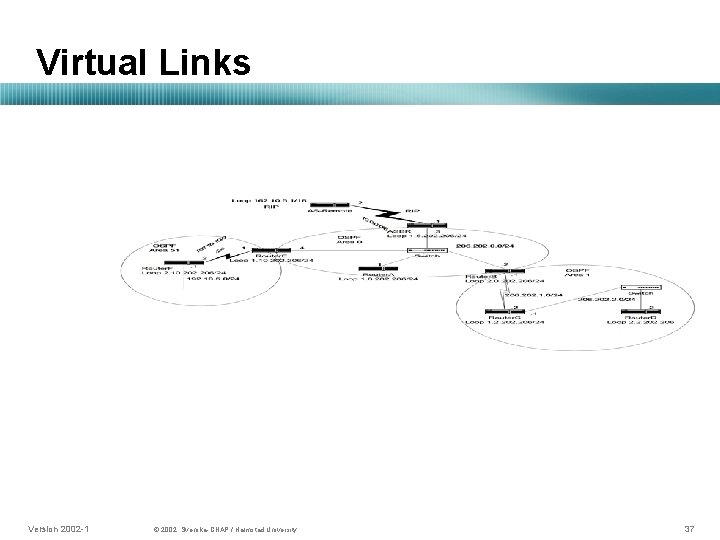
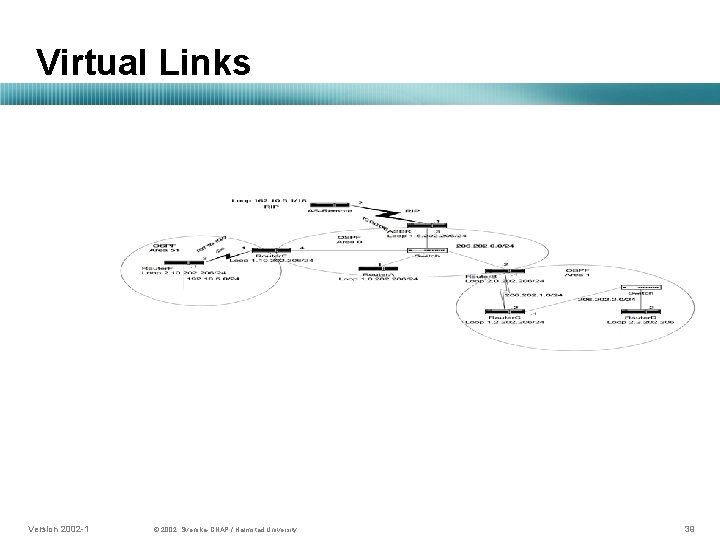
Virtual Links • A virtual link has the following two requirements: – It must be established between two routers that share a common area. – One of these two routers must be connected to the backbone. Version 2002 -1 © 2002, Svenska-CNAP / Halmstad University. 38
Virtual Links Version 2002 -1 © 2002, Svenska-CNAP / Halmstad University. 39
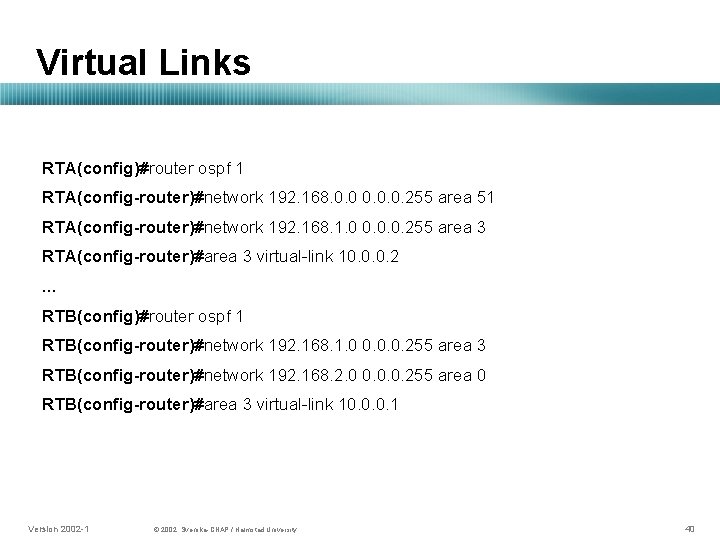
Virtual Links RTA(config)#router ospf 1 RTA(config-router)#network 192. 168. 0. 0. 0. 255 area 51 RTA(config-router)#network 192. 168. 1. 0 0. 0. 0. 255 area 3 RTA(config-router)#area 3 virtual-link 10. 0. 0. 2. . . RTB(config)#router ospf 1 RTB(config-router)#network 192. 168. 1. 0 0. 0. 0. 255 area 3 RTB(config-router)#network 192. 168. 2. 0 0. 0. 0. 255 area 0 RTB(config-router)#area 3 virtual-link 10. 0. 0. 1 Version 2002 -1 © 2002, Svenska-CNAP / Halmstad University. 40
OSPF verification commands • show ip ospf ? – list of possible commands – border-routers – database – neighbours • etc. • Be curious!!!! Version 2002 -1 © 2002, Svenska-CNAP / Halmstad University. 41
• Reserve slides Version 2002 -1 © 2002, Svenska-CNAP / Halmstad University. 42
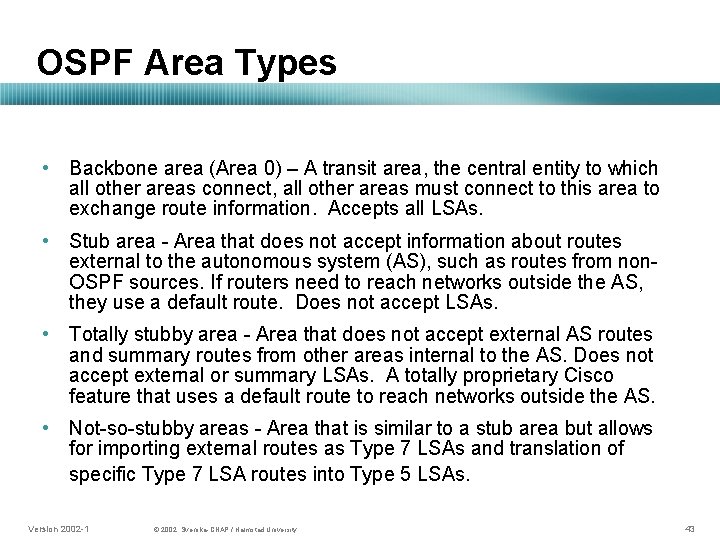
OSPF Area Types • Backbone area (Area 0) – A transit area, the central entity to which all other areas connect, all other areas must connect to this area to exchange route information. Accepts all LSAs. • Stub area - Area that does not accept information about routes external to the autonomous system (AS), such as routes from non. OSPF sources. If routers need to reach networks outside the AS, they use a default route. Does not accept LSAs. • Totally stubby area - Area that does not accept external AS routes and summary routes from other areas internal to the AS. Does not accept external or summary LSAs. A totally proprietary Cisco feature that uses a default route to reach networks outside the AS. • Not-so-stubby areas - Area that is similar to a stub area but allows for importing external routes as Type 7 LSAs and translation of specific Type 7 LSA routes into Type 5 LSAs. Version 2002 -1 © 2002, Svenska-CNAP / Halmstad University. 43
LSA Types Version 2002 -1 © 2002, Svenska-CNAP / Halmstad University. 44
- Slides: 44