
Muller mixers q Different mixing action q Mulling
- Slides: 32
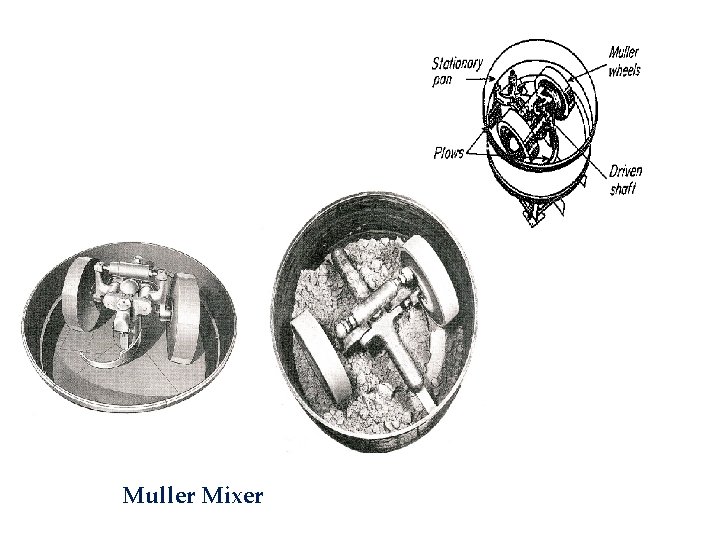
Muller mixers q Different mixing action q Mulling is smearing or rubbing action similar to that in mortar and pestle q Wide, heavy wheels of the mixer did the same job q Pan is stationary & central vertical shaft is driven – causing the muller wheels to roll in circular path on solid § Rubbing action results from slip of the wheel on solids § Plows – guide solids under wheels or to discharge opening q Axis of the wheels is stationary & pan is rotated q Good mixer for batches of heavy solids and pastes q Effective in coating the granular particles with liquid 1
Muller Mixer
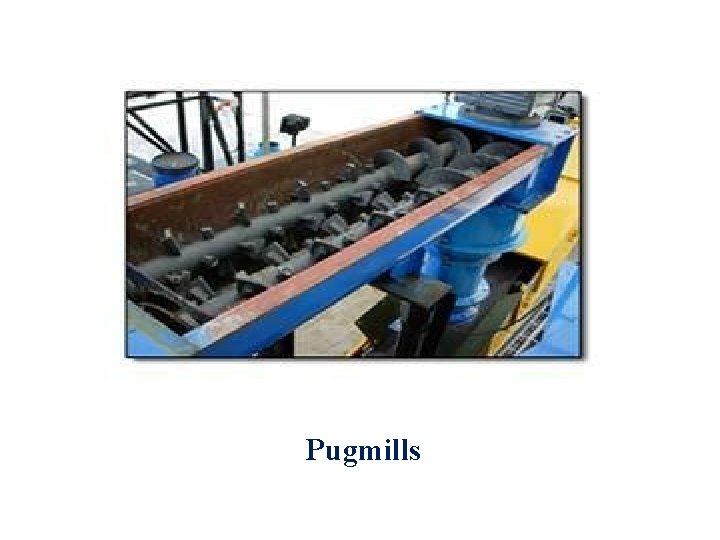
Pug Mills q Mixing is done by blades or knives set in helical pattern on a horizontal shaft. q Open trough or closed cylinder q Cut, mixed and moved forward q closed mixing chamber - Single shaft q Open trough – double shaft for more rapid & thorough mixing q Mostly cylindrical in shape q Heating or cooling jackets q Blend and homogenize clays, mix liquids with solids to form thick heavy slurries 3
Pugmills
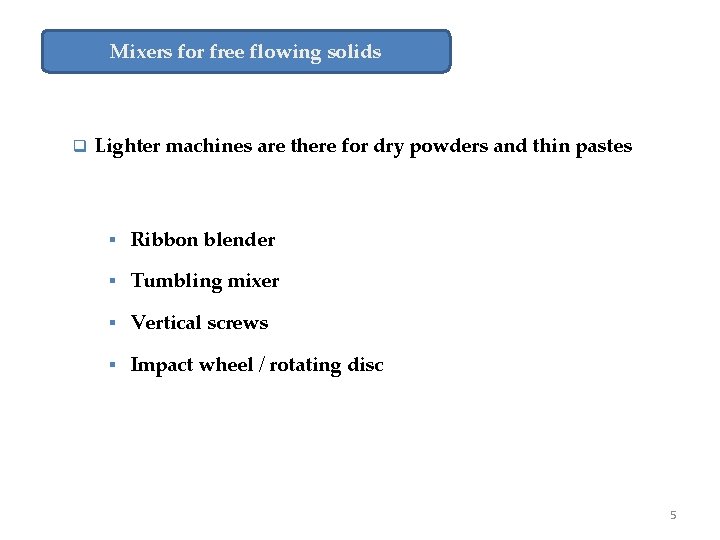
Mixers for free flowing solids q Lighter machines are there for dry powders and thin pastes § Ribbon blender § Tumbling mixer § Vertical screws § Impact wheel / rotating disc 5
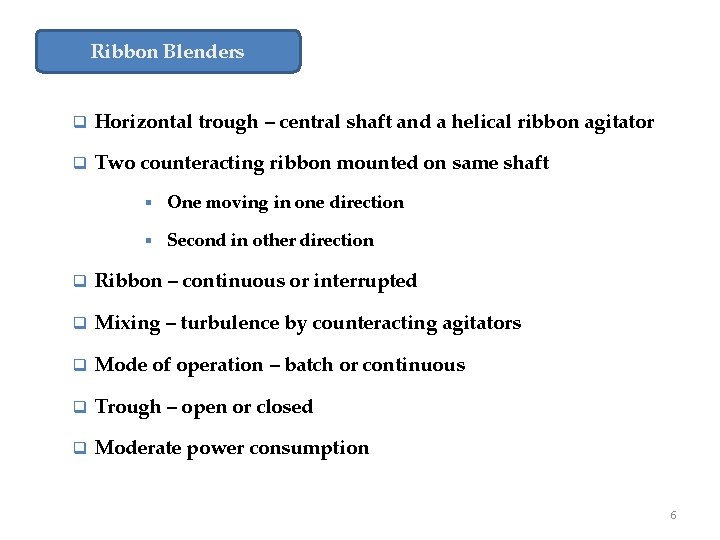
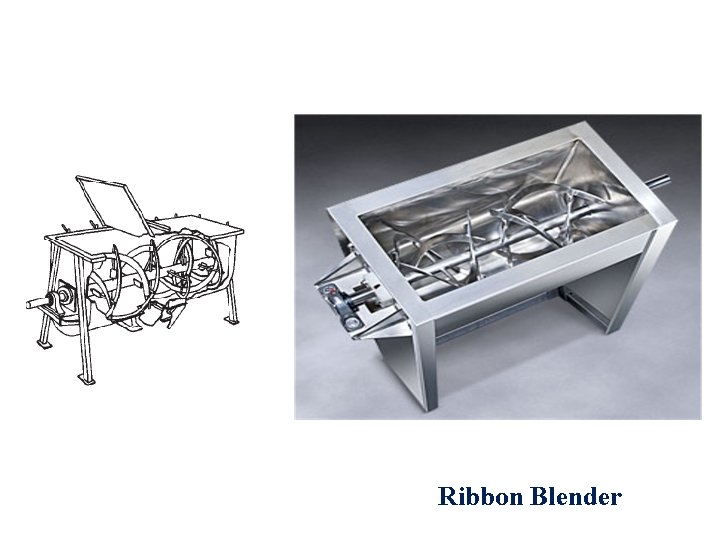
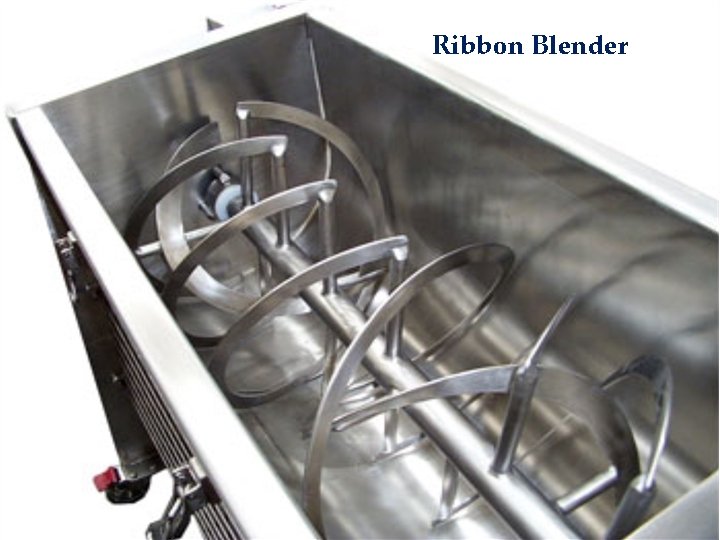
Ribbon Blenders q Horizontal trough – central shaft and a helical ribbon agitator q Two counteracting ribbon mounted on same shaft § One moving in one direction § Second in other direction q Ribbon – continuous or interrupted q Mixing – turbulence by counteracting agitators q Mode of operation – batch or continuous q Trough – open or closed q Moderate power consumption 6
Ribbon Blender
Ribbon Blender
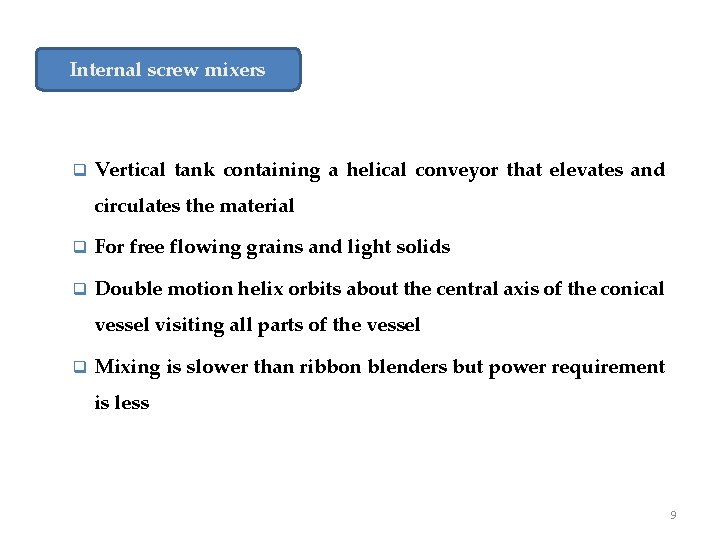
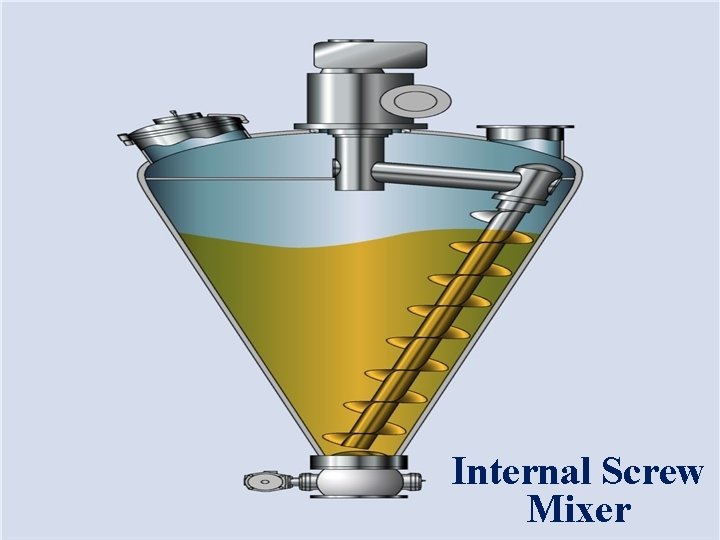
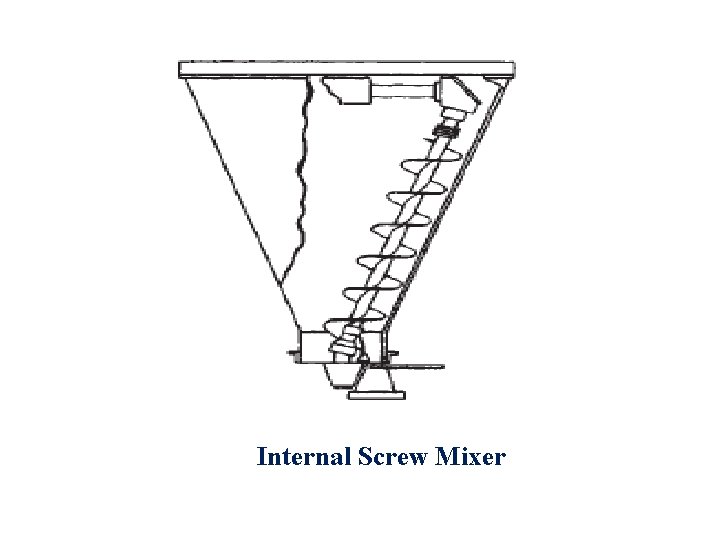
Internal screw mixers q Vertical tank containing a helical conveyor that elevates and circulates the material q For free flowing grains and light solids q Double motion helix orbits about the central axis of the conical vessel visiting all parts of the vessel q Mixing is slower than ribbon blenders but power requirement is less 9
Internal Screw Mixer
Internal Screw Mixer
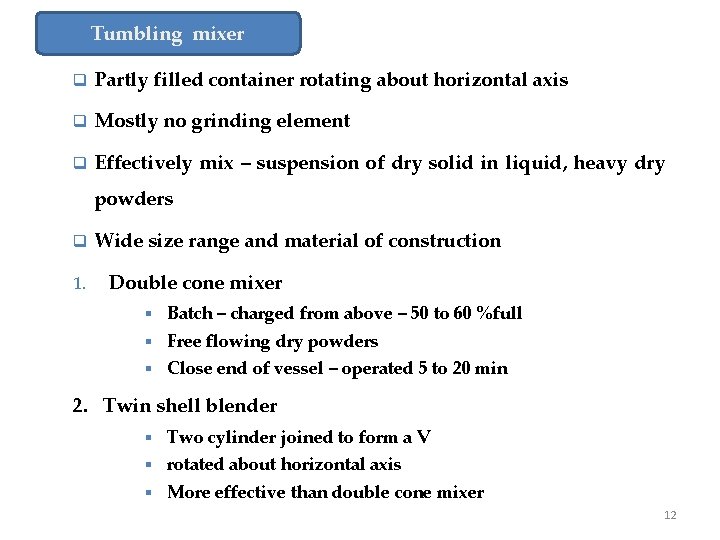
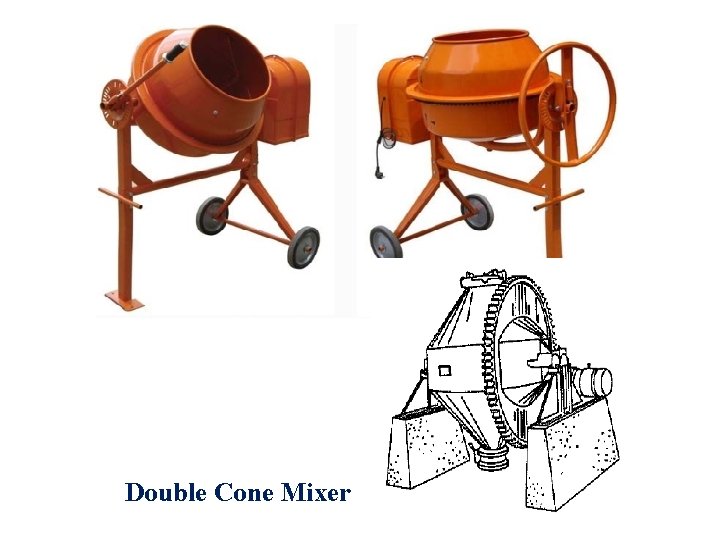
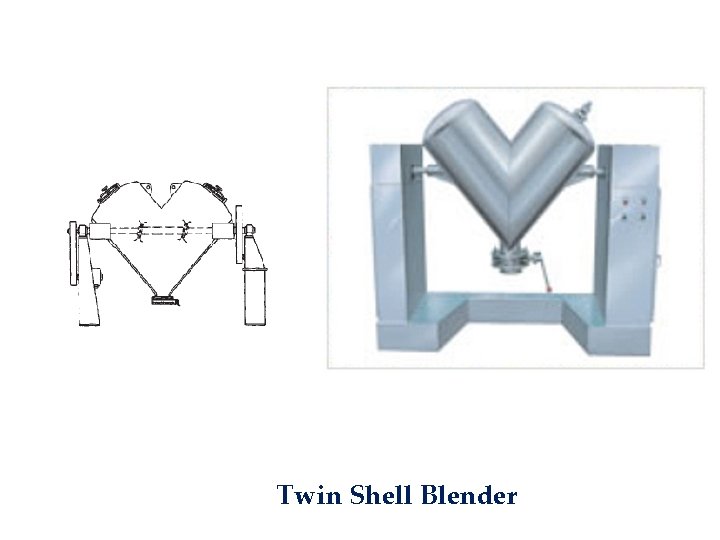
Tumbling mixer q Partly filled container rotating about horizontal axis q Mostly no grinding element q Effectively mix – suspension of dry solid in liquid, heavy dry powders q Wide size range and material of construction 1. Double cone mixer § Batch – charged from above – 50 to 60 %full § Free flowing dry powders § Close end of vessel – operated 5 to 20 min 2. Twin shell blender § Two cylinder joined to form a V § rotated about horizontal axis § More effective than double cone mixer 12
Double Cone Mixer
Twin Shell Blender
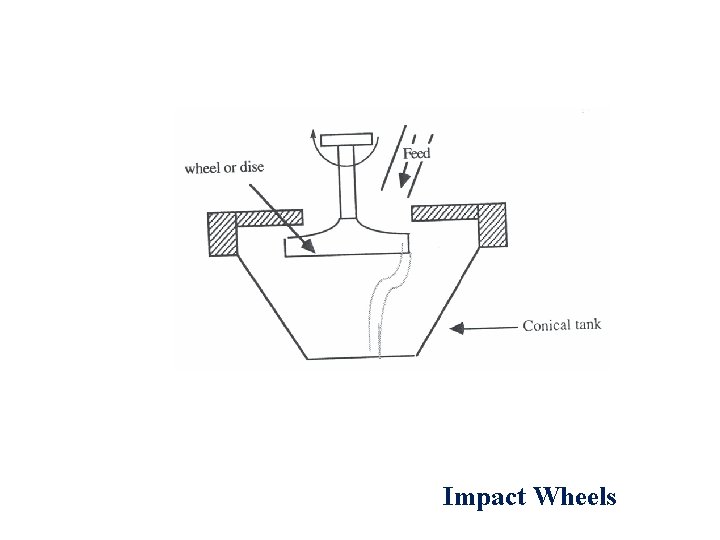
Impact wheels q Operating continuously by spreading them out in a thin layer under centrifugal action q Several dry ingredients are fed continuously near the high speed spinning disk 10 to 27 in. in diameter throwing it in a stationary casing. q Intense shear cause mixing q 1750 to 3500 rpm q Several passes through same or in series q 1 to 25 tons/hr q Fine light powders like insecticides 15
Impact Wheels
Power Requirement for mixing q Mechanical Energy is required for mixing § Large for heavy plastics masses § Relatively small for dry solids q Only part of the energy supplied is directly useful and this part is small q Mixers § Work intensively on small quantities § Work slowly on large quantities q Light machines waste less energy than heavier one q The shorter the mixing time required to bring the material to homogeneity, larger the useful fraction of energy supplied q Major portion of energy supplied appears as heat 17
Criteria of Mixing Effectiveness: Mixing Index q Performance criteria o Time required for mixing o Power load of mixer o Properties of product from mixer q Effective mixing objectives o Rapid mixing action with less time o Minimum power required o High degree of uniformity (homogeneous product) 18
Mixing index for cohesive solids/pastes q The degree of uniformity by sample analysis is a measure of mixing effectiveness q Sampling – number of spot samples ü A – tracer ü B – tracer free ü μ – overall concentration of tracer in mixture ü N – number of spot samples ü xi – conc. of tracer in ith sample ü x’ – average concentration of tracer in all spot samples 19
q If N is very large, i. e; N infinite Ø average conc. will be equal to overall conc. of tracer (x’ = μ) q If N is very small, i. e; N zero Ø average conc. and overall conc. of tracer will be appreciably different ((x’ ≠ μ) q If the mixture is perfectly mixed Ø conc. of each sample is same as average conc. (xi = x’) q If the mixture is not completely mixed Ø conc. of each sample is different from average conc. (xi ≠ x’) 20
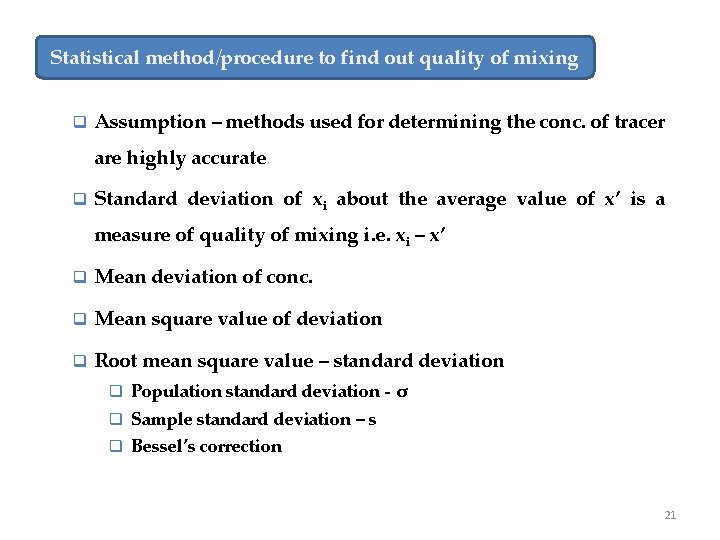
Statistical method/procedure to find out quality of mixing q Assumption – methods used for determining the conc. of tracer are highly accurate q Standard deviation of xi about the average value of x’ is a measure of quality of mixing i. e. xi – x’ q Mean deviation of conc. q Mean square value of deviation q Root mean square value – standard deviation q Population standard deviation - σ q Sample standard deviation – s q Bessel’s correction 21
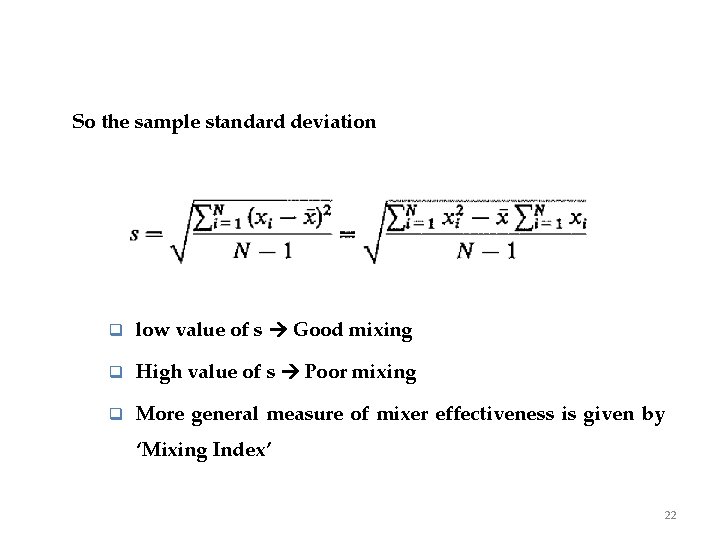
So the sample standard deviation q low value of s Good mixing q High value of s Poor mixing q More general measure of mixer effectiveness is given by ‘Mixing Index’ 22
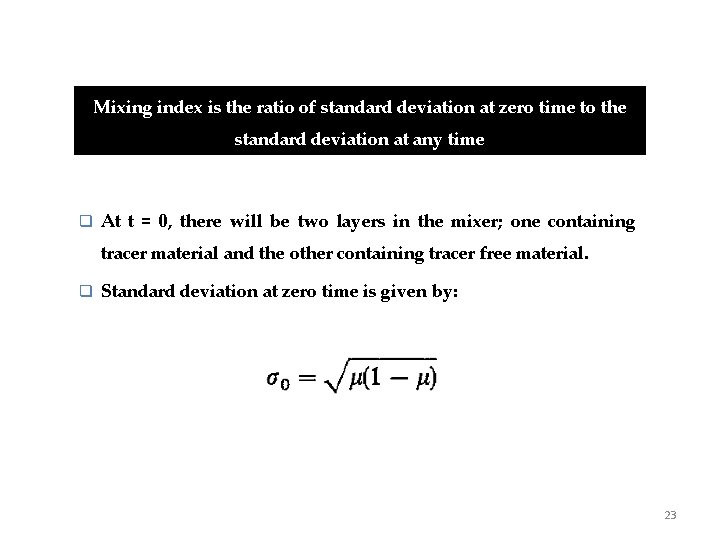
Mixing index is the ratio of standard deviation at zero time to the standard deviation at any time q At t = 0, there will be two layers in the mixer; one containing tracer material and the other containing tracer free material. q Standard deviation at zero time is given by: 23
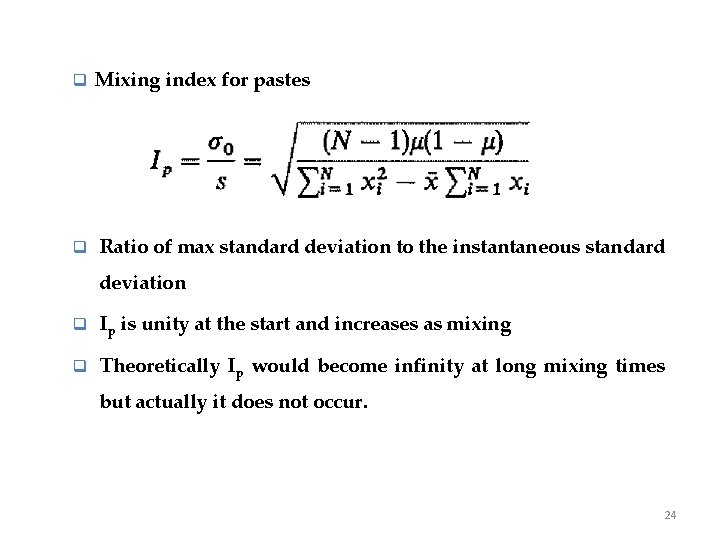
q Mixing index for pastes q Ratio of max standard deviation to the instantaneous standard deviation q Ip is unity at the start and increases as mixing q Theoretically Ip would become infinity at long mixing times but actually it does not occur. 24
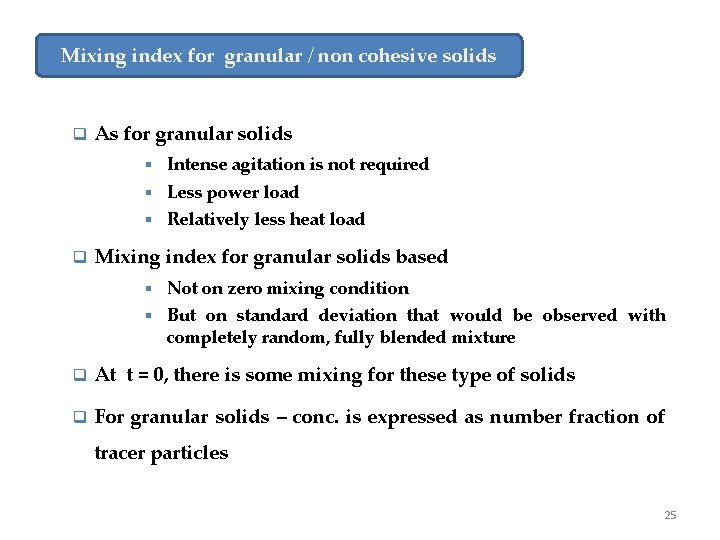
Mixing index for granular / non cohesive solids q As for granular solids § Intense agitation is not required § Less power load § Relatively less heat load q Mixing index for granular solids based § Not on zero mixing condition § But on standard deviation that would be observed with completely random, fully blended mixture q At t = 0, there is some mixing for these type of solids q For granular solids – conc. is expressed as number fraction of tracer particles 25
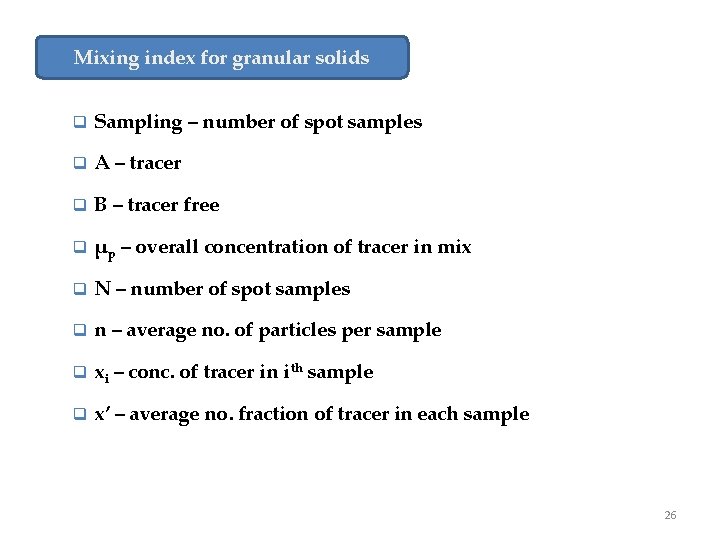
Mixing index for granular solids q Sampling – number of spot samples q A – tracer q B – tracer free q μp – overall concentration of tracer in mix q N – number of spot samples q n – average no. of particles per sample q xi – conc. of tracer in ith sample q x’ – average no. fraction of tracer in each sample 26
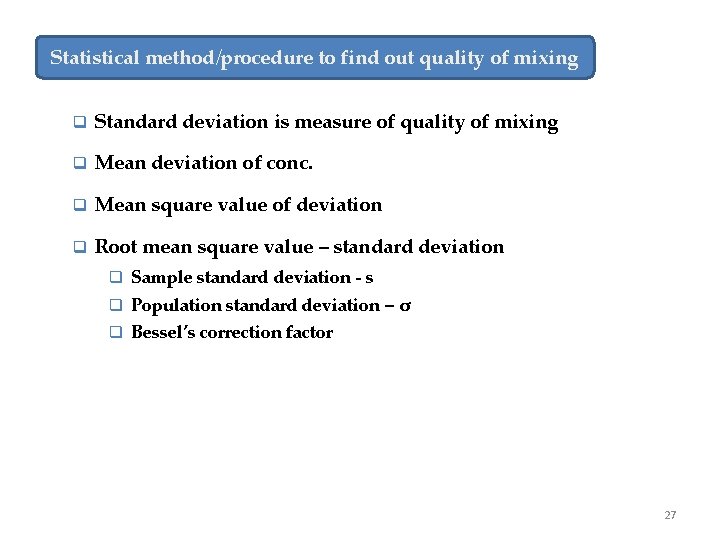
Statistical method/procedure to find out quality of mixing q Standard deviation is measure of quality of mixing q Mean deviation of conc. q Mean square value of deviation q Root mean square value – standard deviation q Sample standard deviation - s q Population standard deviation – σ q Bessel’s correction factor 27
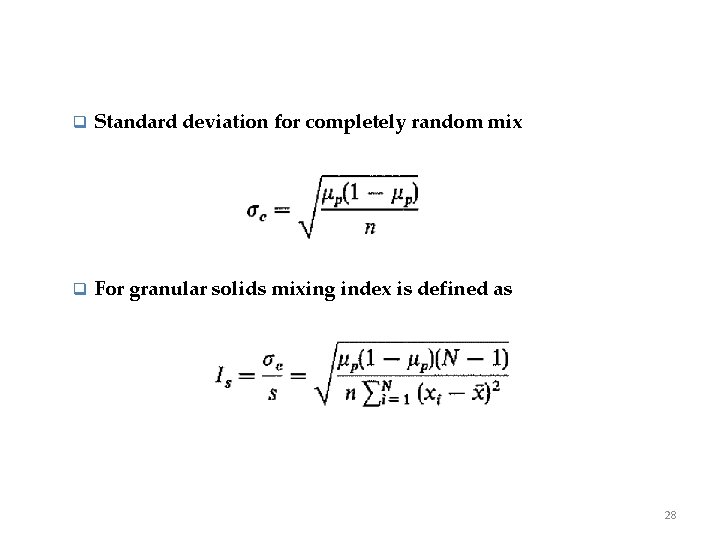
q Standard deviation for completely random mix q For granular solids mixing index is defined as 28
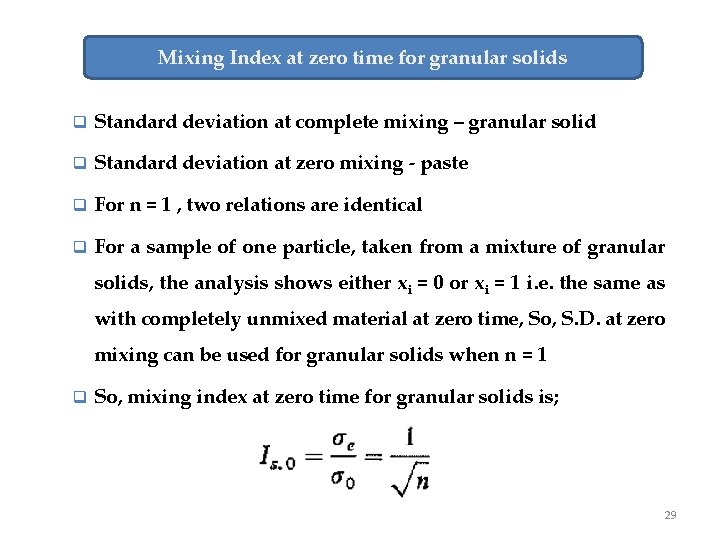
Mixing Index at zero time for granular solids q Standard deviation at complete mixing – granular solid q Standard deviation at zero mixing - paste q For n = 1 , two relations are identical q For a sample of one particle, taken from a mixture of granular solids, the analysis shows either xi = 0 or xi = 1 i. e. the same as with completely unmixed material at zero time, So, S. D. at zero mixing can be used for granular solids when n = 1 q So, mixing index at zero time for granular solids is; 29
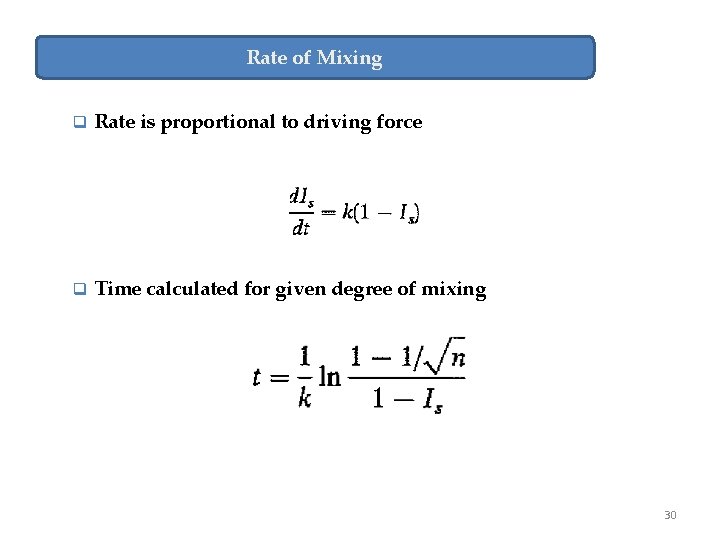
Rate of Mixing q Rate is proportional to driving force q Time calculated for given degree of mixing 30
Axial Mixing q Mixing § Radial § Axial q Degree of axial mixing is measured by injecting the small amount of tracer into feed and check the conc. of tracer at outlet § Max conc. Of tracer § Length of time 31
Quiz no. 1 th course: chapter no. 28 from 5 edition date: 6 th December, 2012 time: 12: 00 pm venue: seminar hall marks: 10 fill in the blanks, mcq’s, true/false, short questions no. Of minutes = no. Of 32