
MULITPLE INTELLIGENCES THEORY BY SheMieka Fane Multiple Intelligences
MULITPLE INTELLIGENCES THEORY BY: She’Mieka Fane
Multiple Intelligences Theory Frames of Mind book Brief history 8 different theories Affects in education Pros and cons of theory
History Development Direct of theory (Brualdi, 1996) challenge to other theories (Klein, 1997) Howard Gardner Beliefs (Klein, 1997) Gardner’s definition of intelligence (Klein, 1997)
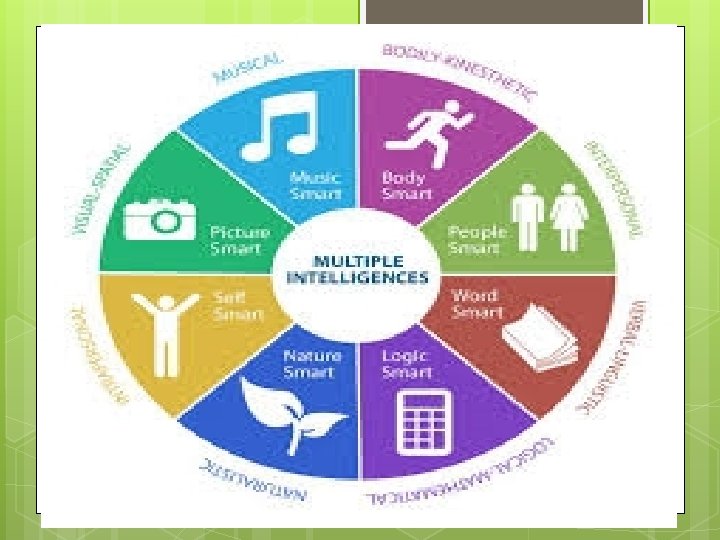
Types of Intelligence Theories Verbal-Linguistic Visual-Spatial Intrapersonal Interpersonal Logical-Mathematical Musical Bodily-Kinesthetic Naturalistic
Multiple Intelligence in Education Teachers teaching (Brualdi, 1996) Adaptability of multiple intelligences (Brualdi, 1996) Assessments (Brualdi, 1996) Traditional test (Brualdi, 1996) Benefits to teachers (Adcock, 2014) Benefits to graduate students (Adcock, 2014)
Pros/Strengths Theoretical foundation (Brualdi, 1996) Classroom Approach (Brualdi, 1996) Students success Challenges other intelligences (Klein, 1997)
Cons/Weaknesses Defending theory (Klein, 1997) Intelligences More diversity(Adock, 2014) supplies may be needed (Hanafin, 2014) Larger classrooms (Hanafin, 2014) Disagreements (Tai, 2014)
REFERENCES Adcock, P. K. (2014). The longevity of multiple intelligence theory in education. Impact on Educational Reforms, 50 -57 Brualdi, A. C. (1996). Intelligences: hardner’s theory. Eric Digest, 1 -6. Hanafin, J. (2014). Multiple intelligences theory, action research, and teacher professional development: The Iris MI Project, Australian Journal of Teacher Education. 39(4), 126 -142. Klein, P. D. (1997). Multiplying the problems of intelligence by eight: A critique of gardner’s theory. Journal of Education 22(4), 377 -394. Tai, F. M. (2014). Exploring multiple intelligences. Journal of Human Resource and Adult Learning, 10, 11 -21.
- Slides: 9