
MUGHAL EMPIRE social structure Sanjay Kumar Shandilya Asst

- Slides: 41
MUGHAL EMPIRE - social structure Sanjay Kumar Shandilya Asst. Master(Social Science) Sainik School Gopalganj
Who were the Mughals? • The Mughal Empire was founded by Babur, a Central Asian ruler who was descended from the Turco-Mongol conqueror. Timur (the founder of the Timurid Empire) on his father's side and from Chagatai, the second son of the Mongol ruler Genghis Khan, on his mother's side.
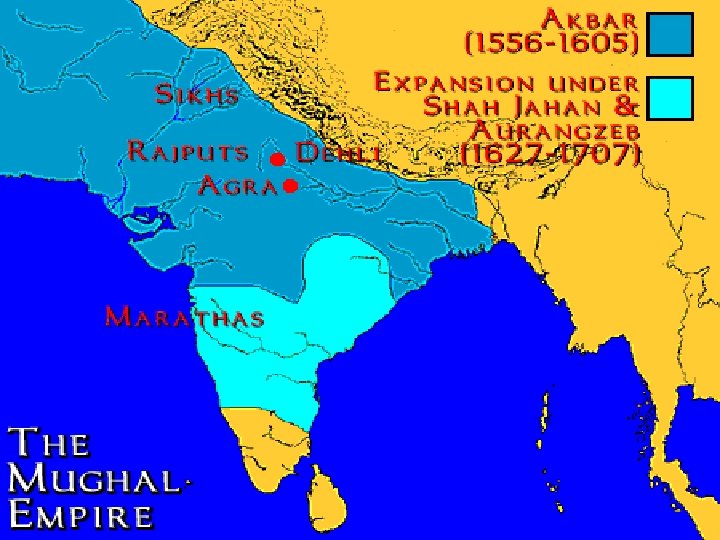
INTRODUCTION • The Mughal Empire was an empire that at its greatest territorial extent ruled most of the Indian subcontinent, then known as Hindustan. • It also parts of what is now Afghanistan and the Baluchistan region. • It was established in 1526, enjoyed expansion and consolidation until about 1707 and survived, even if in drastically attenuated form, until 1857.
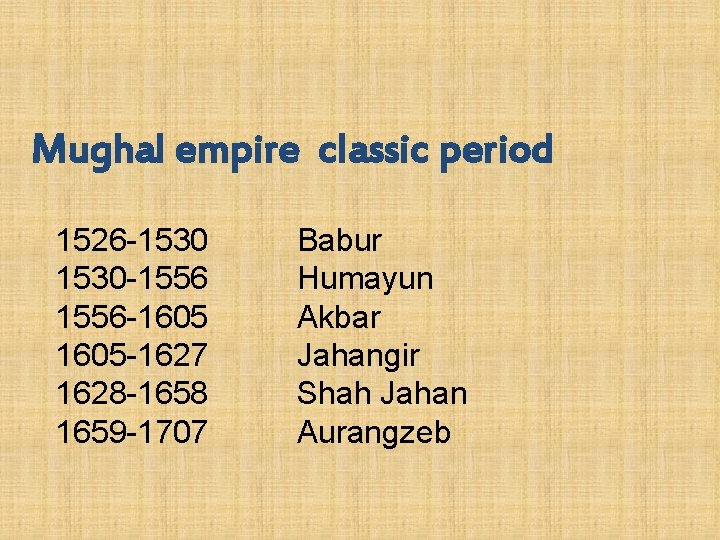
Mughal empire classic period 1526 -1530 -1556 -1605 -1627 1628 -1658 1659 -1707 Babur Humayun Akbar Jahangir Shah Jahan Aurangzeb
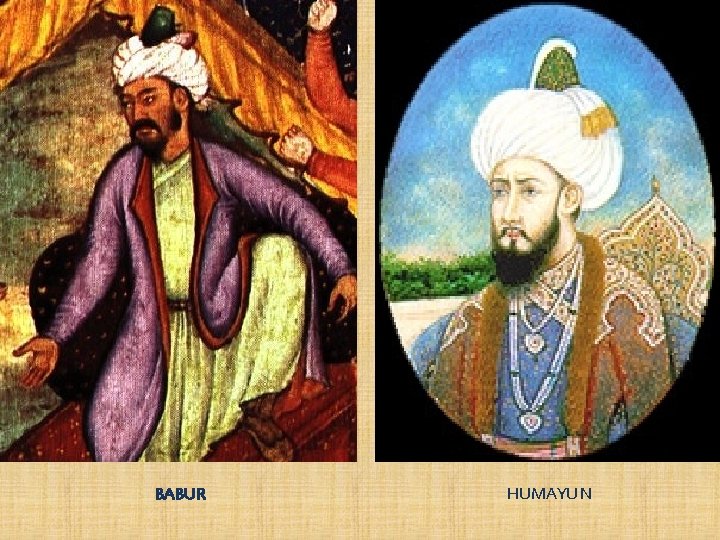
BABUR HUMAYUN
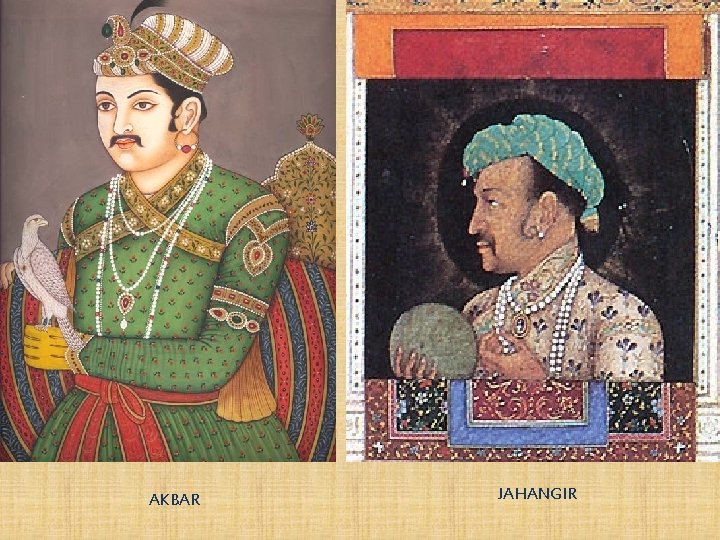
AKBAR JAHANGIR
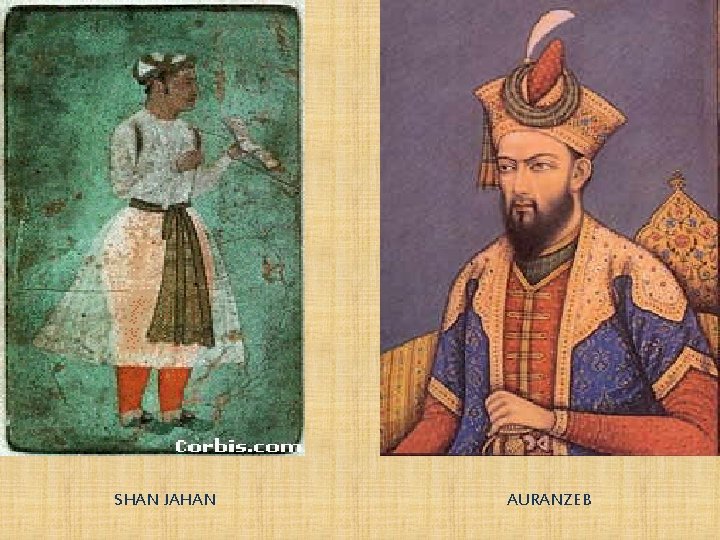
SHAN JAHAN AURANZEB
1526 -1530 Babur, born Ẓahīr-ud-Dīn Muḥammad, was a conqueror from Central Asia who, following a series of setbacks, finally succeeded in laying the basis for the Mughal dynasty in the Indian subcontinent and became the first Mughal emperor. Born: February 14, 1483, Andijan, Uzbekistan Died: December 26, 1530, Agra Children: Humayun, Gulbadan Begum, Kamran Mirza, more Spouse: Mubaraka Yusufzai (m. 1519), Maham Begum (m. 1506– 1530), Aisha Sultan Begum (m. 1499), Saliha Sultan Begum
Babur’s Military Campaigns • Three major military campaigns were fought by Emperor Babur. These include: • 1526 defeat of Sultan Ibrahim Lodi at Panipat and establishment of Mughal empire in India. • 1527 defeat of Mewar king Rana Sanga and his allies at Khanua • 1528 defeat of Rajputs at Chanderi
1530 -1556 Humayun • Mirza Nasir ud-din Baig Muhammad Khan Humayun or Humayun was the second Mughal Emperor who ruled over territory in what is now Afghanistan, Pakistan, and parts of northern India from 1531– 1540 and again from 1555– 1556. • Born: March 17, 1508, Kabul, Afghanistan • Died: January 27, 1556, Delhi • Buried: Humayun's Tomb, New Delhi • Parents: Babur, Maham Begum • Children: Akbar, Bakshi Banu Begum, Mirza Muhammad Hakim, more • Spouse: Mah Chuchak Begum (m. 1546), Hamida Banu Begum (m. 1541– 1556), Bega Begum (m. 1527– 1556)
Humayun’s Military Campaigns • • • 1530 -39 -- HUMAYUN When Babur dies, his son Humayun inherits the throne; but he mishandles Sher Shah's seizure of Bengal and Bihar r. 1540 -45 -- Sher Shah Suri The Suri interval-- Humayun wanders in the wilderness in Afghanistan, but his chance to return doesn't come until well after Shah Sur's death. Sher Shah Sur is a brilliant ruler and administrator, who works out tacts that were later borrowed by the Mughals. r. 1545 -54 -- Islam Shah Suri A reasonably capable son of a brilliant father 1552 -- the Humayun namah Gulbadan Begam (1522/3 -1603) ends her memoir of life with her half-brother, Humayun (or else the rest is missing) r. 1555 -56 -- HUMAYUN returns Humayun finally fights his way back from a base in Kabul, but his early death means that his son Akbar must take throne at the age of 14 (Bairam Khan as regent)
1556 -1605 Akbar • Abu'l-Fath Jalal ud-din Muhammad Akbar, popularly known as Akbar I and later Akbar the Great, was Mughal Emperor from 1556 until his death. He was the third and one of the greatest rulers of the Mughal Dynasty in India. • Born: October 15, 1542, Umerkot, Pakistan • Died: October 27, 1605, Fatehpur Sikri • Buried: Tomb of Akbar the Great, Agra • Spouse: Mariam-uz-Zamani (m. 1562– 1605), more • Parents: Humayun, Hamida Banu Begum • Children: Jahangir, Sultan Murad Mirza, Daniyal, more
Akbar’s Military Campaign • In 1556 -1570 Akbar became independent of the regent Bairam Khan and other members of his domestic staff. Military campaigns were launched against the Suris and other Afghans and other kingdoms of Malwa and Gondwana. • In 1568 he seized the sisodiya capital of Chittor and in 1569 Ranthambhor. • In 1570 -1585 He led military campaigns in Gujarat followed by Bengal, Bihar and Orissa. • In 1585 - 1605 saw expansion of Akbar's empire. Campaigns were launched in the north-west. Qandhar was seized , Kashmir was annexed as also Kabul. Campaigns in the Deccan started and Berar, Khandesh and parts of Ahmadnagar were annexed. In the last years of Akbar's reign Prince Salim rebeled several times.
Akbar, s policies • • 1. Akbar ardently desired religious unity India, and, therefore, he founded a religion of his own, named Din-i-Ilahi was founded with the laudable object of bringing to an end religious bitterness and conflict. 2. Akbar held discussions with the Brahmin scholars, Purushottam and Devi, and reputed theologians of other faiths in the balcony of his bedroom during the night. He had respect for all the faiths including Hinduism, Jainism, Buddhism, Zoroastrianism and Christianity. 3. The emperor adopted many Hindu beliefs and practices, such as, the transmigration of Soul and the doctrine of Karma. He began to celebrate many Hindu festivals, such as Raksha Bandhan, Dushera, Diwali, Shivratri and Vasant 4. The spiritual awakening became responsible for radical changes in the religious policy of Akbar. He first of all abolished the pilgrimage tax (1563) on Hindu Pilgrims visiting their holy shrines, in all parts of his empire. Next, he abolished the hated jiziya in 1564, and thus created a common citizenship for all his subjects
Mansabdari System • • The Mansabdari systemwas the administrative system of the Mughal Empire introduced by Akbar in 1595 -96 CE. The word mansab is of Arabic origin meaning rank or position. The system, hence, determined the rank of a government official. Higher mansabs were given to princes and Rajput rulers who accepted the suzerainty of the emperor The 'mansab' of a noble implied the following: (a) Salary of the officer (b) Status of the officer (c) Number of soldiers, horses and elephants etc. , maintained by an officer. During later years of his reign, Akbar introduced the rank of ‘Zat’ and ‘Sawar’ in the Mansabdari system. Thus, all mansabdars had a zat, or personal ranking, and a sowar, or a troop ranking.
1605 -1627 Jahangir • Mirza Nur-ud-din Beig Mohammad Khan Salim, known by his imperial name Jahangir "conqueror of the world", was the fourth Mughal Emperor who ruled from 1605 until his death in 1627. Wikipedia • Born: August 31, 1569, Fatehpur Sikri • Died: November 8, 1627, Kashmir • Children: Shah Jahan, Khusrau Mirza, Shahryar, Muhammad Parviz, Nithar Begum • Spouse: Nur Jahan (m. 1611– 1627), more • Books: Tuzk-e-Jahangiri, Memoirs of the Emperor Jahangueir, Twelve Years of Jahangirʼs Reign
Jahangir’s Military Campaigns • Military campaigns started by Akbar continued. The sisodiya ruler of Mewar, Amar Singh accepted Mughal supremacy. Prince Khurram rebelled in the last years of his reign. Less successful campaigns against Sikhs, Ahoms and Ahmadnagar followed.
• • • Born the daughter of a Grand Vizier (Minister) who served under Akbar, Nur Jehan was married at a young age to Sher Afgan, governor of Bihar, an important Mughal province. She was a married woman when Prince Jehangir, Akbar's eldest son, fell in love with her. Nur Jehan quickly gained ascendency over husband. A strong, charismatic and well-educated woman who dominated a relatively weak-minded husband, Nur Jehan was the most powerful and influential women at court during a period when the Mughal Empire was at the peak of its power and glory. More decisive and pro-active than her husband, she is considered by historians to have been the real power behind the throne for more than fifteen years.
1628 -1658 • • • Shah Jahan Prince Khurram; Shāhjahān; Shihāb al-Din Muḥammad Khurram Shah Jahān. Mughal emperor Also known as. Prince Khurram Shāhjahān Shihāb al-Din Muḥammad Khurram Born. January 5, 1592 Lahore, Pakistan Died. January 22, 1666 Agra, India Shah Jahān, also spelled Shāhjahān or Shah Jehan, also called (until 1628) Prince Khurram, original name Shihāb al-Dīn Muḥammad Khurram (born January 5, 1592, Lahore [now in Pakistan]—died January 22, 1666, Agra [now in India]) Mughalemperor of India (1628– 58) who built the Taj Mahal.
Shah Jahan’s Military Campaigns • Mughal campaigns continued in the Deccan under Shah Jahan. • The Aghan noble Khan Jahan Lodi rebelled and was defeated. • Campaigns were launched against Ahmadnagar, the Bundelas were defeated and Orchha seized. • In 1632 Ahmad Nagar finally annexed and Bijapur ready for peace. • In 1656 -1658 there was conflict over succession among Shah Jahan's sons. Auranzeb imprisoned his father at Agra.
1659 -1707 • • • Aurangzeb Reign 31 July 1658 – 3 March 1707 Coronation 13 June 1659 at Red Fort, Delhi. Predecessor. Shah Jahan. Successor. Muhammad Azam Shah (titular) Bahadur Shah I Born 3 November 1618 (N. S. ) Dahod, Mughal Empire. Died 3 March 1707 (N. S. ) (aged 88) Ahmednagar, Mughal Empire. Burial. Tomb of Aurangzeb, Khuldabad, Aurangabad, Maharashtra. Consort. Dilras Banu Begum. Wives. Nawab Bai Aurangabadi Mahal. Issue. Zeb-un-Nissa Muhammad Sultan Zinat-un-Nissa Muhammad Azam Shah Mehr-un-Nissa Sultan Muhammad Akbar Bahadur Shah I Badr-un-Nissa Zubdat-un-Nissa Muhammad Kam Bakhsh Full name. Abul Muzaffar Muhi-ud-Din Mohammad Aurangzeb
Aurangzeb’s Military Campaigns • Ahoms were defeated in 1663 but rebelled again in 1680 s. Campaigns against Yusufzai and the Sikhs were temporarily successful. Mughal intervention in the succession and internal politics of Rathors of Marwar led to their rebellion. Campaign against Maratha Chief Shivaji was initially successful. Campaign to the Deccan partialy successful with Bijapur annexed in 1685 and Golconda in 1687. Aurangzeb also faced rebellions of Sikhs, Jats and Satnamis. •
RELIGION • The Mughal ruling class was Muslims, although most of the subjects of the Empire were Hindu. • Although Babur founded the Empire, the dynasty remained unstable until the reign of Akbar. • Akbar was quite possibly the emperor with the most tolerance for Hindus. • He abolished the discriminatory taxes on Hindus and even included non-Muslims in his group of advisors • He never began any wars for religious reasons (jihad), unlike many other emperors
RELIGION • He invited Hindus, Muslims and many others to come debate at his palace for entertainment purposes. • Then, in 1581, he created the Divine Faith, a mixture of his own ideas and those from the debates. • Akbar ‘s bold attempts at religious reform encouraged many Hindus to believe they could live in peace with their conquerors • As other rulers came to power, the religious tolerance that Akbar had created started to diminish. • Mughal emperors tried to convert Hindus, Hindu men married Muslim women and converted them and very few accepted any religion besides their own
CULTURE • Rulers also worked to spread Muslim culture through India • Invited artists, scholars from other parts of Islamic world to Delhi • New culture formed, blending Muslim, Indian elements • Example: new language, Urdu, formed from combination of Arabic, Sanskrit • Religious tolerance was a new idea that Akbar brought with him, but this declined as other emperors came to power. • The Mughal empire also merged their beliefs on the role of women and social classes into daily Indian life.
ECONOMY • The Mughals used the Mansabdar system to generate land revenue. • The emperor would grant revenue rights to a Mansabdar in exchange for promises of soldiers in war-time. • The greater the size of the land the emperor granted, the greater the number of soldiers the Mansabdar had to promise. • The Mansab was both revocable and non-hereditary. • This gave the center a fairly large degree of control over the Mansabdars.
ECONOMY • The Indian economy boomed under the Mughals, because of the creation of a road system and a uniform currency, together with the unification of the country • Cities and towns boomed under the Mughals • however, for the most part, they were military and political centres, not manufacturing or commerce centres.
SOCIAL AND CULTURAL • The Mughal control of India impact the society in several large ways. • Religious tolerance was a new idea that Akbar brought with him, but this declined as other emperors came to power. • He also appreciated the arts, and brought Islamic and Persian perspective to the artwork. • The Mughal empire also merged their beliefs on the role of women and social classes into daily Indian life.
SOCIAL AND CULTURAL • Akbar was quite possibly the emperor with the most tolerance for Hindus. • He abolished the discriminatory taxes on Hindus and even included non-Muslims in his group of advisors. • He never began any wars for religious reasons (jihad), unlike many other emperors. • Akbar was angry with the religious situation. He did not see the need for clashing of religions. Instead, he invited Hindus, Muslims and many others to come debate at his palace for entertainment purposes. • Then, in 1581, he created the Divine Faith, a mixture of his own ideas and those from the debates.
SOCIAL AND CULTURAL • His new religion was never certified by the courts but he still had a huge impact on the citizens of his empire. • "Akbar's bold attempts at religious reform encouraged many Hindus to believe they could live in peace with their conquerors. " • However, as other rulers came to power, the religious tolerance that Akbar had created started to diminish. • Mughal emperors tried to convert Hindus, Hindu men married Muslim women and converted them and very few accepted any religion besides their own.
CLASSES IN THE MUGHAL SOCIETY • Society in Mughal times was organized on a feudal basis and the head of the social system was Emperor. • He enjoyed an unparallel status. He was the ultimate authority in everything. • Next in rank were the nobility along the zamindars. • The Mughal nobles monopolized most of the jobs in the country. • Socially and economically the Mughal nobility formed a privileged class. There were men of every type and nationality among the Mughal nobles. • Clan or family links were the most important considerations for recruitment and admission to the aristocratic class of the society. • Zamindars or the chieftains also constituted the nobility. They had their own armed forces and generally lived in forts or garhis which was both a place of refuge and a status symbol. • There was a large class of merchants and traders. They had their own rights based on tradition and protection of life and property. They also maintained a high standard of living.
WOMEN”S CONDITION IN MUGHAL PERIOD • Mughal rule also brought about better treatment of women. • They had always played an important role in Mughal society. • Men in the government often relied on their wives for political advice and many rich or aristocratic women learned to read and write. • Those women sometimes worked and received salaries, and were also allowed to own land.
WOMEN”S CONDITION IN MUGHAL PERIOD • Some women even fought in wars, right beside the men. • Women of course were not treated equally, but the Mughals brought the Indian society closer to the equality of men and women than they had ever been before. • However, the Mughals imposed several Islamic laws that restricted women, such as isolating women (purdah). • Also, many of the Hindu laws remained intact, so women were clearly not treated equal to men.
ART IN MUGHAL EMPIRE • Akbar brought his love of the arts with him to India. • His style was a mixture of Persian and Indian motifs. • He also had his artists mimic the European style art work, focusing on perspective and life-like recreation. • Also, the Islamic influence of not including humans in pictures lead to the floral motifs that are seen today in carpets, lamps and textiles.
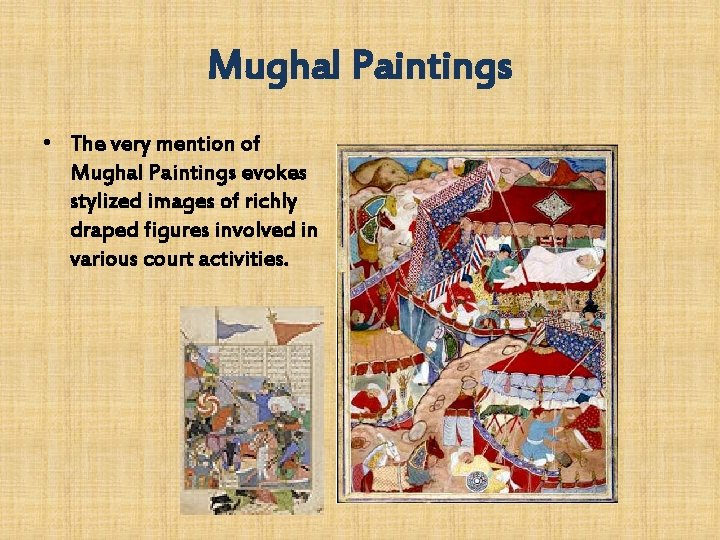
Mughal Paintings • The very mention of Mughal Paintings evokes stylized images of richly draped figures involved in various court activities.
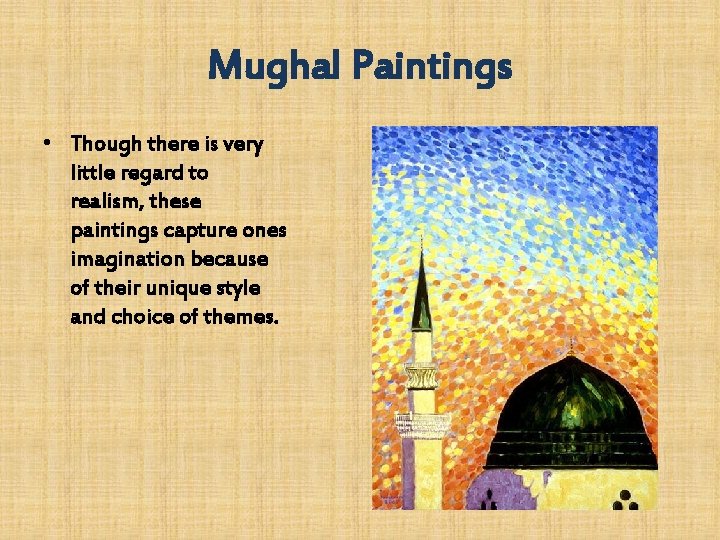
Mughal Paintings • Though there is very little regard to realism, these paintings capture ones imagination because of their unique style and choice of themes.
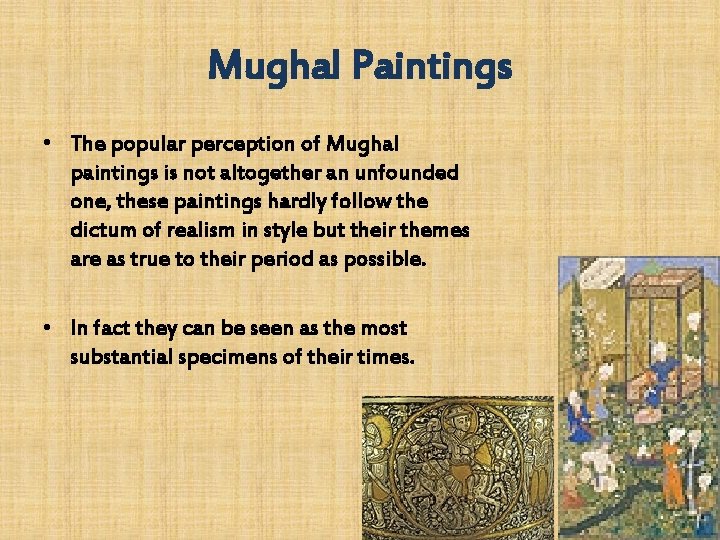
Mughal Paintings • The popular perception of Mughal paintings is not altogether an unfounded one, these paintings hardly follow the dictum of realism in style but their themes are as true to their period as possible. • In fact they can be seen as the most substantial specimens of their times.
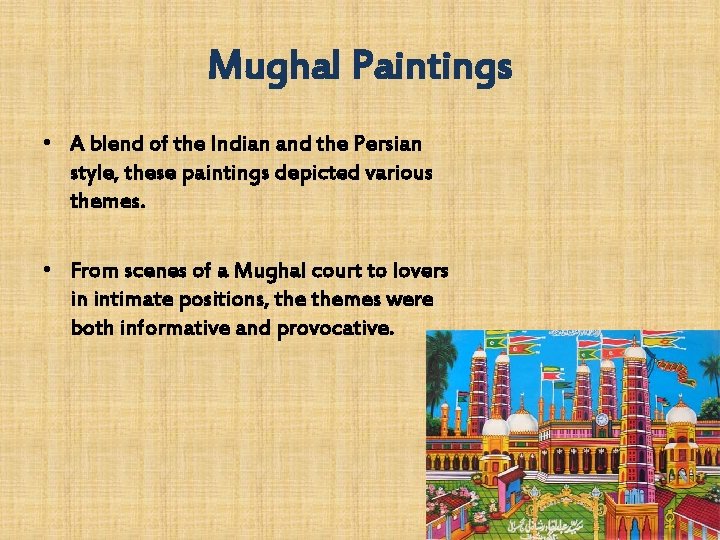
Mughal Paintings • A blend of the Indian and the Persian style, these paintings depicted various themes. • From scenes of a Mughal court to lovers in intimate positions, themes were both informative and provocative.
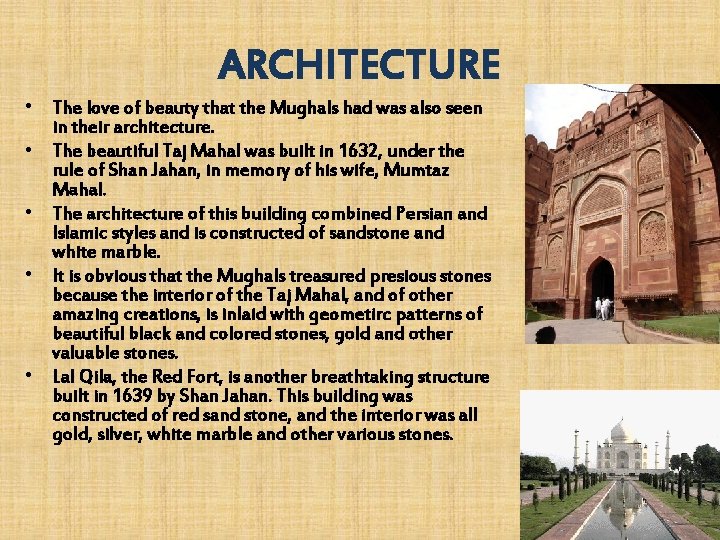
ARCHITECTURE • The love of beauty that the Mughals had was also seen in their architecture. • The beautiful Taj Mahal was built in 1632, under the rule of Shan Jahan, in memory of his wife, Mumtaz Mahal. • The architecture of this building combined Persian and Islamic styles and is constructed of sandstone and white marble. • It is obvious that the Mughals treasured presious stones because the interior of the Taj Mahal, and of other amazing creations, is inlaid with geometirc patterns of beautiful black and colored stones, gold and other valuable stones. • Lal Qila, the Red Fort, is another breathtaking structure built in 1639 by Shan Jahan. This building was constructed of red sand stone, and the interior was all gold, silver, white marble and other various stones.
THANK YOU