
Much Ado About Language To explore Shakespeares language
Much Ado About Language ² To explore Shakespeare’s language. ² To understand techniques used in Shakespeare’s writing.
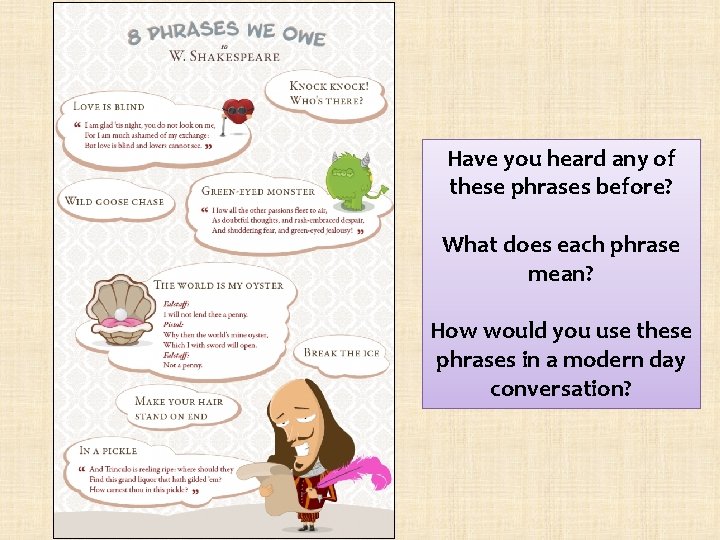
Have you heard any of these phrases before? What does each phrase mean? How would you use these phrases in a modern day conversation?
Background • There were no dictionaries until 1604, so the language used in that era was very fluid and could be moulded and shaped. • People studied Rhetoric (speaking persuasively). • Poets and playwrights experimented with words, phrases and imagery. • Playwrights were free to make up words and to adopt new ones; they could change meanings of words, too. • To make his plays more exciting and appealing to the audience’s senses, Shakespeare used a variety of techniques.

Definition Example Dramatic Language ‘Death lies upon her like an untimely frost Upon the sweetest flower of all the field’ Imagery ‘Why what’s the matter, That you have such a February face, So full of frost, of storm, and cloudiness’ Blank verse = unrhymed and is an important element of his plays. Rhymed verse = the words that fall at the end of lines sound very similar. Antithesis Purpose To engage the audience, and emphasise his ideas. • • To create rhythm and set the mood of a scene Rhyme in speech shared by two characters was used to express shared emotions: Rhyming couplets = two consecutive lines of rhyming verse. Juliet: ‘O now be gone, more light and light it grows’ Romeo: ‘More light and light, more dark and dark our woes’ The opposition of words and phrases against each other. To demonstrate conflicting themes in his plays, or characters that are in conflict.
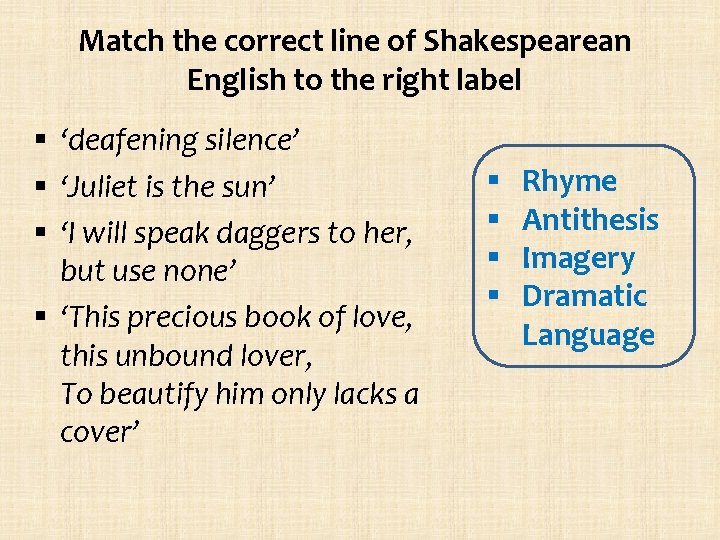
Match the correct line of Shakespearean English to the right label § ‘deafening silence’ § ‘Juliet is the sun’ § ‘I will speak daggers to her, but use none’ § ‘This precious book of love, this unbound lover, To beautify him only lacks a cover’ § § Rhyme Antithesis Imagery Dramatic Language
• ‘deafening silence’ § Antithesis • ‘Juliet is the sun’ § Imagery (metaphor) • ‘I will speak daggers to her, but use none’ § Dramatic Language • ‘This precious book of love, this unbound lover, To beautify him only lacks a cover’ § Rhyme
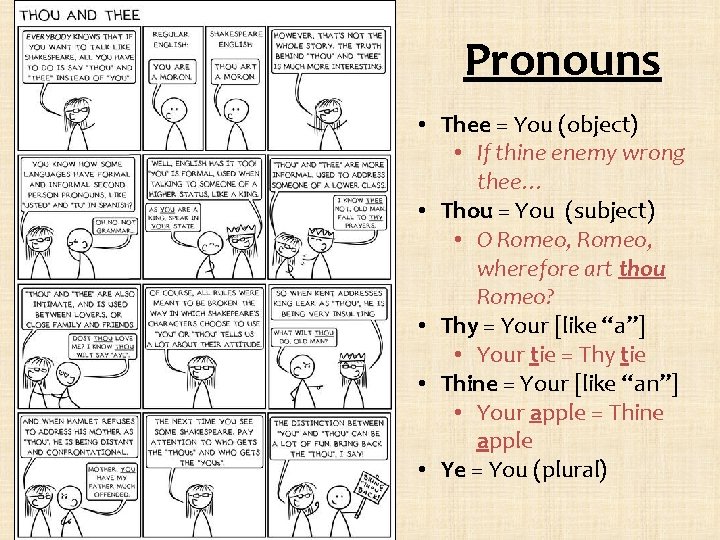
Pronouns • Thee = You (object) • If thine enemy wrong thee… • Thou = You (subject) • O Romeo, wherefore art thou Romeo? • Thy = Your [like “a”] • Your tie = Thy tie • Thine = Your [like “an”] • Your apple = Thine apple • Ye = You (plural)
Elizabethan English After completing the worksheet, write a short scene between two people, discussing regular issues using olden English.
- Slides: 8