
Mu 2 e Electrostatic Septum Prototype Electric Field
- Slides: 29
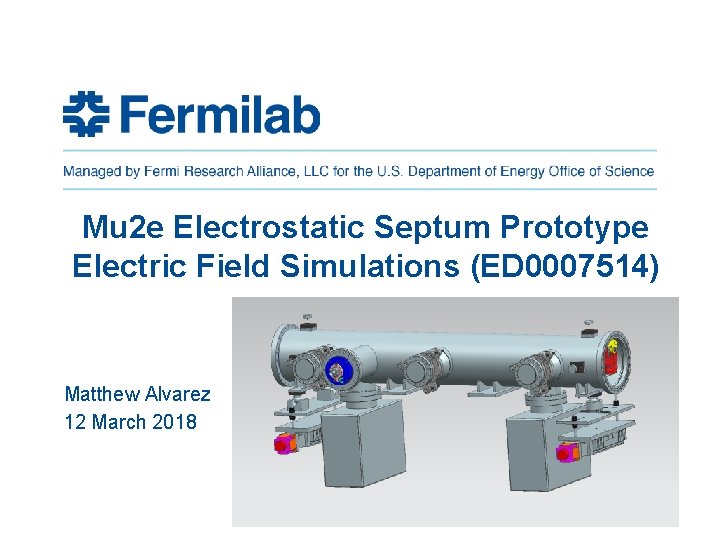
Mu 2 e Electrostatic Septum Prototype Electric Field Simulations (ED 0007514) Matthew Alvarez 12 March 2018
Outline • Introduction – Full Scale Prototype Mechanical Overview • Electrical Field Simulations • (Mechanical and Electrical Requirements are found in Teamcenter Document ED*4162) – HV Feedthrough – Cathode Standoff – Clearing Electrode Ceramic Standoff • 2 Conclusion M. Alvarez | Mu 2 e ESS Prototype Design Electric Field Simulations (ED 0007514) 2/15/2022
Assembly Drawings • F 10036563 - Overall Assembly (sheets 1 -4) – – 3 F 10066902 -Cathode Standoff/Support Assembly F 10036543 - Vacuum Chamber Manufacturing Drawings F 10082810 - High Voltage Feedthrough Assembly F 10055294 -Frame Assembly M. Alvarez | Mu 2 e ESS Prototype Design Electric Field Simulations (ED 0007514) 2/15/2022
Full Scale Prototype Mechanical Overview 4 M. Alvarez | Mu 2 e ESS Prototype Design Electric Field Simulations (ED 0007514) 2/15/2022
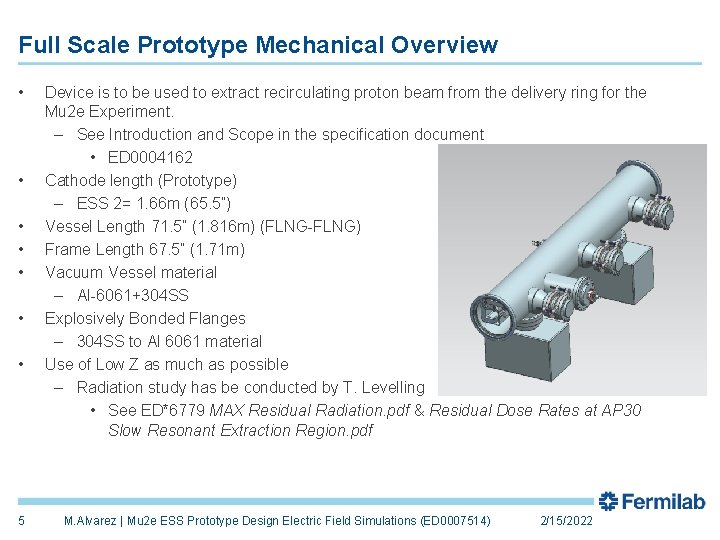
Full Scale Prototype Mechanical Overview • • 5 Device is to be used to extract recirculating proton beam from the delivery ring for the Mu 2 e Experiment. – See Introduction and Scope in the specification document • ED 0004162 Cathode length (Prototype) – ESS 2= 1. 66 m (65. 5”) Vessel Length 71. 5” (1. 816 m) (FLNG-FLNG) Frame Length 67. 5” (1. 71 m) Vacuum Vessel material – Al-6061+304 SS Explosively Bonded Flanges – 304 SS to Al 6061 material Use of Low Z as much as possible – Radiation study has be conducted by T. Levelling • See ED*6779 MAX Residual Radiation. pdf & Residual Dose Rates at AP 30 Slow Resonant Extraction Region. pdf M. Alvarez | Mu 2 e ESS Prototype Design Electric Field Simulations (ED 0007514) 2/15/2022
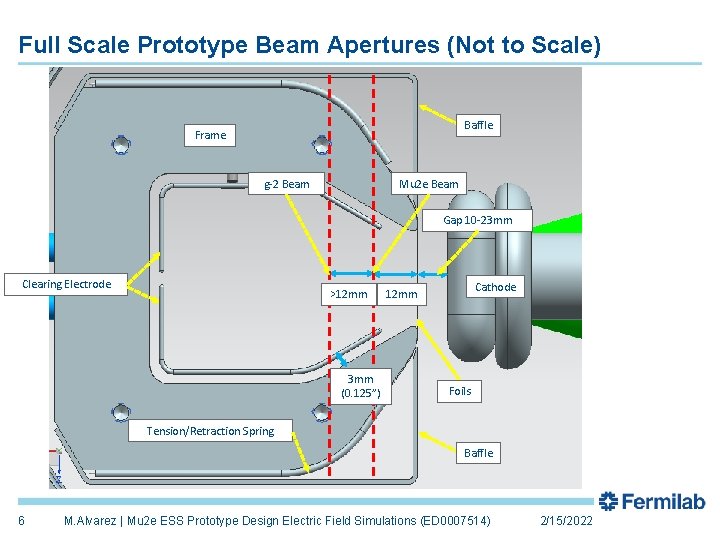
Full Scale Prototype Beam Apertures (Not to Scale) Baffle Frame g-2 Beam Mu 2 e Beam Gap 10 -23 mm Clearing Electrode >12 mm 3 mm (0. 125”) Cathode 12 mm Foils Tension/Retraction Spring Baffle 6 M. Alvarez | Mu 2 e ESS Prototype Design Electric Field Simulations (ED 0007514) 2/15/2022
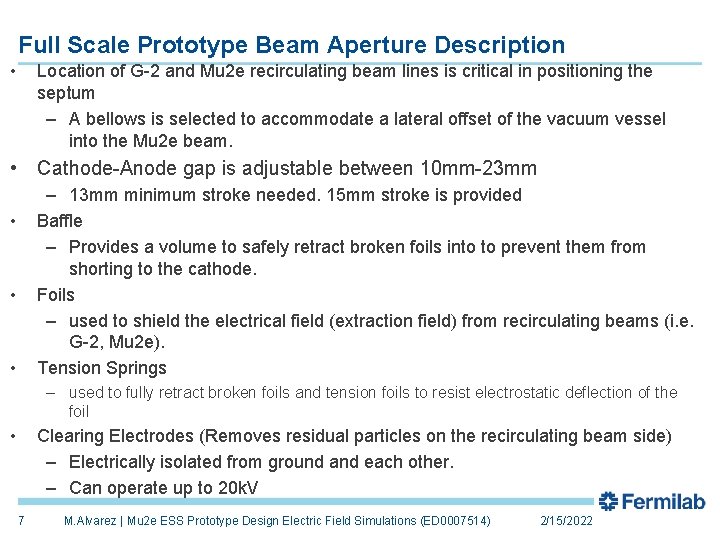
Full Scale Prototype Beam Aperture Description • Location of G-2 and Mu 2 e recirculating beam lines is critical in positioning the septum – A bellows is selected to accommodate a lateral offset of the vacuum vessel into the Mu 2 e beam. • Cathode-Anode gap is adjustable between 10 mm-23 mm – 13 mm minimum stroke needed. 15 mm stroke is provided Baffle – Provides a volume to safely retract broken foils into to prevent them from shorting to the cathode. Foils – used to shield the electrical field (extraction field) from recirculating beams (i. e. G-2, Mu 2 e). Tension Springs • • • – used to fully retract broken foils and tension foils to resist electrostatic deflection of the foil • Clearing Electrodes (Removes residual particles on the recirculating beam side) – Electrically isolated from ground and each other. – Can operate up to 20 k. V 7 M. Alvarez | Mu 2 e ESS Prototype Design Electric Field Simulations (ED 0007514) 2/15/2022
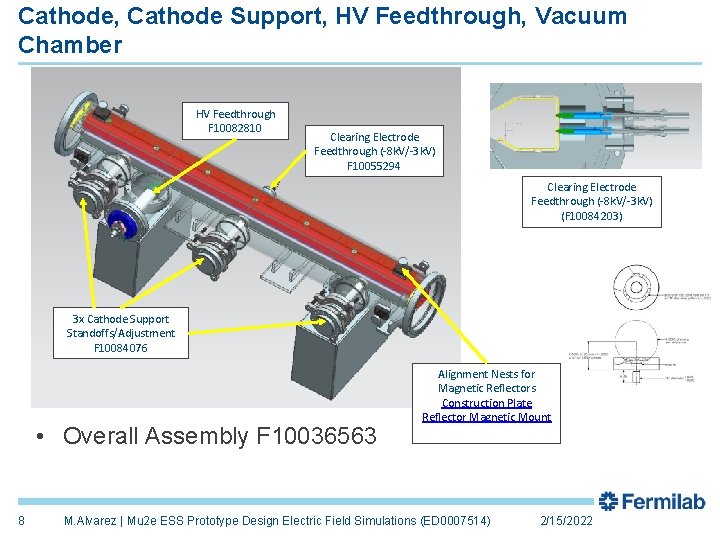
Cathode, Cathode Support, HV Feedthrough, Vacuum Chamber HV Feedthrough F 10082810 Clearing Electrode Feedthrough (-8 k. V/-3 k. V) F 10055294 Clearing Electrode Feedthrough (-8 k. V/-3 k. V) (F 10084203) 3 x Cathode Support Standoffs/Adjustment F 10084076 • Overall Assembly F 10036563 8 Alignment Nests for Magnetic Reflectors Construction Plate Reflector Magnetic Mount M. Alvarez | Mu 2 e ESS Prototype Design Electric Field Simulations (ED 0007514) 2/15/2022
Cathode, Cathode Support, HV Feedthrough, Vacuum Chamber • High Voltage (HV) Feedthrough – Provides a nominal voltage of 100 k. V • Designed to provide up to 150 k. V • Clearing Electrode Feedthrough (rated for 20 k. V operation) – Provides voltage for the clearing electrodes to remove any secondary particles • Cathode Support Standoffs – Designed to withstand 150 k. V voltages – Support the cathode and provide adjustment of at least 13 mm • Designed to provide at least 15 mm stroke • Gap distances will be in the range of 10 mm to 23 mm • Alignment Nests – Will be used to reference the frame and cathode 9 M. Alvarez | Mu 2 e ESS Prototype Design Electric Field Simulations (ED 0007514) 2/15/2022
Electrical Field Simulations 10 M. Alvarez | Mu 2 e ESS Prototype Design Electric Field Simulations (ED 0007514) 2/15/2022
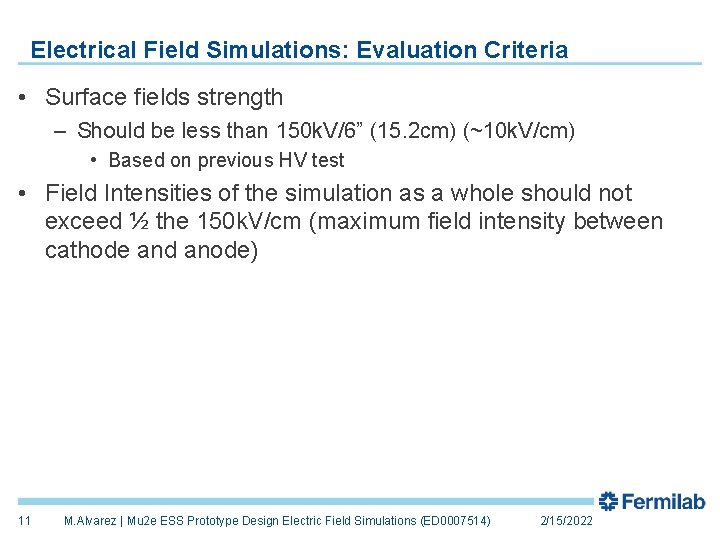
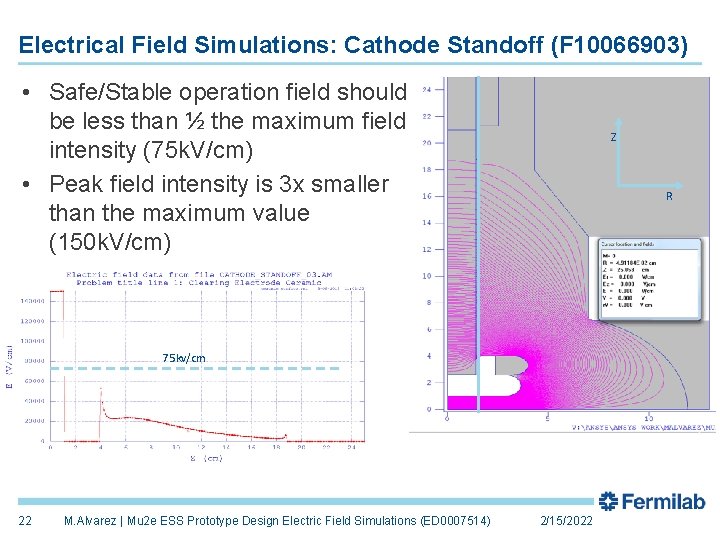
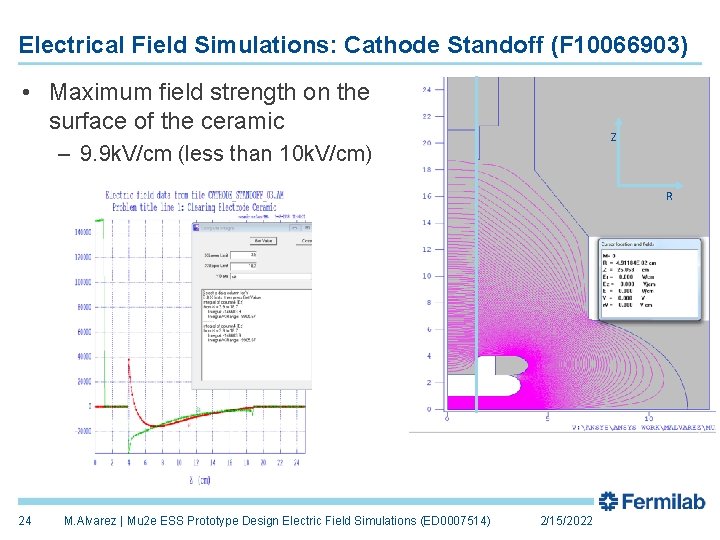
Electrical Field Simulations: Evaluation Criteria • Surface fields strength – Should be less than 150 k. V/6” (15. 2 cm) (~10 k. V/cm) • Based on previous HV test • Field Intensities of the simulation as a whole should not exceed ½ the 150 k. V/cm (maximum field intensity between cathode and anode) 11 M. Alvarez | Mu 2 e ESS Prototype Design Electric Field Simulations (ED 0007514) 2/15/2022
Electric Field Simulations: HV Feedthrough (F 10082810) 12 M. Alvarez | Mu 2 e ESS Prototype Design Electric Field Simulations (ED 0007514) 2/15/2022
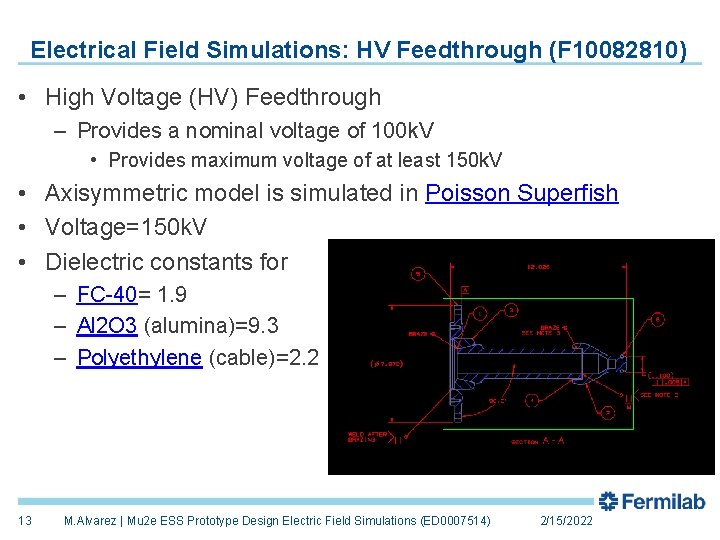
Electrical Field Simulations: HV Feedthrough (F 10082810) • High Voltage (HV) Feedthrough – Provides a nominal voltage of 100 k. V • Provides maximum voltage of at least 150 k. V • Axisymmetric model is simulated in Poisson Superfish • Voltage=150 k. V • Dielectric constants for – FC-40= 1. 9 – Al 2 O 3 (alumina)=9. 3 – Polyethylene (cable)=2. 2 13 M. Alvarez | Mu 2 e ESS Prototype Design Electric Field Simulations (ED 0007514) 2/15/2022
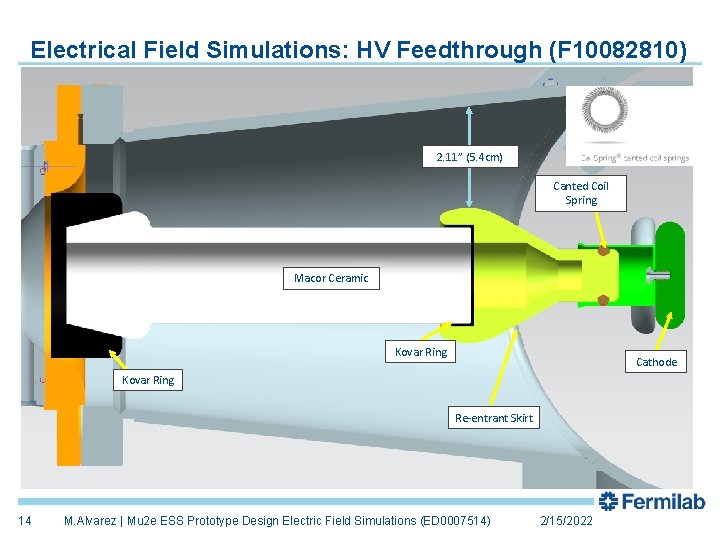
Electrical Field Simulations: HV Feedthrough (F 10082810) 2. 11” (5. 4 cm) Canted Coil Spring Macor Ceramic Kovar Ring Cathode Kovar Ring Re-entrant Skirt 14 M. Alvarez | Mu 2 e ESS Prototype Design Electric Field Simulations (ED 0007514) 2/15/2022
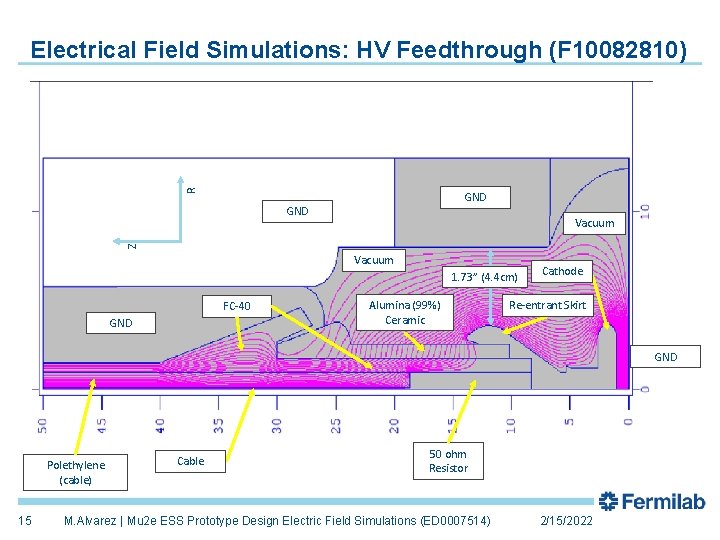
R Electrical Field Simulations: HV Feedthrough (F 10082810) GND Z Vacuum 1. 73” (4. 4 cm) FC-40 GND Alumina (99%) Ceramic Cathode Re-entrant Skirt GND Polethylene (cable) 15 Cable 50 ohm Resistor M. Alvarez | Mu 2 e ESS Prototype Design Electric Field Simulations (ED 0007514) 2/15/2022
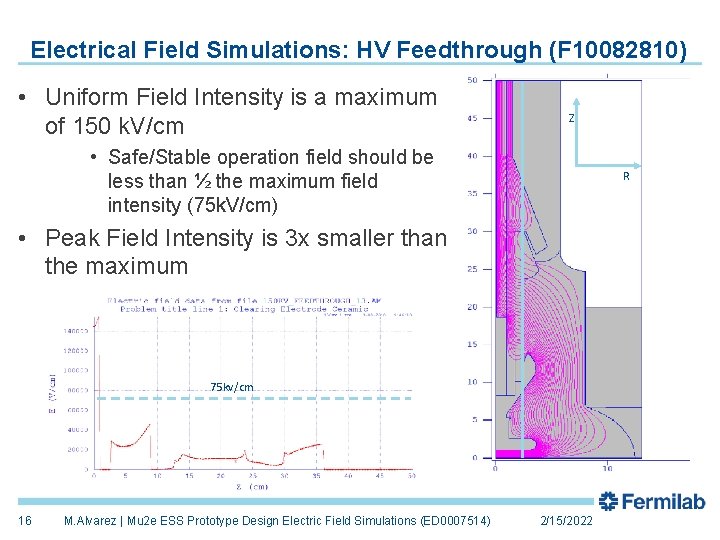
Electrical Field Simulations: HV Feedthrough (F 10082810) • Uniform Field Intensity is a maximum of 150 k. V/cm Z • Safe/Stable operation field should be less than ½ the maximum field intensity (75 k. V/cm) R • Peak Field Intensity is 3 x smaller than the maximum 75 kv/cm 16 M. Alvarez | Mu 2 e ESS Prototype Design Electric Field Simulations (ED 0007514) 2/15/2022
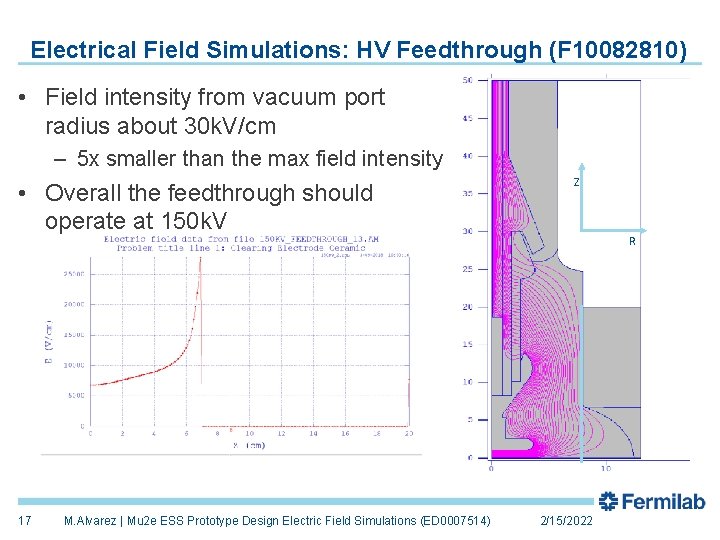
Electrical Field Simulations: HV Feedthrough (F 10082810) • Field intensity from vacuum port radius about 30 k. V/cm – 5 x smaller than the max field intensity • Overall the feedthrough should operate at 150 k. V 17 M. Alvarez | Mu 2 e ESS Prototype Design Electric Field Simulations (ED 0007514) Z R 2/15/2022
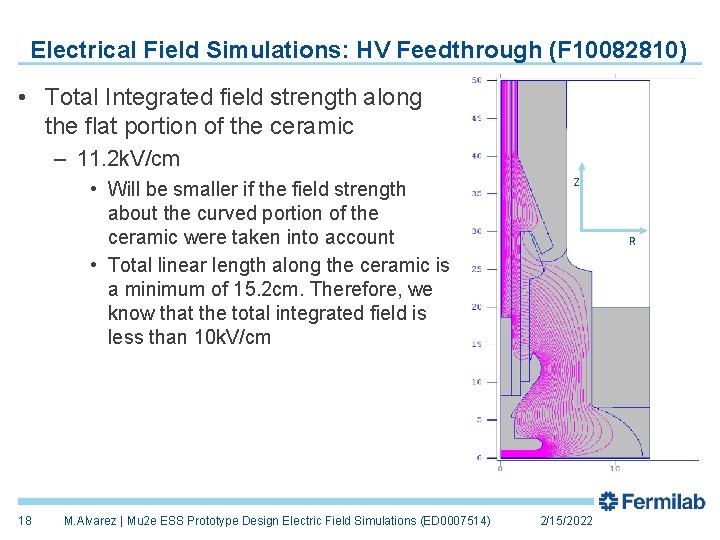
Electrical Field Simulations: HV Feedthrough (F 10082810) • Total Integrated field strength along the flat portion of the ceramic – 11. 2 k. V/cm • Will be smaller if the field strength about the curved portion of the ceramic were taken into account • Total linear length along the ceramic is a minimum of 15. 2 cm. Therefore, we know that the total integrated field is less than 10 k. V/cm 18 M. Alvarez | Mu 2 e ESS Prototype Design Electric Field Simulations (ED 0007514) Z R 2/15/2022
Electric Field Simulations: Cathode Standoff (F 10066903) 19 M. Alvarez | Mu 2 e ESS Prototype Design Electric Field Simulations (ED 0007514) 2/15/2022
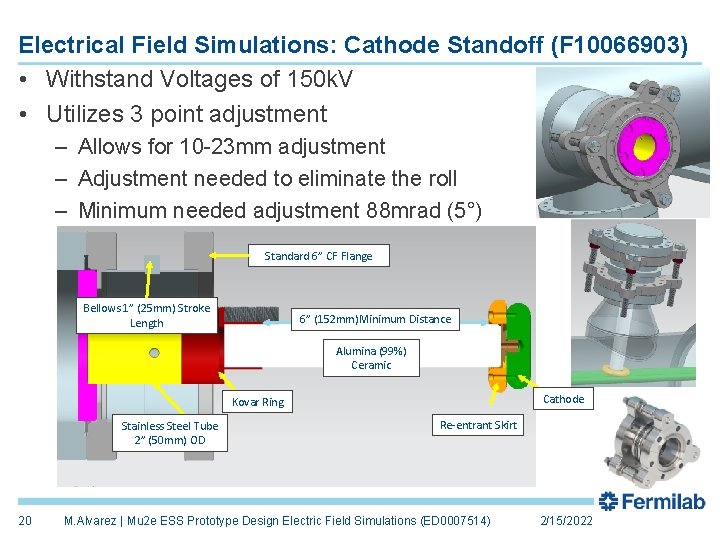
Electrical Field Simulations: Cathode Standoff (F 10066903) • Withstand Voltages of 150 k. V • Utilizes 3 point adjustment – Allows for 10 -23 mm adjustment – Adjustment needed to eliminate the roll – Minimum needed adjustment 88 mrad (5°) Standard 6” CF Flange Bellows 1” (25 mm) Stroke Length 6” (152 mm)Minimum Distance Alumina (99%) Ceramic Cathode Kovar Ring Stainless Steel Tube 2” (50 mm) OD 20 Re-entrant Skirt M. Alvarez | Mu 2 e ESS Prototype Design Electric Field Simulations (ED 0007514) 2/15/2022
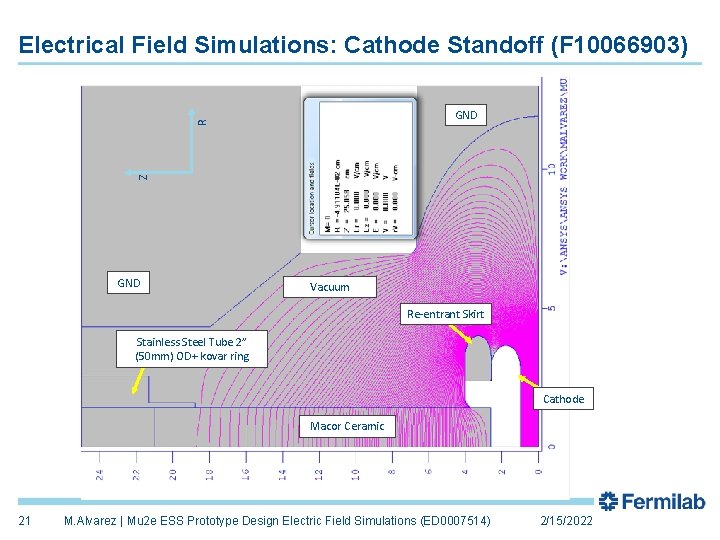
Electrical Field Simulations: Cathode Standoff (F 10066903) Z R GND Vacuum Re-entrant Skirt Stainless Steel Tube 2” (50 mm) OD+ kovar ring Cathode Macor Ceramic 21 M. Alvarez | Mu 2 e ESS Prototype Design Electric Field Simulations (ED 0007514) 2/15/2022
Electrical Field Simulations: Cathode Standoff (F 10066903) • Safe/Stable operation field should be less than ½ the maximum field intensity (75 k. V/cm) • Peak field intensity is 3 x smaller than the maximum value (150 k. V/cm) Z R 75 kv/cm 22 M. Alvarez | Mu 2 e ESS Prototype Design Electric Field Simulations (ED 0007514) 2/15/2022
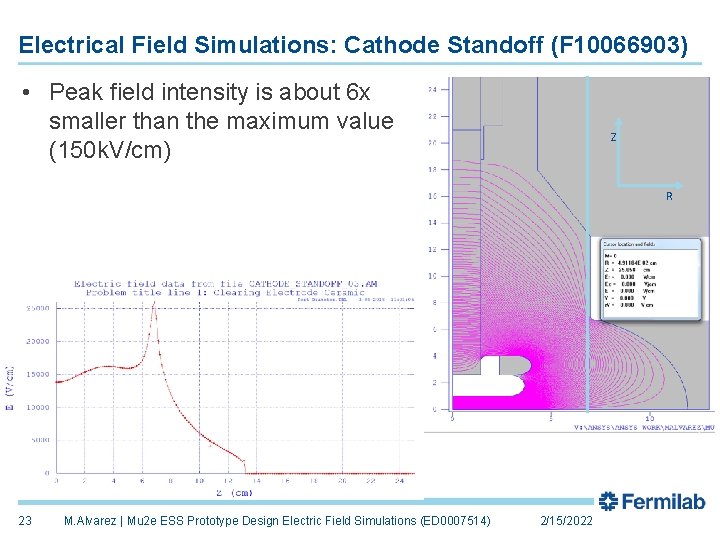
Electrical Field Simulations: Cathode Standoff (F 10066903) • Peak field intensity is about 6 x smaller than the maximum value (150 k. V/cm) Z R 23 M. Alvarez | Mu 2 e ESS Prototype Design Electric Field Simulations (ED 0007514) 2/15/2022
Electrical Field Simulations: Cathode Standoff (F 10066903) • Maximum field strength on the surface of the ceramic Z – 9. 9 k. V/cm (less than 10 k. V/cm) R 24 M. Alvarez | Mu 2 e ESS Prototype Design Electric Field Simulations (ED 0007514) 2/15/2022
Electric Field Simulations: Clearing Electrode Standoff (F 10077530) 25 M. Alvarez | Mu 2 e ESS Prototype Design Electric Field Simulations (ED 0007514) 2/15/2022
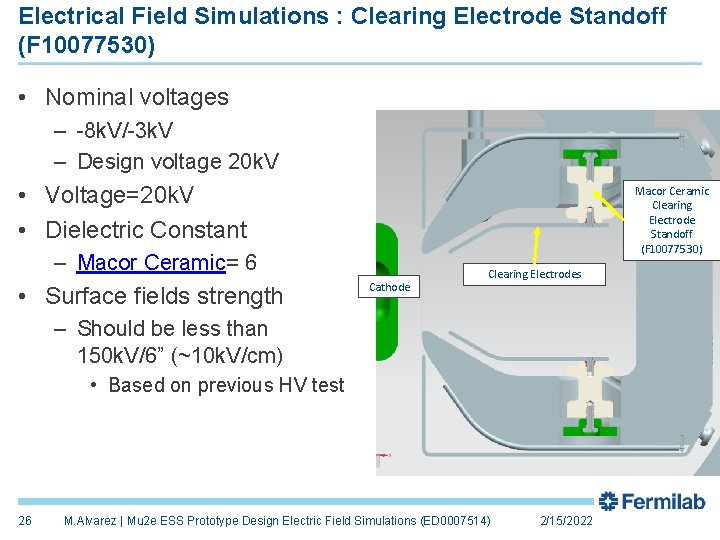
Electrical Field Simulations : Clearing Electrode Standoff (F 10077530) • Nominal voltages – -8 k. V/-3 k. V – Design voltage 20 k. V • Voltage=20 k. V • Dielectric Constant Macor Ceramic Clearing Electrode Standoff (F 10077530) – Macor Ceramic= 6 • Surface fields strength Cathode Clearing Electrodes – Should be less than 150 k. V/6” (~10 k. V/cm) • Based on previous HV test 26 M. Alvarez | Mu 2 e ESS Prototype Design Electric Field Simulations (ED 0007514) 2/15/2022
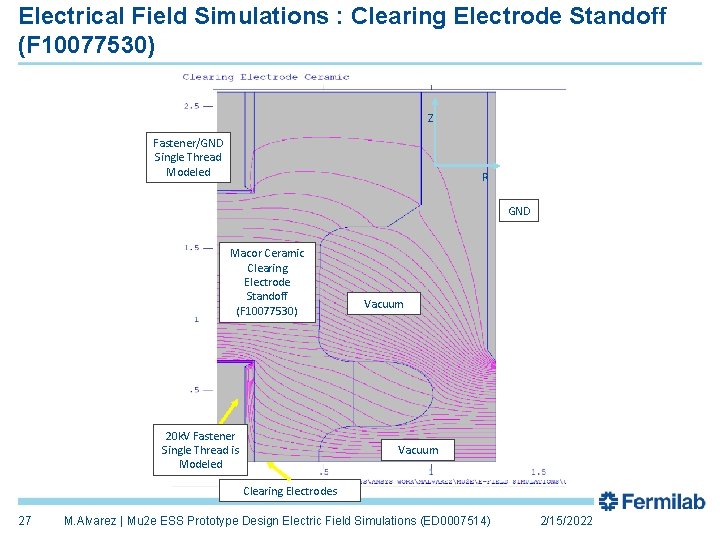
Electrical Field Simulations : Clearing Electrode Standoff (F 10077530) Z Fastener/GND Single Thread Modeled R GND Macor Ceramic Clearing Electrode Standoff (F 10077530) 20 k. V Fastener Single Thread is Modeled Vacuum Clearing Electrodes 27 M. Alvarez | Mu 2 e ESS Prototype Design Electric Field Simulations (ED 0007514) 2/15/2022
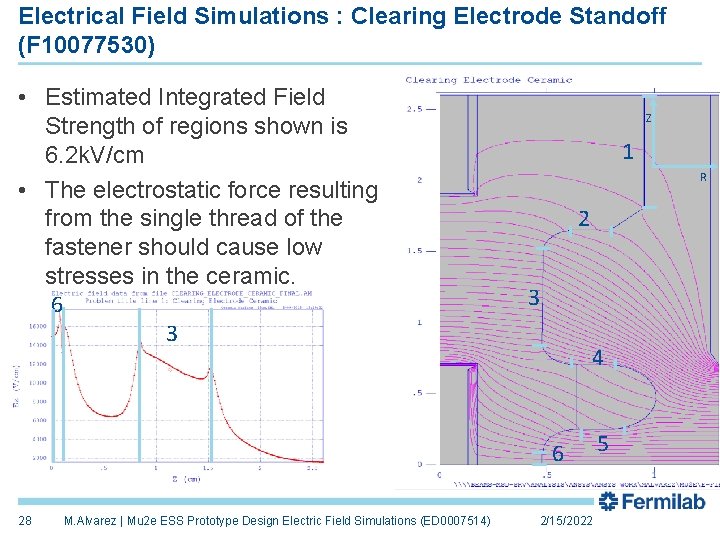
Electrical Field Simulations : Clearing Electrode Standoff (F 10077530) • Estimated Integrated Field Strength of regions shown is 6. 2 k. V/cm • The electrostatic force resulting from the single thread of the fastener should cause low stresses in the ceramic. 6 3 Z 1 R 2 3 4 6 28 M. Alvarez | Mu 2 e ESS Prototype Design Electric Field Simulations (ED 0007514) Z 2/15/2022 5 R
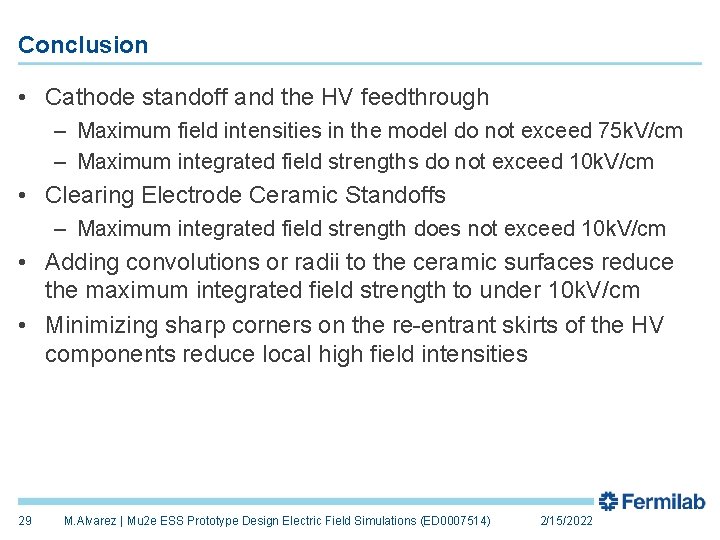
Conclusion • Cathode standoff and the HV feedthrough – Maximum field intensities in the model do not exceed 75 k. V/cm – Maximum integrated field strengths do not exceed 10 k. V/cm • Clearing Electrode Ceramic Standoffs – Maximum integrated field strength does not exceed 10 k. V/cm • Adding convolutions or radii to the ceramic surfaces reduce the maximum integrated field strength to under 10 k. V/cm • Minimizing sharp corners on the re-entrant skirts of the HV components reduce local high field intensities 29 M. Alvarez | Mu 2 e ESS Prototype Design Electric Field Simulations (ED 0007514) 2/15/2022