
MTSA 33 CFR 105 210 Training for Personnel

- Slides: 87
MTSA 33 CFR 105. 210 Training for Personnel with Security Duties.
Learning Objectives At the end of this course, students will know and be able to apply the following: Demonstrate knowledge of the Maritime Transportation Security Act (MTSA), and the required knowledge as listed in 33 CFR 105. 210. Perform their duties within federal regulation.
September 11, 2001 On the morning of September 11, 2001, 2 American passenger aircraft were intentionally flown into the World Trade Center Twin Towers. The impact of this act was such a shock to the American people that most of us can still remember exactly what we were doing when the news broke. A third aircraft was flown into the Pentagon and the fourth aircraft crashed before hitting its’ target, thanks to brave men and women on board, refusing to let the terrorist accomplish their mission. The attacks resulted in the deaths of 2, 996 people and the injuries of 6, 000+ others. The 2, 996 death toll included 265 on the four planes (from which there were no survivors), 2, 606 in the World Trade Center and in the surrounding area, and 125 at the Pentagon. This sparked the realization that the U. S. needed to take terrorism seriously and needed to react accordingly.
Congress & POTUS take Action Immediately, our government brought forward legislation to give Law Enforcement Agencies the power to combat illegal immigrants, penetrate Islamic Fundamentalist cells, and increase our intelligence gathering authority and expertise THE PATRIOT ACT was signed into law by President George W. Bush on October 26, 2001.
Transportation Industry Because airplanes were used in attacking civilians, the airline transportation industry was immediately reviewed and the lack of security was astonishing. Then we turned our eyes to the Maritime Transportation System (MTS). We noticed our ports and waterways had become highly vulnerable since WWII. There were virtually no security at shipping terminals or our harbors and river systems. Foreign crews and personnel were able to walk off a ship right into our towns and cities; from there, anywhere in the United States, all unchecked.
MTSA of 2002 On November 25, 2002, President George W. Bush signed into law the Maritime Transportation Security Act (MTSA). MTSA contained several provisions intended to enhance America’s maritime community against the threat of terrorism. MTSA aligns with the International Ship and Port Facility Security Code (ISPS). MTSA has a broader application than the ISPS and includes domestic vessels and facilities. The U. S. Coast Guard issued regulations in 33 CFR (Code of Federal Regulations) that include requirements for Port Security Committees and Port Security Plans, Vessel Security Assessments and Security Plans, Vessel and Company Security Officers, Facility Security Assessments and Plans, and Facility Security Officers.
Implementation and Enforcement After MTSA became law, the responsibility was placed upon the U. S. Coast Guard to implement and enforce the law. 33 CFR was written, reviewed and then finalized. 33 CFR subchapter H (Maritime Security) delves into the detail of the public’s responsibilities and requirements that were implemented on July 1, 2004.
Facility Security Plan What is it? Facility Security Plan (FSP) means the plan developed to ensure the application of security measures designed to protect the facility and its servicing vessels or those vessels interfacing with the facility, their cargoes, and persons on board at the respective MARSEC Levels. In layman’s terms, it means your employer or owner of the property has written a plan to deal with security threats. Also, if foreign (SOLAS) vessels visit this property there are procedures and protocols on how to handle these people and vessels.
What’s Included in the Plan? Security Administration and Organization of the Facility Personnel Training Drills and Exercises Records and Documentation Response to change in MARSEC Levels Procedures for interfacing with vessels Declaration of Security Communications Security systems and equipment maintenance Security measures for access control, including designated public access areas Security measures for handling cargo Security measures for delivery of vessel stores and bunkers Security measures for monitoring Security incident procedures Audits and Security Plan amendments Facility Security Assessment (FSA) report; and Facility Vulnerability and Security Measures Summary (Form CG-6025)
The Organization of the Facility FSO, PSD’s, and AO’s Security administration and organization of the facility; Explained: Facility Security Officer Personnel w/Security Duties All Other Facility Personnel.
Required Training Personnel Training: 33 CFR 105. 205 FSO Training 33 CFR 105. 210 Personnel w/Security Duties Training. 33 CFR 105. 215 All other Facility Personnel Training
Required Knowledge: Personnel Training Personnel w/Security Duties required Training: 33 CFR 105. 210 Knowledge of current security threats and patterns. Recognition and detection of dangerous substances and devices. Recognition of characteristics and behavioral patterns of persons who are likely to threaten security. Techniques used to circumvent security measures. Crowd management and control techniques. Security related communications Knowledge of emergency procedures and contingency plans.
Personnel Training Personnel w/Security Duties Training Continued: Required Knowledge Operation of security equipment and systems. Testing, calibration, and maintenance of security equipment and systems. Inspection, control and monitoring techniques. Relevant provisions of the Facility Security Plan (FSP). Methods of physical screening of person, personal effects, baggage, cargo, and vessel stores. The meaning and the consequential requirements of the different MARSEC Levels. Familiar with all relevant aspects of the TWIC program and how to carry them out.
Records/Retention Records and Documentation: 33 CFR 105. 225 The FSO MUST keep records of the following activities for 2 years: Training Drills and Exercises Incidents and Breaches of Security Changes in MARSEC Levels Maintenance, calibration, and testing of security equipment. Security Threats Declaration of Security (DOS) Annual audit of the FSP, 33 CFR 105. 415
Knowledge of current Security Threats and Patterns How to Recognize a Threat. Types of Threats • • • Terrorism: Groups such as ISIS, HAMAS, HIZBALLAH, Al-Qa’ida and BOKO HARAM Organized Crime: Groups such as Colombian Drug Cartels, Mexican Cartels, and the Mafia. Lone Criminal Act: such as Theft, criminal mischief, drug smuggling, assaults; when the perpetrator is acting alone. Cyber: Malware, spyware, and ransomware. Civil Unrest: Riots, “Protesters”
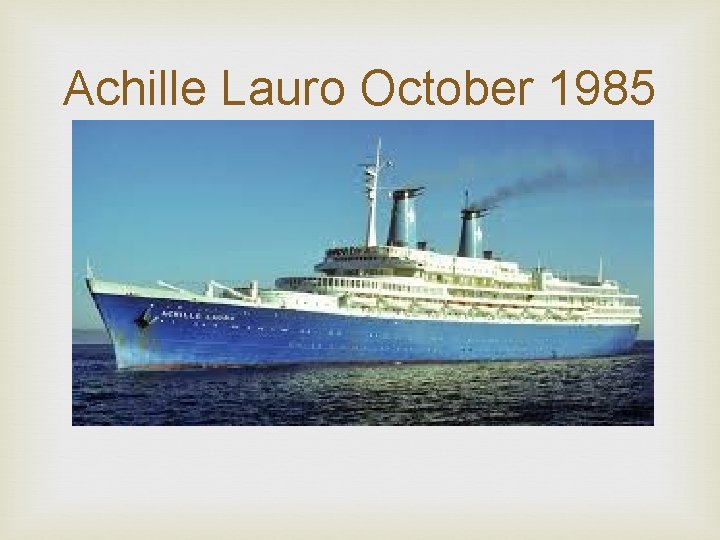
Terrorist Threats Throughout the U. S. history, terrorists were insignificant in the scheme of things and were truly not a threat to national security. This all changed in October of 1985 with the hijacking of the Italian cruise ship the Achille Lauro. This was the first Major maritime impact.
Achille Lauro October 1985
What Happened to the Achille Lauro? Four heavily armed Palestinian terrorists hijacked the Achille Lauro, carrying more than 400 passengers and crew, off the coast of Egypt. The hijackers demanded that Israel free 50 Palestinian prisoners. The terrorists killed a disabled American tourist, 69 y/o Leon Klinghoffer, and threw his body overboard with his wheelchair. After a 2 day standoff, the hijackers surrendered in exchange for a pledge of safe passage. But when an Egyptian jet tried to fly the hijackers to freedom, U. S. Navy fighter pilots intercepted it and forced it to land in Sicily. The terrorists were taken into custody by Italian authorities. Counter -terrorist units from the United States responded, however the situation was resolved before an assault had become necessary.
Moving forward to the 1990’s
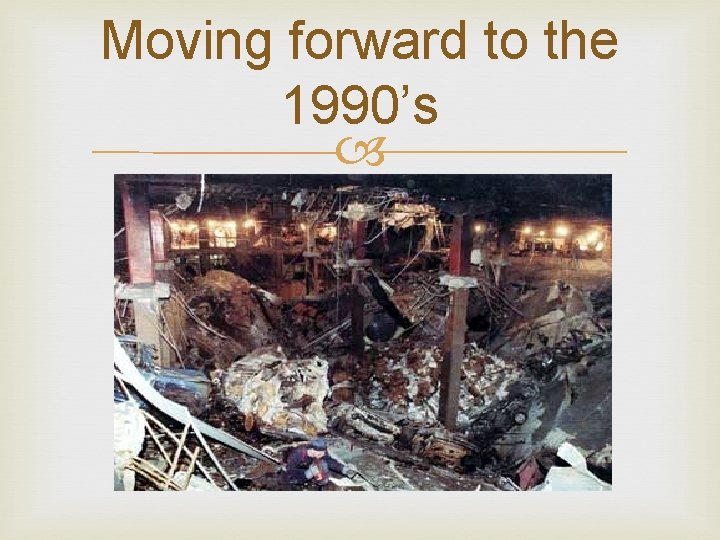
1993 World Trade Center Bombing In the 1990’s, hate for Americans had been growing. The first major attack in the U. S. was the truck bombing of the World Trade Towers. We caught the perpetrators quickly and put them in jail. We bombed a couple of countries that were fostering terrorist training camps and went back to our strong economy. Americans felt that the bombing of the World Trade Center was an isolated incident, but this was just the beginning of a war in which the U. S. was not fully engaged.
March 23, 2013 - Syria The Syrian military is said to believe that a homemade, locally-manufactured rocket was fired, containing a form of chlorine know as CL 17, easily available as a swimming pool cleaner. They claim that the warhead contained a quantity of the gas, and was dissolved in saline solution. 26 People were killed
April 13, 2013 - Boston Two explosives at the Boston Marathon. The bombs exploded about 12 seconds and 210 yards apart at 2: 49 P. M. , near the marathon’s finish line on Boylston Street. The devices were made of pressure cookers filled with nails and ball bearings; sending shrapnel over a wide area. The explosion killed 3 civilians and injured an estimation 264 others.
ARIZONA Sheriff Arpaio is known for his strong stance against illegal immigration into the U. S. and particularly Arizona. An explosive device was sent to Sheriff Joseph Arpaio in a package. It was intercepted before it was detonated and noone was injured.
Washington DC On April 16, 2013 letters containing the deadly chemical Ricin were mailed to President Obama and Senator Wicker. Both letters, which were mailed from Memphis, Tennessee, included the phrases “ No one wanted to listen to me before. There are still Missing Pieces. Maybe I have your attention now even if that means someone must die. ” Both letters were intercepted at the U. S. Postal service facility.
April 21, 2013 – Spring City, TN The Tennessee Valley Authority, which operates the Watts Bar Plant, notified the NRC that a security officer patrolling on TVA property near the Tennessee River exchanged gunfire with an individual. This location is outside the plant’s protected area. The officer was not injured and local law enforcement assisted in the response to the incident.
April 22, 2013 Canadian police and intelligence services arrested two suspects who allegedly planned to derail a passenger rail train in Greater Toronto. The Royal Canadian Mounted Police called it a “Major terrorist attack. ” Chiheb Esseghaier, 30, of Montreal and Raed Jaseer, 35, of Toronto, had received “direction and guidance” from “al-Qaeda elements” in Iran.
December 2, 2015 Inland Regional Center in San Bernardino, California, which consisted of a mass shooting and an attempted bombing. The perpetrators, Syed Rizwan Farook and Tashfeen Malik, targeted a San Bernardino County Department of Public Health training event and Christmas party. 14 People were killed and 22 were seriously injured in the terrorist attack.
June 12, 2016 The Pulse in Orlando, Florida, a terrorist conducted a mass shooting inside the gay nightclub. Omar Mateen, 29, killed 49 people and wounded 53 others in this terrorist attack. This is said to be the deadliest mass shooting by a single shooter, and the deadliest terrorist attack in the U. S. since the September 11 th attacks in 2001.
Organized Crime Organized crime is a category of transnational, or local groupings of highly centralized enterprises run by criminals who intend to engage in illegal activity, most commonly for money and profit. Types of criminal activity committed: Sex trafficking, Drug smuggling, Weapons trafficking (Fast and Furious) Terrorism Cyber warfare, Computer Viruses Labor Racketeering Illegal immigration and people smuggling
The Lone Criminal This is your typical thief, vandal and trouble maker. They tend to look for “easy targets” unlocked vehicle, offices, items left in the open and points of easy access to areas. These types of individuals are generally not given direction to commit a crime and make these decisions on their own to benefit themselves.
Cyber Threats Technology and Cyber Security NIST Framework • • • Identify Protect Detect Respond Recover
Cyber Attacks FBI Director James Comey once said: “There are two kinds of big companies in the United States. There are those who’ve been hacked… and those who don’t know they’ve been hacked. ”
Cyber things to Consider Virus Protection User Policies - Thumb drives - Installation of applications - Personal laptops/tablets - Network access - Access to Network server, and server rooms.
Dangerous Substances and Devices Weapons of Mass Destruction - Biological - Nuclear - Incendiary - Chemical - Explosive
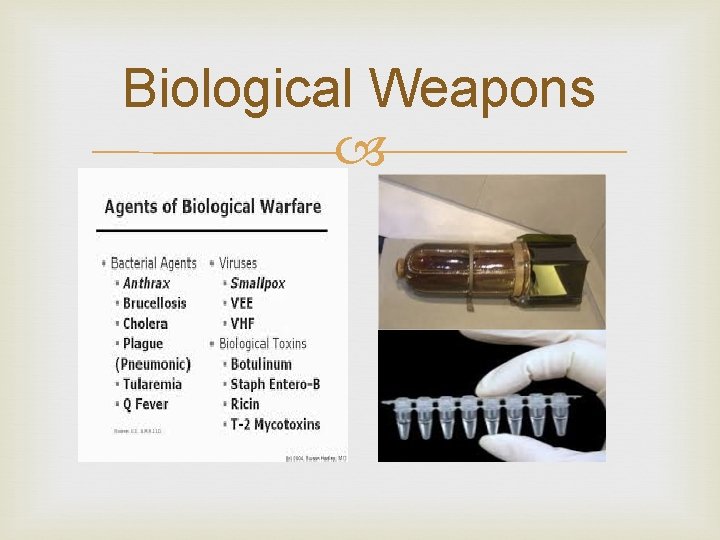
Biological Weapons
Biological Warfare What is a Biological Warfare? Biological Warfare, also known as germ warfare, is the use of biological toxins or infectious agents such as bacteria, viruses, and fungi with the intent to kill or incapacitate humans, animals or plants as an act of war.
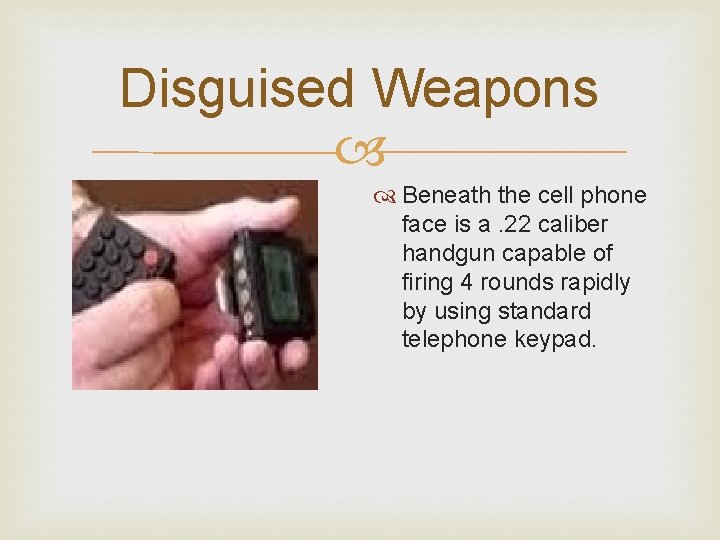
Disguised Weapons Beneath the cell phone face is a. 22 caliber handgun capable of firing 4 rounds rapidly by using standard telephone keypad.
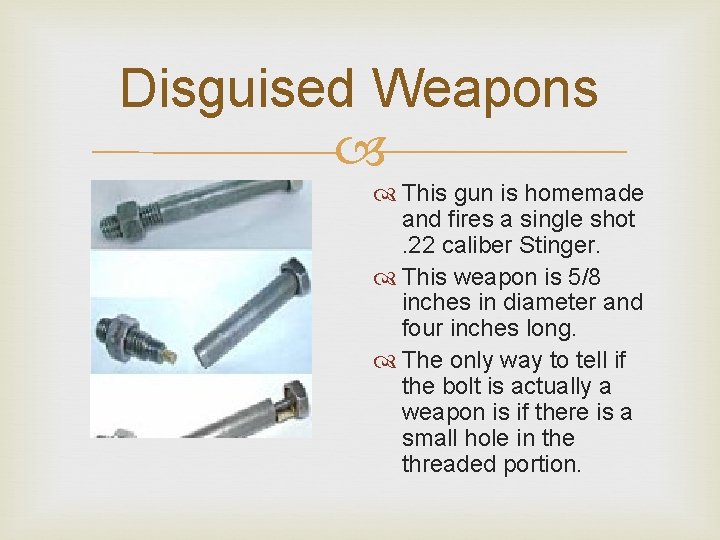
Disguised Weapons This gun is homemade and fires a single shot. 22 caliber Stinger. This weapon is 5/8 inches in diameter and four inches long. The only way to tell if the bolt is actually a weapon is if there is a small hole in the threaded portion.
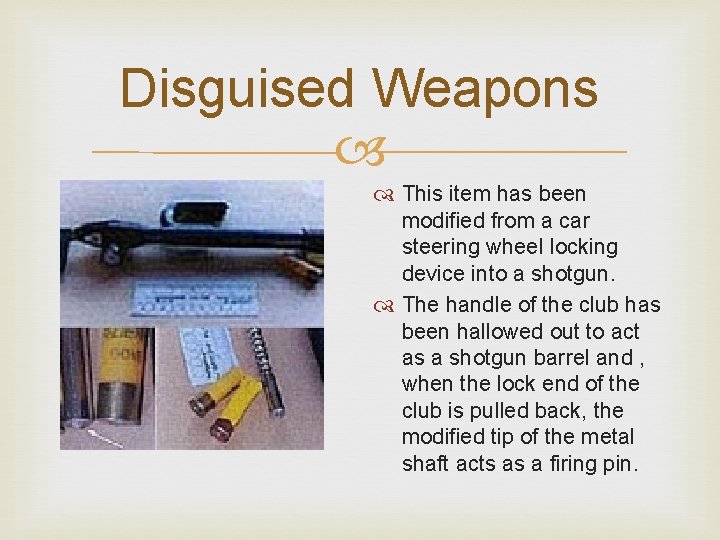
Disguised Weapons This item has been modified from a car steering wheel locking device into a shotgun. The handle of the club has been hallowed out to act as a shotgun barrel and , when the lock end of the club is pulled back, the modified tip of the metal shaft acts as a firing pin.
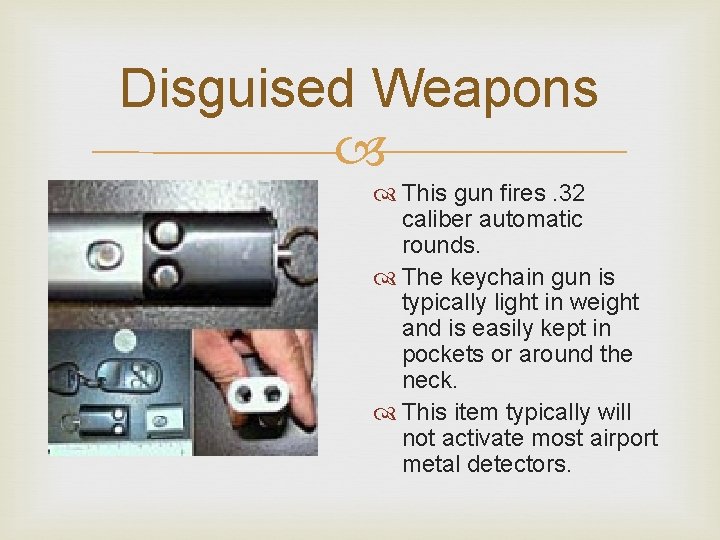
Disguised Weapons This gun fires. 32 caliber automatic rounds. The keychain gun is typically light in weight and is easily kept in pockets or around the neck. This item typically will not activate most airport metal detectors.
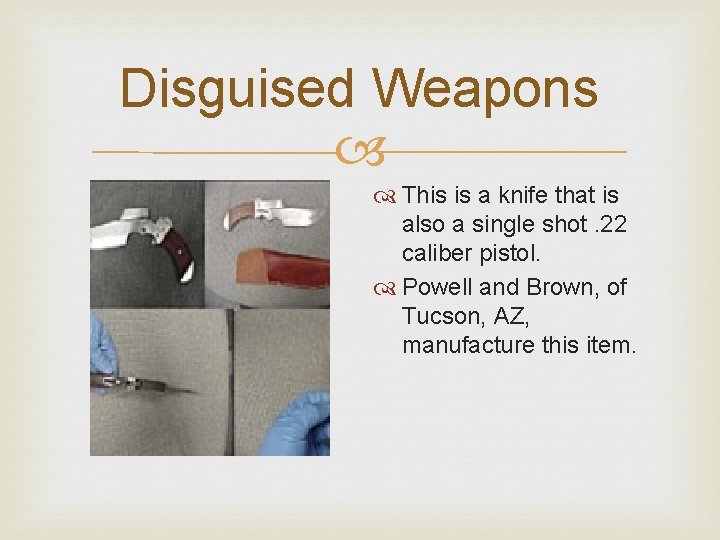
Disguised Weapons This is a knife that is also a single shot. 22 caliber pistol. Powell and Brown, of Tucson, AZ, manufacture this item.
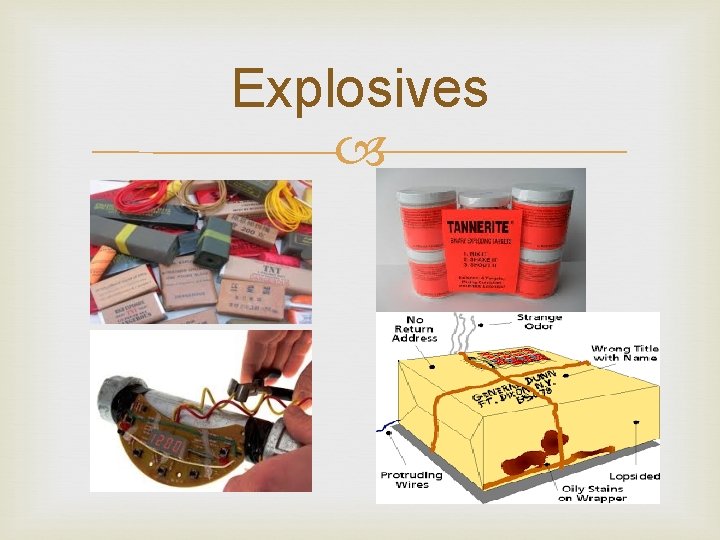
Explosives
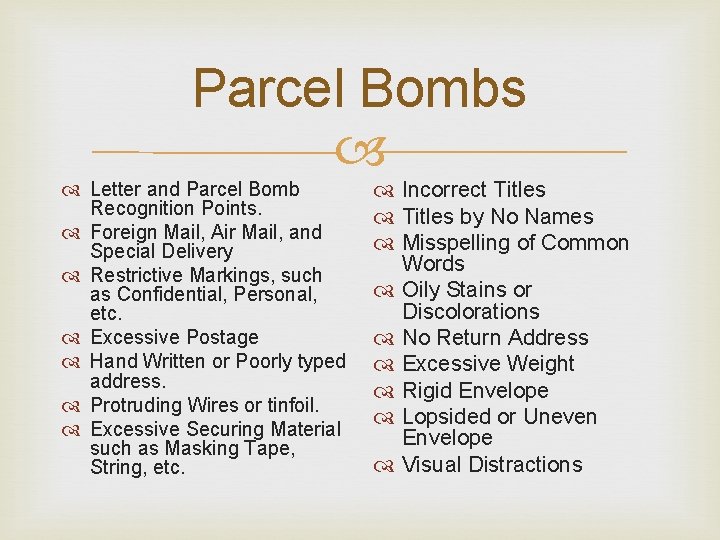
Parcel Bombs Letter and Parcel Bomb Recognition Points. Foreign Mail, Air Mail, and Special Delivery Restrictive Markings, such as Confidential, Personal, etc. Excessive Postage Hand Written or Poorly typed address. Protruding Wires or tinfoil. Excessive Securing Material such as Masking Tape, String, etc. Incorrect Titles by No Names Misspelling of Common Words Oily Stains or Discolorations No Return Address Excessive Weight Rigid Envelope Lopsided or Uneven Envelope Visual Distractions
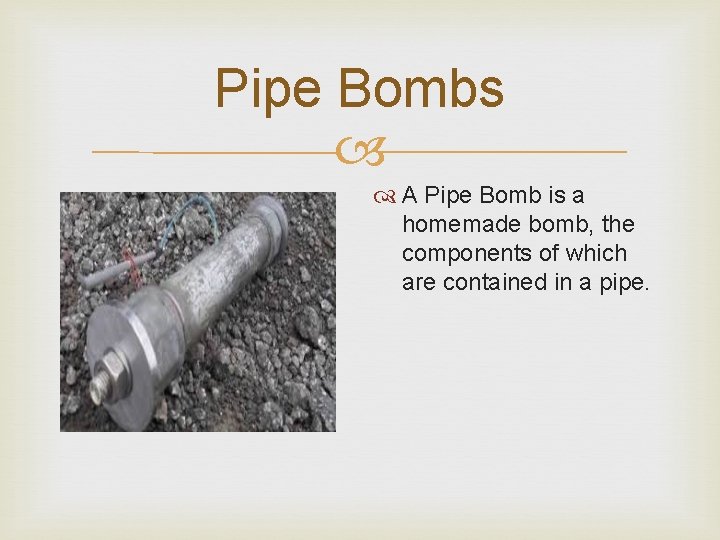
Pipe Bombs A Pipe Bomb is a homemade bomb, the components of which are contained in a pipe.
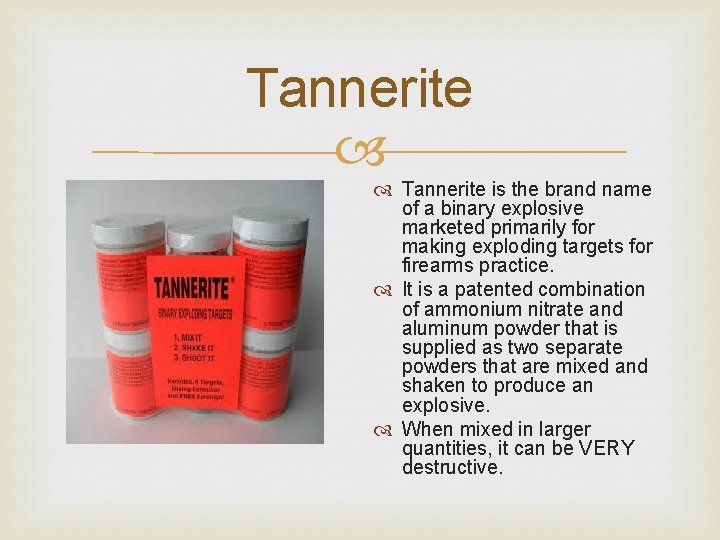
Tannerite is the brand name of a binary explosive marketed primarily for making exploding targets for firearms practice. It is a patented combination of ammonium nitrate and aluminum powder that is supplied as two separate powders that are mixed and shaken to produce an explosive. When mixed in larger quantities, it can be VERY destructive.
Suspicious Persons “PEOPLE ARE NOT SUSPICIOUS, BEHAVIOR IS” Although we all say “suspicious person” when in fact it is their behavior that is suspicious not the person themselves.
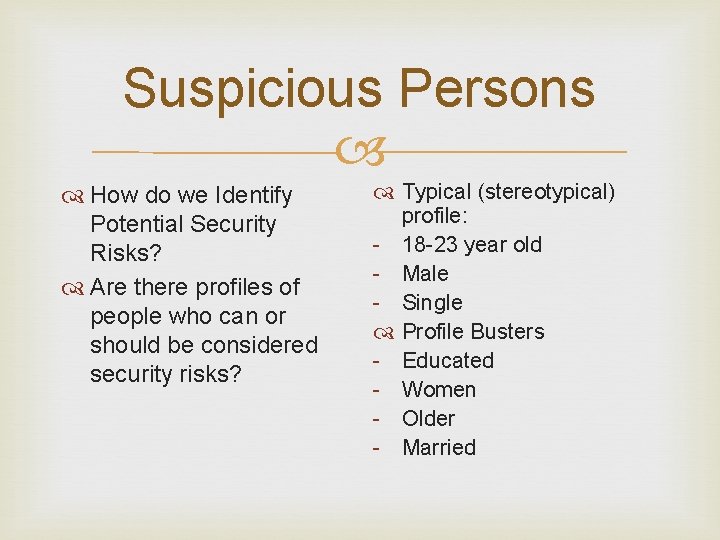
Suspicious Persons How do we Identify Potential Security Risks? Are there profiles of people who can or should be considered security risks? Typical (stereotypical) profile: - 18 -23 year old - Male - Single Profile Busters - Educated - Women - Older - Married
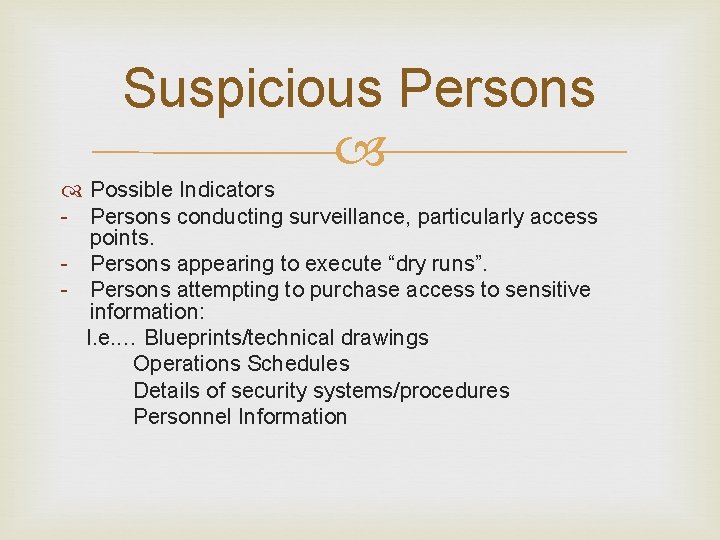
Suspicious Persons Possible Indicators - Persons conducting surveillance, particularly access points. - Persons appearing to execute “dry runs”. - Persons attempting to purchase access to sensitive information: I. e. … Blueprints/technical drawings Operations Schedules Details of security systems/procedures Personnel Information
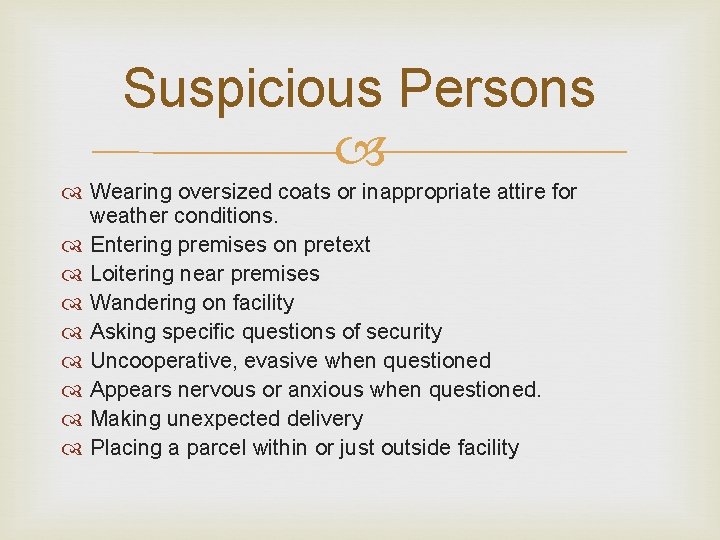
Suspicious Persons Wearing oversized coats or inappropriate attire for weather conditions. Entering premises on pretext Loitering near premises Wandering on facility Asking specific questions of security Uncooperative, evasive when questioned Appears nervous or anxious when questioned. Making unexpected delivery Placing a parcel within or just outside facility
Stereotyping/Profiling Stereotyping: Definition: A conventional or formulaic conception or image. A stereotype is a preconceived notion. Profiling: Definition: The use of personal characteristics or behavior patterns to make generalizations about a person. I. e. Racial Profiling, Gender Profiling
Suspicious Vehicles Unmanned Haphazardly parked Overly weighted down Presence of suspicious materials inside Presence of foreign objects under vehicle Signs of being tampered with (broken ignition, broken locks etc. . ).
Techniques Used to Circumvent Security Measures Disabling of alarm systems Picking of locks Jamming of radio signals Use of Ladders or other equipment to dig under or climb over security fencing. Using vehicles to ram gates or fences. Piggybacking through access points Using Fraudulent ID’s to gain unauthorized access Posing as a contractor, employee or government agent. Developing software to bypass computer firewall systems. Cutting power to critical systems.
Crowd Management and Control Techniques Crowd management means providing a safe and organized setting for patrons entering your facility. The structures of how to handle the ingress and egress of person(s) at your facility will be described in the Facility Security Plan (FSP). It is important to treat everyone with respect, remain calm but stay firm on the rules and if the situation starts to progress past your abilities, contact your supervisor for assistance.
Security Related Communications There are many types of communications. They are listed in the following order as they should be used. VHS Radio Communications Land Line Communications Cell Phone Communications (in allowed areas) E-mail Communications
Emergency Procedures and contingency Plans As facilities differ, so will their emergency procedures and contingency plans. These procedures will generally be contained in the facility’s Emergency Response Plan and/or the Facility Security Plan. Procedures on how to deal with emergencies should also be incorporated into the Post Order at each security post. It is extremely important to become very familiar with the procedures so you feel confident in applying them in real life scenarios.
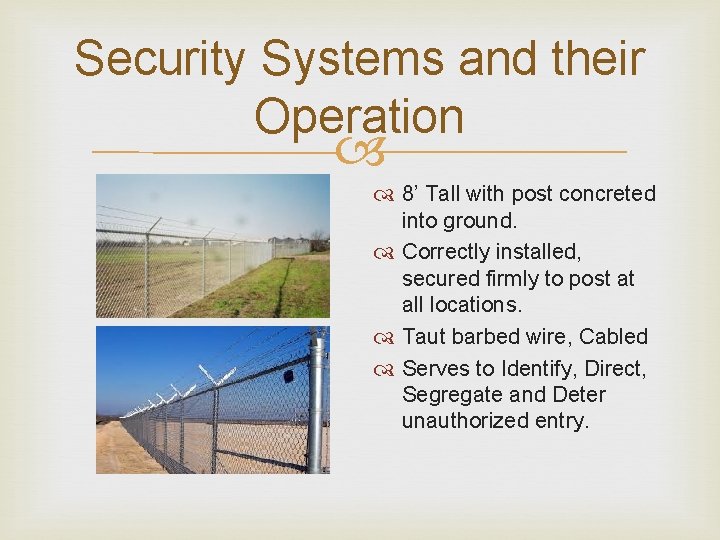
Security Systems and their Operation 8’ Tall with post concreted into ground. Correctly installed, secured firmly to post at all locations. Taut barbed wire, Cabled Serves to Identify, Direct, Segregate and Deter unauthorized entry.
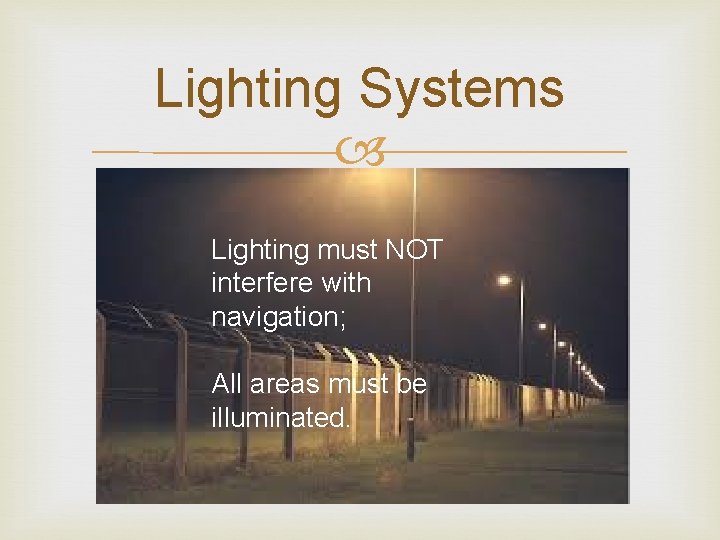
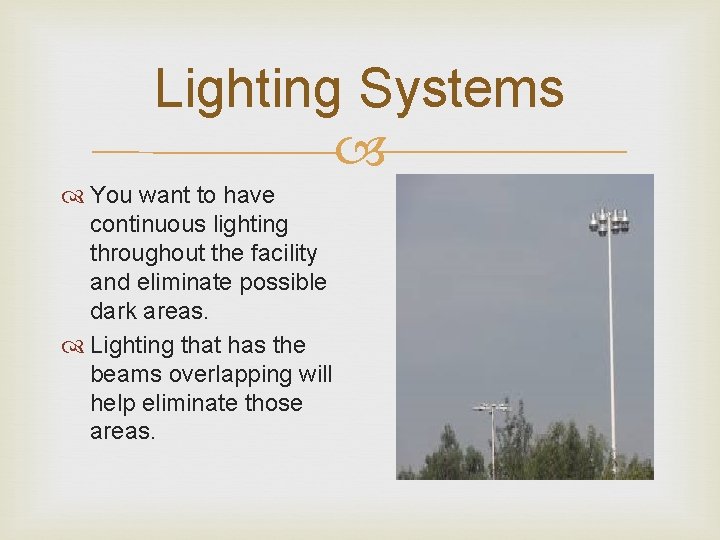
Lighting Systems Lighting must NOT interfere with navigation; All areas must be illuminated.
Lighting Systems You want to have continuous lighting throughout the facility and eliminate possible dark areas. Lighting that has the beams overlapping will help eliminate those areas.
Video Surveillance/CCTV Pan, Tilt, Zoom Color vs. Black and White Low Light/Night Vision or Infrared Concealed Surveillance Alarm activated smart cameras Command Center Master / Split Monitor Recorded imagery
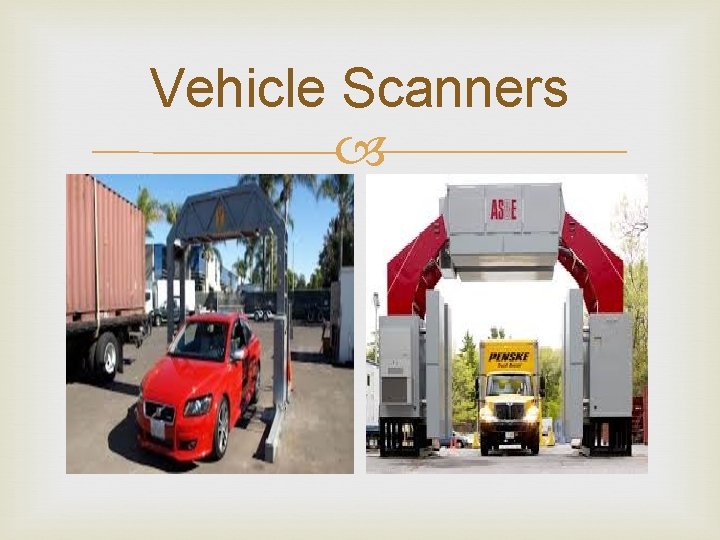
Vehicle Scanners
Vehicle Scanners Vehicle Inspection Scanners are innovative inspection technologies that offer superior threat detection and high quality imaging. These types of equipment are very effective in deterring and protecting against criminal activity. Down side…they are very costly.
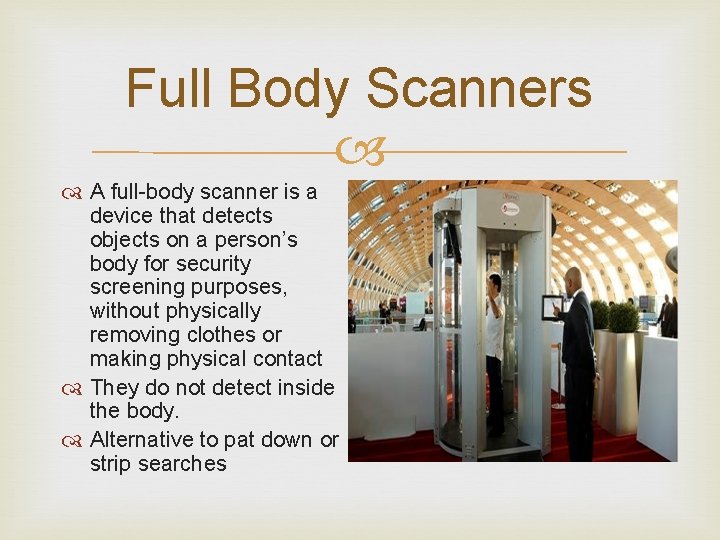
Full Body Scanners A full-body scanner is a device that detects objects on a person’s body for security screening purposes, without physically removing clothes or making physical contact They do not detect inside the body. Alternative to pat down or strip searches
Maintenance and Calibration Follow Manufacturers Directions Utilize All Safety Measures when dealing with equipment Recertify or Recalibrate Equipment regularly A critical piece of technical problems… The Operator! Operating Skills Proper Training Vigilance
MARSEC LEVELS What are they? What Color are they? Who sets the MARSEC Level? Attainment time? (How long you have to comply)
What is MARSEC? 33 CFR 105. 220, 101. 200 and 101. 405 Maritime Security (MARSEC) Level means the level set to reflect the prevailing threat environment to the marine elements of the national transportation system, including ports, vessels, facilities, and critical assets and infrastructure located on or adjacent to waters subject to the jurisdiction of the U. S. Think of MARSEC Levels as a term used for the delineation of threat levels. Now, you have heard of the Homeland Security threat levels of Blue, Yellow, Orange, and red. Well, think of MARSEC Levels as the same thing only without the colors. In the maritime community there are only three levels. MARSEC 1, 2 and 3. MARSEC level 1 would be the equivalent of Homeland Securities YELLOW threat level. In the maritime industry, this is considered the new normalcy. MARSEC 2 would correlate to Homeland Securities ORANGE threat level and MARSEC 3 with Homeland Securities RED threat level. The MARSEC Levels have a direct correlation with the ISPS (International Ship and Port Facility Security) standard worldwide threat levels. They have a different meaning than the homeland security threat levels as they are specifically designed for the national maritime transportation system. Once the MARSEC Level is raised by the Commandant of The USCG, you have 12 hours to be in compliance with directives stipulated in the FSP and to report the attainment to the COTP.
MARSEC LEVELS Response to change in MARSEC Level: 33 CFR 105. 230 These changes will be reflected in the FSP and Post Orders. Items that change as MARSEC Level Changes are; Access Control Restricted Areas Cargo Handling Delivery Vehicles Monitoring
TWIC and Escorting
Transportation Worker Identification Credential (TWIC) What is a TWIC? The TWIC program is a Transportation Security Administration (TSA) and U. S. Coast Guard (USCG) initiative and a requirement of the Maritime Transportation Security Act of 2002 (MTSA). The program provides a tamper-resistant biometric credential to anyone who needs unescorted access to secure areas of MTSA facilities. To obtain a TWIC, an individual must provide biographic and biometric information (fingerprints), sit for a digital photograph and successfully pass a security threat assessment conducted by TSA.
Transportation Worker Identification Credential (TWIC) TWIC training requirements for security personnel… 33 CFR 105. 120 and NVIC 03 -07 3. 3 g(2) require facility personnel with security duties “to be knowledgeable in and able to demonstrate familiarity with all requirements of the TWIC program. ” Specifically, 1. How TWIC applies to your facility 2. Secure/Restricted area locations and requirements 3. Escorting requirements 4. Access for individuals who have reported a lost, stolen or damaged TWIC 5. Recognition of a valid TWIC 6. Resolution of violations (forged or tampered TWIC)
Transportation Worker Identification Credential (TWIC) How TWIC applies to your facility… TWIC is required in the Secure Areas located on your MTSA regulated footprint. Restricted Areas can be located within the Secure Area and these areas are known as Secure/Restricted. Anyone granted unescorted access to the Secure or Secure/Restricted areas of the facility will need a TWIC card. Examples: 1. Employees with frequent access to secure area or Secure/Restricted area. 2. Contractors working in any Secure or Secure/Restricted area of the facility 3. Delivery personnel who need unescorted access beyond the main gate into the Secure or Secure/Restricted Areas. 4. Companies on the gate log going to perform services for moored vessels Anyone with unescorted access must have their TWIC on their person at all times or within ten minutes of their work station. The USCG will verify the presence of a TWIC during compliance audits and spot inspections.
Transportation Worker Identification Credential (TWIC) Escorting requirements… Escorting means “ensuring that the escorted individual is continuously accompanied while within a secure area in a manner sufficient to observe whether the escorted individual is engaged in activities other than those for which escorted access was granted” (33 CFR 101. 105). The escort must be a physical side-by-side presence in secure/restricted areas. Such a presence requires close physical proximity to and visual contact with the escorted individual in order to enable the TWIC holder to witness the escorted individual’s actions (NVIC 03 -07 3. 3 c(3)). Key Performance Standard: Is the person I am escorting doing something they are not authorized to do or trying to go somewhere they are not authorized to be? Escorting Ratio: In a Secure/Restricted Area, 1 TWIC holder can escort up to 5 non-TWIC holders. If you are just in a Secure Area the ratio can be 1 TWIC escort up to 10 non-TWIC holders.
Transportation Worker Identification Credential (TWIC) Access for individuals who have reported a lost, stolen or damaged TWIC… If an individual’s TWIC is lost, stolen, or damaged, he/she must report it immediately to the FSO then to TSA (through the TSA TWIC help desk at 1 -866 -DHS-TWIC). TSA will revoke the card and begin the process of producing a new TWIC, which must be picked up at an enrollment center designated by the individual. During that period after the TWIC has been reported as lost, stolen, or damaged and while a new one is being produced, the individual may be granted unescorted access to the facility for 7 consecutive calendar days under the following circumstances: Note: This provision is not for someone who left their card at home!
Transportation Worker Identification Credential (TWIC) Access for individuals who have reported a lost, stolen or damaged TWIC… (a) The individual can present another identification credential that meets the requirements of 33 CFR 101. 515 (e. g. driver’s license). (b) The FSO or designee verifies that the individual had a valid TWIC and has previously been granted unescorted access to secure areas of the vessel or facility (recommended within the past 90 days). This can be done by checking employee lists, records of access, or knowledge of security staff. (c) The individual has reported the TWIC as lost, stolen, or damaged to TSA. (d) There are no other suspicious circumstances associated with the individual’s claim of loss, theft, or damage. Examples of suspicious circumstances include repeat claims of loss, theft, or damage, questionable explanations for the loss, or coming to work with the TWIC a day or two after claiming it was lost, stolen, or damaged.
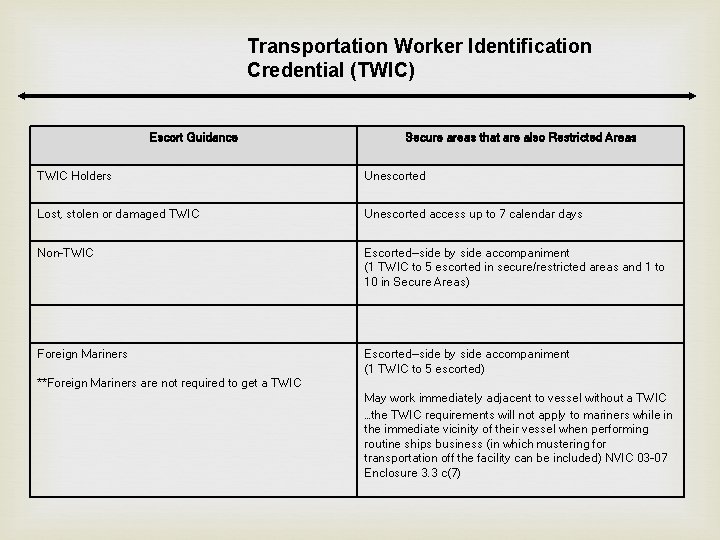
Transportation Worker Identification Credential (TWIC) Escort Guidance Secure areas that are also Restricted Areas TWIC Holders Unescorted Lost, stolen or damaged TWIC Unescorted access up to 7 calendar days Non-TWIC Escorted—side by side accompaniment (1 TWIC to 5 escorted in secure/restricted areas and 1 to 10 in Secure Areas) Foreign Mariners Escorted—side by side accompaniment (1 TWIC to 5 escorted) **Foreign Mariners are not required to get a TWIC May work immediately adjacent to vessel without a TWIC …the TWIC requirements will not apply to mariners while in the immediate vicinity of their vessel when performing routine ships business (in which mustering for transportation off the facility can be included) NVIC 03 -07 Enclosure 3. 3 c(7)
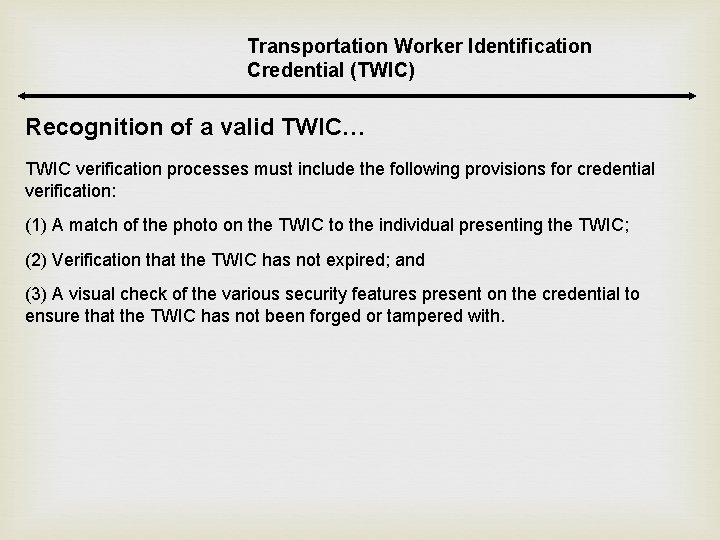
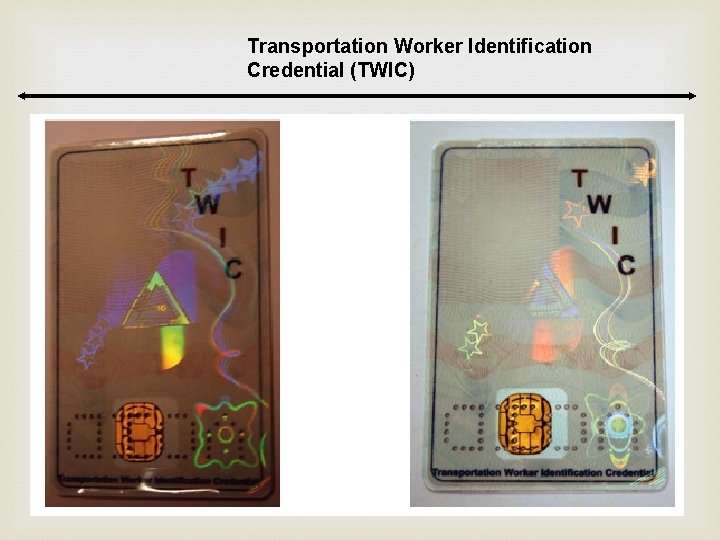
Transportation Worker Identification Credential (TWIC) Recognition of a valid TWIC… TWIC verification processes must include the following provisions for credential verification: (1) A match of the photo on the TWIC to the individual presenting the TWIC; (2) Verification that the TWIC has not expired; and (3) A visual check of the various security features present on the credential to ensure that the TWIC has not been forged or tampered with.
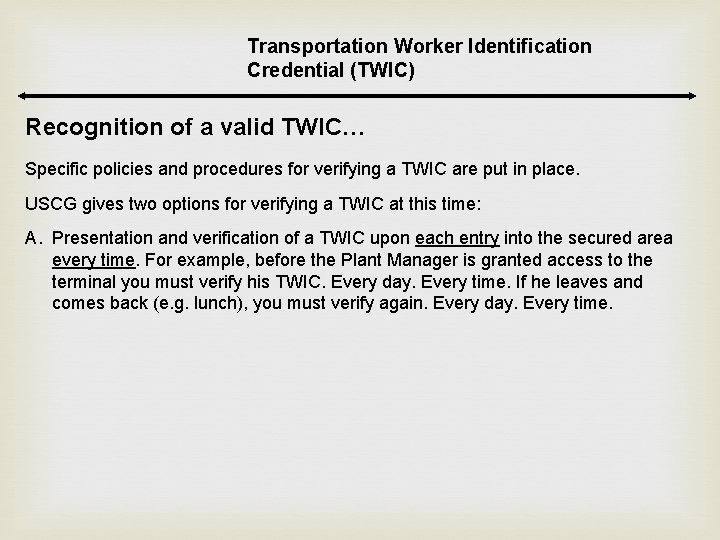
Transportation Worker Identification Credential (TWIC) Recognition of a valid TWIC… Specific policies and procedures for verifying a TWIC are put in place. USCG gives two options for verifying a TWIC at this time: A. Presentation and verification of a TWIC upon each entry into the secured area every time. For example, before the Plant Manager is granted access to the terminal you must verify his TWIC. Every day. Every time. If he leaves and comes back (e. g. lunch), you must verify again. Every day. Every time.
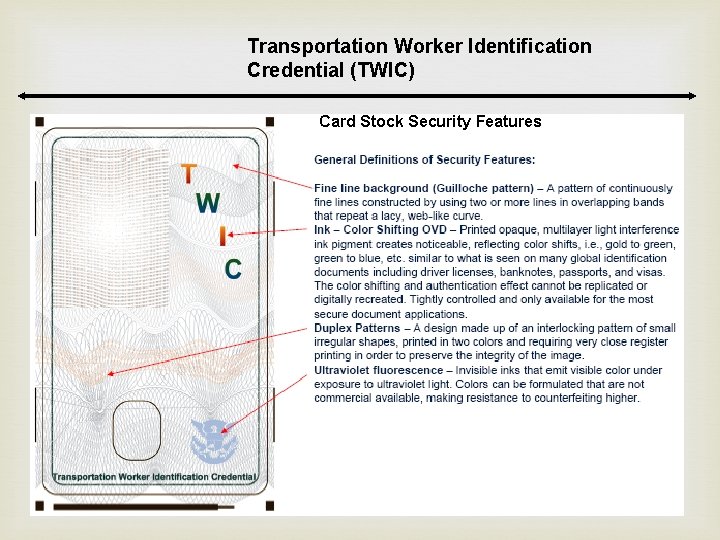
Transportation Worker Identification Credential (TWIC) Card Stock Security Features
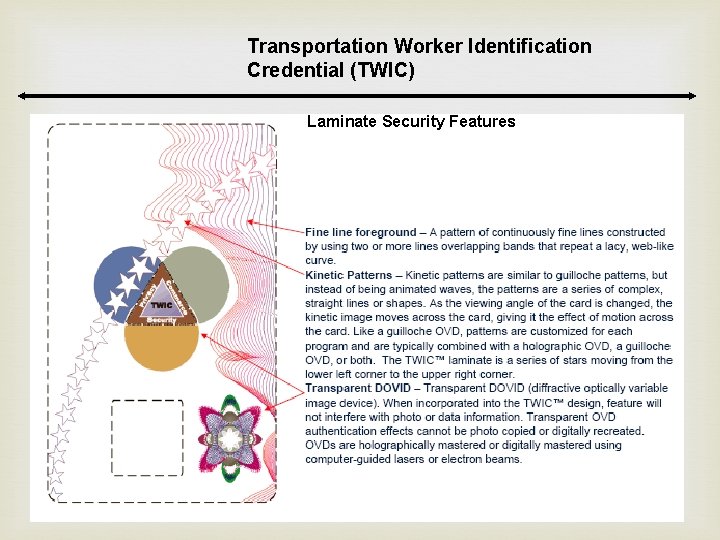
Transportation Worker Identification Credential (TWIC) Laminate Security Features
Transportation Worker Identification Credential (TWIC)
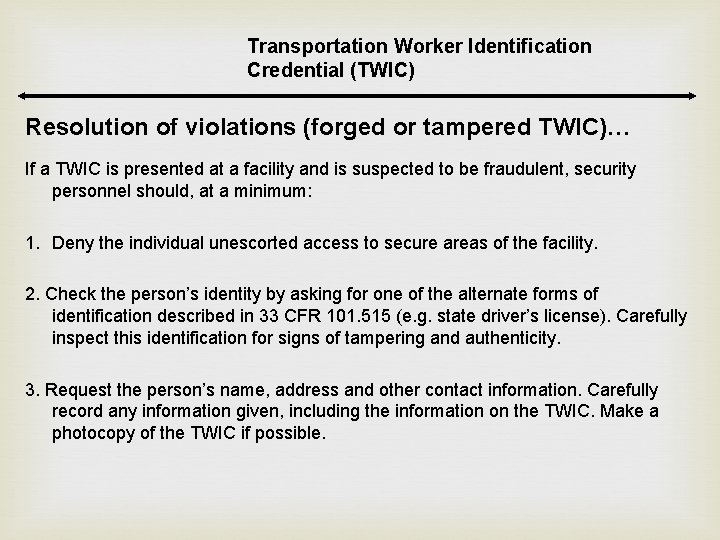
Transportation Worker Identification Credential (TWIC) Resolution of violations (forged or tampered TWIC)… If a TWIC is presented at a facility and is suspected to be fraudulent, security personnel should, at a minimum: 1. Deny the individual unescorted access to secure areas of the facility. 2. Check the person’s identity by asking for one of the alternate forms of identification described in 33 CFR 101. 515 (e. g. state driver’s license). Carefully inspect this identification for signs of tampering and authenticity. 3. Request the person’s name, address and other contact information. Carefully record any information given, including the information on the TWIC. Make a photocopy of the TWIC if possible.
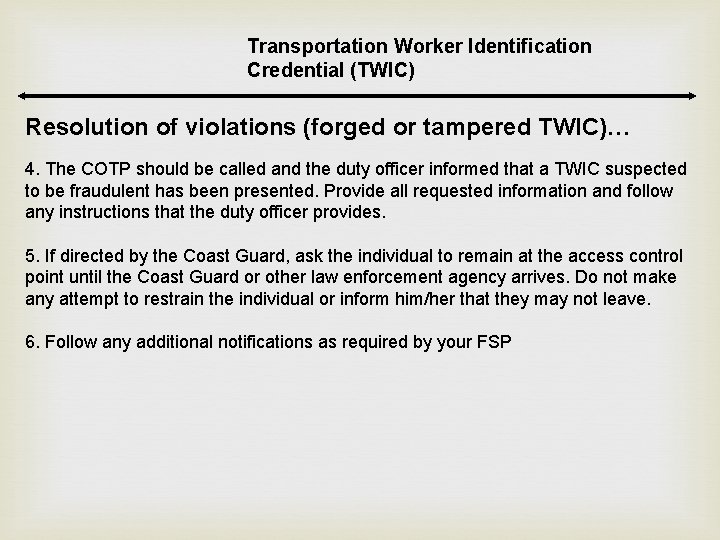
Transportation Worker Identification Credential (TWIC) Resolution of violations (forged or tampered TWIC)… 4. The COTP should be called and the duty officer informed that a TWIC suspected to be fraudulent has been presented. Provide all requested information and follow any instructions that the duty officer provides. 5. If directed by the Coast Guard, ask the individual to remain at the access control point until the Coast Guard or other law enforcement agency arrives. Do not make any attempt to restrain the individual or inform him/her that they may not leave. 6. Follow any additional notifications as required by your FSP
Transportation Worker Identification Credential (TWIC) Escorting in enclosed vehicles… Escorting ratios do not apply when non-TWIC holders are transported in an enclosed vehicle. In this case, one TWIC holder who is driving or riding in the vehicle can escort any number of passengers as long as they are only allowed to depart the vehicle in a location where other TWIC holders will be able to escort them or where they will not need to be escorted (e. g. a public access area or outside the facility). This applies in both secure areas and secure/restricted areas. Escorting requirements must be met once the non-TWIC holders depart the vehicle-NVIC 03 -07 Enclosure 3. 3 c(4)
Sensitive Security Information (SSI) Guidelines for handling of sensitive security information. 49 CFR 1520 governs SSI Navigation and Vessel Inspection Circular (NVIC), explains how the law will be interpreted and enforced.
SSI Sensitive Security Information (SSI) is a category of sensitive but unclassified information under the United States government’s information sharing and control rules. SSI is information obtained in the conduct of security activities whose public disclosure would, in the judgment of specified government agencies, harm transportation security, be an unwarranted invasion of privacy, or reveal trade secrets or privileged or confidential information. SSI should be marked with the appropriate marking and distribution limitation statement as described below. The cover page or first page of the document shall prominently display the SSI marking and the distribution limitation statement. Each subsequent page of the document that contains SSI should also display the SSI marking and distribution limitation statement. The SSI marking should be conspicuously placed on the top of the page and the distribution limitation statement on the bottom.
SSI marking and Distribution Statement. SENSITIVE SECURITY INFORMATION “WARNING” THIS RECORD CONTAINS SENSITIVE SECURITY INFORMATION THAT IS CONTROLLED UNDER THE PROVISIONS OF 49 CFR 1520. NO PART OF THIS RECORD MAY BE DISCLOSED TO PERSONS WITHOUT A “NEED TO KNOW” AS DEFINED IN 49 CFR 1520, EXCEPT WITH THE WRITTEN PERMISSION OF THE ADMINISTRATOR OF THE TRANSPORTATION SECURITY ADMINISTRATION. UNAUTHORIZED RELEASE MAY RESULT IN CIVIL PENALTY OR OTHER ACTION. FOR U. S. GOVERNMENT AGENCIES, PUBLIC DISCLOSURE IS GOVERNED BY 5 U. S. C. 552 AND 49 CFR PART 1520
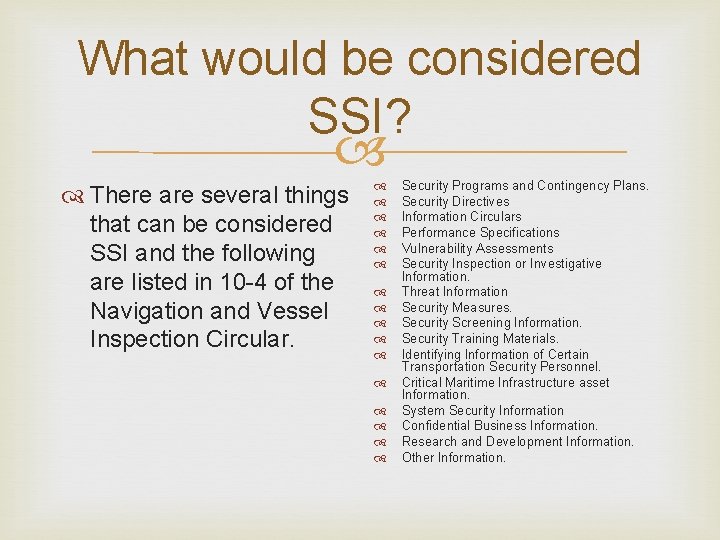
What would be considered SSI? There are several things that can be considered SSI and the following are listed in 10 -4 of the Navigation and Vessel Inspection Circular. Security Programs and Contingency Plans. Security Directives Information Circulars Performance Specifications Vulnerability Assessments Security Inspection or Investigative Information. Threat Information Security Measures. Security Screening Information. Security Training Materials. Identifying Information of Certain Transportation Security Personnel. Critical Maritime Infrastructure asset Information. System Security Information Confidential Business Information. Research and Development Information. Other Information.
QUESTIONS?