
MTO Enforcement Program Hours of Service This is
- Slides: 37
MTO Enforcement Program Hours of Service This is an unofficial interpretation of the federal “Commercial Vehicle Drivers Hours of Service” regulations that take effect on January 1, 2007. For accurate reference, please refer to the official volumes of the Commercial Vehicle Drivers Hours of Service Regulations, made under Motor Vehicle Transport Act, that may be viewed on the Internet at: http: //canadagazette. gc. ca/part. II/20051116/html/sor 313 -e. html October 6, 2006
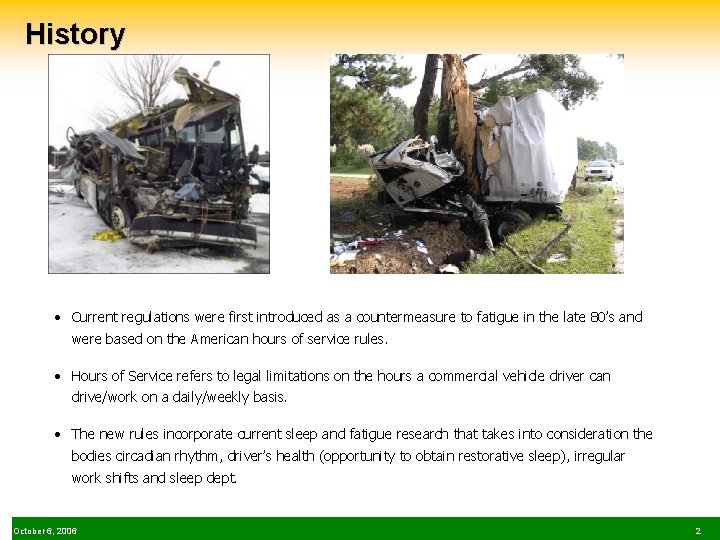
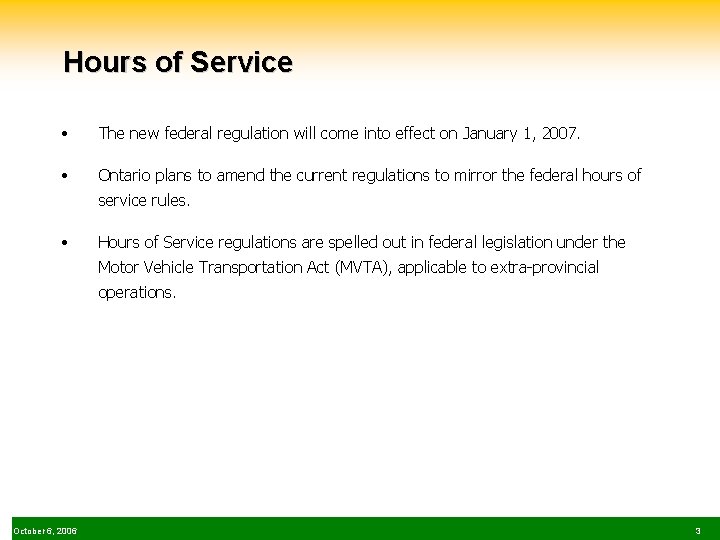
History • Current regulations were first introduced as a countermeasure to fatigue in the late 80’s and were based on the American hours of service rules. • Hours of Service refers to legal limitations on the hours a commercial vehicle driver can drive/work on a daily/weekly basis. • The new rules incorporate current sleep and fatigue research that takes into consideration the bodies circadian rhythm, driver’s health (opportunity to obtain restorative sleep), irregular work shifts and sleep dept. October 6, 2006 2
Hours of Service • The new federal regulation will come into effect on January 1, 2007. • Ontario plans to amend the current regulations to mirror the federal hours of service rules. • Hours of Service regulations are spelled out in federal legislation under the Motor Vehicle Transportation Act (MVTA), applicable to extra-provincial operations. October 6, 2006 3
New Rules Reason for change Current HOS rules are: • Not based on a day (24 hour period); • Allows 16 hours of driving in a “day”; • Allows 26 hours of driving in a 30 hour period (using off duty time reduction); • No limit on a drivers work shift; • Would allow a driver to work everyday; and • Driver and Operator assume all responsibility for compliance. October 6, 2006 4
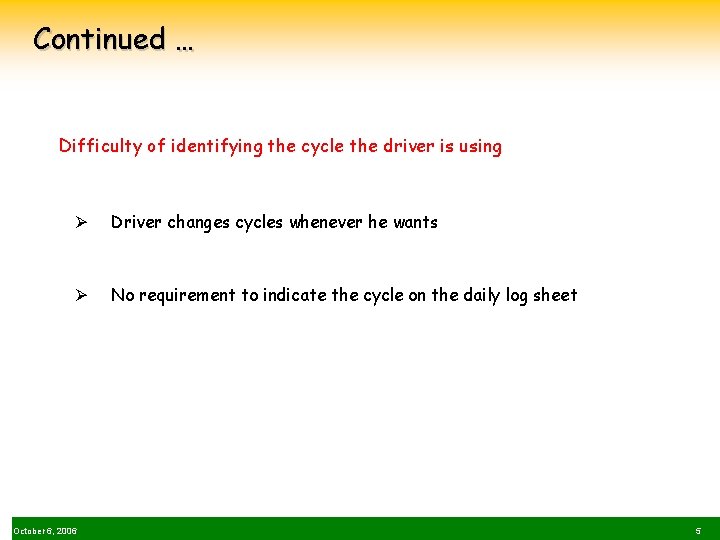
Continued … Difficulty of identifying the cycle the driver is using Ø Driver changes cycles whenever he wants Ø No requirement to indicate the cycle on the daily log sheet October 6, 2006 5
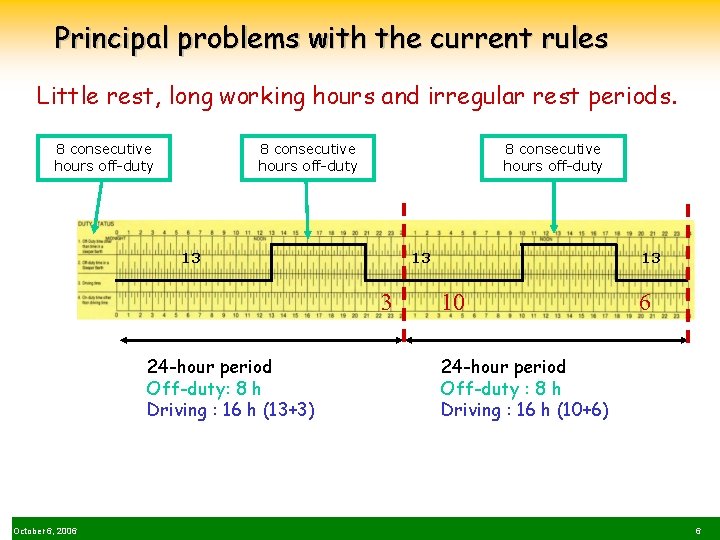
Principal problems with the current rules Little rest, long working hours and irregular rest periods. 8 consecutive hours off-duty 13 13 3 24 -hour period Off-duty: 8 h Driving : 16 h (13+3) October 6, 2006 13 10 6 24 -hour period Off-duty : 8 h Driving : 16 h (10+6) 6
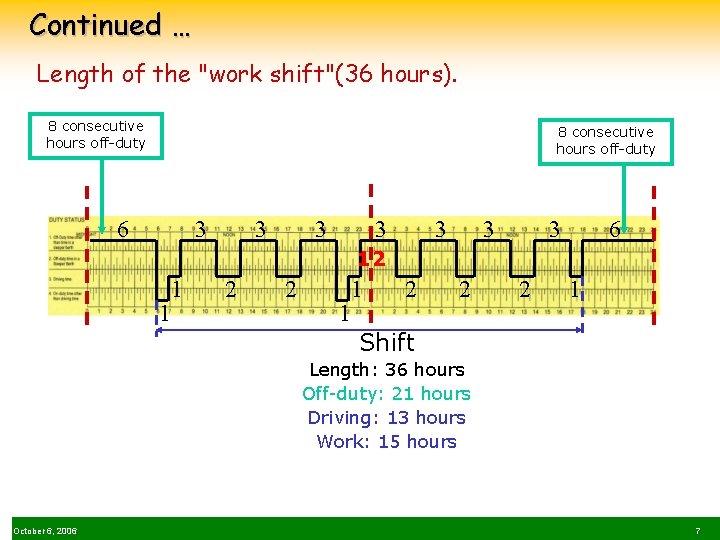
Continued … Length of the "work shift"(36 hours). 8 consecutive hours off-duty 6 3 3 3 3 6 12 1 1 2 2 2 1 Shift Length: 36 hours Off-duty: 21 hours Driving: 13 hours Work: 15 hours October 6, 2006 7
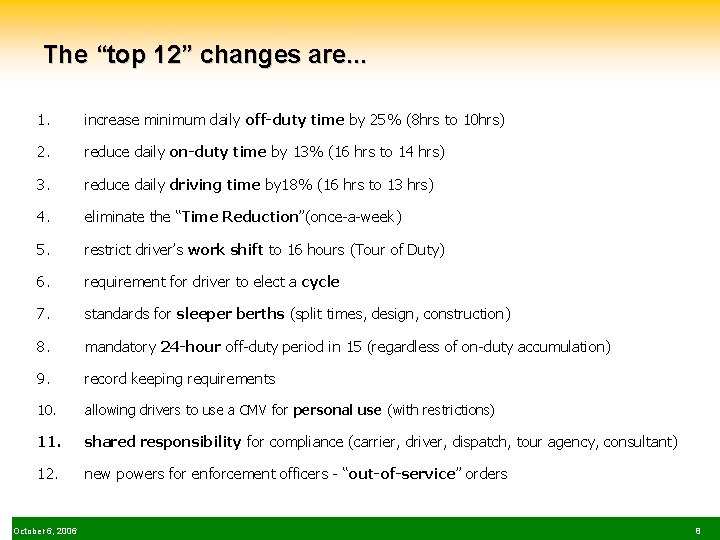
The “top 12” changes are. . . 1. increase minimum daily off-duty time by 25% (8 hrs to 10 hrs) 2. reduce daily on-duty time by 13% (16 hrs to 14 hrs) 3. reduce daily driving time by 18% (16 hrs to 13 hrs) 4. eliminate the “Time Reduction”(once-a-week) 5. restrict driver’s work shift to 16 hours (Tour of Duty) 6. requirement for driver to elect a cycle 7. standards for sleeper berths (split times, design, construction) 8. mandatory 24 -hour off-duty period in 15 (regardless of on-duty accumulation) 9. record keeping requirements 10. allowing drivers to use a CMV for personal use (with restrictions) 11. shared responsibility for compliance (carrier, driver, dispatch, tour agency, consultant) 12. new powers for enforcement officers - “out-of-service” orders October 6, 2006 8
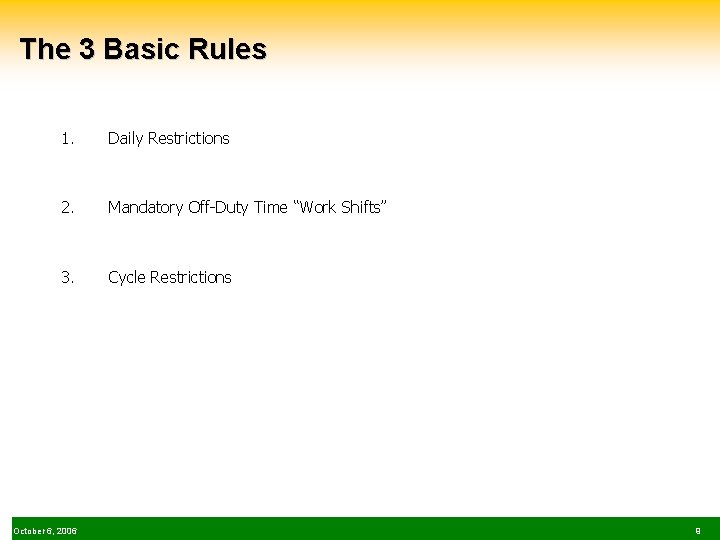
The 3 Basic Rules 1. Daily Restrictions 2. Mandatory Off-Duty Time “Work Shifts” 3. Cycle Restrictions October 6, 2006 9
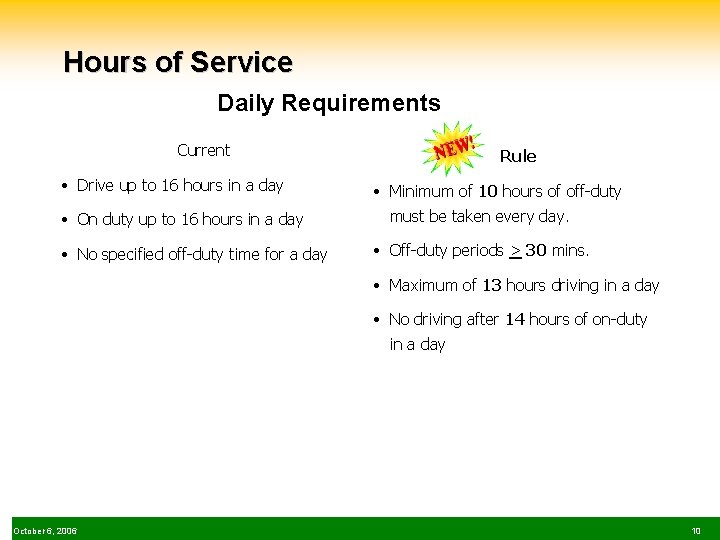
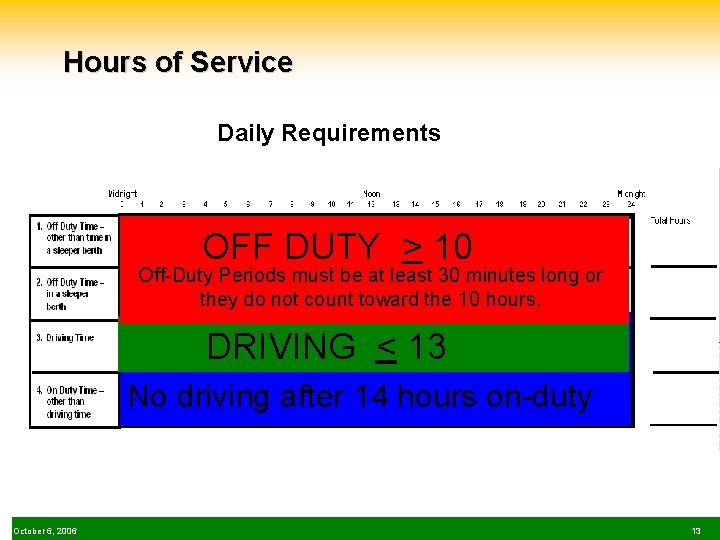
Hours of Service Daily Requirements Current • Drive up to 16 hours in a day • On duty up to 16 hours in a day • No specified off-duty time for a day Rule • Minimum of 10 hours of off-duty must be taken every day. • Off-duty periods > 30 mins. • Maximum of 13 hours driving in a day • No driving after 14 hours of on-duty in a day October 6, 2006 10
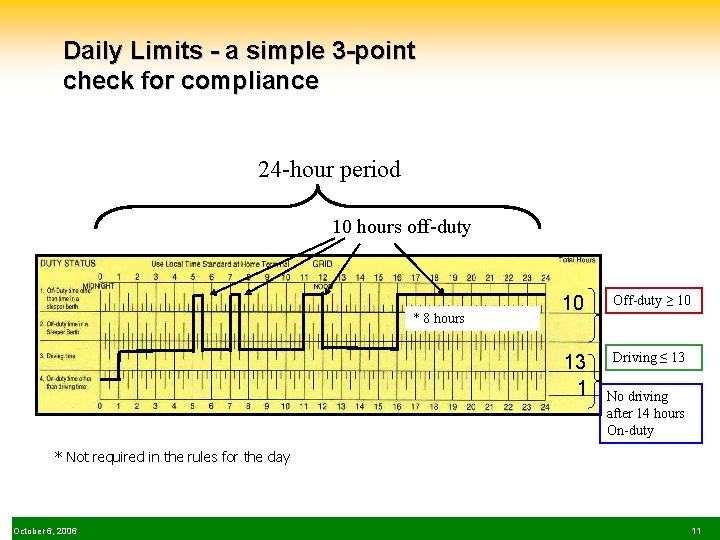
Daily Limits - a simple 3 -point check for compliance 24 -hour period 10 hours off-duty * 8 hours 10 Off-duty ≥ 10 13 11 Driving ≤ 13 No driving after 14 hours On-duty * Not required in the rules for the day October 6, 2006 11
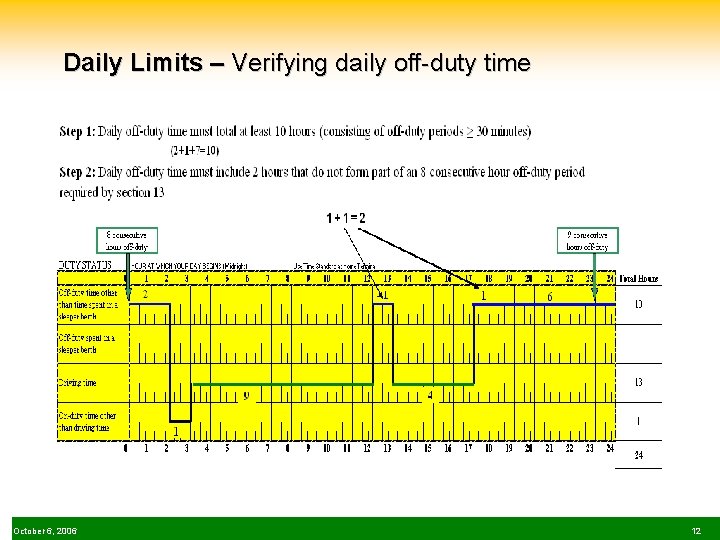
Daily Limits – Verifying daily off-duty time October 6, 2006 12
Hours of Service Daily Requirements OFF DUTY > 10 Off-Duty Periods must be at least 30 minutes long or they do not count toward the 10 hours. DRIVING < 13 No driving after 14 hours on-duty October 6, 2006 13
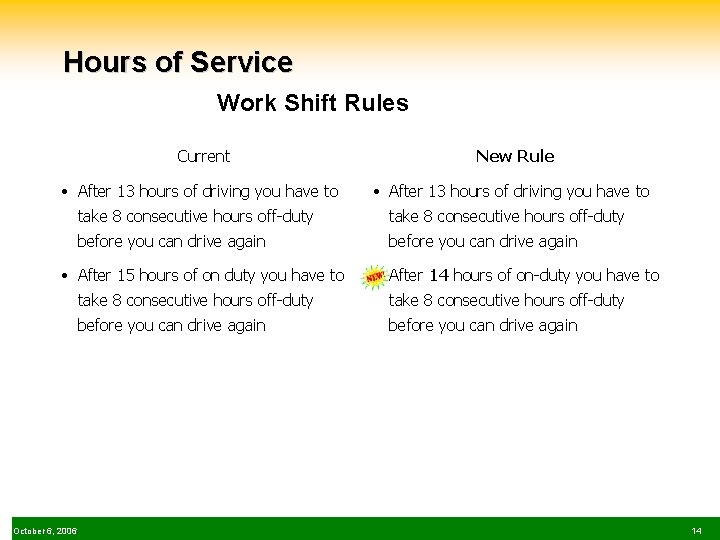
Hours of Service Work Shift Rules Current New Rule • After 13 hours of driving you have to take 8 consecutive hours off-duty before you can drive again • After 15 hours of on duty you have to October 6, 2006 • After 14 hours of on-duty you have to take 8 consecutive hours off-duty before you can drive again 14
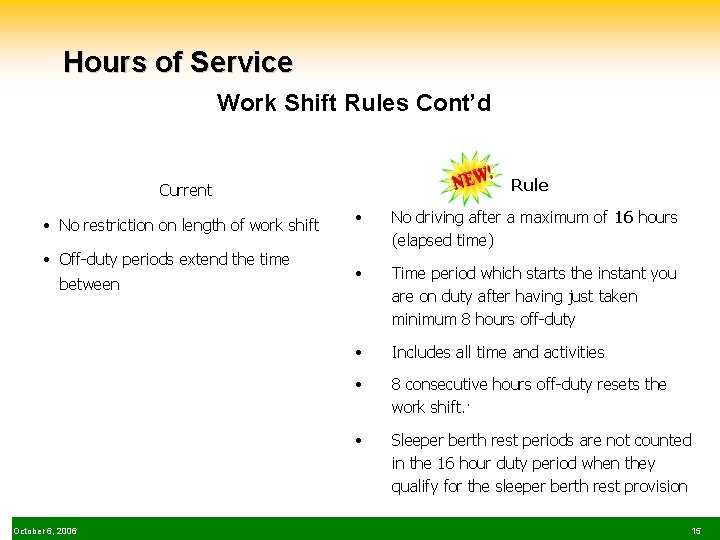
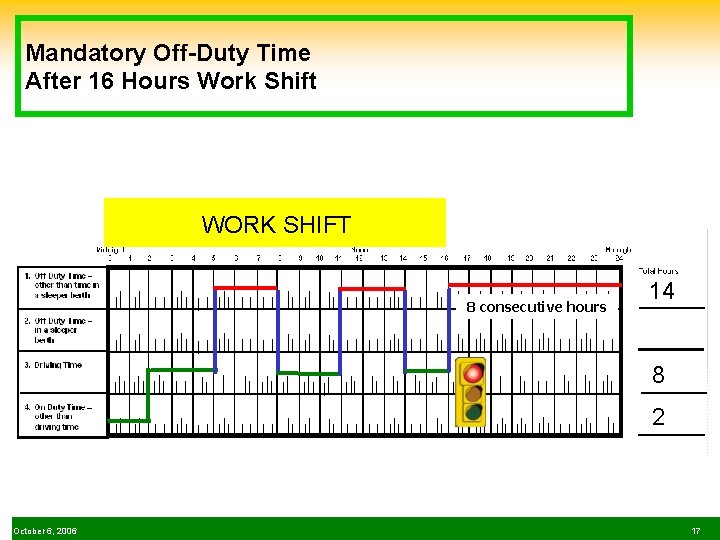
Hours of Service Work Shift Rules Cont’d Rule Current • No restriction on length of work shift • Off-duty periods extend the time between October 6, 2006 • No driving after a maximum of 16 hours (elapsed time) • Time period which starts the instant you are on duty after having just taken minimum 8 hours off-duty • Includes all time and activities • 8 consecutive hours off-duty resets the work shift. · • Sleeper berth rest periods are not counted in the 16 hour duty period when they qualify for the sleeper berth rest provision 15
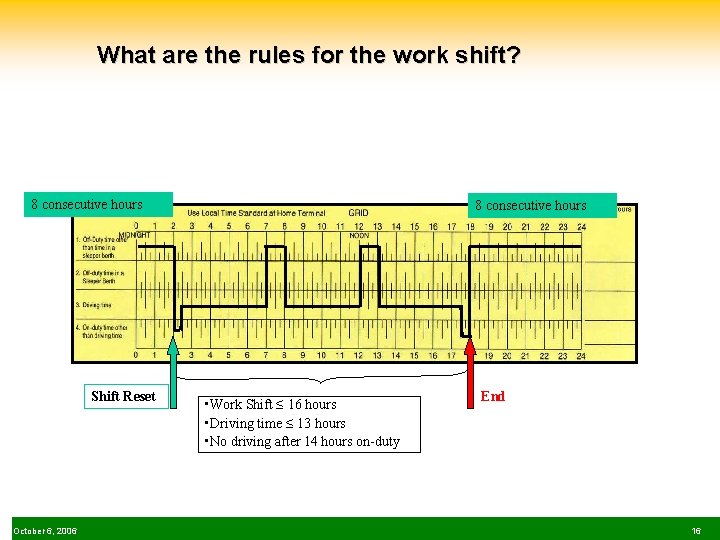
What are the rules for the work shift? 8 consecutive hours Shift Reset October 6, 2006 8 consecutive hours • Work Shift ≤ 16 hours • Driving time ≤ 13 hours • No driving after 14 hours on-duty End 16
Mandatory Off-Duty Time After 16 Hours Work Shift WORK SHIFT 8 consecutive hours 14 8 2 October 6, 2006 17
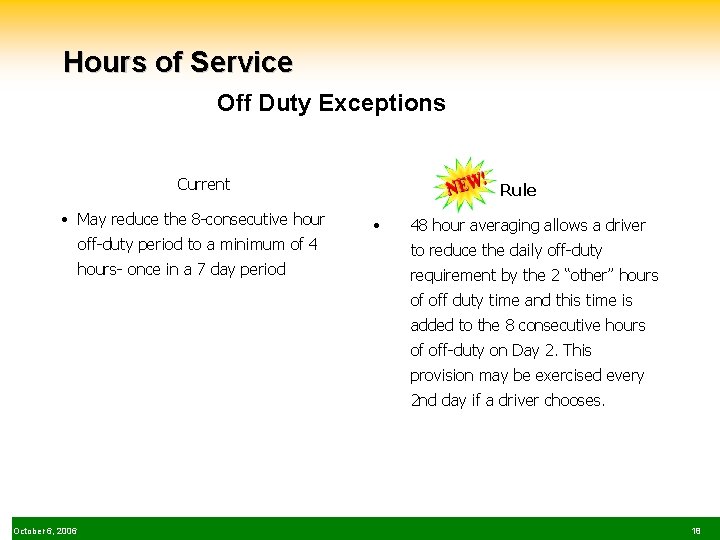
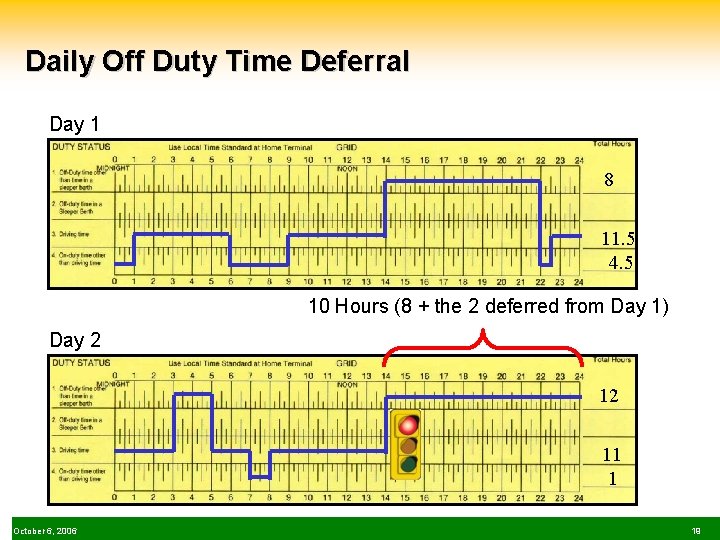
Hours of Service Off Duty Exceptions Current • May reduce the 8 -consecutive hour off-duty period to a minimum of 4 hours- once in a 7 day period Rule • 48 hour averaging allows a driver to reduce the daily off-duty requirement by the 2 “other” hours of off duty time and this time is added to the 8 consecutive hours of off-duty on Day 2. This provision may be exercised every 2 nd day if a driver chooses. October 6, 2006 18
Daily Off Duty Time Deferral Day 1 8 11. 5 4. 5 10 Hours (8 + the 2 deferred from Day 1) Day 2 12 11 1 October 6, 2006 19
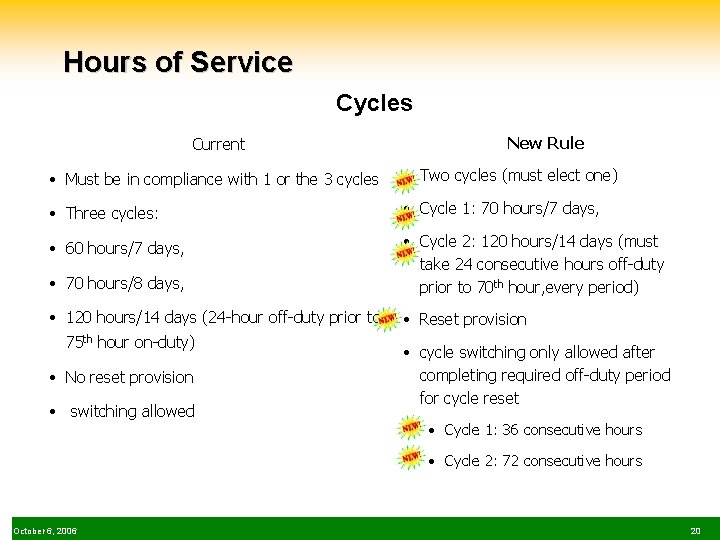
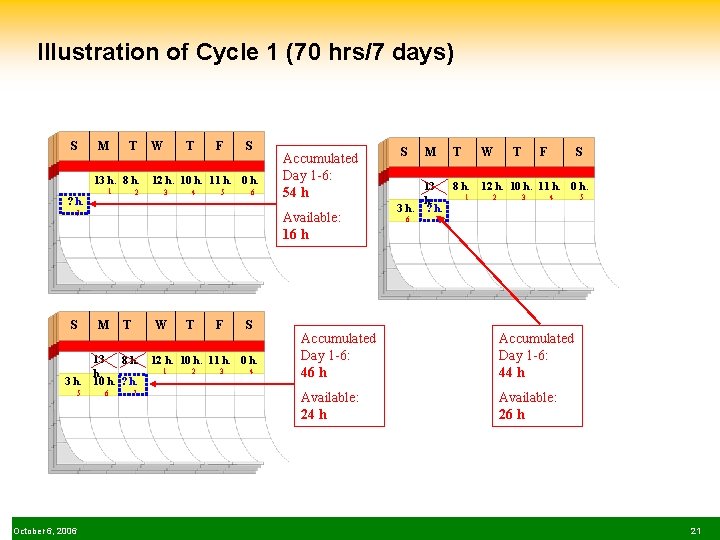
Hours of Service Cycles Current New Rule • Must be in compliance with 1 or the 3 cycles • Two cycles (must elect one) • Three cycles: • Cycle 1: 70 hours/7 days, • 60 hours/7 days, • 70 hours/8 days, • Cycle 2: 120 hours/14 days (must take 24 consecutive hours off-duty prior to 70 th hour, every period) • 120 hours/14 days (24 -hour off-duty prior to • Reset provision 75 th hour on-duty) • No reset provision • switching allowed • cycle switching only allowed after completing required off-duty period for cycle reset • Cycle 1: 36 consecutive hours • Cycle 2: 72 consecutive hours October 6, 2006 20
Illustration of Cycle 1 (70 hrs/7 days) S M T 13 h. 8 h. ? h. 1 2 W T F S 12 h. 10 h. 11 h. 0 h. 3 4 5 6 7 S 3 h. 5 October 6, 2006 Accumulated Day 1 -6: 54 h Available: 16 h M T W 13 8 h. h. 10 h. ? h. 6 7 T F S 12 h. 10 h. 11 h. 0 h. 1 2 3 4 S M T 13 8 h. 1 h. 3 h. ? h. 6 W T F S 12 h. 10 h. 11 h. 0 h. 2 3 4 5 7 Accumulated Day 1 -6: 46 h Accumulated Day 1 -6: 44 h Available: 26 h 21
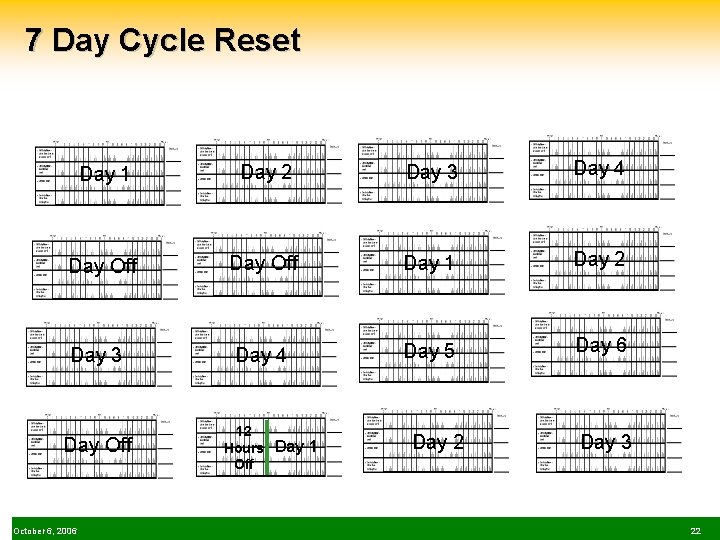
7 Day Cycle Reset Day 1 Day 2 Day 3 Day 4 Day Off Day 1 Day 2 Day 3 Day 4 Day 5 Day 6 Day Off October 6, 2006 12 Hours Day 1 Off Day 2 Day 3 22
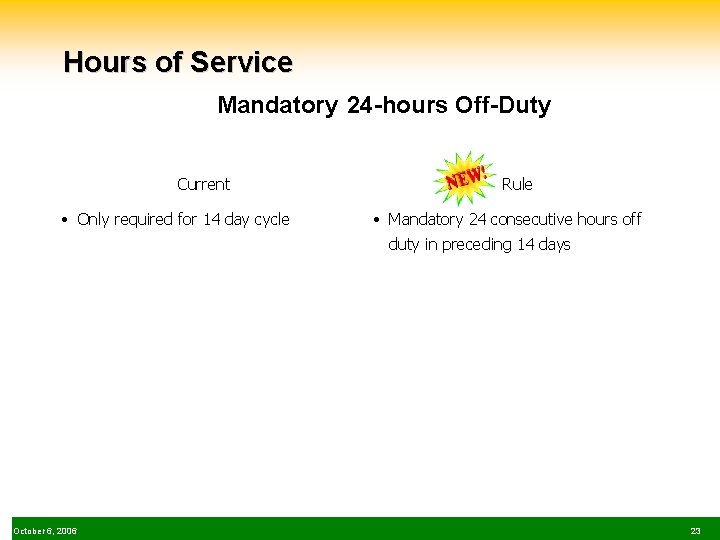
Hours of Service Mandatory 24 -hours Off-Duty Current • Only required for 14 day cycle Rule • Mandatory 24 consecutive hours off duty in preceding 14 days October 6, 2006 23
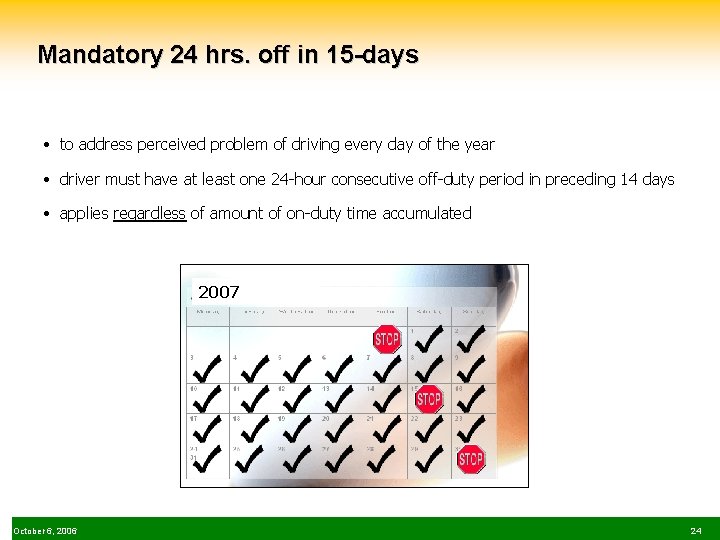
Mandatory 24 hrs. off in 15 -days • to address perceived problem of driving every day of the year • driver must have at least one 24 -hour consecutive off-duty period in preceding 14 days • applies regardless of amount of on-duty time accumulated 2007 October 6, 2006 24
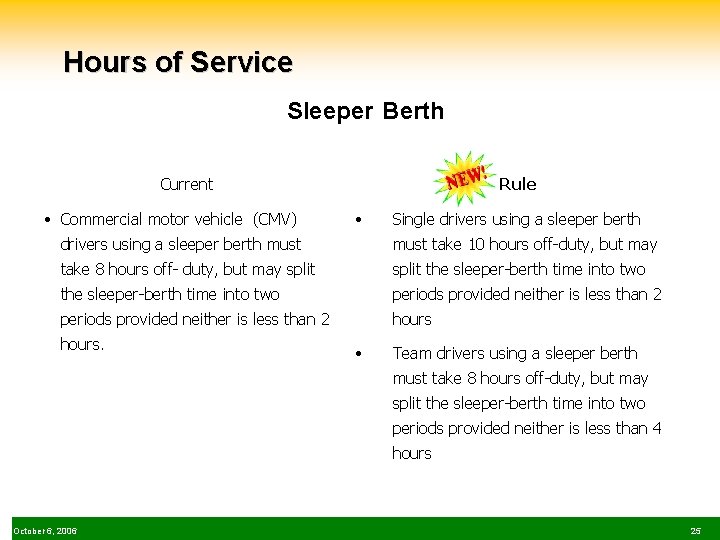
Hours of Service Sleeper Berth Current • Commercial motor vehicle (CMV) Rule • Single drivers using a sleeper berth must take 10 hours off-duty, but may take 8 hours off- duty, but may split the sleeper-berth time into two periods provided neither is less than 2 hours. • Team drivers using a sleeper berth must take 8 hours off-duty, but may split the sleeper-berth time into two periods provided neither is less than 4 hours October 6, 2006 25
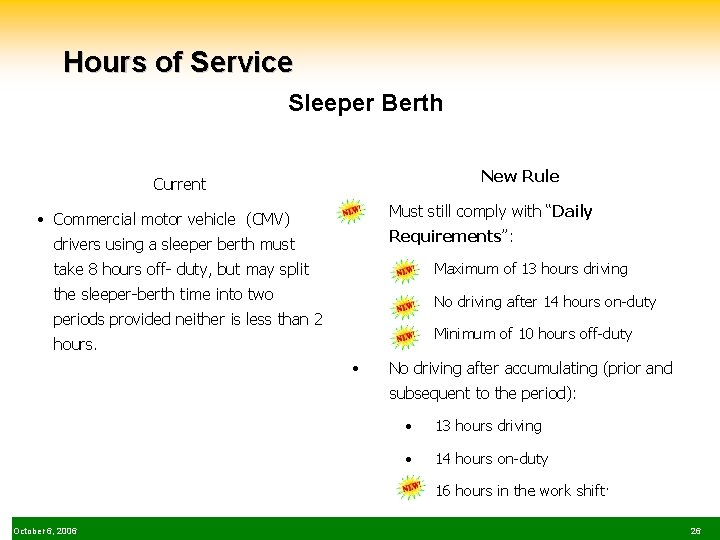
Hours of Service Sleeper Berth New Rule Current • Commercial motor vehicle (CMV) • Must still comply with “Daily Requirements”: drivers using a sleeper berth must take 8 hours off- duty, but may split • Maximum of 13 hours driving the sleeper-berth time into two • No driving after 14 hours on-duty • Minimum of 10 hours off-duty periods provided neither is less than 2 hours. • No driving after accumulating (prior and subsequent to the period): October 6, 2006 • 13 hours driving • 14 hours on-duty • 16 hours in the work shift· 26
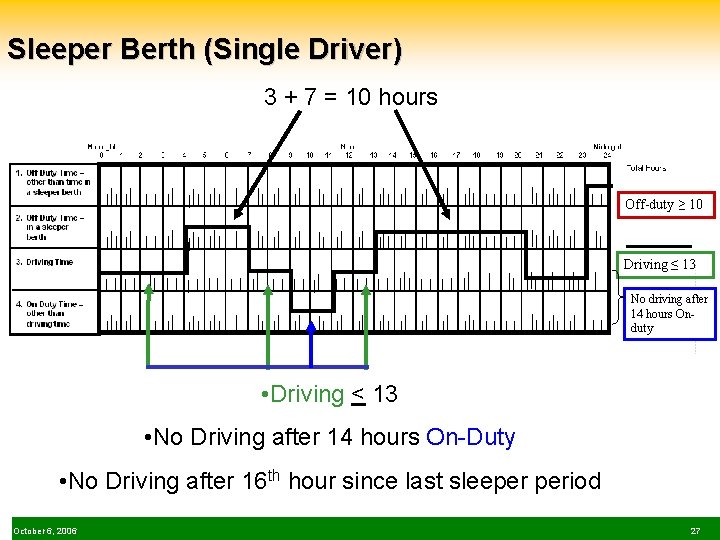
Sleeper Berth (Single Driver) 3 + 7 = 10 hours Off-duty ≥ 10 Driving ≤ 13 No driving after 14 hours Onduty • Driving < 13 • No Driving after 14 hours On-Duty • No Driving after 16 th hour since last sleeper period October 6, 2006 27
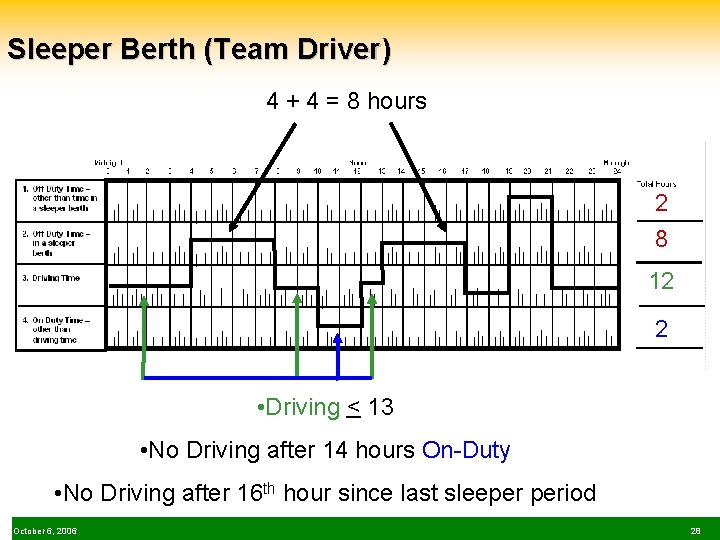
Sleeper Berth (Team Driver) 4 + 4 = 8 hours 2 8 12 2 • Driving < 13 • No Driving after 14 hours On-Duty • No Driving after 16 th hour since last sleeper period October 6, 2006 28
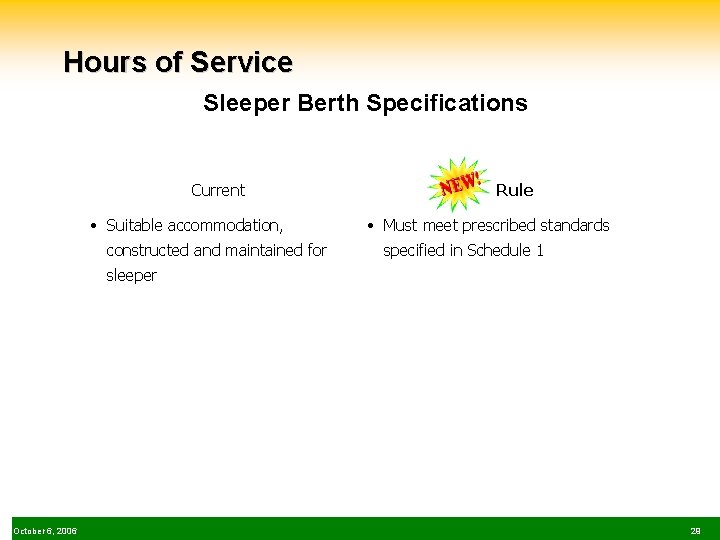
Hours of Service Sleeper Berth Specifications Current • Suitable accommodation, constructed and maintained for Rule • Must meet prescribed standards specified in Schedule 1 sleeper October 6, 2006 29
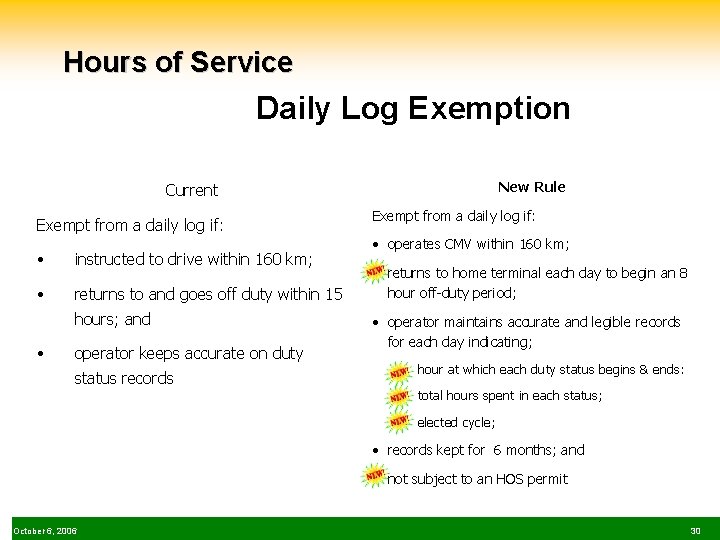
Hours of Service Daily Log Exemption New Rule Current Exempt from a daily log if: • instructed to drive within 160 km; • returns to and goes off duty within 15 hours; and • operator keeps accurate on duty status records Exempt from a daily log if: • operates CMV within 160 km; • returns to home terminal each day to begin an 8 hour off-duty period; • operator maintains accurate and legible records for each day indicating; • hour at which each duty status begins & ends: • total hours spent in each status; • elected cycle; • records kept for 6 months; and • not subject to an HOS permit October 6, 2006 30
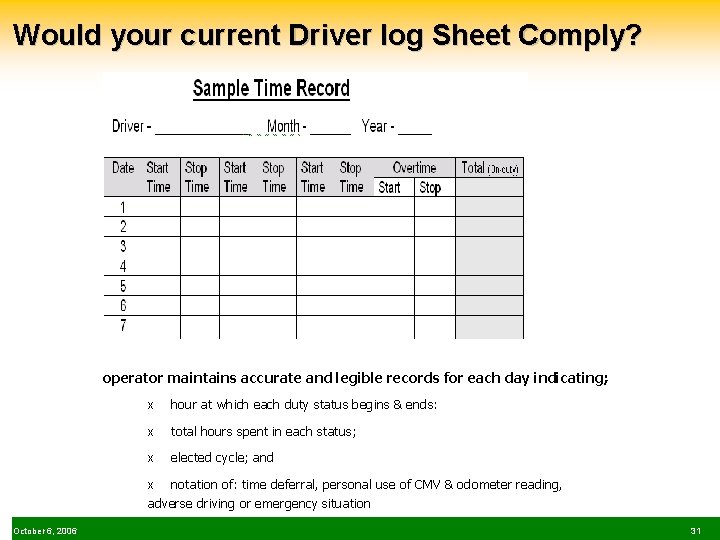
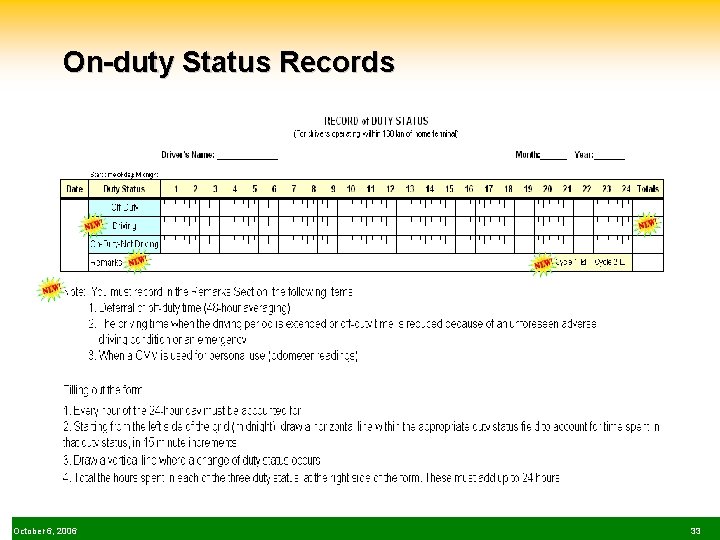
Would your current Driver log Sheet Comply? operator maintains accurate and legible records for each day indicating; x hour at which each duty status begins & ends: x total hours spent in each status; x elected cycle; and x notation of: time deferral, personal use of CMV & odometer reading, adverse driving or emergency situation October 6, 2006 31
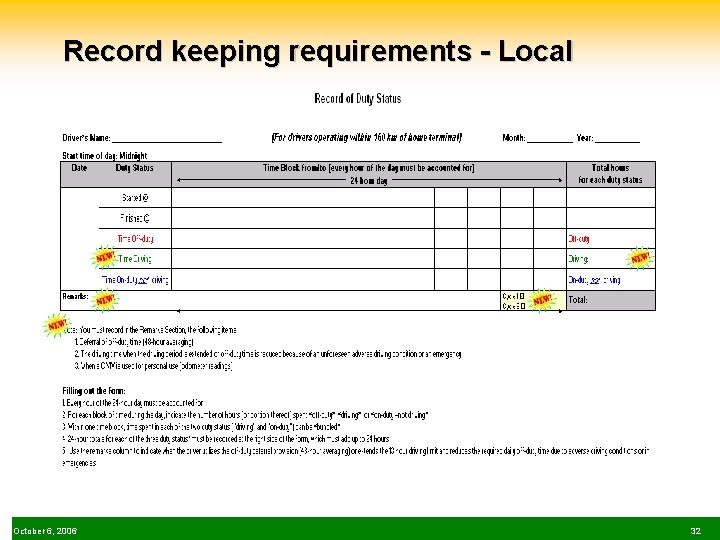
Record keeping requirements - Local October 6, 2006 32
On-duty Status Records October 6, 2006 33
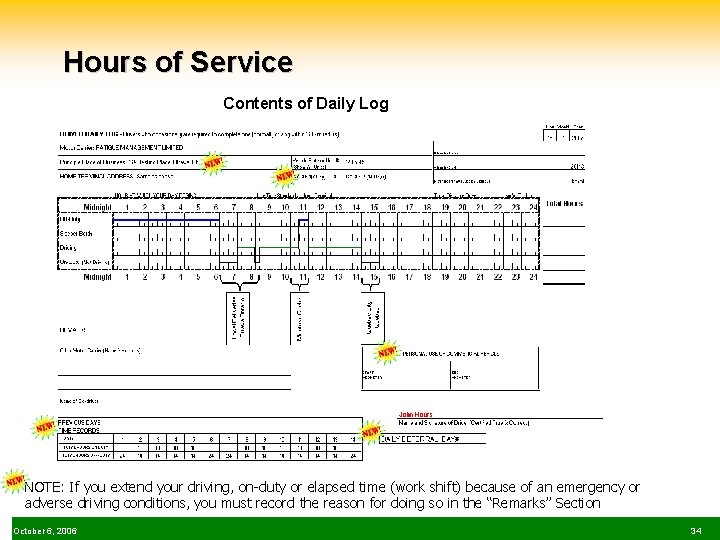
Hours of Service Contents of Daily Log NOTE: If you extend your driving, on-duty or elapsed time (work shift) because of an emergency or adverse driving conditions, you must record the reason for doing so in the “Remarks” Section October 6, 2006 34
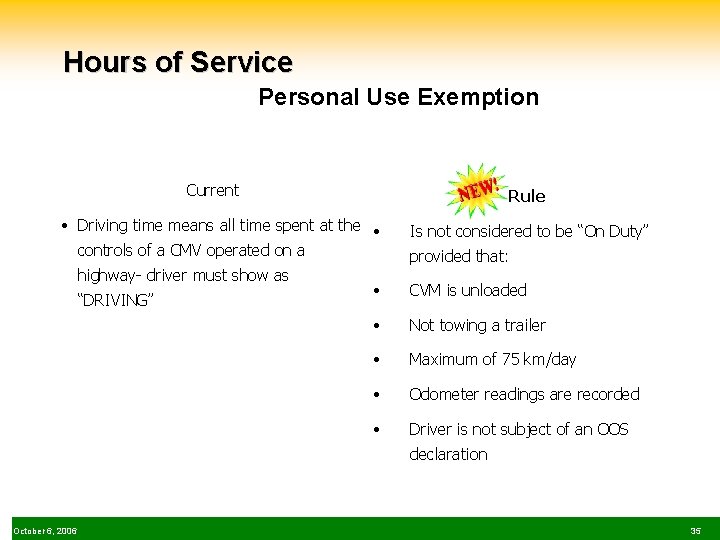
Hours of Service Personal Use Exemption Current Rule • Driving time means all time spent at the • controls of a CMV operated on a highway- driver must show as “DRIVING” Is not considered to be “On Duty” provided that: • CVM is unloaded • Not towing a trailer • Maximum of 75 km/day • Odometer readings are recorded • Driver is not subject of an OOS declaration October 6, 2006 35
Hours of Service Responsibilities Current • Driver and Operator are responsible to ensure compliance October 6, 2006 Rule • No person shall permit, or request a person to contravene the regulation 36
Questions? Hours of Service Application Guide available from the Canadian Council of Motor Transport Administrators website: http: //ccmta. ca/english/producstandservices/publications/reportcentre. cfm - hoursofservice Dwain Smith 613 -545 -4840 dwain. smith@ontario. ca October 6, 2006 Alf Brown OR 905 -704 -2342 alf. brown@ontario. ca 37