
MTB and Treponema in North and South America
MTB and Treponema in North and South America prior to contact with European population Presenter: Zipporah Bosibori Machuki
OBJECTIVES • Background • Trepanema and M. tuberculosis pathologies and effect on bones • Hypothesis on Origin of syphilis Pre-Colombian • Hypothesis on origin of tuberculosis • Summary
Background • Treponemal Diseases aetiological agents: Bacteria from – order Spirochaetales – the family Spirochaetaceae and – the genus Treponema • Mycobacteria tuberculosis (Mtb) causes tuberculosis • Mtb is a member of the family Mycobacteriaceae • Tuberculosis (TB) was recognized in ancient times, kyphosis or gibbus that result in Pott’s disease G. M. Antal et al. / Microbes and Infection 4 (2002)
Pathogenic members of the genus Treponema • Treponema pallidum subspecies pallidum. Syphilis (Venereal syphilis) • T. pallidum ssp. Pertenue-Yaws (hot regions with high humidity) • T. pallidum ssp. Endemicum Bejel (non-venereal or endemic syphilis dry, hot and temperate climates) • Treponema carateum- Pinta • Treponema paraluiscuniculi - a rabbit pathogen causes syphilis G. M. Antal et al. / Microbes and Infection 4 (2002)
Clinical manifestation of Treponemal Diseases • Show overlapping clinical manifestations Including: – Early - includes primary and secondary lesions that are infectious; lasts 5 yrs from time of infection with periods of latency in between symptomatic episodes. – late stages of the disease-A period of latency often precedes the late-stage disease
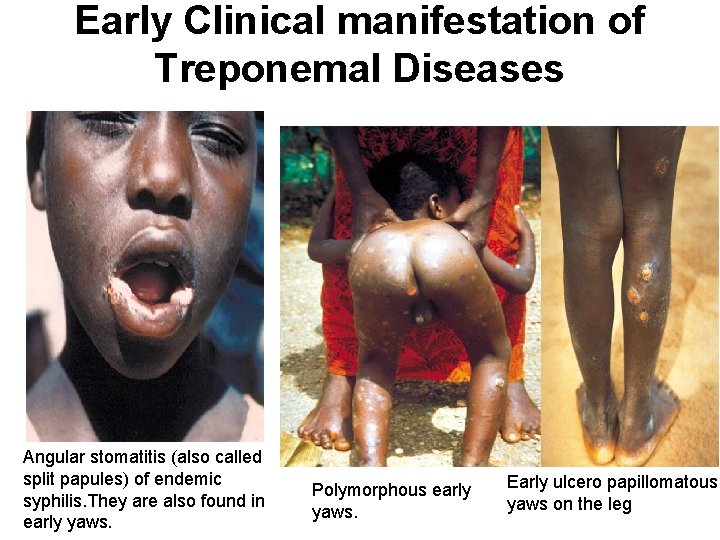
Early Clinical manifestation of Treponemal Diseases Angular stomatitis (also called split papules) of endemic syphilis. They are also found in early yaws. Polymorphous early yaws. Early ulcero papillomatous yaws on the leg
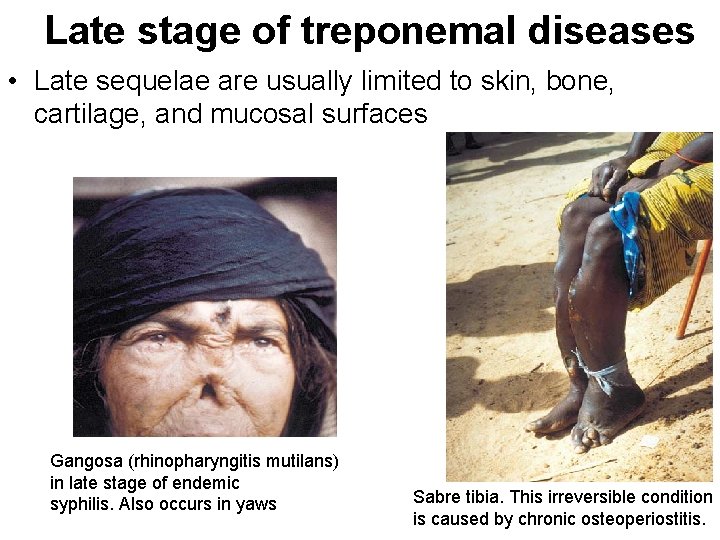
Late stage of treponemal diseases • Late sequelae are usually limited to skin, bone, cartilage, and mucosal surfaces Gangosa (rhinopharyngitis mutilans) in late stage of endemic syphilis. Also occurs in yaws Sabre tibia. This irreversible condition is caused by chronic osteoperiostitis.
Effect of treponemal disease on skeletal tissues • Treponemal disease leaves an osseous signature: – periosteal reaction – tibial remodeling (sabre shin formation) and – occasionally, by bone destruction, referred to as “gumma”
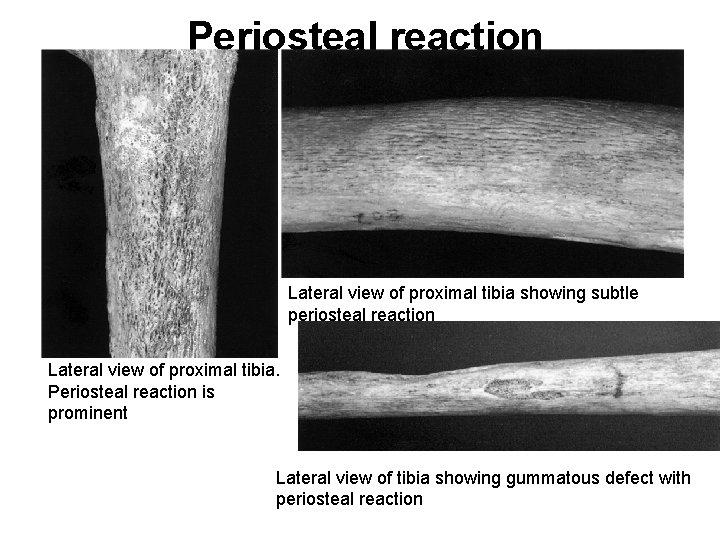
Periosteal reaction Lateral view of proximal tibia showing subtle periosteal reaction Lateral view of proximal tibia. Periosteal reaction is prominent Lateral view of tibia showing gummatous defect with periosteal reaction
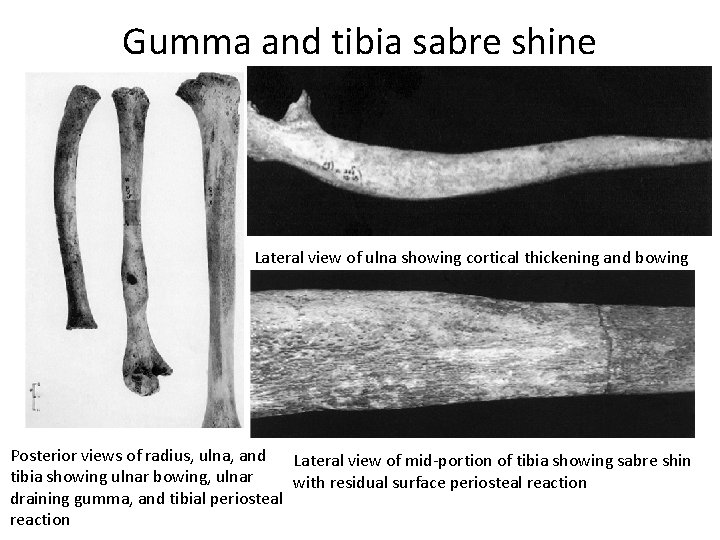
Gumma and tibia sabre shine Lateral view of ulna showing cortical thickening and bowing Posterior views of radius, ulna, and Lateral view of mid-portion of tibia showing sabre shin tibia showing ulnar bowing, ulnar with residual surface periosteal reaction draining gumma, and tibial periosteal reaction
Effect of tuberculosis on skeletal tissues • TB is usually diagnosed in skeletal remains through • Spinal lesions; specifically osteolytic lesions on the anterior regions of thoracic and lumbar vertebrae • Periostitis on ribs • Hypertrophic osteoarthropathy -morphological sign of respiratory distress and increased vascularization around the brain

Hypothesis on the origin of Tuberculosis • TB was associated with animal domestication and that human TB originated from Mycobacterium bovis Donoghue HDClinical Microbiology and Infection, Volume 17 Number 6

Hypotheses on the origin of syphilis • Columbian hypothesis – venereal syphilis originated in the Americas – was unknown in Europe until it was brought back by Columbus and his men upon their return in 1493 from their first voyage of discovery to the New World
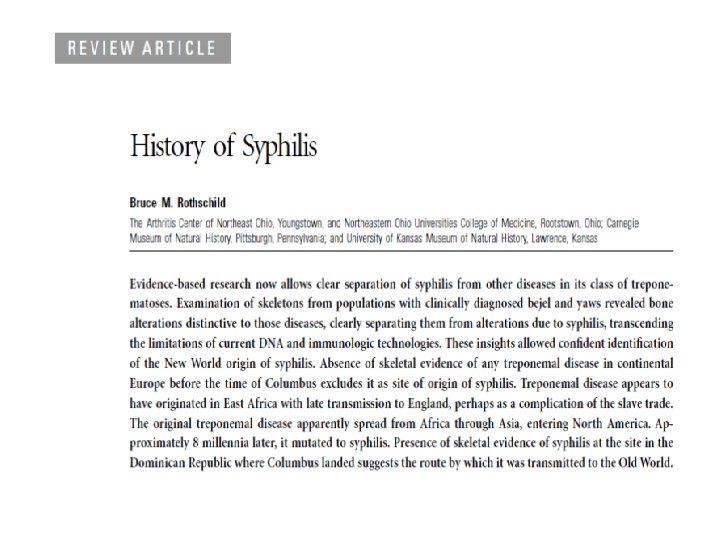
Results • No prove of treponemal disease existed in pre-Columbian Europe. – Lisieux, France, from the fourth century a. d. -pyogenic osteomyelitis. Bones lacked frontal involvement characteristic of syphilis. Focal peripheral periosteal reaction suggestive of trauma – Metaponte, Italy, in the sixth century b. c. . minimal involvement, and focal and taphonomic confusion was suspected as a diagnosis – syphilis in a 14 th century a. d. individual aged 12– 13 years - bone changes were unlike those associated with treponemal disease( typical of lytic damage due to histiocytosis) – hard palate lesion from the 11 th– 14 th century a. d. and thickened skull with pyogenic tibial osteomyelitis from the 12 th– 14 th century a. d. from Poland described by Gladykowska-Rzeczycka are certainly not diagnostic of syphilis. –
Syphilis in the new world • Syphilis present in the New World at the time of Columbus’ arrival • Documentation of syphilis in the area where he actually landed, the Dominican Republic. • The periosteal reaction characteristic of syphilis recognized in – 6%– 14% of skeletons from the El Soco (800 a. d. ), Juan Dolio (1400 a. d. ), La Caleta (1200– 1300 a. d. ), Atajadizo (1200– 1300 a. d. ), and Cueva Cabrera (1200– 1300 a. d. ) sites – The average number of bone groups affected ranged from 1. 7 to 2. 6
Hypotheses on the origin of syphilis • The pre-Columbian hypothesis – syphilis present in Europe before Columbus voyages of discovery – condition had not been diagnostically differentiated from leprosy Holcomb, 1930, 1934, 1935; Hackett, 1963, 1967; Cockburn, 1961; Kampmeier, 1984.
Pre-Columbianist hypothesis • Hackett, a convinced pre-Columbianist, in 1963 proposed: – Pinta arose somewhere in Africa or Asia from an animal infection about 17, 000 years before present (y. BP) and spread to the rest of the world – Mutations on the pinta causing microbe lead to yaws about 12, 000 y. BP, and spread to the world except to the Americas – Bejel arose from yaws about 9, 000 y. BP in arid climates – Mutations on the bejel causing treponeme originated venereal syphilis about 5, 000 y. BP in south-west Asia and then spread to Europe and the rest of the world
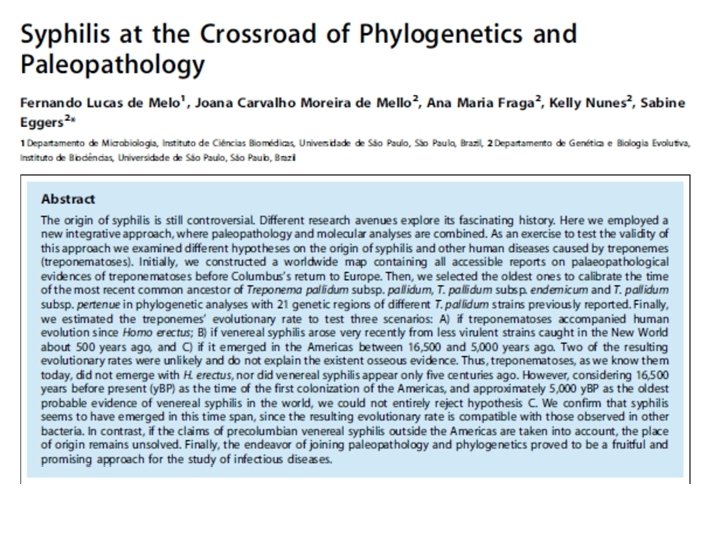
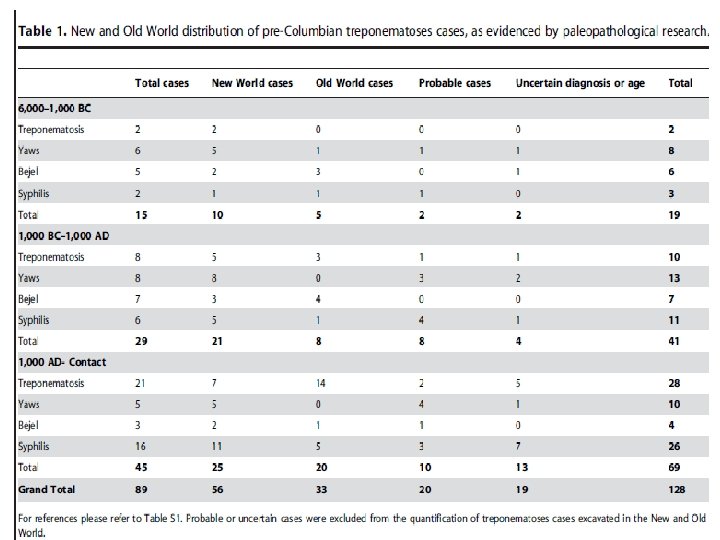
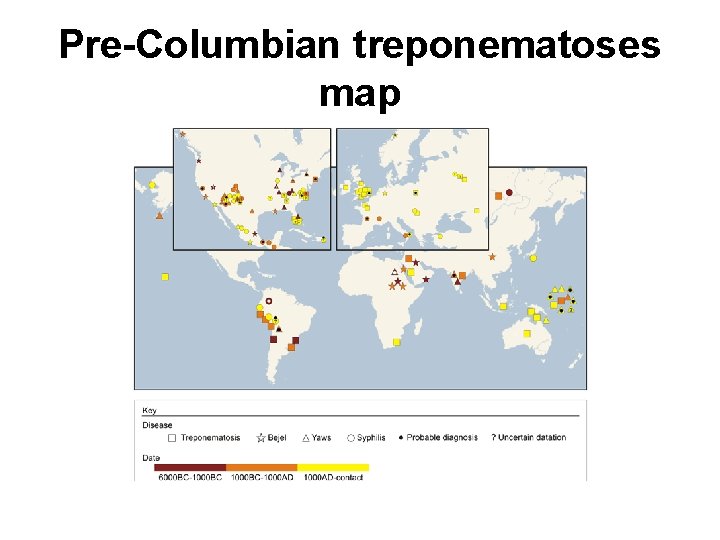
Pre-Columbian treponematoses map
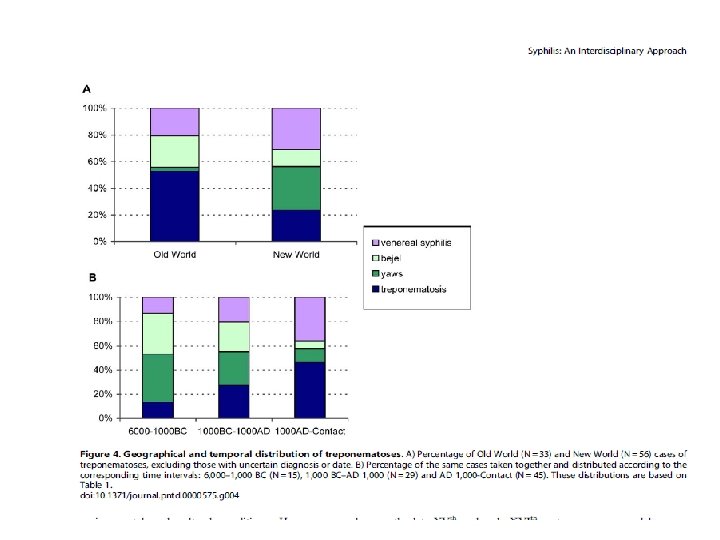

Pre-columbian hypothesis • Validity was not established (lack of technique standardization and reproducibility • Diagnostic vagueness of the historical written records Cook DC. Academic Press, 1984: 235– 69.
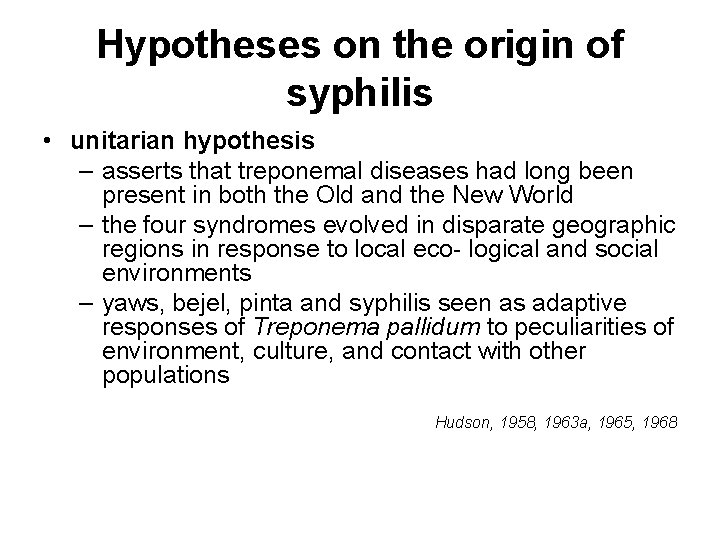
Hypotheses on the origin of syphilis • unitarian hypothesis – asserts that treponemal diseases had long been present in both the Old and the New World – the four syndromes evolved in disparate geographic regions in response to local eco- logical and social environments – yaws, bejel, pinta and syphilis seen as adaptive responses of Treponema pallidum to peculiarities of environment, culture, and contact with other populations Hudson, 1958, 1963 a, 1965, 1968

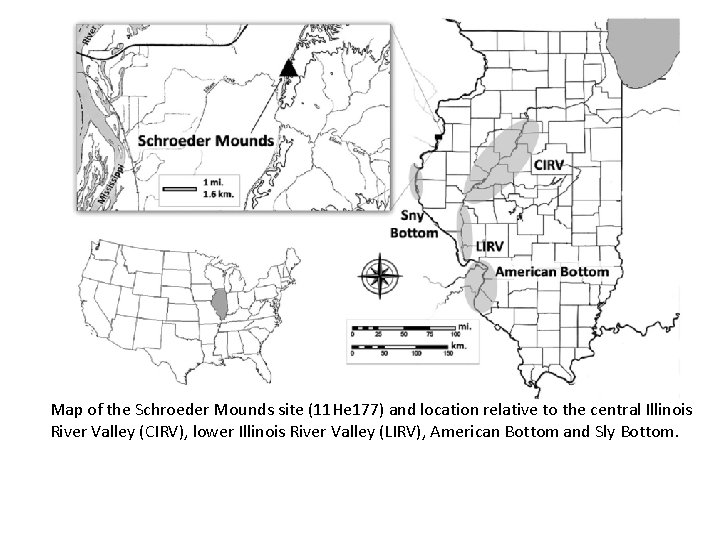
Map of the Schroeder Mounds site (11 He 177) and location relative to the central Illinois River Valley (CIRV), lower Illinois River Valley (LIRV), American Bottom and Sly Bottom.
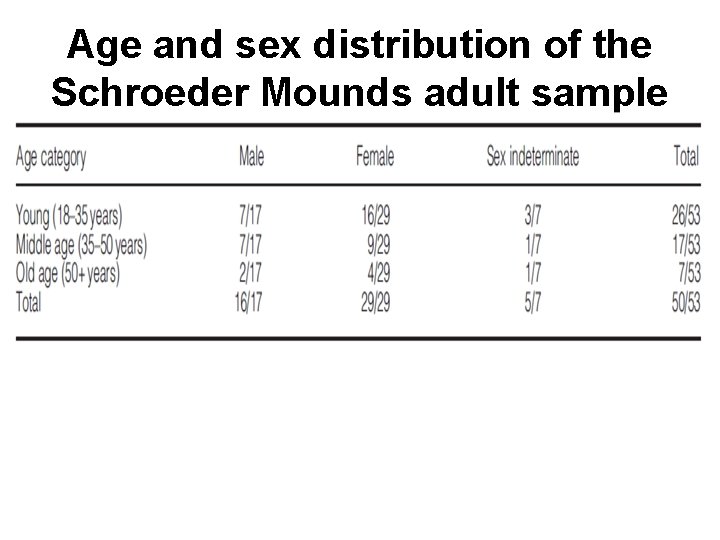
Age and sex distribution of the Schroeder Mounds adult sample
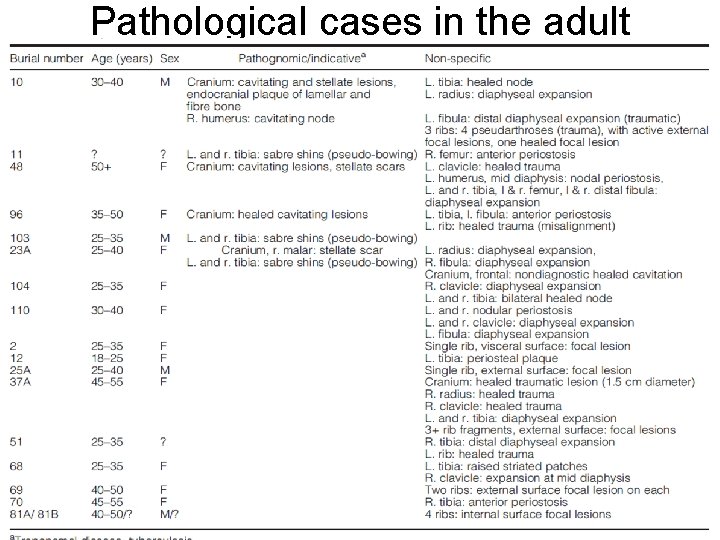
Pathological cases in the adult sampe
Results • Out of the 18 individuals with some form of reactive re-modelling of the bones, 7 (7/53, 13. 2%) display the pathognomonic or indicative classification level of treponemal disease • No individuals exhibit reactive changes on any vertebral body that suggest infection or inflammation (e. g. , ventral destruction, ventral periostosis and fistular defects) • There also no adult individuals who exhibit reactive changes at the metaphases or the large joints. Therefore, there are no pathognomonic or indicative cases of TB
Summary • Absence of skeletal evidence of any treponemal disease in continental Europe before the time of Columbus excludes it as site of origin of syphilis. • Evidence from paleopathology provide a broad and integrative approach to study origin of treponematose and Mycobacteria tuberculosis 30
- Slides: 30