
MTAT 03 231 Business Process Management Lecture 3
MTAT. 03. 231 Business Process Management Lecture 3 – Process Modeling I Marlon Dumas marlon. dumas ät ut. ee 1
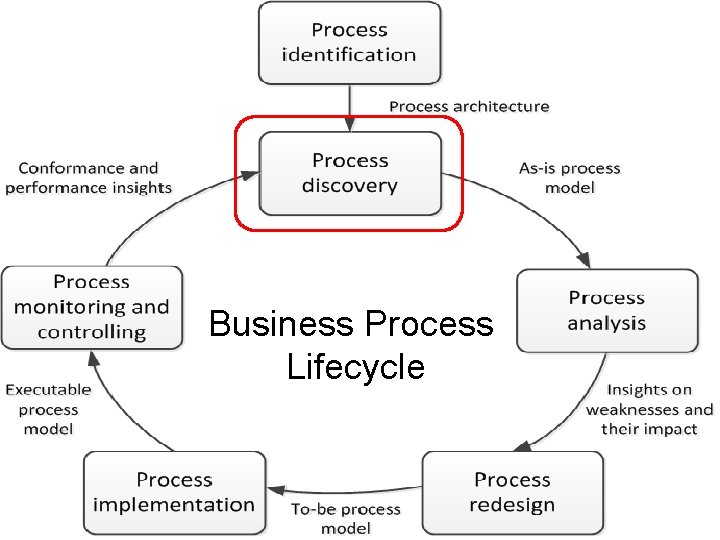
Business Process Lifecycle
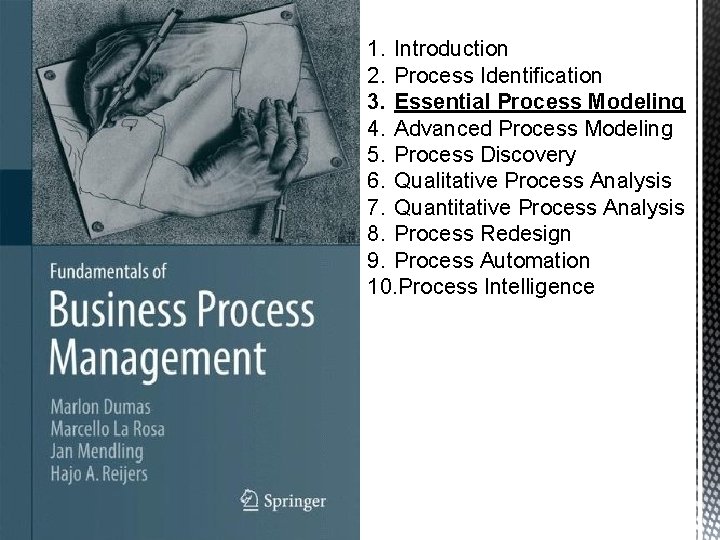
1. Introduction 2. Process Identification 3. Essential Process Modeling 4. Advanced Process Modeling 5. Process Discovery 6. Qualitative Process Analysis 7. Quantitative Process Analysis 8. Process Redesign 9. Process Automation 10. Process Intelligence
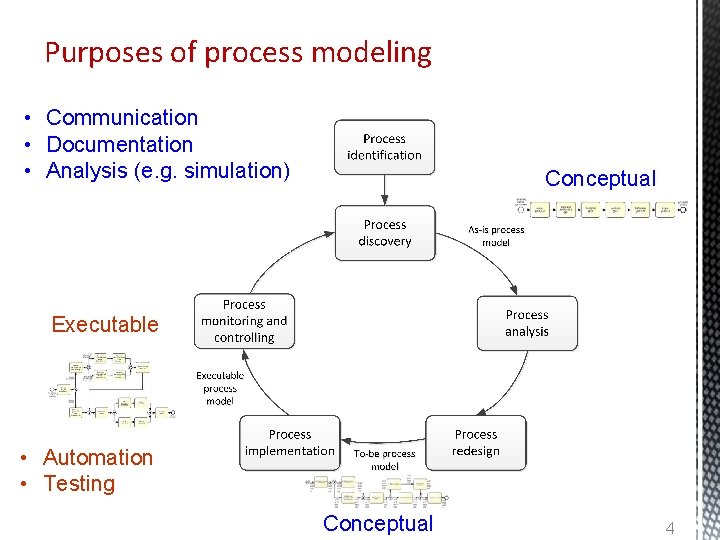
Purposes of process modeling • Communication • Documentation • Analysis (e. g. simulation) Conceptual Executable • Automation • Testing Conceptual 4
Business Process Model and Notation (BPMN) • OMG standard (nowadays BPMN 2. 0) • Both for conceptual and executable models • Supported by numerous tools: bpmn. org lists over 70 tools, incl. • Signavio (we’ll use the academic edition – academic. signavio. com) • Bizagi Process Modeler • Cameo Business Analyst
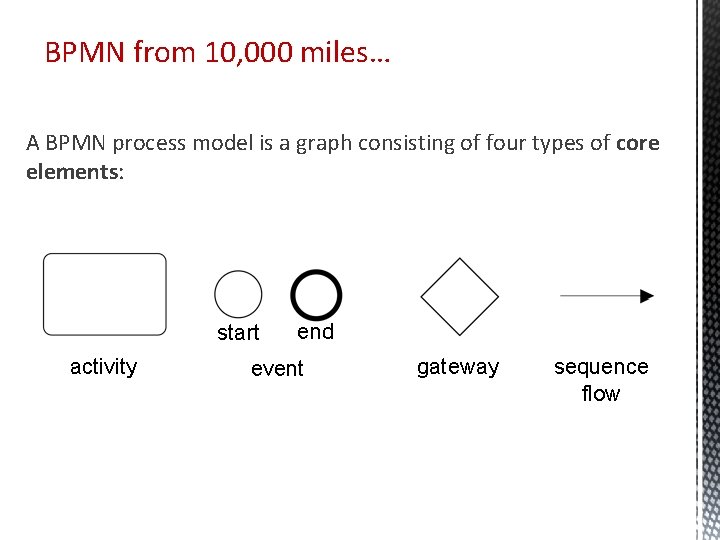
BPMN from 10, 000 miles… A BPMN process model is a graph consisting of four types of core elements: start activity end event gateway sequence flow
Let’s start modeling Order-to-cash An order-to-cash process is triggered by the receipt of a purchase order from a customer. Upon receipt, the purchase order has to be checked against the stock to determine if the requested item(s) are available. Depending on stock availability the purchase order may be confirmed or rejected. If the purchase order is confirmed, an invoice is emitted and the goods requested are shipped. The process completes by archiving the order.
Let’s start modeling – break it down Order-to-cash • An order-to-cash process is triggered by the receipt of a purchase order from a customer. • Upon receipt, the purchase order has to be checked against the stock to determine if the requested item(s) are available. • Depending on stock availability the purchase order may be confirmed or rejected. • If the purchase order is confirmed, an invoice is emitted and the goods requested are shipped. The process completes by archiving the order.
Let’s start modeling – break it down Order-to-cash • An order-to-cash process is triggered by the receipt of a purchase order from a customer. • Upon receipt, the purchase order has to be checked against the stock to determine if the requested item(s) are available.

BPMN Model Order-to-cash 10
Let’s start modeling – break it down Order-to-cash • An order-to-cash process is triggered by the receipt of a purchase order from a customer. • Upon receipt, the purchase order has to be checked against the stock to determine if the requested item(s) are available. • Depending on stock availability the purchase order may be confirmed or rejected. • If the purchase order is confirmed, an invoice is emitted and the goods requested are shipped. The process completes by archiving the order.
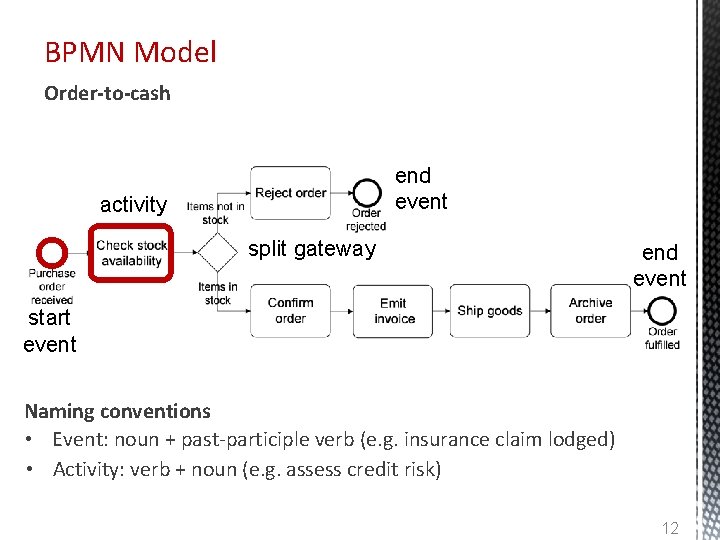
BPMN Model Order-to-cash end event activity split gateway end event start event Naming conventions • Event: noun + past-participle verb (e. g. insurance claim lodged) • Activity: verb + noun (e. g. assess credit risk) 12
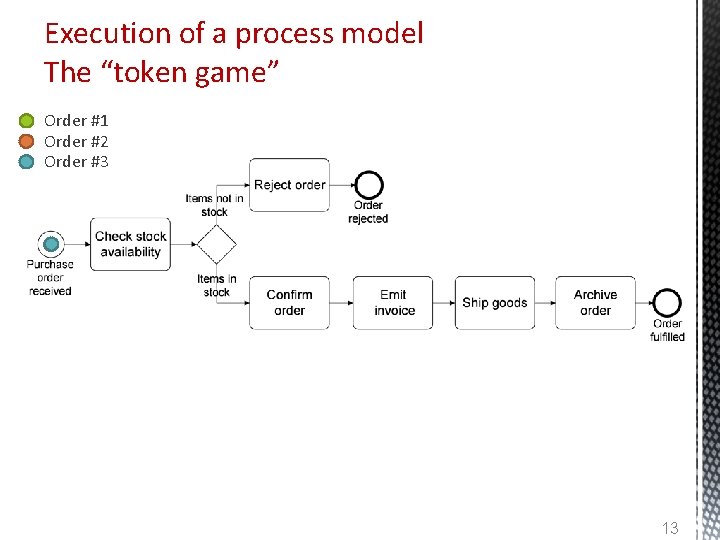
Execution of a process model The “token game” Order #1 Order #2 Order #3 13
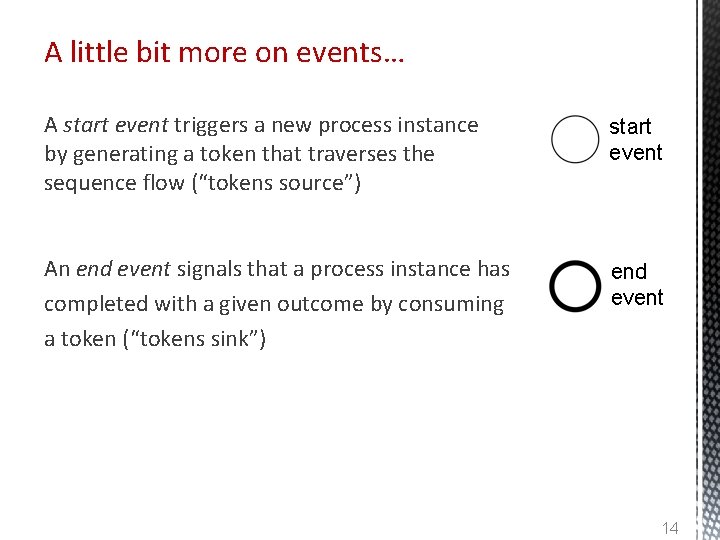
A little bit more on events… A start event triggers a new process instance by generating a token that traverses the sequence flow (“tokens source”) start event An end event signals that a process instance has completed with a given outcome by consuming a token (“tokens sink”) end event 14
![Order-to-cash example revisited… […] If the purchase order is confirmed, an invoice is emitted](http://slidetodoc.com/presentation_image_h2/2842dba72ee40d6bed908f7627439e90/image-15.jpg "Order-to-cash example revisited… […] If the purchase order is confirmed, an invoice is emitted")
Order-to-cash example revisited… […] If the purchase order is confirmed, an invoice is emitted and the goods requested are shipped (in any order). The process completes by archiving the order. […] 15
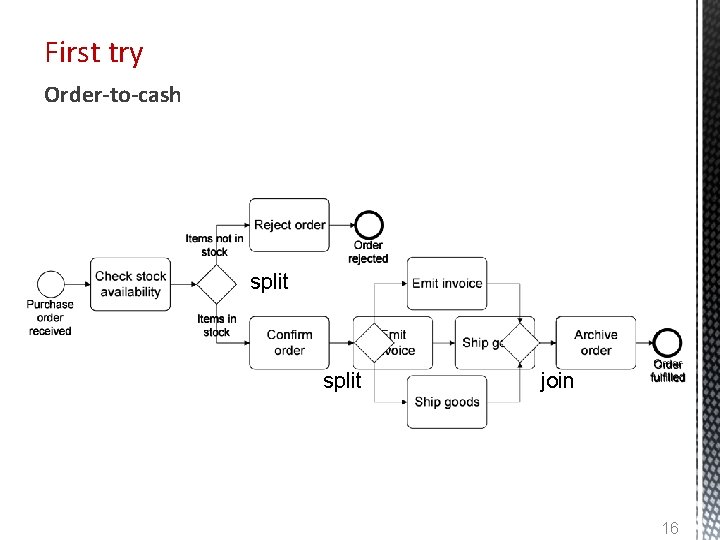
First try Order-to-cash split join 16
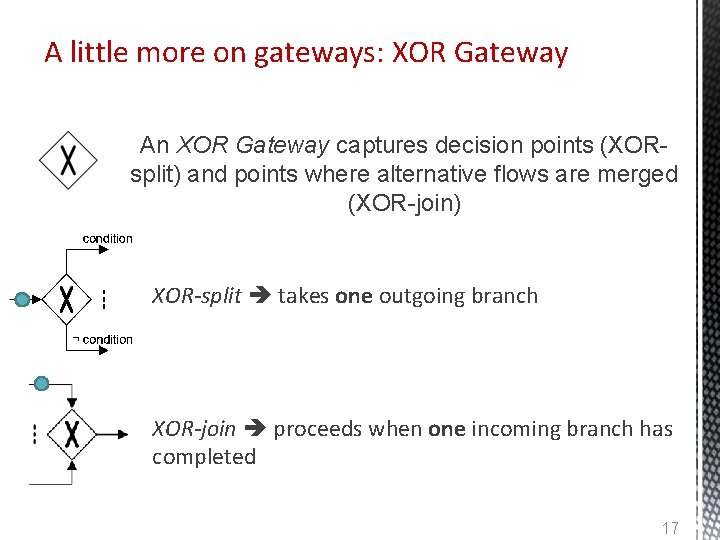
A little more on gateways: XOR Gateway An XOR Gateway captures decision points (XORsplit) and points where alternative flows are merged (XOR-join) XOR-split takes one outgoing branch XOR-join proceeds when one incoming branch has completed 17
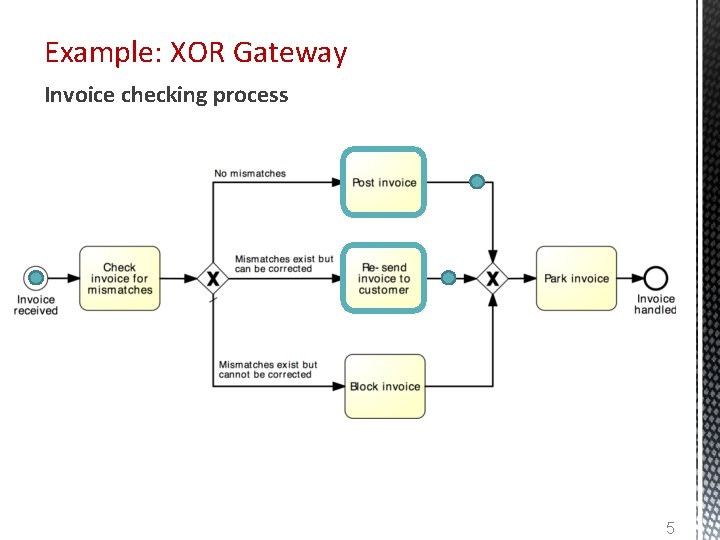
Example: XOR Gateway Invoice checking process 5
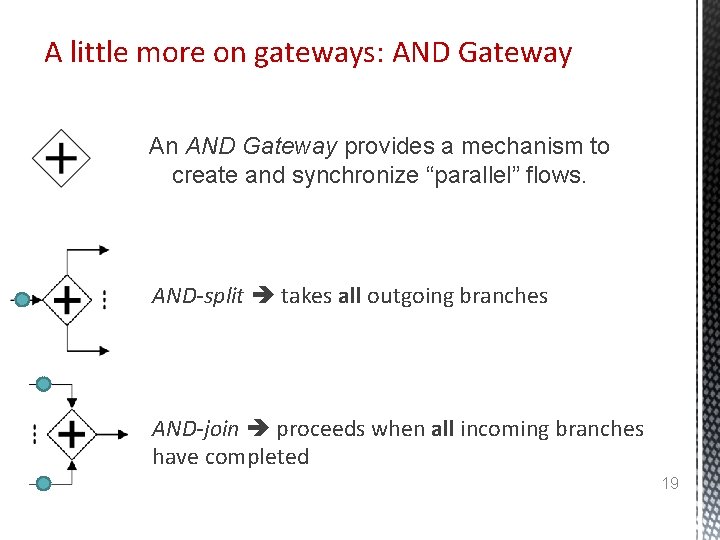
A little more on gateways: AND Gateway An AND Gateway provides a mechanism to create and synchronize “parallel” flows. AND-split takes all outgoing branches AND-join proceeds when all incoming branches have completed 19
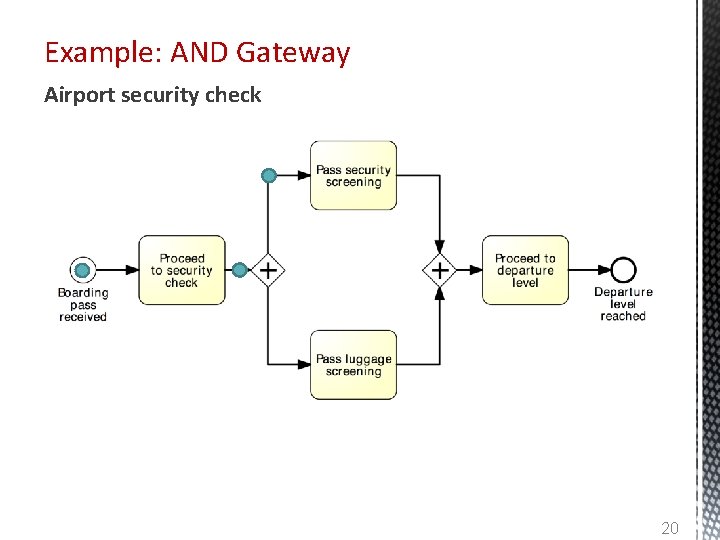
Example: AND Gateway Airport security check 20
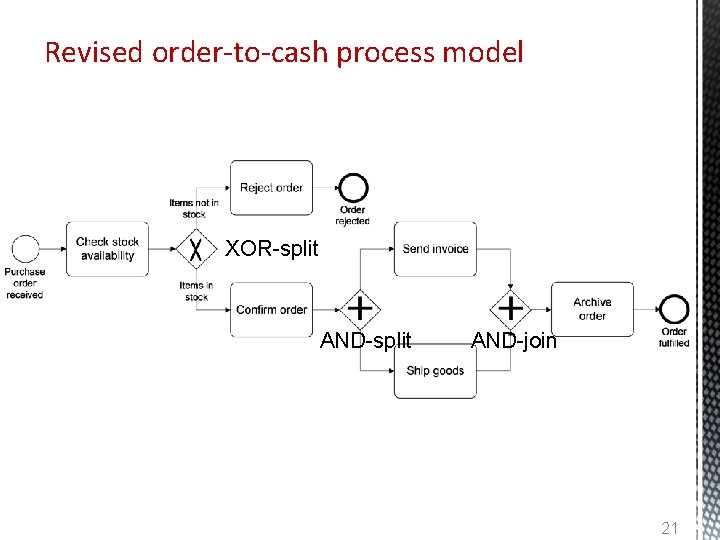
Revised order-to-cash process model XOR-split AND-join 21
Between XOR and AND Order distribution process A company has two warehouses that store different products: Amsterdam and Hamburg. When an order is received, it is distributed across these warehouses: if some of the relevant products are maintained in Amsterdam, a sub-order is sent there; likewise, if some relevant products are maintained in Hamburg, a sub-order is sent there. Afterwards, the order is registered and the process completes. 22
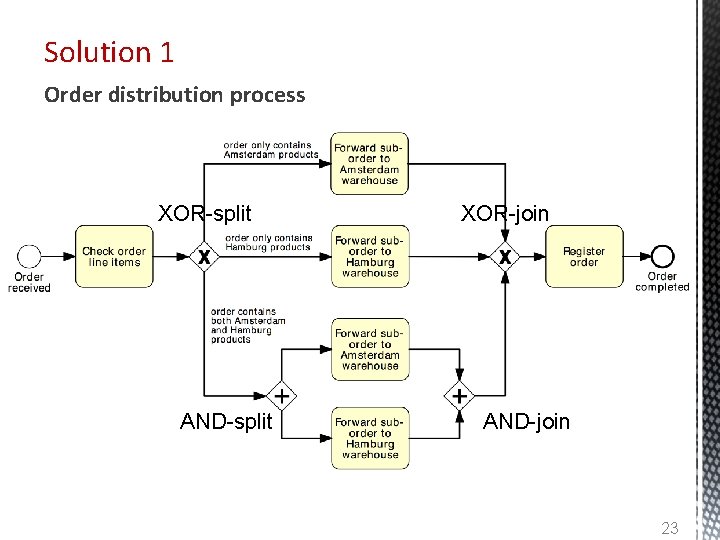
Solution 1 Order distribution process XOR-split AND-split XOR-join AND-join 23
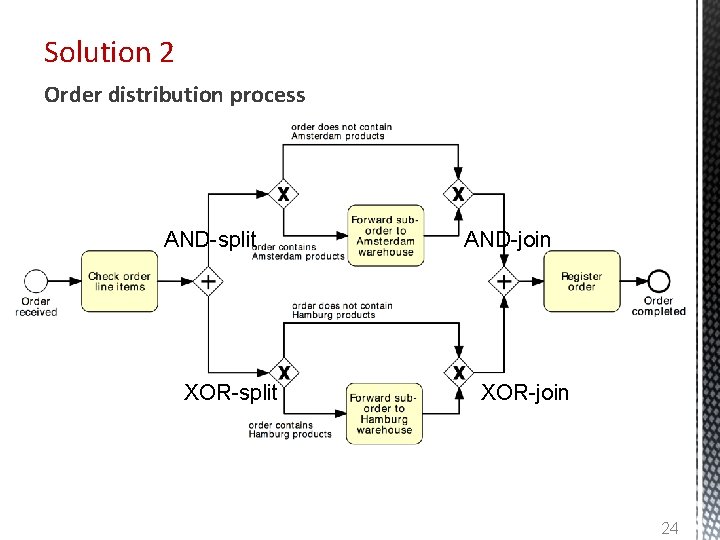
Solution 2 Order distribution process AND-split XOR-split AND-join XOR-join 24
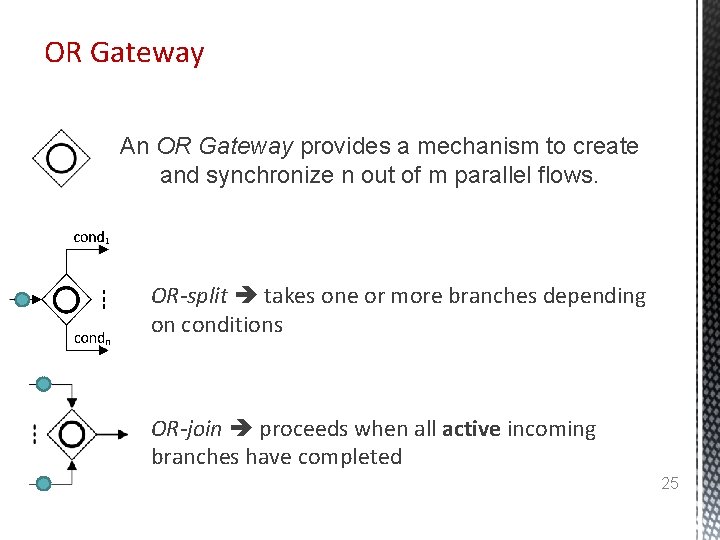
OR Gateway An OR Gateway provides a mechanism to create and synchronize n out of m parallel flows. OR-split takes one or more branches depending on conditions OR-join proceeds when all active incoming branches have completed 25
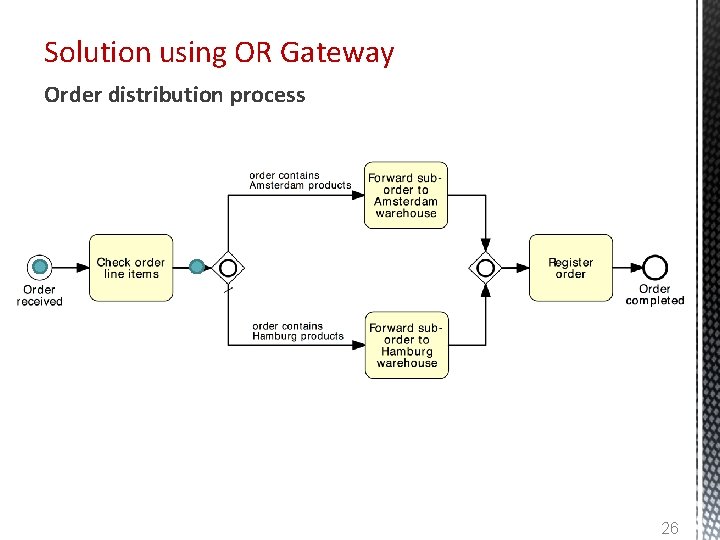
Solution using OR Gateway Order distribution process 26
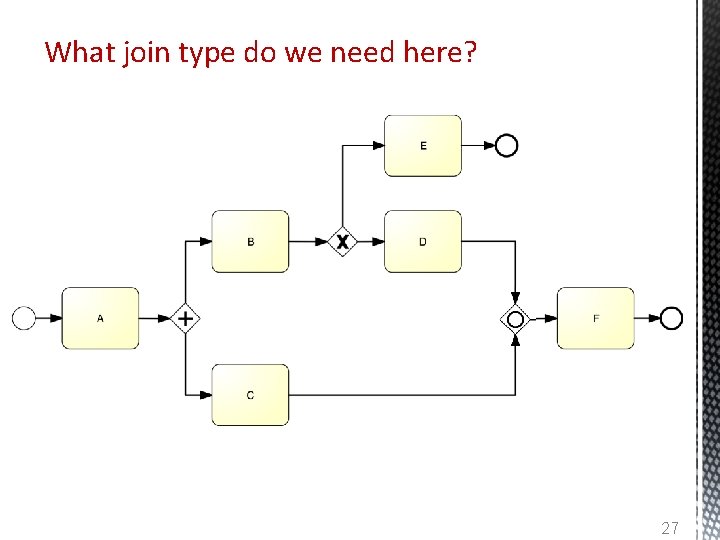
What join type do we need here? 27
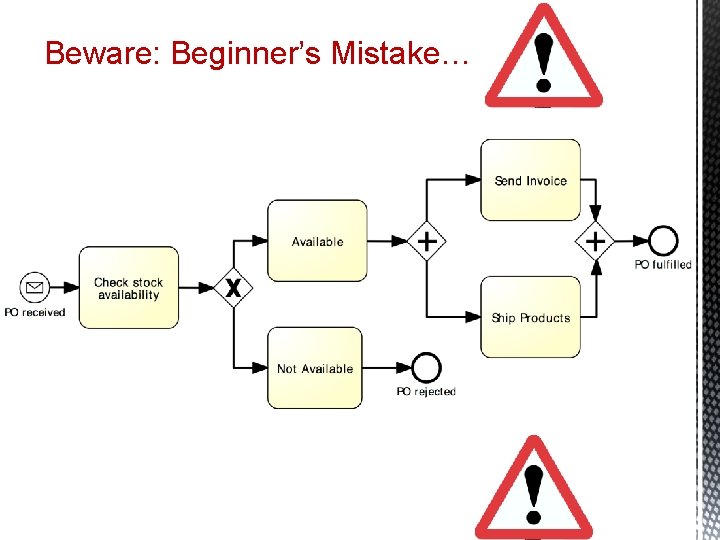
Beware: Beginner’s Mistake…
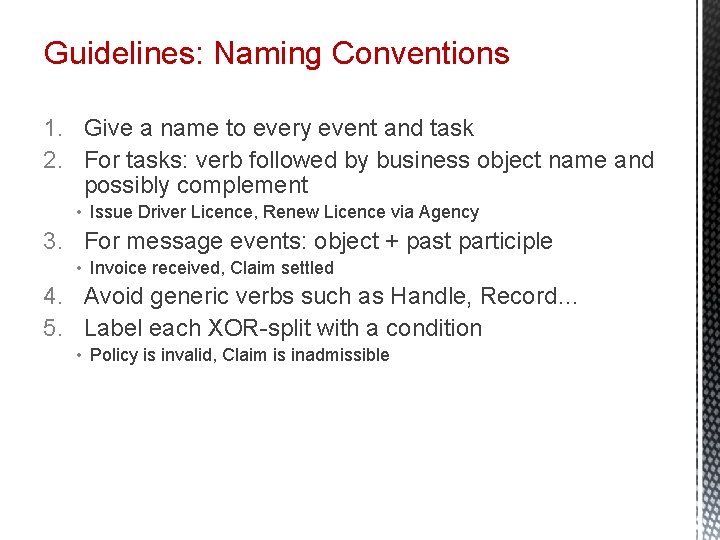
Guidelines: Naming Conventions 1. Give a name to every event and task 2. For tasks: verb followed by business object name and possibly complement • Issue Driver Licence, Renew Licence via Agency 3. For message events: object + past participle • Invoice received, Claim settled 4. Avoid generic verbs such as Handle, Record… 5. Label each XOR-split with a condition • Policy is invalid, Claim is inadmissible
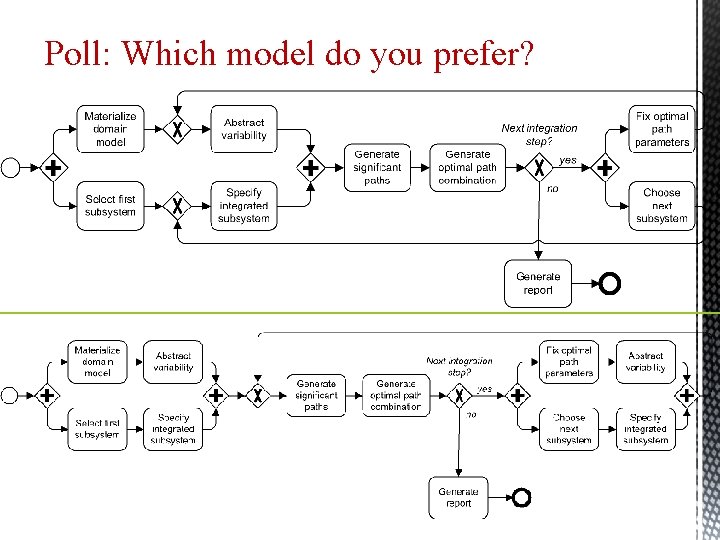
Poll: Which model do you prefer?
One more guideline… • Model in blocks • Pair up each AND-split with an AND-join and each XOR-split with a XORjoin, whenever possible • Exception: sometimes a XOR-split leads to two end events – different outcomes (cf. order management example)
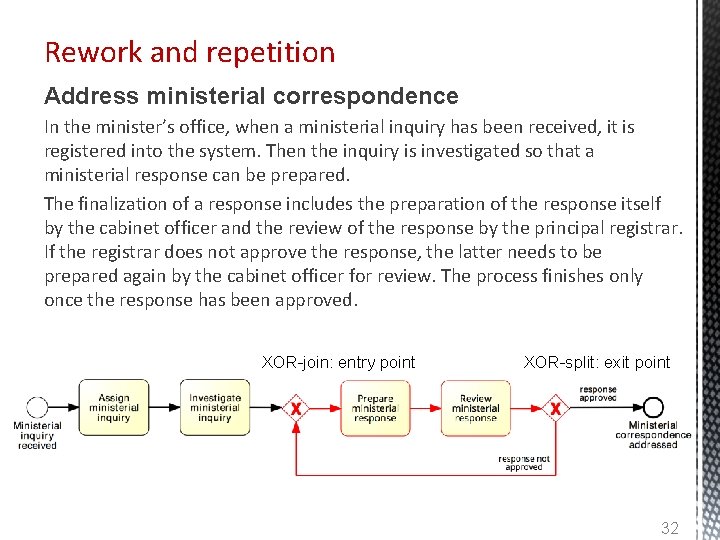
Rework and repetition Address ministerial correspondence In the minister’s office, when a ministerial inquiry has been received, it is registered into the system. Then the inquiry is investigated so that a ministerial response can be prepared. The finalization of a response includes the preparation of the response itself by the cabinet officer and the review of the response by the principal registrar. If the registrar does not approve the response, the latter needs to be prepared again by the cabinet officer for review. The process finishes only once the response has been approved. XOR-join: entry point XOR-split: exit point 32
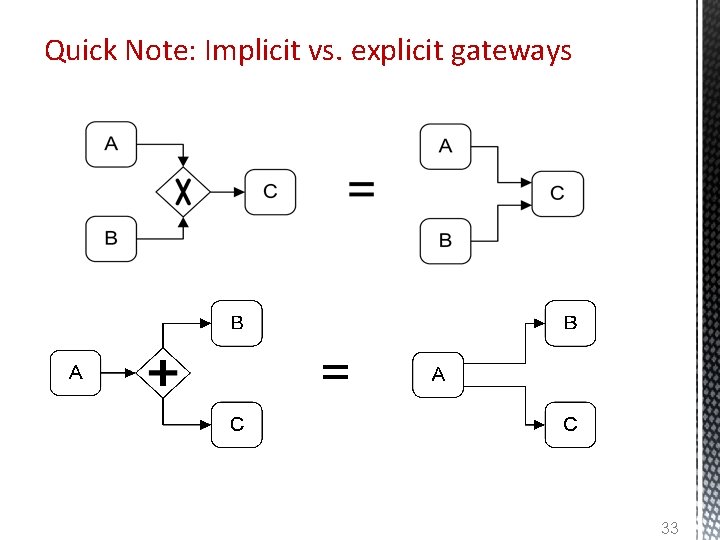
Quick Note: Implicit vs. explicit gateways 33
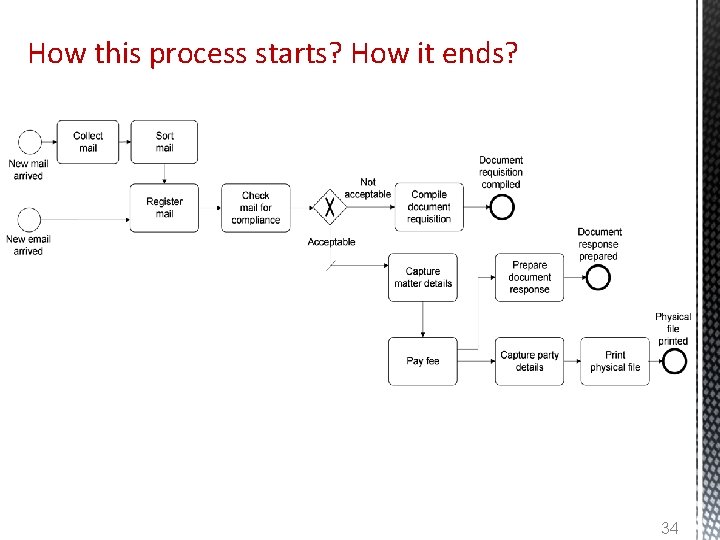
How this process starts? How it ends? 34
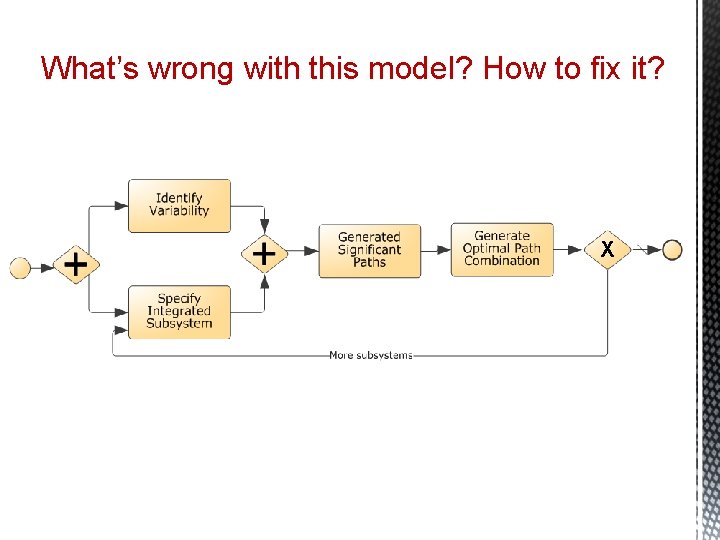
What’s wrong with this model? How to fix it? X
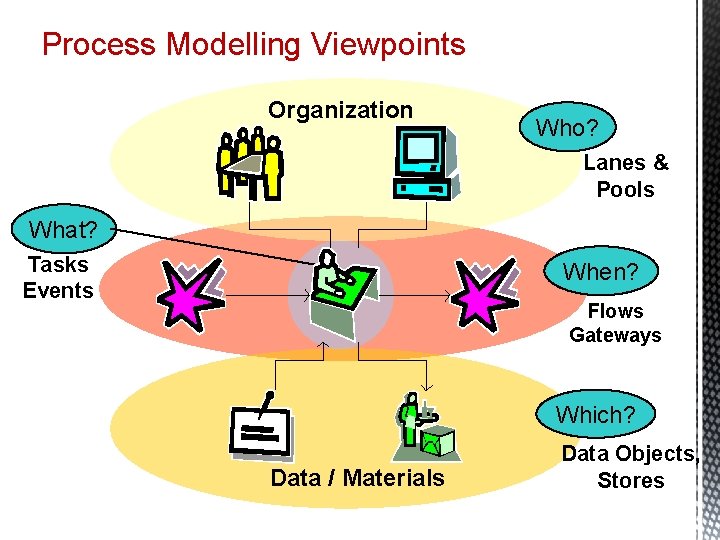
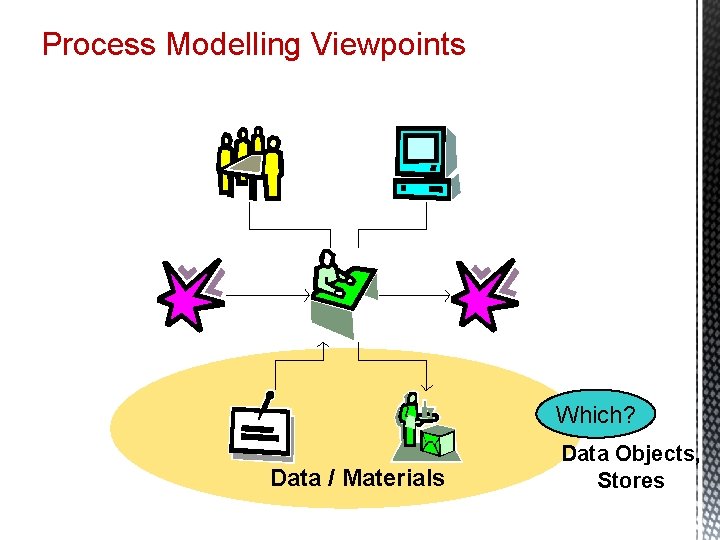
Process Modelling Viewpoints Organization Who? Lanes & Pools What? Tasks Events When? Flows Gateways Which? Data / Materials Data Objects, Stores
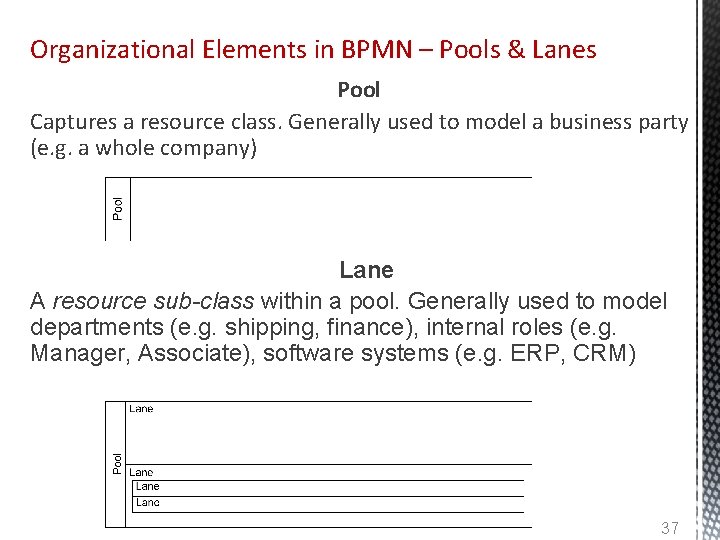
Organizational Elements in BPMN – Pools & Lanes Pool Captures a resource class. Generally used to model a business party (e. g. a whole company) Lane A resource sub-class within a pool. Generally used to model departments (e. g. shipping, finance), internal roles (e. g. Manager, Associate), software systems (e. g. ERP, CRM) 37
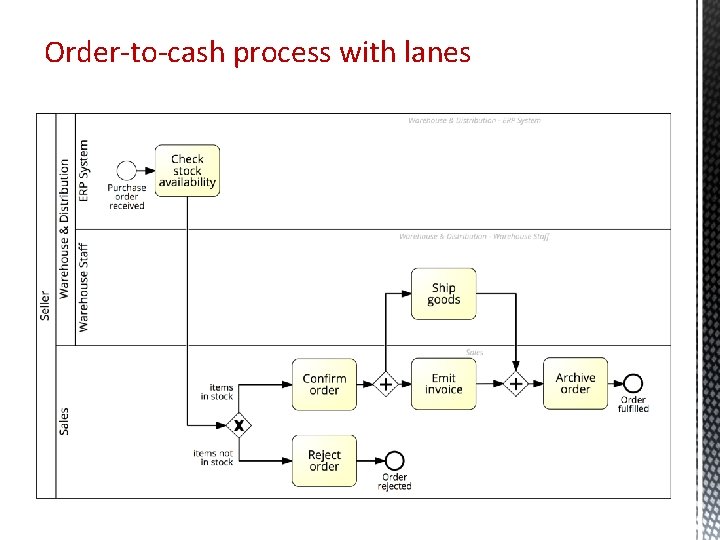
Order-to-cash process with lanes
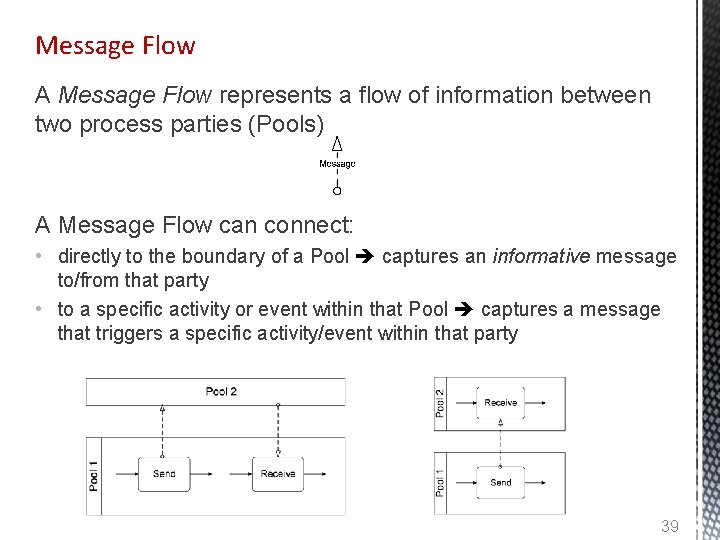
Message Flow A Message Flow represents a flow of information between two process parties (Pools) A Message Flow can connect: • directly to the boundary of a Pool captures an informative message to/from that party • to a specific activity or event within that Pool captures a message that triggers a specific activity/event within that party 39
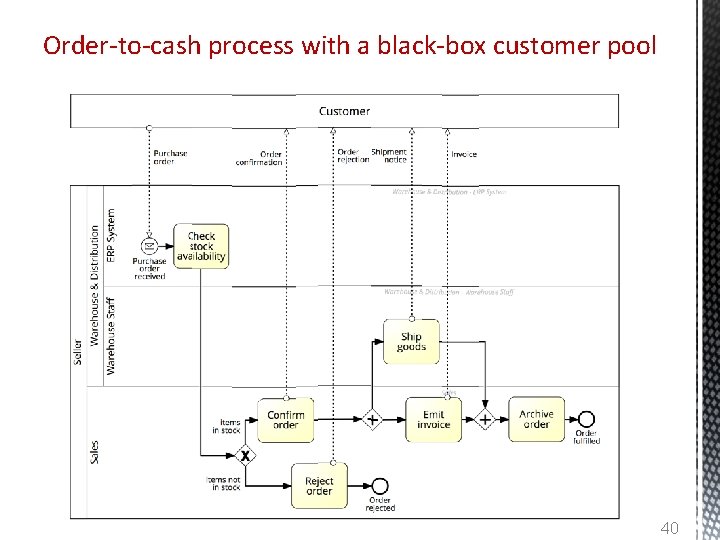
Order-to-cash process with a black-box customer pool 40
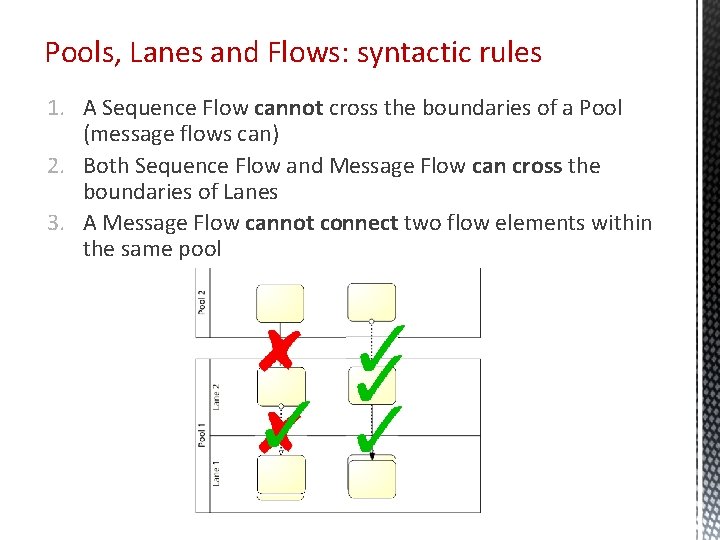
Pools, Lanes and Flows: syntactic rules 1. A Sequence Flow cannot cross the boundaries of a Pool (message flows can) 2. Both Sequence Flow and Message Flow can cross the boundaries of Lanes 3. A Message Flow cannot connect two flow elements within the same pool
One more guideline… • Start modeling with one single “white-box” pool • Initially, put the events and tasks in only one pool – the pool of the party who is running the process • Leave all other pools “black-boxed” • Once you have modeled this way, and once the process diagram inside the white-box pool is complete, you can model the details (events and tasks) in the other pools if that is useful. • In this course we will only model processes with one single whitebox pool – all other pools are black-box
Process Modelling Viewpoints Which? Data / Materials Data Objects, Stores
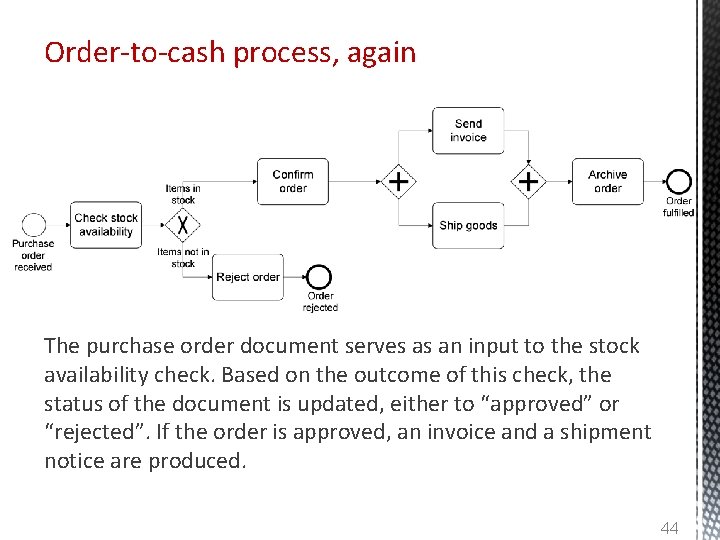
Order-to-cash process, again The purchase order document serves as an input to the stock availability check. Based on the outcome of this check, the status of the document is updated, either to “approved” or “rejected”. If the order is approved, an invoice and a shipment notice are produced. 44
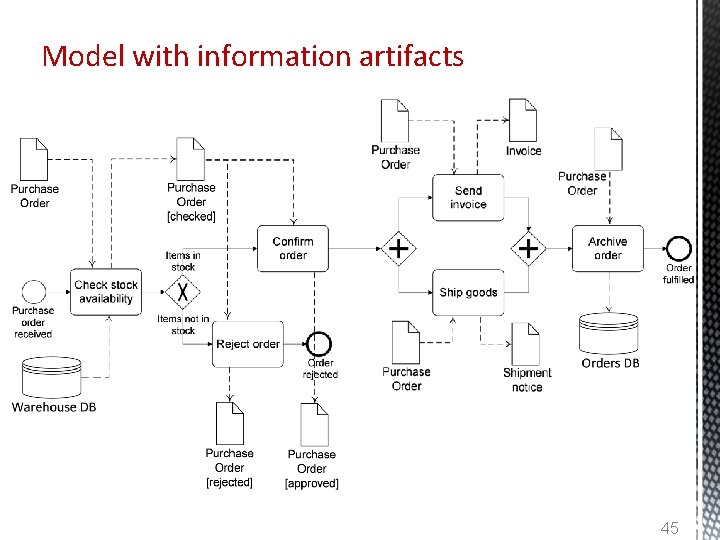
Model with information artifacts 45
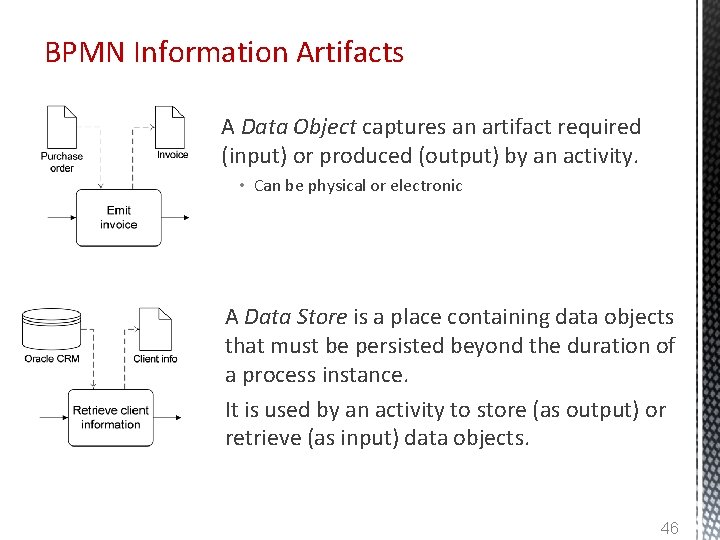
BPMN Information Artifacts A Data Object captures an artifact required (input) or produced (output) by an activity. • Can be physical or electronic A Data Store is a place containing data objects that must be persisted beyond the duration of a process instance. It is used by an activity to store (as output) or retrieve (as input) data objects. 46
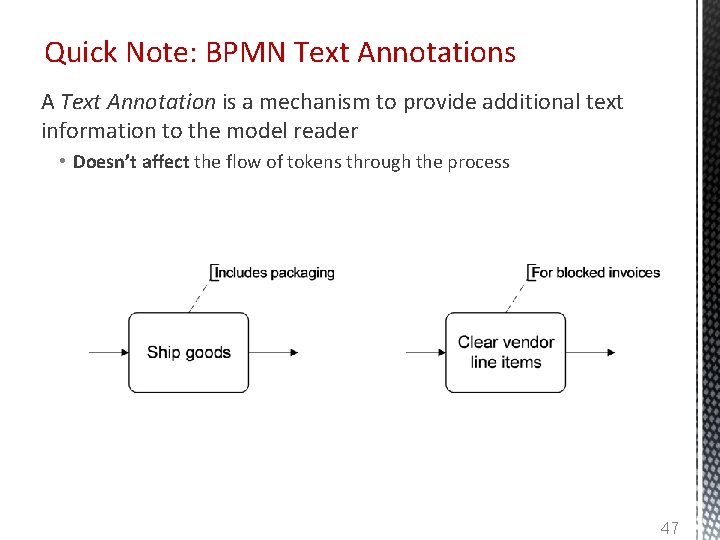
Quick Note: BPMN Text Annotations A Text Annotation is a mechanism to provide additional text information to the model reader • Doesn’t affect the flow of tokens through the process 47
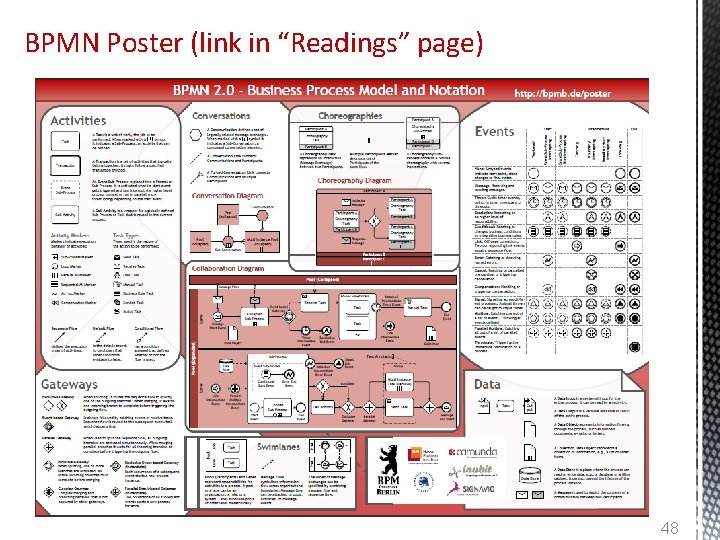
BPMN Poster (link in “Readings” page) 48
- Slides: 48