
MT 26 the International Conference on Magnet Technology
- Slides: 1
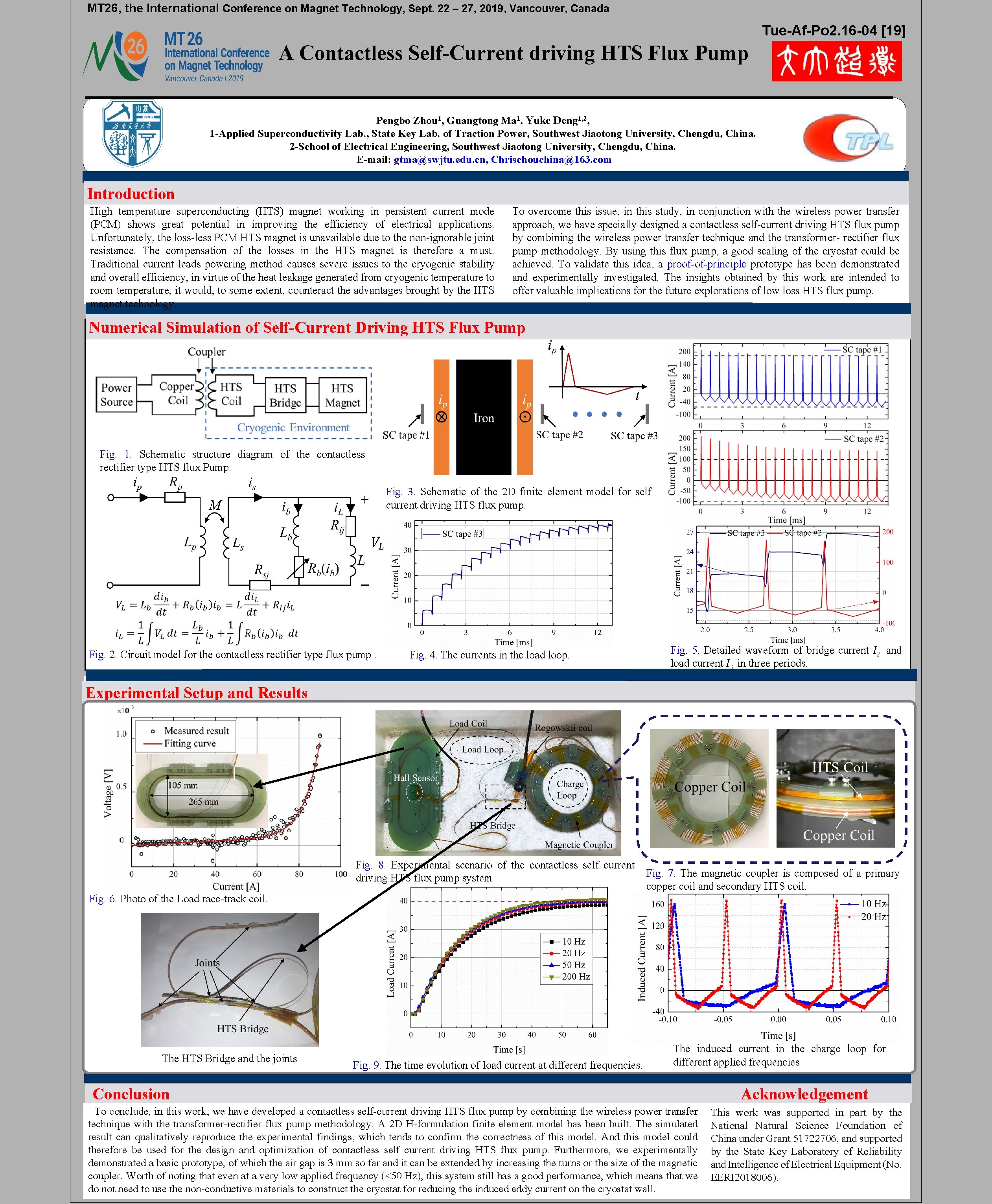
MT 26, the International Conference on Magnet Technology, Sept. 22 – 27, 2019, Vancouver, Canada Tue-Af-Po 2. 16 -04 [19] A Contactless Self-Current driving HTS Flux Pump Pengbo Zhou 1, Guangtong Ma 1, Yuke Deng 1, 2, 1 -Applied Superconductivity Lab. , State Key Lab. of Traction Power, Southwest Jiaotong University, Chengdu, China. 2 -School of Electrical Engineering, Southwest Jiaotong University, Chengdu, China. E-mail: gtma@swjtu. edu. cn, Chrischouchina@163. com Introduction High temperature superconducting (HTS) magnet working in persistent current mode (PCM) shows great potential in improving the efficiency of electrical applications. Unfortunately, the loss-less PCM HTS magnet is unavailable due to the non-ignorable joint resistance. The compensation of the losses in the HTS magnet is therefore a must. Traditional current leads powering method causes severe issues to the cryogenic stability and overall efficiency, in virtue of the heat leakage generated from cryogenic temperature to room temperature, it would, to some extent, counteract the advantages brought by the HTS magnet technology. To overcome this issue, in this study, in conjunction with the wireless power transfer approach, we have specially designed a contactless self-current driving HTS flux pump by combining the wireless power transfer technique and the transformer- rectifier flux pump methodology. By using this flux pump, a good sealing of the cryostat could be achieved. To validate this idea, a proof-of-principle prototype has been demonstrated and experimentally investigated. The insights obtained by this work are intended to offer valuable implications for the future explorations of low loss HTS flux pump. Numerical Simulation of Self-Current Driving HTS Flux Pump Fig. 1. Schematic structure diagram of the contactless rectifier type HTS flux Pump. Fig. 3. Schematic of the 2 D finite element model for self current driving HTS flux pump. Fig. 2. Circuit model for the contactless rectifier type flux pump. Fig. 4. The currents in the load loop. Fig. 5. Detailed waveform of bridge current I 2 and load current I 3 in three periods. Experimental Setup and Results Fig. 8. Experimental scenario of the contactless self current driving HTS flux pump system Fig. 7. The magnetic coupler is composed of a primary copper coil and secondary HTS coil. Fig. 6. Photo of the Load race-track coil. The HTS Bridge and the joints Fig. 9. The time evolution of load current at different frequencies. The induced current in the charge loop for different applied frequencies Conclusion To conclude, in this work, we have developed a contactless self-current driving HTS flux pump by combining the wireless power transfer technique with the transformer-rectifier flux pump methodology. A 2 D H-formulation finite element model has been built. The simulated result can qualitatively reproduce the experimental findings, which tends to confirm the correctness of this model. And this model could therefore be used for the design and optimization of contactless self current driving HTS flux pump. Furthermore, we experimentally demonstrated a basic prototype, of which the air gap is 3 mm so far and it can be extended by increasing the turns or the size of the magnetic coupler. Worth of noting that even at a very low applied frequency (<50 Hz), this system still has a good performance, which means that we do not need to use the non-conductive materials to construct the cryostat for reducing the induced eddy current on the cryostat wall. Acknowledgement This work was supported in part by the National Natural Science Foundation of China under Grant 51722706, and supported by the State Key Laboratory of Reliability and Intelligence of Electrical Equipment (No. EERI 2018006).